
Publisher’s version / Version de l'éditeur:
Vous avez des questions? Nous pouvons vous aider. Pour communiquer directement avec un auteur, consultez la
première page de la revue dans laquelle son article a été publié afin de trouver ses coordonnées. Si vous n’arrivez pas à les repérer, communiquez avec nous à [email protected].
Questions? Contact the NRC Publications Archive team at
[email protected]. If you wish to email the authors directly, please see the first page of the publication for their contact information.
https://publications-cnrc.canada.ca/fra/droits
L’accès à ce site Web et l’utilisation de son contenu sont assujettis aux conditions présentées dans le site LISEZ CES CONDITIONS ATTENTIVEMENT AVANT D’UTILISER CE SITE WEB.
Canadian Society for Civil Engineering 1990 Annual Conference and 1st Biennial Environmental Specialty Conference [Proceedings], IV-2, pp. 846-858, 1990
READ THESE TERMS AND CONDITIONS CAREFULLY BEFORE USING THIS WEBSITE.
https://nrc-publications.canada.ca/eng/copyright
NRC Publications Archive Record / Notice des Archives des publications du CNRC : https://nrc-publications.canada.ca/eng/view/object/?id=05485b4c-9cf2-4eb6-bbb2-3014aec0c299 https://publications-cnrc.canada.ca/fra/voir/objet/?id=05485b4c-9cf2-4eb6-bbb2-3014aec0c299
NRC Publications Archive
Archives des publications du CNRC
This publication could be one of several versions: author’s original, accepted manuscript or the publisher’s version. / La version de cette publication peut être l’une des suivantes : la version prépublication de l’auteur, la version acceptée du manuscrit ou la version de l’éditeur.
Access and use of this website and the material on it are subject to the Terms and Conditions set forth at
Seismic evaluation of concrete dams Jablonski, A. M.; Hunaidi, O.; Rainer, J. H.
Ser
TH 1 N 2 1 d
National Research Conseil national 0.
'yo
1
Council CanadaC. de recherches Canada
-*
Institute for lnstitut de
Research in recherche en
Construction construction
Seismic Evaluation of
Concrete
Dams
by A.M. Jablonski, M.O. Al-Hunaidi and J.H. Rainer
A N A L Y Z E D
Reprinted from the Proceedings of the
Canadian Society for Civil Engineering
4 1990 Annual Conference and
1 st Biennial Environmental Speciality Conference Volume IV-2 Structures
May 16-18 1990 p. 846-858
(IRC Paper No. 1670)
Reprinted with permission from the Canadian Society for Civil Engineering
Resume
L'activite sismique dans ie voisinage des barrages est une question qui merite un examen serieux, car la rupture d'un barrage pourrait Stre desastreuse, au niveau tant des pertes de vie que des dommages materiels. Ce document vise A presenter un aperqu des mkthodes utilisees pour lf6valuation sismique des barrages-poids et des barrages-volites en bkton. Les principaux aspects ktudiks sont : les criteres d'evaluation, l'apport sismique et les modeles d'analyse dynamique des systemes barrage-reservoir-fondation. I1 est fait allusion
A
l'analyse non linkaire. Enconclusion, les auteurs indiquent les axes des recherches qu'il importera au plus haut point d'accomplir dans l'avenir si Yon veut disposer de procedures detaillees d'kvaluation sismique des barrages. Ils situent les grands barrages-poids et barrages- volites canadiens (plus de 60 m de hauteur) .par rapport aux zones sismiques du CNBC 1985.
SEISMIC EVALUATION
OF
CONCRETE DAMSA.M. ~ablonskil, M.O. AI-~unaidil, J.H. ~ a i n e r l
ABSTRACT
Seismic activity in the vicinity
of dams
is an important factor that should be carefully considered as the failure of a dam could be disastrous both in terms loss of life andproperty.
The
purpose of this paper is to present a brief survey of methods usedfor
seismic evaluation of concrete gravity and arch dams. The principal aspects addressed are: evaluation criteria, seismic input, and models for dynamic analysis of dam- reservoir-foundation systems, Reference is briefly made to nonlinear analysis. Theaper concludes by highlighting future research areas that are of primary importance in Ravin comprehensive
procedures for
seismic evaluation of dams. Locationsof large
f
C m a ian gravity and arch dams
(over
60rn
in height) with respect to seismiczoning
of
the NBCC 1985 are presented.
1 Institute for Research in Construction, National Research Council of Canada, Ottawa, Ontario, KIA
OR6
INTRODUCTION
The consequences of the failure of a major dam are of such proportions that they must be ruled out by proper design and maintenance. Seismic activity in the vicinity of the dam is one of the natural environmental factors that needs to be carefully considered. Seismic safety
of
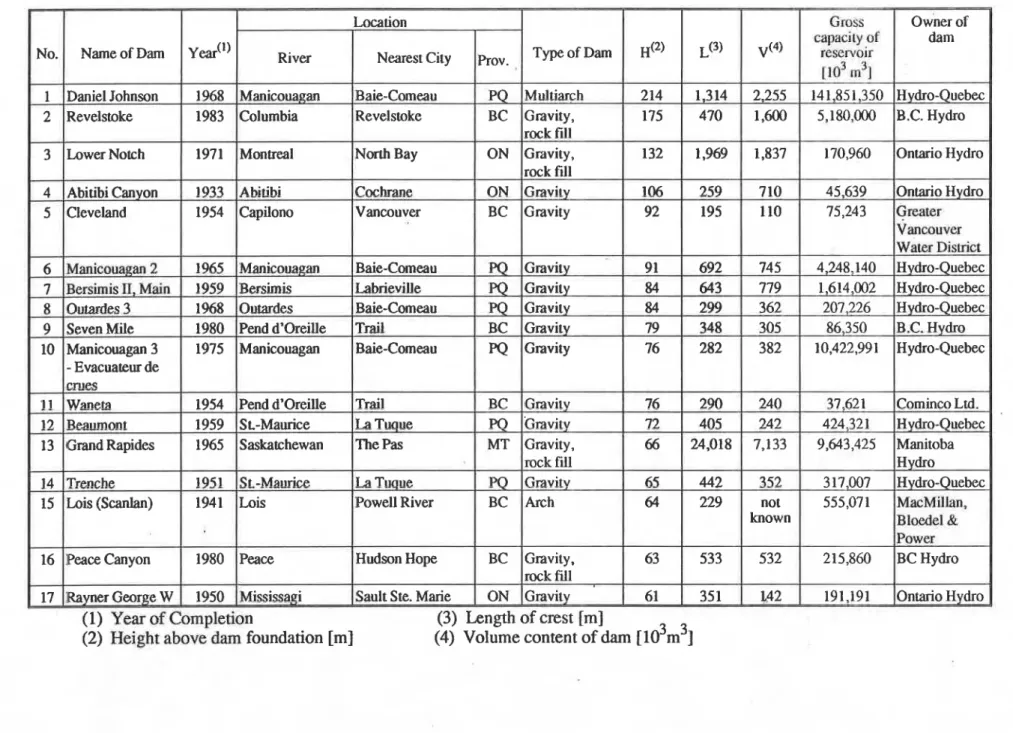
dams has a large bibliography and several reviews have been carried out [2,3,4,51. Several countries including the U.S. have federal or government agency programs for safety evaluation of existing dams. Canada, however, has programs administered by provincial utility companies with one exception: the provincial government program in Alberta.The 1984 re ister of Canadian dams listed 175 large concrete dams which are over 15 m
in height. L o n g thae, 155 were of the gravity type and only 4 were arch dams [5]. Table 1 resents seventeen lar e Canadian dams over 60m in height, includin some technica
f'
data [5]. A majority oP
these dams are located in Zone 3 or 4 of the NB8
C 1985 (61, with maximum predicted accelerations 0.1lg
and 0.16g, respectively, with a return eriodof
475 ears (Fig. 1). Most of the dams are closely supervised by provincial &dro and ud
' ity organizations. Safety assessment of ex~sting dams for earthguake conditions is also an ob'ective for a recent study by the Canadian Eleckrical Association (CEA) [7]; similar s t ud
ies have been carried out by the Electrical Power Research Institute (EPIU) in the U.S.A.This paper presents a brief survey of seismic evaluation criteria of concrete gravity and arch dams. The following aspects are addressed:
1. Seismic safety evaluation criteria of several
U.S.
agencies 2. Seismic input to dam structures3. Engineering models for dam-reservoir-foundation systems (BEM and FEM)
The a er also includes an update on some recent developments and highlights further
88
nee e research topics.I
EXISTING EVALUATION CRITERIA
A comprehensive review
of
the state-of-the-arton
the dynamic and earthquakebehaviour of concrete dams was presented
by
Hall[B].
It includesU.S.,
Chnese, Japanese, EuroB
ean (Italy, U.K., Austria, Switzerland, Yugoslavia,Romania,
Portugaland Spain) an experiences from other countries (India, Taiwan, Russia). Hall points
out that although no concrete dam has ever failed as a result of an earthquake, as far as
is known, never has a large concrete dam with completely full reservoir (i.e. maximum
The U.S. has a long tradition in dam engineering and some
U.S.
agencies have developed criteria or programs for evaluating the seismic safety of concrete dams. Following is a brief summary of procedures used by four major agencies:(1) The
U.S.
Army Corps of Engineers gives the criteria for evaluation of concrete dams in Engineer Technical Letter (ETL) 1110-2-303 [9]. These constitute additional requirements to the pseudostatic dam analysis, which is the standard method of analysis bv the U.S. A r m y Corps of Engineers. The criteria could be summarized in the following steps: '1. As a first check, a pseudostatic analysis using a seismic coefficient should be carried out (based on seismic zoning map).
2. A d namic analysis should be carried out where a specific dam failure could
dY
lea to the loss of many lives and one of three condihons exists:
a) The dam hei ht is greater than 100 feet (approx. 30.5 m) and the predicted round acce
!
i
eration for the so-called maximum credible earthquake MCE) is greater than 0.20g.?
b) The dam height is less than 100 feet (approx. 30.5 m) and the maximum credible earthquake (MCE) has ground acceleration greater than 0.40 g. c) The static or pseudostatic seismic stability criteria are not fulfilled.
The U.S. Arm Corps of Engineers recommends for dynamic analysis the
K
simplified met od proposed by Chopra [lo] or the finite element method by means of commercial computer programs. They consider linear analyses only.The
U.S.
Federal Emergency Management A ency (FEMA) has included evaluation criteria for existing dams in Federi Guidelines, for EarthquakeAnalyses and Design of Dams [Ill. These criteria recommend use of
ap roximate pseudestatic methods as a first ste
P
and later application of more re lned methods of analysis based on FEM, &re refined analysis should be carried out based on engineering judgment, taking into account seismicity of aspecific dam site, the hei ht of dam, the existing geotechnical conditions and material properties. The hMA guidelines make reference to all three types of
methods: pseudo-static, response spectrum and time history.
(3) Criteria for dam safety have also
been
a prime objective for the Department of Water Resources, Divlsion of Safety of Dams (DSOD), State of California [12]. DSOD has supervision of 1185 dams falling under the judisdiction of local ovemments in California and are under public or private ownership. DSOD [as responsibility for review and approval of d e s ~ of new dams and forT'
evduahon of existing dams.
This
proflam was estab ished after a failure of St. Francis Dam on March 12,1928 due to fie massive landslide which developed on the left abutment. DSOD inspects most dams annually and also monitorsdevelopment
of
new dam sites. Approximately 25% of all dams (340) are instrumented with strong motion seismographs. In case of a seismic event, an owner of a dam is notified immediately. An owner should provide DSOD with studies during the evaluation process which is later a proved by DSOD. necess% D D also owns a special computer programQUAKE
whicf
assigns anearth uake to a given d m site. Site specific parameters for evaluation purpose indu
2
e:1. Causative fault or faults
2. Maximum Credible Earthquake (MCE), Richter magnitude and epicentral distance to site
3. Peak ground acceleration (PGA)
4. Dwration of strong motion (amplitudes above 0.05 g) 5. Predominant period of ground motion.
DSOD s ecifically requires three-dimensional finite element modelling for arch dams. The analysis can be linearly elastic. Response spectrum or time history analyses need to be used.
(4) Pacific Gas and Electric Co. (PGE) based in California owns, operates and maintains over 100 dams in Northern and Central California [13]. Among them are 34 concrete dams, 19 concrete gravity dams and 15 concrete arch dams. These dams are regulated under jurisdiction of the DSOD and also must comply with federal requirements by FEMA and the Federal Energy Regulato Commission (FERC). Although PGE participates in annual inspections bv DSO
3
and FERC, a separate dam safety rogram was established. Program objectives are to ins ect and evaluate PGE ams and to report all required information toP
a
state and ederal regulatory bodies.
The principal method used by PGE is the pseudo-static method with updated pseudo-static coefficients according to regional seismici studies. PGE recommends also use of the simplified Chopra method [15,16 jT based on a linear
elastic res onse spectrum approach that includes dam-foundation interaction
and dam
R
exibility in an approximate manner, or a time history finite element analysis. In the response spectnun analysis, maximum stresses for each modeSEISMIC INPUT
A dam may be subjected to two types of earthquakes: natural earthquakes in known seismic areas and reservoir-induced earthquakes.
A statistical study by Haws and Reilly [2] reveals that so far only embankment dams have collapsed or been severly damaged during natural earthquakes. They include Eklutna Dam in Alaska, Lower San Fernando Dam (known also as Van Norman Dam), and Sheffield Dam in England (see
concrete structures were the Five of the clearest cases of
Zambia border in Central Africa, Koyna in India, Hsinfengkiang in China, Nurek in the Soviet Union and Aswan in E
pt.
At Koyna, in addition to significant cracking of theBY
dam, a large number of peop e were kiIIed b the Magnitude 6.5 earthquake. At the Hsinfengkiang dam, the principal shock of a agnitude 6.1 earthquake in 1962 caused
major cracking.
K
An estimate of the seismic input to the specific dam site is a crucial part of the engineering analysis and evaluation process. The most common measures used as inputs are peak accelerations, response spectra, and ground acceleration histories. Ground motion characteristics are usually a function of earth uake magnitude and and the non-linear analyses in the evaluation process.
9
epicentral distance. Seismic inputs should be carefully chosen or both linear elastic
In the
U.S.
as in many other parts of the world, two levels of earthquake input are usually considered in investigating the seismic safety of a dam [121:1. The Maximum Credible Earthquake (MCE) is the earthquake associated with the specific site that would cause the strongest expected ground motion or fault rupture under the foundation. It is usually chosen to be the worst scenario with a very low probability of occurrence.
2. The 0 erating Basis Earthquake (OBE) is a typical earthquake for the particu
!
ar site with a higher probability of occurrence.?
Both the MCE and OBE are usually provided b the U.S. Geological Survey. The Iiichter magnitudes for the MCE have been establis
K
ed for most faults in California [14].Variation of seismic motion throughout canyons is still unresolved. So far, all methods of evaluation have used a spatially uniform seismic input to the foundation of a dam.
ENGINEERING MODELS OF DAM-RESERVOIR-FOUNDATION SYSTEMS
Generally, two types of engineering models are used in the dynamic analysis of dam- reservoir-foundation systems: two-dimensional models used for concrete gravity dams and three-dimensional models used for arch dams.
In
these models,the
dam is usuallyrepresented by an assemblage of finite elements and the reservoir is also modelled by finite elements or in some cases by boundary elements. Displacements are the unknowns for a dam and pressures are the unknowns for a reservoir. A summary of the state-of-theart on FEM modelling of both concrete gravity and arch dams can be found in Ref. 10. In the ei hties, simpIified solutions, based on response spectra analysis, of the roblem o
?
seismic res onse of these complex systems have beendeveloped [15,16f These solutions in
3
ude effects of darn-foundation and dam- reservoir interactions. The FEM modelling is considered essential when the detailed dynamic analysis of this complex system is required. This is especially needed when one of the simplified analyses fails to meet standard requirements for seismic stabilityof
the d a m [10,14].Several important factors can be taken into account in a full FEM analysis, the principal ones being:
I. Dam-reservoir interaction effect on hydrodynamic pressures.
2. Ener
y
loss due to outgoing waves using a special transmitting boundary for an i9
mite reservoir.3. Dissipation of the energy in a reservoir by absorptive soil in the reservoir bottom.
4. Interaction between dam and foundation in the immediate vicinity of a dam.
The above listed factors were included in the FEM linear models of dam-reservoir- foundation systems [17,18,19,20,21], and also (with the exception of the last factor) by BEM [22,23]. All of them are fre uency domain models; thus they could not include nonlinear material behaviour of t
4
e dam or foundation nor could they encompass the important problem of concrete cracking.True
non-linear analyses should be erfonned directly in the time domain, i.e. usingstep-b -step time integration m e t h d . There are
two
methods for analyzing this tye
2:
of pro Iem in the time domain [24] : the substructure method and the direct method.
P
n the substructure method the system is divided into two arts: (i) the dam itself and adjoining arts of the infinite media whichmay
be non- near and/or geometricallyP
E
irregular, ii) the remaining infinite
part
of the system whi& is assumed to be linearly elastic. The structure part is discretized as usual by using finite elements; the infinite part is represented by its dynamic stiffness or influence matrix that could be formulatedindirectly in the fr uency domain [24,25] or directly in the time domain using an
extensive FEM mesh
"t
261. The force contribution to the structureof
the infinite part iscalculated by means of discretized convolution integrals of the boundary matrix of the infinite art and the corres onding boundcuy displacements (see for example [24,25]). The su
g
structure metho c? takes into account all interaction effects and wavecom utational effort of this method is substantial. The direct method, on the other han
f
,
is more economical, but the wave propagation towards infinity, i.e. the radiation condition, is taken into account only a proximately. The finite element model consists of the structure (as defined above) an1
a small part of the linear infinite medium. The remainin infinite part of the system is ap roximately simulated using a frequency- independ
ent wave-absorbing boundar [24f In both the substructure and the direct method, arbitrary seismic input can ge easily applied using the so-called effective seismic input method (271.FURTHER RESEARCH
In s ite of the fact that substantial accomplishments have been made in the last few years
I'
e.g. 28-37], a number of problems remain unsolved. Further progress in the following research areas has been repeatedly stated in the literature as important:Variation of seismic input motions over the dam-foundation interface especially for the case of arch dams.
Development of the substructure method in which the radiation condition in the reservoir and foundation rock can be rigorously and consistently taken into account.
Experimental studies of the properties and constitutive behaviour of concrete under multiaxial dynamic conhtions.
Non-linear analysis rocedures to take into account crack initiation and propagation, gradua
?
crack opening, opening and closing of construction joints, sliding along weak planes, etc.Monitoring of existing dams located in highly seismic regions using strong motion instrumentation to provide benchmark cases for the validation of analytical methods.
Testing of physical models of dams using shaking tables and centrifuge apparatus to investigate failure modes and evaluate analytical methods. The result of these component studies would permit the development of comprehensive evaluation procedures.
REFERENCES
[I] Jansen, R.B., "Dams and Public Safety", A Water Resources Technical Publication, U.S. Department of the Interior, Water and Power Resource Service, 1980.
[2] Haws, E.T., Reilly, N. "Dams, Natural and Induced Earthquakes and the Environment", Dams and Earthquake, Proceedings of a Conference Hold at the Institution of Civil Engineers, London, U.K., 1981, pp. 253-260.
Mineiro, A.J.C., "Seismic Safety Criteria", Proceedings of the International Conference on Safety of Dams, Portugal, 1984, pp. 565-574.
Safety Evaluation of Existin Dams, A Manual for the Safety Evaluation of Embankment and Concrete %ams, United States Department of the Interior Water and Power Resources Service, Denver, Colorado 1980.
1984 Register of Dams in Canada, Canadian National Committee of the International Commission on Large Dams.
Sup lement to the National Building Code of Canada, Commentary J, Effects of
R
Eart quakes, Associate Committee on the National Building Code, National Research Council of Canada, Ottawa, 1985.
Digest of Canadian Electrical Association Research, Project No. CEA420G547, Canadian Electrical Association, Montreal, Quebec, 1988.
Hall, J.F.,. "The Dynamic and Earth uake Behaviour of Concrete Dams: Review of Experimental Behaviour and 0 7 3 servational Evidence", Special Issue, Soil
Dynamics and Earthquake Engineering, Vol. 7,1988, pp. 57-121.
Earthquake Analysis and Design of Concrete Gravity Dams, Engineer Technical Letter 1110-2-303, U.S. Army Corps of Engineers, Washington, D.C., 1985.
Jensen, R.B. (editor), "Advanced Dam Engineering for Design, Construction, and Rehabilitation", Von Nostrand Reinhold, New York, 1988.
Federal Guidelines for Earth uake Analyses and Design of Dams, Interagency Committee on Dam Safety, Fe ?I era1 Emergency Management Agency, 1985.
Persson, V.H. Ahmad, R., "Criteria for Safe Dam Performance in California", Proceedings of China-US Workshop on Earthquake Behaviour of Arch Dams, Beijing, China, 1987, pp. 349-368.
Domer, R.G., Edwards, W.D., Ahlgren, C.S.,"Seismic Evaluation of PG&E Concrete Dams", Proceedings of the ASCE Seventh Structures and Pacific Rim
Engineering Congress, San Francisco, California, Volume on Seismic Engineering, 1989, pp. 317-326.
Koll ard, E.B., "Criteria for Seismic Safety
H
-
Ap roaches for Evaluation of Ana ytical Results", Proceedings of China-US Rorkshop on Earthquake Behaviour of Arch Dams, Beijing, China, 1987, pp. 329-348.Fenves, G., Chopra, A.K., "Simplified Earth uake Analysis of Concrete Gravity Dams: Combined Hydrodynamic and Foun
d
ation Interaction Effects", Journal of Engineering Mechanics Division, ASCE, Vol. 111,1985, pp. 715-735.Fenves, G., Chopra, A.K., "Simplified Earthquake Analysis of Concrete Gravity Dams: Separate Hydrodynamic and Foundation Interaction Effects", Journal of Engineering Mechanics Division, ASCE, Vol. 11 1,1985, pp. 736-756.
Chopra, A.K., Chakrabarti, P., "Earthquake Analysis of Concrete Gravity Dams Including Dam-Water-Foundation Rock Interaction", Earthquake Engineering and Structural Dynamics, Vol. 9,1981, pp. 363-383.
Hall, J.F., Chopra, A.K., "Two Dimensional Dynamic Analysis of Concrete Gravity and Embankment Dams Including Hydrodynamic Effects", Earthquake Engineering and Structural Dynamics, Vol. 10,1982, pp: 305-332.
Hall, J.F., Chopra, A.K., "Hydrod namic Effects in the Dynamic Response of Concrete Gravity Dams", Earthqua e Engineering and Structural Dynamics, Vol. 10,1982, pp. 333-345.
1;
Hall, J.F., Chopra, A.K., "D amic Response of Embankment Concrete Gravit and Arch Dams Including
k
ydrod namic Interaction", Report No. UCB/EERC! 80/39, Earth uake Engineering gesearch Center, University of California, Berkeley, Cali4
ornia, 1980.Fenves, G., Chopra, A.K., "Earth uake Anal sis and Response of Concrete Gravity Dams", Report No. UCB/E
2
RC-84/10,ii
arthquake Engineering Research Center, University of California, Berkeley, CA, 1980.Humar, J.L., Jablonski, A.M., "Boundary Element Reservoir Model for Seismic Analysis of Gravity Dams", Earthquake Engineering and Structural Dynamics", Vol. 16,1988, pp. 1129-1156.
Jablonski, A.M., Humar, J.L. "Three-Dimensional Boundary Element Reservoir Model for Seismic Analysis of Arch and Gravity Dams", Earthquake Engineering and Structural Dynamics, Vol. 19,1990 (in press).
Wolf, J.P., "Soil-structure interaction analysis in time domain", Prentice-Hall Inc., Englewood Cliffs, New Jersey 1988.
Al-Hunaidi, M.O., "A new procedure for evaluating the time domain boundary influence matrix of unbounded media", Computers and Structures, 1989 (in press).
Al-Hunaidi, M.O., "Analysis of wave ro agation in unbounded media", Computers and Structures, Vol. 33, pp. 103
g
-1&
5,1989.Bielak, J., and Christiano, P., "On the effective seismic input for non-linear soil- structure interaction s stems", Earthquake Engineering and Structural Dynamics, Vol. 12, pp. 107-119,l
B
84.Leger, P., Katsouli, M. "Seismic Stabili
of
Concrete Gravity Dams", Earthquake Engineering and Structural Dynamics,$
01.18~1989, pp.Hall, J.F., "The Dynamic and Earthquake Behaviour of Concrete Dams: Review of Experimental Behaviour and Experimental Evidence", Soil Dynamics and Earthquake Engineering, Vol. 7,1988, pp. 58-212.
Fenves, G., Vargas-Loli, L.M., "Non-linear Dynamic Analysis of Fluid-Structure Systems", Journal of Engineering Mechanics, AXE, Vol. 114,1988, pp. 219-240.
[311 Vargas-Loli, L.M., Fenves, G., "Effects of Concrete Cracking on the Earthquake Response of Gravity Dams", Earthquake Engineering and Structural Dynamics, Vol. 18,1989, pp. 575-592.
[32] El-Aidi, B., Hall, J.F., "Non-linear Earthquake Response of Concrete Gravity Dams, Part 1: Modelling", Earthquake Engineering and Structural Dynamics, Vol. 18,1989, pp. 837-851.
[33] El-Aidi, B., Hall, J.F., "Non-linear Earthquake Response of Concrete Gravity Dams, Part 2: Behaviour:, Earthquake Engineering and Structural Dynamics, Vol. 18,1989, pp. 853-865.
[34] Dowling, M.J., Hall, J.F., "Non-linear Seismic Anal sis of Arch Dams", Journal of Engineering Mechanics, ASCE, Vol. 115,1989, pp.
7
68-789.[35] Chen Zhang Zuo, "The Seismic Influence on Uplift-Sliding of Arch Dam", Proceedings of China
-
US Workshop on Earthquake Behaviour of Arch Dams", Beijing, China, 1987, pp. 369-383.[36] Priscu, R., Popovici, A., Stematiu, D., Stere, C., "Earthquake Engineering for Lar e Dams", Edituna Akademiei, Bucuresti and J. Wiley & Sons, Chishester, 198k
[37] Guidelines for selecting and A plying Seismic Criteria for Dams, Report H1841, BC Hydro, Vancouver, BC, 198i.
Table 1. Concrete Gravity and Arch Dams in Canada Exceeding 60 Metres in Height
~
Location 1 1 capaci~y Gross of reservoir [lo3 m3] 14 1,85 1,350 5,180,000 owner ol dam year(')I
River Nearest CityI
Prov. ,(
Type DmI
1968 Manicouagan IBaie-Comeau PQ Multiarch
1983 Columbia Revelstoke BC Gravity,
rock fill Hydro-Quebec B.C. Hydro 170,960 Ontario Hydro Ontario Hydro Greater Vancouver Water District Hydro-Quebec Hydro-Quebec Hydro-Quebec B.C. Hydro Hydro-Quebec 6 Manicmagan 2
7 Bersimis IT, Main
8 Oumdes 3 9 Seven Mile 10 Manicouagan 3
-
Evacuateur de m e s 2 1 Waneta 12 Beaumont 13 grand Rapides1965 'Manicouagan Baie-Comeau PQ Gravity
1959 Bersimis Labrieville PQ Gravity
1%8 Outardes Baie-Corneau PQ Gravity
1980 Pend dlOreille Trail BC Gravity
1975 Manicouagan Baie-Comeau PQ Gravity
1954 Pend d'oreille Trail BC Gravity
1959 St-Maurice La Tuque PQ Gravity
1965 Saskatchewan The Pas MT Gravity,
rock fill
1951 SL-Maurice La Tuque PQ Gravity
1941 Lois IPowell River BC Arch
37,621 Cominco Ltd. 424,32 1 Hydro-Quebec 9,643,425 Manitoba Hydro 3 17,007 Hydro-Quebec 555,071 MacMillan, Bloedel & Power 215,860 BC Hydro 352 not known 15 Lois (Scanlan)
ompletion (3) Length of crest Ern] ove dam foundation [m] (4) Volume content of da
16 ]Peace Canyon
I
17
1
1R.ayner George W(1) Year of
<
(2) Height atTable 2. Some Dams Subjected to Natural Earthquakes (after Haws and Reilly [3])
Earthquake
No. Name of Dam Country Type of Dam Height Built Date M Damage
[ml
1 Sheffield USA Embankment 8 1917 1925 6.3 Collapse
2 Eklutna USA Embankment 6 1929 8.5 Severe
3 'Lower San USA Em bankmen t 42 1912/30 1971 6.5 Very
Fernando Severe
4 Upper San USA Em bankmen t 25 1921 1971 6.5 Serious
Table 3. Some Darns Subjected to Reservoir-Induced Earthquakes (after (3,lO))
i
0
Name of dam: Height:
0
76 rn 72 rn 66 rn
2, = 0
-
6, seismic zones in Canada 65 rng = acceleration due to gravity 64 rn 91 rn Rayner George W. 61 rn 84 rn 73 rn . 76 rn FIGURE 1
LOCATION OF LARGE GRAVITY DAMS WITH RESPECT TO SEISMIC
This paper is being distributed in reprint form by the Institute for Research in Construction. A list of building practice and research publications available from the Institute may be obtained by writing to Publications Section, Institute for Research in Construction, National Research Council of Canada, Ottawa, Ontario, KIA 0R6.
Ce document est distribuC sous forme de tir6-1-part par 1'Institut de recherche en construction. On peut obtenir une liste des publications de 1'Institut portant sur les techniques ou les recherches en matiere de biitiment en ecrivant 1 la Section des publications, Institut de recherche en construction, Conseil national d e recherches du Canada, Ottawa (Ontario), KIA OR6.
![Table 2. Some Dams Subjected to Natural Earthquakes (after Haws and Reilly [3])](https://thumb-eu.123doks.com/thumbv2/123doknet/14265796.489824/15.883.88.832.166.955/table-dams-subjected-natural-earthquakes-haws-reilly.webp)
