THE CENTRIFUGAL DISTORTION COEFFICIENTS
OF
THE MOLECULE.HYDROGEN DEUTERIUM OXIDE
by
WILLIAM HARGROVE LEWIS
S.B., University of Detroit
(1947)
S.M., University
ofBetroit
(1949)
SUBMITTED
INPARTIAL FULFilli'i'.IENT
OFTHE
REQUIREMENTS FOR THE DEGREE OF
MASTER OF SCIENCE
at the
MASSACHUSETTS INSTITUTE OF TECHNOLOGY
(1951)
Signature
of Author ••,Signature redacted ... .
Departme~ o~y~ic~, Yiay,18, 1951 Certified by ••••• , ____ - r -?i~nature
redacted
....
·. ... -U---···. ... _"" Thesis Sup~visorSignature redacted
DattK,
THE CENTRIFUGAL DISTORTION COEFFICIENTS OF THE MOLECULE
HYDROGEN DEUTERIUM OXIDE WILLIAM HARGROVE LEWIS
Submitted for the degree of Master of Science in the Department of Physics on. 18 May, 1951.
ABSTRACT
The centrifugal distortion coefficients of hydrogen deuterium oxide (HDO) are calculated, using the known molecular structure and force constants of the molecule H20, from theoretical expressions. These coefficients are used in the expression developed by R. E. Hillgern for the frequencies of "a" type transitions corrected for centri-fugal distortion to estimate the three molecular parameters
1, a - q , and a + c from five known absorption frequencies
2 2
in the microwave region. The resulting values are
A -0.67712, a - c - 8.2340 cm 1, a c- 14.457 cm:1. These values are slightly different -from previous values obtained by analysis of a vibration-rotation band in the
infrared. Some of the more important "a" type transitions
in the microwave region are predicted on the basis.of the parameters deduced; these transitions, when found, will allow a further refinement of knowledge concerning the
TABLE OF CONTENTS
List of Figures and Tables... ... 4 ii
Abstract... iii
Initrodiuction. ... . 1
Chapter I The Centrifugal Distortion
Coefficients of HDO... 6
Section (a) i]quilibrium Structure and
"Internal" Coordinates ... 6
Section (b) Normal Frequencies and
Normal Coordinates... 9
Section (c) Centrifugal Distortion
Coefficients... 11
Chapter II The Molecular Parameters of HDO... .. 13
Section (a) Estimate of M and a - c.13
Section (b) Estimate of a + c 18
2 Conclusion
Section (a) Summary of Results... 23
Section (b) Prediction of Absorption
Frequencies... 24
LIST OF FIGURES AND TABLES
Figure Title Page
1 Assumed Equilibrium Structure oIf HDO... 5
2 Curves of a - c Vs.z f-or Four
2
MeasuredTransitions... 16
Table Title Page
I Centrifugal Distortion Coefficients off HDO.. 12
II Comparison of Calculated and Measured
Transition Frequencies... 18
III Comparison of Present and Previous
Molecular Parameters of HDO... 23
IV Some Expected Absorption Frequencies of
HDO in the Microwave Region...so 25
ABSTRACT
Using the known structure and force constants of the
molecule H20, the equilibriufl moments of inertia, normal
frequencies and normal coordinates of the molecule
hydro-gen deuterium oxide (HDO) are calculated. This information
is then used to calculate the centrifugal distortion
coeffi-cients as given by H. H. Nielsen. These turn out to be:
D1 = 3.282 x 10⁻⁴ cm-1 DJK 1.140 x 10⁻³ D K =9.oO x 10-3 S 1.198 x 10⁻⁴ R -2.836 x 10⁻⁴
5
R6 -7.251 x 10⁻⁵The centrifugal distortion coefficients are now used in the expression developed by Hillger for "a" type tran-sition frequencies to find the molecular parameters 4and
a - c The equation used gives corrected "a" type frequency
in terms of quantities dependent on the molecular
para-meters and distortion coefficients. By substituting the
measured frequencies of four "a" type transitions in the
equation and plotting curves of a - c vs. A , an estimate
of these parameters is made.
Similarly, the parameter a + c is evaluated by using
-iv-the expression for a AJ + 1 transition and the known
frequency. This is checked by calculating the inertial
defect I 'A + IB I C theoretically and comparing it with that resulting from the values deduced Previously
for the three parameters. Agreement is not very good,
but due to the indefinite state of knowledge, it may be
improved when better values are known.
The values found for the parameters are , = -0.67712,
a-c 8.2340 cm a + c 14.457 cmi.
These are not
2 3.302
in serious disagreement with values determined from
infrared data, and since they are derived from pure rota-tional transitions, should predict the rotarota-tional spectrum
more accurately. Finally, several of the strongest 1"
type transition absorption frequencies are predicted using the new values of the parameters with, a view to further imnrovement of knowledge about the molecule.
ACKNOWLEDGEVENT
The author wishes to express his sincere appreciation to all his associates at M.I.T. for the help and advice given while this work was being done.
In particular the interest and valuable counsel of
Professor M. W. P. Strandberg, who supervised this thesis, is gratefully acknowledged.
-v-INTRODIUCTION
Microwave spectroscopy has become a very useful tool
of physical research, and its applications are numerous.
One of the most important of these applications is in the study of molecular structure, where it supplements and aids in interpreting data obtained by other means, particularly infrared spectroscopy.
The present thesis is concerned with the application of microwave soectroscopy to the study of the molecule hydrogen deuterium oxide. The related molecules H20 and
D20 have been rather thoroughly studied, and a comparison
of the completely asymmetric form HDO with the symmetric
forms H20 and D20 is of some interest. Since little direct
information is available for HDO, the usefulness of a
theo-retical analysis using information obtained from H20 and
D20,can also be examined, to a certain ektent.
The experimental information available on HDO at the present time is meager, and insufficient to determine accu-rately the effective rotational constants and structure
of the molecule. The data in the microwave region consists
of five measured rotational transitions:
Transition Frequency (mc/sec..)
21"-P22 10,278.99
-2-Transition Frequency (mc/sec.)
36--31
50, 236.904 -P42 5,702.78
5-*-P5 22,307.67
The Stark effect for these transitions has also been
evaluated, theoretically and experimentallyl. HerzberS2
has analyzed the band at 1.lp.in the infrared, and obtained approximatelvalues for the rotational constants; these
values were used by King, Hainer, and Cross3 to predict
rotational transitions of the molecule. Some of the
pre-dicted lines have been found to be fairly accurate, but
others are not so good. Accordingly, a reevaluation of the rotational constants using the known rotation spectrum
instead of the rotation-vibration spectrum seems desirable.
-The 41-42 transition was found and identified by P. Sieck
of this laboratory while this work was in progress, thus
increasing direct information in the microwave region by
25%.
The molecule HDO is an asymmetric rotor, and since it has a component of dipole moment along the axis of least moment of inertia as well as along the intermediate axis, both "a" and "b" type transitions are allowed. The
asym-metry of the top causes a splitting of energy levels which
-3-and between which ta" type transitions are allowed. The
small resulting energy differences lead to a number of transitions in the microwave regions (from #v5,000 mc/sec.
to '80,000 mc/sec.).
Centrifugal distortion in such a light molecule as HDO would be expected to be large, and consequently a
rigid rotor analysis is useful only as a first
approxi-mation. An example of this dis the case of the transition
4-*3 1, identified by Strandbergl at 20,460.40 mo/sec.; the rigid rotor approximation predicts this line at about
33,900 mc/sec. 3
The expressions given in-the literature for energy levels of polyatomic molecules all. involve several
para-meters of the molecule: the reciprocal moments of inertia
a, b, and c, and from 5 to 9 terms arising from vibration
and centrifugal stretching in the molecule. Nielsen4
gives the elements of the energy matrix taking centrifugal
stretching into account, and Hillger5 has combined these
elements with the rigid rotor analysis of KHC6 to arrive
at a relatively simple expression for "a" type transition
frequencies.
Because there are more constants to be evaluated than
there are known lines, a unique determination is impossible. Therefore, in the present paper, the centrifugal distortion constants, which are small relative to the reciprocal
-4-moments of inertia, will be calculated from data on H20
and D20 and used to find reasonably close values for the
reciprocal moments of -inertia. The results of this opera-tion can then be used to predict more transiopera-tion frequen-cies, and when enough Of these are found, a complete anal-ysis can be carried out.
-.
5-Hz3
aa,
FIGURE I
CHAPTER I
THE CENTRIFUGAL DISTORTION COEFFICIENTS OF HDO
Section a. Equilibrium Structure and "Internal Coordinates".
The theoretical values of the centrifugal distortion
constants of a molecule are given by Nielsen4 in terms
of the 'equilibrium moments of inertia, and the normal
frequencies and coordinates of Vibration. These can be
found if the assumption. that isotopic substitution makes little difference in the force constants and structure
of the molecule, is allowed. This assumption has been
justified by several workers.
Assuming the H20 equilibrium structure for HDO, then,
(figure 1), the equilibrium moments of inertia are found
to be: I=1. 212 -x 10- 4 0gm-cm = I a - zz 3.071 =IE
b
xx 4.283 I-c yyThe Axis Ib makes an angle of 2103' with the dipole axis (bisector of -HOD) and the axis Ic is perpendicular
to the plane of the molecule. The assignment of x-, y-,
and z-axes is on the basis of the Ir representation of KHC, the most appropriate in view of the fact that x- 2b-a-c
a-c
is in the neighborhood of' -0.7, and "a" type transitions
-6-
-7-will be our major interest.
The equilibrium positions. of the atoms in these coordinates are then:
x£
=-0.7481
z~-
0.5661
x~-
-0.2018
z~=
-0.8473
x3 -
0.0725
z3
=
0.0710
xlo-8
y~-
y~=
Y3 :
O,
cm.where the H, D, and 0 atoms are numbered 1, 2, and
3
.. ·respectively.
The force constants given by Herzberg7 are in terms
·or· ~;~internal" coordinates ,,. -~· Qi. These coordinates .
repres~nt changes of interatomic distances as follows:
Q1 is the change in the distance 0-D,
Q
2 the change inthe distance
0-H,
and Q3 the change in distance
D-H.
Since there are
3N-6
=
3
normal frequencies of vibration,these coordinates have the advantage of reducing the
secular determinant to minimum order automatica~ly.
By applying the conditions:
~~i"i
=
o,
«-=
x,y'
z 1·and
f
1(at~ il!i_-IJ~ S'1)
=
o,
Ill,~
=
x,y,
z,°'i
~
that is, that the center of ·mass remain at rest, and that
-8-relations (f or small amplitude)
(Sx 2- Sx3) Cos Y + (5z -Sz2 ) sin Y
( 3 ~ Sx1) Cos (Sz 52 -z sin
hSx n.Sxn.
the transfformation from Cartesian dispOlacement coordinates
Sxj Syj, S to the coordinates Q
form): SX2 Ex3 Sz2 Sz2 -0. 3562 -0. 5867 0.0963 -0. 6218 -0-7109 0.1287 -1.154 -0.3503 0.1668 -0.1768 0.1339 -0.0057
is found to be (in matrix
0.4616 0.4594 -0.0869 0.8787 -0.1942 -0.0309 [32 $yi 0 1 1, 2, 3.
The Sx1 , Sy', z represent small displacements from
the equilibrium positions x , yo, zo. Writing the kinetic energy as
2T = Zm i( $x )2 $y) 2
(
S'z )2 i i i jj are b 4.387. x 102 b22 = 3.115 b 3 3 2.707Herzberg7 gives for
with bj bji,
gm. b1 2 1. 520
b3
b -2.042
the potential energy:
2V = a
iQ
, a aij ij j32
-9-in which a a 22 9.568 x 10⁵ dynes/cm. a 3 2.037 x 10⁵ a1 2 1.048 x 10⁵ a3 23 -1.535 x 10 5
SectIon b. Normal Frequencies and Nornial Coordinates.
The secular determinant for the normal frequencies
is:
b -a b 2X -a 2 b -a
b1 2X -a1 2 b2 2 A;-a2 2 b2 3 X;-a2 3 0
b -a b2 )-a 2 b 1-a
where 4 i 2 C2a2
The normal coordinates can be found in a straight-forward manner as the solution of a matrix problem: given
two matrices B =bijiand A =
tai-1,
to find atransfor-mation K such that KBK = E, and KAK A (. Essen-tially this is the finding of a linear transformation
Q X lk such that 2T bijQiQ ? .i and
simul-taneously 2V =.a Q
I
=
t
4j
where the are the desiredij ijij 11
normal coordinates. By applying the transformation from
Cartesian coordinates to the Q given above, the Sx,
y, and Sz can be found in terms of the normal coordinates. When the proper congruent transformation K is found,
-10-2823 . 2W 1456
cm.
3884 cm.
and the matrix giving the transformation from Cartesian to normal coordinates is:
x 0.0434 -0.2804 -0.6408 SX2 0.1504 -0.2777 0.0064 x -0.0234 0.0526 0.0794 3 1012X S -0.0188 -0.5341 0.3868 z 0.4921 0.1232 0.0210 2 z 0.0608 0.0181 -0.0270
The 'first three rows are the 1 of Nielsen, and the last
three are the nis; all the mis are zero (the subscript 4 is dropped since there is no degeneracy).
An examination of the matrix shows that the vibration
frequency is associated with a vibration primarily
ofi the'deuterium atom, roughly along the line 0-D. The
frequency C02 is that of a bending vibration of the
mole-cule, the H and D moving in opposite directions; ) is
'3
the frequency of vibration of the hydrogen atom
approxi-mately along the line 0-H. The frequencies of the
funda-mentals of HDO given by Herzberg7 are V
1 2719 cm.-1,
V 1402 cm-1 ,. = 3620 cm.-1 , which must be corrected
-112
Section c. Centrifugal Distortion Coefficients.
This information can how be used to calculate the
centrifugal distortion coefficients. The constants a56
b ... simplify considerably in a planar molecule:
a M ZMizni = i A bs as + cs ca 2 1A x91i dS e O for all:S; f S_ M(xn -1)i i is iis
where Mi mass of i-th atom (grams)
x, zO =,equilibrium position of i-th atom (cm.)
and $xi Sz1 1nisns
C
X in 6m.55m
IVL
in
gm2.-cm.)These quantities turn out to be:
a1 -3.054 x 10⁻²⁰ c 2 -1.642 c 2 2
a
0. 5116 c 333
-0. 4018 1.280 1.902 b = -3.456 f .8549 b -0.3623 f= 1.241 2 2 b 2.413 if -1.0263
3
When these values are substituted in the expressions for the distortion coefficients, which are too long to present here, the distortion coefficients are found to be (in cm.- 1):
-12-TABLE I
Centrifugal Distortion Coefficients of HDO
Di 3.282 x 10~ DJ K 1.140 x 10-DK 9.001 x 10³ 1.198 x 10-R -2.836 x10⁻⁴
5
R6 =--7.251 x 10⁻⁵These coefficients are rather large, as they are for' H20, but the fact that coefficients computed in this way give
good agreement with experiment for several other molecules (e.g. HDS) lends hope that these will be useful in inter-preting experimental data.
CHAPTER II
THE MOLECULAR PARAMETERS OF HDO
Section a. Estimate of z and (a-c)
In applying the distortion coeffic;ients found above to the observed. transitions, the most useful expression for. energy levels, or rather transition frequencies, is
that deVoloped by Hillger5 for "a" type transitions:
+ 2KJ(J 1)Sj + (K 1)j(J + 1)D K H G-F 16(G-F)R6 - 4DK (K even)] .K(K 2 + 2 )(K - 2R5) H2 64(G-F)R6 - 2DK (K odd) H2
Here r is the transition frequency predicted by
the rigid rotor approximation of KHC ~ (a2) AE( P-),
where a, b, and c are the reciprocal moments of inertia
in cm-1 or mc/sec., a k b - c. and M, the asymmetry
parameter, is 2b -a -c.
a - c
&E(;) is the difference in (reduced) energy between
the two 'states involved in the transition. Briefly, the
states are designated by'a quantum number J, and two
symmetry and state indices K1 and K1 . K is the
com-ponent of J along the symmetry axis in the limiting case
-13-
-14-of the prolate symmetric rotor, and K1 is the same
com-ponent in the limiting oblate symmetric rotor. K1 and
K, run from O to J. Thus a state is specified by JKK
In another notation, if T= (K 1 -K), the levels can be
identified as Jr T -J . ... J. Thus there are
2J-4 1 levels for every J, which in the limiting cases
of the symmetric top possass degeneracy, so that they
reduce to J + 1 terms. The selection rules for "a" type
transitions are: AJ OAK 1 0, K -1, 1. e.
A'F +1. Then the levels 22,1 21 and 22,0 22 v
rise to the transition 2022, .etc. Four of the five
known transitions are "a type.
The total energy of a rigid rotor in state J is
W4:r
(a2_c)j(j +j- 1) (a - c) E(X). The values of E (2 2
are given by KHC in a table, and can be calculated for
values of x not listed there from explicit formulae or
as roots of a secular determinant. For "a" type
tran-sitions AE(K) - (E'rIs - E 'r).
In the expression given above for the corrected "al
type transition frequency, K means K~1 , which .is the same
for both levels, and the distortion coefficients are dimen-sionless quantities obtained by dividing those given
pre-viously by a-. The quantities F, G, and H are scale
factors, which in the Ir identification are:
-15-It is seen that the expression can be written
(a - C) &E( 9) 11- 1 - -2 a - c J 2 rearrangement gives a - C * _ I, with bcalculated 2 E(1)
in cm-1 or nc/sec. Because of the dependence of F, G,
and H on C, both quantities on the right are functions
of 9.
If, for each transition frequency V, a curve of a - c
vs. X were plotted, and if the distortion correction S
were exactly correct, the curves for the 4 "a" transitions
"n
would all be tang(et or cross at on:e point, and this would
give the correct values- of the parameters. Now, the
quantities are known roughly as
=
-0.685, a- 2=
8.495cm 1 . A preliminary sketch shows the -curves crossing in
the neighborhood of X= -0.6775, and points were therefore
calculated at intervals of A 0.0005. from z -0. 6790
to X= -0.6760; the result is shown in fiS-ure 2.
As can be seen from this figure, the lines do not all cross at the same point. Pairs having different J
but the same K 1 are almost parallel, from which it appears
that the slope is mostly a function of K_ 1. If it is
assumed that the distortion coefficients are almost correct, the probable value of X is somewhere in the parallelogram
en-1osed by the four lines. If the average values are
-0.67712 andac
-16 -8.300
I
II
.~80t
-~•o ~l
.
l
I
I .Z20t-
+-I
I 8.180 ./~O
-17-It .seemed desirable, at first, to sattempt adjustInent of distortion coefficients, once values of the paraIneters
were selected. However, this did not prove feasible.
The values of R6 and DK are the host critical, since they
contribute -most to the distortion correction. However,
changing R6 will move the curves parallel to themselves
and cannot be.used to bring J : 2 and J =.3 or J,= 4 and
J 5 together. This is almost true for DK, since the.
-&-dependent term containing DK is quite small.
Another possible scheme is to use an expression very nearly equivalent, which Is found by .rearrangement and a slight simplification, as pointed out by Hillger:
(1V - )+ J(J +1) (AK + B)+-vK2 (K - 2)2 (CK+D)
Lawrance8 developed and applied the similar fo 'm
V - (XJ + XJKK)J (3+l) - (XK KKK)K2iKhich has the
advantage-. of having as many constants as there are known
lines. The constants have been determined, but are
probably not reliable, becuase the largest term by far
is the K-deoendent term (XK+XKK), and only two values
of K, 2 and 3, are involved in the four transitions. The
formula gives exact corrections, as -it should, for the
four known lines, but for the transition 7d-7 with
K 4 the correction is over 111, which is much hiEher
-18-It might be well at this point to look at the results
provided by the theoretical coefficients, with K.= -0.67712
anda C -8.2340 cm;1.
TABLE II
Transition I*r orrected' bserved % error
21-022 10,437.19 10,283.97 10,278.99 0.05
3--31 51,050.34 50,213.53 50,236.90 -0.05 542
5,982.94 5,707.39 5,702.78 0.08
5 --5l 23,462.97 22,290.82 22,307. 67 -0.08 megacycles per second
The error of prediction in any of these lines is not so great as to make it difficult to find on a microwave
spectroscooe. If the distortion coefficients are nearly
correct, further lines of different J and K should be predictable with slightly less accuracy, but still close
enough to make them easy to find. The lines most needed
for further refinement are those with K values of 1, 4,
5, and Js of 1, 6, 7.
Section b. Estimate of (a + c)
2
The third important molecular parameter to be found
is a +- c This can be evaluated directly because a AJ = -l 2
transition is known, the 4_-s3 transition. The secular
determinants for each level give quadratic equations for the roots, and the exir-essions for the levels can be written
-19-quite easily. Each expression is of the form
+ c j(j_.) + a - c E(, distortion terms),
and the transition freauency is -8 a c a c E
which upon substitution can be solved for a + c The
2
result is a + c 14.457 cm 1 ; however, a- c &E is very
2 2
large compared to the transition frequency, so that the value is not critically deoendent on transition frequency.
Another way of evaluating a+4- c is to make use of
2
the inertial defect of a planar molecule. It can be shown
that in a planar molecule a relation Ia +, Ib c exists
such that &is independent of anharmonic force constants
to the second approxim ation. Hillger5 has derived the
relationship for HDS, and for HDO the derivation is the
same, except for identification of axes. It starts with
Nielsen's expressions'for effective reciprocal moments of inertia in a vibrational state:
X - X . - x s / 2-XV e ~ oas 5 gs2 v Ye Yo - Ys(vs +gs/2 s
zv
: Ze -Zo z(Vs 5g/2 ) where X1 b, Y c, Z a and X h/8 2cI Z a, and X=h/8 ,2cIh, Ze h 8cI . *The quantities, x0, x5 1
etc. are rather long expressions involving the equilibrium moments of inertia, normal coordinates and frequencies of vibration, and the force constdnts.associated with
-20-cubic terms in the potential energy. xd, yo, and zo are
quite small even in comparison with xs, ys, and. z and
can be neglected. v. is the integral quantum number of
the vibrational state s, and gs depends on the degeneracy
of. state s. Since there is no degeneracy, g 1, and
in the ground state considered here, vs 0. The moments
of inertia can be solved for by inverting the expressions
for a, b, and c. They are dependent, among other things,
on the anharmonic force constants; but when they are
com-bined to find Ia+ Ib c' the anharmonic constants
disapoear because as + cs - b5 0. The expression for
A turns out to be:
2 i2 2 2 2 h/812 2(bs S+ s )s+fs
Lr I(e Ite I C
S . yy xx zz
iMi(ni lis:- ni
tiYl
51od -1
2 52
S Ws 's'
where the quantities have all been previously defined.
The result is A -0.0578 x lo-4 0gm-cm?.
The relation Ia+ Ib - c= -. 0578 x 10-40 combined
with a C 8.2340 cm-. -and = -0.67712, ;ives enough
a + c
information to find 2
+ since there are three unknowns,
a, b, and c. The value of + c obtained in this way is
.2
a + c - 14.636 cm. which differs from that obtained
-21-made much better if it is assumed that the 4-3 level is
higher than the 3 level: in that case a 2 c- 14.627
CM-from the energy difference equation. A decision between
the two cases can be made only by reference to further data, and this data is provided by the Stark effect.
There are two possibilities: either the 43 level
lies between the 30 and 31 levels, or it lies above the
31 level. In the former case, the agreement of
theoreti-cal Stark effect with experiment for both the 4 3 and
3o- 3l transitions has been shown by Strandberg to be
quite good. In the 4 - transition M-dependent terms
of the expression for frequency shift accidentally cancel each other, making the shift independent of M, and this
is observed to be the case experimentally. On the other
hand, if it is assumed that the 4..3 level lies above the
other two, some of the terms of the Stark perturbation
change sign, and the formula for frequency shift no longer.
calls for M-independence. Again, with this assumption the
3 3 Stark effect comes out too small. Therefore, the
conclusion is that the 4. level lies between the 3 and
3 levels.
If the value 14.457 cm 1 is taken, A -0.11 x-lO-40
gm.-cm?. The agreement with theory is not very good, but
since the value of 2 depends almost entirely on a - C
-22-with so little dependence on 1 and the transition frequency, and since small changes of the two parameters can bring!&
into better agreement, the disagreement is not a serious
objection. A at least is of the same order of magnitude,
and even more important, has the right sign. If more
a + c
AJ *1 transitions are found, a better yalue of 2
CONCLUSION
Section a. Summary of' Results.
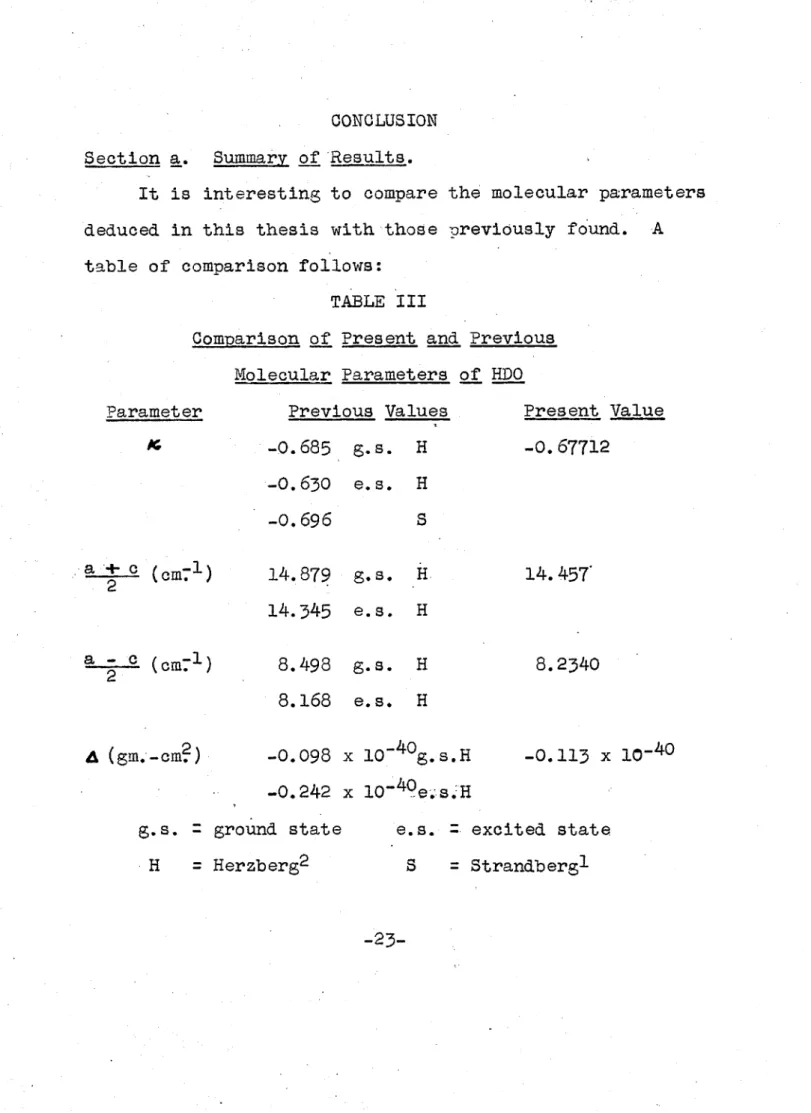
It is interesting to compare the molecular parameters
deduced in this thesis with those previously found. A
table of comparison follows:
TABLE III
Comparison of Present and Previous
Molecular Parameters of HDO
Parameter Previous Values Present Value -0.685 g.s. H -0.67712 -0.630 e.s. H -0.696 S a + c (cm;1 ) 14.879 g.s. H 14.457 2 14.345 e.s. H a - c (cm 1 ) 8.498 g.s. H 8.2340 2 8.168 e.s. H A (g.-cm ) -0.098 x 10-40g.s.H -0.113 x 10-40 -0.242 x 10 4 e s.H
.s. ground state e.s. excited state
H
=
Herzberg2 S Strandberg1-23-
-24-The values deduced in the present paper are not in serious disagreement with those previously reported; and
they are deduced from pure rotational transitions, whereas the former values appear as linear combinations of small
differences between large numbers. The values of Herzberg
were not corrected for centrifugal distortion, which can
make a difference of a few percent in the rotational con-stants and a much larger difference in predicted transition frequencies. The small change of has a negligible effect on the theoretical Stark effect as given by Strandberg,
particularly since the angle S which enters the calculations
is also subject to adjustment.
If the anharmonic force constants of HDO are found
by further infrared measurements, they can be used in a
theoretical treatment to calculate the effective moments of inertia in an excited rotational state and thus provide a direct comoarison of theory with exoeriment; or,
con-versely, assuming theory to be exactly correct, the equi-librium moments may be found and from this the departure,
if any, of HDO structure from H20 structure investigated.
Section b. Prediction of Absorotion Frequencies
The princ.iple use of the molecular parameters derived here is in the prediction of further transition frequencies
-25-when enough are known, to get a complete set of
experi-mental distortion coefficients. These distortion
coeffi-cients cannot be used to gain further information, since the desired fundamental quantities are hopelessly entangled in their formulae, but they can be used to check theory and provide a guide to its reexamination.
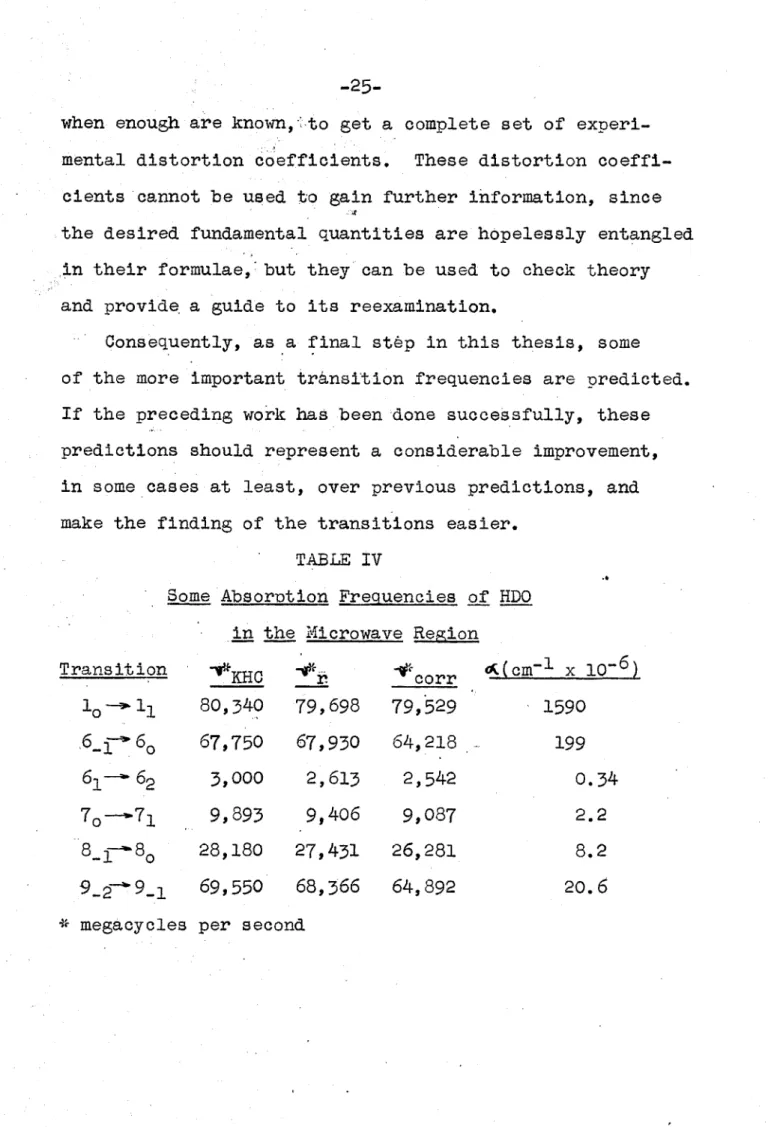
Consequently, as a final step in this thesis, some
of the more important trdnsition frequencies are predicted.
If the preceding work has been done successfully, these
predictions should represent a considerable improvement, in some cases at least, over previous predictions, and make the finding of the transitions easier.
TABLE IV
Some Absorotion Frequencies of HDO in the Microwave Region
Transition KH corr (cm-1 X 10⁻⁶ ~~KHC ____ Corr_ 10-501 80,340 79,698 79,529 1590 6 6 67,750 67,930 64,218 199 61--- 62 3, 000 2,613 2,542 0.34 70-71 9,893 9,406 9,087 2.2 8 8 28,180 27,431 26,281 8.2 9-2 '-9l 69,550 68,366 64,892 20.6
-26-In Table IV, KH) is the frequency predicted by iHC.
r is the rigid rotor frequency on the basis of parameters
deduced in this thesis, and corr is the frequency corrected
for centrifugal distortion. The reduced energies E(K) for
each level except the J 1 levels were calculated from
the reduced energy matrices by the method of continued
fractions (KHC6 ), as interpolation from the tables did
not give satisfactory results where energy differences were small.
No transitions withAJ = l were predicted, since
these transitions are unnecessary in improving a - c and
~a+ c ca ~a
X; the value of + can bd refined, when 2 c is better
known, from the 4_ 3P3 transition, and then used to
pre-dictAJ *1 lines.
The absorption coefficient Cis that given by KHC3,
revised for a line width &V: 0.3 cm-1 and corrected to
the new frequency. The lines given are the strongest
BIBLIOGRAPHY
1. Strandberg, M.W.P., Journal of Chemical Physics 1,
901 (1949).
2. Herzberg, L. Z. Physik 107, 549 (1937).
3. King, G. W., R. M. Hainer and P. C. Cross, Phys.Rev.
71
433.(1947).
4. Nielsen, H. H. Phys. Rev. 60, 794 (1941).
5. Hillger, R7 E., The Microwave Spectrum of Isotopic
Hydrogen Sulphide. Ph.D. Thesis, 1950 (M.I.T.).
6. King, G. W., R. M. Hainer and P. C. Cross, Journal
of Chemical Physics _1, 27 (1943).
7. Herzberg, G. Molecular Spectra and Molecular
Structure, II. Infrared and Raman Spectra of
Polyatomic Moledules. New York: D. Van Nostrand
Company, Inc. 1945.
8. Lawrance, R. B. and M.W.P. Strandberg, Centrifugal
Distortion in Asymmetric Top Molecules, I. Ordinary
Formaldehyde, H2C 20., M.I.T. Research Laboratory of
Electronics, Technical Report No. 177. (3 Oet., 1950).