Publisher’s version / Version de l'éditeur:
Vous avez des questions? Nous pouvons vous aider. Pour communiquer directement avec un auteur, consultez la première page de la revue dans laquelle son article a été publié afin de trouver ses coordonnées. Si vous n’arrivez pas à les repérer, communiquez avec nous à [email protected].
Questions? Contact the NRC Publications Archive team at
[email protected]. If you wish to email the authors directly, please see the first page of the publication for their contact information.
https://publications-cnrc.canada.ca/fra/droits
L’accès à ce site Web et l’utilisation de son contenu sont assujettis aux conditions présentées dans le site LISEZ CES CONDITIONS ATTENTIVEMENT AVANT D’UTILISER CE SITE WEB.
CIB World Building Conference [Proceedings], pp. 1-11, 2004-05-01
READ THESE TERMS AND CONDITIONS CAREFULLY BEFORE USING THIS WEBSITE.
https://nrc-publications.canada.ca/eng/copyright
NRC Publications Archive Record / Notice des Archives des publications du CNRC :
https://nrc-publications.canada.ca/eng/view/object/?id=2777adb4-555d-4a3f-9e69-fca07d2de599 https://publications-cnrc.canada.ca/fra/voir/objet/?id=2777adb4-555d-4a3f-9e69-fca07d2de599
NRC Publications Archive
Archives des publications du CNRC
This publication could be one of several versions: author’s original, accepted manuscript or the publisher’s version. / La version de cette publication peut être l’une des suivantes : la version prépublication de l’auteur, la version acceptée du manuscrit ou la version de l’éditeur.
Access and use of this website and the material on it are subject to the Terms and Conditions set forth at
Design with SkyVision: a computer tool to predict daylighting
performance of skylights
Design with SkyVision: a computer tool to predict daylighting
performance of skylights
Laouadi, A.
NRCC-46752
A version of this document is published in / Une version de ce document se trouve dans :
CIB 2004 World Building Congress, Toronto, Ontario, May 2-7, 2004, pp. 1-11
1
DESIGN WITH SKYVISION: A COMPUTER TOOL TO PREDICT DAYLIGHTING
PERFORMANCE OF SKYLIGHTS
IAQ T5S3
A. Laouadi
*, Ph.D.
Indoor Environment Research Program
Institute for Research in Construction, National Research Council of Canada,
1200 Montreal Road Campus, Ottawa, Ontario, Canada, K1A 0R6
ABSTRACT IAQ T5S3
By providing high indoor daylight availability and covering large roof surface areas, the potential lighting energy savings of skylights is enormous, particularly in commercial buildings. However, these potential energy savings are not fully exploited due to a number of theoretical and technical challenges. The lack of design tools is a major hurdle for building designers to adopt such products and quantify their energy benefits. The newly developed SkyVision tool aims to assist skylight manufacturers and building designers in developing appropriate skylight designs for given building types and daylighting applications. This paper addresses the use of SkyVision to investigate some of the design elements of skylights such as: the proper selection of skylights and wells, skylight spacing, and potential energy and cost savings. The shape of the skylight can significantly alter the overall optical characteristics. High profile clear domes, for example, transmit substantially more than flat skylights with similar glazing, particularly in winter days. Diffusing domes, however, transmit up to 50% less than flat skylights in most the year. An alternative skylight spacing criteria, called Surface Area Coverage (SAC), is proposed, as the current practice of skylight spacing, which is based on illuminance uniformity, may not guarantee energy savings. The SAC is defined as the surface area under the skylight that is under an illuminance equal or higher than the recommended task illuminance. The SAC is an important daylighting parameter for skylight product rating. Using the SAC method, the skylight spacing-to-ceiling-height ratio for diffusing domes was found to be 1.63 and 0.96 for ceiling heights 3 m and 6 m, respectively, to meet a target task illuminance of 200 lux under the CIE clear sky conditions. The SAC is not significantly sensitive to the ceiling height when the target illuminance is between 300 lux and 400 lux. Potential lighting energy savings of a retail store located in Ottawa, Ontario, Canada, may reach up to 50% for a moderately glazed roof. Glazing the roof of more than 5.76% would not result in significant energy savings if a continuous dimming system were used.
*
A. Laouadi is a research officer at the Institute for Research in Construction of the National Research Council, 1200 Montreal Road, Bldg M-24, Ottawa, Ontario, K1A 0R6 Canada
2
INTRODUCTION
In current building designs, daylighting is one the emerging practices to reduce the building energy use and environmental impacts. Skylights usually provides high indoor daylight availability (two to three times higher than windows), and cover large roof surface areas. Given the fact that a large portion of the building floor surface area is under a roof (for example, studies in the USA showed that about 60% of building floor surface area is under a roof, and 90% of new constructions are single storey (USDOE, 1998)), a huge potential energy saving can be achieved by skylighting. In addition, skylights can increase building market values by giving aesthetic look to buildings, admitting natural light indoors and connecting building occupants to the outside world. However, these potential energy savings and amenities are not fully exploited, particularly in commercial building sectors. The lack of design tools is one of the major hurdles building designers face to adopt such products and quantify their energy benefits. Computer simulation tools aid building designers to properly select the right skylight product for the right application. The current practice of skylight selection or rating is based on the optical characteristics of the flat sheets the skylight is made of. The shape of the skylight can significantly alter its optical performance, and therefore, its energy benefits. So far, there has not been a single computer tool that addresses this issue. For example, currently available fenestration simulation software such as FRAMEplus5.1 (CANMET, 2003) and WINDOW5.1 (LBL, 2003a) deal with only planar and transparent geometry, such as windows and flat skylights. Sophisticated lighting simulation software such as RADIANCE (LBL, 2003b), LUMEN MICRO (Lighting Technologies, 2003) and SUPERLITE (IEA SHC Task 21, 2000), are not only cumbersome to use, but they do not provide any output related to the skylight optical characteristics. Specialized skylight software are very rare and limited. The SkyCalc program (HMG, 2003) is limited to some USA climate regions, and handles only flat translucent skylights.
Proper design of skylights also requires proper selection of the light well space under the skylight. Most of small size skylights require a curb (space between the skylight and roof) and/or a well (space between the roof and the ceiling). The well space may reduce the amount of daylighting and solar heat gains entering the indoor space. The skylight and well spaces are prone for hot air stagnation and temperature stratification, thus alleviating the conditioned space form excessive high temperatures. Recent studies showed that the well space may reduce the solar heat gains by up to 25% (Klems, 2002), and the skylight space may reduce the annual cooling energy by up to 6% (Laouadi et al., 2002).
Skylight spacing is another major design parameter. Skylight spacing affects not only the indoor illumination levels but also the total cost of skylights and energy savings. The current criterion for skylight spacing is based on uniform illumination on the work plane covered by the skylights. The IES (IESNA, 2000) defines the spacing criterion as the distance between two skylights that yields a mid illuminance equal to that just under the skylights. The CIBSE code for lighting (CIBSE, 1994) recommends that the ratio of the minimum to average illuminance over any task area and immediate surrounds should be higher than 0.8. There have been a few studies undertaken for this purpose. McHugh et al. (2002) conducted photometric measurements of intensity distribution of several white skylight and well combinations. Based on the IES criterion, they found that the skylight spacing should be less than 1.4 times the mounting height. Dewey and Littlefair (1998) used scale model measurements under CIE overcast skies to calculate the spacing of several roof light types (shed, sawtooth, monitor, dome, flat). Based on the CIBSE spacing criterion, they found that the recommended spacing-to-height ratio of 1.5. Previous works mentioned in Lynes (1968) gave spacing recommendations for circular domes with/without wells. For domes without wells, the spacing-to-height ratio was found to be 1.25.
3
Recognizing this gap in the skylight applications, a specialized computer tool, called SkyVision, was developed to address the skylight performance. The SkyVision tool aims at assisting skylight manufacturers and building designers to come up with an appropriate skylight design for a given building and use. The tool analyses the optical characteristics of skylights of various shapes and types, and calculates their daylighting and energy performance. To maximize the energy benefits of skylights, SkyVision accounts for the lighting and shading controls, skylight shape and glazing type, curb/well geometry, building location and orientation, and prevailing climate. It is intended for use by skylight and curb manufacturers, building designers, architects, engineers, fenestration councils, and research and educational institutions. SkyVision is available free of charge from the web site: http://irc.nrc.cnrc.gc.ca/ie/light/skyvision.
The aim of this paper is to use the SkyVision tool to investigate some the design elements of skylights such as: the proper selection of skylights and wells, skylight spacing, and potential lighting energy and cost savings.
SELECTING THE SKYLIGHT – SHAPE VERSUS GLAZING
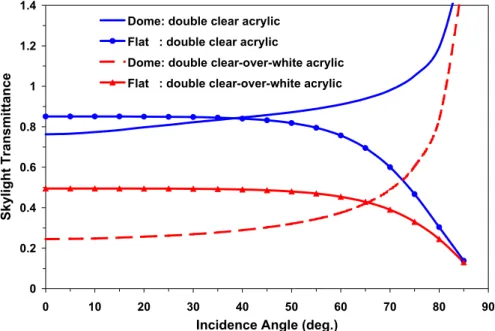
Skylights come in different shapes and sizes (such as domes, pyramids, barrel vaults, lightpipes, etc.), and glazing types (clear, translucent, or combination of the two). Similar to windows, the optical characteristics of the skylight are the primary parameters for the skylight product selection. So far there is no standard procedure to calculate the optical characteristics of non-flat skylights. Rather skylight manufactures publish the optical and thermal performance of the flat sheet the skylight is made of. The skylight shape can significantly alter its overall optical characteristics. To illustrate this effect, Figure 1 shows the transmittance profile as a function of the incidence angle on a horizontal surface for translucent and transparent circular domes (height = radius). The transparent dome is double glazed with clear acrylic (visible transmittance = 0.92). The translucent dome is double glazed with clear-over-white acrylic (the diffuse visible transmittance of the white acrylic = 0.53). The transmittance of a flat skylight with similar glazing is also plotted in the figure. Contrary to flat skylights, the transmittance of transparent domes increases with the incidence angle. Up to an incidence angle of 40° (e.g., summer days at noontime), transparent domes transmit up to 13% less than flat skylights. Beyond this incidence angle (e.g., winter days at noontime), however, the dome transmits substantially more than a flat skylight. For instance, at an incidence angle = 70°, transparent domes may transmit up to 61% more than similar flat skylights. Translucent domes transmit less than flat skylights with similar glazing in most of the year, except in winter days (incidence angles higher than 65°). For instance, at near normal incidence angle, the translucent dome transmits up to 50% less than a flat skylight.
In view of these results, skylight selection should be based on the optical characteristics and the shape and size of the skylight. If the design intent is to reduce the glazed surface area and maximize daylighting, then high profile domes (height = radius) with clear glazing should be selected. The glare problem that could arise from the clear skylight can be accommodated by the light well or by using ceiling diffuser. However, translucent domes should be low profile (height < radius) to maximize daylighting. When the design requires large-size skylights (such as the ones used in atriums, malls, etc.), then translucent domes with high profile should be used to minimize solar heat gains. Clear domes should be low profile, and be used with shading, or with low glazing transmittance.
SELECTING THE LIGHT WELL
The effect of the well on the indoor daylight availability is assessed through the well efficiency (WE). The well efficiency is defined as the ratio of the incident light flux on the well top surface to the exiting flux from the well bottom surface. Figure 2 shows the WE profile as a function of the well index ( WI = height * [width + length] / [2 * width*length] ) for three splay angles. The well cover and walls are assumed
perfect diffuser with a cover reflectance set to 10% and that of the walls to 80%. The WE decreases with increasing the well index and the splay angle. Shallow vertical wells (WI < 1, and splay angle = 90o) may reduce indoor daylight availability by up to 42%. Deep wells (WI > 1) worsen the WE, and therefore they should be used with low splay angles to improve their efficiency. Splaying the well less than 60o will not significantly improve the well efficiency. This finding was also backed up by measurements (Parent and Murdoch, 1989). 0 0.2 0.4 0.6 0.8 1 1.2 1.4 0 10 20 30 40 50 60 70 80 9
Incidence Angle (deg.)
Skylight Transmittance
0
Dome: double clear acrylic Flat : double clear acrylic
Dome: double clear-over-white acrylic Flat : double clear-over-white acrylic
Figure 1: transmittance profiles of clear and diffusing circular domes and flat skylights.
0 0.2 0.4 0.6 0.8 1 0 0.5 1 1.5 2 Well Index Well Efficiency
Splay angle = 90 deg. Splay angle = 75 deg. Splay angle = 60 deg.
Figure 2: Well Efficiency profile.
SKYLIGHT SPACING
Following the IES spacing criterion, if the second skylight center is placed at a distance (x) from the center of the first skylight, then the illuminance at the middle point can be expressed as follows:
2
x
E
1
2
x
E
(
/
)
=
+
(
)
(1)where E(x) is the ratio of the illuminance at distance (x) to the maximum illuminance at (x=0) under only one skylight. The illuminance profile under the skylight should thus be known to solve Equation (1). If the illuminance profile can be fitted with a polynomial series (with order N > 3) in the interval 0 ≤ x ≤ L, such as:
∑
=+
=
N i i ix
a
x
E
11
)
(
(2)then, Equation (1) becomes:
(
2
2
)
0
2 2 1−
=
∑
= − − − N i i i i N Nx
a
(3)Equation (3) will have multiple solutions. The only accepted solution will be constrained to be in the interval: 0 ≤ x ≤ L.
Following the CIBSE spacing criterion, the minimum illuminance (Emin) between two skylights may occur
at the mid distance of the skylight spacing, or just underneath the skylight center. The latter case is excluded since it corresponds to under-sized skylight spacing. The average illuminance (Eav) between
two skylights spaced with a distance (x) is expressed as follows:
∑
=+
+
=
N i i i avx
i
a
x
E
11
2
2
)
(
(4)The CIBSE criteria is then translated into the following relationship:
8
0
x
1
i
a
2
2
x
2
a
2
2
E
E
N 1 i i i N 1 i i i i av.
min≥
+
+
+
=
∑
∑
= = (5)which reduces to the following equation:
0
2
.
0
)
1
(
2
2
8
.
0
1
1≥
+
+
⋅
−
+
∑
= N i i i i ix
a
i
i
(6)Solving Equation (6) will lead to the recommended skylight spacing.
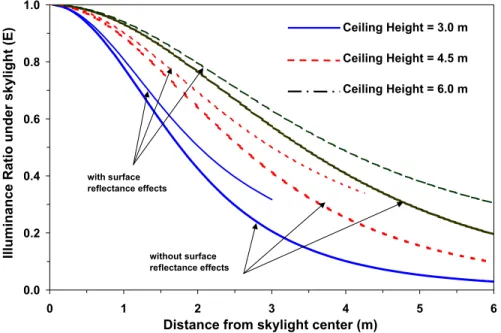
Profile of the illuminance distribution under a square (1.2 m x 1.2 m) diffusing dome (clear-over-white acrylic glazing) without a light well were calculated and presented in Figure 3. The effect of surface
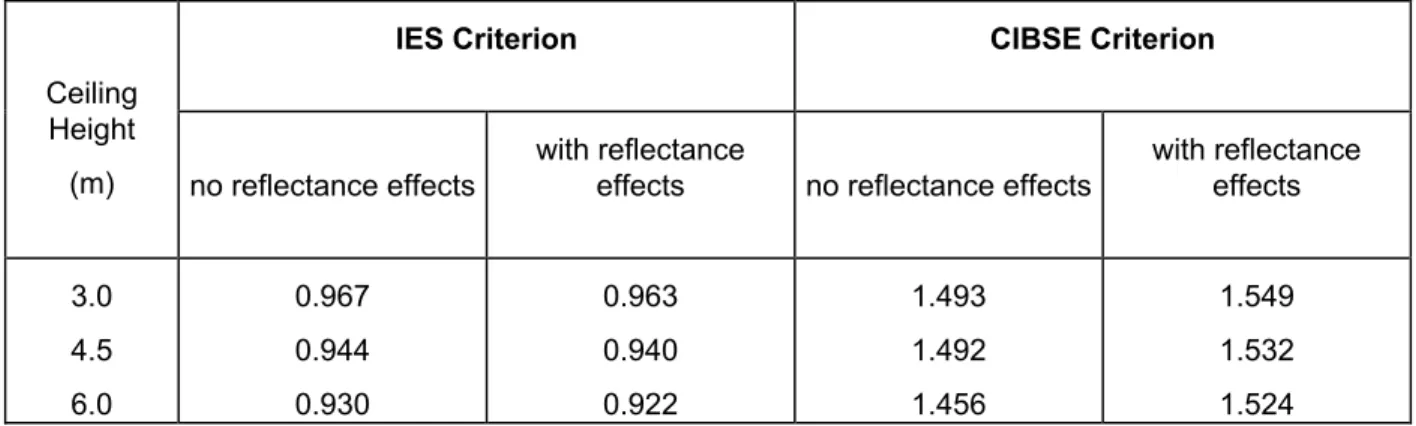
reflectance on the illuminance profile is also plotted (walls, floor and ceiling reflectance fixed at 0%, 20%, and 80%, respectively). Table 1 summarizes the skylight spacing-to-ceiling-height ratios calculated according to the IES and CIBSE criteria. For the three investigated ceiling heights, the skylight spacing ratio is almost constant and equal to 0.94 ± 0.03 according to the IES criterion, and 1.48 ± 0.01 according to the CIBSE criterion. Although the surface reflectance increases the illuminance uniformity in the space, the spacing ratio seems not significantly affected.
0.0 0.2 0.4 0.6 0.8 1.0 0 1 2 3 4 5 6
Distance from skylight center (m)
Illuminance Ratio under skylight (E) without surface reflectance effects with surface reflectance effects Ceiling Height = 3.0 m Ceiling Height = 4.5 m Ceiling Height = 6.0 m
Figure 3: Illuminance distribution under a square diffusing dome without a well.
SKYLIGHT SURFACE AREA COVERAGE
The previous analysis showed that the skylight spacing criterion guarantees illuminance uniformity within a space, but not energy savings as the latter is based on a recommended task illuminance. Skylight spacing should therefore be based on the trade-off between illuminance uniformity and energy savings. The parameter that guarantees energy saving is called the skylight surface area coverage (SAC). The skylight surface area coverage is defined as the surface area under the skylight, which is under an illuminance equal or greater than the recommended task illuminance. This is a very important parameter for skylight product selection and rating for daylighting applications. A standard procedure should be developed under which sky condition, or outdoor illuminance, the SAC should be calculated for typical building types (commercial, residential, etc.). Given the roof surface area to be skylighted, the number of the required skylights can be easily determined if the SAC is known a priori (from the product rating). Figure 4 shows the SAC profile of a square diffusing dome (without a well) as a function of the recommended illuminance for three types of sky conditions at noontime: CIE overcast (CIE, 1995), IES partly cloudy (IESNA, 2000) and CIE clear (industrial areas). The dimensions of the typical building were fixed at: length = width = 6 m, and height = 3 m. The floor, walls and ceiling reflectances were fixed at 20%, 50% and 80%, respectively. The building is located in Ottawa, Ontario (Latitude 45o). For residential building applications requiring a recommended illuminance of 200 lux (e.g., kitchen), the dome may cover a surface area of 25.5 m2 under overcast skies, the worst sky conditions. For commercial building applications requiring a recommended illuminance of 750 lux (e.g., retail stores with medium activity), the dome may cover a surface area of 22.5 m2 under partly cloudy sky conditions.
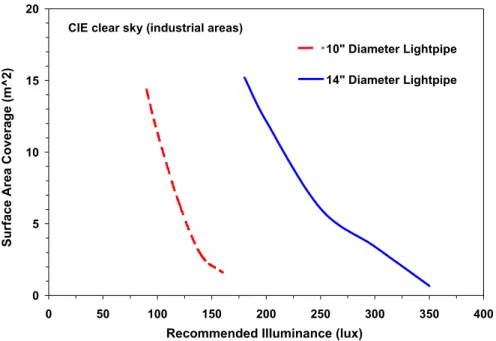
Figure 5 shows the SAC profile of two typical residential tubular skylights (lightpipes) under CIE clear sky conditions at noontime. The characteristics of the tubular skylight are: collector is glazed with polycarbonate, pipe length = 1.6 m, pipe reflectance = 95%, and diffuser reflectance 90%. The dimensions of the typical building were fixed at: length = width = 4 m, and height = 2.7 m. For a recommended illuminance of 100 lux (e.g., stairways lighting), the 10” lightpipe covers an area of 11.34 m2. For a recommended illuminance of 200 lux (e.g., kitchen lighting), the 14” lightpipe covers an area of 12.16 m2.
Figure 6 shows the SAC profile of a square diffusing domes as a function of the ceiling height under clear sky conditions for fixed values of the recommenced illuminance. The typical building had the following dimensions: width = length = 12 m. The floor, walls and ceiling reflectances were fixed at 20%, 50% and 80%, respectively. For low values of the recommended illuminance (lower than 200 lux), the SAC increases with the ceiling height, similar to the profile of the skylight spacing. However, for high values of the recommended illuminance (higher than 600 lux), the SAC decreases with increasing the ceiling height. There must be therefore an intermediate illuminance for which the SAC is not sensitive to the ceiling height variation. This intermediate illuminance was found to be between 300 lux and 400 lux.
0 5 10 15 20 25 30 35 0 500 1000 1500 2000
Recommended Illuminance (lux)
Surface Area Coverage (m
^2)
CIE clear sky (industrial areas) IES partly cloudy sky
CIE overcast sky
Figure 4: Surface Area Coverage of a square diffusing dome without a well for a ceiling height = 3 m.
0 5 10 15 20 0 50 100 150 200 250 300 350 400
Recommended Illuminance (lux)
Sur face Ar ea Cover age ( m ^2) 10" Diameter Lightpipe 14" Diameter Lightpipe CIE clear sky (industrial areas)
Figure 5: Surface Area Coverage of a lightpipe (tubular skylight) for a ceiling height = 2.7 m under CIE clear sky conditions.
0 50 100 150 3 4 5 6 Ceiling Height (m) Sur face Ar ea Cover age ( m ^2)
Recommended illuminance = 200 lux Recommended illuminance = 600 lux CIE clear sky (industrial areas)
Figure 6: Profile of the Surface Area Coverage as a function of the ceiling height for a square diffusing dome without a well under CIE clear sky conditions.
9
ENERGY SAVINGS
A retail store located in Ottawa, Ontario, was considered to calculate the potential energy savings from skylighting. The store had a floor surface area of 2500 m2 and ceiling height of 6 m. The roof of the building had arrays of diffusing double glazed domes (clear-over-white acrylic) mounted on a 0.3 m curb. The rough opening area of the dome was 4 m2. The store was of type medium activity, and an illuminance of 750 lux (IESNA, 2000) had to be maintained throughout the floor surface. The store occupancy schedule is between 9 AM to 9 PM all days. The lighting system of the store had a power density of 18 W/m2, and was controlled to complement the natural lighting from the skylights. Two control strategies were investigated: ON/OFF automatic and continuous dimming with a base load of 10%. Table 2 shows the potential lighting energy and cost savings as a function of the glazed-to-roof surface area ratio. The lighting energy savings were calculated relative to when there was no lighting control (lights were on during building occupancy). The cost savings were based on an electricity rate of $0.10/kWh. The energy savings increase with the glazed surface area ratio. The dimming system provides up to 28% better energy saving than the on/off automatic control. The results also show that glazing the roof of more than 5.76% would not result in significant energy savings if a continuous dimming system were used. The cost energy saving may reach up to $3.9/m2.
CONCLUSION
The SkyVision tool was used to investigate some of the design elements of skylights that included: the proper selection of skylights and wells, skylight spacing, and potential energy and cost savings.
The optical characteristics are the primary parameters for skylight selection. The shape of the skylight can significantly affect the optical performance of skylights. The tool predicted that non-flat clear skylights such as high profile domes transmit substantially more light at low sun altitude angles (e.g., winter days) than flat skylights with similar glazing. However, diffusing domes transmit up to 50% less light than flat skylights in most of the year, except in winter days. In this regard, small-size clear domes (such as the ones used in residential or commercial buildings) are better to maximize the indoor daylight availability and minimize the glazed roof surface area proportions. Shadings or ceiling diffusers should be used to accommodate the potential glare problem that could arise from clear glazing. Large-size diffusing domes (such as the ones used in atriums or malls) are better to reduce solar heat gains.
The well space can also alter the daylighting performance of skylights. Shallow wells (Well Index < 1) may reduce the indoor daylight availability by up to 42%. Deep wells (Well Index > 1) should be splayed to increase their efficiency. Splay angles lower than 60o would not significantly improve the well efficiency.
The current practice of skylight spacing is based on the illuminance uniformity. The illuminance uniformity may not guarantee energy savings, as the latter is based on a recommended task illuminance. Skylight spacing should therefore be a trade-off between illuminance uniformity and energy savings. Based on the illuminance uniformity, the skylight spacing-to-ceiling ratio for diffusing domes was found to be 0.94 and 1.48 according to the criteria of the IES (IESNA, 2000) and CIBSE code for lighting (CIBSE, 1994), respectively. An alternative spacing criterion, called Surface Area Coverage (SAC) was proposed to guarantee the energy savings. The SAC is defined as the surface area under the skylight that is under an illuminance equal or higher than the recommended task illuminance. The SAC is an important daylighting parameter for skylight product rating. Using the SAC method, the skylight spacing ratio for square diffusing domes was found to be 1.63 and 0.96 for ceiling heights 3 m and 6 m, respectively, to meet a target task illuminance of 200 lux under the CIE clear sky conditions.
Potential lighting energy saving of a retail store box located in Ottawa, Ontario, Canada, may reach up to 50% for moderately glazed roof (glazed-to-roof surface area ratio lower than 8%). Glazing the roof of
10
more than 5.76% would not result in significant energy savings if a continuous dimming system were used.
ACKNOWLEDGEMENTS
This work has been funded by the Institute for Research in Construction of the National Research Council Canada; the CETC Buildings Group of Natural Resources Canada; Panel on Energy Research and Development (PERD), Office of Energy Efficiency, Natural Resources Canada; and Public Works and Government Services Canada. The author is very thankful for their contribution. The author would also like to thank: Artistic Skylight Domes Ltd. (Etobicoke, Ontario, Canada), Mac Plastics Ltd. (Edmonton, Alberta, Canada), and Energy Harmony (St. Catharine, Ontario, Canada) for donating some skylight products for testing.
REFERENCES
CANMET, FRAMEplus 5.1: web site: www.frameplus.net, 2003.
CIE, Spatial Distribution of Daylight -Luminance Distributions of Various Reference Skies, Technical Report, 1995.
CIBSE code for interior lighting, Chartered Institution for Building Services Engineers, London, 1994. Dewey EJ, and Littlefair PJ, Rooflight spacing and uniformity, LRT, 30(3), pp. 119 – 125, 1998.
HMG, SkyCalc: Skylighting Tool for California and the Pacific Northwest, Heschong Mahone Group: www.h-m-g.com, 2003.
IEA SHC Task 21, ADELINE 3.0, RADIANCE and SUPERLITE User’s Manual, 2000.
IESNA, Lighting Handbook, Reference And Application Volume. New York: Illuminating Engineering Society of North America, 2000.
Klems J.K., Skylight Well Reduces Solar Heat Gain, EETD Newsletter Spring 2002.
Laouadi, A., Atif, M.R. and Galasiu, A.D. "Towards developing skylight design tools for thermal and energy performance of atriums in cold climates," Building and Environment, 37, (12), pp. 1289-1316, 2002.
LBL, WINDOWS 5.1, Lawrence Berkeley Laboratory: http://windows.lbl.gov/, 2003a. LBL, RADIANCE 3.5, Lawrence Berkeley Laboratory: http://radsite.lbl.gov/radiance/, 2003b. Lighting Technologies, Inc., LUMEN MICRO 2000: www.lighting-technologies.com, 2003.
McHugh J., Lewin I., and Domigan J., Skylights as Luminaires: PIER skylight photometric test results, IESNA Annual Conference , Aug, 2002.
Lynes JA, Principles of natural lighting, Elsevier, London, 1968.
Parent M.D. and Murdoch J.B., Skylight dome-well system analysis from intensity distribution data, Lighting Res. Technol. 21(3), pp. 11-123, 1989.
US DOE, Energy information administration. A look at the commercial buildings in 1995: characteristics, energy consumption, and energy expenditures, DOE/EIA-0625(95), Washington DC, 1998.
11
Table 1 Recommended spacing-to-ceiling-height ratio for square diffusing domes without a light well.
IES Criterion CIBSE Criterion
Ceiling Height
(m) no reflectance effects
with reflectance
effects no reflectance effects
with reflectance effects 3.0 4.5 6.0 0.967 0.944 0.930 0.963 0.940 0.922 1.493 1.492 1.456 1.549 1.532 1.524
Table 2 Lighting energy and cost savings for a retail store.
ON/OFF Automatic Continuous dimming with 10% base load Glazed-to-roof
surface area ratio (%)
Energy Saving (%) Cost saving ($/m2)
Energy Saving (%) Cost saving ($/m2)
1.44 1.3 0.1 17.7 1.4
2.56 8.9 0.7 28.1 2.2
5.76 29.7 2.3 44.3 3.5