Publisher’s version / Version de l'éditeur:
Vous avez des questions? Nous pouvons vous aider. Pour communiquer directement avec un auteur, consultez la première page de la revue dans laquelle son article a été publié afin de trouver ses coordonnées. Si vous n’arrivez pas à les repérer, communiquez avec nous à [email protected].
Questions? Contact the NRC Publications Archive team at
[email protected]. If you wish to email the authors directly, please see the first page of the publication for their contact information.
https://publications-cnrc.canada.ca/fra/droits
L’accès à ce site Web et l’utilisation de son contenu sont assujettis aux conditions présentées dans le site
LISEZ CES CONDITIONS ATTENTIVEMENT AVANT D’UTILISER CE SITE WEB.
The 2009 13th IEEE International Conference on Computer Supported
Cooperative Work in Design [Proceedings], pp. 1-6, 2009-04-22
READ THESE TERMS AND CONDITIONS CAREFULLY BEFORE USING THIS WEBSITE.
https://nrc-publications.canada.ca/eng/copyright
NRC Publications Archive Record / Notice des Archives des publications du CNRC :
https://nrc-publications.canada.ca/eng/view/object/?id=c156d796-f1ef-4819-8aeb-f72bde317278 https://publications-cnrc.canada.ca/fra/voir/objet/?id=c156d796-f1ef-4819-8aeb-f72bde317278
NRC Publications Archive
Archives des publications du CNRC
This publication could be one of several versions: author’s original, accepted manuscript or the publisher’s version. / La version de cette publication peut être l’une des suivantes : la version prépublication de l’auteur, la version acceptée du manuscrit ou la version de l’éditeur.
Access and use of this website and the material on it are subject to the Terms and Conditions set forth at
Service-oriented coordinated intelligent rational agent model for
distributed information systems
http://irc.nrc-cnrc.gc.ca
Se r vic e -orie nt e d c oordinat e d int e llige nt
rat iona l a ge nt m ode l for dist ribut e d
infor m at ion syst e m s
N R C C - 5 1 1 4 0
W a n g , Y . D . ; G h e n n i w a , H . ; S h e n , W .
A p r i l 2 0 0 9
A version of this document is published in / Une version de ce document se trouve dans:
The 2009 13th IEEE International Conference on Computer Supported
Cooperative Work in Design, Santiago, Chile, April 22-24, 2009, pp.1-6
The material in this document is covered by the provisions of the Copyright Act, by Canadian laws, policies, regulations and international agreements. Such provisions serve to identify the information source and, in specific instances, to prohibit reproduction of materials without written permission. For more information visit http://laws.justice.gc.ca/en/showtdm/cs/C-42
Les renseignements dans ce document sont protégés par la Loi sur le droit d'auteur, par les lois, les politiques et les règlements du Canada et des accords internationaux. Ces dispositions permettent d'identifier la source de l'information et, dans certains cas, d'interdire la copie de documents sans permission écrite. Pour obtenir de plus amples renseignements : http://lois.justice.gc.ca/fr/showtdm/cs/C-42
Service-Oriented Coordinated Intelligent Rational Agent Model for
Distributed Information Systems
Ying Daisy Wang
1, Hamada Ghenniwa
2, Weiming Shen
3, Yunjiao Xue
21
School of Economic Information Engineering, Southwestern University of Finance and
Economics, Chengdu, China
[email protected]
2Dept. of Electrical and Computer Engineering, University of Western Ontario, Canada
{hghenniwa,yxue24}@eng.uwo.ca
3
Institute of Research in Construction, National Research Council Canada
[email protected]
Abstract
This paper presents a Service-Oriented Coordinated Intelligent Rational Agent (SO-CIR-Agent) model to address three design issues of open Cooperative Distributed Systems (CDS): autonomy, distribution, and heterogeneity. This work incorporates the service-oriented design paradigm, agent-service-oriented design paradigm, and Web service technology as supporting pillars by extending the CIR-Agent model so that agents can survive not only in agent-oriented environments but also in service-oriented environments. The implementation issues of the proposed agent model are discussed at the end.
Keywords: Agent, Service-Oriented, Distributed Systems.
1. Introduction
An open CDS can be constructed from distributed entities that have limited knowledge and are able to perform some functions independently and exercise some degree of authority in sharing their capabilities. These entities are able to work together to achieve individual and/or global goals in some domain. The characteristics and the major design issues of open CDS are autonomy in terms of control, distribution / transparency in terms of information location and working environment, and heterogeneity in terms of information content and implementation technology.
Although researches in distributed systems and artificial intelligence attempted to solve these design issues, the solutions such as Service-Oriented Architecture (SOA) are limited in autonomy while cooperative multi-agent systems (MAS) are limited by the assumption that entities in the environment are wrapped as agents and run on agent platforms.
As a software design paradigm, SOA helps to organize and utilize the distributed capabilities in an
open CDS and simplifies the communication between entities by adopting well-defined and highly interoperable communication mechanisms. Therefore, services can be found on heterogeneous distributed platforms while still being accessible across the networks. Thus, SOA solves both the distributed and heterogeneous design issues.
On the other hand, Agent-Oriented (AO) architecture [3] empowers agents with the property of autonomy which means that agents are able to perform tasks without direct intervention from other agents including human agents and they have control of their own internal states and actions. This property addresses the open CDS design issue of autonomy.
At present, although SOA claims to include autonomy as one of its properties, autonomy is still its desirable feature. On the other hand, MAS claims architecture to have a distribution property and the AO architecture to have the capability to solve heterogeneous issues. However, this distribution property is based on the assumption that these distributed entities are all implemented as agents and running on the same type (e.g. FIPA-based) of agent platforms. This assumption is not always true in reality and limits the heterogeneous nature of open CDS. Based on the above insight, the SO-CIR-Agent has been proposed as a service-oriented agent model [9] by extending the CIR-Agent model [1], so that agents can survive not only in agent-oriented environments, but also in service-oriented environments and all three design issues are solved. The integration of SOA and AO technology opens up agent technology towards a service-oriented environment. Therefore, agent technology is proposed to a larger set of possible users and the interesting and advanced work carried out by the agent community can be fruitfully exploited in the area of service-oriented computing, e.g. coordination and collaboration.
The rest of this paper is organized as follows: Section 2 provides a brief literature review; Section 3 introduces the SO-CIR-Agent; Section 4 discusses
implementation issues of SO-CIR-Agent; and Section 5 concludes the paper with some perspectives.
2. Literature review
As discussed above, AO architecture is strong in solving the autonomy issue. We take an in-depth review and compare different AO models. An approach in AO systems design views the system as a rational agent having certain mental attitudes of Belief, Desire and Intention (BDI), representing the information, motivational, and deliberative states of the agent [7] respectively. The CIR-Agent model previously developed within our group [1] is a design paradigm for cooperative distributed systems. This work extends the CIR-Agent model with SO capability.
A multi-agent system (MAS) is designed not only for achieving autonomy but also for overcoming the distribution and heterogeneity caused by the open nature of CDS [5,8]. The way MAS deals with distribution is based on adoption of Agent Communication Languages (ACL) such as FIPA ACL, and/or agent platforms such as JADE. It effectively resolves these two major design issues while suggests two major implications: (1) agents communicate in the same language, and (2) agents must reside on agent platforms. In other words, agents are not equipped with the capability to communicate with heterogeneous counterparts and they are not survivable in heterogeneous environments. Thus, distribution and heterogeneity are solved to a certain degree by MAS while new concerns are arising right from there.
As mentioned above, SOA helps to organize and utilize the distributed capabilities in an open CDS as well as simplifies the communication by adopting a well-defined and highly interoperable communication mechanism so that services can be discovered on heterogeneous distributed platforms. Web service is an implementation of SOA and is designed to support interoperable machine-to-machine interaction over a network. Its major advantages are the adoption of: (1) XML-based highly interoperable communication / interaction languages, and (2) widely accessible Web technology as the communication backbone which is based on HTTP – a text-based protocol.
Researchers have proposed different approaches to benefit from both sides of the SOA and AO architecture. Some of them investigated the Web services-oriented agent [4] at the implementation level while some others focus on extending the agent platform with Web service capability [2] or the integration between a certain agent platform and a Web service platform [6]. This paper discusses the combination of SOA and AO architecture at the conceptual level and presents a concrete implementation based on CIR-Agent model extension that uses JADE as the agent platform and Web services as SOA implementation. Thus, it gives a high level and broader view for future SOA and AO architecture hybrid software engineering. The implementation is not
limited by a certain choice of platforms. Also the agent’s survivability in the SO environment no longer depends on the agent platform on which it resides.
3. SO-CIR-Agent
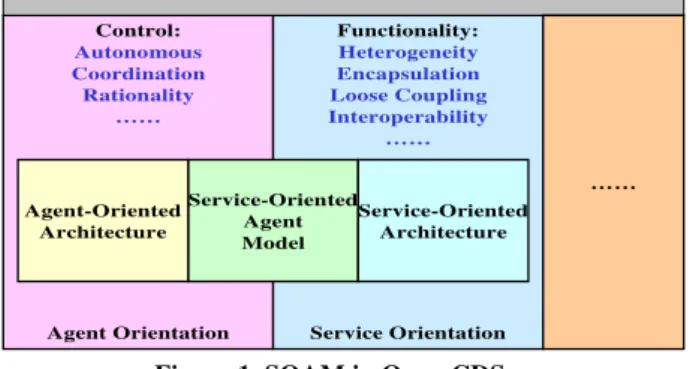
SOA has a higher encapsulation and abstraction power than heterogeneous computational artifacts due to its advantages of autonomy, loose coupling, modularity, and interoperability. Thus it is an appropriate paradigm for open computing environments. However, the service itself is not automatically autonomous. It is rather a desirable characteristic of SOA’s conceptual model than the nature of it. On the other hand, AO architecture is promising in realizing complex interactions and coordination behaviors due to its autonomy characteristics. Naturally, we can get a Service-Oriented Agent Model (SOAM) by hybridizing the SOA and AO architecture and benefit from both of them as shown in Figure 1. In a SOAM, AO design provides a focus and cohesive set of service capabilities. The fundamental elements of the environment are services. Software agents capture and implement services as their functionalities and services consider software agents as their owners. A SOAM can be implemented in Web service in terms of service-orientation and CIR-Agent in terms of agent service-orientation.
Control: Autonomous Coordination Rationality …… Agent Orientation Functionality: Heterogeneity Encapsulation Loose Coupling Interoperability …… Service Orientation Service-Oriented Agent Model Agent-Oriented Architecture Service-Oriented Architecture
Design Paradigms in Open Cooperative Distributed Systems (CDS)
……
Figure 1. SOAM in Open CDS
The structure of a CIR-Agent is based on the mental state as to achieving a goal. The CIR-Agent architecture is composed of four major components: knowledge,
problem-solver, interaction and communication. The
knowledge component has the mental state of the goals, local world history, coordination knowledge, models of the other agents and communication knowledge. The problem solver is responsible for working out solutions to achieve a goal. The interaction component associates the problems with the corresponding type of interdependencies. The communication component executes the plan so that the agent’s acts affect the outside world. In the CIR-Agent model, no global control is allowed, but agents use different interaction devices to resolve the interdependency problem.
To make the CIR-Agent survivable in a SO environment, a particular interconnection of agent components is required to reflect the agent’s mental
state pattern related to the reasoning about goal achievement. This requires the original CIR-Agent model to be extended in its knowledge and communication components.
3.1. Knowledge Component
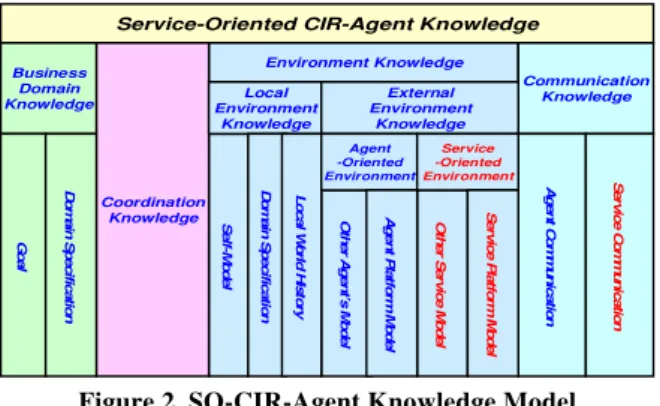
The knowledge part is the agent’s mental state, which is the information an agent has in its memory. This information includes its business domain knowledge, coordination knowledge, environment knowledge, and communication knowledge as depicted in Figure 2. Two components need to be enriched, namely, external environment knowledge and communication knowledge for service-oriented extension. The external environment knowledge needs to include: (1) the knowledge about other service models, namely, their capability, location, parameters needed to perform a service, and (2) the service platform model that is the operation procedure described in the platform specifications. The communication knowledge model needs to include the knowledge about service communication including service communication languages and protocols.
Service-Oriented CIR-Agent Knowledge
Environment Knowledge Communication Knowledge S e lf-M o d e l Ot he r A g e n t’s M o d e l Coordination Knowledge Local Environment Knowledge External Environment Knowledge D o m a in S p e c if ic a tio n Lo c a l W o rld H is to ry Ot he r S e rv ic e M o d e l Ag e n t C o m m u n ic a tio n S er vi ce C o m m u n ica tio n Business Domain Knowledge Go a l D o m a in S p e c if ic a tio n Agent -Oriented Environment Service -Oriented Environment A g e n t P la tfo rm M o d e l Se rv ic e Pl a tfo rm M o d e l
Figure 2. SO-CIR-Agent Knowledge Model
The external environment knowledge of an agent includes the information that an agent has about the external environment, including the knowledge about its AO environment and the knowledge about SO environment.
Model of AO environment, denoted by
{
MA MAP i m}
MAEAgi = Agi, Agi1≤ ≤ , where MAAgi are
the models of the other agents in the AO environment
and MAPAgi is the model of the agent platform is
running on, and denotes the number of agents in the
environment.
i
Ag
m
Models of the other agents are denoted by
{
M i m l mi l}
MA i l i Ag Ag Ag = ≤ ≤ ≤ ≤ ≠ , 1 , 1 , where i i i i l Ag x Ag Ag Ag Ag def X X X M 1 , 2 ,..., - the definition ofdefines the parameters that agent might know
about agent , and
m
denotes the number of agentsin the environment. These parameters might include the capability of managing information and the mental state
of an agent in achieving its goals. Such knowledge is usually dynamic and kept in its memory by agents.
s
X
i Ag l AgAn agent usually runs only on one agent platform.
The model of the agent platform is denoted byMAPAgi.
This model is usually reflected in the user’s guide or system specification of the agent platform. Information might include the execution procedure that an agent needs to know for registration, and the interface an agent needs to follow to interact with the platform, etc.
Model of SO environment, denoted by
{
MS MSP i m}
MSEAgi = Agi, Agi1≤ ≤ , where are
the models of the other services in the SO environment
and is the model of the service platforms is
involved with, and
m
denotes the number of agents inthe environment. i Ag MS
Ag
i Ag MSP iModels of the other services are denoted by
{
M i m l n}
MS i l i Ag Sv Ag = ≤ ≤ ≤ ≤ 1 , 1 , where i i i i l Ag y Ag Ag Ag Sv def Y Y Y M 1 , 2 ,..., - the definition ofdefines the parameters that agent might know
about service , and
m
denotes the number of agentsin the environment while
n
denotes the number ofservices in the environment. These parameters that
agent might know about service include the
capability and location of a service, as well as parameters needed to perform the service.
s
Y
i AgSv
lSv
iAg
lAn agent might be involved in more than one service platform. Model of the service platforms is denoted by
{
MSP i m l r}
MSP i l i Ag Sp Ag = 1≤ ≤ ,1≤ ≤ , where is themodel of a service platform that agent is involved
with, and
m
denotes the number of agents in theenvironment while i l Ag Sp MSP i Ag
r
denotes the number of serviceplatforms that agent is involved with in the
environment.
i Ag
Furthermore, the communication knowledge of an agent includes: Models of agent-oriented
communication, denoted byCA=
{
ALi,Oi 1≤i≤ p}
,where
p
denotes the number of AO communicationlanguages existing in the environment, ALi denotes one
of the AO communication languages while Qi denotes
the ontology pairing with ALi. Models of
service-oriented communication, denoted by
{
}
{ }
{
SL O P i q j r}
CS= i, i , j 1≤ ≤ ,1≤ ≤ , where
q
denotesthe number of SO languages existing in the
environment,
r
denotes the number of communicationprotocols existing in the environment, SLi denotes the
SO communication language existing in the
environment while Qi denotes the ontology pairing with
SLi. Thus, there are two subsets of elements in the set of
SO communication model – the SO communication language pair and the communication protocol.
3.2. Communication Component
Two components (NonAgent and Agent-Environment communication) of the original model need to be extended as depicted in Figure 3. This work adds service as new types of NonAgent entity. Agents need to follow the service communication languages and protocols. This work also adds the SO environment (or service platform) as a new type of environment. It is related to a series of execution procedures whose semantics is based on service platform specifications.
We need to address language, ontology and protocol when talking about communication. The following discussion is based on Web service communication.
Agent-Service Communication. Communication
Language – for agents running on a Web Service Platform, they need to communicate with services in SO communication languages, e.g. SOAP for accomplishing a service, WSDL for describing the agent’s problem solving capabilities, and UDDI for describing the agents’ own locations. Communication Ontology – for agents and services to understand each other correctly, they need to refer to an associated ontology, e.g. OWL, for encapsulation and embodiment of the domain business concepts and rules. Communication Protocol – communication networking protocols, e.g. HTTP, and TCP/IP.
Service-Oriented CIR-Agent Communication Agent
-None Agent Entity
Agent -Environment Agent -Human Agent -Agent T e x tua l d ia log …… Com m un ic a tion P rot oc o l P red e fin ed M ech a n is m Message Interface Da ta b a s e : N a m e & Ad d re s s O p er at in g S ys tem : U s er M an u al Environment - Oriented Communication Entity - Oriented Communication O b ject : O b ject I D , M et h o d Na m e & T y p e d P a ra m e te rs S e rvi ce: S e rvi ce C o m m u n icat io n L a ngu a ge s & P ro to c ol s …… S er vi ce-O rien ted E n vi ro n m en t: U s er M a nu al A g en t-O rien ted E n vi ro n m e n t: U s er M a nu al …… Execution Procedure
Figure 3. SO-CIR-Agent Communication Model Agent-ServicePlatform Communication.
Communication Language – for agents to communicate with SO platforms in operations such as service registration and service look up, in a way (or call it a “language” literally) that the SO platform understands, agents need to follow platform specifications. Communication Ontology – usually the semantics of the communication between any type of service providers/requesters and the SO platform is implicitly reflected in the documentations mentioned in “Communication Language” above. Communication Protocol – usually the SO platform would provide an API for entities to connect with it, and this would serve as the communication protocol between the agents and the SO platforms.
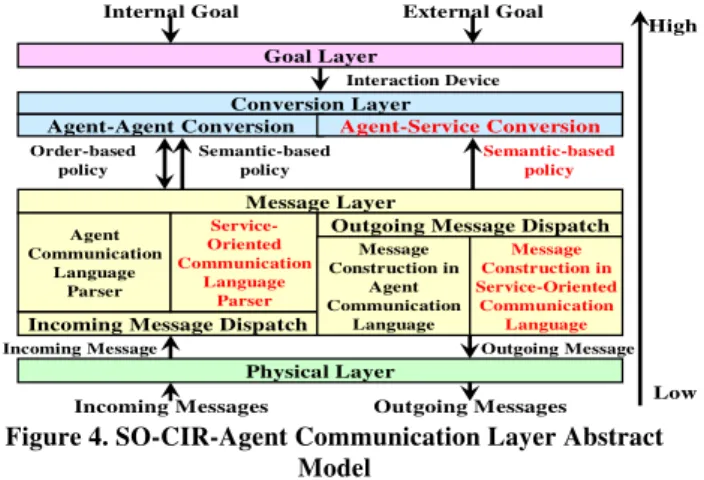
The CIR-Agent communication model is divided into four layers – Goal Layer, Conversion Layer, Message Layer and Physical Layer – to cope with the agent’s interaction with other entities. The Goal Layer
provides mapping between agent internal/external goal(s) and the conversion layer. The Conversion Layer is a structurally well-formed language used to ensure sending/receiving the intended messages without misunderstanding. The Message Layer provides mapping between the conversion layer and the physical layer, which involves outgoing message construction in ACL and incoming message parsing. The Physical Layer provides a uniform interface to the underlying telecommunication physical layer.
Figure 4. SO-CIR-Agent Communication Layer Abstract Model
Assuming that agents and services are working in the same type of network, it is obvious that we need to have the conversion layer and the message layer extended for SO. The other two layers are not affected as depicted in Figure 4.
Conversion Layer SO extension: The order-based predefined conversion is not applicable in agent-service communication because the commitment to such an order cannot be ensured when agents communicate with heterogeneous types of counterparts. The semantic-based emergent conversion policy allows the agent to use a dynamic order of messages and is based on the interpretation of the received messages. Therefore, the communication conversion mechanism solely relies on the agent’s interpretation capability rather than the counterparts’ commitment. As long as the agent is equipped with such a message exchanging conversion mechanism, the effectiveness and correctness are ensured.
Message Layer SO extension: When an agent needs to send out a message, the outgoing message is dispatched according to the type of intended receiver first. For a message to be sent to a service, it would be passed to the message construction unit according to SO communication languages, such as SOAP, WSDL and UDDI for Web Services, and then passed to the physical layer. When an agent receives a message from the physical layer, it distinguishes whether the sender is an agent or a service first. For a service type of sender, the newly extended SO Communication Language-based parser would be applied.
Goal Layer Conversion Layer Message Layer Physical Layer High Low
Incoming Messages Outgoing Messages
Internal Goal External Goal
Interaction Device
Order-based policy
Semantic-based policy
Agent-Agent Conversion Agent-Service Conversion
Incoming Message
Semantic-based policy
Outgoing Message
Incoming Message Dispatch
Outgoing Message Dispatch
Service-Oriented Communication Language Parser Agent Communication Language Parser Message Construction in Agent Communication Language Message Construction in Service-Oriented Communication Language
4. Implementation
When an instance of a SO-CIR-Agent is deployed, among the four components of the agent model, the
Knowledge component plays an essential role. The
remaining three components (Problem Solver, Interaction Device and Communication) are deployed based on an agent’s knowledge about itself and the environment. Based on this insight, this work proposes a Knowledge-Driven Self-Deployment Algorithm that allows an instance of a SO-CIR-Agent being deployed driven by its knowledge.
For a SO-CIR-Agent
Ag
i , it is represented as:{
Agi Agi Agi}
i K PS ID
Ag = , , Agi,C , where KAgi is
the Knowledge component, denoted by
where
is the Goal knowledge,
⎪ ⎭ ⎪ ⎬ ⎫ i Ag MS , , i ⎪ ⎩ ⎪ ⎨ ⎧ = i i i i i i i i i Ag Ag Ag Ag Ag Ag Ag Ag Ag Ag CA MSP MA LH SK CK D G K , , , , , i Ag G Ag i i Ag CS MAP , , , D is the Domain
Specification knowledge, is the Coordination
Knowledge, denoted by
,where is the Resource Scheduling knowledge,
is the Conflict Resolution knowledge, is the Synchronization knowledge,
i Ag ⎪⎩ ⎪ ⎨ ⎧ = i i i Ag Ag Ag KUK AK RAK SCK CRK RSK CK , , i Ag RSK i Ag CRK i Ag SCK CK i i Ag Ag , , ⎪⎭ ⎪ ⎬ ⎫ i i Ag Ag , i Ag RAK
is the RedundancyAvoidance knowledge, AK Agi is the
Assignment knowledge, is the Knowledge
Update knowledge, is the Self Model
knowledge, it points to SO-CIR-Agent instance ,
i Ag i Ag L KUK i Ag SK i Ag
H is the Local History knowledge, MA Agi
Ag
is the
Model of other Agent knowledge, MAP i is the
Model of Agent Platform knowledge, MS is the
Model of other Service knowledge, MSP is the
Model of Service Platform knowledge, CA is the
Agent Communication knowledge, is the Service
Communication knowledge, is the Problem
Solver component which takes self model for initiation, i Ag i Ag i Ag i Ag SK i Ag CS i Ag PS i Ag
ID
⎪⎩ ⎪ ⎨ ⎧ = i i Ag Ag Ag A RA CR RS ID , i Ag RS i Ag SK i Agis the Interaction Device component,
denoted by , where
is the Resource Scheduling device which takes
for initiation, CR is the Conflict Resolution
device which takes SK for initiation, S is the
Synchronization device which takes SK for initiation, ⎪⎭ ⎪ ⎬ ⎫ i i i Ag Ag KU S , , i i Ag Ag , , i Ag i Ag i Ag i Ag RA i Ag SK
is the RedundancyAvoidance device
which takes for initiation, AAgi is the
Assignment device which takes for initiation, is the Knowledge Update device which takes
for initiation, is the Communication
component, denoted by i Ag SK i Ag KU i Ag SK C Agi
{
i i i i}
i Ag Ag Ag Ag Ag AEC ASC AAC AHC C = , , , i Ag AHC i Ag SK AAC i Ag ASC i Ag AEC ,where is the Agent-Human Communication
device which takes for initiation, is
the Agent-Agent Communication device, is the
Agent-Service Communicaton device, is the
Agent-Environment Communication device, denoted by
i Ag
{
i i i}
i Ag Ag Ag Ag SPC APC OSC AEC = , , i Ag OSC i Ag i Ag APC i Ag SPC , where is the Agent-OS Communication device whichis the only default component of , and it has a
read() method, read() takes knowledge name as input and returns with the corresponding knowledge,
is the Agent-AgentPlatform Communication
device, is the Agent-ServicePlatform
Communication device. Some Knowledge component
member is necessary for agent deployment while others are not. Instead, they are essential for an agent to be functional during its life cycle. Assuming the agent’s deployment capability is guaranteed when necessary knowledge is available, the logical relationship between the deployment necessary member of a Knowledge component and the member of the rest of a SO-CIR-Agent components according to their semantics and intended use are represented as follows:
(
OSCAgi∧CAAgi∧MAPAgi) (
→ AACAgi∧APCAgi (1)(
OSC Agi ∧ CS Agi)
→ ASC Agi (2)(
OSC Agi ∧ MSP Agi)
→ SPC Agi (3)(
OSC Agi ∧ G Agi ∧ D Agi)
→ PS Agi (4)(
OSC Agi ∧ RSK Agi)
→ RS Agi (5)(
OSC Agi ∧ CRK Agi)
→ CR Agi (6)(
OSC Agi ∧ SCK Agi)
→ S Agi (7)(
OSC Agi ∧ RAK Agi)
→ RA Agi (8)(
OSC Agi ∧ AK Agi)
→ AAgi (9)(
OSC Agi ∧ KUK Agi)
→ KU Agi (10) { } ( ) ( Agi ) → ⎟⎟ ⎟ ⎟ ⎠ ⎞ i i i Ag Ag Ag Ag K CA G KUK x x ⎜⎜ ⎜ ⎜ ⎝ ⎛ ∧ ∧ ∈ ∃ , i i i Ag Ag Ag MSP AK RAK , , i SCK ∧ i i i i i Ag Ag Ag Ag Ag CS MAP D CRK RSK ∧ ∧ ∧ , , (11){
}
(
x i KUAg)
Agi x ∈ ∃ RSAgi,CRAgi,SAgi,RAAgi,AAg, i →ID (12){
AHCAgi,AACAgi,ASCAgi,OSCAgi,APCAgi,SPCAgi}
→CAgi (13)(
)
iAg Ag
C
K i ∧ PS Agi ∧ ID Agi ∧ i → Ag (14)
The objective of this algorithm is to take K as
input, and generate the rest of a SO-CIR-Agent
components ( ,
i
Ag
i
Ag
PS IDAgiand ). The expected
output should be a component collection in the normalized form of i Ag C { i,ID Agi, Agi} i i i i i i Ag Ag Ag Ag Ag Ag Ag APC ASC RA S MSP SCK , , , , , , i Ag PS K , ∈ ∃ ∈ ∃ i i i i i i i i i i i i Ag Ag Ag Ag Ag Ag Ag Ag Ag Ag Ag Ag Ag AAC AHC RS x x PS CS CA MAP MA LH SK RSK x x D G , , , , , , , , , , , , Ag i CR MS CRK , i C Ag = , like: { } ( ) ( ) ⎪ ⎪ ⎪ ⎪ ⎪ ⎪ ⎭ ⎪⎪ ⎪ ⎪ ⎪ ⎪ ⎬ ⎫ ⎪ ⎪ ⎪ ⎪ ⎪ ⎪ ⎩ ⎪⎪ ⎪ ⎪ ⎪ ⎪ ⎨ ⎧ = i i i i i i Ag Ag Ag Ag i SPC A KUK RAK Ag , , , , , , { } ( ) ( ) i i i Ag Ag Ag Ag KU AK , , 5
5. Conclusions
This paper presents SO-CIR-Agent as a Service-Oriented agent model in solving the three design issues of Open CDS, namely, autonomy, distribution and heterogeneity. This work involves a number of emerging technologies including Web services and intelligent agents. The research starts from a conceptual level investigation of service-oriented agent model as an infrastructure to carry out services in open CDS. The advantages of such an agent model include: (1) AO design empowers the model with autonomy; (2) SOA endows the model with heterogeneity, encapsulation, loose coupling and interoperability; (3) most importantly, agents are robust so that individual agents can survive in both AO and SO environments.
Considering the concrete implementation based Web service and CIR-Agent model, this work proposes a Knowledge-Driven Self Deployment algorithm to guide the agent deployment progress. The proposed SO-CIR-Agent is generic and can be applied to many open CDS application domains, such as intelligent personal assistant services, e-business, healthcare, and resource management. In future work, we intend to validate the proposed model through comprehensive scenarios in different application domains and on different agent platforms.
6. References
[1] Ghenniwa, H., Kamel, M., 2000. Interaction Devices for Coordinating Cooperative Distributed Systems,
Automation and Soft Computing, 6(2), 173-184.
[2] Greenwood, D., Calisti, M., 2004. An Automatic, Bi-Directional Service Integration Gateway, IEEE Systems,
Cybernetics and Man Conference, 10-13 October, The
Hague, Netherlands.
[3] Jennings, N., Wooldridge, M., 2001. Agent-Oriented Software Engineering, Handbook of Agent Technology, J. Bradshaw (Eds.), AAAI/MIT Press.
[4] Li, Y., Ghenniwa, H., Shen, W., 2004. Agent-Based Web Services Framework and Development Environment,
Computational Intelligence, 20(4), 678-692.
[5] Marik, V., Muller, J., Pechoucek, M., Eds., 2003.
Multi-Agent Systems and Applications, Springer-Verlag
Heidelberg, pp. 626-635.
[6] Nguyen, X.T., Kowalczyk, R., 2007. WS2JADE: Integrating Web Service with Jade Agents,
Service-Oriented computing: Agents, Semantics, and Engineering,
Springer Berlin/Heidelberg, pp. 147-159.
[7] Rao, A.S., Georgeff, M.P., 1995. BDI agents: From theory to practice, Proceedings of ICMAS-95, pp. 312-319, Menlo Park, California, June, AAAI Press.
[8] Wooldridge, M., 2002. An Introduction to Multi-Agent System, John Wiley & Sons.
[9] Wang, Y.D., Ghenniwa, H., Shen, W., 2008. An Amphibian Service-Oriented Agent Model for Cooperative Distributed Systems, IEEE International Conference on e-Business Engineering, Xian, China, 22-24 October.