Borehole Electroseismic Phenomena: Field
Measurements and Theory
by
Oleg Mikhailov
B.S., Physics, Moscow Institute of Physics and Technology (1991)
M.S., Mechanical Engineering, Dartmouth College (1993)
Submitted to the Department of
Earth, Atmospheric, and Planetary Sciences
7m
in partial fulfillment of the requirements
MOOSY
for the degree of
Doctor of Philosophy in Geophysics
AR
S
at the
MASSACHUSETTS INSTITUTE OF TECHNOLOGY
July 1998
-@ 1998, MASSACHUSETTS INSTITUTE OF TECHNOLOGY
All rights reserved
Signature of Author.... ...
...
Department of Earth, Atmospheric, and Planetary Sciences
July 27, 1998
C ertified by .
7.
...
... . ...
Professor M. Nafi Toks6z
Thesis Advisor
A ccepted by ...
Professor Ronald G. Prinn
Chair, Department of Earth, Atmospheric, and Planetary Sciences
iIM11 P
Borehole Electroseismic Phenomena: Field
Measurements and Theory
by
Oleg Mikhailov
Submitted to the Department of Earth, Atmospheric, and Planetary Sciences
on July 27, 1998, in partial fulfillment of the requirements
for the degree of
Doctor of Philosophy
Abstract
A Stoneley wave propagating in a borehole generates a flow of pore fluid in permeable
zones intersected by the borehole. In turn, this flow of pore fluid induces a streaming
electrical field. This thesis is an experimental and theoretical investigation of the
electrical fields induced by Stoneley waves. The main emphasis of this thesis is to
understand the electroseismic phenomena that are observed in the field.
In the first experiment described in this thesis, we measured
Stoneley-wave-indu-ced electrical fields in a borehole drilled through fractured igneous rocks. Analysis of
field data confirms that the electrical fields that we measured were induced by fluid
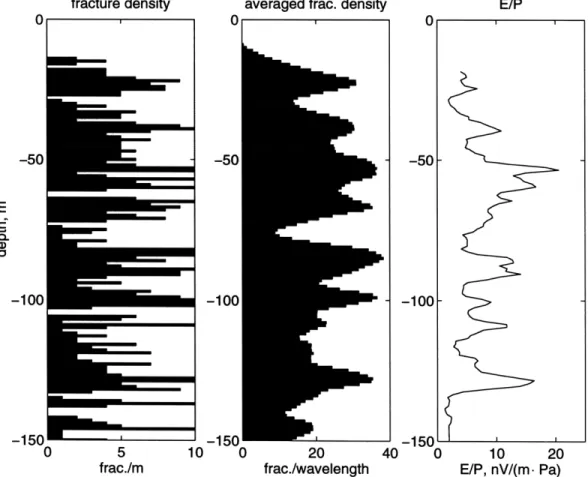
flow in fractures. The normalized amplitude of these electrical fields correlated with
the fracture density log.
In the second experiment, we measured Stoneley-wave-induced electrical fields
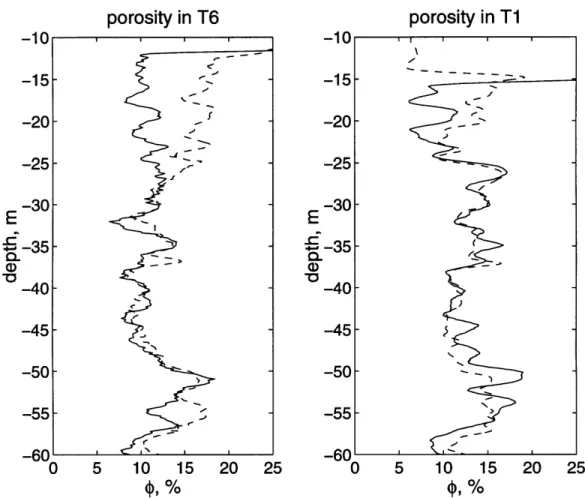
in several boreholes in vuggy dolomite. In dolomite, the normalized amplitude of
the Stoneley-wave-induced electrical field correlates with the porosity of the
forma-tion around the borehole. Further, the Stoneley-wave-induced electrical fields have
anomalously high amplitudes at an isolated fracture that intersected two boreholes.
To explain the experimental results, we developed a theoretical model for the
Stoneley-wave-induced electrical fields. According to the model, the normalized
am-plitude of the Stoneley-wave-induced electrical field is proportional to the porosity and
inversely proportional to the pore space tortuosity of a formation around a borehole.
Moreover, the amplitude-versus-frequency behavior of this electrical field depends on
the permeability of the formation.
To further test the theory's prediction, we measured electrical potentials induced
by the borehole Stoneley wave in the frequency range from 100Hz to 4kHz. The
normalized amplitudes of the Stoneley-wave-induced electrical potentials measured in
the field were consistent with the amplitudes predicted by the theory. Also, the
amp-litude-versus-frequency dependence of the electroseismic signals recorded at the depth
of the large fracture roughly followed the trend predicted by the theory. However, the
general amplitude-versus-frequency dependence of the electroseismic signals recorded
in the field is more complicated than that predicted by the theory.
The main contributions of this thesis are:
1. This thesis develops a borehole electroseismic measurement technique and
demonstrates that it works in the field. This technique can be used to make
electro-seismic logging measurements.
2. This thesis investigates an electrical field induced by a borehole Stoneley wave.
This electroseismic phenomenon is explained, measured in the field and modeled
theoretically.
3. This thesis derives from field data a parameter that describes local
electro-seismic coupling in a formation around a borehole. This parameter, the normalized
amplitude of the Stoneley-wave-induced electrical field, is defined as the ratio of an
electrical field amplitude to a pressure amplitude in the Stoneley wave at a certain
depth. This thesis demonstrates that the normalized amplitude of the
Stoneley-wa-ve-induced electrical field can be used to identify permeable fractures in situ.
4. This thesis uses field electroseismic measurements to quantitatively characterize
rock formations around a borehole. Using the theoretical model developed in this
thesis, a porosity log for fractured granite is derived from electroseismic field data.
Thesis supervisor: M. Nafi Toks6z
Title: Professor of Geophysics
Acknowledgment
This thesis is a result of efforts by many people and it is my pleasure to thank
them all for the help and encouragement that I received during my five years at MIT.
First of all, I would like to thank my thesis advisor, Professor M. Nafi Toks5z for his
support and guidance throughout my stay at MIT. The Earth Resources Laboratory,
established by Professor Toks6z, has been a tremendous resource for me. No matter
what technical or organizational problem I had, there always was someone within the
lab who could help me with it. Also, being associated with such a reputable scientist
as Professor Toks6z opened many doors and allowed me to collaborate with great
scientists in academia and the oil industry.
This thesis would have been impossible without the help of Mr. Peter Britton
of Hamilton, Massachusetts. I had the privilege to conduct field experiments at Mr.
Britton's beautiful property. Mr. Britton encouraged me in my quest to characterize
fractures, provided me with all the geophysical data on the site and always rescued
me with his tractor whenever my truck got stuck in snow. I would like to thank Mr.
Britton on behalf of all graduate students who have collected data for their thesis on
his property.
Dr. John Queen of CONOCO, Inc. has given me tremendous support in my
research. Together we worked on designing the measurement devices, making field
measurements, interpreting the data and convincing other people that what we see
is real. John and I became great friends and I hope to continue this friendship for
many more years.
Dr. Dan Burns has always been a source of inspiration and encouragement for
me. Dan helped me with the theoretical part of this thesis and with data analysis.
Dan never allowed me to give up and always reminded me that the ultimate goal of
one's life is to be happy.
At MIT, I had the privilege to meet and work with Professor Ted Madden. Ted
helped me with developing the measurement technique, with the field experiments
and processing the data. Ted also gave me great insights into the physics of the
electroseismic phenomena. Ted has always encouraged me and I am grateful to him
for that.
The foundation for the work described in this thesis was established with the help
of Dr. Randall Mackie. During my second year at MIT I worked very closely with
Randy on making electroseismic field measurements and on processing electroseismic
data. Randy's help was crucial in unmasking the electroseismic signals from beneath
the noise that was hundreds of times stronger than the signal.
The experiment in Belvidere, Illinois was made possible by Dr. Frederick Paillet
of USGS. Dr. Paillet supplied me with a great amount of supporting geophysical data
and helped me with the data interpretation. I also would like to thank the Region
V U.S. Environmental Protection Agency office in Chicago for providing funding for
the field work and for providing access to the site.
Professor Gene Simmons gave me a lot of help with the Hamilton experiment.
Professor Simmons provided geophysical data, gave great suggestions on how to
un-derstand the results of electroseismic experiments and was a source of moral support.
I also would like to thank Hager-Richter Geoscience for the help in data acquisition
and for acquiring geophysical logs for the Hamilton well.
This thesis was inspired by Dr. Matthijs Haartsen. Matthijs is a fascinating person
with many great ideas. Following Matthijs' footsteps as a Ph.D. student at ERL was
a great challenge for me. Early on I decided to make my thesis on electroseismic
phenomena as different from his as possible. However, I have to confess that as time
went by, I found myself reading his thesis more and more often.
I would like to thank Dr. Ernie Majer of Lawrence-Berkeley Laboratory and Dr.
Tom Plona of Schlumberger-Doll Research for providing me with the equipment for
the experiments.
I would like also to thank the following people for helping me with designing
the experiment, processing the signals and interpreting the electroseismic data: Dr.
Arthur Thompson of Exxon, Professor Gary Olhoeft of Colorado School of Mines, Dr.
Roger Turpening of MIT, Dr. Rama Rao of MIT, Dr. Zhenya Zhu of MIT, Mr. John
Beck of AMOCO, Dr. Ben Jeffryes of Schlumberger Cambridge Research, Professor
Richard Gibson of Texas A&M University, Dr. Keith Katahara of ARCO, Professor
Yves Bernabe of Institut de Physique de Globe, Mr. Sergei Osechinsky of Pacific
Scanning, Inc., and Dr. Valentine Mikhailov of the United Institute of Physics of the
Earth in Moscow.
I am also grateful to all my friends who helped me with field measurements: Mr.
Vitaly Granovsky, Mr. Ivan Djikaev, Ms. Jennifer Sigmund, Dr. Grigory Boubnov,
Dr. Svetlana Panasyuk, Dr. Dmitry Kroujiline, Mr. Alexander Zelikin, Dr. Viktor
Oancea, and Lt. Scott Carter (USAF). This thesis would have not been possible
without their help.
During the five years that I spent at ERL I have received great help and
encour-agements from Sue Turbak, Sara Brydges, Liz Henderson, Naida Buckingham and
Lori Weldon. They not only dealt with my manuscripts, purchase orders, letters and
etc, but also wiped my tears and shared my smiles. I really thank them for making
ERL a warm and friendly place.
I would like to thank my officemates Tony Sena, Francesca Scire-Scapuzzo, Hafiz
Alshammery, Kate Jesdale and Phil Reppert for their friendship. I would like to
especially thank Francesca for the great years that we were officemates. Francesca's
friendship is one of the most important things that I gained at MIT. I only wish is
that we stayed officemates longer. I want also to thank Kate Jesdale for making me
smile during the most difficult times.
My technical writing has been greatly improved with the help of Ms. Kate Jesdale,
Dr. Karen Muller, Mr. Chuck Doll, Dr. Shirley Rieven, Dr. Rob Reilinger, Dr.
William Rodi and Dr. Joe Matarese. I would like to thank Dr. Matthias Imhof, Dr.
Joe Matarese, Ms. Jane Maloof and Mr. Chuck Doll for helping me to tame wild
computers by which I am sometimes intimidated.
I would like to thank all my fellow students and visiting scientists at ERL for
all the things that we shared at MIT and for loading the heavy equipment into
the truck: Jon Kane, Franklin Ruiz, Bob Greaves, Tony Delilla, Maria Perez, Jie
Jang, Yulia Garipova, Mary Krasovec, Xiaojun Huang, Wei Chen, Feng Shen, Jesus
Sierra, David Cist, Bertram Nolte, Weiqun Shi, Matthias Imhof, Shirley Rieven, John
Sogade, Yervant Vichabian and John Olson.
Finally, I would like to thank my girlfriend Jennifer for all that she has endured
during the last two years of my Ph.D. program. Her love and support kept me sane
during the most crazy times. I always kept telling her that once I defend my thesis,
everything will become normal. Now the thesis has been defended but it does not
seem that craziness is subsiding. I am starting to wonder whether it had anything to
do with the thesis in the first place...
imomllmilllliiiili.
Contents
1 Introduction
13
1.1 The main goal of the thesis . . . . 13
1.2 Electroseismic phenomena and their possible applications . . . . 14 1.2.1 Electroseismic phenomena as a method for measuring streaming
potentials in situ . . . . 15
1.2.2 Electroseismic phenomena as a method for detecting seismic-wave-generated flow of pore fluid . . . . 18 1.3 Previous studies of electroseismic phenomena . . . . 21 1.4 Thesis outline and summary of results . . . . 26
2 Low-frequency measurements of electrical fields induced by borehole
Stoneley waves 34
2.1 Electroseismic phenomena caused by a borehole Stoneley wave . . . . 35
2.1.1 Electrical field induced by a Stoneley-wave-generated fluid flow in permeable formations . . . . 35
2.1.2 Electrical field and electromagnetic radiation generated by a Stoneley wave at an isolated fracture . . . . 37
2.2 Borehole electroseismic measurements in fractured igneous rocks . . . 38
2.2.1 Experimental site . . . . 39
2.2.2 Field experimental procedure . . . . 40
2.2.3 Noise reduction in the electrical data . . . . 41
2.2.4 Full-waveform electroseismic data . . . . 42
2.3 Analysis of the Stoneley-wave-induced electrical fields in fractured ig-neous rocks ... .. ... 44
2.3.1 Definition of the normalized amplitude of the Stoneley-wave-induced electrical fields . . . . 44
2.3.2 Analysis showing that the Stoneley-wave-induced electrical fields are caused by the fluid flow in fractures . . . . 46
2.3.3 Summary: using borehole electroseismic measurements to iden-tify fractured zones . . . . 48
2.4 Borehole electroseismic measurements in dolomite: general description of the experimental site . . . . 49
2.4.1 Permeable zones in the subsurface and estimates of their hy-draulic transmissivity . . . . 50
2.4.2 Porosity measurements . . . . 51
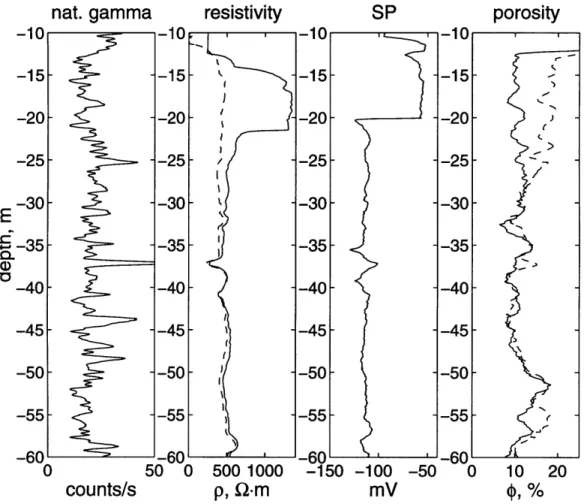
2.4.3 Borehole televiewer images of a fracture and vugs in dolomite 52 2.4.4 Gamma, resistivity and SP measurements . . . . 53
2.4.5 Correlation of the formation properties between different bore-holes . . . . 55
2.5 Borehole electroseismic measurements in dolomite: data and its inter-pretation . . . . 56
2.5.1 Field experimental procedure . . . . 56
2.5.2 Full-waveform electroseismic data . . . . 56
2.5.3
Borehole T6 . . . .
2.5.4
Borehole T7 . . . .
2.5.5
Borehole T2 . . . .
2.5.6
Borehole TI . . . .
2.5.7
Summary of the results of the dolomite experiment
2.6 Conclusions . . . .
3 Theoretical model for the Stoneley-wave-induced electrical field
3.1
Stoneley-wave-induced electrical field in a homogeneous, porous,
per-m eable forper-m ation . . . .
3.1.1
Pressure distribution in the borehole and in the formation around
the borehole created by the Stoneley wave . . . .
3.1.2
Streaming and conducting electrical currents induced by pore
fluid flow in the formation . . . .
3.1.3
The analytical solution for the amplitude of the electrical field
induced by the Stoneley wave . . . .
3.1.4
Comparison of the amplitudes predicted by the theoretical model
to the amplitudes measured in granite . . . .
3.1.5
Consistency of the theoretical model with the field
measure-m ents in dolomeasure-m ite . . . .
3.2
Determining porosity from the normalized amplitude of the
Stoneley-wave-induced electrical fields at low frequencies . . . .
3.2.1
Deriving a porosity log for granite from the electroseismic field
data ...
...
3.3
High amplitude anomaly at the isolated fracture in dolomite: the
tor-tuosity effect . . . .
. . . . . . 57. . . .
60
. . . .
61
. . . .
62
. . . .
64
. . . .
65
98
99
99
100
101
102
103
105
105
107
11111WININ __ IIIEUEIUUMII
3.4 Determining permeability from the amplitude-versus-frequency
behav-ior of the Stoneley-wave-induced electrical potential . . . .
109
3.4.1
Permeability dependence of the electroseismic coupling
coeffi-cient for the rock formation . . . .
110
3.4.2
Modification of electrical potential amplitude by the borehole
presence: a effect . . . .
113
3.5
Relationship between the amplitude of the Stoneley-wave-induced
elec-trical field and the lithology . . . .
115
3.6 Conclusion . . . .
117
4 Electroseismic logging: broadband measurements of the
Stoneley-wave-induced electrical potential
123
4.1
Introduction . . . .
123
4.2 Electroseismic logging technique . . . .
125
4.2.1
Stoneley wave source . . . .
125
4.2.2
Electrode configuration and the noise reduction processing . .
126
4.3 Field experim ent . . . .
128
4.3.1
Experimental site . . . .
128
4.3.2
Field experimental procedure . . . .
129
4.3.3
Full-waveform electroseismic data . . . .
131
4.4
Analysis of the Stoneley-wave-induced electrical potential . . . .
133
4.4.1
Deriving the normalized amplitudes of the
Stoneley-wave-indu-ced electrical potential at different frequencies from the field
data ...
...
134
4.4.2
Comparing the amplitude of the Stoneley-wave-induced
electri-cal potential with other geophysielectri-cal measurements . . . .
135
kvav = i 1101116 II 1 , 11 911 - - 11111
4.5 Comparison of the field data and theory: amplitude-versus-frequency
dependence of the Stoneley-wave-induced electrical potential . . . . .
136
4.5.1
Synthetic amplitude-versus-frequency curves for the
Stoneley-wave-induced electrical potential . . . .
136
4.5.2
Comparison between the synthetic curves and the field data .
137
4.6 D iscussion . . . .
138
4.7 Conclusion . . . .
140
5
Conclusions
158
5.1
Suggestions for future work . . . .
161
A Analysis of the electrical signals generated by the Stoneley wave's
action on the electrodes or on the borehole wall
174
A.1 Electrical signals due to the electrode motion induced by the Stoneley
w ave . . . .
175
A.2 Streaming potentials due to the fluid motion along the borehole wall .
176
A.3 Streaming potentials due to the fluid motion along the surface of the
electrodes . . . .
177
B Solution for the amplitude and phase of the Stoneley-wave-induced
electrical field
179
C Analysis of the mysterious electrical signal M-M
182
D Sensitivity functions of the 4 and 2-electrode measurements
186
D.1 Relationships between the amplitude of the electrical potential
oscilla-tion and the amplitudes of the signals measured using the 4-electrode
D.2 Relationships between the amplitude of the electrical potential
oscilla-tion and the amplitudes of the signals measured using the 2-electrode arrays . . . . 188
E Instrument response of the measuring devices 193
Chapter 1
Introduction
1.1
The main goal of the thesis
Detection and characterization of permeable zones in the subsurface is an important challenge for geophysical exploration. In this thesis we investigate a new method for detecting and characterizing permeable zones around a borehole. In our experiments, a Stoneley wave propagating in a borehole creates an oscillating pressure gradient in a rock formation around the borehole. If a formation is permeable, then this pressure gradient generates a flow of pore fluid. We detect this flow of pore fluid
by measuring the streaming electrical field that it induces 1. Thus, our method
utilizes electroseismic phenomena (i.e., electrical fields induced by seismic waves) to characterize rock formations around a borehole.
'Recently, a method for determining formation permeability from Stoneley wave attenuation has been developed (Winkler et al., 1989; Tang et al., 1991). In this method, a Stoneley-wave-generated fluid flow in a formation around a borehole is detected by measuring the attenuation of the Stoneley wave that is caused by the flow. Our electroseismic method uses a different physical phenomena to detect the Stoneley-wave-generated fluid flow.
1001011111mlhwa
Electroseismic phenomena in porous media are very complex. They involve pro-cesses on scales from 10-8m (the charged double layer in the vicinity of the pore surfaces) to 10 6m--10-3m
(sizes
of pores where fluid flow takes place) to 1m-102m (lengths of seismic waves that generate the fluid flow). To understand the electroseis-mic phenomena one has to study chemistry (to describe the adsorption of ions to thepore surfaces), thermodynamics (to determine the distribution of ions in the vicinity of the pore surfaces), fluid mechanics (to describe fluid flow on the pore scale) and poroelasticity theory (to understand how a seismic wave generates a pore fluid flow). This thesis does not intend to give a full description of all aspects of the electroseismic phenomena because each of them can be a subject of a separate monograph. This thesis intends to demonstrate the practical use of the electroseismic phenomena in geophysical exploration, given the present day understanding of what electroseismic phenomena are.
1.2
Electroseismic phenomena and their possible
applications
The simplest way to understand electroseismic phenomena is as follows. A seismic wave propagating in a porous medium generates a flow of pore fluid. In turn, this flow of pore fluid induces a streaming electrical field. Numerous monographs have been written on wave propagation in porous media and on streaming potentials induced
by fluid flows. Comprehensive reviews of these two subjects were written by Bourbie
et al. (1987) and Morgan (1989). Instead of replicating these reviews, we will describe
a few unique applications of electroseismic phenomena. These applications are feasible only because electroseismic phenomena combine streaming potentials and acoustics of porous media.
w1111111 ilhl 0l1,. i hIll M h
1.2.1
Electroseismic phenomena as a method for measuring
streaming potentials in situ
Fluid flow through porous rocks induces a streaming electrical field 2 because the pore fluid saturating the rocks carries an excess electrical charge. This electrical charge is accumulated in the pore fluid because surfaces of most minerals adsorb ions of a certain polarity from the pore fluid, leaving an excess of ions of the opposite polarity in the fluid (Bockris and Reddy, 1970). For example, in quartz-bearing rocks filled with water, rock surfaces adsorb negative ions, leaving an excess positive electrical charge in water. The excess electrical charge within the pore fluid is concentrated in a thin layer along the pore surfaces. Whenever a pressure gradient forces the pore fluid to flow through the rock, the fluid displacement along the pore surfaces moves this excess electrical charge, thus creating a streaming electrical current. This streaming
electrical current results in induction of an electrical field.
In the field, streaming potentials are traditionally used to detect large-scale flows such as water seepage through dams (Armbruster et al., 1989) or hydrothermal con-vection (Hashimoto and Tanaka, 1995). Wurmstich and Morgan (1994) proposed to use streaming potentials to monitor oil well pumping and hydro-fracturing. Mizu-tani et al. (1976) proposed to use streaming potentials induced by fluid flow in a fault zone as a means for earthquake prediction. None of these applications have been established yet. In oil exploration, streaming potentials are measured as a part of a Self-Potential log. Even though the Self-Potential logs can identify permeable zones, the contribution of streaming potentials to the Self-Potential signals is small (Desbrandes, 1985).
A number of theoretical and laboratory studies showed that streaming potentials 2We would like to emphasize here that the terms streaming electrical potentials and streaming
can be used to characterize porous rocks. Traditionally, the goal of these studies is
permeability estimation. Theoretical studies (e.g., Pride, 1994 and Bernabe, 1998)
related the streaming potential coupling coefficient (i.e., the ratio of the induced
electrical potential to the applied pressure gradient) to the pore geometry of a medium
and to salinity and conductivity of the pore fluid. The general consensus of the
theoretical models is that the DC streaming potential coupling coefficient does not
change with permeability, except for very tight rocks, where surface conductivity
effects become important. Sprunt et al. (1994) measured the streaming potential
coupling coefficient on a number of limestone samples and reported no variation of
the coupling coefficient with permeability. Jouniaux and Pozzi (1995) reported a
slight increase of the streaming potential coupling coefficient with permeability in
their sandstone and limestone samples. Jouniaux and Pozzi (1995) attributed their
results to a surface conductivity effect and used a simple theoretical model to validate
their conclusion.
Even though at low frequencies there is no direct relationship between the
stream-ing potential couplstream-ing coefficient and permeability, it is still possible to estimate
permeability using streaming potentials. The following three methods have been
proposed.
1. Chandler (1981) proposed to estimate permeability from the decay time of a
pore pressure pulse applied to a porous medium. In laboratory experiments he used
streaming potentials to observe time-varying fluid flow induced in a porous sample by
a pressure pulse. Chandler (1984a,b) patented a borehole apparatus for permeability
logging based on his method.
2. Po-zen Wong and colleagues (Pengra et al., 1995; Li et al., 1995) proposed
to determine permeability from measuring the conductivity, streaming potential
cou-pling coefficient and electro-osmosis coucou-pling coefficient of a porous medium.
I - I I, I 111111N_ _ - 0 01 I ,
osmosis, i.e., fluid flow generated in a porous medium by an applied electrical field,
is a reverse phenomenon of streaming potentials. Li et al. (1995) successfully deter-mined permeability for a number of rock samples from the combination of these three media parameters. Wong (1995) patented his method and a borehole apparatus for permeability measurements.
3. Pride's (1994) model predicts that the frequency behavior of the streaming
potential coupling coefficient depends on permeability. Reppert and Morgan (1998) measured the streaming potential coupling coefficient at different frequencies in a porous filter and a sandstone sample. Their results validate Pride's (1994) model. No borehole measurement technique that is used on Pride's (1994) model has been patented. It has not been clear how the frequency dependence of the streaming potential coupling coefficient can be measured in situ.
The studies referenced above demonstrate that streaming potential measurements can have important applications in oil exploration and environmental geophysics. However, all these methods were implemented only in the laboratory. Borehole meth-ods patented by Chandler (1984a,b) and Wong (1995) have not been implemented in the field because they are based on establishing a hydrodynamically sealed con-tact between an apparatus and a rock formation in a borehole. Unfortunately, rock surfaces in boreholes are rarely polished as nicely as surfaces of laboratory samples. Without establishing a hydrodynamically sealed contact, it is not possible to initiate fluid flow in a formation in a controlled manner. Thus, measurements of streaming potentials initiated by a controlled source have never been made in the field.
Electroseismic phenomena provide a method for measuring streaming potentials initiated by a controlled source. Thus, by using these phenomena it is possible to im-plement the methods proposed by Chandler (1984b), Wong (1995) and Pride (1994) in reality. In electroseismic experiments the amplitude of a seismic wave can be
- ---0- II N 19Iii
sured simultaneously with the amplitude of the streaming potential that it induces.
A combination of seismic and electrical measurements can be used to estimate the
streaming potential coupling coefficient in situ. Moreover, by varying the frequency of a seismic source, it is possible to estimate the frequency dependence of the stream-ing potential couplstream-ing coefficient. In turn, in situ measurements of the streamstream-ing
potential coupling coefficient can be used to characterize rock formations.
1.2.2
Electroseismic phenomena as a method for detecting
seismic-wave-generated flow of pore fluid
The general equations describing the acoustics of porous media were derived by Biot (1956a,b, 1962). 3 Biot's equations are based on the assumption that stresses and
strains in solid and fluid are linearly related (Biot, 1941; Biot and Willis, 1957) and the assumption that an oscillating force and an oscillating relative displacement be-tween solid and fluid are linearly related (Schmitt, 1986). ' Thus, in their general form (i.e., with complex, frequency-dependent moduli, permeability and tortuosity), Biot's equations are applicable to a variety of media. For a specific medium, moduli, per-meability and tortuosity depend on the geometry of the pore space. Pore-geometry-dependent moduli for specific examples of fluid-saturated media were derived by Kuster and Toks6z (1974) and O'Connel and Budiansky (1977). General expres-sions for frequency-dependent permeability and tortuosity were derived by Johnson
et al. (1987).
'For the sake of fairness, we need to mention that 12 years before Biot, Frenkel (1944) derived almost the same set of equations, except for one term - Frenkel (1944) did not consider inertial coupling between solid and fluid. Thus, Frenkel's (1944) equations are a special case of Biot's equations for a medium with a tortuosity of 1. Using his equations, Frenkel (1944) predicted the existence of two compressional waves and the attenuation of waves due to fluid flow. Biot was fully aware of Frenkel's results when he wrote his papers (Biot, 1956a,b).
4The latter linearity assumption is equivalent to Biot's postulate of quadratic kinetic energy and
The Biot theory describes pore fluid flow generated by seismic waves and the attenuation associated with it. The seismic-wave-generated fluid flows are very small and cannot be observed directly. However, it is possible to detect these fluid flows by measuring the streaming electrical field that they induce. Figure 1-1 shows a diagram of a streaming electrical field induced by a compressional wave. A compressional wave propagating in a fluid-saturated porous rock creates a pressure gradient that drives the fluid flow from the zone of compression to the zone of extension. If the pore fluid carries an excess positive electrical charge, then the flow results in accumulation of a positive electrical charge in the zone of extension and a negative electrical charge in the zone of compression. This charge separation induces an electrical field that travels with the compressional wave.
Figure 1-2 shows results of surface electroseismic measurements at a site near Walden Pond, Massachusetts. Figure 1-2 shows that electrical field oscillations are induced by both a P-wave and a surface wave. The first motion of the P-wave is compressional and the "first motion" of the electrical field is negative. This result is consistent with the diagram in Figure 1-1. This experiment is a simple illustration for the idea of detecting seismic-wave-generated fluid flows by measuring the streaming electrical field that it generates.
The Biot theory predicts a second compressional wave in the medium that is referred to as the Biot slow wave. This wave attenuates rapidly in the medium due to the large fluid-solid displacements that it induces (Biot, 1956a,b). Biot slow waves have been observed only in laboratory experiments on synthetic media (Plona, 1980) and have not been observed in the field. However, when a fast compressional wave crosses an interface between two media, it generates a flow of pore fluid across the interface. In turn, this flow generates a slow compressional wave. The theoretical analysis of Gurevich and Lopatnikov (1995) demonstrated that fast compressional waves can be significantly attenuated in finely layered porous media due to fluid flow
MWN MIN 1111111141111011101 WINIMON111
across interfaces. The theoretical results of Gurevich and Lopatnikov (1995) have not been supported by field data because it has not been possible to observe directly this
seismic-wave-generated fluid flow across interfaces in the subsurface.
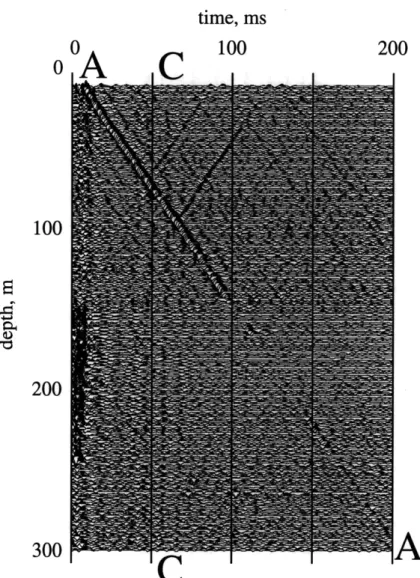
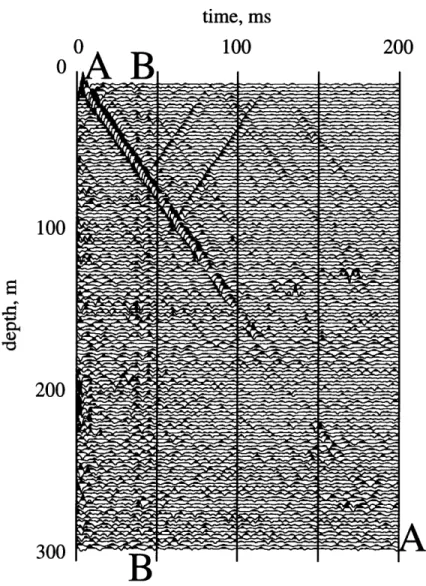
Electroseismic phenomena in porous media can be used to detect fluid flow across an interface at the time when a fast compressional wave crosses it. Figure 1-3 is an illustration of the phenomenon called electroseismic conversion. Electroseismic conversion is the generation of an an electromagnetic wave by a compressional wave crossing an interface between two media. If the medium above the interface has a soft frame and the medium below has a hard frame, then the compressional wave creates higher pore pressure in the medium above the interface than in the medium below. The difference in pore pressure across the interface drives fluid flow from the medium above the interface to the medium below. This flow results in accumulation of a positive electrical charge below the interface and of a negative electrical charge above. This charge separation across the interface generates an electromagnetic wave that can be recorded on the surface (Figure 1-3). Figure 1-4 shows results of an experiment where such electromagnetic waves were recorded in the field. Figure 1-4 demonstrates that electroseismic measurements allow detection of fluid flow across an interface at the time when a compressional wave crosses it. The details of this experiment and results of numerical simulations of the field data are described in a paper by Mikhailov, Haartsen and Toks6z (1997).
The two examples that we described in this section demonstrate that studying electroseismic phenomena can contribute to understanding Biot-type attenuation of seismic waves in homogeneous media and at interfaces. In turn, understanding the attenuation of seismic waves is important for seismic exploration.
1.3
Previous studies of electroseismic phenomena
Various applications for electroseismic phenomena have been envisioned a long time ago. However, these phenomena were investigated in a very small number of studies. Electroseismic phenomena in porous media were first detected in the field by Ivanov
(1939). Ivanov's (1939) experiments inspired Frenkel (1944) to develop the first
the-oretical model for electroseismic phenomena in porous media. The first laboratory observations of electroseismic phenomena in porous rocks were made by Antsyferov
(1958) 5.
Until very recently, theoretical, laboratory and experimental investigations of elec-troseismic phenomena were completely independent. The most progress has been achieved in theoretical modeling. Frenkel (1944), Neev and Yeatts (1989) and Pride (1994) proposed various sets of equations that described electroseismic phenomena. Pride's (1994) set of equations is the most complete of these three. Pride (1994) com-bined Biot's and Maxwell's equations and also derived frequency-dependent coupling coefficients that relate pore fluid flow with electrical current. Pride and Haartsen
(1996) have obtained plane-wave and point-source solutions for Pride's (1994)
equa-tions in a homogeneous medium. Pride and Haartsen (1996) predicted that in homo-geneous media slow and fast compressional waves induce electrical fields and shear waves induce magnetic fields. Haartsen and Pride (1997) incorporated the plane-wave solutions of Pride and Haartsen (1996) into a numerical algorithm and numerically simulated acoustic and electromagnetic waves generated in a layered medium by a point explosion source. Their numerical calculations simulated electroseismic conver-sion at mechanical and fluid salinity contrasts. Haartsen and Pride (1997) simulated
'In the literature on electroseismic phenomena, terms electroseismic and seismoelectric are used interchangeably. In Russian literature the convention is to refer to electrical fields induced by seismic waves as a seismoelectric phenomena and to seismic waves induced by electrical fields as
electroseismic phenomena. In order to add to the confusion, we refer to the electrical fields induced
by seismic waves as electroseismic phenomena, which is opposite to the Russian convention.
-_ - IIIU
both surface acquisition and VSP geometries. Haartsen et al. (1998) used Pride's (1994) model to investigate the sensitivity of the streaming electrical current induced
by compressional and shear waves to various media properties.
Laboratory experiments on electroseismic phenomena can be divided into two groups. Experiments in the first group investigated electrical fields induced in vibrat-ing porous samples (Antsyferov, 1958; Parkhomenko and Tsze-San, 1964; Chien-San and Zangirov, 1965; Antsyferov, 1966; Parkhomenko and Gaskarov, 1971; Gaskarov and Parkhomenko, 1974; Parkhomenko et al., 1975; Chernyak, 1975, 1976; Migunov and Kokorev, 1977; Simonyan, 1985; Parkhomenko et al., 1986; Simonyan, 1987; Mi-gunov et al., 1993; Mironov et al., 1993; Parkhomenko and Topchian, 1994; MiMi-gunov
et al., 1995). In this group of experiments the relationship between the electroseismic
amplitudes and various rock and fluid properties were investigated. We will summa-rize the most important conclusions that were made based on their results.
1. When water that saturates sandstone samples is frozen, no electroseismic
sig-nals can be detected (Gaskarov and Parkhomenko, 1974).
2. In general, the amplitude of electroseismic signals depends on the rock type. For example, it is higher in limestones than in sands (Gaskarov and Parkhomenko, 1974).
3. The amplitude of the electroseismic signals decreases with increasing salinity
of water saturating the samples (Parkhomenko and Gaskarov, 1971; Gaskarov and Parkhomenko, 1974; Simonyan, 1987).
4. In sandstone samples saturated with a mixture of water and kerosene, the am-plitude of electroseismic signals decreases with increasing kerosene content (Mironov
et al., 1993).
5. In partially saturated rocks, the amplitude of electroseismic signals first sharply
increases with saturation and then decreases (Parkhomenko and Tsze-San, 1964; Chien-San and Zangirov, 1965; Parkhomenko and Gaskarov, 1971; Gaskarov and Parkhomenko, 1974).
6. In partially saturated shaly sandstones with approximately the same porosity,
the amplitude of the electroseismic signals decreases with permeability (Parkhomenko
et al.,
1975). 67. The amplitude of the electroseismic signals increases with porosity (Migunov
and Kokorev, 1977).
All these results can be explained within the current models of electroseismic
coupling (e.g. Pride, 1994) and streaming potentials (e.g., Morgan et al., 1989). We summarized these laboratory results results to give an idea of the complexity of electroseismic phenomena and their interpretation.
In the second group of experiments, emphasis was placed on simulating field ac-quisition geometries. Zhu et al. (1994) recorded electrical signals induced by P-waves and Rayleigh waves in a porous sample. Haartsen et al. (1995) simulated surface ac-quisition geometry and recorded an electroseismic conversion at an interface. Results of these laboratory measurements were modeled using Haartsen's (1995) algorithm. Zhu and Toks6z (1996) simulated a VSP acquisition geometry. Zhu and Toks6z (1997) simulated borehole acquisition geometry and recorded electrical fields induced by bo-rehole Stoneley waves. One of the important results of the their experiments was that a Stoneley wave induced stronger electrical fields in permeable sand than in a non-permeable slate. Most recently, Zhu and Toks6z (1997, 1998) recorded
electro-6
Parkhomenko et al. (1975) made their measurements at the 80kHz frequency. Their result
does not contradict the fact that at zero frequency the streaming potential coupling coefficient is independent of permeability. Pride's (1994) model predicts that at high frequencies the streaming potential coupling coefficient decreases if permeability increases.
magnetic waves generated by a Stoneley wave at an interface between two media and at an isolated fracture intersected by a borehole. The experiments made by Dr. Zhu are indeed elegant. Dr. Zhu has simulated under controlled conditions all the elec-troseismic phenomena that have been observed in the field or predicted numerically. Unfortunately, the experimental results of Dr. Zhu cannot be used for a quantitative analysis because the experiments were made for illustrative purposes and amplitudes were not properly recorded.
Electroseismic phenomena were the least investigated in field experiments. The main reason is the difficulty of recording seismic-wave-induced electrical fields in situ.
A typical signal-to-noise ratio encountered in experiments with a sledgehammer is
1/200 (Mikhailov et al., 1997). Several reports of recording electroseismic signals in the field have been published (Ivanov, 1939, 1940; Neyshtadt and Osipov, 1959; Mart-ner and Sparks, 1959; Zablocki and Keller, 1961; Broding et al., 1963; Parkhomenko and Gaskarov, 1971; Tome, 1975; Skokan and Chi, 1990; Thompson and Gist, 1993; Butler et al., 1994, 1996; Wolfe et al., 1996; Mikhailov et al., 1997; Russel et al.,
1997). More than a half of these reports explained the origin of the measured
elec-troseismic signals (Neyshtadt and Osipov, 1959; Martner and Sparks, 1959; Broding
et al., 1963; Thompson and Gist, 1993; Butler et al., 1994, 1996; Wolfe et al., 1996;
Mikhailov et al., 1997; Russel et al., 1997). Thompson and Gist (1993) were the first to provide a theoretical model and an amplitude estimate for the electroseismic con-versions that they recorded. Mikhailov, Haartsen and Toks~z (1997) were the first to record electroseismic signals, explain their origin and compare field data with results of full waveform numerical modeling. Mikhailov et al. (1997) correctly modeled the arrival times, polarities and amplitude-versus-offset dependence of the electroseismic signals recorded in the field. The modeling was performed using Haartsen's (1995) algorithm based on Pride's (1994) model.
were aimed at recording electroseismic conversions at interfaces. Thompson (1990) patented a method for electroseismic prospecting by delineating interfaces at which electroseismic conversions take place. However, our experience with surface electro-seismic measurements convinced us that the use of electroelectro-seismic conversions in geo-physical exploration still faces some difficulties. The main reasons for our conclusion
are the following:
1. Electroseismic signals are extremely weak and it is problematic to measure
electroseismic conversions at interfaces that are deep. Thompson and Gist (1993) recorded signals from a depth of 300m. In the rest of the field experiments referenced above, the depths to the interfaces were less than 15m.
2. Pride's model incorporates a vast number of media parameters, including drained and undrained frame moduli, porosity, permeability, tortuosity of pore space, fluid conductivity, fluid salinity, etc. It is very problematic to constrain these param-eters of the subsurface from the surface. Thus, any inversion of electroseismic data runs into a problem of non-uniqueness.
These considerations convinced us to investigate electroseismic phenomena in boreholes. Our primary goal was to develop a real field method for characterizing porous rocks in situ. As always happens, we were not the first to come up with this idea.
Almost 60 years ago, Ivanov (1940) suggested using borehole electroseismic mea-surements to characterize rock formations in situ. Various ideas of borehole electro-seismic measurements have been patented since 1947 (Doll, 1947, 1949, 1951, 1957; Ivanov, 1961; Semmelink, 1971). However, none of these ideas have been implemented in reality. Parkhomenko and Gaskarov (1971) made the first and only borehole elec-troseismic measurements and reported higher amplitudes of elecelec-troseismic signals in limestones than in shales. However, Parkhomenko and Gaskarov (1971) did not
termine which seismic wave induced these electrical signals and did not clarify which parameters of the rock formation can be deduced from borehole electroseismic mea-surements. Haartsen (1995) simulated electroseismic surveys in VSP or reverse VSP geometries. However, Haartsen (1995) did not simulate any electroseismic phenom-ena generated by waves propagating in a borehole. In his VSP simulations Haartsen
(1995) recorded electrical fields at points along a vertical line in the subsurface and
did not simulate any waves propagating in a borehole.
1.4
Thesis outline and summary of results
In this thesis, borehole electroseismic phenomena are investigated experimentally and theoretically. The main emphasis of this thesis is to understand the electroseismic phenomena that are observed in the field.
In Chapter 2, we first explain how a Stoneley wave propagating along a borehole in a permeable formation induces an electrical field. Then, we describe a borehole electroseismic measurement technique and present results of field experiments in a borehole drilled through fractured granite and diorite at a site in Hamilton, Mas-sachusetts. In the field data we identify the electrical fields induced by the Stoneley wave. Analysis of the normalized amplitudes of these electrical fields shows that they were induced by the Stoneley-wave-generated fluid flow in fractures. The normalized amplitudes of the Stoneley-wave-induced electrical fields correlate with the fracture density log in granite.
Further in Chapter 2, we present measurements of the Stoneley-wave-induced electrical fields in four boreholes drilled through sedimentary rocks (dolomite) at a site in Belvidere, Illinois. In dolomite, the normalized amplitudes of the Stoneley-wave-induced electrical fields correlate with the porosity of a formation around a
borehole. Also, the Stoneley-wave-induced electrical fields have anomalously high
amplitudes at an isolated fracture that intersects two of the boreholes.
In Chapter 3, we develop a Biot-theory-based model for the Stoneley-wave-induced
electrical fields. The amplitudes of the electrical fields predicted by the theoretical
model agree with the amplitudes measured in the field. According to the
theoret-ical model, the normalized amplitude of the Stoneley-wave-induced electrtheoret-ical field
is proportional to the porosity of a formation around the borehole. This result is
consistent with the results of borehole electroseismic measurements in dolomite. We
use the theoretical model to derive a porosity log for the granite formation from the
electroseismic field data collected at the Hamilton site.
Further, according to the theoretical model, the normalized amplitude of the
Sto-neley-wave-induced electrical field is inversely proportional to the pore space
tortuos-ity of a formation around a borehole. We use this result to explain the anomalously
high amplitudes of the Stoneley-wave-induced electrical fields measured at the isolated
fracture in the dolomite. We attribute this high amplitude anomaly to the tortuosity
of the fracture being lower than the tortuosity of the pore space in the vuggy
do-lomite. Finally, the theoretical model predicts that the amplitude-versus-frequency
behavior of the Stoneley-wave-induced electrical field depends on the permeability of
the formation. The field data presented in Chapter 2 do not allow us to test this
theoretical result.
In Chapter 4, we investigate experimentally the amplitude-versus-frequency
be-havior of the electrical fields induced by Stoneley waves. We develop an experimental
technique that allows logging-type measurements of the Stoneley-wave-induced
elec-trical potentials. Using this technique, we make electroseismic measurements in the
borehole drilled through fractured igneous rocks. In our experiments we record
Stone-ley-wave-induced electrical potential in the frequency range from 300Hz to 4000Hz.
IMinnlinnomommonommunaluumlummuma
The normalized amplitude of the Stoneley-wave-induced electrical potential identifies
a large fracture intersected by the borehole.
By combining the data described in Chapter 4 with the data described in Chapter
2, we obtain the amplitude-versus-frequency dependence of the
Stoneley-wave-indu-ced electrical potentials in the frequency interval from 100Hz to 4000Hz. We compare
this amplitude-versus-frequency dependence with the predictions of the theoretical
model. From this comparison we find that the theoretical model predicts the
cor-rect magnitudes for the electrical potentials induced by the Stoneley wave. Also, the
amplitude-versus-frequency dependence of the electroseismic signals recorded at the
depth of the large fracture roughly follows the trend predicted by the theory.
How-ever, the general amplitude-versus-frequency dependence of the electroseismic signals
recorded in the field is more complicated than the one predicted by the theory. This
can be attributed to (a) imperfection of the measurement devices; (b) failure of the
theoretical model to correctly describe the phenomenon observed in the field; or (c)
presence of some other electroseismic phenomenon that we do not account for.
The main contributions of this thesis are:
1. This thesis develops a borehole electroseismic measurement technique and
demonstrates that it works in the field. This technique can be used to make
electro-seismic logging measurements.
2. This thesis investigates an electrical field induced by a borehole Stoneley wave.
This electroseismic phenomenon is explained, measured in the field and modeled
theoretically.
3. This thesis derives from field data a parameter that describes local
electro-seismic coupling in a formation around a borehole. This parameter, the normalized
amplitude of the Stoneley-wave-induced electrical field, is defined as the ratio of an
electrical field amplitude to a pressure amplitude in the Stoneley wave at a certain depth. This thesis demonstrates that the normalized amplitude of the Stoneley-wa-ve-induced electrical field can be used to identify permeable fractures.
4. This thesis uses field electroseismic measurements to quantitatively characterize rock formations around a borehole. Using the theoretical model developed in this thesis, a porosity log for fractured granite is derived from electroseismic field data.
compression
extension
porefluidflow
electrical field
+
Figure 1-1: Diagram of a streaming electrical field induced by a compressional wave.
A compressional wave propagating in a fluid-saturated porous rock creates a
pres-sure gradient that drives the fluid flow from the zone of compression to the zone of extension. If the pore fluid carries an excess positive electrical charge, then the flow results in accumulation of a positive electrical charge in the zone of extension and a negative electrical charge in the zone of compression. This charge separation induces an electrical field that travels with the compressional wave.
Field data: vertical displacement
geophone offset, ft
12 20 28 50 LOO 150Field data: horizontal E-field
antenna offset, ft 4 12 20 28 0 PT 100 150
Figure 1-2: Measurements of vertical displacements and horizontal electrical fields at
a site near Walden Pond, Massachusetts. The electrical data show that oscillations
of the electrical field are induced by both the P-wave and the surface wave. The first
motion of the P-wave is compressional and the "first motion" of the electrical field is
negative. This result is consistent with the diagram in Figure 1-1.
antenna
seiseismic source
seismic wave -- \
less stiff medium interface more stiff medium
-flow across the interface
Figure 1-3: Diagram of an electromagnetic wave generated by a compressional wave crossing an interface between two media. If the medium above the interface has a soft frame and the medium below has a hard frame, then the compressional wave creates higher pore pressure in the medium above the interface than the pore pressure in the medium below. The difference in pore pressure across the interface causes pore fluid to flow from the medium above the interface to the medium below. This flow results in accumulation of a positive electrical charge below the interface and of a negative electrical charge above. This charge separation across the interface generates an electromagnetic wave that can be recorded on the surface.
antenna offset, ft
2 6 10 14 18 22 0)50E
E
= 10 15 C) 4~) -) ( I ~-'j\
(
0 0a. The original data
Ay
A
<C ~
~
~<C <7 ~ P k
L
20 CD,E
E
4060
b. The interpretation
Figure 1-4: a) Electroseismic data collected at a site in Hamilton, Massachusetts. b)
the first 60 ms of these data. Event A-A is the electroseismic conversion at the top
soil-glacial till interface. Event C-C is, possibly, the electroseismic conversion at the
watertable. Dashed lines mark the onset of these signals.
IL
U
Chapter 2
Low-frequency measurements of
electrical fields induced by
borehole Stoneley waves
In this Chapter we describe an electroseismic phenomenon that is the primary focus of our investigation. This phenomenon is an electrical field induced by a borehole Stoneley wave. In permeable formations, this electrical field is induced by a Stoneley-wave-generated pore fluid flow.
This Chapter has two goals. The first goal is to demonstrate that this electroseis-mic phenomenon can be observed in the field. We describe a borehole electroseiselectroseis-mic measurement technique and present results of field experiments in fractured igneous rocks and sedimentary rocks (dolomite). In the field data we identify the electrical fields induced by the Stoneley wave. From the analysis of their normalized ampli-tudes, we conclude that these electrical fields were induced by a pore fluid flow in the formation around a borehole.
The second goal of this Chapter is to investigate how this electroseismic phe-nomenon can be used for characterizing fluid transport properties of a formation around the borehole. From our field data we derive a parameter that describes local electroseismic coupling at each depth. This parameter is the normalized amplitude of the Stoneley-wave-induced electrical field. We demonstrate that in the experiment in fractured granite, this normalized amplitude correlates with the fracture density log. In the experiments in dolomite, the normalized amplitude of the Stoneley-wave-in-duced electrical fields correlates with the porosity of a formation around a borehole. Also, the Stoneley-wave-induced electrical fields have anomalously high amplitudes at an isolated fracture that intersects two boreholes.
2.1
Electroseismic phenomena caused by a
bore-hole Stoneley wave
In this section we explain how a Stoneley wave induces an electrical field when prop-agating along a permeable formation. This electrical field moves along the borehole together with the Stoneley wave. When a Stoneley wave encounters an isolated frac-ture, it locally induces an electrical field and also generates an electromagnetic wave. This electromagnetic wave propagates in all directions with a velocity much higher than the velocities of seismic waves.
2.1.1
Electrical field induced by a Stoneley-wave-generated
fluid flow in permeable formations
A seismic wave propagating in a fluid-saturated permeable rock induces an electrical
electrical charge is accumulated in the pore fluid because surfaces of most minerals adsorb ions of a certain polarity from the pore fluid, leaving an excess of ions of the opposite polarity in the fluid. This excess electrical charge is concentrated in a thin layer of pore fluid along the pore surfaces (Morgan et al., 1989). For example, in quartz-bearing rocks filled with water, rock surfaces adsorb negative ions, leaving an excess positive electrical charge in water in the vicinity of rock surfaces. Whenever a pressure gradient, created by a seismic wave, forces the pore fluid to flow through the rock, the fluid displacement along the pore surfaces moves this excess electrical charge, thus creating a streaming electrical current. This streaming electrical current results in the induction of an electrical field.
Figure 2-1 is a diagram of an electrical field induced by a borehole Stoneley wave.
A Stoneley wave propagating in a borehole creates a pressure gradient in a formation
around the borehole. This pressure gradient drives the fluid flow from the zone of compression to the zone of extension. If the pore fluid carries a positive electrical charge (as in quartz-bearing rocks saturated with water), then the flow results in accumulation of a positive electrical charge in the zone of extension, and a negative electrical charge in the zone of compression. Thus, the Stoneley wave creates a capacitor-like electrical charge separation that moves along the borehole together with the wave. This charge separation induces an electrical field that also moves along the borehole together with the Stoneley wave.
We argue that the charge separation created by the Stoneley wave propagating along a homogeneous formation does not radiate electromagnetic waves. If the for-mation is homogeneous, then the charge separation and the electrical field created
by the Stoneley wave do not change in magnitude as the wave propagates along the
borehole. Thus, in a reference frame that moves along the borehole with the Stoneley wave velocity, the capacitor-like charge separation created by the Stoneley wave is stationary and constant. A stationary and constant charge separation does not