V. ATOMIC RESONANCE AND SCATTERING Academic and Research Staff
Prof. D. Kleppner Dr. T.W. Ducas* Dr. J.R. Rubbmark Prof. D.E. Pritchard Dr. M.B. Elbel Dr. J.A. Serri Dr. C.H. Becker Dr. R.A. Gottscho Dr. M.L. Zimmerman Dr. T.A. Brunner Dr. A. Morales-Mori Dr. W.H. Wing+
Graduate Students
S. Atlas M.M. Kash N. Smith
L.R. Brewer W.P. Lapatovich W.P. Spencer J.C. Castro A.L. Migdall A.G. Vaidyanathan
P.L. Gould P.E. Moskowitz R.E. Walkup R.G. Hulet W.P. Moskowitz G.R. Welch
T.P. Scott
1. STUDIES OF ROTATIONAL ENERGY TRANSFER
U.S. Air Force - Office of Scientific Research (Grant AFOSR-76-2972) Timothy A. Brunner, Susan L. Dexheimer, David E. Pritchard,
Thomas P. Scott, Neil Smith
The advent of gas lasers has caused considerable interest in energy-transfer mechanisms that would create or degrade a population inversion. In molecular gases,
rotational energy transfer (RET) is by far the most probable collision process, being typically 1-2 orders of magnitude more likely than vibrational transfer and 2-3 orders of magnitude more likely than electronic energy transfer.
We have measured nearly 500 thermally averaged rate constants, with typical experimental errors of 6-10%, for the process
Na*(j ) + X - Na2(+A) + X - AE, (1)
where the * indicates that the Na2 is in the A'Eu state, X is the target atom or molecule, ji is the initial rotational quantum number of the Na2 which is changed by an amount A in its collision with X, and AEr is the corresponding increase in
Assistant Professor at Wellesley College.
(V. ATOMIC RESONANCE AND SCATTERING)
rotational energy caused by such a collision.
These rate constants represent measurements over a variety of target gases (X = Xe, Kr, Ar, Ne, He, H2, N2, and CH4), a span of initial rotational quantum numbers that includes 97% of the Na2 molecules in our apparatus (ji = 4, 16, 26, 38, 66, and 100), and with IAI as large as 28.
With this data base, we have seen the limits of validity of our own statis-tical power gap (SPG) fitting law and found evidence to support the recently pro-posed energy-corrected sudden (ECS) scaling law.1 In a paper to be published, we quantitatively evaluate the various proposed fitting laws as applied to the pro-cess (1).2 The energy-corrected sudden approximation has so far provided the best
r) 0 X rr rr) 0 I LO rn E '© C-
t
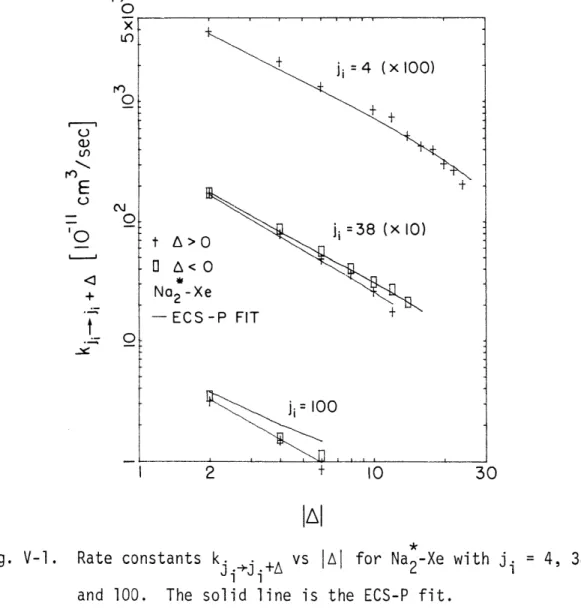
0 +__ O -o + 10 30Fig. V-l. Rate constants k. vs AI for Na2-Xe with i = 4, 38,
1 1id +A 2 i
and 100. The solid line is the ECS-P fit. PR No. 123 ji=4 (x100) t A> ji =38 (x10) No -Xe -ECS-P FIT + j = 100
(V. ATOMIC RESONANCE AND SCATTERING) fit to our data (typically 8-12% average error), and thus has motivated more de-tailed study. Figure V-I shows a typical ECS fit to our data where we have used a power law to generate the basis rate constants (ECS-P).
As a scaling law, ECS permits calculation of the entire matrix of level-to-level rate constants from a subset of this matrix. But to do so, ECS requires additional knowledge of a parameter c, which is interpreted as an effective length over which the collision takes place. No theory predicts the value of kc;
IC
01
C 2.4 3.2
Vr
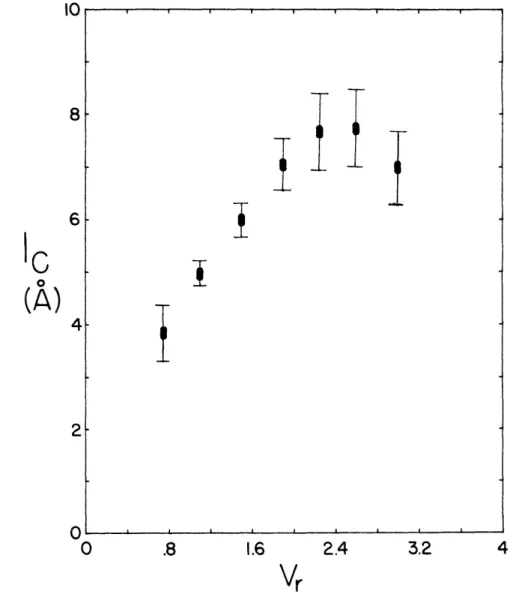
Fig. V-2. Relative velocity dependence of the k of best fit for Na2-Xe with ji = 16, 38, and 66. c
I
I I I I 1
i i I(V. ATOMIC RESONANCE AND SCATTERING)
it must be determined by best fit to experimental data. Analysis with our previ-ously mentioned data base yields a thermally averaged value of c. Using, however, our previously developed technique of velocity selection by Doppler shift (VSDS), we have measured the velocity dependence of some level-to-level rates, and hence measured the velocity dependence of the Zc of best fit to our data3 (see Fig. V-2).
In brief, the VSDS technique consists of measuring the rate constants as a function of laser detuning from the center of the parent line's Doppler profile. This detuning causes the relative velocity distribution to vary in a known way,
enabling deconvolution of our data to yield rate constants as a function of rela-tive velocity. Although surpassed in resolution by molecular-beam techniques, VSDS exceeds molecular beams in sensitivity and dynamic range of accessible
rela-tive kinetic energies, as well as in experimental simplicity. References
1. T.A. Brunner, N. Smith, and D.E. Pritchard, J. Chem. Phys. 71, 358 (1980). 2. T.A. Brunner, N. Smith, A.W. Karp, and D.E. Pritchard, to appear in J. Chem.
Phys. (tentative date: March 1981).
3. N. Smith, T.A. Brunner, and D.E. Pritchard, J. Chem. Phys. 71, 467 (1980).
2. LEVEL-TO-LEVEL INELASTIC DIFFERENTIAL CROSS SECTIONS BY DOPPLER VELOCITY ANALYSIS
National Science Foundation (Grant CHE79-02967)
Christopher H. Becker, Matthias B. Elbel, James L. Kinsey, John A. Serri, Warren P. Moskowitz, David E. Pritchard
We have measured level-to-level differential cross sections for vibrationally and rotationally inelastic collisions of the ground electronic state Na2 with Ar.
This study1 of the process
Na2(v=O, ji= 7) + Ar Na2(v=l, jf=ji+AJ) + Ar
complements our previous measurements2 of vibrationally elastic cross sections PR No. 123
(V. ATOMIC RESONANCE AND SCATTERING) in the same system. Cross sections from both of these studies display a charac-teristic peak whose position depends only on Aj.
These measurements have been made in a crossed-supersonic-beams apparatus using two single-mode tunable dye lasers. One laser (called the pump), incident on the Na2 beam upstream of the collision region, tags the initial level by opti-cal depopulation. The second laser (opti-called the analysis laser), incident on the collision region along the relative velocity vector, excites those molecules which have been scattered into the desired final level and have been Doppler-shifted into resonance by scattering through center-of-mass angle 0. Fluorescence from these molecules is detected by a photomultiplier and stored in a computer. The computer chops the pump laser and Ar target beam while scanning the analysis laser through the %2.5-GHz Doppler profile. A two-way phase detection at the pump and target-chopping frequencies yields a level-to-level cross section versus cos 8. Comparisons of our data with predictions of classical, hard ellipsoid scat-tering have provided good qualitative agreement and useful insight. For instance, the decrease in the magnitude of the Av = 1 cross sections relative to those with Av = 0 appears to result from simple dynamic considerations which are independent of the details of the interaction potential.
Work is currently under way to measure cross sections for rotationally ine-lastic collisions in high vibrational levels:
Na2(v=37, j i=7) + Ar - Na2(v=37, jf =ji+Aj) + Ar.
This study should increase our understanding of the effect of vibrational excita-tions on these scattering processes.
Future plans include scattering at different collision energies, and imple-mentation of our newly developed PADDS technique3 which involves alignment of the analysis laser perpendicular to the relative velocity vector to enhance the
angu-lar resolution at small scattering angles. References
1. J.A. Serri, C.H. Becker, M.B. Elbel, J.L. Kinsey, A. Morales, W.P. Moskowitz, and D.E. Pritchard, to appear in J. Chem. Phys. (March 1981).
2. J.A. Serri, A. Morales, W.P. Moskowitz, D.E. Pritchard, C.H. Becker, and J.L. Kinsey, J. Chem. Phys. 72, 6304 (1980).
(V. ATOMIC RESONANCE AND SCATTERING)
3. J.A. Serri, J.L. Kinsey, and D.E. Pritchard, submitted to J. Chem. Phys.
3. SPECTROSCOPY OF WEAKLY BOUND MOLECULES
National Science Foundation (Grant PHY79-09743)
Richard A. Gottscho, Walter P. Lapatovich, Philip E. Moskowitz, David E. Pritchard
The van der Waals spectroscopy experiments have yielded accurate molecular constants for NaNe and NaAr weakly bound molecular systems. These molecules have been found to be bound by a mere 8 and 35 wavenumbers, respectively, in their ground states, and are among the weakest bound diatomic systems known. Utilizing supersonic molecular-beam technology, coupled with a 150-GHz scannable dye laser, experimental output has consisted of hundreds of spectral lines, analyzed using standard spectroscopic pattern-recognition techniques. Details of the NaNe spec-tral analysis, as well as experimental procedure, have recently been published.1 Further analysis of NaNe involving sophisticated computer fitting to spectra and model potential calculations revealed unusual angular momentum transitions (Hund's case 'a' to 'c') at large internuclear distance, and perturbations due to the close relative magnitudes of the vibrational and rotational spacings and spin-orbit
interaction energy. Experimental access to this most interesting region of the potential is unique to this class of systems. A full description of this analysis in NaNe is soon to be published.2
References 1. W. Lapatovich et al., J. Chem. Phys.
2. R. Gottscho, W. Lapatovich, P. Moskowitz, and D.E. Pritchard, submitted to J. Chem. Phys.
(V. ATOMIC RESONANCE AND SCATTERING) 4. COLLISIONAL LINE-BROADENING STUDIES
National Science Foundation (Grant PHY79-09743)
Joint Services Electronics Program (Contracts DAAG29-78-C-0020 and DAAG29-80-C-0104) Alan L. Migdall, Robert E. Walkup, David E. Pritchard
Several projects are in progress that fall into the general category of col-lisional line broadening. These include detailed experimental study of the Na D lines perturbed by collisions with rare-gas atoms, theoretical investigations of collision-induced line shapes, and an experimental investigation of laser-induced collisional energy transfer.
Careful probing of the Na D lines perturbed by ragas collisions has re-vealed a number of interesting phenomena. Velocity-scrambling collisions combine with diffusion-limited transport to produce efficient optical pumping of the ground-state hyperfine levels of Na,1 even for very weak pumping fields (small laser intensity). Laser measurements of the collision-broadened line shape have yielded accurate values for collision broadening rates2 and have demonstrated for
the first time the effects of a finite collision duration on the line shape.3 Instantaneous collisions produce Lorentzian line shapes but real collisions have a characteristic duration Td and real line shapes deviate from Lorentzian. Near resonance, the correction is of order ATd where A is the detuning from resonance. A theoretical description (currently in preparation) of line broadening from a dressed atom picture reproduces this correction.
Experimental investigations of laser-induced energy transfer (or equivalently, collision-induced absorption) are being carried out on Na-H2. A type of resonance-enhanced Raman effect was investigated: Na(3P) + H2(J) -+ Na(3S) + H2(J') + hw. This process was not detectable due to the competing process of far-wing line broadening: Na(3P) + H2(J) - Na(3S) + H2(J) + hw. Similar processes are under investigation which should be relatively free from the far-wing background.
References
1. R.E. Walkup, A. Spielfiedel, W.D. Phillips, and D.E. Pritchard, to appear in Phys. Rev. A (1981).
(V. ATOMIC RESONANCE AND SCATTERING) 2. R.E. Walkup, A. Spielfiedel, D. Ely,
appear in J. Phys. B (1981).
3. R.E. Walkup, A. Spielfiedel, and D.E. (1980).
W.D. Phillips, and D.E. Pritchard, to Pritchard, Phys. Rev. Lett. 45, 986