Publisher’s version / Version de l'éditeur:
Vous avez des questions? Nous pouvons vous aider. Pour communiquer directement avec un auteur, consultez la première page de la revue dans laquelle son article a été publié afin de trouver ses coordonnées. Si vous n’arrivez pas à les repérer, communiquez avec nous à [email protected].
Questions? Contact the NRC Publications Archive team at
[email protected]. If you wish to email the authors directly, please see the first page of the publication for their contact information.
https://publications-cnrc.canada.ca/fra/droits
L’accès à ce site Web et l’utilisation de son contenu sont assujettis aux conditions présentées dans le site LISEZ CES CONDITIONS ATTENTIVEMENT AVANT D’UTILISER CE SITE WEB.
Research Report (National Research Council of Canada. Institute for Research in Construction), 2009-11-04
READ THESE TERMS AND CONDITIONS CAREFULLY BEFORE USING THIS WEBSITE.
https://nrc-publications.canada.ca/eng/copyright
NRC Publications Archive Record / Notice des Archives des publications du CNRC :
https://nrc-publications.canada.ca/eng/view/object/?id=03981c11-62b3-4e66-84cd-bcbdeec7d90c https://publications-cnrc.canada.ca/fra/voir/objet/?id=03981c11-62b3-4e66-84cd-bcbdeec7d90c
NRC Publications Archive
Archives des publications du CNRC
For the publisher’s version, please access the DOI link below./ Pour consulter la version de l’éditeur, utilisez le lien DOI ci-dessous.
https://doi.org/10.4224/20374881
Access and use of this website and the material on it are subject to the Terms and Conditions set forth at
A hybrid fire-resistance test method for steel columns
http://www.nrc-cnrc.gc.ca/irc
A H ybrid Fire -Re sist a nc e T e st M e t hod for St e e l Colum ns
I R C - R R - 2 9 2
M o s t a f a e i , H . ; H u m , J . K .
N o v e m b e r 2 0 0 9
The material in this document is covered by the provisions of the Copyright Act, by Canadian laws, policies, regulations and international agreements. Such provisions serve to identify the information source and, in specific instances, to prohibit reproduction of materials without written permission. For more information visit http://laws.justice.gc.ca/en/showtdm/cs/C-42
Les renseignements dans ce document sont protégés par la Loi sur le droit d'auteur, par les lois, les politiques et les règlements du Canada et des accords internationaux. Ces dispositions permettent d'identifier la source de l'information et, dans certains cas, d'interdire la copie de documents sans permission écrite. Pour obtenir de plus amples renseignements : http://lois.justice.gc.ca/fr/showtdm/cs/C-42
1
NRC-CNRC
A Hybrid Fire-Resistance Test Method for Steel Columns
By H. Mostafaei, and J.K. Hum
Research Report No. 292
2
ABSTRACT
This paper describes a simple hybrid approach for estimating fire-resistance of steel columns within a building frame. This approach includes the effects of the structural system and thermal expansion phenomenon. In this technique, a steel column is tested in fire in a furnace while the structural system is modeled using computer software. Response of the steel column from the fire test and response of the structural system from the analysis are coupled according to the compatibility and equilibrium condition using a sub-structuring method. A real time interaction is implemented between the structural system response and the steel column response. Two analytical approaches are described in this report for evaluation of the structural system response; a simplified method and a full-structural analysis. In the first method, the entire frame is simplified into a single equivalent spring coupled with the column. The spring is an analytical model which is defined in the form of a load-displacement curve. The column specimen is then exposed to fire using a column furnace test facility and loaded according to the obtained load-displacement curve. The second method uses structural analysis software to determine the load-displacement relation. More efforts were extended to the simplified method in this study, since it is more applicable for practice. Frames with differing numbers of stories and heights were selected for the analysis. A comparison was undertaken between the results of the simplified method and that of the full-analysis approach resulting in a consistent agreement. This research report provides the theoretical concept and formulation of the simple hybrid test approach. Before application in practice, the model should be verified through a future experimental program.
3
TABLE OF CONTENTS
Contents
ABSTRACT ... 2 TABLE OF CONTENTS ... 3 LIST OF FIGURES ... 4 LIST OF TABLES ... 5 1. INTRODUCTION ... 6 2. TEST METHODOLOGY ... 63. MODELING STRUCTURAL SYSTEM STIFFNESS ... 9
3.1. Full Structural Analysis Method ... 9
3.2. The Simplified Method ... 10
3.2.1 Beam Connections Rigidity Factor ... 11
3.2.2 Lateral Rigidity Factor ... 12
4. APPLICATION AND EXAMPLES ... 13
4.1 Results of analysis and model verification ... 14
4.2 An example with calculation details. ... 20
5. CONCLUSIONS ... 25
6. ACKNOWLEDGEMENT ... 25
7. REFERENCES ... 25
Appendix:Plots ... 26
4
LIST OF FIGURES
Figure 1 A hybrid testing technique for assessment of fire resistance of columns
considering the restraint conditions from the structural system. ... 7
Figure 2 A simple performance based test technique for fire resistance of columns considering the restraint conditions from the structural system. ... 8
Figure 3 Process of determining vertical stiffness of the structural system K by the Full-Analysis method. ... 9
Figure 4 P-Δ curve obtained by implementing a full analysis using the SAFI software. 10 Figure 5 Factor α for fixed, variable and cantilever beams. ... 11
Figure 6 Roughly symmetric deformation and rotation in connections in frames when a middle column is selected for the test. ... 13
Figure 7(a) Details of columns and beams for frame U1. ... 15
Figure 7(b) Details of columns and beams for frame U2. ... 16
Figure 7(c) Details of columns and beams for frame U3. ... 17
Figure 7(d) Details of columns and beams for frame U4. ... 18
Figure 7(e) Details of columns and beams for frame U5. ... 18
Figure 7(f) Details of columns and beams for frame U6. ... 19
Figure 8 Details of the cross-section for beams. ... 21
Figure 9(a) Load-Deformation (P-Δ) curve for prototype U1a. ... 26
Figure 9(b) Load-Deformation (P-Δ) curve for prototype U1b. ... 26
Figure 9(c) Load-Deformation (P-Δ) curve for prototype U1c. ... 27
Figure 10(a) Load-Deformation (P-Δ) curve for prototype U2a. ... 27
Figure 10(b) Load-Deformation (P-Δ) curve for prototype U2b. ... 28
Figure 10(c) Load-Deformation (P-Δ) curve for prototype U2c. ... 28
Figure 10(d) Load-Deformation (P-Δ) curve for prototype U2d. ... 29
Figure 11(a) Load-Deformation (P-Δ) curve for prototype U3a. ... 29
Figure 11(b) Load-Deformation (P-Δ) curve for prototype U3b. ... 30
Figure 11(c) Load-Deformation (P-Δ) curve for prototype U3c. ... 30
Figure 11(d) Load-Deformation (P-Δ) curve for prototype U3d. ... 31
Figure 11(e) Load-Deformation (P-Δ) curve for prototype U3e. ... 31
Figure 12(a) Load-Deformation (P-Δ) curve for prototype U4a. ... 32
Figure 12(b). Load-Deformation (P-Δ) curve for prototype U4b ... 32
Figure 12(c) Load-Deformation (P-Δ) curve for prototype U4c. ... 33
Figure 13(a) Load-Deformation (P-Δ) curve for prototype U5a. ... 33
Figure 13(b) Load-Deformation (P-Δ) curve for prototype U5b. ... 34
Figure 13(c) Load-Deformation (P-Δ) curve for prototype U5c. ... 34
Figure 13(d) Load-Deformation (P-Δ) curve for prototype U5d. ... 35
Figure 14(a) Load-Deformation (P-Δ) curve for prototype U6a. ... 35
Figure 14(b) Load-Deformation (P-Δ) curve for prototype U6b. ... 36
Figure 14(c) Load-Deformation (P-Δ) curve for prototype U6c. ... 36
Figure 14(d) Load-Deformation (P-Δ) curve for prototype U6d. ... 37
Figure 14(e) Load-Deformation (P-Δ) curve for prototype U6e ... 37
5
LIST OF TABLES
Table 1 Details of frame prototypes... 14 Table 2 Details of Steel. ... 15
6
1. INTRODUCTION
Fire safety design of buildings based on their performance requires assessment and testing of structural elements including the structural system response. The traditional single-element-based fire resistance assessment method needs to be upgraded to a multi-element-based method to include fire performance of the entire structure system. This research report explores a new, simple, experimental technique to test the fire resistance of a steel column with consideration of the effects from the structural systems. Components of interaction between a steel column and the surrounding structure include the column’s end deformations and loads. A similar approach was developed previously for fire resistance testing of reinforced concrete columns (Mostafaei and Mannarino 2009). This report describes a similar method applied to the fire resistance testing of steel columns.
2. TEST METHODOLOGY
Figure 1 illustrates the main tools employed in applying the new test technique. It includes computer software, or a simplified calculation, and a structural furnace test facility; in this case it is the column furnace facility at the National Research Council (NRC). The analytical tools model the entire structure to determine the restraint conditions of the column specimen. The column specimen is assumed to be the critical column in the structure for the worst case fire scenario.
The column specimen’s boundary conditions are the column axial load, and lateral loads at the support. These components are varied during the test according to the state of the analytical models. The analytical models are the load-deformation relations obtained from the analysis of the entire structure.
The axial and lateral load-deformation curves are determined according to the axial and lateral thermal expansion of the structure. For this study, only the axial load-deformation relation is determined by the analytical process. Therefore, the column is fire tested under variable axial load. The value of the axial load is determined according to the frame stiffness calculated by the analysis. This process can be implemented in real time to feed back the test results into the analysis with the new mechanical properties of the column obtained from the test.
7
For the analytical tool in Figure 1, there are two methods that can be explored for the hybrid test: a full structural analysis method using computer software or a simplified method using a hand calculation. The simplified method is relatively easier and more practical for this application. This is an approach through which the resistant condition of the column support, the axial load-deformation curve, is determined by a simple calculation process.
Figure 1 A hybrid testing technique for assessment of fire resistance of columns considering the restraint conditions from the structural system.
Figure 2 illustrates the hybrid test technique for testing of the right corner column of the first floor of a 3-bay, 3-story frame. The main contribution from the frame in this method is the frame vertical stiffness in the direction of the test column’s axial thermal expansion. When the test column is exposed to fire, it elongates vertically due to thermal expansion which results in vertical displacement of the column. A future expansion of this method is to include the horizontal component of thermal expansion as an extra horizontal spring model on the column.
When the column is at the ambient temperature, typically it is only under the initial axial load Po due to the gravity load. In order to include the effect of frame restraint, an additional deformation-dependent load (kΔ) is added to the initial load Po using Equation (1).
8
P=KΔ+ Po (1) where ∆ is column axial deformation during the fire test; K is the vertical stiffness of the frame at the column’s support and Po is the initial applied axial load. The test can be implemented with either load or displacement control using Equation (1).
Δ = Column deformation during the test
P=KΔ+ Po K Δ Δ Test Column Column in Furnace
Figure 2 A simple performance based test technique for fire resistance of columns considering the restraint conditions from the structural system.
9
3. MODELING STRUCTURAL SYSTEM STIFFNESS
Figure 3 Process of determining vertical stiffness of the structural system K by the Full-Analysis method.
Figure 3 illustrates a three story frame when it is detached from the test column. It shows the interaction components of load, P, and deformation, Δ, between the frame and the test column and the vertical load-deformation, P-Δ, relation. The P-Δ curve is the main result obtained from the analysis which will be employed later to control the load/deformation of the test column during the test.
3.1. Full Structural Analysis Method
This is the full approach through which the entire structure frame is simulated and modeled using a structural analysis program. In this study, the SAFIR computer program, developed at the University of Liege for the simulation of the behavior of building structures subjected to fire, (Franssen, 2007) was used for the analysis.
As an example, the full analysis method was applied using the SAFIR program for a three story frame, frame U1, with material properties provided in Table 1 and Table 2. The results are illustrated in Figure 4. The P-Δ curve was obtained by simulating the entire frame and exposing only the test column to the ASTM E119 temperature-time curve.
Δ P
Beams resisting to vertical deformation Δ and
contributing in the stiffness K
Δ P
K
10
Although the P-Δ curve is nonlinear at the large deformations, in most cases, the axial deformation of the test column would not exceed the linear part of the P-Δ curve. Therefore stiffness K may be considered constant for the duration of the test. This provides more stability and makes the load control process of the test easier. If the axial deformation exceeds the linear stage of the curve then the nonlinear relation for K is used.
The full analysis method is applicable for the case when the analysis program is capable of simulating the response of structures in fire. However, if such a program is not available, the designer may employ any structural analysis software used for ambient temperature by removing the test column, then applying vertical deformation ∆ at the disconnected point and measuring the load reaction P to determine K as illustrated in Figure 3. 0 20 40 60 80 100 120 140 160 180 200 0 0.005 0.01 0.015 0.02 0.025 P (kN) Δ (m) K
Figure 4 P-Δ curve obtained by implementing a full analysis using the SAFI software.
3.2. The Simplified Method
An attempt was made to develop a simple analytical process to determine the structure vertical stiffness K implemented in hand calculation. In this method, K is determined according to Equation (2), derived for a beam with flexible supports.
∑ . (2)
11
where n is the number of beams that are resisting against vertical movement of the test
column. In Figure 3, three beams are resisting vertical movement and are accordingly deformed. Therefore, n = 3 for a corner test column, but in case of the middle test
columns, in the same figure, n = 6; E, I, and L are Modulus of Elasticity, Moment of
Inertia, and Length of the beam; i is an index number identifying a particular beam; and
α, the Beam Connections Rigidity Factor, is between 0 and 1, which is determined based on the rigidity ratio of beam connections, as described in the next section. Derivation of Eq. (2) is provided in the Appendix A.
3.2.1 Beam Connections Rigidity Factor
The rigidity of the beam connections is included in Equation (2) using factor α. Figure 5 illustrates values of α for different beam support conditions.
Figure 5 Factor α for fixed, variable and cantilever beams. In general factor α could be determined by Equation (3).
(3) where E, I, and L are components of the beam i and Ka and Kb are the beam’s end
support rigidities to rotation determined by Equation (4).
∑ ∑ (4)
where E, I, and L are determined for the beams and columns connected to beam i in
Equation (2), except the beam i. ma and mb are total number of beams and columns
connected to beam i at a and b respectively. Lateral Rigidity Factor, , of the beams
and columns in Equation (4) is between 1 to 4 based on beam or column rigidity against lateral movement.
α = 0
12
3.2.2 Lateral Rigidity Factor
For all beams, the lateral rigidity factor can be determined based on the axial rigidity of the columns in the frame, which is comparatively high for typical building structures. In low to moderate rise frames, a between 3.0 and 3.5 would be reasonable. This also applies to columns in a braced frame where lateral movements are limited by the bracing system. In this study, a value of . is considered for lateral rigidity of the beams. For columns in moment-resisting frames, is relatively more variable and determined according to Equation (5).
(5) where E, I, and L are calculated for the column and:
∑
∑
(6)
where Ks is the lateral rigidity for column s; E, I, and L are components for column j in
floor i; n is number of floors in and underneath of column s and m is number of columns
in floor i.
For simplicity, one may consider all the columns to be similar in equations (5) and (6), resulting in:
(7) For test column in Figure 2, n = 1 and m = 4, therefore, = 3.4.
13
Test Column
Figure 6 Roughly symmetric deformation and rotation in connections in frames when a middle column is selected for the test.
Equation (6) applies when all connections are rigid for rotation. In the case of a middle test column where there is more likelihood of symmetric frame deformations, as shown in Figure 6, this equation may be applicable. However, for a corner test column, due to asymmetric deformations (see Figure 4), connections are also rotating according to the beams stiffness. Based on the analysis implemented for different frames in this study, when a corner column is selected as the test column, is considered as 55% of the values determined by Equation (5). This value may be reduced for frames with higher number of floors, but for the group of frames in this study such a value seems reasonable. Further study is needed on this.
4. APPLICATION AND EXAMPLES
Six steel frame prototypes with different heights have been selected for this study. The analysis was implemented for both corner and middle test column cases. Beam and column details are provided in Table 1 and Table 2. Dimensions of the frames are provided in figures 7(a) to 7(f). The frame sections and dimensions were selected according to typical steel building frames seen in the North America.
14
4.1 Results of analysis and model verification
Both the full analysis method using the SAFIR program and the simplified method were implemented to determine the vertical frame stiffness corresponding to test columns of the frame prototypes. The results were illustrated and compared in figures 9 to 14. The comparison and correlation between the results of the two approaches indicate that the simplified method provides relatively acceptable values for the frame equivalent vertical load, P, deformation, Δ, and stiffness K.
In the next section, the detailed analytical process of the simplified method is provided for one of the frame prototype.
Table 1 Details of frame prototypes.
Frame Number of
Stories Test Column
Column Serial Size (mm) Column Length (mm) Beam Serial Size (mm) Beam Length (mm)
U1a 3 1st floor, corner W360x370 (147.3) 3800 W610x180 (81.9) 7000 U1b 3 1st floor, middle W360x370 (147.3) 3800 W610x180 (81.9) 7000 U1c 3 2nd floor, middle W360x370 (147.3) 3800 W610x180 (81.9) 7000 U2a 6 1st floor, corner W360x370 (196.4) 3800 W610x230 (113.1) 7000 U2b 6 1st floor, middle W360x370 (196.4) 3800 W610x230 (113.1) 7000 U2c 6 2nd floor, middle W360x370 (196.4) 3800 W610x230 (113.1) 7000 U2d 6 5th floor, middle W360x370 (196.4) 3800 W610x230 (113.1) 7000 U3a 10 1st floor, corner W360x410 (236.6) 3800 W760x265 (147.3) 7000 U3b 10 1st floor, middle W360x410 (236.6) 3800 W760x265 (147.3) 7000 U3c 10 2nd floor, middle W360x410 (236.6) 3800 W760x265 (147.3) 7000 U3d 10 5th floor, middle W360x410 (236.6) 3800 W760x265 (147.3) 7000 U3e 10 8th floor, middle W360x410 (236.6) 3800 W760x265 (147.3) 7000 U4a 3 1st floor, corner W360x370 (147.3) 3800 W610x180 (81.9) 7000 U4b 3 1st floor, middle W360x370 (147.3) 3800 W610x180 (81.9) 7000 U4c 3 2nd floor, middle W360x370 (147.3) 3800 W610x180 (81.9) 7000 U5a 6 1st floor, corner W360x370 (196.4) 3800 W610x230 (113.1) 7000 U5b 6 1st floor, middle W360x370 (196.4) 3800 W610x230 (113.1) 7000 U5c 6 2nd floor, middle W360x370 (196.4) 3800 W610x230 (113.1) 7000 U5d 6 5th floor, middle W360x370 (196.4) 3800 W610x230 (113.1) 7000 U6a 10 1st floor, corner W360x410 (236.6) 3800 W760x265 (147.3) 7000 U6b 10 1st floor, middle W360x410 (236.6) 3800 W760x265 (147.3) 7000 U6c 10 2nd floor, middle W360x410 (236.6) 3800 W760x265 (147.3) 7000 U6d 10 5th floor, middle W360x410 (236.6) 3800 W760x265 (147.3) 7000 U6e 10 8th floor, middle W360x410 (236.6) 3800 W760x265 (147.3) 7000
15
Table 2 Details of Steel.
Serial Size
Mass Per Unit
Length Area Depth Width
Web Thickness Flange Thickness Corner Radius (mm) (kg/m) (cm2) (mm) (mm) (mm) (mm) (mm) W760x265 147.3 187.7 753.1 265.4 13.2 17.0 16.5 W610x230 113.1 144.5 607.6 228.3 11.2 17.3 12.7 W610x180 81.9 104.5 598.7 177.9 10.0 12.8 12.7 W360x410 236.6 301.3 380.5 395.4 18.9 30.2 15.2 W360x370 196.4 250.3 372.4 374.0 16.4 26.2 15.2 W360x370 147.3 187.7 359.7 370.0 12.3 19.8 15.2
*Data copied from JFE Steel Corporation "W-Beams.pdf", Cat.No.D1E-101-01.
Figure 7(a) Details of columns and beams for frame U1.
7.0m 7.0m 7.0m Beams: W 610×82 Columns: W 360×147 3.80m 3.80m 3.80m Frame U1 c a b
16
Figure 7(b) Details of columns and beams for frame U2.
7.0m 7.0m 7.0m Columns: W 360×196 3.80m 3.80m 3.80m 3.80m 3.80m 3.80m All beams: W 610×113 Frame U2 d c a b
17
3.80m 3.80m
Figure 7(c) Details of columns and beams for frame U3.
7.0m 7.0m 7.0m 3.80m 3.80m 3.80m All Columns W 360×237 3.80m 3.80m 3.80m 3.80m 3.80m Beams: W 760×147 Frame U3 e d c a b
18
Figure 7(d) Details of columns and beams for frame U4.
Figure 7(e) Details of columns and beams for frame U5.
7.0m 7.0m 7.0m 3.80m 3.80m 3.80m 3.80m 3.80m 3.80m
All beams: W 610×113 All Columns: W 360×196
7.0m 7.0m Frame U5 a b c d 7.0m 7.0m 7.0m Beams: W 610×82 All Columns: W 360×147
3.80m 3.80m 3.80m c b a 7.0m 7.0m Frame U4
19
W = Distributed load on beams, W (all beams) = 30000 N/m E (steel)= 2.0×10¹¹ N/m2, fy (Steel)= 2.9×10⁸ N/m2
Figure 7(f) Details of columns and beams for frame U6.
7.0m 7.0m 7.0m 3.80m 3.80m 3.80m 3.80m 3.80m All Columns W 360×237 3.80m 3.80m 3.80m 3.80m 3.80m Beams: W 760×147 7.0m 7.0m Frame U6 a b c e d
20
16B
4.2 An example with calculation details.
This example illustrates the calculation process for the frame U1a shown in Figure 7, a 3 story frame, where the right corner column on the first floor is selected as the test column, similar to the frame and test column in Figure 2.
Step 1 Determine section properties
. E+11
. E‐4 m4, (Manufacturer specification, JFE Steel Corporation)
. E‐4 m4, (Manufacturer specification, JFE Steel Corporation)
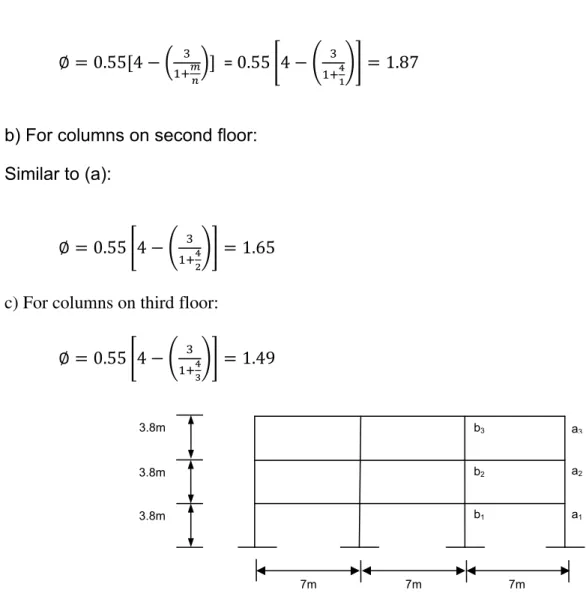
Step 2 Determine lateral rigidity factors for beams and columns
For all beams lateral rigidity factor is considered =3.5. For columns, since the frame is a moment-resisting frame, lateral rigidity must be determined using equations (5) or (7).
a) For columns on the first floor:
. E . E‐ . . E . . E . . E . E‐ . .
The same result is obtained using Equation (7). Note that the test column is a corner column and the values from equations (5) or (7) must be multiplied by 0.55.
21
. = . .
b) For columns on second floor:
Similar to (a):
. .
c) For columns on third floor:
. .
Figure 8 Details of the cross-section for beams.
Step 3 Determine beam connections stiffness
a) For connection a1 of the beam (a1,b1) on the first floor: zero beam and two columns
are connected to a1 (the main beam (a1,b1) should not be counted).
∑ . . E . E‐ . . E a1 a2 a3 b1 b2 b3 7m 7m 7m 3.8m 3.8m 3.8m
22
b) For connection b1 of the beam (a1,b1) on the first floor: one beam and two columns
are connected to b1 (again the main beam (a1,b1) is not counted).
∑ . . E . . E‐ . . E . E‐ . E
c) For connection a2 of the beam (a2,b2) on the 2nd floor: zero beam and two columns
are connected to a2 (the main beam (a2,b2) is not counted).
. . E . E‐
. . E
d) For connection b2 of the beam (a2,b2) on the 2nd floor: one beam and two columns are
connected to b2 (again the main beam (a2,b2) is not counted).
. . E . E‐ . . . E . E . E
e) For connection a3 of the beam (a3,b3) on the 3rd floor: zero beam and one column are
connected to a3 (the main beam (a3,b3) is not counted).
23 . . E . E‐
. . E
f) For connection b3 of the beam (a3,b3) on the 3rd floor: one beam and one column are
connected to b3 (again the main beam (a3,b3) is not counted).
. . E . E‐ . . . E . E‐ . E
Step 4 Determine beam connections factors
a) First Floor . E . E . E‐ . E . E. E‐ . b) Second Floor . E . E . E‐ . E . E. E‐ . c) Third Floor
24 . E
. E . E‐ . E . E. E‐
.
Step 5 Determine vertical stiffness for each floor a) First Floor . . . . . E . E‐ . E b) Second Floor . . . . . E . E‐ . E c) Third Floor . . . . . E . E‐ . E
Step 6 Determine total vertical stiffness
. E . E . E . E
25
8B
5. CONCLUSIONS
A new hybrid test technique was developed to assess fire performance of steel columns. A simple calculation process was developed to determine the effect of the structural frame response on fire resistance of the steel columns. Load and deformation of the test columns, at the support, were the main interaction components between the analysis and the test. The method was implemented for columns in different stories in six different steel building frames. Studies are still being carried out to implement the approach to include consideration of the lateral load, due to floor thermal expansion. For application in practice, the model needs to be verified through a future experimental program.
9B
6. ACKNOWLEDGEMENT
Acknowledgements are extended to Jessica Mannarino, for her contributions in this study.
10B
7. REFERENCES
Franssen J.M., User’s Manual For SAFIR 2007a Computer Program For Analysis of Structures Subjected to Fire, University of Liege, Belgium, 2007
Mostafaei H., Mannarino J., A Performance-based Approach for Fire-Resistance Test of Reinforced Concrete Columns, Research Report, No. 287, National Research Council Canada, 2009.
26
11B
Appendix:Plots
Figure 9(a) Load-Deformation (P-Δ) curve for prototype U1a.
27
Figure 9(c) Load-Deformation (P-Δ) curve for prototype U1c.
28
Figure 10(b) Load-Deformation (P-Δ) curve for prototype U2b.
29
Figure 10(d) Load-Deformation (P-Δ) curve for prototype U2d.
30
Figure 11(b) Load-Deformation (P-Δ) curve for prototype U3b.
31
Figure 11(d) Load-Deformation (P-Δ) curve for prototype U3d.
32
Figure 12(a) Load-Deformation (P-Δ) curve for prototype U4a.
33
Figure 12(c) Load-Deformation (P-Δ) curve for prototype U4c.
34
Figure 13(b) Load-Deformation (P-Δ) curve for prototype U5b.
35
Figure 13(d) Load-Deformation (P-Δ) curve for prototype U5d.
36
Figure 14(b) Load-Deformation (P-Δ) curve for prototype U6b.
37
Figure 14(d) Load-Deformation (P-Δ) curve for prototype U6d.
38
12B
Appendix A: Derivation of Stiffness Equation for the Simplified
Method
The derivation of the stiffness equation, Eq. (2), is provided here.
Figure 15 Equivalent beam for beam ab and the boundary stiffness conditions
The stiffness matrix for equivalent beam ab of the above frame may be arranged in the following formed:
where, E, I, and L are the modulus of elasticity, second moment of inertia and length of the equivalent beam respectively; Ka and Kb are the rotational stiffness of the frame at
joints a and b; θa, θb and δ are the beam’s rotations at a and b and its vertical
deformation at a and V is the vertical load at a. The first row of the above matrix gives: a b δ beam beam beam beam beam beam o V, δ a b Kb Ka L
39 Or:
(1) The second row gives:
Or:
This results in:
(2) Finally the last row of the matrix yields to:
Or:
(3) Substituting (2) and (3) into (1) gives
40
This yields to:
.
Or:
.