PoS(EPS-HEP2017)485
Phase-II upgrades
Djamel Boumediene∗†
Laboratoire de Physique de Clermont, Université Clermont-Auvergne, CNRS-IN2P3
E-mail:[email protected]
The ATLAS detector was designed and built to study proton-proton collisions produced at the
LHC at centre-of-mass energies up to 14 TeV and instantaneous luminosities up to 1034cm−2s−1.
A Liquid Argon-lead sampling (LAr) calorimeter is employed as electromagnetic and hadronic calorimeters, except in the barrel region, where a scintillator-steel sampling calorimeter (TileCal) is used as hadronic calorimeter. This presentation gives first an overview of the detector operation and data quality, as well as of the achieved performances of the ATLAS calorimetry system. Ad-ditionally the upgrade projects of the ATLAS calorimeter system for the high luminosity phase of the LHC (HL-LHC) are presented. For the HL-LHC, the instantaneous luminosity is expected to
increase up to L≃ 7.5 × 1034cm−2s−1and the average pile-up up to 200 interactions per bunch
crossing. The major R&D item is the upgrade of the electronics for both LAr and Tile
calorime-ters in order to cope with longer latencies of up to 60 µs. The expected radiation doses will
exceed the qualification range of the current readout system. The status of the R&D of the low-power ASICs (pre-amplifier, shaper, ADC, serializer and transmitters) and readout electronics for all the design options is discussed. Moreover, a High Granularity Timing Detector (HGTD) is
proposed to be added in front of the LAr calorimeters in the end-cap region (2.4 < |η| < 4.2) for
pile-up mitigation at Level-0 trigger level and offline reconstruction. The HGTD will correlate the energy deposits in the calorimeter to different proton-proton collision vertices by using TOF information with high time resolution (30 pico-seconds per readout cell) based on the Silicon sensor technologies. The current test beam results are presented in this document as well.
The European Physical Society Conference on High Energy Physics 5-12 July, 2017
Venice
∗Speaker.
PoS(EPS-HEP2017)485
1. IntroductionThe ATLAS detector [1] is one of the two general purpose particle detectors at the LHC. It consists of multiple sub-detectors designed to measure proton-proton collisions with a center of mass energy up to√s = 14 TeV at a typical instantaneous luminosity of 1034cm−2s−1as well as lead-lead and proton-lead collisions.
Within these conditions, the ATLAS calorimeters were designed to operate efficiently up to a total integrated luminosity of 1000 fb−1.
2. ATLAS calorimeters in Run 2 of LHC
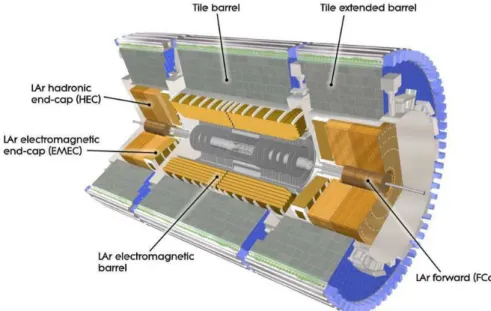
ATLAS calorimeters were operated successfully during Run 1 and Run 2 of LHC. The Liquid Argon calorimeters [2] (LAr) cover ranges in pseudo-rapidity, η, of |η| < 1.475 for the Elec-tromagnetic Barrel (EMB), 1.375 < |η| < 3.2 for the Electromagnetic End-Cap (EMEC) and 1.5 < |η| < 3.2 for the Hadronic End-Cap (HEC). The Tile hadronic calorimeter (TileCal) covers the barrel region|η| < 1.7. They are presented on Figure 1. Their performances will be described in terms of efficiency, data quality and calibration.
Figure 1: The ATLAS Calorimeters.
2.1 The LAr performances in LHC Run 2
The Liquid Argon calorimeters are sampling calorimeters using Liquid Argon as an active medium and combinations of lead, tungsten and copper as passive absorbers. The LAr readout was designed to provide digitized calorimeter input to the Level-1 (L1) trigger processor at a maximum acceptance rate of 100 kHz. Front-End Boards (FEB) include Layer Sum Boards (LSB) that create analog sums from detector pulses. A baseplane routes the signals to Trigger Builder Boards (TBB) that are connected to the back-end receiver and L1 calorimeter processors.
PoS(EPS-HEP2017)485
More than 99.6% of the LAr channels were operational and more than 99% of data had good quality in 2016 as seen on Figure 2. The electromagnetic scale and particle reconstruction were monitored using the data. The calibration and identification of electrons and photons were con-trolled with J/ψ and Z events showing the good stability and performance of the LAr Electro-magnetic calorimeter. Timing and noise were monitored during data taking periods and were stable.
Period
A B C D E F G I K L All
Lost luminosity due to defects [%]
1 − 10 1 10 Total loss: 0.58% / 215 pb-1 2016 -1 0.01% / 5 pb noisy channels -1 0.08% / 32 pb noise burst -1 0.42% / 157 pb trigger misconfiguration -1 0.01% / 6 pb high voltage trip
-1 0.02% / 7 pb HV non nominal -1 0.02% / 9 pb data corruption ATLAS Preliminary
Figure 2: LAr data quality summary for 2016. Sources of defects are given as a function of the data-taking
period [3].
2.2 The Tile Calorimeter
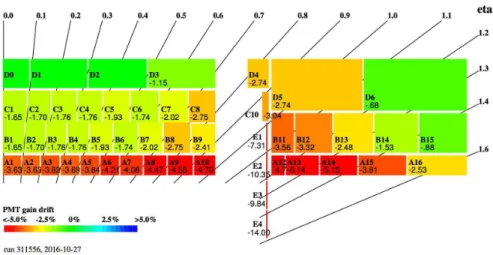
The Tile calorimeter [4] is a non-compensating sampling calorimeter where steel is used as ra-diator and scintillating tiles as an active medium. The light from the tiles is read out via fibers and transmitted to photo-multiplier tubes (PMTs). The TileCal readout follows several steps [5]: shap-ing, amplification and digitization of PMT signals. The digitized samples are stored in a pipeline memory and sent to the back-end through optical fibers if a L1 trigger is received. The cell re-sponse can evolve in time because of unstability of PMTs high-voltage, PMTs stress induced by high light flux or optics ageing. Several calibration systems [6] are used to monitor the stability of these elements and provide per channel calibration. The calibration of Tile optic components and PMTs is performed with movable Cesium radioactive gamma source. The Calibration of phototube gains is performed weekly with custom Laser calibration system. With a similar frequency, cali-brations of digital gains and linearities is performed with charge injection system (CIS) integrated on module front-ends. Finally, monitoring of beam conditions and TileCal optics is possible using the so-called integrator system. These systems are used in conjunction to monitor and correct in-stabilities affecting the channels gain like PMT drifts, induced by high instantaneous luminosity or to identify the small fraction of pathological channels as illustrated on Figure 3. Thanks to regular maintenance, the fraction of inefficient cells is kept at a typical level of 1%.
3. Upgrades of ATLAS calorimeters in Phase-II
A series of upgrades of the LHC [8] have been planned [9]. Phase-I period preceeds the LHC Run 3 which will start at the of 2020 and is characterised by an instantaneous luminosity
PoS(EPS-HEP2017)485
Figure 3: The mean gain variation of the 9852 channels is computed cell by cell as a function ofη and radius in 2016 using the Laser system. The mean values are averaged over total azimuthal coverage of the detector [7].
of about 2× 1034 cm−2s−1. It will be followed by Phase-II period preparing for the LHC Run 4 that starts at the end of 2026 and that will be characterised by an instanteneous luminosity up to 7.5 1034 cm−2s−1 and a targeted integrated luminosity of 3000fb−1. Such a high luminosity
im-plies a high and challenging pile-up, up to 200 collisions per bunch crossing, which is 5-7 times larger than the nominal Run 2 value. This will lead to overlapping vertices and a high pile-up noise in the calorimeters. The replacement of ageing detector components is also required to endure 3 times the radiation tolerance of the nominal design. The new ATLAS trigger architecture will require L0 and L1 acceptance rates of 1 MHz and 400 kHz with latencies of 10µs and 60µs re-spectively. ATLAS calorimeters have to be adapted to these conditions with an improved radiation tolerance, by sending the full granularity digital data at 40 MHz to back-ends. Calorimeters could complete the measurements of the extended tracking system at high|η| by adding a detector which has high granularity with high timing resolution.
3.1 Upgrades of the LAr readout
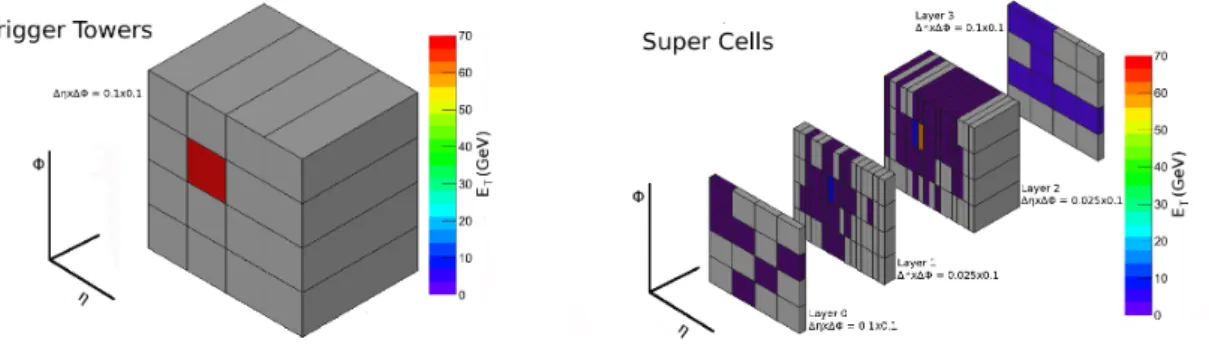
LAr readout will be upgraded during Phase-II with an intermediate stage in Phase-I [10] while maintaining the current 100 kHz acceptance rate and a latency below 3 µs. During Run 3, LAr calorimeter trigger readout will already provide finer granularity input to the trigger thanks to dedicated electronics. Figure 4 illustrates the evolution of the granularity comparing the current Trigger Tower (TT) and the new Super Cell (SC) trigger sums. They will provide enhanced shape and isolation informations that will allow to mitigate pile-up effects and to reduce the background rates while maintaining high physics acceptance. New Layer Sum Boards (LSB) will be installed in order to sum LAr cell signals into SC. A new baseplane is required in order to route the 34k SC signals that will be digitized by 124 LAr Trigger Digitizer Boards (LTDB) while tower sums will be
PoS(EPS-HEP2017)485
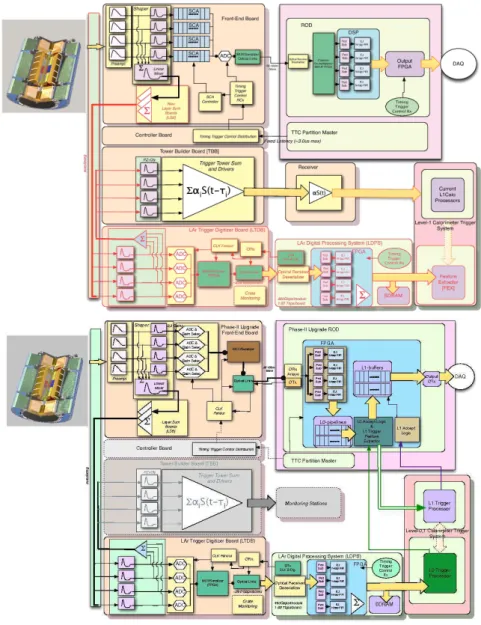
sent to the current TBB for backward compatibility during Run 3. This trigger upgrade will remain in Run 4 and will provide an input to the new L0 trigger while the current TBB will be removed. The major readout evolution in Phase-II will be the installation of new FEBs and back-ends (BE) LAr Pre-Processor units (LPPR). The new FEBs will amplify, shape and digitize detector signals with full granularity. Radiation-hard ADCs with 16-bit dynamic range will be integrated. The new LPPRs will carry high bandwith FPGAs. Total data transfer rate will reach 1 Tbps per board. The LAr upgraded readouts are illustrated on Figure 5.
Figure 4: Comparison between the curent Trigger Towers granularity (left) and the Super Cells designed
for LAr trigger upgrades (right).
3.2 Upgrades of the TileCal
Major detector components: absorber, scintillating tiles, fibers, and PMTs are largely in good shape and do not have to be replaced for the High Luminosity LHC. The front-end and back-end electronics, calibration systems and electronics drawer will evolve in II [11]. The new Phase-II readout scheme is illustarded on Figure 6. At this moment, two options are being considered for the Front-End Boards (FEB) [12]. One is based on the original design (so called 3in1) based on dis-crete components but with an improved dynamic range and resolution. The other option is based on a specific ASIC, called FATALIC. Prototypes were equipped with current design and new options and were then exposed to test beams, in 2016 and 2017, in order to quantify their performances. Good results were optained in terms of linearity and efficiency. In addition to the readout, new elec-tronics drawer mechanics was designed in order to ease maintenance interventions. Two new high voltage distribution systems supplying TileCal PMTs were designed. An upgrade of the original design, internal supply option, is proposed together with a remote option [13], off detector power supplies.
3.3 High Granularity Timing Detector (HGTD)
The High Granularity Timing Detector (HGTD) is a potential new sub-detector for Phase-II upgrades. In the frame of the extended tracking coverage in ATLAS, up to|η| = 4.0, the HGTD will help to mitigate the pile-up impact by adding a time information to each track. Time informa-tion allows track to vertex assignments leading to the improvement of lepton and photon isolainforma-tions and the suppression of pile-up jets. As shown on Figure 7, a 30 ps time resolution allows to achieve these improvements. The HGTD would be installed in front of the LAr end-caps, covering the region 2.4 < |η| < 4.2. Composed of 4 layers, it will use low gain avalanche diodes (LGAD) as
PoS(EPS-HEP2017)485
Figure 5: Upgraded LAr readout schemes for Phase-I (top) and Phase-II (bottom).
PoS(EPS-HEP2017)485
active elements. Time resolution will be governed by three properties: the thickness, the signal shape and the electronics resolution. They were optimised for a design proposal whose perfor-mances were validated in test beam campaigns in August and September 2016. A good efficiency and uniformity were observed while time resolution was measured to be within the requirements as seen on Figure 7.
Collisions/mm 0 0.2 0.4 0.6 0.8 1 1.2 1.4 1.6
Pile-up track fraction
0 0.05 0.1 0.15 0.2 0.25 0.3 ITK ITK + HGTD >=200 µ =14 TeV, < s Inclined Barrel =50mm z σ Pythia8 dijets <60 GeV T jet 30<p |< 3.8 jet η 2.4 <| (t)=30 ps σ
ATLAS Simulation Preliminary
Gain 0 10 20 30 40 50 60 Time resolution [ps] 0 20 40 60 80 100 120 ATLAS Preliminary
HGTD test beam Aug. 2016 120 GeV pions m thick µ wide 45 2 1.2)mm × (1.2 LGAD 1 LGAD 2
Figure 7: Reduction of the pile-up fraction in jets when HGTD measurements are associated to tracker
(ITK) measurements (left). Measured LGAD prototype time resolution in test beam (right) [14].
4. Conclusion
The calorimeters are an important component of the ATLAS detector at LHC. They performed very well in LHC Run 2. The upgrades for High Luminosity LHC require a redesign of some elements. The Liquid Argon calorimeters will upgrade their readout electronics in two stages starting with the Phase-I. It will be able to send improved granularity signals to the trigger system and to be in line with the new Run 4 architecture. Two upgrade options are envisaged for the Tile calorimeter front-end electronics. Prototypes are being tested and technological choices being validated. In addition to the upgrade of the existing detectors, new detectors could be installed like the High Granularity Timing Detector. A design proposal was presented while first test-beam results show good perfomances of the proposed technology.
References
[1] ATLAS Collaboration, The ATLAS Experiment at the CERN Large Hadron Collider, JINST 3 (2008)
S08003.
[2] ATLAS Collaboration, ATLAS Liquid Argon Calorimeter Technical Design Report,
CERN-LHCC-96-41 (1996).
[3] ATLAS Liquid Argon Calorimeter Subsystem, Approved Plots
https://twiki.cern.ch/twiki/bin/view/AtlasPublic/LArCaloPublicResults2015.
[4] ATLAS Collaboration, Readiness of the ATLAS Tile Calorimeter for LHC collisions, Eur. Phys. J. C
PoS(EPS-HEP2017)485
[5] K. Anderson et al., Design of the front-end analog electronics for the ATLAS tile calorimeter, Nucl.
Instrum. Meth. A 551 (2005) 469.
[6] D. Boumediene et al., Calibration of the Tile Hadronic Calorimeter of ATLAS at LHC, J. Phys. Conf.
Ser. 587 (2015) no.1. 012009.
[7] ATLAS Tile Calorimeter Subsystem, Approved Plots
https://twiki.cern.ch/twiki/bin/view/AtlasPublic/ApprovedPlotsTile.
[8] CERN, High-Luminosity Large Hadron Collider (HL-LHC) Technical Design Report,
CERN-2017-007-M (2017).
[9] ATLAS Collaboration, ATLAS Phase-II Upgrade Technical Design Report, CERN-LHCC-2015-022. [10] ATLAS Collaboration„ ATLAS Liquid Argon Calorimeter Phase-I Upgrade Technical Design Report,
CERN-LHCC-2013-017 ; ATLAS-TDR-022.
[11] G. Usai et al., ATLAS Tile Calorimeter electronics and future upgrades, JINST 10 (2015) no.04, C04026.
[12] A. Gomes et al., The new front-end electronics for the ATLAS Tile Calorimeter Phase-2 Upgrade,
JINST 11 (2016) no.02, C02015.
[13] F. Vazeille et al., Performance of a remote High Voltage power supply for the Phase-II upgrade of the
ATLAS Tile Calorimeter, JINST 12 (2017) no.08, C08004.
[14] ATLAS High Granularity Timing Detector, Public results
![Figure 2: LAr data quality summary for 2016. Sources of defects are given as a function of the data-taking period [3].](https://thumb-eu.123doks.com/thumbv2/123doknet/14077492.463214/3.892.198.687.293.494/figure-quality-summary-sources-defects-function-taking-period.webp)