Bayesian Computational Models for Inferring Preferences
by
ARCHIVES
MASSACHUSETTS INSTITUTE
Owain Rhys Evans OF TECHNOLOGY
B.A., Columbia University in the City of New York (2008)
OCT
15 2015
LIBRARIES
Submitted to the Department of Philosophy
in Partial Fulfillment of the Requirements for the Degree of Doctor of Philosophy
at the
MASSACHUSETTS INSTITUTE OF TECHNOLOGY
September 2015
0 2015 Massachusetts Institute of Technology. All rights reserved.
Signature redacted
Signature of A uthor ... ...
Depart ent of Philosophy
/
26 August 2015Signature redacted
Certified by... ... .. .. . ... ... Roger White Professor of PhilosophySignature
redactedupervisor
A ccepted by ... ... . x ByrneV
Professor of PhilosophyBayesian Computational Models for Inferring Preferences
Owain Evans
submitted to the Department of Philosophy on August 26, 2015,
in partial fulfillment of the requirements for the degree of Doctor of Philosophy
Abstract
This thesis is about learning the preferences of humans from observations of their choices. It builds on work in economics and decision theory (e.g. utility theory, revealed preference, utilities over bundles), Machine Learning (inverse reinforcement learning), and cognitive science (theory of mind and inverse planning).
Chapter
1 lays the conceptual groundwork for the thesis and introduces key challenges for
learning preferences that motivate chapters 2 and 3. I adopt a technical definition of 'preference' that is appropriate for inferring preferences from choices. I consider what class of objects preferences should be defined over. I discuss the distinction between actual preferences and informed preferences and the distinction between basic/intrinsic andderived/instrumental preferences.
Chapter 2 focuses on the challenge of human 'suboptimality'. A person's choices are a function of their beliefs and plans, as well as their preferences. If they have inaccurate beliefs or make inefficient plans, then it will generally be more difficult to infer their preferences from choices. It is also more difficult if some of their beliefs might be inaccurate and some of their plans might be inefficient.
I develop models for learning the preferences of agents subject to false beliefs and to time
inconsistency. I use probabilistic programming to provide a concise, extendable
implementation of preference inference for suboptimal agents. Agents performing suboptimal sequential planning are represented as functional programs.
Chapter 3 considers how preferences vary under different combinations (or
&compositions') of outcomes. I use simple mathematical functional forms to model composition. These forms are standard in microeconomics, where the outcomes in question are quantities of goods or services. These goods may provide the same purpose (and be
substitutes for one another). Alternatively, they may combine together to perform some useful
function (as with complements). I implement Bayesian inference for learning the preferences of agents making choices between different combinations of goods. I compare this procedure
to empirical data for two different applications.
Thesis supervisor: Roger White
Collaborations
Chapter 2 is based on joint work in collaboration with Andreas Stuhimueller and Daniel Hawthorne. Chapter 3 is based on two projects. One (which I acknowledge in the text) was in collaboration with Leon Bergen and Josh Tenenbaum. The other (on the Knobe effect) was in collaboration with Josh Tenenbaum. All mistakes are my own.
Bayesian Computational Models for Inferring Preferences
Owain Evans
Long Abstract
This thesis is about learning the preferences of humans by observing their choices. These choices might be in the context of psychology experiments in a lab, where the decision problems that people face are simple and controlled. They could be choices in some real-world task, such as navigating a city or building a website. Preferences inferred from observed choices are sometimes called 'revealed preferences' in economics. A related idea appears in the field of Machine Learning, under the label 'Inverse Reinforcement Learning' (Ng and Russell 2000), and also in Cognitive Science, where it's called 'Inverse-Planning' (Baker and Tenenbaum 2014).
Inferring things from observed choices is not the only way to learn about someone's preferences. It's possible that in daily life we learn more about preferences from verbal testimony than from observed choices. Nevertheless, this thesis will only consider inference of preferences from choices'.
I treat the problem of learning preferences from choices as an inductive, statistical
inference problem. One goal of this work is to develop algorithms for automatically
learning an agent's preferences from data that records their choices. However, my principal concern in this thesis is with questions that are prior to building such algorithms. Two of these major questions, which are explored in Chapters 2 and 3, are the following:
1
One can construe verbal testimony as a choice (much like construing speech as an 'action') and treat it in the framework I develop in this thesis. This is beyond the scope of this work.(1) What is the causal and evidential connection between people's preferences and
their choices? If people do not always choose what they prefer, what kind of evidence do their choices provide about their preferences? Can we learn about their preferences even if people don't reliably choose based on them?
(2) How should human preferences be formally represented so as to facilitate inference from choices and to capture the full range and structure of human preferences?
Chapter 1 lays the conceptual groundwork for the rest of the thesis and introduces the key challenges for learning preferences that motivate chapters 2 and 3. Chapter 1 begins with a discussion of the concept of 'preference' itself. My focus is on what I call 'economic preferences', which are defined as 'total subjective comparative evaluations' of world histories2
. This definition aims to capture the notion of preference used in economics and decision theory. Since economic preferences are
total evaluations, the question of whether A is preferred to B depends on a comparison
across all evaluative dimensions that are relevant to the agent. So it's not just a question of whether the agent likes A more than B. It might also depend on whether A is morally better than B, whether A satisfies an obligation or commitment (e.g. a promise or agreement) that B does not, and so on for other evaluative dimensions.
Having explained the notion of economic preferences, I discuss two distinctions that are important in the rest of this thesis. First, there is the distinction from the theory of well-being between actual preferences and informed or enlightened preferences (Railton 1986, Sobel 1994). Actual preferences have a closer link to observed choices but a weaker link to what is good for the agent. While much more difficult to infer from choices, I argue that enlightened preferences should be the ultimate target of the project of preference inference. The second distinction is between basic preferences and instrumental or derived preferences. Some world states are preferred for their intrinsic or immediate properties (this is a basic preference), while others are preferred only because they cause the former kind of state (a derived preference). It is often difficult to infer from observed choices whether a preference is
derived or basic. Yet basic preferences will provide more concise and robust explanations of behavior. They should generally be the aim of preference inference.
Having made some conceptual distinctions about preferences, I explain why the problem of learning preferences is important. I consider its relevance to the social
sciences, to normative ethics and value theory, and to cognitive science.
The final section of Chapter 1 introduces two general challenges for learning preferences from observations of human choices. The first challenge is the problem of human 'suboptimality'. An idealized agent has complete knowledge of the world3 and computes optimal plans to realize its preferences. The problem of inferring the preferences of such an agent has been studied in economics and Machine Learning. In real-world situations, humans are not omniscient and are not optimal in their planning. So existing formal techniques for inferring preferences don't straightforwardly carry over to humans. In Chapter 2, I develop models for learning the preferences of agents with false beliefs and for agents subject to time inconsistency4. These models apply to sequential decision problems. I make use of recent advances in probabilistic programming to provide a concise, easily extendable implementation of preference inference for suboptimal agents.
The second challenge is the problem of finding formal representations for preferences that facilitate learning and are able to capture (as far as possible) the richness and complexity of human preferences. Human preferences seem to be 'sparse'. That is, most macro-level properties are irrelevant to whether people prefer an outcome. Few people care, for example, whether the number of blades of grass in their lawn is odd or even. It seems that preference learning would be easier and more efficient, if we could make some general assumptions about which properties are likely to matter for preferences.
A related question is how preferences vary under different combinations (or
'compositions') of properties. Suppose someone values a number of distinct and independent goods (e.g. friendship, art, community, hedonic pleasures). It's plausible that while these goods are independent, they are not perfectly substitutable. That is, having a large quantity of just one of these goods would not be preferred to having a
3 When I write 'complete knowledge', I always mean 'complete knowledge up to non-deterministic features of the world that are not possible to know'.
4 Time inconsistency has been used to explain behaviors like procrastination, temptation, and addiction (Ainslie 2001).
more equitable balance'. In Chapter 3, I explore representations of preferences that use simple mathematical functions to model how different properties compose. These functions are standard utility functions in microeconomics, where the properties in question are quantities of goods or services that a consumer might purchase. These goods may serve the same purpose (and so be substitutes for one another), they may combine together to perform some useful function (as with complements), or they may be entirely independent. I describe and implement a Bayesian inference procedure for inferring the preferences of agents making choices between different combinations of goods. I compare this procedure to empirical data for two different applications.
s I use the term 'goods'. This might sound like a discussion of 'objective goods' for an individual, rather than a discussion of the structure of someone's preferences. However, I'm just using 'goods' as a shorthand for 'a property or quality of a future state of affairs that someone prefers/values'.
Chapter 1:
Key Concepts and Challenges for Learning
Preferences
1. Concepts and Distinctions for Preference Learning
1.1. Preferences as total subjective comparative evaluations
Throughout this thesis I do not use 'preference' in its everyday sense. Instead I use the notion of 'preference' found often in economic theory or decision theory'. This notion is close to the everyday notion but differs in important ways. Hausman (2012) argues that preferences in both economic and everyday senses are 'subjective comparative evaluations' of states or outcomes. These evaluations involve multiple outcomes (in contrast to desires) and they involve multiple dimensions of evaluation. The key difference is that the economic notion of preference involves all dimensions of evaluation that the subject finds relevant. The everyday notion, in contrast, includes some but not all dimensions. So on Hausman's terminology, economic preferences are 'total subjective comparative evaluations', while everyday preferences are 'overall subjective comparative evaluations'.
The everyday notion of preference includes someone's 'likes', their predilections, and their aesthetic evaluations. It typically excludes moral considerations, obligations, 6 I'm not suggesting that work in economic theory or decision theory always uses this notion of
'preference'. Some work uses this notion but it's often hard to tell exactly which notion is being used. See Hausman's discussion of this in his (2012).
7 Everyday preferences are 'overall evaluations' because they involve comparing outcomes across a
number of dimensions and then coming to an overall, holistic judgment. For example, a preference for one restaurant over another will take into account the food, the cost, the dicor, the service, and so on.
and commitments. Someone might prefer (in the everyday sense) to drink wine at dinner but abstain because they promised their partner to cut down or because they agreed to drive people home. In this case their economic preference is not to drink wine (Hausman 2012). Economic preferences consider all relevant dimensions and weigh them against one another to reach a total evaluation.
Why work with economic preferences instead of everyday preferences? Here are
two major motivations:
1. The economic notion of preference has a tighter connection to choice than the
everyday notion. In domains where moral considerations and commitments are important, people's preferences (in the everyday sense) won't much influence their choices. The tighter connection between preference and choice
makes prediction of choices from preferences more reliable. I discuss the
importance of predicting choices below when explaining the relevance of preference learning to the social sciences and cognitive science.
2. The economic notion of preferences is more relevant to the task of helping someone by providing normative advice or normative recommendations. If you only learn about someone's preferences in the everyday sense, you won't provide useful advice in situations where the moral stakes are high. By definition, economic preferences include all dimensions of evaluation relevant to the agent. If you learn someone's economic preferences, you can provide advice that includes everything the subject deems relevant to their making a decision. For this reason, someone's economic preferences are similar to their 'values' or to 'everything they consider important'. The difference is that economic preferences encompass not only the list of evaluative dimensions that are important to someone but also the precise way in which these dimensions are weighted or traded-off in different contexts8.
Using a notion of preferences that combines or 'collapses' different evaluative dimensions does not imply that distinctions among these dimensions are unimportant. On the contrary, it's plausible that there are important philosophical and
8 Advice based on economic preferences may notbe the best advice from an objective moral
psychological differences between moral constraints or commitments and someone's personal tastes or predilections. However, it can be hard to determine (a) whether someone's choice was influenced by moral considerations or by a personal preference and (b) if both influences were present how those influences interact/compete to result in the choice. In this thesis the focus is on learning preferences from observed choices. Observed choices typically do not provide evidence about whether the evaluations underlying the choice were moral or were due to personal preference or predilection. So while the distinctions between evaluative dimensions are important, it won't be something that the preference learning ideas I explore here can directly address.
It's important to note that the economic notion of preference does not collapse all subjective influences on choice. I discuss below the fact that choices are influenced by cognitive biases such as Loss Aversion and hyperbolic discounting. In Chapter 2, I consider ways to learn preferences from observed choices without collapsing these biases into the preferences. Building on the ideas in Chapter 2, future work could try to infer preferences while avoiding collapsing different evaluative dimensions (e.g. avoid collapsing together someone's likes and someone's moral concerns)'.
1.2. The Objects of Preferences
If economic preferences are 'total evaluations', what are they evaluations of? In
everyday speech, we sometimes talk about preferences over types of goods or over
types of activities. For example, one might prefer Coke to Pepsi or prefer playing
tennis to hiking. We also talk of preferences over tokens of these types. For example, one might prefer to play tennis this afternoon (but not necessarily on other occasions).
I discuss preferences over things like goods and activities in Chapter 3. In this chapter I will not consider preferences over goods or activities (in either the type and token
sense). Instead I consider preferences to be over more 'fine-grained' or 'specific' entities, namely, complete world histories (or 'possible worlds').
9 The idea is to make some structural assumptions about tastes and moral constraints and how they influence choice. If there is some difference in how they influence choice, you might be able to distinguish them from observing choices alone. One example is that people will talk differently about tastes and moral constraints. Another is that moral constraints might be more consistent across individuals and across time. People might also be less likely to make mistakes or be subject to biases for some dimensions rather than others, and so on.
To make it clear what I mean by 'preferences over world histories', I will make some terminological distinctions. In this chapter I use the term 'world state' to mean the state of the world at a particular time. I use 'world history' to mean the sequence of all world states, i.e. the set of all facts about a world throughout time as well as space. When rational agents are choosing actions, they evaluate the world histories that would result from taking each possible action. (Note that the world history includes the past and future world states that result from taking an action. In some cases, the agents will only consider the future consequences of an action when evaluating it'0.)
The motivation for defining preferences over world states is that it leads to a simpler connection between choices and preferences. If preferences were over token goods or activities, there would be a more complex relation between preferences and choices. This is because rational agents make choices based on the ensuing complete world history, rather than on the good or activity that ensues in the short-term. For example, someone might enjoy drinking wine more than water but choose water because of the likely consequences of drinking wine. These consequences could be short-term (e.g. a hangover) or long-term (e.g. acquiring a social reputation as a drinker or adverse long-term health effects).
The assumption that people consider the entire future resulting from each action is unrealistic. People have cognitive/computational limits. Moreover, it's clear that many properties of a world history will be irrelevant to most people's preferences. For example, the choice of saying one word vs. another word will influence the movement of a particular oxygen molecule in the room. But no one would care about this molecule's movements in itself. I will consider each of these issues later in this
chapter.
A related question is whether we should consider world states to be the primary
objects of preferences, as opposed to world histories. Some would claim that people's preferences on world histories are a conceptually and computationally simple function of their preferences on world states (e.g. a discounted sum of world-state utilities)". I
" In the models in Chapter 2, the agents only take into account the value of the future resulting from an
action. For some purposes (e.g. maintaining pre-commitments) it might be important to also take into account the past.
11 This claim is made both by economists and computer scientists (Schwarz 2009). People who are
hedonists about preferences (i.e. who think that people's only basic or fundamental preferences are for pleasure over pain) might also have this view. If one is modeling preferences in a narrow domain, it
will not address this claim here. In this chapter I will stick to world histories, which are the more fine-grained object. If it turns out human preferences can be fully characterized in terms of preferences on world states, then this will make little difference to the points I raise here.
1.3. Actual vs. enlightened preferences
Consider the following example:
Fred is offered the choice between a cup of ice water and a cup of hot tea. Because it's hot and humid, Fred would like the water. Unbeknownst to Fred, the water is poisoned and would kill Fred if he drank it. There is no poison in the tea.
This kind of example has been used in philosophical discussions of welfare or well-being to illustrate the . distinction between 'actual' and 'informed'/'enlightened' preferences. The idea is that Fred's actual preference for the cup of water differs from the preference he'd have if he knew the water was poisoned (his 'informed' preference). According to the notion of preference I've introduced, Fred does not have an actual preference for the cup of water. I define preferences over world histories, rather than objects like 'the cup of water' or the state of drinking the water. The relevant world histories are:
(1) 'feel refreshed (from water), alive'
(2) 'not refreshed (due to drinking tea), alive'
(3) 'feel refreshed, dead from poison'"2
Fred prefers the first and second histories to the third one. Unfortunately for Fred, the first (and most preferred) outcome is not a realistic outcome given his choice.
might be plausible that this assumption holds. And even if the assumption is not plausible, it might be a modeling assumption that simplifies computation.
12 I only include the first part of these world histories and not the entire future extending beyond what
happens to Fred. We can assume the histories don't differ in important ways after the events in the first part.
On my notion of preference, Fred does not prefer the cup of water. However he does plan to get the water and does believe this will cause a good outcome. This is relevant to tightness of the connection between preference and choice. Fred chooses the water despite its causing a world history he prefers least. The virtue of my view is that preferences are robust over time. Fred's preference wouldn't change on learning about the poison. It's plausible that many preferences (e.g. for survival, bodily integrity and basic comforts, or for social interaction) are much more robust over time than beliefs about which choices will help realize these preferences.
I've just argued that if preferences are over world histories, there is no difference between actual and informed/enlightened preferences in the example of Fred. This argument did not depend on Fred being logically omniscient or having any unrealistic computational powers. If we asked Fred about his preferences over outcomes (1) - (3)
above, he would rank the outcomes with no difficulty. Moreover, we could read his preferences off his choices if he didn't have false beliefs. So even though Fred's preferences are defined over complex, fine-grained objects (i.e. entire world histories), there is not a practical difficulty here in learning those preferences.
While the actual vs. informed/enlightened distinction isn't applicable in Fred's case, it is still applicable to my account of preferences. It's often hard to say which of two world histories is preferable. This is the case in moral dilemmas or in the kind of examples used to argue for incommensurability or incomparability (Chang 1998). In these examples the difficulty seems to lie in trying to compare different dimensions of value. In other examples where comparison is difficult, the problem is not just multiple dimensions of value but also the cognitive complexity of the comparison.
I will illustrate the distinction between actual and enlightened preferences with an
example. Suppose Bill, a teenager, considers moving to a foreign country permanently vs. staying in his home country. Possible futures resulting from each choice will differ in many ways. If Bill were able to see each future laid out in full detail (e.g. in an exhaustive, novelistic description of his possible life stories), it might be very hard to choose between them. Making this choice might require lots of deliberation and empirical investigation (e.g. trying out different experiences or hearing the testimony of other people). When it's hard to decide between two world histories, people's judgments will vary over time as a function of their deliberation and inquiry. In such cases we can distinguish between the person's actual preferences
and their enlightened preferences. The enlightened preferences are what the person would converge to under further deliberation and inquiry.
This actual/enlightened distinction is important for the problem of learning preferences from observed choices. Suppose we observe someone making a choice and we know that they have no false beliefs and no failings of rationality. Yet for the reasons given above, we also know that they might revise the actual preference implied by this choice. How likely are they to revise it? Answering this would require having a model of (a) how likely they are to deliberate and investigate this preference, and (b) how likely they are to change their mind if they do deliberate on it. I won't discuss such models here. Incorporating them into my current framework is a challenge for future work.
2. Why preferences? Why learning preferences?
The previous section introduced the idea of economic preference and made some basic distinctions about preferences. Why should we care about economic preferences? And why care about learning them?
2.1. Social Science
The social sciences aim to predict and explain human behavior that is relevant to social, political and economic entities. People's behavior is a function of many things. It depends on their beliefs, their abilities to plan and to strategize, and on constraints imposed by law and convention. Individual preferences are a crucial determinant of behavior. Suppose, for example, we want to predict how people will behave during a major recession. This will depend on their preferences for moving to a new city, their preferences for being employed (even at lower wages), their preferences for consumption, and the preferences of employers to hold on to employees (even if times are bad), as well as many other more specific preferences.
13 One might argue that the actual preferences are likely to be incoherent. So they won't have the
Why care about learning preferences? As a thought experiment, we can imagine
humans having homogeneous preferences that researchers could write down by doing some armchair introspection. It could be that humans prefer only a certain simple-to-identify pleasure state and all human behavior is the pursuit of this state. Alternatively, it could be that human preferences are easy to deduce from our evolutionary history. In actual fact, it seems that human preferences are complex. People seem to care about a wide array of apparently distinct things. Preferences are also heterogeneous across times and places and across individuals. So techniques for learning preferences have two key roles. First, they are needed to learn the complex structure constituting human preferences (some of which is probably common to nearly all humans). Second, they are needed to learn particular preferences of each
individual.
This argument for the importance of preference learning doesn't explain my choice of focusing on learning from observed human choices. An obvious alternative way of learning preferences is to give people a big survey about their preferences. While surveys are valuable in learning about preferences, I want to highlight some advantages of learning from actual choices. First, people may intentionally misreport some of their preferences (e.g. to conceal unpopular preferences). Second, people may be bad at accurately reporting their enlightened preferences on a survey. If people actually face a choice between outcomes, they are likely to think carefully about each option, to consult wise friends, and to gather any empirical evidence that is relevant.
A well-constructed survey might provoke some of this thinking but it's unlikely to
match the real-life decision.
2.2. Normative Ethics and Value Theory
One theory of individual welfare/well-being is that someone's well-being is a function of whether their preferences are satisfied (Parfit 1984). I will call this the 'preference-satisfaction' theory. Versions of this theory do not always construe preferences as economic preferences that include all relevant evaluative dimensions between outcomes. Nevertheless, whether an agent's economic preferences are satisfied is likely to be highly relevant to their well-being on such theories.
There are various objections to preference-satisfaction theories. One objection is that a person preferring an outcome is insufficient for the outcome to confer well-being (Hausman 2012). The person also has to find the outcome rewarding or gratifying in some way. Another objection focuses on the problem (discussed above) that people can have actual preferences for outcomes they will later not prefer. Even if these objections undermine the claim that preferences are all that matters for individual well-being, it is still plausible that satisfying one's preferences is an important part of well-being.
If we assume that preferences are an important component of individual well-being,
then the problem of learning individual preferences will be important both practically and philosophically. On the practical side, making people's lives better will depend on learning their preferences. For the reasons discussed in the section above on social science, there are good grounds for learning preferences from observed choices and not just from surveys or from introspection on one's own preferences.
On the philosophical side, if preferences are important for well-being, we need to understand better the content of those preferences. This means not just learning preferences in order to predict future choices but developing ways to represent the learned preference in some comprehensible form". It's plausible that we already have a good understanding of some important preferences (e.g. for survival and for good health). But some preferences may be more subtle. For instance, most people have a preference for having children. Some of these people don't end up having children and fertility rates in many rich countries are much lower than in the past. People's preferences here don't seem easy to capture in a simple formula or simple logical principle5.
Moving on from the preference-satisfaction theory, there are other ways in which preferences are relevant to value theory and normative ethics. First, consider the importance of respecting people's freedom of choice and autonomy in modern societies. If there was a drug that made people less likely to commit violent crimes, many philosophers would judge it wrong for a government to secretly put the drug in
"4 In principle there could be an algorithm that infers preferences and represents them in a form that is very hard for us to interpret.
'- People don't desire to maximize their number of children. People don't want exactly one or two
children (otherwise there'd be no people who wanted children but didn't have them). Many only want children if the right partner comes along or if it won't get in the way too much of other projects. But how can we formalize these conditions? The claim is not that it's impossible but that it's a substantive task to formalize human preferences.
the water supply. This judgment would be stronger if the drug had negative side-effects - even if the benefits of the drug overall would outweigh the side-effects. More generally, governments need to obtain consent from individuals before taking actions that affect them in substantive ways. An individual will give consent if they prefer (in the economic-preference sense) the outcome. Individuals can be influenced in their judgments about what they prefer by evidence and argumentation: it's not just their immediate gut feeling that matters. But people's preferences will be an important determiner of whether moral or political ideas are able to influence actual behavior'".
2.3. Cognitive Science
As I noted in my discussion of social science (above), preferences are important for predicting human behavior. This makes the problems of learning and representing preferences of obvious relevance to cognitive science. Preference learning is also important in cognitive science because it's an important cognitive task that humans perform. People's ability to reason about other minds, often known as Theory of Mind', has been extensively studied in recent decades. It has been shown that Theory of Mind and preference inference develop very early, with sophisticated abilities observed before one year of age (Hamlin et al. 2007 and Hamlin et al. 2013). It is plausible that preference learning plays an important role in young children's ability to learn about the world during childhood. For adults, inferring the preferences of others is important in many spheres of life. It's important in social and family life, but also in doing deals (in business or politics), in designing new products or organizations, and in creating or understanding art.
Improved theories of the structure of human preferences and new techniques for learning human preferences can be applied to modeling Theory of Mind. In the other direction, we might better understand how to learn human preferences from studying how humans do it.
16 Note that this is analogous to the relevance of Pareto improvements in economics. Policies should be easier to bring about if no one is worse off from them. (One final way in which preferences relate to normative ethics: If people can be swayed by argument to economically prefer what is objectively good for them, then economic preferences will ultimately converge to preferences for objectively good things.)
3. Challenges for Learning Preferences from Observed Choices
The previous section motivates the general problem of learning preferences from observed choices. This section introduces two specific challenges that are part of this general problem. I address these challenges in greater detail in Chapters 2 and 3. In those chapters, I define and implement formal models that learn preferences in ways that attempt to deal with these challenges. This section discusses the challenges from a big-picture perspective.
3.1. False beliefs, suboptimal cognition and failures of rationality
3.1.1. Suboptimality and false beliefs
The choices of optimal, omniscient agents will generally be more informative about their preferences than those of suboptimal agents. Imagine an omniscient, optimal agent with human-like preferences is navigating a busy shopping district. (Optimal agents love shopping.) This agent knows about every product in every store, without having to do any browsing. So if it buys something, then it must have bought the best item relative to its preferences. Imagine now that a normal human is thrown into the same shopping district with no ability to see or hear (e.g. due to a blindfold) and having never visited the district before. If this person manages to stumble into a store, their doing so would not provide any information about their shopping preferences. This example shows that even if we (as observers of the person doing the choosing) had full knowledge of the person's epistemic state, we would not be able to infer anything about their shopping preferences from their choices.
There are similar problems with inferring preferences when we (as observers) are uncertain about the epistemic state of the agent choosing. If we don't know whether or not the person wears a blindfold, then knowing which store they visit will not allow us to identify their preferences-though it will provide some information. Consider
again the example of Fred and the poisoned water (above). If Fred chooses the hot tea, it's ambiguous whether he prefers the tea (and doesn't know about the poison) or prefers the water (and knows about the poison).
The examples of the blindfolded person and of Fred involve agents with uncertain or false beliefs. It's important to note that the difficulty in inferring their preferences is not that their choices are 'random' or 'noisy'. Random errors in someone's choices will make it more difficult to infer their preferences. But if the choices are repeated and are not completely random, errors will average out over time and preferences can still be inferred. By contrast, inaccurate beliefs can make it impossible to infer preferences
- even if observations are repeated. Here's an example. Suppose Sue regularly eats candy containing gelatin. One possible inference is that Sue is happy to eat animal products. Another is that she doesn't know about the gelatin in the candy (or doesn't know that gelatin is an animal product). If Sue never receives any evidence about the
gelatin, then we (as observers) can never distinguish between these two possibilities.
I have given examples that show how the agent's uncertainty or false beliefs can
make preference inference more difficult. Other kinds of deviation from an ideally rational, omniscient agent will generate similar difficulties. One such deviation is suboptimal planning". For example, without computer assistance, people will plan travel routes suboptimally. The deviation from optimality will be bigger for a longer and more complex route. Suppose someone works out a route from A to B that is very inefficient. We observe part of their route. From this evidence, we might infer that they intend to go from A to a different place C, for their route might be an efficient way to get to C. (Also note that if someone's ability to plan routes is completely non-existent, their choices would tell us nothing about their intended destination. This is like the example of the blindfolded person.)
3.1.2. Cognitive Biases
Suboptimal planning is a deviation from optimality but not one that humans could be blamed for. After all, many planning problems are known to be computationally intractable. Psychologists have argued that humans are also subject to an array of
17 Note that suboptimal planning is consistent with the agent knowing all the relevant empirical facts.
'cognitive biases'. These are deviations from ideal rationality that arise from a contingent shortcoming of our cognitive design -- analogous to our visual blind spot. I will give two examples of biases and discuss how they interact with preference inference.
Loss Aversion
You are offered a gamble where you get $200 if the coin comes up heads and you lose
$100 if it comes up tails. Many Americans (for whom losing $100 is a small,
inconsequential loss) reject this gamble, despite its expected value (Rabin 2000). Psychologists explain this as a specific aversion to outcomes that are framed or interpreted as a loss.
How does Loss Aversion interact with learning preferences? Studies show that not all subjects are equally loss averse. If we observed someone reject this gamble and didn't know whether they were subject to Loss Aversion, we would be uncertain about their preferences. They might reject it because losing $100 would have drastic consequences relative to winning $200. While this interpretation is unlikely to describe a typical US college professor, it is important that a general-purpose preference learning technique include this possibility.
Loss Aversion is described as a bias because it leads to 'preference reversals', i.e. to sets of preferences over outcomes that are inconsistent. It can't be explained away as a basic preference for avoiding loss over realizing gains.
Time Inconsistency
Time inconsistency (also called 'dynamic inconsistency') is one of the best-studied cognitive biases. This inconsistency arises when someone's desired choice between two options changes over time without them receiving any new pertinent information about the options. For example, someone might desire to get up early the night before and then reverse their desire when their alarm rings in the morning. One of the most influential formal models of time inconsistency is the 'hyperbolic discounting' model (Ainslie 2001). I will consider time inconsistency in much greater detail in Chapter 2.
I've noted that deviations from optimality and omniscience create difficulties for learning preferences from choices. The general problem is roughly that suboptimal agents will not always end up with outcomes that they prefer. This means that outcomes will either be uninformative about preferences or they will be highly ambiguous. One idea for getting around this problem is to try to learn preferences only from simple settings where human behavior is likely to be optimal. This could be a natural setting or it could be a lab setting which is specifically constructed to be simple. Simplified settings seem to be a valuable way of learning about preferences while avoiding the problems of suboptimality discussed here. There are, however, some shortcomings with this approach. First, it's often hard to communicate to subjects the precise structure of a very simple decision problem. Consider the Prisoner's Dilemma. Formally the game is defined by a pay-off matrix with four entries. Yet when subjects without a background in decision theory play against each other, they are likely to place some value on their opponent's utility and on equitable or 'fair' outcomes. This can make the 'cooperate' option more appealing than it is in payoff matrix.
A different, more fundamental problem is that some important human preferences
may be hard to test in a simplified setting. For one example, consider again the Prisoner's Dilemma and also related games involving cooperation, coordination and conflicts between selfish and altruistic behavior. Even if the payoff matrix in these games is simple, the game is intrinsically complex because simulating the game involves simulating another human being. Moreover, it's not clear one could really model and understand human behavior in game-theoretic settings without including our ability to simulate others.
Another example of preferences that are hard to investigate in simplified settings are those involving processes unfolding over long periods of time and correspondingly large time investments. It might be hard to learn someone's preferences for friendships, family relationships, or for skills that take years to develop, in a lab experiment lasting only a few hours. Suppose it takes five years of training or experience to be in a position to evaluate two life options A and B. Then a lab experiment won't be able to do a simplified or controlled version of this training period and so won't be helpful in trying to learn about this preference.
I've argued that simplified settings are not sufficient to get around the problem of humans being suboptimal in their planning and being non-omniscient. In Chapter 2, 1 develop a different approach to learning preferences despite these deviations from optimality. This approach explicitly models the deviations, learns from observed behavior whether they apply to a given individual, and then uses this accurate model of an individual to infer their preferences. There are limitations to this approach also. You can only learn someone's deviations from optimality if there is sufficient behavioral evidence to do so. Moreover, if someone has very limited knowledge or planning ability (as in the case of the blindfolded person), then inferring the precise nature of their suboptimality will not help with inferring their preferences. So it seems likely that a hybrid approach to inferring preferences (e.g. combining inference in simplified settings with explicit modeling of suboptimality in the style of Chapter 2) will be needed.
3.2. Representing preferences
The second challenge with learning preferences that I explore in this thesis is the problem of how to formally represent human preferences.
3.2.1 Representing preferences as a series of high-level properties
In Section 1 of this chapter (above) I specified preferences as taking world histories as their objects. From the perspective of everyday human cognition, world histories are extremely fine-grained entities. Miniscule differences in the physical properties of single atoms (even for a very short period of time) anywhere in the universe suffice to differentiate world histories. Yet most humans, if actually living through these two world histories, would find them indistinguishable. Humans are typically aware of only very coarse, high-level or macro-level properties of a world history.
Moreover, human preferences seem to mostly concern a small subset of these high-level properties". The relevant properties concern pleasure and pain, good physical and mental health, rewarding artistic and leisure activities, family and friends, and so on for many more. While we might have some practical or scientific interest in how many grains of sand there are on a beach, or in whether a particular tree has more mass in its roots or its bark, few people will have a preference either way. I summarize this point by saying that preferences are 'sparse' over the set of useful macro-level properties of the world. That is, if we collect a long, diverse list of high/macro-level properties of world histories then most of these predicates would be irrelevant to the preferences of most people. It's not easy to spell out this 'sparsity' claim formally. The intuition is that if we took a non-gerrymandered and extensive list of macro-level properties that are useful in describing the world, then most of these properties would not be useful for characterizing human preferences. An example of a non-gerrymandered list would be all properties expressed by single words in a big dictionary or all properties used in Wikipedia articles.
This sparsity property is important when it comes to learning human preferences from observations. In most cases the two possible world histories resulting from a choice will differ in a large number of their high-level properties. For instance, suppose Mary is choosing between a holiday in Puerto Rico and one in Mexico'. This choice clearly has consequences that are relevant to Mary's preferences. But the choice also has many consequences that Mary would not even think about. In Mexico Mary would minutely influence currency exchange rates and would also influence prices for Mexican goods and labor. She might kill some individual blades of grass by treading on them. She might bring over some pollen from the US, and so on. If we observe Mary choose to go to Mexico, then this could be because of a preference for any of these high-level properties on which the Mexico and Puerto Rico options differ. All we know is that one of these thousands of properties speaks in favor of Mexico. It could also be the interaction of different properties that is important (see below). If we assume that each of these different properties is equally important, we would scarcely be able to generalize having observed Mary's choice. Any similar choices in the future would themselves be between world histories which differ in
'8 By 'properties' I mean any function of world histories, not just those expressed by one-place
predicates. This can include arbitrary relations.
'9 In practice, Mary would usually have lots of uncertainty about how the holidays would go. But for
thousands of mostly inconsequential ways from each other and from the Puerto Rico and Mexico world histories.
One obvious way around this problem of generalization is to limit the set of relevant properties from the beginning. That is, we just assume that most of the
consequences of choosing Mexico as opposed to Puerto Rico are irrelevant and so we don't even consider them. This still leaves us the problem of which properties to include. Ideally, we would develop algorithms that include a large space of properties and winnow them down in response to data. It's also not obvious what properties to include in the initial 'large space of properties'. It's clear that we can ignore micro-physical properties for the most part (e.g. the acceleration of a random nitrogen molecule). But what kind of high-level properties do we need to include? There are two problems here. One is the problem of casting our net wide enough that we capture all relevant properties. The other is finding good formalizations of the properties that we are pretty sure should be included. Various feelings of pleasure, reward, pride, belonging, familiarity, novelty and so on are plausibly important to us. While we have familiar and frequently used words for these concepts, it's not clear that everyday language is good at precisely specifying the states that are valuable. It might be that we can communicate about them with each other because we have enough common experience of them to be able to use vague terms20.
3.2.2. Basic/intrinsic preferences vs. derived/instrumental preferences
I've suggested that we can represent preferences by a long list of high-level properties of world histories. It's a theoretical possibility that this long list turns out to be unnecessary. For instance, it could turn out that all humans are in fact psychological hedonists and the only relevant properties are amounts of pleasure and pain. But it seems plausible that a long and diverse list of properties is needed"
20 So we might want to include some related concepts from philosophy, cognitive science or neuroscience that might help precisely formulate these states.
2 The claim of sparsity (above) is that most high-level properties useful for describing the world are not useful for characterizing human preferences. This is consistent with there being a fairly long and diverse list of properties that are needed to characterize human preferences.
One general issue is that there will be semantically distinct properties that agree or coincide across a large space of possible world histories. For example, consider the following properties:
* 'being in pain'
* 'having activation in pain circuits in the brain'
* 'having activation in pain receptors (which normally leads to feeling of pain)' * 'having a cut on the part of the skin where the pain receptors are'
While some of these properties are semantically distinct, they would coincide across many world histories. This has important consequences for learning preferences. Suppose we (as observers) see someone choosing between options, where some of the options involve getting a cut and feeling pain. From this evidence alone, we cannot tell which of the list of properties above is relevant to determining the person's choice. It's intuitively clear that some of these properties are what people actually care about in a 'basic', 'primitive', or 'intrinsic' way, while the importance of the rest is only a consequence of their robust connection to those we care about intrinsically. For example, we don't think people care intrinsically about their pain receptors firing. But people do care about the experience pain and about damage to their body.
This suggests a distinction between preferences that are 'intrinsic' or 'basic' and those that are 'instrumental' or 'derived'. In explaining someone's choice, basic preferences will give a stronger and deeper explanation. Derived preferences are contingent, and would not be present in all possible world histories".
22 This distinction, for a given individual, can be read off from individual's preferences on world histories. If someone doesn't have a basic preference for their pain receptors being activated then they won't care about this happening in strange world histories where it happens without being caused by body damage and without causing pain.
23 Note that basic/intrinsic preferences are not the same thing as intrinsic objective goods. If humans
are able to converge on normative truths, then we'd hope that they end up having preferences for the intrinsic objective goods. But it's possible that humans have basic/intrinsic preferences for objectively bad things and that these preferences are very robust.
3.2.3. Composition of properties
I've considered representing preferences in terms of a long list of high-level properties of world histories. An individual's preferences would then be represented by a utility function from this list of properties to the real numbers. But what kind of function is this? I'll refer to this as the question of how properties compose to produce preferences or utilities.
The simplest functional form for a utility function would be a weighted sum of each property, where the property will have a value of '0' or '1' depending on whether it holds of the world history. We could also consider multiplicative functions, functions with 'max' or 'min' operators, and functions with terms with diminishing marginal utility, and so on. As I discuss in Chapter 3, such functions have been explored in microeconomics. From a theoretical standpoint, it is desirable to explore the most expressive class of functions. So we could consider all functions satisfying some smoothness property or else all functions satisfying computability or some tractability constraint.
The distinction (above) between basic and derived preferences relates to the issue of composition. The compositional structure discussed in microeconomics can sometimes be eliminated by considering only properties for which the agent has a basic, rather than derived, preference. Consider the following example. As chili is added to a dish it first gets better (i.e. tastier) and then gets worse (as the quantity of chili makes the dish too hot). One can plot the function for the quality of the dish as a function of amount of chili. But this function is not actually needed to represent someone's preferences. The basic preference here is for a certain richness of flavoring and for the overall gustatory experience. Varying the amount of chili is only relevant to the person's preferences in so far as it changes the gustatory experience. Whereas the chili had a non-monotonic effect on the desirability of a dish (more chili made the dish better then worse), the property of gustatory experience is monotonic in its
desirability.
It's plausible that lots of rich compositional structure (like the non-monotonic influence of chili on a dish) that appears to be relevant to preferences can actually be eliminated by switching to basic preferences. This leaves open the question of whether there is any rich and interesting compositional structure between properties
for which there are basic preferences. One candidate would be the desirability of a balance between distinct sources of value2 4. People might prefer a balance between success or satisfaction (a) in work, (b) in family life, and (c) in personal hobbies and leisure. That is, people would prefer attaining some decent standard in all three categories over huge success in just one of them. For this to be an aspect of their basic preferences, the preference for balance cannot arise from the causal effect of failure in one category on the others. Some minimal level of success in work (or in making money) might be a causal pre-requisite for success in other spheres of life. The question is whether a certain level of success in work intrinsically enhances the value of success in other areas2
.
4. Conclusion
This chapter introduced the notion of economic preference that I use in this thesis. Economic preferences are total subjective comparative evaluations of world histories. Since economic preferences depend on all dimensions of normative evaluation of world histories, they are robustly relevant both to predicting human choices and to providing normative advice or recommendations about how someone should choose. Economic preferences that satisfy basic rationality constraints have been formalized and studied extensively in economics and decision theory. I make use of the utility-function representation of economic preferences in the models I develop for learning preferences.
In Section of 2 of this chapter, I considered two challenges for inferring preferences from observed choices. The first challenge is due to humans deviating from omniscience and from optimal rationality. Because of human suboptimality, human choices are less informative about preferences than they'd otherwise be. I discussed
24 Some version of this idea goes back to Aristotle's Nichomachean Ethics.
5 Here are some quite different examples. The same pain experience could be bad (in normal contexts)
or good (for an exercise freak who grows to like the pain of training or for a masochist). Likewise, one might normally prefer to treat people with respect. But one might prefer to withhold respect for someone who doesn't deserve it. These are cases where the value of an event varies conditionally on the context.
some strategies for dealing with suboptimality and I will look at a different strategy in Chapter 2.
The second challenge I looked at was the questions of the form and representation of human preferences. This is a fundamental question for thinking about preferences in general. The question is, 'What is a precise description (in regimented natural language or a formal language) of human preferences or of the kinds of preferences that humans have?' I also considered the related question of which preferences are basic/intrinsic as opposed to derived/instrumental. These questions are important for inferring preferences from choices. If we rule out many kinds of preferences a priori (because they seem too implausible) we risk failing to capture some surprising and counter-intuitive feature of human preferences. On the other hand, the wider we cast our net (i.e. considering a very broad class of possible preferences) the more difficult we make learning. This problem is discussed in a more applied setting in Chapter 3.
Chapter 2:
Learning the Preferences of Ignorant, Inconsistent
Agents
0. Overview
Chapter 1 gave an overview of conceptual issues related to learning preferences from observed choices. In this chapter, I introduce a Bayesian statistical model for inferring preferences and describe my implementation of this model using probabilistic programming. The model intends to deal with one of the challenges for preference inference that I raised in Chapter 1. This is the problem of 'suboptimality'.
I consider two kinds of suboptimality in this chapter. First, humans often have
uncertain or inaccurate beliefs about the empirical world (e.g. believing that a restaurant is open when it's already closed). Second, humans are subject to time inconsistency (e.g. staying in bed after having planned to get up early). My approach is to define a model of decision making that includes both inaccurate beliefs (which can be updated on evidence) and time inconsistency (formalized as hyperbolic discounting). I show that it is possible to learn each of the following properties of an agent from observed choices:
(1) whether an agent has inaccurate beliefs and the values of the credences or
subjective probabilities,
(2) whether the agent is time inconsistent and (if so) the value of the discount rate,
(3) the agent's preferences.
The learning approach is Bayesian joint inference (implemented via probabilistic programming), returning a posterior distribution on all parameters characterizing the agent and their preferences. I test the inference algorithm's performance on simple scenarios involving planning and choosing a restaurant. This performance is also compared to inferences from human subjects asked to make preference inferences from the same stimuli.
1. Introduction
1.1. Examples illustrating inaccurate beliefs and time inconsistency
In Chapter 1, 1 gave some examples of how uncertain or false beliefs can make it more difficult to infer someone's preferences. I will now consider an additional example and discuss in more detail its implications for inference. The example is chosen to match the kind of decision problem I'll focus on in this chapter.
Example 1
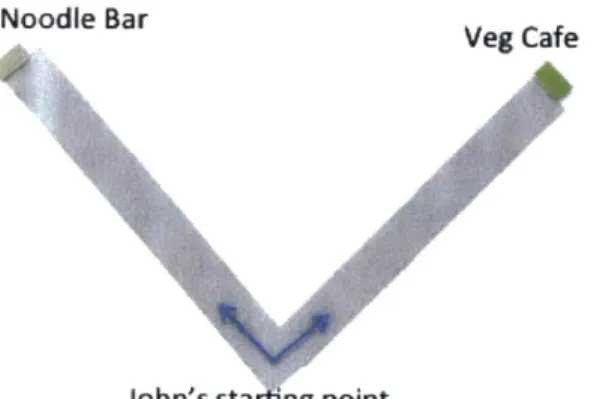
John is choosing between restaurants for lunch. There are two restaurants close by. The Noodle Bar is a five-minute walk to John's left and the Vegetarian Cafe is five minutes to his right. Each is open and has plenty of tables. John goes directly to the Vegetarian Cafe and eats there.
Noodle Bar Veg Cafe
Figure 1. John's choice between two restaurants in Example 1. Each restaurant is a five-minute walk from John's starting point.
John's starting point
If John is fully informed about the restaurants, then it's a plausible inference that he prefers the Vegetarian Cafe'. However, John might not know that the Noodle Bar even exists. He might think it's further away than it is. He might falsely believe that it is closed today or that it has no free tables. He might have accurate beliefs about the Noodle Bar but falsely believe the Vegetarian Cafe to be closer or less busy or better in the quality of its food than it actually is. He might know nothing about either restaurant and have chosen the Vegetarian Cafe by flipping a coin.
' As I discuss below, it's also possible that he has a long-term preference for eating at the Noodle Bar
In the terminology of Chapter 1, John chose the world history where he eats at the Vegetarian Cafe. But this choice is compatible with his preference being for the world history where he eats at the Noodle Bar. There are many plausible inaccurate beliefs that could have led John to pick an outcome he does not prefer. I now consider a similar example, intended to illustrate how the possibility of time inconsistency can make inferring preferences more difficult.
Example 2
John is choosing between restaurants for lunch. There are two options nearby. There is a Burger Joint seven minutes away and a Salad Bar another five minutes further down the street. John walks down the street and eats at the Burger Joint.
John's starting point
"Nw
Salad Bar
Figure 2. John's choice between restaurants in Example 2.
Suppose we assume that John has full information about each restaurant. Can we infer that he prefers the Burger Joint? Here is an alternative explanation. John planned to go to the Salad Bar. In walking to the Salad Bar, he had walk right past the Burger Joint. From close proximity, he found the Burger Joint so tempting that he abandoned his plan and ate there instead. This kind of explanation is common in everyday reasoning about people's actions. It ascribes a temporal or 'dynamic' inconsistency to John. When making his plan, John prefers that he eat at the Salad Bar over the Burger Joint. But when John stands right in front of the Burger Joint he has the reverse preference. One explanation for the preference reversal is a change in John's knowledge. John might see how delicious the burgers look and change his mind on this basis. But I want to focus on the case where there is no new information of this kind. John might feel tempted on seeing the burgers but not because he gets any new information about them.
If this temptation explanation is right, should we say that John has a preference for
the Burger Joint? We can imagine arguing either side. One side is that John's real preference is for the Salad Bar and that he only went to the Burger Joint because of weakness of will. He planned to avoid eating there and he'll regret having eaten there