HAL Id: hal-01972803
https://hal.archives-ouvertes.fr/hal-01972803
Submitted on 7 Jan 2019HAL is a multi-disciplinary open access archive for the deposit and dissemination of sci-entific research documents, whether they are pub-lished or not. The documents may come from teaching and research institutions in France or abroad, or from public or private research centers.
L’archive ouverte pluridisciplinaire HAL, est destinée au dépôt et à la diffusion de documents scientifiques de niveau recherche, publiés ou non, émanant des établissements d’enseignement et de recherche français ou étrangers, des laboratoires publics ou privés.
Electronic ratchets as necessary stepping stones for new
PV concepts
Amaury Delamarre, Daniel Suchet, Nicolas Cavassilas, Zacharie Jehl,
Yoshitaka Okada, Masakazu Sugiyama, Jean-Francois Guillemoles
To cite this version:
Amaury Delamarre, Daniel Suchet, Nicolas Cavassilas, Zacharie Jehl, Yoshitaka Okada, et al.. Elec-tronic ratchets as necessary stepping stones for new PV concepts. EUPVSEC, Sep 2018, Bruxelles, Belgium. �hal-01972803�
Electronic ratchets as necessary stepping stones for new PV concepts
Amaury Delamarre1,2, Daniel Suchet1,4, Nicolas Cavassilas1,5, Zacharie Jehl1,2, Yoshitaka Okada1,2, Masakazu
Sugiyama1,2 and Jean-François Guillemoles1,3,*
1NextPV, LIA, CNRS-RCAST/U. Tokyo-U. Bordeaux, Tokyo, Japan; 2RCAST, The University of Tokyo,
Tokyo, Japan ; 3 CNRS, IPVF, UMR 9006 Palaiseau, France ; 4 Ecole Polytechnique, IPVF, UMR 9006 Palaiseau,
France ; 5Aix Marseille Université, IM2NP UMR 7334, Marseille, France
* Corresponding author: [email protected]
ABSTRACT — Although promising, new solar cells concepts such as Intermediate Band Solar Cells have not shown efficiency improvements beyond single junction records so far. A potential path for increasing the performances would be to introduce electronic ratchets, which consists in a slight energy shift within one of the three bands of the system. Considering realistic properties such as sub optimal absorption and non-radiative recombination, we show that intermediate band can result in severe decrease of the performances, while a ratchet state can compensate those non-idealities. This allows us to consider new structures for the practical realization of intermediate band solar cells, such as quantum wells, which have been largely less considered than quantum dots so far.
I. INTRODUCTION
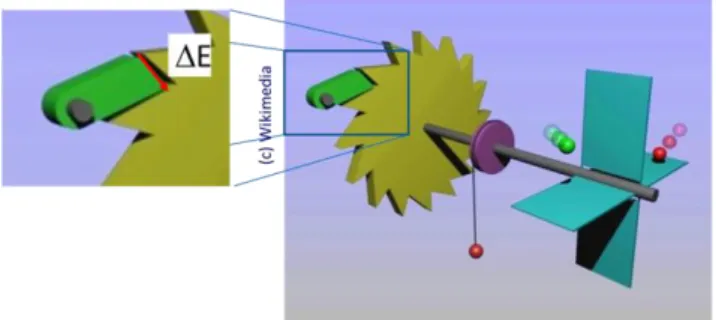
A ratchet is a concept popularized by Richard Feynman[1], in which a dented wheel is designed in such a way that it can rotate in one direction only. The allowed rotation involves a dissipation of E so that the pawl can block the reverse rotation. The wheel can be coupled to blades, which, being sensitive to gas pressure fluctuations, could rotate the wheel so as to lift a weight, thereby producing work from a single heat source (Fig. 1).
Figure 1: The principle of a Feynman Ratchet is illustrated. A
dented wheel is designed in such a way that it can rotate in one direction only. The allowed rotation involves a dissipation of E so that the pawl can block the reverse rotation. The wheel can be
coupled to blades, which, being sensitive to gas pressure fluctuations, could rotate the wheel so as to produce work.
This apparent paradox, which opposes the second law of thermodynamics, can be lifted by a closer look into the details of the device. The pawls has to be loose enough to allow the wheel to rotate at all; but then temperature induced fluctuations, can also lift the pawl, and allow the wheel to rotate backwards. At the end of the day, at constant temperature, the device works as an electrical rectifier where the mechanical torque plays the role of the electric field and the angular velocity that of the electrical current.
It is therefore not surprising to see that such a ratchet system can bring significant insights in the context of solar cells, where the same rectifying behavior allows charge separation and thereby energy conversion. And just as in the case of
Feynman’s ratchet, a closer look on the details of charge separation in a solar cell has led (and still leads) to lively debates concerning the behavior of the ratchet mechanism – in this case, the built-in potential [2], [3].
In this work, we highlight the role of a ratchet system for advanced concepts in PV. We will mainly focus on Intermediate level Solar Cell (IBSC), an advanced concept [4]–[7], that has been predicted to result in efficiencies of about 46.7% under one sun illumination [6]. We show that adding a ratchet system to such a device appears not as a mere improvement, but as a requirement to overcome the Shockley-Queisser limit [8] with materials currently available. Considering electrical figures of merit, we offer a qualitative and quantitative interpretation of the influence of the ratchet on such systems. This analysis can contribute to a better understanding of the physics at stake behind the ratchet mechanism.
II. THEORETICAL MODEL
The IBSC is a concept of device where, in parallel to the direct generation of carriers by absorption of photons, these can be generated in two absorption steps via an intermediate level (Figure ). Nevertheless, photogenerated carriers can also recombine back using the intermediate level, that acts as a catalyst for this reaction. The theoretical performance of IBSC is close to that of triple junctions, series connected, but efficient devices have not been demonstrated yet because of current material limitations in absorption efficiency and bandwidth, and because of non-radiative recombination. In nanostructures (quantum dots (QD) and quantum wells (QW)), which are one of the most considered path to the practical implementation of an intermediate band [9], this can be explained by two intrinsic properties: the reduced absorption energy width between the quantized states and the continuum, as well as increased non-radiative recombinations. As a consequence, a Voc drop and a limited
current increase are commonly observed. We have quantified [10] the impact of those two properties on the expected efficiencies, and highlighted that currently considered
structures are not compatible with efficiencies in excess of the SQ limit.
It has been suggested that a ratchet mechanism can increase the efficiency of an IBSC [10]–[15]. When implemented on the intermediate band (as in Figure (b), although implementation on the conduction or valance band can be also considered [14]), a ratchet consists in an additional state at a slightly lower energy, from which recombination to the valence band is forbidden. In case of reduced absorption strength, it has been further demonstrated that the efficiency reduction becomes less pronounced [14]. However, the effect on the non-radiative recombination has been given less consideration so far [12], despite a Voc loss being regularly
reported in practical realization of IBSC.
(a) (b)
(c)
Figure 2 Band diagram of (a) an IBSC and (b) an RBSC with a ratchet implemented in the IB. (c) Efficiencies of the single junction (full green line), IBSC and RBSC, as a function of the largest gap value (Eg1), in the radiative limit and for an ideal absorption (respectively full orange and blue lines), with a narrow absorption (δE = 250 meV, orange and blue dotted lines), with a narrow absorption and non-radiative recombination ratio of 10-3 for the transition Eg
3 (dashed orange and blue lines).
To account for these effects, the bandgap configuration and the notations of Figure 2 (a) are considered. The limit efficiencies are calculated following a method similar to [13], to which the non-ideal behavior of the nanostructures will be added. For each transition i, the absorption Gi is given
by the convolution of the absorption ai and the sun spectrum,
approximated by the black body radiation flux at a temperature Tsun = 6000 K. We consider the efficiencies in
non-concentrated light. The radiative emission Ri for each
transition i is given by the generalized Planck’s law, for Tcell
= 300 K and using the quasi-Fermi level splitting for each bandgap, Δµi.
The transitions associated with the bandgap Eg1 and Eg2
are considered ideal, that is, a1=1 strictly above Eg1, and a2=1
strictly between Eg2 and Eg1, whereas their recombination is
purely radiative. Non-idealities will be considered for Eg3.
This will mimic the nanostructured devices in which the intermediate band is obtained thanks to quantized states in the conduction band, such as the widely studied InAs QDs in GaAs [9]. For this transition, both absorption and recombination are assumed only between Eg3 and Eg3+δE
where δE is the absorption energy width. Moreover the recombination is increased by considering a radiative recombination ratio rrad such that 𝑅3∗ =
1 𝑟𝑟𝑎𝑑
𝑅3.
The full model can be found in [10], [13], [16]. It is firstly used to numerically compute I-V curves and efficiencies for given sets of bandgaps, which allows finding the best configurations. Another solution is to solve the system analytically, in the framework of Lagrange multipliers, which provides additional equations by explicitly considering the system constraints (matching of the currents through Eg2 and Eg3, Δµ1= Δµ2+Δµ3).
III. RESULTS
On Figure (c) are represented the efficiency as a function of Eg1, for the single junction, the IBSC and the RBSC. The
position of the intermediate level and of the ratchet is optimized for highest efficiency. The full lines represent the efficiencies in the ideal configuration (rrad=1, unlimited δE).
Already in that configuration, it is observed that the implementation of a ratchet can result in an efficiency improvement. When the absorption width is reduced (δE = 250 meV), an efficiency reduction is observed for both the IBSC and the RBSC. When considering in addition a non-radiative recombination ratio of rrad=10-3 for Eg3, we observe
that the IBSC gives efficiencies lower than what can be achieved with the best single junction. Oppositely, we find that the introduction of the reduced radiative efficiency has a negligible impact on the RBSC performances.
A more detailed study [10] shows that a ratchet makes the cell tolerant to non-ideal characteristics, to that point that any value of the absorption width and radiative recombination ratio is compatible with efficiencies in excess of the Shockley-Queisser limit. This result gives new opportunities to realize IBSC with quantum structures. So far, QD have been preferred to QW for the practical implementation of IBSC, since the former are expected to exhibit larger radiative recombination ratios. We show here that when a ratchet system can be included, the reduced radiative efficiency of the QW can be acceptable to overcome the SQ limit, thanks to their larger expected absorption.
For a better understanding of the mechanisms at stake, the Voc, Jsc and FF values are compared in Figure , instead of the
aggregated efficiency value. As could be seen on Fig 2.c, for too small values of Eg1, the optimal situation in the absence
of ratchet aborts the intermediate band and behaves as a single junction. Above this threshold, we observe that the
VOC of the cell including a ratchet keeps values close to that
of the single junction, whereas the standard IBSC shows values reduced by about 10 %. Conversely, the RBSC gives a Jsc close to that of the IBSC, much above that of SJ,
therefore taking advantage of the additional generation from the IB.
Figure 3 Top: Open-circuit voltage, as a function of the Eg1 bandgap, for an IBSC with a ratchet (filled blue symbols) and an IBSC w/o ratchet (open yellow symbols). A narrow absorption (δE
= 250 meV) and non-radiative recombination ratio of 10-3 are considered for the transition Eg3 Middle: same for the short
circuit current. Bottom: same for the FF.
These numerical observations have been supported analytically [16]. It has been shown that the introduction of a ratchet, by offering one additional degree of freedom to the system thanks to the ΔE adjustable parameter, allows for the simultaneous preservation of the open-circuit voltage and the current matching of the transition associated to Eg2 and Eg3.
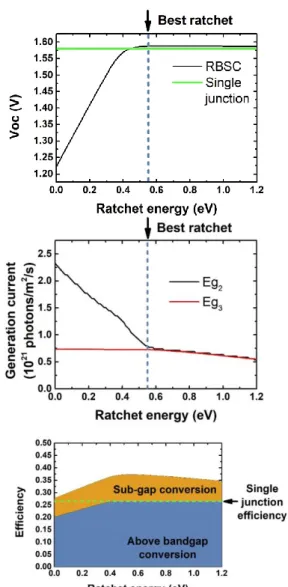
Oppositely, a standard IBSC cannot fulfill those two criteria, resulting in a trade-off providing lower performances. This is illustrated in Figure , where the global open-circuit voltage, the generation through the sub-Eg1 transitions (Eg2
and Eg3) and the energy conversion are represented as a
function of the ratchet energy. For the e nergy conversion graph, we have differentiated the energy provided by the largest gap (Eg1) and the energy provided by the two lowest
gaps (together Eg2 and Eg3). In those graphs, we fixed δE =
200 meV and rrad=10-3. Eg1 is also fixed at 1.86 eV, which is
the value that optimizes the IBSC efficiency. We observe that the ratchet is at the same time able to achieve current matching (G2 equaling G3) and to optimize the
recombination, the Voc reaching a plateau, equivalent to the
single junction at a similar Eg1.
Figure 4 Evolution of recombination, generation and conversion efficiency as a function of the ratchet value, for Eg1 fixed at 1.86 eV, which is the optimal value for an IBSC when the absorption width is 200 meV and the radiative efficiency 10-3. Eg
2 is optimized for each ratchet value. Top: Voc as a function of ratchet energy E. The green line represents the value of the single junction for the same Eg1. Middle: photogenerated current via transition 2 (middle) and 3 (small gap) as a function of E. Bottom: fraction converted by the Eg1 transition and fraction converted with the help of the intermediate band (i.e. converted by Eg2 and Eg3). The green dashed line represents the efficiency of the single junction with the same Eg1.
For an implementation of a ratchet in real world, it is needed that some transitions must be forbidden (Figure ), and this calls for specific selection rules. They may be spatial, in momentum space, or spin related [9]. Structure with quantum cascade, exhibiting spatial separation have been demonstrated experimentally recently [17] . Structures using spin selection rules could be realized in principle with dilute magnetic semiconductors [12], albeit in practice it is hard to obtain long minority carrier lifetimes and high Curie temperatures in these materials. Finally, another unexplored possibility is some 2D materials (MoS2 nanoribbons) that
could exhibit relevant selection properties in reciprocal space [18].
These conclusions were obtained with detailed balance calculations using the generalized Planck law. When more elaborate models are used, such as NEGF are used [19], an additional Voc loss is found due to broadening of the final
states that leads to increased recombination. Moreover, Jsc
losses from lower optical absorption were also found.
IV.
DISCUSSIONSeveral interpretations are often considered to explain the influence of a ratchet. It is sometimes argued that the ratchet induces an energy dissipation ΔE as carriers relax from the top to the bottom of the shifted intermediate band. However, this picture does not hold when considering the full process driving a carrier from the valence to the conduction band. In an IBSC, when absorbing two photons with energies 𝐸𝛾1 and
𝐸𝛾2, the carrier will dissipate (𝐸𝛾1− 𝐸𝑔2) when relaxing after the first transition from VB to IB and (𝐸𝛾2− 𝐸𝑔3) when
relaxing after the second transition from IB to CB. In an RBSC, the carrier would first dissipate (𝐸𝛾1− 𝐸𝑔2), then ΔE
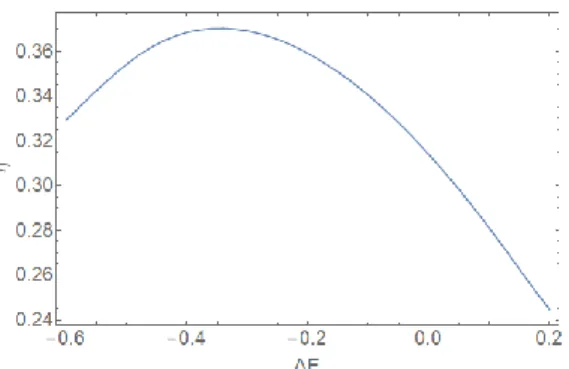
through the ratchet, then (𝐸𝛾2− (𝐸𝑔3+ ΔE)) over the second transition. The total amount of dissipated energy is unchanged; what changes is the band in which this energy is dissipated, and the spectral range of absorbed photons. It is also worth noting that, in some conditions, the optimal ratchet can be negative (see Figure 5). In this case, carriers brought to the intermediate band have to climb up a potential barrier, gathering energy from the ambient temperature, before they undergo a second transition to the conduction band. This situation occurs when photogeneration G3 is initially so low that its increase compensates the additional recombination induced by ΔE<0. While this situation is purely conceptual (an appropriate treatment would require considering the influence of populations on the absorptivity), it highlights the limits of an interpretation based on relaxation.
Figure 5 Power conversion efficiency as a function of the ratchet
ΔE in the ideal case with Eg1 = 2 eV and Eg2 = 1.1 eV.
Ratchet have also been suggested to reduce the “Boltzmann” entropy creation [13], which is due to the geometrical mismatch between the absorption and emission optical étendues. As concentration is increased, it appears indeed that the role of the ratchet becomes more and more limited in the ideal case [13], even if a direct link with the absorption and emission étendues mismatch is not obvious. This numerical observation on the impact of concentration
can be expanded with the other non-idealities considered above. We have found that the ratchet remains useful even under full concentration when non-radiative recombination (which produce additional entropy) are included, but not when considering a narrow absorption (which does not produce additional entropy). While there is a clear role of the ratchet energy to improve net current photogeneration through the IB while keeping current matching, the numerical observation above may also support the idea that the ratchet helps mitigating entropy production in the system.
V. CONCLUSION
We have discussed the ratchet analogy that has been proposed in the context of intermediate band solar cell. In this course, we have quantified the impact of non-radiative recombination and reduced absorption on the efficiency of nanostructured IBSC. The impact of those two intrinsic deficiencies result in strong performance reductions, unless an electronic ratchet is introduced, in which case efficiencies in excess of the SQ limit can be expected.
We have analyzed in depth the origin of the action of the ratchet on efficiency and concluded after careful examination of the proposed explanations that the main actions are (i) matching of the currents in the 2 step photogeneration process and (ii) reduction of the recombination losses. These conclusions were obtained with detailed balance calculations using the generalized Planck law. When more elaborate models are used, such as NEGF, other factors affecting recombination and generation were found that also serendipitously pointed out to additional beneficial action of the ratchet.
REFERENCES
[1] R. Feynman, R. Leighton, and S. Matthew, “Ratchet and pawl,” in The Feynman Lectures on Physics. Volume I: Mainly mechanics, radiation, and heat, Addison–Wesley, 1964. [2] U. Wurfel, A. Cuevas, and P. Wurfel, “Charge Carrier Separation in Solar Cells,” IEEE J. Photovolt., vol. 5, no. 1, pp. 461–469, Jan. 2015.
[3] P. Würfel and U. Würfel, Physics of solar cells: from basic principles to advanced concepts, 2nd, updated and expanded ed ed. Weinheim: Wiley-VCH, 2009.
[4] M. Wolf, “Limitations and Possibilities for Improvement of Photovoltaic Solar Energy Converters: Part I: Considerations for Earth’s Surface Operation,” Proc. IRE, vol. 48, no. 7, pp. 1246–1263, Jul. 1960.
[5] M. J. Keevers and M. A. Green, “Efficiency
improvements of silicon solar cells by the impurity photovoltaic effect,” J. Appl. Phys., vol. 75, no. 8, pp. 4022–4031, Apr. 1994. [6] A. Luque and A. Martí, “Increasing the efficiency of ideal solar cells by photon induced transitions at intermediate levels,” Phys. Rev. Lett., vol. 78, no. 26, p. 5014, 1997. [7] J.-F. Guillemoles and S. Kettemann, “Limiting
efficiencies of LDS intermediate band solar cells,” in Proceedings of the 13th European Photovoltaic Solar Energy Conference and Exhibition, Nice, 1995, pp. 119–121.
[8] W. Shockley and H. J. Queisser, “Detailed Balance Limit of Efficiency of p‐n Junction Solar Cells,” J. Appl. Phys., vol. 32, no. 3, pp. 510–519, Mar. 1961.
[9] Y. Okada et al., “Intermediate band solar cells: Recent progress and future directions,” Appl. Phys. Rev., vol. 2, no. 2, p. 021302, Jun. 2015.
[10] A. Delamarre, D. Suchet, N. Cavassilas, Y. Okada, M. Sugiyama, and J.-F. Guillemoles, “An Electronic Ratchet Is Required in Nanostructured Intermediate-Band Solar Cells,” IEEE J. Photovolt., pp. 1–7, 2018.
[11] T. Trupke, M. A. Green, and P. Würfel, “Improving solar cell efficiencies by up-conversion of sub-band-gap light,” J. Appl. Phys., vol. 92, no. 7, pp. 4117–4122, Oct. 2002.
[12] P. Olsson, C. Domain, and J.-F. Guillemoles, “Ferromagnetic Compounds for High Efficiency Photovoltaic Conversion: The Case of AlP:Cr,” Phys. Rev. Lett., vol. 102, no. 22, Jun. 2009.
[13] M. Yoshida, N. J. Ekins-Daukes, D. J. Farrell, and C. C. Phillips, “Photon ratchet intermediate band solar cells,” Appl. Phys. Lett., vol. 100, no. 26, p. 263902, Jun. 2012.
[14] A. Pusch et al., “Limiting efficiencies for intermediate band solar cells with partial absorptivity: the case for a quantum ratchet: Limiting efficiencies for intermediate band solar cells,” Prog. Photovolt. Res. Appl., vol. 24, no. 5, pp. 656–662, May 2016.
[15] M. A. Green and S. P. Bremner, “Energy conversion approaches and materials for high-efficiency photovoltaics,” Nat. Mater., vol. 16, no. 1, pp. 23–34, Jan. 2017.
[16] D. Suchet et al., “Analytical optimization of intermediate band systems: Achieving the best of two worlds,” Prog. Photovolt. Res. Appl., vol. 26, no. 10, pp. 800–807, Oct. 2018.
[17] A. Vaquero-Stainer et al., “Semiconductor nanostructure quantum ratchet for high efficiency solar cells,” Commun. Phys., vol. 1, no. 1, p. 7, Mar. 2018.
[18] S.-F. Chen and Y.-R. Wu, “A design of intermediate band solar cell for photon ratchet with multi-layer MoS2 nanoribbons,” Appl. Phys. Lett., vol. 110, no. 20, p. 201109, May 2017.
[19] N. Cavassilas et al., “Beneficial impact of tunneling in nano-structured intermediate-band solar cell,” Submitt. EPJ Photovolt., 2018.