HAL Id: hal-02992980
https://hal.archives-ouvertes.fr/hal-02992980
Submitted on 19 Nov 2020HAL is a multi-disciplinary open access
archive for the deposit and dissemination of sci-entific research documents, whether they are pub-lished or not. The documents may come from teaching and research institutions in France or abroad, or from public or private research centers.
L’archive ouverte pluridisciplinaire HAL, est destinée au dépôt et à la diffusion de documents scientifiques de niveau recherche, publiés ou non, émanant des établissements d’enseignement et de recherche français ou étrangers, des laboratoires publics ou privés.
Fun with Flags and Chemistry
Christophe Coudret, Nicolas Dietrich
To cite this version:
Christophe Coudret, Nicolas Dietrich. Fun with Flags and Chemistry. Journal of Chemical Education, American Chemical Society, Division of Chemical Education, In press, �10.1021/acs.jchemed.0c00514�. �hal-02992980�
ACCESS
*
3ABSTRACT: The purpose of this study is to present a learning 4activity that combines the simultaneous practice of geography and 5chemistry. It is a game activity based on the identification of 6national flags and colored molecules (from the famous CPK 7model), with an extension to the creation of imaginaryflags from 8real, useful molecules for middle school, high school, and university 9classrooms. The goal of using a game is to motivate/involve 10learners, to encourage them to work and develop adaptability and 11responsiveness by practicing chemistry and geography components. 12The feedback received from students who participated in this 13exercise during the 2019−2020 academic year has been evaluated 14and shows an increase of motivation and critical thinking. The 15objective is to make students more aware of geopolitics, to engage
16discussion on their awareness of the world, and to prepare them to play an active role in it.
17KEYWORDS: Humor/Puzzles/Games, Pedagogy, Interdisciplinary/Multidisciplinary, Domain, General Public, Audience, 18History/Philosophy, Domain, Molecular Properties/Structure, Topics
19
■
INTRODUCTION20If we are to face the great challenges of the 21st century1,2(clean 21energy, sustainable cities, climate action, good health, etc.), a 22new approach is required for education.3−5The next generation 23will have to solve important national or global problems to create 24the industries and jobs of the future; expand the frontiers of 25human knowledge about ourselves and the world around us; and 26tackle important problems related to energy, health, education, 27the environment, national security, and global development. 28Interaction between social sciences and natural sciences is a 29necessary condition for success in this endeavor and an 30important part of the modernization of the educational process 31in regard to these challenges. For example, the new technologies 32and devices that enriched our lives in the 21st century require 33rare earth metals.6Future engineering should be sensitive to the 34planet’s natural resources,7their location, the reserves available, 35and possible substitute products. Therefore, teaching the next 36generation will require a multidisciplinary approach:8 a 37combination of natural science, technology, innovation, and 38social science to help them face the challenge of managing the 39world’s resources. Some educators have already developed 40innovative, multidisciplinary approaches9 to teaching geogra-41phy, chemistry, and ecology together,10 or combining 42geography, math, and science to teach climate change and sea 43level rise.11 The results of this research suggest that most 44students view such developments positively and recognize that 45they bring many advantages, such as critical thinking and a 46broadening of their knowledge horizons.12In the perspective of 47developing a new educative activity in this direction, humanities
48
and chemistry could be associated, and this paper presents an
49
original, engaging activity to help students to connect chemistry
50
and geography. It was developed on a game based on
51
recognizing flags with simple chemical molecules and is
52
named“Fun with Flags” in reference to episode 14 of the fifth
53
season of The Big Bang Theory,13an American television sitcom
54
created by Chuck Lorre and Bill Prady in 2007, where two of the
55
main characters present a YouTube podcast on the topic of
56
vexillology14(term created by Whitney Smith in 1958 from the
57
Latin word vexillum/”flag” and the Greek suffix -logia /”study”)
58
named “Sheldon Cooper Presents: Fun With Flags”. In this
59
fictional video podcast, several “fun facts” about flags, such as the
60
shape, the presence of animals, or the origins of theflags, are
61
presented in an entertaining way. Using pop-culture
refer-62
ences15−18 is an interesting approach to improve students’
63
motivation,17and several educators have developed educational
64
games19−22 to involve students in interactive, entertaining
65
activities.23Games are an excellent method of active learning in a
66
recreational environment,24 and many methods have been
67
tested in the past decade:25a word game,26quiz games,27−35
68
card games,36−38dice games,39,40board games,41−46computer
69
games,47−49 memory/concentration games,50−52 and even
Received: May 24, 2020 Revised: September 19, 2020
© XXXX American Chemical Society
A
https://dx.doi.org/10.1021/acs.jchemed.0c00514 J. Chem. Educ. XXXX, XXX, XXX−XXX
70escape games.53−58,58−61All of these educators have succeeded 71in creating a recreative environment improving the student’s 72engagement and motivation for science.
73 The link between flags and chemistry has already been 74attempted by educators, only on the basis of the chemistry 75necessary to produce the colored dyes.62
76 Some authors have tried to connect objects with molecules in 77order to create a recreative environment, such as structural 78chemical formulas with human forms (called NanoPurtians),63 79monsters (NanGobelin),64or racing car shapes.65,66The goal of 80these studies was to educate children in the sciences in an 81effective and enjoyable manner. They have made several videos 82featuring the NanoPutians as anthropomorphic animated 83characters. In order to relate vexillology with chemistry, and in 84the following of these chemistrymorphisms, we propose to create 85a game on the manipulation of colored atoms looking like the 86realflags. In 1952, Corey and Pauling published a description of 87space-filling models of proteins and other biomolecules that they 88had been building at Caltech.67Their models represented atoms 89by faceted hardwood balls, painted in different colors to indicate 90the component chemical elements. Their color scheme included 91the following: white for hydrogen, black for carbon, blue for f1 92nitrogen, and red for oxygen (Figure 1a). In 1965, Koltun 93patented68 an improved version of the Corey and Pauling 94modeling technique. In his patent, he added several colors: 95yellow for sulfur, purple for phosphorus, green for the halogens 96(F, Cl, Br, I), and silver for metals. This model is known as the 97CPK model (for Corey, Pauling, and Koltun). Several of the 98CPK colors refer mnemonically to colors of the pure elements or 99notable compounds (hydrogen is a colorless gas; carbon, as 100charcoal, graphite, or coke, is black; sulfur powder is yellow; 101chlorine is a greenish gas; etc.). This molecular model is typically 102used by students in introductory organic chemistry courses to 103represent bonds and atoms with small plastic polygons or 104spheres,69,70 and the models are helpful when students are 105learning about molecular geometry and stereochemistry. This 106paper describes an activity to link national flags to simple 107chemical molecules of the same color (according to the CPK 108code) in order to make students manipulate geography and 109chemical concepts simultaneously. This activity can be done 110remotely for distance learning7,54,60,71from middle school to
111
university level (with an adaptation of the discussion, see the
112
Discussionsection).
113
■
RELATIONSHIP BETWEEN FLAGS AND THE CPK114
MODEL
115
There are numerousflags in the world, representing the different
116
geographical, ethnic, religious, and national groups of
human-117
kind. Aflag is more than an image or a scrap of fabric, it can be a
118
part of an individual’s identity and a visual representation of a
119
collective. According to the United Nations, there is a total of
120
193 sovereign states in the world (and 2 observers states), and
121
each one has a recognizable nationalflag.72The most frequent
122
type is the three-coloredflag (40% of flags), followed by
two-123
and four-coloredflags (20% each).73Red is the most widely used
124
color by percentage surface area and by number offlags (Figure
125
1b). The second color in the ranking is not the same by area and
126
by frequency (blue or white), as shown in Figure 1b,c. It is
127
noteworthy that the colors originally chosen for the CPK model
128
are very similar to the colors present in theflags of the world’s
129
nations.
130
It is also worth noting that there is a similarity in value for
131
some colors/atoms between the presence inflags and presence
132
in the universe. For example, the hydrogen atom (white in the
133
CPK model) is present at 70.57% in the universe and appears in
134
72.92% of the flags while the phosphorus atom (purple) is
135
present at less than 0.1% in the universe or in national flags
136
(purple is used only in theflags of Spain, Nicaragua, and Sri
137
Lanka and in a small proportion). This demonstrates a good
138
probability of identifying flags and molecules with the same
139
colors. The only exception is for the color orange, which is not
140
included in the original CPK model but is present in 4.6% of
141
flags (1.2% of surface area), excluding flags of Ireland, India,
142
Côte d’Ivoire, and a few other countries from our analysis. In
143
vexillology there are many geometricalflag designs: cantons (a
144
flag divided in four equal quarters), pales (a flag divided into 2 or
145
3 vertical bands), fesses (a flag divided into three horizontal
146
bands), saltire (aflag with a diagonal cross), and Scandinavian
147
cross (aflag with a cross, the vertical arm of which is positioned
148
more toward the hoist). Two thirds of all nationalflags include
149
the use of symbols (sometimes even more than one) such as a
150
star (30%), emblem (14%), cross (9%), sun (8%), or crescent
151
(7%). Most flags are based on a simple formula of colors,
Figure 1.(a) CPK model. (b) Mass fraction in the universe in % plotted against the percentage offlags containing the color. (c) Representation of the atom fraction in parts per million in the universe plotted against the percentage offlags containing the color (refs73and74). Hydrogen mass fraction in the universe is 70.57%, and white is present in 72.92% offlags and in 19.12% of the surface.
Journal of Chemical Education pubs.acs.org/jchemeduc Activity
https://dx.doi.org/10.1021/acs.jchemed.0c00514 J. Chem. Educ. XXXX, XXX, XXX−XXX
166activity, the teacher invited all students to evaluate the activities 167by completing an online form in French containing 10 questions 168with responses based on the Likert75 scale. Participants were 169approached twice by email, and the response rate was 80%. The 170data from the online surveys were entered into a Microsoft Excel 171spreadsheet and were collated. All responses were analyzed, and 172the results are presented in the next section.
173
■
ACTIVITY174The core of the activity is based on quizzes concerning the 175identification of the country from a simple molecule 176representing the associatedflag. The objectives of the activity 177are to make student practice the CPK model (memorizing color 178and atoms), to manipulate the molecular geometry (VSEPR 179theory), and also to initiate discussions on resource localization 180and geopolitics and culture and history. We willfirst restrict the 181activity to band typeflags with one to four colors in order to 182propose perfect matching or quasiperfect matching between the 183flags and chemical molecules of 1−4 atoms, and we will neglect 184all the symbols (emblem, cross, coat of arms, etc.) or differences 185in shape ratio to simplify the problem. After what was, to the best 186of our knowledge, a complete analysis of all nationalflags, we 187found only 10 “perfect matches” between existing flags and 188existing chemical compounds, with the right color, the right 189order of the colors, and the correct number of colors (4 for 190bicolor flags, and 6 for tricolor flags) and 20 quasiperfect 191matches (where the colors were correct but not the number of f2 192colors or the order of the colors).Figure 2depicts the 10“perfect 193matches”: from left to right, the flags are Gabon (Figure 2a, it 194could also work for Rwanda in the reverse order), Estonia 195(Figure 2b), Monaco/Indonesia/Singapore (Figure 2c; it could 196work for Poland in the reverse order), Algeria (Figure 2d; it 197could also work for Pakistan in the reverse order and Wales with 198a rotation), Russia/Slovakia/Slovenia (Figure 2e), Spain 199(Figure 2f), Romania/Moldavia/Chad (Figure 2g), Belize 200(Figure 2h), Nigeria (Figure 2i), and Portugal (Figure 2j; it 201could also work for Burkina Faso with a 90° rotation). The 202molecules used to recreate theflags are given in the legend of the 203figure.
204 Thisfirst series of flags is considered as easy due to the perfect 205match of color/order/number of colors between aflag and its 206CPK representation. It allows a total of 16 countries to be 207manipulated (depending on the orientation of the molecule). 208This series provides a good introduction to the activity and 209permits a focus on the similarity of certainflags in the world. 210 The second series concerns quasiperfect matching, where the 211number of atoms and their colors are identical to the number of
212
bands and the colors of an existingflag, but not the order. The
213 f3
difficulty is thus greater than in the first series.Figure 3depicts 5
214
“quasiperfect matches”. From left to right, the flags are Austria/
215
Peru (Figure 3a), Belgium/Germany (Figure 3b), Bulgaria/
216
Italy/Hungary/Iran/Mexico/Tajikistan (Figure 3c), Mauritius
217
(Figure 3d), and Barbados (Figure 3e). The molecules used to
218
recreate theflags are given in the legend of the figure.
219
Note that “perfect match” flags could also be used for
220
“quasiperfect” matching:Figure 2e could be used in that context
221
for the flags of France/Netherlands/Luxemburg/Croatia/
222
Czech Republic, andFigure 2e could be used for the flags of
223
Colombia/Ecuador/Armenia/Venezuela. This second series of
224
flags allows a total of 20 supplementary countries to be
225
manipulated. The difficulty is higher due to the fact that colors
226
are not in the right order, but as there is often more than one
227
solution for each molecule, the possibility of success is good. The
228
third series proposed concerns the“imperfect matches” where
229
the color of theflags and the molecules are the same, but the
230
order or the number of colors are not correct, making this
231 f4
category the hardest one. Figure 4 depicts the 17 “imperfect
232
matches”. Starting with the band flag, at the top, from left to
233
right: Somalia (Figure 4a), Argentina/Salvador/Guatemala/
234
Honduras/Israel (Figure 4b), Vatican (Figure 4c), Bolivia/
235
Lithuania/Cameroon/Republic of the Congo/Guinea/Mali/
236
Senegal/Ethiopia/Myanmar (Figure 4d), Sierra
Leone/Uzbeki-cyanide; (c) Monaco/Indonesia/SingaporeOH− hydroxide; (d) AlgeriaHCL hydrochloric acid; (e) Russia/Slovakia/Slovenia HNO nitroxyl; (f) SpainOSO sulfur dioxide; (g) Romania/Chad/ Moldavia/AndorraOSN−sulfinylazanide; (h) BelizeNO2−nitrite;
(i) NigeriaHF2−bifluoride; (j) PortugalClO−hypochlorite.
Figure 3.Molecularflags built with the CPK model for: (a) Austria/ PeruOHO hydroperoxyl; (b) Belgium/GermanyOCS carbonyl sulfide; (c) Bulgaria/Italy/Hungary/Iran/Mexico/TajikistanHClO hypochlorous acid; (d) MauritiusClNOS sulfinylamino chloride; (e) BarbadosN2S dinitrogen-N-sulfide.
https://dx.doi.org/10.1021/acs.jchemed.0c00514 J. Chem. Educ. XXXX, XXX, XXX−XXX
237stan/Lesotho (Figure 4e), Yemen/Egypt/Syria/Iraq (Figure 2384f), Azerbaijan (Figure 4g), and Malawi/Afghanistan/Libya 239(Figure 4h, which also works for the Pan-Africanflag). This 240series adds more than 27 countries, to give a total of 64 (triband 241flags that can be linked to a simple chemical molecule with 242several levels of difficulty).
243 In order to complete the analysis with nonband flags, 244including all the elements present in the flag this time, some 245other shapes are presented inFigure 4: at the bottom, from left 246to right, Brazil (Figure 4i), Ukraine/Congo/Kazakhstan/ 247Sweden (Figure 4j, which also works for the European Union 248flag), Oman (Figure 4k), Turkey/Tonga/Switzerland/Tunisia/ 249Japan/Denmark/Canada/Bahrein (Figure 4l), China/Kyrgyz-250stan/North Macedonia/Vietnam (Figure 4m), Bahamas (Figure 2514n), South Korea (Figure 4o), Jamaica (Figure 4p), and South 252Africa (Figure 4q, which also works for the Olympicflag). This 253last series, which adds 23 extra countries, is more complicated to 254solve due to the complexity of certainflags such as those of Brazil 255or South Africa. A full table is proposed in the Supporting 256Informationin order to list all the combinations of color possible 257with simple molecules for the 186 states of the United Nations. 258Another series offlags is also proposed. It is the most difficult 259one, based onflags that no longer exist. For this section, special 260attention has been paid to unicolor flags, which is open to 261discussion for specific molecules. This category implies 262matching the flag with a homonuclear molecule (molecule 263composed of only one type of element). The most familiar 264homonuclear molecules are diatomic (they consist of two 265atoms): hydrogen (H2), oxygen (O2), nitrogen (N2), and all the 266halogens (an easy-to-remember mnemonic for the diatomic 267elements is “Have No Fear Of Ice Cold Beer” for hydrogen, 268nitrogen, fluorine, oxygen, iodine, chlorine and bromine). 269Ozone (O3) is a triatomic homonuclear molecule and
270
phosphorus (P4) a tetratomic molecule. Allotropes are different 271
chemical forms of the same element (not containing any other
272
element) that are homonuclear: sulfur forms several allotropes
273
containing different numbers of sulfur atom (S2, S3, S6, S8)
274
forms. The element carbon is known to have several
275
homonuclear molecules, including diamond and graphite.
276
With these particular molecules, it is possible to establish
277
single-color flags. Although no monocolor flags exist at the
278
present time, there have been several in the past, as presented
279 f5
with the last series offlags inFigure 5.
280
Figure 5depicts the 5“lost flags”, starting with the monocolor
281
flags: from left to right, the flag of the former Kingdom of France
282
(1814−1830) inFigure 5a (it could also work for the flag of
283
peace or surrender), the former flag of the Maldives (1796−
284
1903) inFigure 5b (thisflag could also be used as an imperfect
285
match for Morocco), the formerflag of Libya (1944−1971) in
286
Figure 5c, the bandflag of the former Russian Empire (1858
287
1883) inFigure 5d, the formerflag of Zanzibar (January−April
288
1964) inFigure 5e, and the formerflag of Belarus (1991−1995),
289
the last two of which are also perfect matches. This last series
290
enables the student to manipulate specific homonuclear
291
molecules and may also lead on to a discussion on the effect
292
of political events and regime changes (royalty to democracy)
293
that could lead to a change of the nationalflag. This last series
294
also provides the opportunity to manipulate well-known
295
molecules such as water (H2O), which is one of the most
296
famous molecules in the world. In order to encompass as many
297
of the known molecules as possible, a last series is proposed. In
298
this series, it is not the molecule that is represented but afictional
299
flag created on the basis of an existing well-known molecule. The
300 f6
8 imaginaryflags that can be found are depicted inFigure 6and
301
complete the list of famous molecules already used in the
302
previous series (HCl, HCN, HClO, etc.).
303
These molecules can lead to a specific discussion on the
304
complex shapes of flags and specific elements of vexillology
305
(stripes, triangle, circle) and introduce the rare color purple.
306
Discussion of the production of each molecule and the
307
production locations in real countries is also possible. CPK
308
colors are concentrated in the nonmetal part of the periodic
309
table. To achieve brightly colored edifices, one should then
310
imagine combinations with this restricted group of elements.
311
This can lead to an interesting exploration of chemical literature:
312
are such combinations stable? When have they been prepared?
313
What for? What are their properties?
Figure 4.Molecularflags built with the CPK model for (a) Somalia N2nitrogen; (b) Argentina/Salvador/Guatemala/Honduras/Israel
NH3 ammonia; (c) VaticanH2S hydrogen sulfide; (d) Bolivia/
Lithuania/Cameroon/Republic of the Congo/Guinea/Mali/Senegal/ Ethiopia/MyanmarCl2OS thionyl chloride; (e) Sierra Leone/
Uzbekistan/LesothoNH2Cl chloramine; (f) Yemen/Egypt/Syria/
IraqCH2O formaldehyde; (g) AzerbaijanClNO nitrosyl chloride;
(h) Malawi/Afghanistan/LibyaCCl2O phosgene; (i) Brazil
H2ClNS amino thiohypochlorite; (j) Ukraine/Congo/European
Union/Kazakhstan/SwedenN2S dinitrogen-N-sulfide; (k) Oman
HClO hypochlorous acid; (l) Turkey/Tonga/Switzerland/Tunisia/ Japan/Denmark/Canada/Bahrein OH− hydroxide; (m) China/ Kyrgyzstan/North Macedonia/VietnamSO sulfur monoxide; (n) BahamasCN2S thiocyanamide; (o) South KoreaCHNO cyanic
acid; (p) JamaicaCCl2S thiophosgene; (q) South Africa/Olympic
FlagCH2ClNOS N-sulfanylcarbamoyl chloride.
Figure 5.Molecularflags built with the CPK model for: (a) Kingdom of France (1814−1830)H2 hydrogen; (b) Maldives (1796−1903)
O2oxygen; (c) Libya (1944−1971)Cl2chlorine; (d) Russian Empire
(18581883)CH2S thioformaldehyde; (e) Zanzibar (January−
April 1964)CClN cyanogen chloride; (f) Belarus (1991−1995) H2O water.
Journal of Chemical Education pubs.acs.org/jchemeduc Activity
https://dx.doi.org/10.1021/acs.jchemed.0c00514 J. Chem. Educ. XXXX, XXX, XXX−XXX
314
■
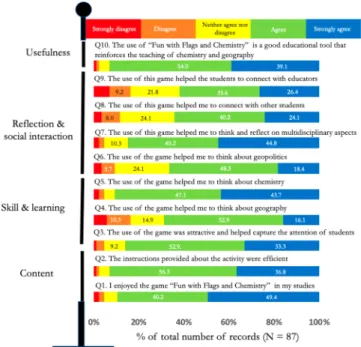
DISCUSSION315From all of these series of flags, simple quizzes could be 316organized with the students, where the objective is tofind what 317molecule and what country (or countries) is (are) represented 318by each molecularflag. Some variations could be done to adapt 319the level of the activity from middle school to university such as 320letting (or not) the students have access to a database offlags in 321order tofind the most difficult ones and even to an encyclopedia 322to identify flags from earlier times (see the Supporting 323Information). Teachers can let each student draw a molecule 324at random and let them find the corresponding flag, and the 325different characteristics of the country, and of the molecule. 326After the game, questions can be raised, based on the 327identification of capitals, continents, and the molar weight or 328the applications of the chemical compounds. It is also an 329opportunity to address the question of resources and its 330localization and about the gross domestic product (GDP) of 331each country. Moreover, combined questions can be elaborated 332such as“In which continent is Thiophosgene?” (Thiosphosgene 333is Jamaica; answer is “america”), “What is the most Belgian 334molecule?” (answer is “carbonyl suflide”), “Propose an existing 335molecule with the most common color combination (and name 336the country)” (there are 30 countries with the red−blue−white 337combination; see the list in theSupporting Informationsection), 338“What is the most populated molecule?” (sulfur monoxide 339corresponding to the Chinese flag) or “What is the molecule 340with the higher GDP?”. According to the level targeted, and as a 341variation for the postgame discussion, a list of some of the 342countries/capitals/molecules can be proposed in front of 343molecularflags to create a matching game. Whatever the results 344of the game, the objective remains to practice basic knowledge of 345worldflags and manipulation of the CPK model representation. 346 Students from two separate courses used the game activity and 347were surveyed after the activity with responses based on the f7 348Likert75scale (Figure 7). The response rate was 95%. In general, 349all statements showed high levels of agreement (“agree” and 350“strongly agree”), ranging from 62.1% to 93.1% of those 351surveyed.
352 A majority of students (89.7%) enjoyed the use of“Fun with 353Flags” in the courses and thought it was attractive and helped 354capture their attention (86.2%) while 81.6% also agreed that 355using this game helped them make connections between the 356theoretical aspects of courses in geography (69%), chemistry 357(90.8%), and geopolitics (69.0%). Fewer students (66.7%)
358
agreed that this activity helped them to develop a
multi-359
disciplinary outlook.
360
It is worth noting that a majority thought that this activity
361
helped them to connect with other students (64.4%) and also
362
with educators (62.1%). Finally, a large majority (93.1%) think
363
that“Fun with Flags and Chemistry” is an excellent educational
364
tool that can be used to practice chemistry and geography
365
simultaneously. Using“Fun with Flags and Chemistry” is thus
366
beneficial for the classroom because it creates engaging links
367
between chemical concepts and geography, and between
368
educators’ and students’ interests. The objective is to connect
369
the student’s knowledge in the two disciplines and to initiate
370
discussions/debate on geopolitical aspects of both. Geography
371
education research has worked hard to remove itself from the
372
common misconception of geography education relating to
373
memorizing (countries, capitals, and state/nationalflags). Here,
374
theflag identification is not the end of the activity, it is a pretext
375
to practice and manipulate CPK code and to discuss on
376
geopolitics in a recreative environment; it is then an original
377
approach for more discussion on advanced and modern topics.
378
Work can then be extended after the activity to think more
379
deeply about where resources are located, independence of
380
resources, global politics concerning resources, and the future
381
societal challenge linked with the abundance of chemical
382
compounds.
383
Educators need to be careful to open the boundaries of this
384
activity so as to unleash the students’ curiosity to think about
385
facing these future problems. It is also important to leave the
386
students free to search for information on chemistry, geography,
387
or even history during projects/activities using all types of
388
media, recent or not. Finally, combining geography and
389
chemistry promotes critical thinking and develops skills in
390
humanities, which will be important throughout the students’
391
lives.
CO2carbon dioxide; (d) HNO3nitric acid; (e) H2SO4sulfuric
acid; (f) CH4methane (g); C7H14heptane.
Figure 7.Student responses relating to the use of“Fun with Flags and Chemistry”. Total number of respondents = 87 (academic year 2019/ 2020).
https://dx.doi.org/10.1021/acs.jchemed.0c00514 J. Chem. Educ. XXXX, XXX, XXX−XXX
392
■
CONCLUSION393The objective of this paper is to present an original way to 394practice chemistry and geography simultaneously. The activity is 395based on the similarities of color observed in world nationalflags 396and in simple molecular models. With some simplifying 397hypotheses (band flags, approximation of colors, and neglect 398of coats of arms and symbols), and after a precise analysis of 399almost 200 nationalflags, several series of molecular flags have 400been proposed with several levels of difficulty, from perfect 401matching of colors, their number, and their order, to imperfect 402matching considering color matches only. These series were 403used as a base for a quiz game where the objective was to identify 404the country corresponding to the molecularflag. The feedback 405received from students that participated in this exercise has been 406evaluated and indicates an increase in motivation through such 407activities and their acceptance as a good multidisciplinary tool. 408The game was seen as a good exercise for practicing chemistry 409and geography, breaking down frontiers between disciplines, 410engaging students, and raising their awareness of the world’s 411challenges. Such a combination of disciplines made it possible to 412start discussions about locations of resources and geopolitical or 413societal challenges of the future. The activity helped students to 414connect together, and to develop their own curiosity and 415creativity. It could be adapted to regional flags or those of 416province/state. To conclude,“Fun with Flags and Chemistry”, 417thefirst ever attempt of chemo-vexillology, offers a wide range of 418possibilities for involving students in the classroom, from games 419to critical thinking, and from basic chemistry to human sciences. 420
■
ASSOCIATED CONTENT421
*
sı Supporting Information422The Supporting Information is available at https://pubs.ac-423s.org/doi/10.1021/acs.jchemed.0c00514.
424 List of combination for the representation of the 195 UN 425 nationsflags (PDF,DOCX)
426
■
AUTHOR INFORMATION 427Corresponding Authors428 Christophe Coudret − Interactions Moléculaires et Réactivité 429 Chimique et Photochimique (IMRCP), Université de Toulouse, 430 CNRS, UPS, Toulouse 31063, France; orcid.org/0000-431 0001-7334-5112; Email:[email protected] 432 Nicolas Dietrich − Toulouse Biotechnology Institute (TBI), 433 Université de Toulouse, CNRS, INRA, INSA, Toulouse 31077, 434 France; orcid.org/0000-0001-6169-3101;
435 Email:[email protected];ndietrich.com 436Complete contact information is available at:
437https://pubs.acs.org/10.1021/acs.jchemed.0c00514 438Notes
439The authors declare no competingfinancial interest. 440
■
REFERENCES(1)
441 Tjoa, A. M.; Tjoa, S. The Role of ICT to Achieve the UN 442Sustainable Development Goals (SDG). In ICT for Promoting Human
443Development and Protecting the Environment; Mata, F. J., Pont, A., Eds.; 444IFIP Advances in Information and Communication Technology;
445Springer International Publishing: Cham, 2016; pp 3−13,
446DOI: 10.1007/978-3-319-44447-5_1.
(2)
447 Borthakur, A.; Singh, P. Sustainability Sciencebelow and above
448the Ground as per the United Nation’s Sustainable Development Goals.
449
In Climate Change and Soil Interactions; Prasad, M. N. V., Pietrzykowski,
450
M., Eds.; Elsevier, 2020; pp 453−471, Chapter 17, DOI: 10.1016/ 451
B978-0-12-818032-7.00017-5.
(3)Petersen, B.; Barnes, J. R. From Hopelessness to Transformation 452 453
in Geography Classrooms. Journal of Geography 2020, 119 (1), 3−11. (4)Hupy, J. P. Teaching Geographic Concepts Through Fieldwork 454
455
and Competition. Journal of Geography 2011, 110 (3), 131−135. (5)Anthamatten, P.; Bryant, L. M. P.; Ferrucci, B. J.; Jennings, S.; 456
457
Theobald, R. Giant Maps as Pedagogical Tools for Teaching
458
Geography and Mathematics. Journal of Geography 2018, 117 (5),
459
183−192.
(6) Massari, S.; Ruberti, M. Rare Earth Elements as Critical Raw 460 461
Materials: Focus on International Markets and Future Strategies.
462
Resour. Policy 2013, 38 (1), 36−43.
(7) Dietrich, N.; Kentheswaran, K.; Ahmadi, A.; Teychené, J.; 463 464
Bessière, Y.; Alfenore, S.; Laborie, S.; Bastoul, D.; Loubière, K.; Guigui,
465
C.; Sperandio, M.; Barna, L.; Paul, E.; Cabassud, C.; Liné, A.; Hébrard,
466
G. Attempts, Successes, and Failures of Distance Learning in the Time
467
of COVID-19. J. Chem. Educ. 2020, 97, 2448.
(8) Alvargonzález, D. Multidisciplinarity, Interdisciplinarity, Trans- 468 469
disciplinarity, and the Sciences. International Studies in the Philosophy of
470
Science 2011, 25 (4), 387−403.
(9) Wilder, A.; Brinkerhoff, J. D.; Higgins, T. M. Geographic471 472
Information Technologies + Project-Based Science: A Contextualized
473
Professional Development Approach. Journal of Geography 2003, 102
474
(6), 255−266.
(10)Florentina, M.; Barbu, M. An Inter-Disciplinary Approach in 475 476
Teaching Geography, Chemistry and Environmental Education.
477
Procedia - Social and Behavioral Sciences 2015, 180, 660−665.
(11)Oldakowski, R.; Johnson, A. Combining Geography, Math, and478 479
Science to Teach Climate Change and Sea Level Rise. Journal of
480
Geography 2018, 117 (1), 17−28.
(12)Keighren, I. M.; Crampton, J. W.; Ginn, F.; Kirsch, S.; Kobayashi,481 482
A.; Naylor, S. N.; Seemann, J. Teaching the History of Geography:
483
Current Challenges and Future Directions. Progress in Human
484
Geography 2017, 41 (2), 245−262.
(13)Hu, S. An Analysis of Humor in The Big Bang Theory from 485 486
Pragmatic Perspectives. TPLS 2012, 2 (6), 1185.
(14) Whyte, B. On Cartographic Vexillology. Cartographica: The487 488
International Journal for Geographic Information and Geovisualization
489
2007, 42, 251.
(15) Skluzacek, J. M.; Harper, J.; Herron, E.; Bortiatynski, J. M. 490 491
Summer Camp To Engage Students in Nutritional Chemistry Using
492
Popular Culture and Hands-On Activities. J. Chem. Educ. 2010, 87 (5),
493
492−495.
(16)Clauss, A. W. Using Popular Culture To Teach Chemistry. J. 494 495
Chem. Educ. 2009, 86 (10), 1223.
(17)Smiley, S. L. Teaching Cultural Geography with The Amazing 496 497
Race. Journal of Geography 2017, 116 (3), 109−118.
(18)Smiley, S. L.; Post, C. W. Using Popular Music to Teach the 498 499
Geography of the United States and Canada. Journal of Geography
500
2014, 113 (6), 238−246.
(19)Zainuddin, Z.; Chu, S. K. W.; Shujahat, M.; Perera, C. J. The501 502
Impact of Gamification on Learning and Instruction: A Systematic
503
Review of Empirical Evidence. Educational Research Review 2020, 30,
504
100326.
(20)Ponce, P.; Meier, A.; Mendez, J.; Peffer, T.; Molina, A.; Mata, O. 505 506
Tailored Gamification and Serious Game Framework Based on Fuzzy
507
Logic for Saving Energy in Smart Thermostats. J. Cleaner Prod. 2020,
508
262, 121167.
(21)Rodríguez, I.; Puig, A.; Tellols, D.; Samsó, K. Evaluating the 509 510
Effect of Gamification on the Deployment of Digital Cultural Probes for
511
Children. International Journal of Human-Computer Studies 2020, 137,
512
102395.
(22)Conway, C. J.; Leonard, M. Insulin-Glucagon Interactions: Using 513 514
a Game To Understand Hormonal Control. J. Chem. Educ. 2014, 91
515
(4), 536−540.
(23)Rau, M. A.; Kennedy, K.; Oxtoby, L.; Bollom, M.; Moore, J. W.516 517
Unpacking“Active Learning”: A Combination of Flipped Classroom
Journal of Chemical Education pubs.acs.org/jchemeduc Activity
https://dx.doi.org/10.1021/acs.jchemed.0c00514 J. Chem. Educ. XXXX, XXX, XXX−XXX
535Renaissance Foundry. Education for Chemical Engineers 2020, 30, 49− 53659.
(30)
537 Dizon, A. C. O.; An, S.; Lubguban, A. A.; Suppes, G. J. Online
538Quiz Methods for Remedial Learning in Chemical Engineering.
539Education for Chemical Engineers 2018, 23, 18−24. (31)
540 Roštejnská, M.; Klímová, H. Biochemistry Games: AZ-Quiz and 541Jeopardy! J. Chem. Educ. 2011, 88 (4), 432−433.
(32)
542 Adair, B. M.; McAfee, L. V. Chemical Pursuit: A Modified Trivia 543Board Game. J. Chem. Educ. 2018, 95 (3), 416−418.
(33)
544 Brydges, S.; Dembinski, H. E. Catalyze! Lowering the Activation
545Barriers to Undergraduate Students’ Success in Chemistry: A Board 546Game for Teaching Assistants. J. Chem. Educ. 2019, 96 (3), 511−517.
(34)
547 Kucukkal, T. G.; Kahveci, A. PChem Challenge Game:
548Reinforcing Learning in Physical Chemistry. J. Chem. Educ. 2019, 96
549(6), 1187−1193. (35)
550 Stojanovska, M. Celebrating the International Year of Periodic 551Table with Chemistry Educational Games and Puzzles. Chemistry
552Teacher International 2020, in press.. (36)
553 Costa, M. J. CARBOHYDECK: A Card Game To Teach the
554Stereochemistry of Carbohydrates. J. Chem. Educ. 2007, 84 (6), 977. (37)
555 da Silva Júnior, J. N.; Santos de Lima, P. R.; Sousa Lima, M. A.; 556Monteiro, Á. C.; Silva de Sousa, U.; Melo Leite Júnior, A. J.; Vega, K. B.; 557Alexandre, F. S. O.; Monteiro, A. J. Time Bomb Game: Design, 558Implementation, and Evaluation of a Fun and Challenging Game
559Reviewing the Structural Theory of Organic Compounds. J. Chem.
560Educ. 2020, 97 (2), 565−570.
(38)
561 Battersby, G. L.; Beeley, C.; Baguley, D. A.; Barker, H. D.; Broad,
562H. D.; Carey, N. C.; Chambers, E. S.; Chodaczek, D.; Blackburn, R. A.
563R.; Williams, D. P. Go Fischer: An Introductory Organic Chemistry 564Card Game. J. Chem. Educ. 2020, 97, 2226.
(39)
565 Dietrich, N. Chem and Roll: A Roll and Write Game To Illustrate
566Chemical Engineering and the Contact Process. J. Chem. Educ. 2019,
56796, 1194. (40)
568 Iribe, J.; Hamada, T.; Kim, H.; Voegtle, M.; Bauer, C. A. Rolling
569the Dice: Modeling First- and Second-Order Reactions via Collision
570Theory Simulations in an Undergraduate Laboratory. J. Chem. Educ. 5712020, 97, 764.
(41)
572 Pippins, T.; Anderson, C. M.; Poindexter, E. F.; Sultemeier, S. 573W.; Schultz, L. D. Element Cycles: An Environmental Chemistry Board
574Game. J. Chem. Educ. 2011, 88 (8), 1112−1115.
(42)
575 Martín-Lara, M. A.; Calero, M. Playing a Board Game to Learn
576Bioenergy and Biofuels Topics in an Interactive, Engaging Context. J.
577Chem. Educ. 2020, 97, 1375. (43)
578 Azizan, M. T.; Mellon, N.; Ramli, R. M.; Yusup, S. Improving 579Teamwork Skills and Enhancing Deep Learning via Development of 580Board Game Using Cooperative Learning Method in Reaction
581Engineering Course. Education for Chemical Engineers 2018, 22, 1−13.
(44)
582 Triboni, E.; Weber, G. MOL: Developing a European-Style
583Board Game To Teach Organic Chemistry. J. Chem. Educ. 2018, 95 (5),
584791−803. (45)
585 da Silva Júnior, J. N.; Uchoa de, D. E. A.; Sousa Lima, M. A.; 586Monteiro, A. J. Stereochemistry Game: Creating and Playing a Fun
604
Environmental Chemistry Class Review. J. Chem. Educ. 2007, 84 (2),
605
239.
(51)Silva, D. M.; Ribeiro, C. M. R. Analogue Three-Dimensional 606 607
Memory Game for Teaching Reflection, Symmetry, and Chirality to
608
High School Students. J. Chem. Educ. 2017, 94 (9), 1272−1275. (52)da Silva Júnior, J. N.; Sousa Lima, M. A.; Silva de Sousa, U.; do 609
610
Nascimento, D. M.; Melo Leite Junior, A. J.; Vega, K. B.; Roy, B.;
611
Winum, J.-Y. Reactions: An Innovative and Fun Hybrid Game to
612
Engage the Students Reviewing Organic Reactions in the Classroom. J.
613
Chem. Educ. 2020, 97 (3), 749−753.
(53) Dietrich, N. Escape Classroom: The Leblanc ProcessAn614 615
Educational“Escape Game. J. Chem. Educ. 2018, 95 (6), 996−999. (54) Estudante, A.; Dietrich, N. Using Augmented Reality to 616
617
Stimulate Students and Diffuse Escape Game Activities to Larger
618
Audiences. J. Chem. Educ. 2020, 97, 1368.
(55)Clapson, M. L.; Gilbert, B.; Mozol, V. J.; Schechtel, S.; Tran, J.;619 620
White, S. ChemEscape: Educational Battle Box Puzzle Activities for
621
Engaging Outreach and Active Learning in General Chemistry. J. Chem.
622
Educ. 2020, 97 (1), 125−131.
(56) Peleg, R.; Yayon, M.; Katchevich, D.; Moria-Shipony, M.; 623 624
Blonder, R. A Lab-Based Chemical Escape Room: Educational, Mobile,
625
and Fun! J. Chem. Educ. 2019, 96 (5), 955−960.
(57)Vergne, M. J.; Simmons, J. D.; Bowen, R. S. Escape the Lab: An 626 627
Interactive Escape-Room Game as a Laboratory Experiment. J. Chem.
628
Educ. 2019, 96 (5), 985−991.
(58)Yayon, M.; Rap, S.; Adler, V.; Haimovich, I.; Levy, H.; Blonder, 629 630
R. Do-It-Yourself: Creating and Implementing a Periodic Table of the
631
Elements Chemical Escape Room. J. Chem. Educ. 2020, 97 (1), 132−
632
136.
(59) Monnot, M.; Laborie, S.; Hébrard, G.; Dietrich, N. New 633 634
Approaches to Adapt Escape Game Activities to Large Audience in
635
Chemical Engineering: Numeric Supports and Students’ Participation.
636
Education for Chemical Engineers 2020, 32, 50.
(60)Vergne, M. J.; Smith, J. D.; Bowen, R. S. Escape the (Remote) 637 638
Classroom: An Online Escape Room for Remote Learning. J. Chem.
639
Educ. 2020, 97, 2845.
(61) D’Angelo, J. G. Choose Your Own “Labventure”: A Click- 640 641
Through Story Approach to Online Laboratories during a Global
642
Pandemic. J. Chem. Educ. 2020, 97 (9), 3064−3069.
(62)Dewar, P. D. Red, White, Blue, and Yellow Chemistry. J. Chem.643 644
Educ. 1992, 69 (7), 572.
(63)Chanteau, S. H.; Ruths, T.; Tour, J. M. Arts and Sciences Reunite645 646
in Nanoput: Communicating Synthesis and the Nanoscale to the
647
Layperson. J. Chem. Educ. 2003, 80 (4), 395.
(64)Sakai, T.; Nagao, Y.; Nakamura, Y.; Mori, Y. Methanolysis of the 648 649
Cyclic Acetal Function of NanoKid Catalyzed by NanoGoblin, the
650
Pyridinium Salt of Tetracyanocyclopentadienide. ACS Omega 2017, 2
651
(11), 8543−8549.
(65) Shirai, Y.; Osgood, A. J.; Zhao, Y.; Kelly, K. F.; Tour, J. M.652 653
Directional Control in Thermally Driven Single-Molecule Nanocars.
654
Nano Lett. 2005, 5 (11), 2330−2334.
https://dx.doi.org/10.1021/acs.jchemed.0c00514 J. Chem. Educ. XXXX, XXX, XXX−XXX
(66)
655 Nishino, T.; Martin, C. J.; Takeuchi, H.; Lim, F.; Yasuhara, K.;
656Gisbert, Y.; Abid, S.; Saffon-Merceron, N.; Kammerer, C.; Rapenne, G. 657Dipolar Nanocars Based on a Porphyrin Backbone. Chem. - Eur. J. 2020,
65826 (52), 12010.
(67)
659 Corey, R. B.; Pauling, L. Molecular Models of Amino Acids, 660Peptides, and Proteins. Rev. Sci. Instrum. 1953, 24 (8), 621−627.
(68)
661 Koltun, W. L. Space Filling Atomic Units and Connectors for 662Molecular Models. US 3170246 A, February 23, 1965.
(69)
663 Turner, K. L. A Cost-Effective Physical Modeling Exercise To 664Develop Students’ Understanding of Covalent Bonding. J. Chem. Educ. 6652016, 93 (6), 1073−1080.
(70)
666 Grumman, A. S.; Carroll, F. A. 3D-Printing Electron Density 667Isosurface Models and High-Resolution Molecular Models Based on
668van Der Waals Radii. J. Chem. Educ. 2019, 96 (6), 1157−1164. (71)
669 Holme, T. A. Journal of Chemical Education Call for Papers: 670Special Issue on Insights Gained While Teaching Chemistry in the
671Time of COVID-19. J. Chem. Educ. 2020, 97 (5), 1226−1227.
(72)
672 Mingst, K.; Karns, M. P. The United Nations In The Post-Cold War 673Era, 2nd ed.; Routledge, 2019.
(73)
674 Raeside, R. Flags of the World, 2012.https://www.crwflags.com/ 675fotw/flags/index.html.
(74)
676 Croswell, K. The Alchemy of the Heavens: Searching for Meaning in 677the Milky Way; Anchor Books, 1996.
(75)
678 Likert, R. A Technique for the Measurement of Attitudes.
679Archives of Psychology 1932, 22140, 55−55.
Journal of Chemical Education pubs.acs.org/jchemeduc Activity
https://dx.doi.org/10.1021/acs.jchemed.0c00514 J. Chem. Educ. XXXX, XXX, XXX−XXX