HAL Id: tel-02136219
https://tel.archives-ouvertes.fr/tel-02136219
Submitted on 21 May 2019HAL is a multi-disciplinary open access
archive for the deposit and dissemination of sci-entific research documents, whether they are pub-lished or not. The documents may come from teaching and research institutions in France or abroad, or from public or private research centers.
L’archive ouverte pluridisciplinaire HAL, est destinée au dépôt et à la diffusion de documents scientifiques de niveau recherche, publiés ou non, émanant des établissements d’enseignement et de recherche français ou étrangers, des laboratoires publics ou privés.
Jian Zhang
To cite this version:
Jian Zhang. Deep Learning based Vehicular Mobility Models for Intelligent Transportation Systems. Automatic Control Engineering. Ecole Centrale de Lille, 2018. English. �NNT : 2018ECLI0015�. �tel-02136219�
Nod’ordre : 3 6 7
CENTRALE LILLE
THÈSE
présentée en vue d’obtenir le grade de
DOCTEUR
Spécialité : Automatique, génie informatique, traitement du signal et des images par
ZHANG Jian
Master of Engineering of Beijing Jiao Tong University (BJTU)
Doctorat délivré par Centrale Lille
Titre de la thèse :
Modèles de Mobilité de Véhicules par Apprentissage Profond
dans les Systèmes de Transport Intelligents
Soutenue le 7 décembre 2018 devant le jury :
M. Pierre BORNE École Centrale de Lille Président M. Ismael LOPEZ-JUAREZ Centre de Recherche CINVESTAV, Mexique Rapporteur Mme. Shaoping WANG Beihang University, Chine Rapporteur M. Alejandro CASTILLO ATOCHE Universidad Autónoma de Yucatán, Mexique Examinateur M. Abdelkader EL KAMEL École Centrale de Lille Directeur de Thèse M. Gaston LEFRANC Pontificia Universidad Católica de Valparaíso, Chili Examinateur Mme. Zhuoyue SONG Beijing Institute of Technology, Chine Examinateur Mme. Liming ZHANG University of Macau, Chine Examinateur
Serial No : 3 6 7
CENTRALE LILLE
THESIS
presented to obtain the degree of
DOCTOR
Topic: Automatic Control, Computer Engineering, Signal and Image Processing by
ZHANG Jian
Master of Engineering of Beijing Jiao Tong University (BJTU)
Ph.D. awarded by Centrale Lille
Title of the thesis:
Deep Learning based Vehicular Mobility Models
for Intelligent Transportation Systems
Defended on December 7, 2018 in presence of the committee:
M. Pierre BORNE École Centrale de Lille President M. Ismael LOPEZ-JUAREZ Centre de Recherche CINVESTAV, Mexico Reviewer Ms. Shaoping WANG Beihang University, China Reviewer M. Alejandro CASTILLO ATOCHE Universidad Autónoma de Yucatán, Mexico Examiner M. Abdelkader EL KAMEL École Centrale de Lille Phd Supervisor M. Gaston LEFRANC Pontificia Universidad Católica de Valparaíso, Chile Examiner Ms. Zhuoyue SONG Beijing Institute of Technology, China Examiner Ms. Liming ZHANG University of Macau, China Examiner
To my parents, to all my family,
to my professors,
Acknowledgements
This research work has been carried out at “Centre de Recherche en Infor-matique, Signal et Automatique de Lille (CRIStAL)” in Centrale Lille, within the research group “Optimisation : Modèles et Applications (OPTIMA)” from September 2015 to December 2018. This work is financially supported by China Scholarship Council (CSC). Without the founding of CSC, I would never have this valuable living and studying experience in France.
First and foremost I offer my sincerest gratitude to my PhD supervisor, Prof. Abdelkader EL KAMEL, for his continuous support of my Ph.D. expe-rience and research, for his patience, motivation, enthusiasm, and immense knowledge. His guidance helped me in all the time of research and writing of this dissertation. I could not have imagined having a better tutor and mentor for my Ph.D. study. He has provided his supervision, valuable guidance, con-tinuous encouragement as well as given me extraordinary experiences through out my Ph.D. experience.
Besides my supervisor, I would like to thank Prof. Pierre BORNE for his kind acceptance to be the president of my PhD Committee. I would also like to express my sincere gratitude to Prof. Ismael LOPEZ-JUAREZ and Prof. Shaop-ing WANG, who have kindly accepted the invitation to be reviewers of my PhD thesis, for their encouragement, insightful comments and helpful ques-tions. My gratitude to Prof. Alejandro CASTILLO ATOCHE, Prof. Gaston LEFRANC, Prof. Zhuoyue SONG and Prof. Liming ZHANG, for their kind acceptance to take part in the jury of the PhD defense.
I am also very grateful to the staff in Centrale Lille. Vanessa FLEURY, and Brigitte FONCEZ have helped me in the administrative work. Many thanks go also to Patrick GALLAIS, and Gilles MARGUERITE, for their kind help
and hospitality. Special thanks go to Christine VION, Martine MOUVAUX for their support in my lodgement life.
My sincere thanks also goes to Dr. Chen XIA, Dr. Bing LIU, Dr. Yihan LIU and Dr. Qi SUN, for offering me the useful advices during my study in the laboratory as well as after their graduation.
I would like to take the opportunity to express my gratitude and to thank my fellow workmates in CRIStAL: Qing SHI for the stimulating discussions for the hard teamwork. Also I wish to thank my friends and colleagues: Yue WANG, Ben LI, Yuchen Xie, Paul Cazenave, etc., for all the fun we have had in the past three years. All of them have given me support and encouragement in my thesis work.
All my gratitude goes to Ms. Lucie VERDIERE, my French teacher, who showed us the French language and culture. She inspired me with the French culture, opened my appetite for art, history and enriched my life in France.
A special acknowledgment should be shown to Prof. Wei LU and Prof. Weiwei XING at the School of Software Engineering, Beijing Jiao Tong Univer-sity, who enlightened me at the first glance of research. I always benefit from the abilities that I obtained on his team.
Last but not least, I convey special acknowledgement to my parents, Chun-lai ZHANG and Yuemei CHENG, for supporting me to pursue this degree and to accept my absence for four years of living abroad.
Villeneuve d’Ascq, France ZHANG Jian
Contents
Acknowledgements i
Table of Contents iii
List of Figures vi
List of Tables x
List of Algorithms xii
Abbreviations xv
General Introduction 1
1 Introduction 7
1.1 Background . . . 7
1.1.1 Motivation . . . 7
1.1.2 Intelligent Transportation Systems . . . 8
1.2 Mobility Models in Vehicular Ad hoc Network . . . 13
1.2.1 Brief introduction to VANET . . . 13
1.2.2 Major concerns of VANET . . . 14
1.2.3 Self-Driving Cars and ACC systems . . . 16
1.3 Challenges, Opportunities and Connections . . . 19
1.3.1 Realistic level: another starting point . . . 19
1.3.2 Traffic prediction with Deep Learning approaches . . . . 21
1.3.3 Relationship with Self Driving . . . 22
2 Neural network based data-driven mobility model 25
2.1 Introduction . . . 25
2.1.1 Neural Network in intelligent traffic . . . 27
2.2 Problem descriptions - Why using NN . . . 28
2.3 Neural network structure and backpropagation algorithm . . . 30
2.4 NN Application in traffic simulation problem . . . 34
2.4.1 Pre-processing the obtained data . . . 35
2.4.2 Deep Learning Method . . . 37
2.4.3 Learning Process . . . 40
2.4.4 Implement simulator for virtual traffic flow . . . 43
2.4.5 Performances . . . 45
2.5 Discussion and Conclusion . . . 51
2.5.1 Discussion . . . 51
2.5.2 Conclusion . . . 52
3 Enhanced Mobility Model with HMM 53 3.1 Introduction . . . 54
3.2 Traditional Mobility Models and their adaptation . . . 54
3.2.1 Mobility Models . . . 55
3.2.1.1 Basic categories on Mobility Models . . . 55
3.2.1.2 Movement restrictions in Mobility Models . . . 57
3.2.1.3 Adaptation to Probabilistic Models . . . 59
3.2.2 Basic adaptation in 1-dimension . . . 62
3.2.3 Adaptation of Car-following model in 2-dimension . . . 69
3.2.4 Summary on Adaptation method of Mobility Models . . 76
3.3 HMM for Mobility Model improvements . . . 77
3.3.1 HMM in intelligent traffic . . . 80
3.3.2 HMM: Basic knowledge and its denotation . . . 80
3.3.2.1 Definitions and denotations . . . 80
3.3.2.2 The three problems . . . 81
3.3.3 HMM combined Mobility Model . . . 87
3.3.3.1 Scaling Problem . . . 92
3.3.3.2 Multi-observation sequences . . . 93
3.3.3.3 Partial knowledge estimation . . . 94
CONTENTS
3.4 Discussion and Conclusion . . . 99
3.4.1 Discussion . . . 99
3.4.2 Conclusion . . . 99
4 Experiment platform and scenario simulation 101 4.1 Introduction . . . 101
4.2 UML design of NN-VMM . . . 102
4.2.1 Commercial usage . . . 105
4.2.2 Open-source platform . . . 106
4.3 Scenario simulation . . . 108
4.3.1 Highway scenario reproduction . . . 108
4.3.2 Scenario extension: MIXED NN-VMM/TP-AIM . . . 110
4.3.3 Applications in Transportation technology . . . 116
4.4 Discussion and Conclusion . . . 118
Conclusions and Perspectives 123
Résumé Étendu en Français 129
List of Figures
1.1 Vehicles per thousand people: US (over time) and other coun-tries (in 2006 and 2016)
(Sourcehttp://www.greencarcongress.com/2018/10/20181010-fotw.
html) . . . 9
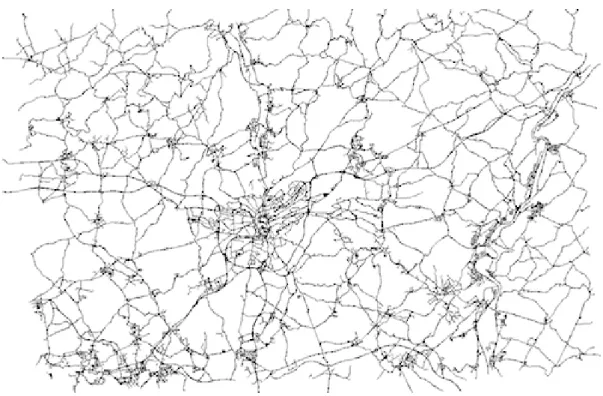
1.2 Sensors planted in Luxembourg area (Sourcehttps://vehilux.gforge.uni.lu/index.html) . . . 12
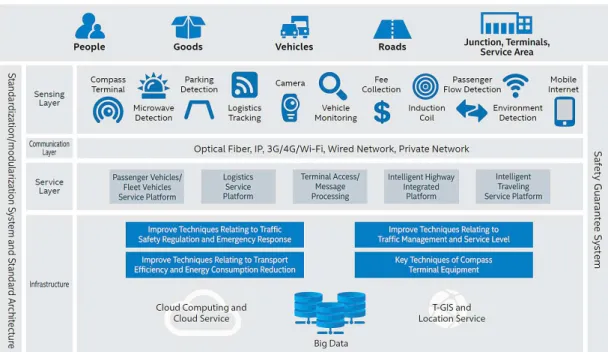
1.3 Instance for road ITS system layout . . . 13
1.4 Vehicular Ad hoc Networks (Sourcejohndayautomotivelectronics.com) . . . 15
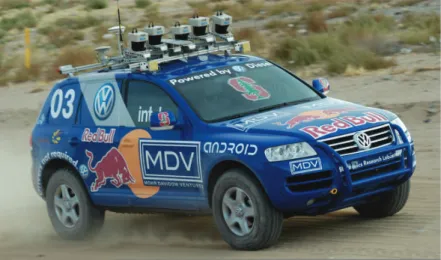
1.5 Stanley at Grand Challenge 2005 . . . 17
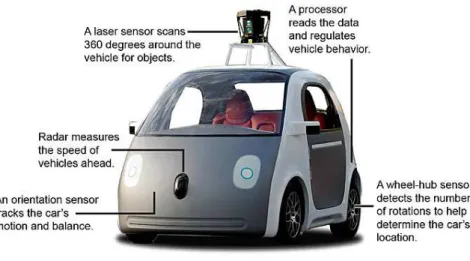
1.6 Sensors on Google’s self-driving car (Sourcewww.aventurine.com) 18 2.1 Comparison on average speed of vehicle flows with different models . . . 28
2.2 Demonstration of the architecture of Neural Network . . . 31
2.3 Demonstration of a single neuron . . . 31
2.4 Overview of the proposed method . . . 34
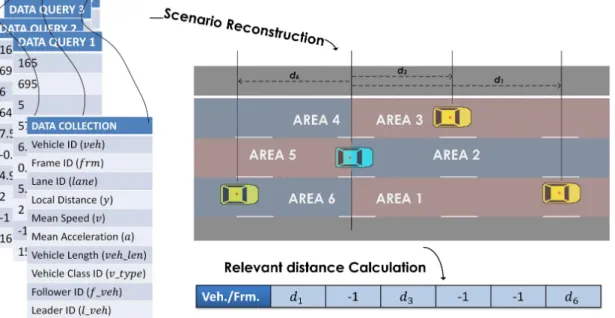
2.5 A single data query formed to represent the vehicles’ state . . . 35
2.6 Definitions of different areas and the relevant distances . . . 36
2.7 Comparison on different Batch Size . . . 39
2.8 Structure of a recurrent neural network . . . 41
2.9 Structure of a LSTM network . . . 41
2.10 Composition of a LSTM unit and its denotations . . . 42
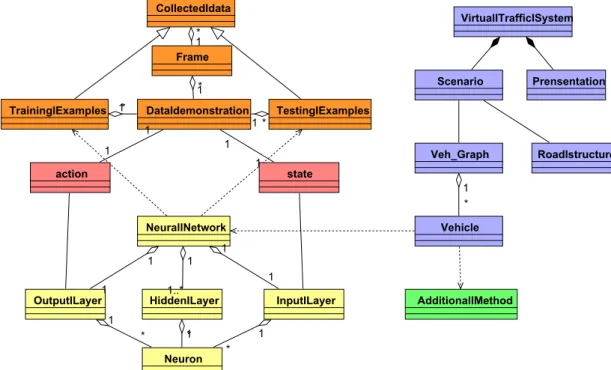
2.11 Detail System Design in UML Class Diagram . . . 44
2.13 Neural network training, result presented by tensor-board, which
indicates the changes on cost through iterations . . . 49
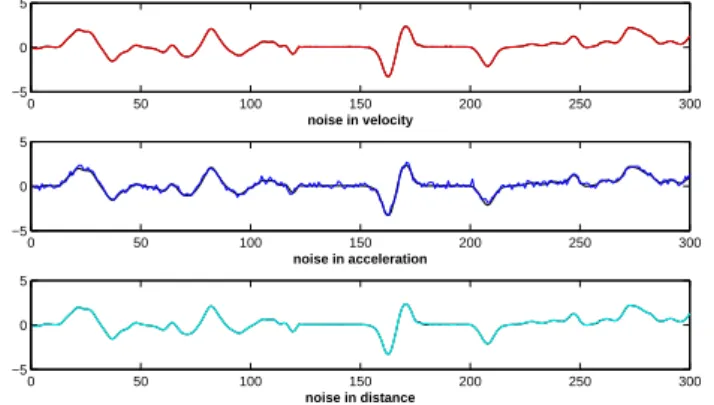
2.14 Output with Gaussian noise in velocity, acceleration and distance 50 2.15 A simulation for sudden stop scenario . . . 50
3.1 Categorization on Mobility Models: scale . . . 55
3.2 Category Overlapping on Mobility Models . . . 56
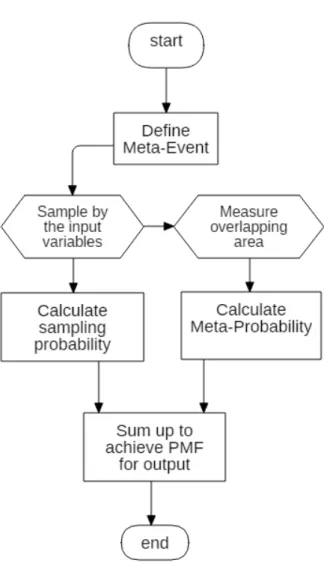
3.3 Flow chart of the adaptation algorithm . . . 61
3.4 Adaptation of representation of a model . . . 62
3.5 Schematic diagram on the location of Vi, Vj, and possible evalu-ation interval of v0 . . . 66
3.6 Overlapping area demonstration for different[v0min, v0max] . . . . 68
3.7 "Velocity"-"Spacing" plane in 2-dimension and probability deno-tations . . . 72
3.8 Impacts on different speed of preceding vehicle . . . 74
3.9 Differences of the flow chart between enhanced method and the original one . . . 79
3.10 Dependency and composition relationship between different com-ponents in the enhanced method . . . 79
3.11 Transition and Emission of our HMM . . . 88
3.12 Histogram of marginal and joint distribution: (Left) Marginal distribution of Speed; (Middle) Marginal distribution of Spac-ing; (Right) Joint distribution of Speed and Spacing . . . 90
3.13 Convergence of Baum Welch algorithm for multi-observation sequences, measured by Logarithm-Probability . . . 96
3.14 Result of Learned NN after HMM labeling by LM-algorithm . . 98
3.15 Result of Learned NN after HMM labeling by BFGS-algorithm . 98 4.1 Flow Chart of the simulation system NN-VMM . . . 103
4.2 Sequence Diagram of the simulation system . . . 104
4.3 State chart Diagram of a vehicle object . . . 105
4.4 User interface of PTV Studio:PTV Vissim . . . 105
4.5 Interface TraCI and its relation with SUMO . . . 106
4.6 Neural network construction on Tensorflow: open-source plat-form for deep learning . . . 107
LIST OF FIGURES
4.7 Our method in different layer . . . 108
4.8 Road structure of the section that surveillance camera covers . . 109
4.9 Highway reproduction scenario presented by SUMO . . . 109
4.10 Performance comparison from different models: original ob-served data, NN-VMM, Enhanced NN-VMM and Car-following Model . . . 111
4.11 the MIXED simulation system: NN-VMM/TP-AIM . . . 112
4.12 Road infrastructure of the under simulated intersection . . . 115
4.13 Impacts on throughput of different composition of the traffic flow115
4.14 SUMO presentation of experiments on NN-VMM/TP-AIM . . . 116
4.15 Highway structure of this simulation scenario . . . 117
4.16 Queue’s forming over time . . . 118
4.17 Traffic simulation for queue length estimation by SUMO . . . . 119
1 Véhicules par millier d’habitants: États-Unis et autres pays (en 2006 et 2016)
(Sourcehttp://www.greencarcongress.com/2018/10/20181010-fotw.
html) . . . 130
2 Conception de système dans un diagramme de classes UML . . 133
3 L’organigramme de la simulation avec modèle de mobilité améliorée135
List of Tables
3.1 Adaptation result for a demonstration . . . 75
3.2 Joint and marginal distribution of Speed and Spacing . . . 90
3.3 Deviation on frequency/probability of corresponding events . . 91
3.4 Estimated Transition Matrix . . . 96
3.5 Estimated Emission Matrix . . . 97
4.1 Basic protocol of the simulation . . . 112
List of Algorithms
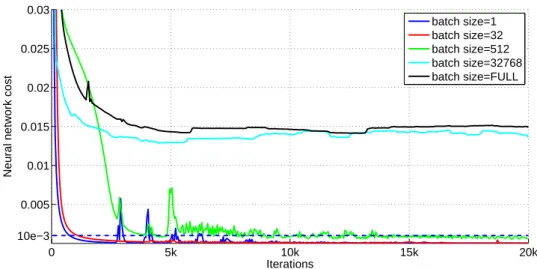
1 Procedure of traditional gradient descent learning . . . 38
2 Procedure of stochastic gradient descent learning . . . 38
3 Procedure of Mini-batch gradient descent learning . . . 39
4 Insert action for a veh-graph . . . 46
5 Delete action for a veh-graph . . . 47
6 Adaptation Method in 1-dimension . . . 70
Abbreviations
FFNN - Feed Forward Neural Network
HMM - Hidden Markov Model
ITS - Intelligent Transportation Systems
LSTM - Long Short-term Memory
MM - Mobility Model
NN - Neural Network
OD - Origins and Destinations
RNN - Recurrent Neural Network
RWP - Random Waypoint Model
UML - Unified Modeling Language
VANETs - Vehicular Ad hoc Networks
VMM - Vehicular Mobility Model
V2C - Vehicle-to-Cloud
V2I - Vehicle-to-Infrastructure
V2P - Vehicle-to-Pedestrian
V2V - Vehicle-to-Vehicle
General Introduction
Scope of the thesis
This thesis is dedicated to providing a more realistic and a "better" mobility model in an intelligent transportation system and to provide an approach to bridge up its micro and macro impacts. This "better" will be specifically dis-cussed in detail in the following of this thesis.
According to the ancient Chinese literature and records, the word traffic comes from the crossing of roads and movement of human. Since then, people moves from here to there, by foot, by horse, by wagon, etc. After the industrial revolution, vehicle became the major participants of traffic and thus the pro-totype of modern traffic appeared. Researches on relevant areas started at the same time.
Despite the long history of the study of traffic or say transportation sys-tems, the fundamental purposes have never changed too much. With the continuous expansion and induction, it can be expressed as the three aspects: safety, fast and environmental friendly.
To address these major purposes and to solve the corresponding problems, such as to reduce the occurrence of traffic accidents, to ease the impact of traf-fic congestions and to decrease the emission of traftraf-fic pollution, the concept of intelligent transportation systems (ITS) proposed by the US Department of transportation, comes into being. Several similar traffic systems have also been proposed after, and the researches upon it have gain lots of interests recent years.
ITS contains a very wide research interests and plenty of different research fields and subjects have been involved, which makes ITS an even more com-plex system so that it could be regarded as an independent discipline.
Specifically speaking, ITS covers both microscopic and macroscopic level. One of these ideas is to make full use of the current hardware in a transporta-tion system and to equip sensors and cameras to acquire informatransporta-tion for de-cision making and then to provide assistance to the human driver or to ful-fill complete automatic driving behavior on road. There are also other ideas, for example the non-driver thinking, which is based on the assumption of fu-ture evolution of the hardware of a transportation system. The existing traffic lights, traffic signs, etc. are designed for human drivers and these traffic infras-tructures limit the performance of an automatic driving, such as the eyesight range depends on the weather conditions. In the V2X assumptions, the vehi-cles and the infrastructures can communicate with each other in another high efficient method, then comprehensive information for automatic driving could be obtained, meanwhile an optimization arrangement of the vehicles can also become possible. As for a macroscopic perspective, there is also existing appli-cations of ITS, such as the VehiLux project, which uses open-world map data and generates macroscopic vehicle traces. These traces are particularly useful in a Vehicular ad hoc network (VANET) simulation.
Great deal of examples remains, but we would rather set them aside now. Researches presented in this thesis focus on the mobility model, which is tradi-tionally used in a microscopic level traffic simulation and this model describes the behavior pattern of vehicles. The traditional mobility models have already been studied, which is normally an optimization model based on the three ma-jor purposes: safety, fast and environmentally friendly. However, considering possible applications at current stage, the realistic level could be another mea-surement of the model. Combining with machine learning methods, a more realistic mobility model could be obtained. Since the mobility model is the critical point to address the applications including but not limited to trajectory prediction, behavior simulation, meanwhile prediction of trajectory remains essential useful in automatic driving and assistant driving. As long as the V2X assumption is not completely located, to discover a mobility model at a con-vincing realistic level is important and necessary for the virtual scenario traffic simulation.
Researches in this thesis locate at the scope of microscopic mobility model in intelligent transportation systems, combining with the use of machine
learn-GENERAL INTRODUCTION
ing methods in computer science and technology to extract and depict the re-alistic level of the proposed mobility model. Besides, the validation of the mobility model in a virtual scenario traffic simulation needs ethe support of certain relevant simulation techniques, including but not limited to the anima-tion presentaanima-tion platform, and details that should be considered in practical implementation. Combining all these, the mobility model allows bridging up the microscopic level behavior and macroscopic level planning.
Main contributions
The main contributions of the thesis are summarized as follows:
• A data-driven mobility model is proposed to characterize vehicular be-haviors in extreme situations. The basic thinking of this method is not limited to extreme situations such as bridges, tunnels or highways en-trances (exits). On the contrary, the proposed model shows obvious ad-vantages in these situations, which bring unknown and unconsidered issues that may cause significant error if using traditional models.
• Probabilistic represented mobility models are under consideration in this thesis. Traditional mobility models intent to show the vehicular behav-ior through the use of partial differential equations (PDE), which meet the dynamics and kinematics constraints of corresponding situations and certain hypothesis. An adaptation method of these models to the prob-abilistic represented models are given in this thesis, so that it is possible to observe and review the probabilistic distribution of possible perfor-mances, since the probabilistic represented models are more closely cou-pled with machine learning method.
• With the assumption that the driving state can be described by Markov property, Hidden Markov Model (HMM) is introduced into the proposed data-driven mobility model to improve its performance. The probabilis-tic mobility models are also used to represent the vehicular behaviors in an HMM.
• A simulation platform based on the Unified modeling language (UML) is designed and used. Both the static structure and the dynamic process of this platform can be found in corresponding UML diagrams. Besides, vehicles are organized according to a proposed algorithm and structure during the simulation. Training of neural network is carried out in an open-source tensorflow project by Google while the Simulator SUMO (Simulation of Urban Mobility) is also used to present the simulation re-sults. Matlab was chosen as the major simulation programming language to connect and communicate through the different parts of the platform.
Outline of the thesis
This thesis is divided into 5 chapters:
In Chapter 1, brief introduction of the intelligent transportation systems (ITS) would be given, including the development of ITS and various motiva-tions of previous work. Intelligence has been added into the transportation systems based on different purposes, which are safety, efficiency and environ-mental friendly. Applications on these purposes will be reviewed. Meanwhile, the motivation of this thesis will also be discussed.
In Chapter 2, a neural network based data-driven mobility model is pre-sented. This mobility model itself is simple, but it is the fundamental of the following method. Objective of this mobility model is to extract the historical driving pattern from the existing traffic trajectory data. An application of neu-ral network will do the work, and the applications of neuneu-ral network on ITS will also be reviewed.
In Chapter3, an HMM is introduced to the previous proposed model. In order to address this integration, an adaptation of traditional mobility model is necessary. Objective of this adaptation is to keep the model meanwhile change the form. Context of traditional mobility models is also presented. Comparing with traditional models, their probabilistic adaptation present the same model, however its probabilistic description will show advantages when being used in a machine learning context. Basic knowledge of HMM and its applications in ITS is reviewed in this chapter. Knowledge on the adapted traditional model,
GENERAL INTRODUCTION
which is regarded as a definite state of HMM, will make contribution on the initialization of the HMM so that its estimation will be more accurate.
In Chapter 4, a simulation scenario based on algorithms from previous chapters is described. The design of our simulation environment will be given by UML: both static and dynamic properties. Some mechanisms in practice will also be discussed and the traffic scenario simulation using our mobility model will be derived, including a highway scenario from database to evalu-ate the realism of our model, an intersection scenario to demonstrevalu-ate the appli-cation of our model in a mixed model and a lane merge scenario to show the application of our model in transportation prediction.
Chapter 1
Introduction
Contents
1.1 Background . . . . 7
1.1.1 Motivation . . . 7
1.1.2 Intelligent Transportation Systems . . . 8
1.2 Mobility Models in Vehicular Ad hoc Network . . . . 13
1.2.1 Brief introduction to VANET . . . 13
1.2.2 Major concerns of VANET . . . 14
1.2.3 Self-Driving Cars and ACC systems . . . 16
1.3 Challenges, Opportunities and Connections . . . . 19
1.3.1 Realistic level: another starting point . . . 19
1.3.2 Traffic prediction with Deep Learning approaches . . . 21
1.3.3 Relationship with Self Driving . . . 22
1.4 Conclusion . . . . 22
1.1
Background
1.1.1
Motivation
Transportation has been known as a research subject and been well studied for a long time. Putting aside the academic purposes, transportation plays such an important role in human societies.
As a result of modernization and urbanization, transportation system grows and becomes bigger, heavier and much more sophisticated. Maintaining and organizing of transportation system bring challenges indeed, and sometimes it could still turn out to be useless operations, which will result in inefficient traffic. Some of these inefficiencies would be ascribed to the incomplete con-sideration, while the others are the pure responsibility of the urbanization. Ve-hicles per capita, as shown in Figure1.1, have reached an insane number now. According to the statistical research, the road motor vehicles per thousand in-habitants reaches 910 in United States in 2017, and over 500 in most of the European countries. As for developing countries such as China, this number in 2016 would be almost five times larger than it was ten years ago (in year 2006). More and more data and information indicate that a wave of ripples in the transportation may eventually affect the global economy and have far-reaching effects.
Due to the importance mentioned above, people have been conducting re-searches on transportation and transportation systems for a long time. Al-though these researches have a long history, this domain regains many attrac-tions recently especially because of the breakthroughs in computer science. Improvements on both computer hardware and software bring out more ca-pabilities in calculation. As a result, the concept of intelligent transportation, which takes the transportation into a higher level, is proposed. Using the deep learning technology, intelligent transportation is one step closer to its realiza-tion.
1.1.2
Intelligent Transportation Systems
People have their demands for intelligent transportation in various ways. As a fruit of such demands, intelligent transportation systems (ITS) is presented as an answer. In summary, we could conclude that a transportation system with a safety guaranteed property, an efficient mechanism in dealing with congestion problems and a solution to environmentally friendly emission issues is in need. Facing all these issues of current road transportation systems, ameliorations in both system level and individual level need to be investigated.
ITS has gained a huge amount of attention in recent years. It can be broadly defined as the application of advanced technologies to supply real-time
infor-1.1 Background
Figure 1.1: Vehicles per thousand people: US (over time) and other countries (in 2006 and 2016)
mation, to improve safety, efficiency and comforts, at the same time reduce its impact to environment (Perng et al.(2011)). It is an interdisciplinary study. Benefit from its wide coverage, information technology, communication tech-nology, sensors, control, and computer science, etc. have made a contribution to the research of ITS. This interdisciplinary nature increases the problem’s complexity due to the requirement of knowledge transfer and cooperation among different research domains (Figueiredo et al.(2001)).
As a consequence, ITS contains a wide range of research interests. It can be found among previous work on ITS that there is a diversity kind of problems that have been faced. For example, the routing or communication problems of the network focus on the network or its communication protocols for either vehicle-to-vehicle communication or vehicle-to-infrastructure communication
(Li & Wang (2007)). Game theory is also employed in dealing with the
traf-fic light management and organization problems (Zhao et al. (2012)) in order to ease traffic congestion. Besides, Liu & El Kamel (2016) provide a platoon control method to adjust the speed of vehicles so as to fulfill the blind crossing of an intersection. It is also possible to find research on the interests such as length estimation problem of the waiting platoon (Liu et al.(2009); Tiaprasert
et al.(2015)), co-operative traffic monitoring problem, etc.
In short, all these research on ITS are committed to either improve road safety, relieve traffic congestion or comfort driving experience (Baskar et al.
(2011)). Safety, efficiency, environment friendly can be summarized as the three basic elements of ITS. Each of them comes from a real-world practical problem, and leads to an issue that deeply concerns the performance of a transportation system.
When talking about the traffic safety issues, traffic accidents take away a considerable number of human lives every year and even more injuries. These accidents directly cause a huge quantity of families to be incomplete and bring deep sorrow to their relatives which deals mental damages unseen. To calm the relatives and to recover the accidents shall cost quite a fortune, yet not to mention the immeasurable impact on the related economical loss, which could be linked to causing congestion and inefficiency on the implicated logistics system. Increasing traffic has produced a growing number of accidents and fa-talities. Nearly 1.3 million people die in road crashes each year (WHO(2018)),
1.1 Background
on average 3,287 deaths a day, and 20-50 million are injured or disabled. The majority of accidents are caused by incorrect driving behaviors, such as violate regulations, speeding, fatigued driving, and drunken driving.
In another aspect, lots of examples on traffic efficiency exist. Such as the EURO CUP 2016 held in France, the event itself brought huge traffic impact to the local traffic. Settling such a heavy traffic system is not just considering about the time and congestions, in fact, the space consuming is also another subject that means. In order to deal with congestion and parking difficulties due to the increasing traffic loads, streets are widened and parking areas are built, which seizes the space for public activities like markets, parades, and community interactions.
One step further, when congestion appears, vehicles move at a low velocity. Considering the green traffic concept proposed in recent years, the congestion may bring much more emissions than a smooth passage road so that it cost more energy than it does in a smooth passage. Additional energy consump-tion is the one last thing that modern society would like to see. Air polluconsump-tion and noise pollution are the by-products of road transportation systems, espe-cially in metropolis where vehicles are considerably gathered. Smog brought by vehicles, industries and heating facilities is hurting people’s health. The exhaust from incomplete combustion when the vehicle is in congestion is even more pollutant.
To address these aspect, meta-type of ITS has been proposed. As for an instance of ITS, project "VehiLux" (Grzybek et al.(2012)) is a very good exam-ple. The VehiLux makes full use of its sensors deployed all over the highway in Luxembourg as shown in Figure1.2. It can also generate random restoration of virtual trajectories. The system contains both a microscopic level using mobil-ity models and a macroscopic level. At the macroscopic level, traffic demand is defined in terms of origins and destinations (OD) of traffic flows. Traffic mobility is time-variant and presents different characteristics dependent on a considered scenario.
Another instance of an architecture of road ITS for commercial vehicles is designed as in (Intel(2015)). This system is used to reduce fuel consumption through fuel-saving advice, maintain driver and vehicle safety with remote ve-hicle diagnostics and enable drivers to access information more conveniently.
Figure 1.2: Sensors planted in Luxembourg area (Sourcehttps://vehilux.gforge.uni.lu/index.html)
As shown in Figure1.3, there are three layers in this system:
• Sensing Layer: this layer employs a vehicle terminal which enables the interaction between the driver and the vehicle. Meanwhile, it acts as a gateway for in-vehicle technologies and sensors, including microwave detection, speed sensor, radio frequency identification, camera, monitor-ing equipment, etc.
• Communication Layer: this layer ensures real-time, secure and reliable transmission from a vehicle to the service layer via different networks, such as 3G/4G, Wi-fi, Bluetooth, wired networks and optical fiber. • Service Layer: in this layer, diverse applications using various
technolo-gies are implemented, such as cloud computing, data analytics, informa-tion processing and artificial intelligence. Vehicle services are supported by a cloud-based, back-end platform that has a network connection to ve-hicles and runs advanced data analytic applications. Different categories
1.2 Mobility Models in Vehicular Ad hoc Network
Figure 1.3: Instance for road ITS system layout
of services can be supplied, including collision notification, roadside res-cue, remote diagnostic, positioning monitoring.
1.2
Mobility Models in Vehicular Ad hoc Network
In an ITS, attention is paid to both individual intelligence and systematical intelligence because of the different research focuses. Individual intelligence refers to the intelligent vehicles, the self-driving car and cruise aid system, while the systematic intelligence means the implementation of vehicular net-works.
1.2.1
Brief introduction to VANET
Although we are so eager to achieve system-level intelligent transportation, it cannot be accomplished by simply replacing the vehicles on road with intelli-gent vehicles. One of the key features in ITS is the communication ability of all the participants which enables information exchange among them. A Vehicu-lar Ad hoc Network (VANET) is a part of the whole ITS framework. It is an
ideal network model to represent the communication among vehicles, while vehicles are regarded as the mobile nodes within the network.
As for a real-world vehicle, driver makes his decision according to his judg-ment, which is based on his acknowledgment of his surrounding. There are methods that dedicate to path planing meanwhile concern the modeling of sight range (Geraerts & Schager (2010)). This kind of vehicle can be repre-sented by an intelligent vehicle, and the sight range depends on the perfor-mance of its sensors. However, suppose the driver is aware of the whole sit-uation, it is possible for him to make the global optimal decision, which will greatly increase the efficiency of the whole traffic system. This total awareness is possible for an intelligent vehicle if its sensors accuracy and range perfor-mance can be ensured fully functional. Assuming that, the drivers can share their sight and acknowledgment of the environment, it could help them to predict the future road condition and make even better decisions. This infor-mation share is normally represented by the communication among intelligent vehicles. Thus the individual intelligence can be turned into group intelligence and systematic intelligence.
To achieve these features, there are several kinds of such communication in VANET. The communication between a vehicle and another vehicle or non-vehicle agent is usually noted as V2X, including V2V (Vehicle-to-Vehicle), V2I Infrastructure), V2P Pedestrian) and V2C (Vehicle-to-Cloud) (Park & Min(2015)). With VANET, we can upgrade autonomous sys-tems to cooperative syssys-tems.
1.2.2
Major concerns of VANET
While being promising in saving time and saving lives and being conceptually straightforward, design and deployment of VANET is technically and econom-ically challenging (Hartenstein & Laberteaux (2010)). In technical terms, its concerns include the following issues:
• High mobility of the nodes. Due to high relative speed between cars, network’s topology changes very fast, and many paths disconnect before they can be used (Yousefi et al. (2006)). Wang(2004a,b) tried to find the
1.2 Mobility Models in Vehicular Ad hoc Network
Figure 1.4: Vehicular Ad hoc Networks (Sourcejohndayautomotivelectronics.com)
approximation of link’s lifetime. In (Artimy et al. (2004, 2005)), the au-thors attempted to capture some relationship between the model of ve-hicular mobility and connectivity of the networks. In (Blum et al.(2004)), the effective network diameter in a typical VANET is studied.
• Self-organized structure. Lacking of centralized management and coor-dination entity. It is difficult to synchronize and manage the transmission events of different nodes.
• The signal’s physical transmission. The transmission could be blocked by obstacles, e.g. buildings in cities, the propagation models of the signal and the influence on the performance of VANET need to be studied. • Standardization and flexibility. Standardization is necessary to make the
equipment from different manufactures compatible. while the manufac-tures will want to create some product differentiation.
These issues can be concluded into two major concerns. First, how to guar-antee an effective communication is the number one priority of VANET. The problem in the communication part includes the difficulty in its physical im-plementation, and the communication protocol’s design. In order to thor-oughly and systematically study a VANET protocol, it is important to
simu-late this protocol and evaluate its protocol performance. Thus, it leads to the second major concern of VANET, which is the mobility model (Bai & Helmy
(2004)). Mobility model is associated with the protocol, it can be used to exam-ine the impact of high mobility on the performance of VANET protocol.
A mobility model, which is only used to represent the mobility of mobile nodes in VANET in the beginning, is used to describe the behavior, and moment pattern of vehicles now. In our research, we dedicate to providing a ve-hicular mobility model with more realistic attribute. Such a model can make a difference in mimicking the movements of real vehicles during simulation and may play a vital and essential role in such as self-driving vehicles, trajectory prediction, and many other applications.
1.2.3
Self-Driving Cars and ACC systems
People are always interested in self-driving cars, which started long before the concept of ITS was proposed. A self-driving car is built according to the three basic elements as mentioned above: improved road safety, relieved traf-fic congestion and comforted driver experience (Sukthankar et al.(1998)). Tak-ing advantage of the development of computer vision, online recognition and classification of objects in surrounding can be done efficiently (Levinson et al.
(2011); Peña-Cabrera et al. (2005)). Then, the car can sense and perceive the
surroundings using its sensors and strives to achieve more efficient vehicle op-eration either by assisting the driver (via advisories or warnings) or by taking complete control of vehicle (Baskar et al.(2011)).
Since 2003, Defense Advanced Research Projects Agency (DARPA) of USA has found a prize competition ”Grand Challenge” to encourage the develop-ment of technologies needed to create the first fully autonomous ground vehi-cles. The Challenge required robotic vehicles to travel a 142-mile long course through the desert within 10 hours. Unfortunately, in the first competition, none of the 15 participants have ever completed more than 5% of the entire course. while in the second competition in 2005, five of 23 vehicles success-fully finished the course, and ”Stanley” of Stanford (see Figure1.5) became the winner with a result of 6 h 53 min (Russell (2006); Thrun et al. (2006)). This robotic car was a milestone in the research for modern self-driving cars. Then it comes to the “DARPA Urban Challenge” in 2007. This time the autonomous
1.2 Mobility Models in Vehicular Ad hoc Network
Figure 1.5: Stanley at Grand Challenge 2005
vehicles should travel 97km through a mock urban environment in less than 6 hours, interacting with other moving vehicles and obstacles and obeying all traffic regulations (Montemerlo et al.(2008);Urmson et al.(2008)). These vehi-cles were regarded as the initial prototype of Google self-driving cars.
In 2010, European Research Council sponsored a project: VisLab Interconti-nental Autonomous Challenge (VIAC) to build four driver-less vans to accom-plish a journey of 13,000 km from Italy to China. The vans have experienced all kinds of road conditions from high-rise urban jungle to broad expanses of Siberia (Broggi et al.(2012)).
Google also started world wide known self-driving car project. It is consid-ered to be currently the most successful project in the domain (Guizzo(2011)). Using Google’s map service, the vehicle equipped with a GPS can obtain its location. Besides, a laser is installed to generate a detailed 3D map of the envi-ronment. The car then combines the laser measurements with high-resolution maps of the world, producing different types of data models that allow it to drive itself while avoiding obstacles and respecting traffic laws. More details in terms of sensors can be seen in Figure1.6. It should be noticed that Google’s approach relies on very detailed maps of the roads and terrain to determine accurately where the car is. When GPS information got disturbed, awful mis-takes could happen.
Similarly, in China, the company Baidu announced its autonomous car has successfully navigated a complicated route through Beijing (Davies (2015)).
Figure 1.6: Sensors on Google’s self-driving car (Sourcewww.aventurine.com) The car drove a 30 km route around the capital that included side streets as well as highways. The car successfully made turning, lane changing, overtaking, merging onto and off the highway.
The commercialization of self-driving cars cannot be done without auto-mobile manufacturers. Some of them have launched their own self-driving projects targeting different scenarios (Chandler(2016)), such as ”Drive Me” of Volvo (Ziegler(2015)), ”Buddy” of Audi (Davies(2014)), Tesla (Korosec(2016)), etc. These prototypes are still at test stage, but it is a necessary step of self-driving car development.
Along with self-driving cars, a set of advanced driver-assistant systems (ADAS) are developed, include the very important adaptive cruise control (ACC) system (Vahidi & Eskandarian(2003)). ACC is now commercially avail-able in a wide range of passenger vehicles.
ACC systems are an extension of cruise control (CC) systems. CC is used to maintain vehicle’s velocity to a decided value, and the driver does not have to depress the pedals, therefore the driver can be more focused on steering wheel. CC can be turned off both explicitly and automatically when the driver depresses the brake. As for ACC, if there is no preceding vehicle within a certain range, it works as a CC system; else, it uses the range sensor to mea-sure the distance and the relative velocity to the preceding vehicle. Then after calculation, if the preceding vehicle is too close or is traveling slowly, ACC
1.3 Challenges, Opportunities and Connections
shifts from velocity control to time headway control by control both the throt-tle and brake (Xiao & Gao (2010)). Of course, ACC still has its own limits: in general, ACC system is limited to be operated within a velocity range from 40km/h to 160km/h and under a maximum braking deceleration of 0.5g (
Ra-jamani (2011)). The operations outside these limits are still in the charge of
driver, because it is very difficult to anticipate the preceding vehicle’s motion only by using range sensors. Yet with the help of V2X communication in a VANET model, the distance acquirement can be more precise, and the systems turns into a cooperative ACC (CACC) system De Bruin et al. (2004); Lu et al.
(2002);Xu & Sengupta(2003).
Despite the differences between completely self-driving and assistance driv-ing, self-driving vehicles and ADAS with the example of ACC-series systems share the same purpose and use a similar methodology. Comparing these with mobility models, mobility model locates itself into a more abstract level: it fo-cuses on the attributes presented such as velocity. While ACC and self-driving vehicles cannot get away with the dynamics model of vehicle, it locates in a more actual level.
1.3
Challenges, Opportunities and Connections
In this section, we will discuss the major challenges and the possible oppor-tunities of realizing a realism based mobility model, and the connections be-tween such a mobility model and its potential application in self-driving.
1.3.1
Realistic level: another starting point
To begin with, the three major elements of ITS shall be reminded: safety, ef-ficiency, and environmental friendly. These three aspects cannot be seen as completely disjoint sets of features (Hartenstein & Laberteaux (2010)), they can transform to each other under certain conditions, and they can explain each other in certain scenarios. For example, vehicle crashes will lead to a traf-fic jam. A message reporting an accident can be regarded as a safety message for the near-by vehicles on one hand and can also be regarded as an input to find an alternative route in a transport efficiency application on the other
hand. Traffic inefficiency will result in extra resources consuming, which will lead to more emissions. Bad traffic organization leads to bad road condition. As a result, frequently speed changes will happen, which leads to not only congestions but also extra safety risks since the collision chances increases.
Major existing works that are rooted in either of these three aspects, could be seen as that they are from the same purpose. For example, Liu & El Kamel
(2016)’s work aims at the blind traverse of an intersection. Its directly target would be the safety, meanwhile the efficiency of intersection traverse increases.
De Schutter & De Moor(1998) presents a traffic light control method for a two
by two way street intersection. Schedule of the traffic light is calculated to optimize the average queue length. It focuses on the efficiency, meanwhile the performance of safety at this intersection augments indirectly.
In short, the existing works are more or less dedicated to optimizing on one of these three aspects. However, it could be seen from a totally another point of view. The realistic level of the output behaviors has not been mentioned a lot, it can also be used as the measurement of a model. It is important to use a realistic mobility model so that results from the simulation correctly reflect the real-world performance of a VANET (Karnadi et al.(2007)). InHärri et al.
(2006)’s work, a VanetMobiSim is proposed as a generator of realistic vehicu-lar movement traces for telecommunication networks simulators. Real-world database TIGER (Topologically Integrated Geographic Encoding and Referenc-ing) (Bureau (2018)) is used to enhance its previous model CanuMobiSim in representing macro-mobility features. Similar things have also been done in
(Saha & Johnson(2004)), where TIGER is also been used to provide
geograph-ical information and special attention has been paid to the characteristics of a realistic street model, and in (Jardosh et al.(2003)), where Voronoi diagram is used to determine pathways through obstacles, thus this model produces better traces than standard random waypoint model.
The NGSIM (Next Generation of Simulation) database is also widely used in realism based model. Differs from the TIGER database, the NGSIM database provides data of vehicles behavior in microscopic level. However, the NGSIM database does not provide vehicle trajectory data directly, the dataset is built for vehicle tracking. Background segmentation (Osorio et al. (2013)) and ob-ject extraction methods (Zhang & Lenders(2002)) are necessary to recognize
1.3 Challenges, Opportunities and Connections
the vehicles in the surveillance image data. Besides, it is also possible to use near-accurate reconstructed data from (Montanino & Punzo(2015);Punzo et al.
(2011)), which specifically focus on NGSIM data retrieve.
To mimic the real world behavior, if the real world situation has been well observed, then it will not be hard to find out that the behaviors taken are the good solutions instead of the optimal solutions. Thus, using the optimal models are not very proper. In oder to evaluate the realistic level of entity behaviors, a data-driven based method is commonly used (Charalambous &
Chrysanthou (2016); Wolinski (2016)). However, since this kind of method
depends very much on the selected dataset, there is no universal evaluation method. If real-world data exist, then the realistic level can be measured by a comparison between the model and data. If there is no existing data, which is the common situation, then the virtual traffic flow generated by the model is examined that if it can meet the property described by traffic flow theory in macroscopic level. Our proposed models in this thesis are based on a realistic target. The comparison with corresponding real-world data and the examina-tion on traffic flow theory of our model will be given in the following chapters.
1.3.2
Traffic prediction with Deep Learning approaches
Another important application of the realistic model is in traffic prediction. A good traffic prediction has the potential to improve traffic conditions and re-duce travel delays by facilitating better utilization of available capacity. Since deep learning method with neural network model will be used in the following chapters to produce our realistic convincing mobility models, some represen-tative uses of neural network in traffic prediction methods will be examined in this section.
Song et al.(2016) constructed a deep recurrent neural network to predict the
human mobility. Satellite GPS records are collected and used, which means the human mobility in this model may contain mobility with various kinds of transportation, such as by foot, by car or by train.
Lv et al. (2015) however, makes the prediction for traffic flows. Stacked
autoencoders structure is used to learn the patterns in the traffic data with training performed by a greedy layer-wise fashion. Likewise, Ma et al.(2015)
uses a long short-term memory neural network for traffic speed prediction. This prediction is built based on the remote microwave sensor data.
Although these methods and our method in this thesis show some degrees of similarity, the traffic predictions normally come with traffic flow, as a conse-quence, it will be always acted on macroscopic level, such as in (Lv et al.(2015)). There is no individual trajectories there. In other representative examples, such
as (Song et al.(2016)), GPS records from satellite can only produce rough
tra-jectories data. As for the result, it is more likely to the Original-Destination structure than a detailed trajectory.
1.3.3
Relationship with Self Driving
As claimed in VANET, if global acknowledgment of the whole environment is known, then it will be more flexible to plan the future paths. However, this requirement somehow stands in ideal model. In path planning of self-driving, which is a more practical application, the behavior of surrounding vehicles are usually marked as unknown.
In the domain of self-driving, a realistic mobility model in microscopic level is highly demanded. Currently, static position of the adjacent vehicle is not hard to acquire, but their future dynamic trajectory is not considered predictable. Practically, it will be regarded as simple car-following models (Xu
et al.(2017)). Deep learning is also widely used in self-driving (Houenou et al.
(2013)), but the difference is that it is used mostly in order to complete a pattern recognition task, instead of prediction.
1.4
Conclusion
This chapter gives an introduction to the scope of our work. Firstly, the back-ground information is introduced, that our research combines the research in transportation and deep learning. Due to interdisciplinary, the ITS plays an im-portant role in the research of transportation. Normally, the core purposes of ITS consist of three main aspects: safety, efficiency and environmental friendly. Secondly, we have introduced the VANET as a part of the whole ITS frame-work. There are two important points in VANET model: protocols and
mo-1.4 Conclusion
bility models. The former focuses on the communication model and its im-plementation, while the latter describes the movement of a mobile node in abstract (or a vehicle in practice). It is also the major concern of our research. By analyzing the composition and its relationship, we indicate that mobility model also has essential applications in individual intelligence, including both self-driving cars and ACC systems.
Thirdly, we talked about some related interests and inspirations of our re-search. To begin with, the three elements of ITS can convert to each other, yet we choose none of them for performance analysis of our research. We would like to use the realistic level to evaluate a model instead. Then, the demand of a realistic model in traffic prediction is clarified, and the difference between current representative research on traffic prediction with deep learning and behavior produced by our mobility model: major existing traffic prediction is always at a macroscopic level, while we focus on a realistic microscopic level model. At last, we claim the connection between mobility model and self-driving. In self-driving, since it is ego-centric, the behavior of adjacent vehicles is no predictable or using simple models. A realistic mobility model as we do may help self-driving to fulfill the trajectory prediction of other vehicles.
A conclusion can be made that the mobility model is the core of our re-search. It comes from the VANET structure, which is part of the whole ITS framework. The mobility model describes the behavior of a single vehicle. It may be associated with self-driving and ACC systems. Deep learning method will be combined since the realistic model is in demand. The detailed method to achieve such a model will be introduced in the following chapters of this thesis. As far as the model is concerned, it differs, yet still has connections with the traffic prediction, and it has essential applications in self-driving.
Chapter 2
Neural network based data-driven
mobility model
Contents
2.1 Introduction . . . . 25
2.1.1 Neural Network in intelligent traffic . . . 27
2.2 Problem descriptions - Why using NN . . . . 28
2.3 Neural network structure and backpropagation algorithm . 30
2.4 NN Application in traffic simulation problem . . . . 34
2.4.1 Pre-processing the obtained data . . . 35
2.4.2 Deep Learning Method . . . 37
2.4.3 Learning Process . . . 40
2.4.4 Implement simulator for virtual traffic flow . . . 43
2.4.5 Performances . . . 45
2.5 Discussion and Conclusion . . . . 51
2.5.1 Discussion . . . 51
2.5.2 Conclusion . . . 52
2.1
Introduction
In this chapter, we will introduce a realistic mobility model. Its realistic prop-erty comes from the neural network learning.
First, we will discuss the advantage of a data-driven model with neural network. Then we explain the structure of a neural network and the algorithm to train a neural network so that we can introduce our specified application with a neural network in the next step. In the end, a demonstration application of this mobility model on virtual traffic simulation will be given.
More specifically speaking, traffic simulation can have different interpre-tation. Previous work of Yu et al. (2014a) has combined conventional traffic motion model with virtual reality technique, and produced a traffic simulator for driving scenarios. It can also be as the virtual traffic system that is repre-sented as an autonomous agent system, similar to a crowd simulation system. According to (Reynolds(1999)), a well-rounded agent system could be built in three layers: the action selection layer, the steering layer and the locomotion layer. In this chapter, we try to carry out a novel traffic simulation system with the realistic mobility model. The simulation refers to produce virtual, reliable, and realistic vehicular flow. This kind of vehicular flow has a critical use in predicting, pre-casting and simulating a certain traffic situation for the speci-fied transportation scenario as mentioned in previous chapter. The simulation aims to build up a bridge between the two kinds of view of daily traffic: the macroscopic traffic and the microscopic traffic. Changes in microscopic traf-fic could be easily shown when some macro managements are taken. Thus, it could help to ease the congestion and reduce the pollution, in alternative way. It also has an essential application in traffic design or traffic control for either daily life traffic or special events traffic.
For example, a special event can bring up a large amount of traffic load and causes changes to daily traffic. At the same time, a specified, well-rounded parking and traffic control plan would be in need, which is very much based on the in-coming and out-coming vehicular flows. However, since the event is not a normal action for city traffic, little previous traffic data can be used as reference. Organizing scenarios of large-scale real traffic can solve the problem, however, with a huge expense and can still be inefficient. Thus, the virtual vehicular flow is essential to simulate these scenarios.
In this chapter, we mainly focus on a vehicular mobility model using a neural network based method to produce more realistic virtual traffic vehi-cle flows. The proposed method may also consider the interactions among
2.1 Introduction
vehicles, that although every vehicle makes its decision individually, it also considers the relative information from the adjacent vehicles. Neural network is used to learn the hidden spatial-temporal relationships among vehicles. The learned mobility model would help in providing the traffic simulation locally, which indicates that it is possible to synthesize and generate virtual trajecto-ries for each single vehicle agent in a traffic system. The produced simulation would be more realistic than the one produced by conventional ones. A speci-fied structure to organize and manage the virtual vehicles is implemented. The presentation by far is implemented by employing a traffic simulator SUMO.
2.1.1
Neural Network in intelligent traffic
Artificial neural network (Hagan et al. (1996)) is a computational approach which is based on a loosely modeling on the way how real neural network solves problems. As the elaboration ofMacKay(2003), a neural network model could be efficiently used in applications such as clustering, estimating of sta-tistical distributions, compression and filtering. Meanwhile it is also capable in applications such as regression analysis, prediction and modeling.
As for the existing work in relevant domain,Yu & Chen(1993) used a three layer simple neural network model with back-propagation algorithm to pre-dict traffic. Due to the limitation of computational capability, the proposed network is quite simple in his modeling that the traffic quantity of a time pe-riod is chosen as the only feature focused during the prediction.
Recently, the network grows much bigger and more complex. Jiang & Fei(2015) proposed a two-level vehicle speed prediction system for highways based on neural network and hidden Markov model. In this system, the under simulated road has been divided into several segments. The traffic speed of certain road segments on certain time stamp is predicted by neural network with the information of neighbor segments using historical data. Differently,
Ma et al. (2015) presented a long short-term memory neural network to
pre-dict speed using microwave detector data. To validate the effectiveness of the proposed method, one month traffic data with the updating frequency of two minutes from two sites in Beijing expressway were collected. Comparisons with other method such as SVM have also been made on the same dataset.
0 50 100 150 200 8.5 8.6 8.7 8.8 8.9 9 9.1 9.2 9.3 9.4 Time(frame) Vehicle−Average−Speed(m/s) Observed data 0 50 100 150 200 17 17.5 18 18.5 19 19.5 Time(frame) Vehicle−Average−Speed(m/s) Car−following Model 0 50 100 150 200 11.8 12 12.2 12.4 12.6 12.8 Time(frame) Vehicle−Average−Speed(m/s) Our Model
Figure 2.1: Comparison on average speed of vehicle flows with different models
Despite the diversity of using neural network in solving traffic prediction problem, there is one essential difference that all these prediction systems fo-cus on the overall speed prediction, which is from the macroscopic-level mod-eling. Individual behaviors have not been considered in their methods. As for the simulation in microscopic level,Lerner et al.(2007) presented an example-based simulation technique, however for the human crowds. Xia & El Kamel
(2016) used neural network with reverse reinforcement learning method to solve an enhanced a-star path planning problem in an unknown scenario for robot.
In our neural network usage in this chapter, we focus on the simulation and prediction in microscopic level. Differs from has been done byXia & El Kamel
(2016), the under-simulated target would rather be a traffic vehicular flow with multiple diverse vehicles than a single robot. It is quite different from simple duplication that the interactions between vehicles would be considered which makes the situation much more complex.
2.2
Problem descriptions - Why using NN
According to the three-layer-division of Reynolds (1999), people shall have corresponding solutions for each of the multiple aspects to address a complete traffic simulation system. However, without considering the other irrelevant issues, the model that describes how the vehicle behaves is the core of the research in this chapter. In order to create a virtual vehicular flow, multiple previous works have been done in the action selection layer and steering layer.
2.2 Problem descriptions - Why using NN
Yet many of them, such as the car-following model (Gipps(1981);Krauß et al.
(1997)) that describes how single vehicle behaves while following a preceding vehicle, belong to the rule-based method.
The car-following model is a branch of vehicle control models (Brackstone
& McDonald(1999);Krauß(1998)), which uses ordinary differential equations
to constrain and to explain how the factors that influence the vehicles’ behavior evolve throughout the whole following procedure. The factors, from the ba-sic vehicle velocity and acceleration to psychological factors are all considered in new models. Attention should be paid that the rule-based method consid-ers only a small set of pre-defined behaviors or situations, which means the rule-based model cannot react with those situations that are emergent or have not been acknowledged before. Since modern traffic has gain more complex-ities, the rule-based method loses its efficiency in facing certain traffic situa-tions and also loses its accuracy in describing certain traffic situasitua-tions. Thus, the example-based method has gained more and more interests recently along with the development of computational capability. Machine learning algo-rithms were applied in an example-based method to reveal the overall motion directions of the agents.
We construct an experiment to demonstrate the impact on global attributes of the traffic flow when using different local mobility models from different kinds of method: the car-following model from the rule-based method and a neural network learned mobility model from the example-based method.
The comparison is as shown in Figure 2.1. Car-following model can deal with the car following behavior ideally. However, if employing the model with large scale of vehicular flow and in a complex and unexpected situation, the result would go far from the reality.
In the scenario for this experiment, we imitated a sudden stop action hap-pened in daily highway traffic, that an uncertain vehicle in the driving lane would suddenly hit the brake and decelerated until fully stopped. The me-chanical fault would then be excluded and the vehicle would accelerate and drive ahead again. The curves in Figure 2.1indicate the average speed of the vehicles, which are located within the surveillance area, during the simulation. Since we need to initialize the scenario by filling the scene with generated vir-tual traffic flow, the result from the very beginning of the simulation has not
been presented.
While the curve in the left is the observed data selected from real-world highway surveillance, the curve in the middle is the simulation driven by con-ventional car-following model, with an initialized speed at 10.0 m/s, and curve in the right is the simulation driven by our neural network learned mobility model. As shown, there are decreases when the stop happened in both three curves. The shapes of these three curves are similar, but if we focus on the value of the peak and trough of the curves, we may notice that since the real world observed data is at around 10 m/s, the data from car-following model goes up to about 18 m/s, while our model is at about 12 m/s that is closer to the observed real-world data.
We can conclude that our learned mobility model shows more realistic at-tributes than the car-following model of the rule-based method (Zhang & El
Kamel (2018)). That is because in a rule-based method, the behavior is
char-acterized by pre-defined rules. Any unexpected issues would have impacts in the method. While in an example-based method, it is believed that the target driving model is hidden in a black box. According to the multiple inputs and outputs, which are the real world situations and real world corresponding ob-servations in the chapter, using a learning method could adjust the parameters and then approximate the neural network to the driving model and finally, the network would be accurate enough to represent the hidden driving model.
2.3
Neural network structure and backpropagation
algorithm
A neural network is a set of neurons (as shown in Figure 2.3) organized in a multi-lay structure, as shown in Figure 2.2. "Neuron" here, inspired by the biological neuron in the brain, is the meta-computational unit in the whole structure.
Neurons have been arranged into layers. Signal (input) goes into the net-work by the input layer (i1 to in in Figure 2.2), and comes out by the
2.3 Neural network structure and backpropagation algorithm
Figure 2.2: Demonstration of the architecture of Neural Network
Figure 2.3: Demonstration of a single neuron
hidden layer. Neurons between different adjacent layers are usually intercon-nected. Links connecting neurons have a weight to indicate its strength on ei-ther increasing or decreasing the signal when it passes through this link. There is a special kind of neuron called bias, which is marked as+1 in Figure2.2.
The different combinations of weights can process the input signal differ-ently. By adjusting the weights, it is possible to carry out a certain kind of treatment on the signal, and this procedure is called the training of a neural network. According to the universal approximation theorem, a neural network with hidden layer of a finite number of neurons can be trained to approximate a random continuous function.
A bit of denotations would be necessary here. As shown in Figure2.3, we denote the output of the ith neuron in layer l as y(il), input from the kth neuron of previous layer l−1 of the same neuron as z(kil). Weight that connects between ith neuron in layer l and jth neuron in layer l+1 is denoted as wij(l). Specifically, the weight from bias in layer l to ith neuron in next layer l+1 is denoted as b(il).