Publisher’s version / Version de l'éditeur:
Vous avez des questions? Nous pouvons vous aider. Pour communiquer directement avec un auteur, consultez la première page de la revue dans laquelle son article a été publié afin de trouver ses coordonnées. Si vous n’arrivez pas à les repérer, communiquez avec nous à [email protected].
Questions? Contact the NRC Publications Archive team at
[email protected]. If you wish to email the authors directly, please see the first page of the publication for their contact information.
https://publications-cnrc.canada.ca/fra/droits
L’accès à ce site Web et l’utilisation de son contenu sont assujettis aux conditions présentées dans le site LISEZ CES CONDITIONS ATTENTIVEMENT AVANT D’UTILISER CE SITE WEB.
Proceedings of the Second Conference on Machine Translation, 2, pp. 589-597,
2017-09-11
READ THESE TERMS AND CONDITIONS CAREFULLY BEFORE USING THIS WEBSITE. https://nrc-publications.canada.ca/eng/copyright
NRC Publications Archive Record / Notice des Archives des publications du CNRC :
https://nrc-publications.canada.ca/eng/view/object/?id=e873a590-859e-4c30-a39f-3201fd3696b0 https://publications-cnrc.canada.ca/fra/voir/objet/?id=e873a590-859e-4c30-a39f-3201fd3696b0
NRC Publications Archive
Archives des publications du CNRC
This publication could be one of several versions: author’s original, accepted manuscript or the publisher’s version. / La version de cette publication peut être l’une des suivantes : la version prépublication de l’auteur, la version acceptée du manuscrit ou la version de l’éditeur.
For the publisher’s version, please access the DOI link below./ Pour consulter la version de l’éditeur, utilisez le lien DOI ci-dessous.
https://doi.org/10.18653/v1/W17-4767
Access and use of this website and the material on it are subject to the Terms and Conditions set forth at
MEANT 2.0: accurate semantic MT evaluation for any output language
MEANT 2.0: Accurate semantic MT evaluation for any output language
Chi-kiu Lo NRC-CNRC
Multilingual Text Processing National Research Council Canada
1200 Montreal Road, Ottawa, ON K1A 0R6, Canada [email protected]
Abstract
We describe a new version of MEANT, which participated in the metrics task of the Second Conference on Machine Trans-lation (WMT 2017). MEANT 2.0 uses idf-weighted distributional ngram accuracy to determine the phrasal similarity of seman-tic role fillers and yields better correlations with human judgments of translation qual-ity than earlier versions. The improved phrasal similarity enables a subversion of MEANT to accurately evaluate translation adequacy for any output language, even languages without an automatic semantic parser. Our results show that MEANT, which is a non-ensemble and untrained metric, consistently performs as well as the top participants in previous years including ensemble and trained ones -across different output languages. We also present the timing statistics for MEANT for better estimation of the evaluation cost. MEANT 2.0 is open source and publicly available.1
1 Introduction
We introduce a new version of MEANT, which participated in evaluating MT systems for all lan-guage pairs in the metrics task of the Second Conference on Machine Translation (WMT 2017). MEANT 2.0 is a non-ensemble and untrained met-ric that only requires a monolingual corpus in the output language to build the word embeddings and an automatic shallow semantic parser to obtain the predicate-argument structure to evaluate MT sys-tems for a language pair. We have also build a degraded subversion, MEANT 2.0 - nosrl, to eval-uate MT systems for any output language by
re-1http://chikiu-jackie-lo.org/home/index.php/meant
moving the dependency on semantic parsers for semantic role labeling (SRL) the reference and the machine translations. The correlation of MEANT with human judgments has been improved by us-ing both inverse document frequency (idf) and dis-tributional ngram accuracy within the phrasal sim-ilarity calculation: the former to weight the impor-tance of each word for better adequacy, the latter to to account for word reordering for greater flu-ency. Our results show that MEANT consistently performs as well as the top participants in previous years across different output languages, including ensemble and trained participants. We also present the timing statistics that show the relatively low cost of running MEANT. This highly portable and open source semantic MT evaluation metric is a more accurate alternative to BLEU in evaluating translation quality for low-resource languages. 2 The family of MEANT
MEANT and its variants (Lo et al., 2015, 2014;
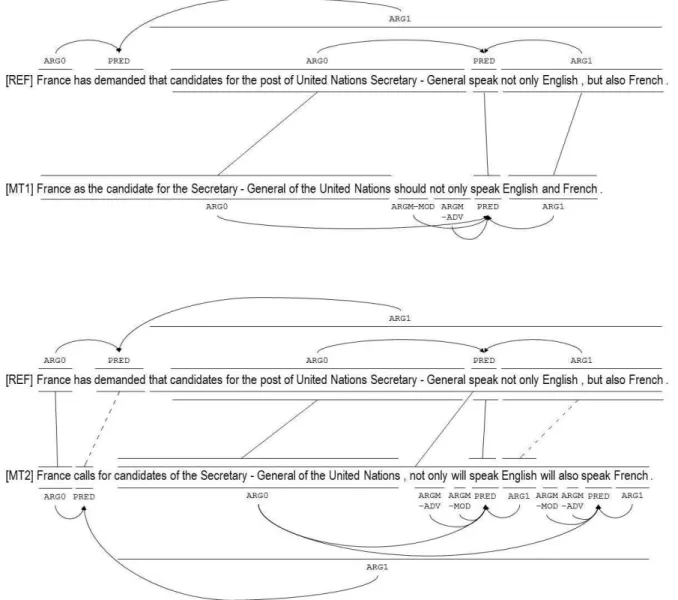
Lo and Wu,2011a) evaluate translation adequacy by measuring the similarity of the semantic frames and their role fillers between the human reference and machine translations. Figure1illustrates the concept of MEANT - the semantic roles and their fillers of the reference translation match more with those of the MT2 than with those of the MT1, therefore MT2 is a more adequate translation than MT1.
MEANT consistently outperforms the com-monly used automatic MT evaluation metrics, BLEU (Papineni et al.,2002), NIST (Doddington,
2002), METEOR (Denkowski and Lavie, 2014), TER (Snover et al.,2006), CDER (Leusch et al.,
2006) and WER in correlation with human ade-quacy judgment. It is relatively easy to port to other languages. In the full version of MEANT, it required only a monolingual corpus (for
Figure 1: Example that illustrates the concept of MEANT. The solid role alignments mean the translation is mostly correct while the dotted role alignments mean the translation is partly correct. The semantic roles and fillers of the reference match more with those of MT2 than those of MT1, therefore MT2 is a more adequate translation than MT1.
uating lexical semantic similarity) and an auto-matic semantic parser (for evaluating frame se-mantic similarity) of the output language. In sec-tion3, we describe a new subversion of MEANT that can be computed even when a semantic parser for the output language is unavailable.
MEANT is the weighted f-scores over corre-sponding semantic frames and role fillers in the reference and the machine translations. MEANT is generally computed as follows:
1. Apply a shallow semantic parser to both the reference and machine translations.
2. Apply the maximum weighted bipartite matching algorithm to align the semantic
frames between the reference and machine translations according to the lexical similar-ities of the predicates.
3. For each pair of the aligned frames, apply the maximum weighted bipartite matching algo-rithm to align the arguments between the ref-erence and MT output according to the lexi-cal similarity of role fillers.
4. Compute the weighted f-score over the matching role labels of these aligned predi-cates and role fillers according to the follow-ing definitions:
qi,j0 ≡ ARG j of aligned frame i in MT
qi,j1 ≡ ARG j of aligned frame i in REF
wi0 ≡
#tokens filled in aligned frame i of MT total #tokens in MT wi1 ≡
#tokens filled in aligned frame i of REF total #tokens in REF w0nf ≡
#tokens that are not fillers of any role inMT total #tokens in MT w1nf ≡
#tokens that are not fillers of any role in REF total #tokens in REF
w{pred|j} ≡ weight of similarity of predicates or ARG j
esent ≡ the whole sentence string of MT fsent ≡ the whole sentence string of REF
ei,{pred|j} ≡ role fillers of pred or ARG j of the aligned frame i of MT fi,{pred|j} ≡ role fillers of pred or ARG j of the aligned frame i of REF
s(e, f ) = lexical similarity of token e and f
prece,f =
P
e∈emaxf∈f s(e, f )
| e | (1)
rece,f =
P
f∈fmaxe∈e s(e, f )
| f | (2)
ssent =
2 · precesent,fsent· recesent,fsent
precesent,fsent+ recesent,fsent (3)
si,pred =
2 · prec
ei,pred,fi,pred· recei,pred,fi,pred
precei,pred,fi,pred+ recei,pred,fi,pred (4)
si,j =
2 · precei,j ,fi,j· recei,j ,fi,j
precei,j ,fi,j+ recei,j ,fi,j (5)
precision = P iw 0 iwpredsi,pred+ P j wj si,j wpred+Pj wj |q0i,j| + wnf0ssent P iw 0 i+ w 0 nf (6) recall = P iw 1 iwpredsi,pred+ P j wj si,j wpred+Pj wj |q1i,j| + w1 nfssent P iwi1+ w 1 nf (7)
MEANT = precision · recall
α· precision + (1 − α) · recall (8)
where s(e, f ) is the lexical similarity computed using word embeddings (Mikolov et al.,2013). By aggregating the lexical similarities, we can obtain the phrasal similarities. ssent is the phrasal
simi-larity of the whole sentence between the reference and the MT output. si,predis the phrasal
similari-ties of the predicates between the reference trans-lations and the MT output and si,j is that of the
role fillers of the arguments of role type j.
wpredis the weight of the lexical similarities of
the aligned predicates in step 2. wj is the weight
of the phrasal similarities of the role fillers of the arguments of role type j of the aligned frames be-tween the reference translations and the MT output in step 3 if their role types are matching. There is a total of 12 weights for the set of semantic role labels in MEANT (Lo and Wu,2011b) estimated by heuristics (Lo and Wu,2012).
Finally, the weight α for the precision and re-call is introduced for different usages of MEANT. α should be set to 1 so that MEANT is pure recall when it is used for MT evaluation and α should be
set to 0.5 so that MEANT is the balance of pre-cision and recall, when it is used for MT system optimization.
HMEANT (Lo and Wu, 2011a) is the variant of MEANT for human evaluation, where the se-mantic roles in the reference and in the MT output are annotated by humans. XMEANT (Lo et al.,
2014) is the cross-lingual variant of MEANT, which estimates translation quality of the MT out-put against the source sentence using automatic se-mantic parsers for the input and output languages and alignment probabilities to determine the cross-lingual lexical semantic similarity.
3 Improvements in MEANT 2.0
We improve the performance of MEANT on eval-uating translation adequacy by weighing the im-portance of each word by inverse document fre-quency when computing phrasal similarity, so that a higher score will be given to phrases with more matches for content words than for function words. We also modify the phrasal similarity cal-culation so that instead of aggregating lexical sim-ilarities for the bag of words in the phrase, it ag-gregates ngram lexical similarities. Thus, the word order of the semantic role fillers for the whole sen-tence is taken into account. Our development ex-periments showed that the optimal value of n is 2.
We also generalize the concept of weighted pre-cision and recall when computing phrasal similar-ities for the semantic role fillers. Lastly, we sim-plify the computation of the frame semantic simi-larities by introducing a weight β to linearly com-bine the phrasal similarity of the whole sentence and the frame semantic similarity of the reference and the MT output into MEANT. Our develop-ment experidevelop-ments show that the optimal value of β is 0.1. In summary, equations (1) to (8) are re-placed by equations (9) to (16) as follow:
prece,f≡ idf-weighted max-aligned distributional ngram precision (9)
rece,f≡ idf-weighted max-aligned distributional ngram recall (10)
si,pred=
precei,pred ,fi,pred·recei,pred ,fi,pred
α·precei,pred ,fi,pred+(1−α)·recei,pred ,fi,pred (11)
si,j=
precei,j ,fi,j·recei,j ,fi,j
α·precei,j ,fi,j+(1−α)·recei,j ,fi,j (12)
ssent=
precesent ,fsent·recesent ,fsent
α·precesent ,fsent+(1−α)·recesent ,fsent (13)
precision = P iw 0 iwpredsi,pred+ P j wj si,j wpred+Pj wj |q0i,j| P iw0i (14) recall = P iw 1 i wpredsi,pred+Pj wj si,j wpred+Pj wj |q1i,j| P iw1i (15)
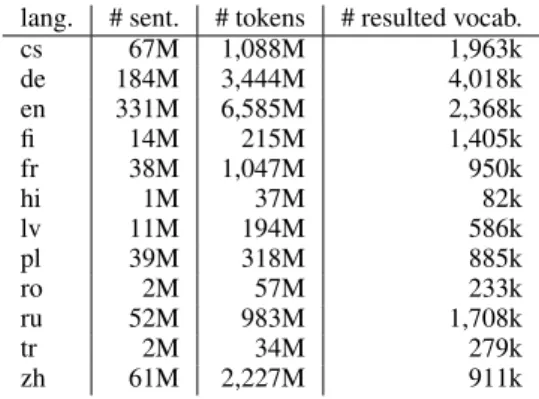
lang. # sent. # tokens # resulted vocab. cs 67M 1,088M 1,963k de 184M 3,444M 4,018k en 331M 6,585M 2,368k fi 14M 215M 1,405k fr 38M 1,047M 950k hi 1M 37M 82k lv 11M 194M 586k pl 39M 318M 885k ro 2M 57M 233k ru 52M 983M 1,708k tr 2M 34M 279k zh 61M 2,227M 911k
Table 1: Statistics of resources used to train the word embeddings and the resulted vocabulary size of the model.
MEANT = β precision · recall
α· precision + (1 − α) · recall+ (1 − β)ssent (16)
As a result, for languages without an auto-matic semantic parser or sentences without a valid predicate-argument structure recognized by an au-tomatic semantic parser, the MEANT score is the phrasal similarity of the whole sentence.
4 Setup
We use the monolingual corpora provided for the WMT translation task (Bojar et al., 2014,
2015, 2016a) to build the word embeddings for evaluating lexical similarities using word2vec (Mikolov et al., 2013). Table 1 summarizes the resources used to train the word embeddings and the resulting vocabulary size of the distributional lexical semantic similarity model.
We use mateplus (Roth and Woodsend,
2014) for German and English semantic role label-ing and mate-tools (Bj¨orkelund et al., 2009) for Chinese semantic role labeling. Instead of the 12 semantic role types used in (Lo and Wu,
2011b), we merge the semantic role labels of Chi-nese, English and German into 8 role types (who, did, what, whom, when, where, why, how) for more robust performance.
For languages except Chinese, tokenization step simply involves separating punctuations at the end of the words in both the reference and the MT out-put. Chinese does not have clear word boundaries. Each individual Chinese character usually carries multiple meanings and relies on surrounding char-acters to disambiguate it. Naive Chinese character segmentation would affect the accuracy of the vec-tor representation and the distributional lexical se-mantic similarity model. Thus, we use ICTCLAS
(Zhang et al.,2003) to segment the Chinese mono-lingual corpus into words before building the word embeddings.
5 Experiments and results
We use the WMT 2014-2016 metrics task evalu-ation set (Machacek and Bojar, 2014; Stanojevi´c et al.,2015;Bojar et al.,2016b) for our develop-ment experidevelop-ments. The official human judgdevelop-ments of translation quality were collected using relative ranking. The annotators were given the original input and the reference and were asked to order up to 5 different MT outputs according to the transla-tion quality.
Two other kinds of human judgments of transla-tion quality were collected in the WMT 2016 met-rics task. The direct assessment evaluation proto-col gave the annotators the reference and one MT output only and asked them to evaluate the trans-lation adequacy of the MT output on an absolute scale. The HUME metric (Birch et al., 2016) is very similar to HMEANT, which evaluates trans-lation adequacy via semantic units in the input sen-tence annotated by humans following the UCCA (Abend and Rappoport, 2013) guidelines. How-ever, HUME also takes nominal and adjectival ar-gument structures into account (instead of only predicate argument structure as in HMEANT).
Due to space limitations, we only report the re-sults of MEANT 2.0, MEANT 2.0 - nosrl, BLEU and the best correlation in each of the in-dividual language pairs. Since we use exactly the same protocol for each of the test sets, our reported results are directly comparable with those reported in Machacek and Bojar (2014); Stanojevi´c et al.
(2015); Bojar et al. (2016b). We summarize the observations in the following sections.
5.1 Correlation with human at system-level 5.1.1 On relative ranking judgment
Table 2 shows the Pearson’s correlation with the WMT 2014-2016 official human relative ranking scores at system-level. As expected, MEANT 2.0 performs significantly better than MEANT 2.0 -nosrl in most of the language pairs. Overall, both MEANT 2.0 and the nosrl variant are very competitive with other metrics for all test sets.
For the WMT14 test set, MEANT 2.0 is the best metric among all participants in that year in the de-en and en-de direction. On aver-age over from-English directions, MEANT 2.0
input language cs de fr hi ru en en en en en
output language en en en en en ave. cs fr hi ru ave. de
WMT14 MEANT 2.0 .990 .960 .979 .791 .843 .913 – – – – – .482
RRsys MEANT 2.0 - nosrl .983 .957 .979 .761 .830 .902 .978 .941 .986 .938 .961 .236 individual best .993 .943 .981 .976 .870 .944 .988 .960 .990 .941 .959 .357
BLEU .909 .832 .952 .956 .789 .888 .976 .937 .973 .915 .950 .216
input language cs de fi fr ru en en en en en
output language en en en en en ave. cs de fi fr ru ave.
WMT15 MEANT 2.0 .974 .965 .946 .994 .970 .970 – .764 – – – –
RRsys MEANT 2.0 - nosrl .972 .956 .939 .995 .969 .966 .984 .676 .833 .961 .937 .878 individual best .993 .981 .977 .997 .981 .978 .977 .879 .878 .964 .970 .916
BLEU .957 .865 .929 .975 .851 .915 .936 .573 .602 .948 .841 .780
input language cs de fi ro ru tr en en en en en en
output language en en en en en en cs de fi ro ru tr
WMT16 MEANT 2.0 .989 .947 .953 .940 .990 .980 – .540 – – – –
RRsys MEANT 2.0 - nosrl .985 .928 .969 .917 .984 .978 .967 .541 .902 .868 .925 .933 individual best .997 .985 .974 .970 .990 .981 .975 .915 .974 .959 .954 .956
BLEU .992 .905 .858 .899 .962 .899 .968 .752 .868 .897 .835 .745
Table 2: Pearson’s correlation of the metric scores with the WMT 2014-2016 official human relative ranking scores at system-level. For consistency with the task overview paper, en-de results are not included into out-of-English system average in WMT 2014 results (Machacek and Bojar,2014); system average are not reported in WMT 2016 results (Bojar et al.,2016b).
input language cs de fi ro ru tr en
output language en en en en en en ru
WMT16 MEANT 2.0 .990 .950 .966 .946 .959 .990 –
DAsys MEANT 2.0 - nosrl .988 .942 .979 .930 .958 .987 .946 individual best .995 .985 .980 .957 .976 .982 .966
BLEU .989 .808 .864 .940 .837 .895 .838
Table 3: Pearson’s correlation of metric scores with the WMT 2016 direct assessment of translation adequacy at system-level.
- nosrlis the best metric among all the partici-pants in that year. On average over into-English directions, MEANT 2.0 ties with the 4th-place participant in that year while MEANT 2.0 -nosrlis in 7th place. Both variants of MEANT lose only to ensemble and trained metrics in that year.
For the WMT15 test set, MEANT 2.0 -nosrl is the best metric among all the partici-pants in that year in the en-cs direction. On av-erage over into-English directions, MEANT 2.0 is in 6th place while the nosrl variant is in 9th place. Both variants of MEANT lose only to en-semble and trained metrics in that year.
For the WMT16 test set, MEANT 2.0 ties for 1st place with the best metric in the ru-en direction in that year. Both variants of MEANT perform as well as the leading metrics in all other directions, except en-de.
5.1.2 On direct assessment judgment
Table 3 shows the Pearson’s correlation with the WMT 2016 direct assessment of translation ade-quacy at system-level.
Both MEANT 2.0 and MEANT 2.0 -nosrlbeat all the other metrics that year in the tr-en direction and perform very competitively when compared to the leading pack in other directions. MEANT 2.0 performs better than the nosrlvariant in all directions, except fi-en. 5.2 Correlation with human judgment at
segment-level
5.2.1 On relative ranking judgment
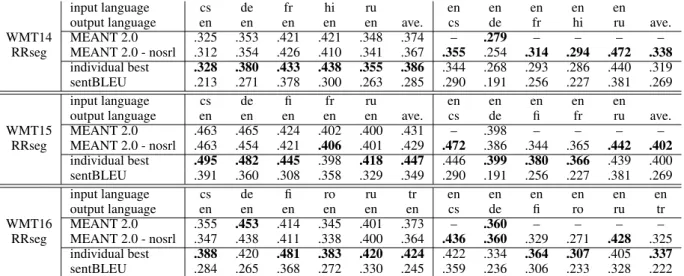
Table 4 shows the Kendall’s correlation with the WMT 2014-2016 official human relative ranking judgments at segment-level. Similar to the corre-lation at the system-level, MEANT 2.0 performs significantly better than MEANT 2.0 - nosrl for most language pairs.
For the WMT14 test set, MEANT 2.0 beats all the participants in the en-de direction while the nosrl variant beats all the participants in all other from-English directions (and their average) in that year. On the average of all the to-English directions, MEANT 2.0 and the nosrl variant are in 2nd and 3rd place respectively and only lose to an ensemble and trained metric in that year.
input language cs de fr hi ru en en en en en
output language en en en en en ave. cs de fr hi ru ave.
WMT14 MEANT 2.0 .325 .353 .421 .421 .348 .374 – .279 – – – –
RRseg MEANT 2.0 - nosrl .312 .354 .426 .410 .341 .367 .355 .254 .314 .294 .472 .338 individual best .328 .380 .433 .438 .355 .386 .344 .268 .293 .286 .440 .319 sentBLEU .213 .271 .378 .300 .263 .285 .290 .191 .256 .227 .381 .269
input language cs de fi fr ru en en en en en
output language en en en en en ave. cs de fi fr ru ave.
WMT15 MEANT 2.0 .463 .465 .424 .402 .400 .431 – .398 – – – –
RRseg MEANT 2.0 - nosrl .463 .454 .421 .406 .401 .429 .472 .386 .344 .365 .442 .402 individual best .495 .482 .445 .398 .418 .447 .446 .399 .380 .366 .439 .400 sentBLEU .391 .360 .308 .358 .329 .349 .290 .191 .256 .227 .381 .269
input language cs de fi ro ru tr en en en en en en
output language en en en en en en cs de fi ro ru tr
WMT16 MEANT 2.0 .355 .453 .414 .345 .401 .373 – .360 – – – –
RRseg MEANT 2.0 - nosrl .347 .438 .411 .338 .400 .364 .436 .360 .329 .271 .428 .325 individual best .388 .420 .481 .383 .420 .424 .422 .334 .364 .307 .405 .337 sentBLEU .284 .265 .368 .272 .330 .245 .359 .236 .306 .233 .328 .222
Table 4: Kendall’s correlation of metric scores with the WMT 2014-2016 official human relative ranking judgments at segment-level. For consistency with the task overview paper, system averages are not reported in WMT 2016 results (Bojar et al.,2016b).
input language cs de fi ro ru tr en
output language en en en en en en ru
WMT16 MEANT 2.0 .674 .510 .539 .607 .535 .588 –
DAseg MEANT 2.0 - nosrl .672 .484 .522 .587 .540 .577 .664 individual best .713 .601 .598 .661 .618 .663 .666 sentBLEU .557 .448 .484 .499 .502 .532 .550
Table 5: Pearson’s correlation of metric scores with the WMT 2016 direct assessment of absolute trans-lation adequacy at segment-level.
For the WMT15 test set, both MEANT 2.0 and MEANT 2.0 - nosrlbeat all the participating metrics in that year in the fr-en direction. MEANT 2.0 - nosrl also has the highest correlation with human in the en-cs and en-ru directions and the overall average of the from-English directions. Again, on the average of all the to-English direc-tions, MEANT 2.0 and the nosrl variant are in 2nd and 3rd place respectively and only lose to an ensemble and trained metric.
For the WMT16 test set, both MEANT 2.0 and MEANT 2.0 - nosrl beat all other partic-ipants in that year in the de-en, en-de directions while MEANT 2.0 - nosrl is also the cham-pion in the en-cs and the en-ru directions. Both variants perform very competitively when com-pared to the leading metrics in all other directions. 5.2.2 On direct assessment judgment
Table 5 shows the Pearson’s correlation of MEANT with the WMT 2016 direct assessment of absolute translation adequacy at segment-level. Both variants of MEANT perform very competi-tively when compared to the leading pack in other directions. MEANT 2.0 performs better than the
HUME input language en en en en output language cs de pl ro MEANT 2.0 – .522 – – MEANT 2.0 - nosrl .508 .522 .619 .479 individual best .544 .480 .639 .435 sentBLEU .349 .377 .550 .328
Table 6: Pearson’s correlation of metric scores with the WMT 2016 HUME human assessment at segment-level.
nosrlvariant in all directions, except ru-en. 5.2.3 On HUME evaluation
Table 6 shows the Pearson’s correlation of MEANT with the HUME human assessment on the himltest test set at segment-level.
Both MEANT 2.0 and MEANT 2.0 -nosrl beat all other participating metrics in that year in the en-de direction. MEANT 2.0 - nosrl also has the highest correlation with HUME among all the participants in that year in the en-pl direction.
5.3 Evaluation speed
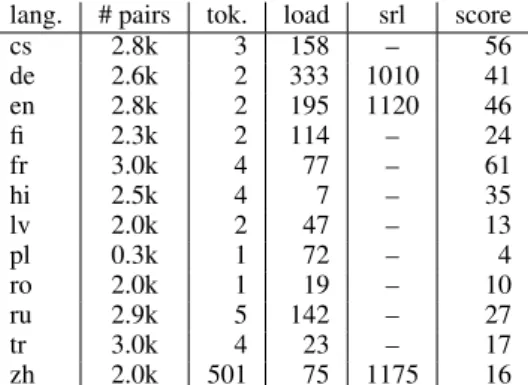
Table 7 shows the average time (in seconds) for each step of a typical WMT system evaluation
lang. # pairs tok. load srl score cs 2.8k 3 158 – 56 de 2.6k 2 333 1010 41 en 2.8k 2 195 1120 46 fi 2.3k 2 114 – 24 fr 3.0k 4 77 – 61 hi 2.5k 4 7 – 35 lv 2.0k 2 47 – 13 pl 0.3k 1 72 – 4 ro 2.0k 1 19 – 10 ru 2.9k 5 142 – 27 tr 3.0k 4 23 – 17 zh 2.0k 501 75 1175 16
Table 7: Average time in seconds for each step of evaluating a typical WMT system using MEANT: tokenizing both the reference and the MT output; loading the distributional lexical semantic similar-ity model; semantic role labeling the reference and the MT output; and scoring the MT output.
on different output languages using MEANT. The time taken for punctuation tokenization is almost negligible. This is because in common practice for MT system development, the validation and eval-uation set are reused frequently, so the process-ing of the reference translation is typically pre-computed. Furthermore, the MT system is trained to output tokenized translations, so it is not neces-sary to run the tokenization step on the MT out-put. Therefore, the tokenization step does not af-fect the time cost of MEANT in practical appli-cations (even in the case of Chinese, where word segmentation takes significantly longer).
The loading time of the word embedding model is proportional to the vocabulary size of the model reported in table1; it takes less than a second to load 10k vocabularies into memory.
Automatic semantic role labeling (SRL) is the most time consuming step in running MEANT. The time reported in table7includes parsing both the reference and the MT output. However, as pointed out above, common practice for MT sys-tem development is to frequently reuse the valida-tion and evaluavalida-tion sets. Thus, semantic role la-beling of the reference translation could be pre-computed to reduce the time taken for the SRL step in the development cycle.
Finally, the time used in computing the MEANT score is proportional to the size of the evaluation set and the word embedding model. The scoring step processes around 50 to 100 sen-tences each second.
6 Conclusion
We present a new version of MEANT that partici-pated in evaluating MT systems for all language pairs in the metrics task of the Second Confer-ence on Machine Translation (WMT 2017). The correlation of MEANT with human judgment has been improved by better addressing translation ad-equacy via weighing the importance of each word in the phrasal similarity computation by inverse document frequency, and better addressing trans-lation fluency via using distributional ngram accu-racy to account for word reordering in the compu-tation. Our results show that MEANT consistently performs well across different output languages in the previous year’s test set at both system-level and segment-level.
MEANT 2.0 - nosrl is a non-ensemble and un-trained metric that requires only a monolingual corpus in the output language for building the word embeddings to evaluate MT systems for a new language pair. Although there is an overhead time cost in semantic role labeling sentence pairs in MEANT 2.0 and loading the word embedding model in both MEANT 2.0 and its nosrl subver-sion, the time cost can be reduced almost by half in real applications. This highly portable and open source semantic MT evaluation metric is a more accurate alternative to BLEU in evaluating trans-lation quality for low-resource languages.
Acknowledgement
The author would like to thank Markus Saers, Kar-teek Addanki and Meriem Beloucif for provid-ing code review before the software release and Roland Kuhn for editing the paper.
References
Omri Abend and Ari Rappoport. 2013. UCCA: A
Semantics-based Grammatical Annotation Scheme. In Proceedings of the 10th International Confer-ence on Computational Semantics (IWCS 2013) – Long Papers. Association for Computational
Linguistics, Potsdam, Germany, pages 1–12.
http://www.aclweb.org/anthology/W13-0101. Alexandra Birch, Omri Abend, Ondˇrej Bojar, and
Barry Haddow. 2016. HUME: Human
UCCA-Based Evaluation of Machine Translation. In Pro-ceedings of the 2016 Conference on Empirical Meth-ods in Natural Language Processing. Association for Computational Linguistics, Austin, Texas, pages
1264–1274.
Anders Bj¨orkelund, Love Hafdell, and Pierre Nugues.
2009. Multilingual semantic role labeling. In
Proceedings of the Thirteenth Conference on Com-putational Natural Language Learning (CoNLL
2009): Shared Task. Association for
Computa-tional Linguistics, Boulder, Colorado, pages 43–48.
http://www.aclweb.org/anthology/W09-1206. Ondrej Bojar, Christian Buck, Christian Federmann,
Barry Haddow, Philipp Koehn, Johannes Leveling, Christof Monz, Pavel Pecina, Matt Post, Herve Saint-Amand, Radu Soricut, Lucia Specia, and Aleˇs
Tamchyna. 2014. Findings of the 2014
Work-shop on Statistical Machine Translation. In Pro-ceedings of the Ninth Workshop on Statistical Ma-chine Translation. Association for Computational Linguistics, Baltimore, Maryland, USA, pages 12– 58.http://www.aclweb.org/anthology/W14-3302. Ondˇrej Bojar, Rajen Chatterjee, Christian Federmann,
Yvette Graham, Barry Haddow, Matthias Huck, Antonio Jimeno Yepes, Philipp Koehn, Varvara Logacheva, Christof Monz, Matteo Negri, Aure-lie Neveol, Mariana Neves, Martin Popel, Matt Post, Raphael Rubino, Carolina Scarton, Lucia Spe-cia, Marco Turchi, Karin Verspoor, and Marcos
Zampieri. 2016a. Findings of the 2016 Conference
on Machine Translation. In Proceedings of the First Conference on Machine Translation. Association for Computational Linguistics, Berlin, Germany, pages
131–198.
http://www.aclweb.org/anthology/W16-2301.
Ondˇrej Bojar, Rajen Chatterjee, Christian Federmann, Barry Haddow, Matthias Huck, Chris Hokamp, Philipp Koehn, Varvara Logacheva, Christof Monz, Matteo Negri, Matt Post, Carolina Scarton, Lucia
Specia, and Marco Turchi. 2015. Findings of the
2015 Workshop on Statistical Machine Translation. In Proceedings of the Tenth Workshop on Statisti-cal Machine Translation. Association for Compu-tational Linguistics, Lisbon, Portugal, pages 1–46.
http://aclweb.org/anthology/W15-3001.
Ondˇrej Bojar, Yvette Graham, Amir Kamran, and
Miloˇs Stanojevi´c. 2016b. Results of the WMT16
Metrics Shared Task. In Proceedings of the First Conference on Machine Translation. Association for Computational Linguistics, Berlin, Germany, pages
199–231.
http://www.aclweb.org/anthology/W16-2302.
Michael Denkowski and Alon Lavie. 2014. METEOR universal: Language specific translation evaluation for any target language. In 9th Workshop on Statis-tical Machine Translation (WMT 2014).
George Doddington. 2002. Automatic evaluation
of machine translation quality using n-gram co-occurrence statistics. In The second international conference on Human Language Technology Re-search (HLT ’02). San Diego, California.
Gregor Leusch, Nicola Ueffing, and Hermann Ney. 2006. CDer: Efficient MT evaluation using block
movements. In 11th Conference of the European Chapter of the Association for Computational Lin-guistics (EACL-2006).
Chi-kiu Lo, Meriem Beloucif, Markus Saers, and
Dekai Wu. 2014. XMEANT: Better semantic MT
evaluation without reference translations. In Pro-ceedings of the 52nd Annual Meeting of the Associa-tion for ComputaAssocia-tional Linguistics (Volume 2: Short Papers). Association for Computational Linguistics,
pages 765–771.
https://doi.org/10.3115/v1/P14-2124.
Chi-kiu Lo, Philipp Dowling, and Dekai Wu.
2015. Improving evaluation and optimization
of MT systems against MEANT. In Proceed-ings of the Tenth Workshop on Statistical Ma-chine Translation. Association for Computational Linguistics, Lisbon, Portugal, pages 434–441.
http://aclweb.org/anthology/W15-3056.
Chi-kiu Lo and Dekai Wu. 2011a. MEANT: An
inexpensive, high-accuracy, semi-automatic metric for evaluating translation utility based on seman-tic roles. In Proceedings of the 49th Annual Meeting of the Association for Computational Lin-guistics: Human Language Technologies. Associa-tion for ComputaAssocia-tional Linguistics, pages 220–229.
http://aclweb.org/anthology/P11-1023.
Chi-Kiu Lo and Dekai Wu. 2011b. SMT
Ver-sus AI Redux: How Semantic Fames Eval-uate MT More Accurately. In Proceedings of the Twenty-Second International Joint Con-ference on Artificial Intelligence - Volume Vol-ume Three. AAAI Press, IJCAI’11, pages 1838–
1845.
https://doi.org/10.5591/978-1-57735-516-8/IJCAI11-308.
Chi-kiu Lo and Dekai Wu. 2012.Unsupervised vs.
su-pervised weight estimation for semantic MT eval-uation metrics. In Proceedings of the Sixth Work-shop on Syntax, Semantics and Structure in Sta-tistical Translation. Association for Computational Linguistics, Jeju, Republic of Korea, pages 49–56.
http://www.aclweb.org/anthology/W12-4206.
Matous Machacek and Ondrej Bojar. 2014. Results
of the WMT14 Metrics Shared Task. In Pro-ceedings of the Ninth Workshop on Statistical Ma-chine Translation. Association for Computational Linguistics, Baltimore, Maryland, USA, pages 293– 301. http://www.aclweb.org/anthology/W14-3336. Tomas Mikolov, Ilya Sutskever, Kai Chen, Greg
Corrado, and Jeffrey Dean. 2013. Distributed
representations of words and phrases and their compositionality. In Proceedings of the 26th International Conference on Neural
Information Processing Systems. Curran
As-sociates Inc., USA, NIPS’13, pages 3111–3119.
http://dl.acm.org/citation.cfm?id=2999792.2999959.
Kishore Papineni, Salim Roukos, Todd Ward,
and Wei-Jing Zhu. 2002. BLEU: a method
for automatic evaluation of machine
transla-tion. In 40th Annual Meeting of the
Associa-tion for Computational Linguistics (ACL-02).
Philadelphia, Pennsylvania, pages 311–318.
https://doi.org/10.3115/1073083.1073135.
Michael Roth and Kristian Woodsend. 2014.
Com-position of word representations improves seman-tic role labelling. In Proceedings of the 2014 Conference on Empirical Methods in Natural Lan-guage Processing (EMNLP). Association for Com-putational Linguistics, Doha, Qatar, pages 407–413.
http://www.aclweb.org/anthology/D14-1045. Matthew Snover, Bonnie Dorr, Richard Schwartz,
Lin-nea Micciulla, and John Makhoul. 2006. A study of translation edit rate with targeted human anno-tation. In 7th Biennial Conference Association for Machine Translation in the Americas (AMTA 2006). Cambridge, Massachusetts, pages 223–231.
Miloˇs Stanojevi´c, Amir Kamran, Philipp Koehn, and
Ondˇrej Bojar. 2015. Results of the WMT15 Metrics
Shared Task. In Proceedings of the Tenth Workshop on Statistical Machine Translation. Association for Computational Linguistics, Lisbon, Portugal, pages
256–273. http://aclweb.org/anthology/W15-3031.
Hua-Ping Zhang, Hong-Kui Yu, De-Yi Xiong, and Qun Liu. 2003. HHMM-based Chinese Lexical Analyzer ICTCLAS. In Proceedings of the Second SIGHAN Workshop on Chinese Language Processing. As-sociation for Computational Linguistics, Sapporo, Japan, pages 184–187.