3rd International Conference on Bio-Based Building Materials June 26th - 28th 2019
Belfast, UK ID_ B183
VARIOUS METHODS OF BINDING LIGHT AGRICULTURAL BYPRODUCTS
F. Bacoup1, A. Mahieu1*, A. Vitaud1, P. Drone1, R. Gattin1, N. Leblanc1
1 UniLaSalle-Artois university, Transformations & Agro-Ressources research unit, VAM²IN (EA 7519),
3 rue du Tronquet 76130 Mont-Saint-Aignan, France
*Corresponding author: A.Mahieu, e-mail: [email protected]
Abstract
A lot of porous agricultural byproducts have few valorization possibilities and are mainly used as animal litter. In order to propose more valuable applications for these byproducts, research is being carried out to use these resources in particleboards for application as building materials for insulation or flooring underlayer, or as molded cushioning for packaging or horticultural support medium for example.
The objective of this study is to investigate the potential of low density materials obtained from corn pith. At industrial scale this type of material is generally obtained by adding synthetic binder. To obtain totally biobased materials, corn pith particles are bound by different methods:
- without addition of any binder. In that case water is sprayed on the vegetal particles before the forming process. The lignocellulosic compounds contained in the agroresources can act as binders. Rate of sprayed water must be optimized in order to minimize the process time. - with various biosourced binders, based on vegetal resins or animal proteins to improve
particleboards resistance.
The particleboards are made at a laboratory scale by thermocompression of the vegetal raw particles with densities range from 50 to 200 kg/m3 according to the target application.
The corn pith particles highlight interesting properties, such as a low density as well as a hygrometry control capacity due to their alveolar structure. Particleboards are characterized by their thermal insulation properties, their mechanical properties by bending tests according to the densities and the different binders and by their resistance to water. Several applications can be considered according to the properties obtained.
Keywords:
Corn pith; biobased binder; thermocompression process; insulation properties; mechanical properties.
1 INTRODUCTION
One of the most important challenges of future and existing buildings is the reduction of energy consumptions in all their life phases, from construction to demolition. One approach to reduce energy consumptions in buildings is to improve the insulation properties of building envelopes. To date, synthetic materials from polymers such as polystyrene and mineral or glass wool have been used as high-quality thermal insulation for building envelopes. However, these materials are costly, consume a great deal of energy to be manufactured and release a large amount of waste in the environment [Korjenic 2016]. The introduction of the concept of “sustainability” in the building sector gradually led to the production of insulation products made of recycled or natural material [Asdrubali 2015]. Several authors reported that bio-based insulation materials made from crop by-products are an interesting alternative to those obtained from fossil energy. They have lower thermal conductivity and
density, are cheaper, available in abundance and environmentally friendly compared to conventional ones [Ashori 2014]. In this context, low-density particleboards were developed from a combination of crop by-products and natural binders to have potential application for ceiling panels, core materials, and bulletin boards [Wang 2002]. Particleboard performance is mostly related to the properties of adhesives [Wang 2002]. Many researches focused on alternatives to petroleum-based wood binder are reported in recent years. Novel bio-insulating materials based on natural fibers and biobased binders from lignin [Ghaffar 2014], tannin [Pizzi 2016], or protein, for example, soy proteins [Mo 2013], wheat gluten [Khosravi 2015] or bone glue [Nguyen, 2018] have been studied by many research groups. Studies about casein, from bovine milk, show its interest to make thermoplastic edible sheet [Chevalier, 2018] but few studies propose to use it as adhesive for plant particles [El Hajj 2012]. Modified biobased binder, like lignosulfonate [Privas 2013] have been widely studied and reported in recent years. Polysaccharides like Arabic gum [Abuarra 2014] and
starch [Norström 2014] were also investigated. Mati-Baouche et al. [Mati-Mati-Baouche 2015] developed a mix of polymers with adhesive properties to optimize chitosan content. They showed mechanical properties higher than the building specifications (DIN 4108-10) for bio-insulating.
Some crop by-products can also be agglomerated without addition of a binder. In that case the use of water vapor during the thermocompression process leads to extraction of lignocellulosic compounds from the agroressources and these compounds act as binders [Mahieu 2019].
The objective of this study is to investigate the potential of low density materials obtained from corn pith. For the corn stalks, the valorization chain exists at industrial scale but new valorization ways can be considered [Grass 2014]. In this study of novel bio-insulating particleboards, different biobased binders such as Arabic gum, latex and sodium caseinate are investigated. The targets are to manufacture and evaluate the thermal and mechanical performances of these bio-materials for buildings.
2 MATERIALS AND METHODS
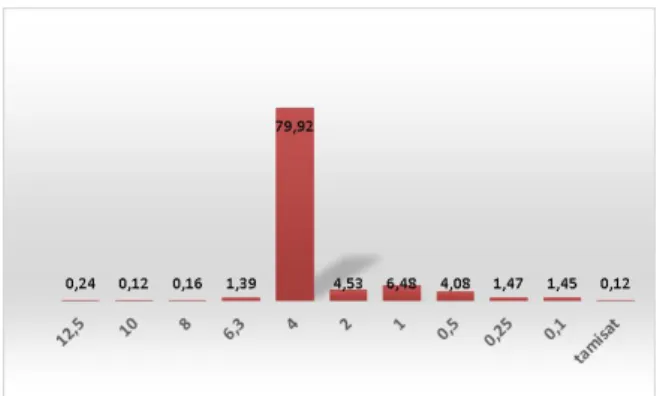
This study is performed on corn pith separated from the bark in corn stalks coming from the East of France. The bulk density of the corn pith is 15 kg/m3 and the particle
size is mostly 4 mm (Figure 1). The corn pith presents an alveolar structure with regular pores which give its interesting insulation properties. As shown by the Figure 2, fibers with lightly denser structure pass through the corn pith.
Fig. 1: Particle size distribution.
This corn pith is used to make particleboards by thermocompression. The boards are made in order to have a target density of 50 kg/m3 or 200 kg/m3. Before
compression the plant matter is blended with 40% w/w of water for the boards without binder addition and with 20% w/w of various biosourced binder for the others boards. The biosourced binders which are studied are a polysaccharide: the Arabic gum (from Nexira Food), a plant polymer: the natural latex (from Synthomer), and an animal protein: the sodium caseinate (from Sigma Aldrich) solved in water. The boards are thermopressed at 150°C during 45 min. The press is controlled by the position in order to reach the target density of the boards. The board dimensions are 150*150*25 mm3.
The efficiency of the different binding solutions is evaluated through the comparison of the board properties. In this short paper, the bending properties of the boards and their thermal insulation properties are presented.
Three-point bending tests were carried out on each particleboard with a universal mechanical properties testing machine (Shimadzu AGS-X) equipped with a load cell of 200 N with a precision of 0.1%. A constant speed of 3 mm/min was applied on the central cylinder and the required force to deform the sample was measured up to failure. The sample dimensions were 150*30*25mm3. They were conditioned at 50% relative
humidity before testing. Four samples were tested on each board.
The thermal conductivity of the particleboards was measured with a Heat Flow Meter HFM 436 Lamda from Netzch. The sample size was 150*150*25 mm3. The
measurements were performed in a steady state at 20°C with a temperature gradient between the hot and the cold plate of 20°C and repeated at least 4 times for each material.
3 RESULTS AND DISCUSSION
3.1 Mechanical properties of the biosourced boards
The mechanical resistance of the different boards is evaluated by three point bending tests. 50 kg/m3 seems
to be the lower density that can be reach for particleboards of corn pith to obtain boards with a sufficient cohesion to be manipulated. The minimum load measured at the failure is about 0.35 N for the 50 kg/m3 boards made with latex or Arabic gum. This value
is very low and close to the minimum that can be measured by the testing machine (0.2 N). We also made boards of 200 kg/m3 in order to obtain higher maximal
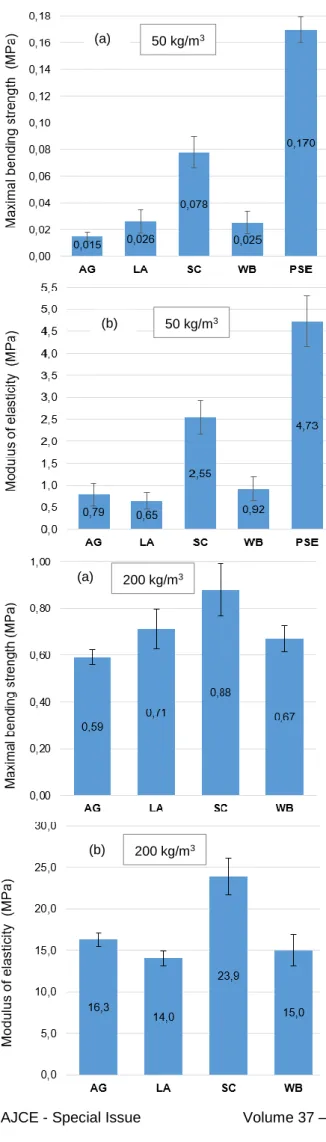
bending strength thanks to higher quantity of matter in the boards and so be better able to evaluate the effect of each studied binder. Figure 3 presents the maximal bending strength and the modulus of rupture of the boards of 50kg/m3 or 200 kg/m3 made without binder or
with the three studied binders: latex, Arabic gum or sodium caseinate. A commercial insulation board made of expanded polystyrene (PSE) is taken as a reference.
Fig. 3: Maximal bending strength (a) and modulus of rupture (b) of the boards made without binder (WB) or bounded with Arabic gum (AG), natural latex (LA) and sodium caseinate (SC) at 50 and 200 kg/m3 or the commercial reference of expanded polystyrene (PSE). For boards of 50 kg/m3 the Figure 3 shows that all the
biosourced boards present a maximal strength lower than that of the PSE, in spite of the higher density of the biosourced boards. The better biosourced board in terms of resistance to bending strength is the caseinate-based board which is about three times more resistant than the boards made with Arabic gum or latex or the binderless. We can also notice that the corn pith board made without binder addition presents slightly higher maximal strength than the Arabic gum board and an elasticity modulus slightly higher than both Arabic gum and latex boards. So for this low density the addition of the both last ones quoted binders does not improve the mechanical resistance of the corn pith boards. For the sodium caseinate board the values of maximal bending strength is low with 0.078 MPa but it ensures that the board can be manipulated, knowing that the major expected properties for the boards at 50kg/m3 are the
insulation ones and not the mechanical ones.
For the 200 kg/m3 boards the evolution of the
mechanical properties according to the binder used follows the same trend as the 50 kg/m3 boards. In that
case the binderless board presents nearly same properties as the board bound with the natural latex in terms of maximal bending strength and elasticity modulus. The board bound with Arabic gum shows slightly smaller maximal strength and slightly higher elasticity modulus but in view of the standard deviations these variations are not really significant. The mechanical resistance is improved only with the addition of the caseinate binder. But the maximal strength increases of only 30% between the binderless board and the caseinate-based board and of 60% for the modulus of elasticity whereas this difference is about 300% for the corresponding boards at 50 kg/m3.
We can conclude that for low density particleboards made of corn pith the cohesion due to the compounds extracted by vapor during the thermocompression is quite significant and should be sufficient according to the application of these materials. The addition of a biosourced binder as the sodium caseinate can have other advantages as improve the resistance to water of these materials. We can noticed that the standard deviations on the values of the mechanical properties are high. It is due to the difficulty to obtain a well homogeneous blend by hand mixing the little volume of binder with the high volume of corn pith. By an industrial process of mixing this problem would not occur and the properties would be less variable.
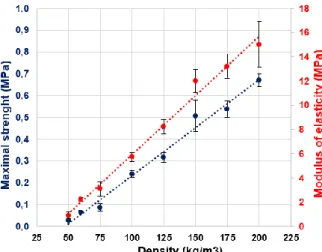
In order to check if the mechanical properties are linear according to the board density, binderless boards of 8 different densities between 50 and 200 kg/m3 were
studied. Figure 4 shows these results. (b)
(a) 50 kg/m3
50 kg/m3
(a) 200 kg/m3
The evolution of the mechanical properties, the maximal strength and the modulus of elasticity, by bending test is clearly linear for the binderless boards. These properties are multiplied by about 2.6 to 2.8 when the board density increases from 100 kg/m3 to 200 kg/m3.
The higher the density, the higher the mechanical properties but the higher the thermal properties also and these boards are targeted to be used as thermal insulation materials so a compromise between mechanical and thermal properties should be done to choose the better density for these materials.
3.2 Thermal insulation properties of the biosourced boards
The Figure 4 presents the thermal conductivity measured for each different board at 50 kg/m3. The PSE
is taken as a reference since it is the more used material for building insulation. Its density is 17 kg/m3.
Fig. 4: Thermal conductivity of the boards at 50 kg/m3. The thermal conductivities are close for all the biosourced boards with between 39.8 and 40.6 mW.m -1.K-1. These values are very close to that of the PSE
(38.3 mW.m-1.K-1) in spite of the significant difference
between density of the biosourced boards and the PSE.
4 CONCLUSION
In this study, we have investigated the potential uses of corn pith in low-density particleboards with different biobased-binders. About thermal performances, insulation properties of all studied particleboards are interesting, with thermal conductivities near to that of the commercial reference even if adding a binder increases slightly the thermal conductivity. About mechanical performances, for both densities of particleboards, the best results were obtained with the binder based on sodium caseinate. For other biobased binder, the impact of density is more important than the adhesion binder/plant particle. The results of the various experiments presented in this paper show that corn pith with different binders or without binder can be used with advantage in manufacturing particleboards for building insulation. This study is still under progress and further results will show the influence of the corn pith particle size on the board properties. The resistance to water of these boards will be investigated. We also intend to optimize the thermocompression time to be able to reduce it in order to facilitate the scale up of the process.
5 ACKNOWLEDGMENTS
The authors would like to thank the INTERREG program for funding this work under the project Sustainable Bio and Waste Resources for Construction (SB&WRC). The authors also wish to express their gratitude to SORBA Enterprise for kindly donating of corn pith.
6 REFERENCES
[Abuarra 2014] Abuarra A.; Hashim R.; Bauk S.; Kandaiya S., Fabrication and characterization of gum Arabic bonded Rhizophora spp. Particleboards, Material and Design, 2014, 60 108-115.
[Asdrubali 2015] Asdrubali F.; D'Alessandro F.; Schiavoni S. A review of unconventional sustainable building insulation materials, Sustainable Mater. Technol., 2015, 4, 1-17.
[Ashori 2014] Ashori A.; Nourbakhsh A.; Tabrizi A. K. Thermoplastic hybrid composites using bagasse corn stalk and E-glass fibers; fabrication and characterization, Polym. Plast. Technol., 2014, 53, 1-8. [Chevalier 2018] Chevalier E.; Assezat G.; Prochazka F.; Oulahal N., Development and characterization of a novel edible extruded sheet based on different casein sources and influence of the glycerol concentration, Food Hydrocolloids 2018, 75, 182-191.
[El Hajj 2012] El Hajj N.; Dheilly R.M.; Goullieux A.; Aboura Z. Innovant agromaterials formulated with flax shaves and proteinic binder: Process and characterization, Composites: Part B 2012, 43, 381– 390.
[Ghaffar 2014] Ghaffar S.H.; Fan M. Lignin in straw and its applications as an adhesive, International Journal of Adhesion and Adhesives, 2014, 48, 92-101.
[Korjenic 2016] Korjenic A., Jiri Zach J., Hroudova J., The use of insulating materials based on natural fibers in combination with plant facades in building constructions, Energy Build. 116 (2016) 45–58. [Mahieu 2019] Mahieu A.; Alix S.; Leblanc N. Properties of particleboards made of agricultural by-products with a classical binder or self-bound. Industrial Crops & Products, 2019, 130, 371–379.
[Mati-Baouche 2015] Mati-Baouche N. ; De Baynast H. ; Sun S. ; Lebert A. ; Petit E.; Michaud P., Polysaccharidic binders for the conception of an insulating agro-composite, Composites: Part A, 2015, 78 152–159.
[Mo 2013] Mo X.; Sun X.S.; Soy proteins as plywood adhesives: formulation and characterization, Journal of Adhesion Science & Technology, 2013, 27 2014-2026. [Nguyen 2018] Nguyen D.M.; Grillet A.-C.; Diep T.M.H.; Bui Q.B.; Woloszyn M. Influence of thermo-pressing conditions on insulation materials from bamboo fibers and protein based bone glue, Industrial Crops and Products, 2018, 111 834-845.
[Norström 2014] Norström E; Fogelström L; Nordqvist P; Khabbaz F; Malmström E. Gum dispersions as environmentally friendly wood adhesives, Ind Crop Prod 2014, 52, 736–44.
[Pizzi 2016] Pizzi A.; Wood products and green chemistry, Annals of Forest Science, 2016, 73, 185-203.
[Privas 2013] Privas E.; Navard P.; Preparation, processing and properties of lignosulfonate-flax composite boards, Carbohydrate Polymers, 2013, 93 300-306.
[Wang 2002] Wang D.; Sun X.S. Low density particleboard from wheat straw and corn pith, Ind. Crops Prod., 2002, 15, 43-50.