Publisher’s version / Version de l'éditeur:
Indian Concrete Journal, 70, 3, pp. 133-138, 1996-03-01
READ THESE TERMS AND CONDITIONS CAREFULLY BEFORE USING THIS WEBSITE. https://nrc-publications.canada.ca/eng/copyright
Vous avez des questions? Nous pouvons vous aider. Pour communiquer directement avec un auteur, consultez la première page de la revue dans laquelle son article a été publié afin de trouver ses coordonnées. Si vous n’arrivez pas à les repérer, communiquez avec nous à [email protected].
Questions? Contact the NRC Publications Archive team at
[email protected]. If you wish to email the authors directly, please see the first page of the publication for their contact information.
NRC Publications Archive
Archives des publications du CNRC
This publication could be one of several versions: author’s original, accepted manuscript or the publisher’s version. / La version de cette publication peut être l’une des suivantes : la version prépublication de l’auteur, la version acceptée du manuscrit ou la version de l’éditeur.
Access and use of this website and the material on it are subject to the Terms and Conditions set forth at
Self-levelling cement-based underlayments
Mailvaganam, N. P.
https://publications-cnrc.canada.ca/fra/droits
L’accès à ce site Web et l’utilisation de son contenu sont assujettis aux conditions présentées dans le site
LISEZ CES CONDITIONS ATTENTIVEMENT AVANT D’UTILISER CE SITE WEB.
NRC Publications Record / Notice d'Archives des publications de CNRC:
https://nrc-publications.canada.ca/eng/view/object/?id=6f2412dd-74b5-4f4f-b109-2654f0392211 https://publications-cnrc.canada.ca/fra/voir/objet/?id=6f2412dd-74b5-4f4f-b109-2654f0392211http://www.nrc-cnrc.gc.ca/irc
Se lf-le ve lling c e m e nt -ba se d unde rla ym e nt s
N R C C - 4 0 0 8 4
M a i l v a g a n a m , N . P .
M a r c h 1 9 9 6
A version of this document is published in / Une version de ce document se trouve dans:
Indian Concrete Journal, 70, (3), pp. 133-138, March 01, 1996
The material in this document is covered by the provisions of the Copyright Act, by Canadian laws, policies, regulations and international agreements. Such provisions serve to identify the information source and, in specific instances, to prohibit reproduction of materials without written permission. For more information visit http://laws.justice.gc.ca/en/showtdm/cs/C-42
Les renseignements dans ce document sont protégés par la Loi sur le droit d'auteur, par les lois, les politiques et les règlements du Canada et des accords internationaux. Ces dispositions permettent d'identifier la source de l'information et, dans certains cas, d'interdire la copie de documents sans permission écrite. Pour obtenir de plus amples renseignements : http://lois.justice.gc.ca/fr/showtdm/cs/C-42
Self-levelling
cement-based
underlayments
"'" ",LL^ZGLZ_HョGOIMヲ|ZBQセZセGLAョェ\GyQェGHェイZGZセLZZZZZZQセy[Z[[ZGゥス[ZL_BLZGBLMLBLM[LLZML[L[NNoel p..
Mailvaganam
-."';' :". ',' -"" '. ·f·-,-_:\{',i:_;,Y;;i\:f'<:; -,.':. . /_, ,", ;.. '<:<;:c.,Self-levelling underlayments are primarily used topravide a
smooth or levelfloor surface beforefloor caverings are
。ーーャセ、NThey reduce sound and heat transmission as y;ell as pravide
additional fire resistance. Most products are applied over old
or new floors constructed of cast-in-situ concrete, precast
concrete or wood and are being increasingly used to repair
floors that have deteriorated, sagged, scaled, or wornout.
The
materials are easy to use, eliminate trowelingand can
take
foot
traffic in
4to
6hours at atemperature in the range of15-32°
C. (60°_ 90
0F)1,2. Prepackaged proprietary materials when
. mixed with water, produce self-Iev.elling slurry-like-mixes
that can be placed either by pumping, squeegee, or spread by
trowel, Fig
1.Although termed self-levelling, most products
have to be spread with some tool and some products have to
be floated lightly, especially those containing aggregates.
This paper discusses the technology relating to self-levelling characteristics, installation and quality control of cementbased underlayments.Italso presents a comparison to
gyp-sum-based systems which are also used for similar purposes.
Technology
Flow and self-levelling characteristics are governed by the rheological behaviour of the slurry-like materials produced when the solid components of underlayment products are mixed with water. Most liquids we are familiar with --- water and alcohol for example behave as Newtonian fluids where
the relationship 「・エキセ・ョ shear stress and rate of shear is
linear, the slope of the line being the reciprocal of the viscosity,
Fig 2(a). Cement and gypsum slurries however, show
non-Newtonian behaviour because these are fluids containing large molecules, high concentrations of dissolved solids, or quantities of suspended solids. and are said to behave like Bingham fluids. Such flUids al"echaracterised by a finite yield stress which musi be exceeded before flow is initiated. The
relationShip between shear stresS
and
rate of shear is alsoセセセ[ZセGセMスセZャュ[セZエセ_ャセLセAセセセ[セセセZセセセセセセᄋセェセセゥセLセ
;fi?
ZRセ ISLセN
Noel P. Mailvaganam, National Research Council Canada, Insttitute for Research Fig 1Placingofthe underlayment
inConstruction, Ottawa, Canada KIAorVᄋ[ェMBBZGZセI[エG⦅L|QZ[G\|[Z[hvZ|GQ V "i
March 1996" The Indian Concrete Journal 133
,00 '00 200 '00
°
ャlllNNセオNNN _ _L...L.._ _.-l._ _---J o セ•
'"
m2 /kg 0 0 0 0 oO"'on c-10 ... fV) '" 8The properties o'f the finished product are also governed by the type of mixer, mixing time, mixer load and type of pump used. Increasing the vigour of mechanical mixing will lower
....
セ.
•
セ•
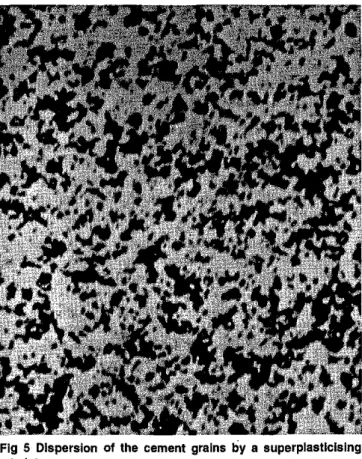
'0 ,The pivotal role that a superplasticiser plays in the formulation of self-levelling underlayments is due to the dramatic effects it produces on flow behaviour. Such an effect is believed to be derived by the absorp-tion of the admixture on the surface of cement grains
and thereby providing surfaces of a similar or zero
charge which are mutually repulsive. They thus fully disperse cement particles, Fig 5, freeing more water for lubrication and reducing interparticle attraction. Both yield stress and plastic viscosity are decreased and the decrease is greater for yield stress; it may be completely eliminated if sufficient admixture is added so that Newtonian behaviour is observed,
Fig 6"'.
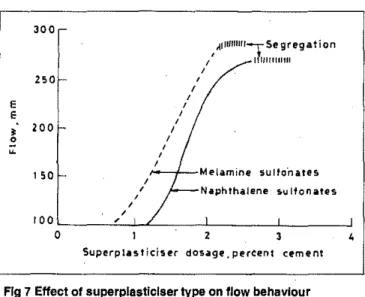
Although desired properties such as high flow, early strength development and good abrasion can be achieved with a high superplasticiser dosage, there has to be a correct match of the dosage with other Ingredients to prevent segregation of the mix in the plastic state···. The opti-mum dosage required is dependent on the type of superplas-ticiser andthe amount of cementitious material (type 1, fly ash or blast furnace slag) present in the mixture.
Most superplasticisers are based on either melamine for-maldehyde sulfonate (MFS) or naphthalene forfor-maldehyde sulfonate (NFS) which react dlfferently with the various types
of cements, Fig
7';
Thus thetypeof superplastidser used in themixture may influence the flowability of the product at
differ-ent temperatures. For a given dosage, coarsely ground ce*
ments with low C,A contents (less than 6 percent) produce higher flowability than more finely ground cements with higher C,A (greater than 8 percent) contents. Similarly, a mixture of cementitious material (type 1 and blast furnace slag) require a lower dosage of the superplasticiser to produce the desired flowability than a mixture containing solely type 1
cement,?·
,
iiセ
Water- ceoment ratio
0 ' " 0 '" 0 BGセャdセ on
o
Co 6 0 0, 400."
'00 セ•
セ•
200 1;•
:;'"
'00 Shear stress.'r (al (b) (•
•
セ•
•
:;'"
Fig 2(a)and(b)Rheological behaviour
ッ⦅セセセセ⦅セ _ _
o 60 120 180
At the low water
I
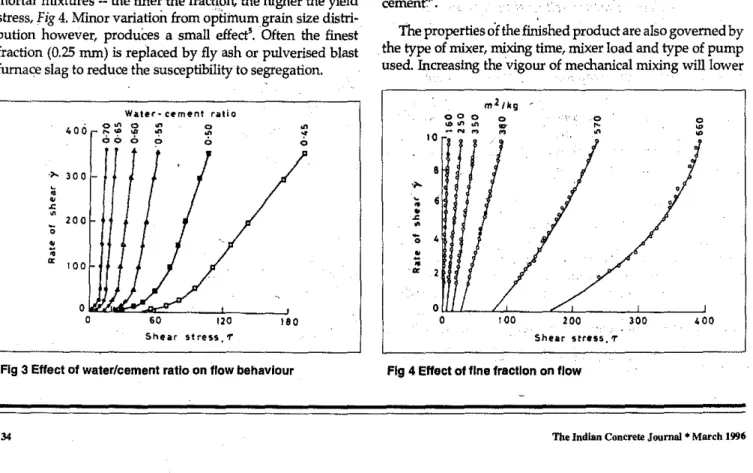
cement ratios required to ensure propersuspension of the solids, most self-levelling compositions are
characterised by a yield stress and thixotropic behaviour',
Fig 3. Concentric cylinder viscometer tests done on
underlay-ment slurries indicate that they canbeconsidered Bingham
fluids, which give yield stresses ranging from 1.6-1.9 N
I
m'and a plastic viscosity of 0.0006-0.0010 N/m' ''''. To obtain
self-levelling properties, the yield stress has to be reduced and this is achieved by the selection and combination of suitable
mix ingredients at optimum levels.
Commercially available products are factory pre-blended
mixtures of sand, cement and admixtures (superplasticisers,
polymer latex and gelling agents) which are included to give specific properties',s,·. For example the addition of a superplas-ticising admixture resuits in the reduction of the yield stress and a simultaneous decrease in the thixotropy of the mix. The amount and type of the finest fraction of the aggregate has a significant influence on the stability and flowability of these
mortar mixtures -- the finer
the
fraction, the higher the yield. stress, Fig 4. Minor variation from optimumgrain size distri-bution however, produces a small effect'. Often the finest fraction (0.25 mm) is replaced by fly ash or pulverised blast furnace slag to reduce the susceptibility to segregation.
Shear stress." Shear stress, 'r
Fig 3 Effect of water/cement ratio on flow behaviour Fig 4 Ellect of fine fraction on flow
134 The Indian Concrete Journal*March 1996
Fig 6 Effect of superplastlclser dosage on flow behaviour·
0·8 perct'r'lt
Shear streS$.'7' /
Properties
Self levelling underlayments are formulated for minimal shrinkage, rapid strength gain and flowability without segre-gation. However, these and other properties can be adversely
affected by excessive amounts of water. Too much water will
cause dusting, low strength and shrinkage cracks. The mate-rials weigh from 100-120 pef, produce 28 day compressive
strengths in the range of 10.35-38 N
Imm'
(1500-5500 psi), arepumpable and able. to level off after minor screeding and be feather edged if necessary'·"'''. Depending on the product, hand must be Installed by the manufacturer's approved
appli-catoe,2. Since gypsum based products are usually installed
thicker than cement based underlayments, the latter materials
are more often used in situations where thin layers are
re-quired. Minimum thickness for gypsum-based products are
usually 10-12.7mm (3 /8-112")overconcrete and 20 mm(3I 4")
cover wood. Portland. cement-based products are usually
in-stalled at 23.18-10 mm(1/8-3/8")over concrete and atleast
1/4" over wood1
,9,tCI. Gypsum underlayments generally cost
less to install than portland cement underlayments, especially when thick layers are applied"'.
Portland cement underlayments are water-resistant, whereas gypsum products are not recommended for on--or
below grade applications, unless the area is well drained. Portland cement underlayments are generally stronger than
gypsum underlayments and are therefore used more for com-mercial applications where heavier loads are more common.
Fig9 shows the crumbling of a weak underlayment subjected
to foot traffic.
Gypsum underlayments set faster than portland cement underlayments, permitting foot traffic sooner and the floor can be open to other construction activity. Gypsum products must be cured for at least five days prior to the installation floor coverings whereas for portland cement products they can often be installed within one or two days. Gypsum prod-ucts are less likely to crack, except for rare hairline cracking. Instead of shrinking and cracking when they are dry, gypsum products expand slightly"'. Thus they can be installed without
jointsin a continuous pour. Most manufacturers of portland
cement Wlderlayments recommend extending the existing
floor joints up through the underlayment.
"
•
•
セ•
"0セiM
lL
0pl!rc.nt•
.,..
Cement based materials are easy to install, when the manufacturer's instructions are diligently
fol-lowed. Gypsum based underlayments on the other
Fig 5 Dispersion of the cement grains
by
a superplastlclslng admixturethe yield stress and a wide variation in yield stress and viscos-ity can be obtained with different mixing procedures,
Fig8(a)"'·". Mixers which produce medium intensity mixing
such as pan mixers, give more effective mixing in a shorter
time than free fall mixers7
•·The optimum mixing time can
range from 3-5 minutes; prolonged mixing may cause rapid
decrease in flowability,Fig8(b). With some mixers high loads
produce poor mixing due to the inability to disperse the high
fines content in water, hence segregation results. Since most
self-levelling products are placed by pumping, it is important to use the correct type of pump. Spindle drag pumps con-nected to the mixer gIve better results than the piston type which produces relatively high stiffening of the wet
mix-ture2,lC1.11.
Types of underlayment
Most self-levelling underlayments are either ce-ment or gypsum plaster based. The two types differ
in their installation requirements, minimum and
maximum thickness which can be applied, certain
properties such as water and fire resistance, rate of curing and costs. Type of floor finish and materials
specified therefore, will depend on the nature of operations that will be carried out in the particular
location.
March 1996 '" fhe Indian Concrete Journal 135
&JltZiMW
---Fig 8 Ellect 01 mixing on rheolOgy (a)Dillerent types ot mixing (b)Ellects due
to prolonged mechanical mixing
Installation of self-levelling underlayments involves the fol-.lowing steps:
!
i
I
s .'.-
-time.mm Cb) Yield セエイ・ウウ Yiltos.ity Milling ,,0•
,
•
>]
セ•
0:: 0.4<-_ _-;- : - - .1 o 2 4 6 /111is crucial that the substrate surface be properly prepared to ensure firm bonding of the underlayment. The concrete base does not have to be level, but must be free of dirt and loose dust, grease and oily substances, curing compounds and other mailer which will inhibit the formation of a good bond be-tween the base and mortar topping.
Spalled areas and large cracks on concrete subfloors should be patched with repair mortar while neat epoxy liquid can be used to repair the smaller cracks. On wood subfloor, plywood must be nailed down firmly and weak or delaminated ply-wood removed. Shotblasting and vacuuming may also be
required tofen:LOveャ。ゥエ。イオZセN from concrete subfloorsl,2,.10..
The sub-floor absorbs water from the underlayment and reduces working time. This should be prevented by coating
the concrete or wood base with a primerfsealer after cleaning.
The primer which usually consists of a 20 percent solid latex
emulsion is appliedby squeegee or push broom on to the
clean sub-floor. It seals the pores and microcracks of the
concrete and wood sub-floor and insures a good bond. To prevent absorption of water from gypsum based wallboards or columns or other absorbent materials, the absorbent me-dium should be covered with plastic or thin wood strips to the
anticipated thickness of
the
underlayment.Some portland cement underlayments require special sub-floor preparations when they are placed over wood. The preparation may include stapling a metal lath mesh to the floor to. provide a mechanical bond with the underlayment.
The mesh also prevents crackiIig of the underlayment by
distributing loads from movement over a great area1,9.
Most products are factorypreblended mixtures which only require the addition of the recommended amount of water to
achieve the fluid like composition.It is important to adhere to
the
manufacturer's recommended water content as excess water reduces strength, causes shrinkage and resultsinsur·face dusting, which inhibits the bonding of floor coverings. Mixing operations should comply with the manufacturer's
recommendations viz. mixertype and period of mixing. This
will avoid potential problems such as segregation (due to poor mixing) ora rapid decrease in flowability (due to prolonged
Shear !otr"",T . (a.) .:
•
セ•
.,... Superplasticiser dosage. per¢ent cementpreparation and priming the subfloor mixing of the drymix materials with water placing (by pump or other manual means) and spreading of the wet slurry and letting it to level selting and curing of the
under-layment prior to allOwing foot traffic
(v) curing of the underlaymentto a
dry condition (to the
manufac-turer's Stipulated moisture con·
tent) before the laying of floor
coverings. (iv) (i) (ii) (iii) 300 I,/lllmurr:-I Se gregation I I IlIlltliUl
,
2'0,
I,
E I E,
I•
200 I 0 I セ,,
I150 I Melamine su Ito'nues
,
Naphthalene !tulfonates,
,
I roo,
0 2 3 4Fig 7 Effect of superplasticlser type on flow behaviour
they can be walked on in 2-4 hours and a floor covering
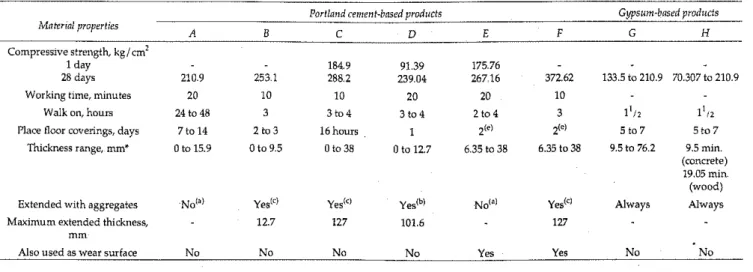
applied in 2-7 days or more after placement"u.Table1
pre-sents properties of some of the products available in the market.
Installation
Quality control
Quality of the product is monitored primarily by (;) a
flow-ability at stipulated water contents and(iiistrength
develop-ment. Flowability may be measured by an empirical
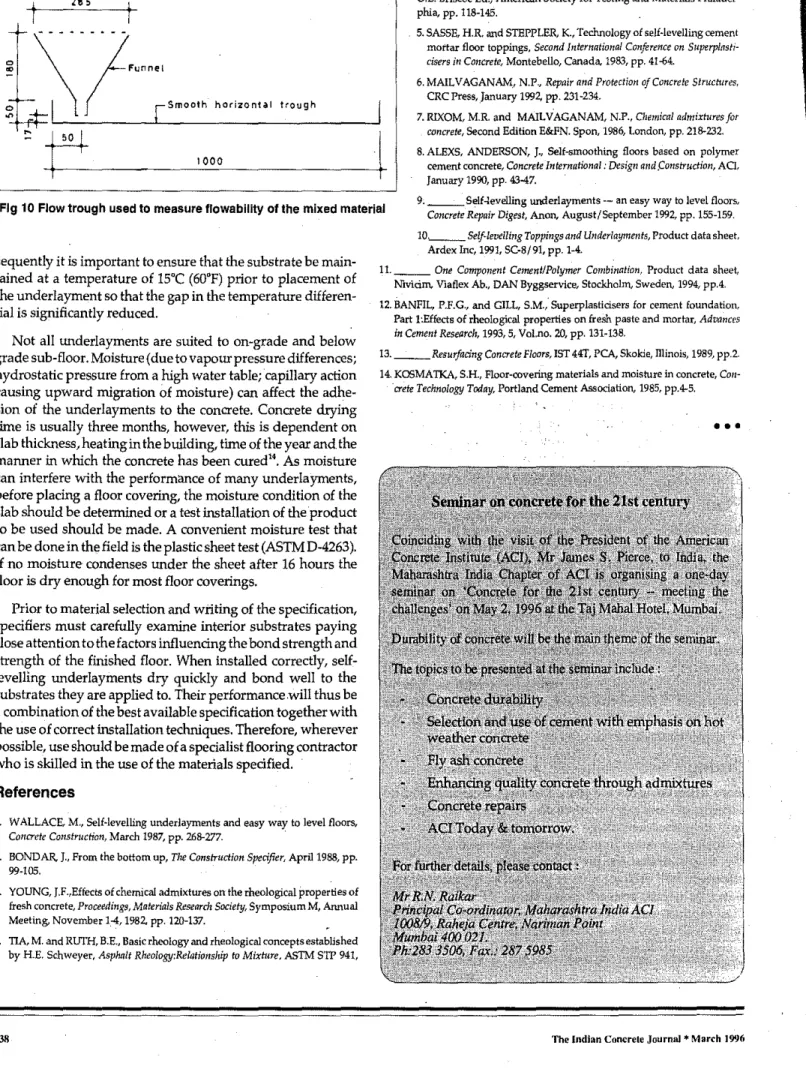
workability test such as the flow trough shown in FiglOU. A
stopper at point A is removed to allow 3litres of the slurry-like mortar to flow along the smooth horizontal steel trough. The
distances the mortar flows in 30 seconds is recorded.
Surface preparation
Since cement-based self-levelling products contain high cement contents, they are placed
at nearly fluid consistencies over large areas
and subject to conditions where high rate of
evaporation can occur, there is ahigh potential
for the underlaymentto debond. Therefore, it
136 The Indian Concrete Journal - March 1996
Table 1 : Descriptions of a few self-levelling underlayment products2
Portland cement-based products Gypsum-based prodllcts Material properties
A s C D E F G H
Compressive strength, kglcml
1 day 184.9 91.39 175.76
28 days 210.9 2531 288.2 239.04 267.16 372.62 133.5to210.9 70.307to210.9
Working time, minutes 20 10 10 20 20 10
Walk on, hours 24to48 3 3t04 3 t04 2 t04 3 11/2 1112
Place floor coverings, days 7to 14 2to3 16 hours 1 2(<:) 2(e) 5 to 7 5t07
Thickness range,.mm* oto 15.9
o
to9.5 oto38 oto12.7 6.35 to 38 6.35to38 9.5 to 76.2 9.5min. (concrete) 19.05 min. (wood) Extended with aggregates No(a} Yes(c) Yes(C) Yes(bj -No(a) Yes(c) Always AlwaysMaximum extended thickness, 12.7 127 101.6 127
mm
Also used as wear surface No No No No Yes Yes No No
". Most products can be feather-edged,ifnecessary
(n)Already contains graded silica aggregates (b)Manufacturer recommends adding 6.8 kg of.3.17 mm sand to each 22.68 kg bag (c)Manufacturer recommends adding 3.17 t9 6.35 mm fine gravel (d)Denotes time when topping can take traffic (e)Compressive strength depends on mix design
mixing). Since the mixed material has a limited period during which flowability and self levelling is maintained, it is prudent to mix only enough material that can be applied in 15-20 minutes. The approximate coverage per 25 kg (55 lb) mixed
with 0.91 litres (6.5 quarts) of wateris ---for 3.18 mm(1/8")
thickness 5.58 m' (60 sqIt),for 6.3 mm(1/4")thickness 2.79 m'
(30sqIt)and for 10mm (112")thickness 1.29m' (15 sq. ft)",,",ll.
Placing
Self-levelling compounds are most often placed by pumping,
Fig 1. Manual installation by squeegee is sometimes done
particularly on the top floors of high rise buildings when there is limitation to the height a given material can be pumped. Most materials are readily pumped, but some products pos-sess rheological properties that are more sensitive to pumpline pressures and respond poorly, causing purnpline blockages. Hence, it is important that the correct consistency (as
recom-mended by the manufacturer)isobtained after mixing so that
the rheological properties are compatible with the type of
pump used1
,2,9.Itis advisable to carry out pumping trials prior
to site work so that the product can be matched with the equipment intended to be used on the job.
Curing
Since underlayments are placed in large expanses, and no curing compounds can be applied to the freshly laid material, they are prone to shrinkage and cracking due to the potential for high evaporation from the surface. Therefore it is impor-tant to ensure that the prevailing ambient conditions after placement will produce a more gradual evaporation of mix water. At normal ambient temperatures, IS"-36"C (60"-95"F) most products cure within 4 hours to provide a surface that can be walked on. At lower temperatures, 4-15"C (40"-59"F) it takes an additional 2-6 hours to reach the "walk on"
strength1,2,10.
March 1996*The Indian Concrete Journal
Precautions
Self-levelling underlayments should not be installed at low temperatures (below 5"C (40" F) for portland cement-based products and below lO"C (50" F) for most gypsum based products). Heat and ventilation may be required for underlay-ments to dry properly, especially gypsum-based products; these products should not be installed in high humidity. Ex-posure to direct sun light and drying winds should be
pre-vented to avoid fast surface drying. Normally this is not a
problem because materials are designed for interior use only and are enclosed after the building is enclosed.
The high cement and superplasticiser contents in these products result in the rapid hydration of the cement. Thus, high temperatures (27"-31"C, [80-88"F]) can develop when the
material is mixedinbulk. Placing of a warm unde;rlayment on
a cold substrate (less than 15"C, [60"F]) will result in the debonding of the underlayment as it cures and hardens.
Con-Fig 9 Crumbling of weak underlayment
Fig 10 Flow trough used to measure f10wabillty of the mixed material
•••
14. KOSMAlKA, SH., Floor-covering materials and moisture in concrete,COil·
crete Technology Today,Portland Cement Association, 1985, pp.4-5. O.E. Briscoe Ed., American Society for Testing and Materials Philadel-phia, pp. 118·145.
5. SASSE, H.R. and STEPPLER,K.,Technology of self-levelling cement mortar floor toppings,Second International Conference on Superplnsti· risers in Concrete,Montebello, Canada, 1983, pp. 41--64.
6. MAILVAGANAM, N.P.,Repair and Protection of Concrete Structures,
CRe Press, .January 1992, pp. 231-234.
7. RIXOM,M.R.and MAILVAGANAM, N.P.,Chemical admixtures for concrete,Second Edition E&FN. Spon, 1986, London, pp. 21&.232. 8. ALEXS, ANDERSON,J., Self-smoothing floors based on polymer
cement concrete,Concrete International: Design and [:onstruetion,AO, January 1990, pp. 43-47.
9. Self..J.evelling underlayments·- an easy way to level floors,
Concrete Repair Digest,Anon, August/September 1992, pp. 155-159.
10, Self-levelling Toppings and Underlayments,Product data sheet Ardex Inc, 1991, SC·8/91, pp. 1·4.
11. One Component Cement/Polymer Combination,Product data sheet, Nivicim, Viaflex Ab., DAN Byggservice, Stockholm, Sweden, 1994, ppA. 12. BANFIL, P.F.G., and GILL, SM.,· 5uperplasticisers for cement foundation,
Part l:Effects of rheological properties on fresh paste and mortar,Advances in Cement Research,1993, 5, Vol.no. 20, pp. 131·138.
13. Resurfacing Concrete Floors,1ST 441, PCA, Skokie, lllinois, 1989, pp.2.
-1
285r-セOGBBセLNBB
.,,,,,.,, ",."
I
セ
e---c-=,
°"-°°'---
-+1
3. YOUNG, J.F.,Effects of chemical admixtures on the rheological properties of fresh concrete,Proceedings, Materials Research Society,Symposium M, Annual Meeting. November 1-4, 1982, pp. 120·137.
4. TIA, M. and RIITH, RE., Basic rheology and rheological concepts established by H.E. Schweyer,Asphalt Rheology:RelatiollshiptoMixture,ASTM: 511' 941, 1. W ALLAca M., Self-levelling underlayments and easy way to level floors,
Concrete Construction,March 1987, pp. 268-277.
2. BONDAR,.J.,From the bottom up,The Construction Specifier,April 1988, pp. 99·105.
sequently it is important to ensure that the substrate be main-tained at a temperature of 15"C (60"F) prior to placement of the underlayment so that the gap in the temperature differen-tial is significantly reduced.
Not all underlayments are suited to on-grade and below grade sub-floor. Moisture (due to vapour pressure differences; hydrostatic pressure from a high water table; capillary action causing upward migration of moisture) can affect the adhe-sion of the underlayrnents to the concrete. Concrete drying time is usually three months, however, this is dependent on slab thickness, heating in the building, time of the year and the mannerin which the concrete has been cured14
•As moismre
can interfere with the performance of many underlayrnents, before placing a floor covering, the moisture condition of the slab should be determined or a tesl installation of the product to be used should be made. A convenient moisture test that can be done in the field is the plastic sheet test (ASTM D-4263). If no moisture condenses under the sheet after 16 hours the
floorisdryenough for most floor coverings.
Prior to material selection and writing of the specification, specifiers must carefully examine interior substrates paying close attention to the factors influencing the bond strength and strength of the finished floor. When installed correctly, seIf-leveIling underlayments dry quickly and bond well to the substrates they are applied to. Their performance,wiIl thus be a combination of the best available specification together with the use of correct installation techniques. Therefore, wherever possible, use should be made of a specialist flooring contractor who is skilled in the use of the materials specifted.
References
138 The Indian Concrete Journal '" March 1996