Publisher’s version / Version de l'éditeur:
Canadian Acoustics, 28, 3, pp. 98-99, 2000-09-01
READ THESE TERMS AND CONDITIONS CAREFULLY BEFORE USING THIS WEBSITE. https://nrc-publications.canada.ca/eng/copyright
Vous avez des questions? Nous pouvons vous aider. Pour communiquer directement avec un auteur, consultez la
première page de la revue dans laquelle son article a été publié afin de trouver ses coordonnées. Si vous n’arrivez pas à les repérer, communiquez avec nous à [email protected].
Questions? Contact the NRC Publications Archive team at
[email protected]. If you wish to email the authors directly, please see the first page of the publication for their contact information.
NRC Publications Archive
Archives des publications du CNRC
This publication could be one of several versions: author’s original, accepted manuscript or the publisher’s version. / La version de cette publication peut être l’une des suivantes : la version prépublication de l’auteur, la version acceptée du manuscrit ou la version de l’éditeur.
Access and use of this website and the material on it are subject to the Terms and Conditions set forth at
Modelling structure-borne sound transmission at bolted joints
Bosmans, I.; Nightingale, T. R. T.
https://publications-cnrc.canada.ca/fra/droits
L’accès à ce site Web et l’utilisation de son contenu sont assujettis aux conditions présentées dans le site LISEZ CES CONDITIONS ATTENTIVEMENT AVANT D’UTILISER CE SITE WEB.
NRC Publications Record / Notice d'Archives des publications de CNRC:
https://nrc-publications.canada.ca/eng/view/object/?id=af88807d-8acd-4a3a-b654-0e4150299513 https://publications-cnrc.canada.ca/fra/voir/objet/?id=af88807d-8acd-4a3a-b654-0e4150299513
NRCC-44244
M
ODELLINGS
TRUCTURE-B
ORNES
OUNDT
RANSMISSIONA
TB
OLTEDJ
OINTS.
Ivan Bosmans and Trevor R.T. NightingaleNational Research Council Canada, Institute for Research in Construction, Montreal Road, Ottawa, Ontario, K1A 0R6.
Canadian Acoustics, 28, (3), Proceedings of the Acoustics Week in Canada (Sherbrooke, Québec, 9/28/2000), pp. 98-99,
September 01, 2000
RÉSUMÉ -
Disponible aussi tôt que possible.
1. INTRODUCTION
Structure-borne sound transmission at a bolted junction between a plate and a stiffening rib is modelled using an analytical calculation model. This model is based on the wave approach for semi-infinite plates and calculates coupling loss factors for Statistical Energy Analysis (SEA). Modelling vibration transmission in rib stiffened plate structures is very relevant when studying flanking transmission in wood frame buildings, where walls and floors are composed of plate elements (gypsum board and OSB sheets) which are supported by a series of beams (studs and joists). These plate and beam elements are connected using nominally equally spaced screws or nails.
A model for a bolted plate/rib joint must properly account for the rib as well as for the characteristics of the connection. The first problem has been studied in earlier work [1], where the stiffening rib was modelled as an infinite plate strip. The plate strip formulation allows for the deformation of the rib cross-section and includes the effects of standing waves. The second problem regarding the characteristics of a bolted junctions represents the topic of this paper.
Historically, junctions involving bolts, rivets or spot weldings have been modelled using the modal approach in SEA [2]. In this approach, the coupling loss factors are expressed in terms of point mobility functions. This method is implemented in most commercial SEA packages and its popularity is due to the simplicity of the formulation and the low cost of calculations. However, there are some drawbacks to this simplified method. Firstly, expressions for the point mobility are not available for all situations and often assume an infinitely small connection length. Secondly, the modal approach assumes that the point connections act independently, which implies that the energy flow at the junction is independent of the point spacing. This assumption is not justified at low frequencies, where the structural wavelength is considerably larger than the point spacing. In reality, a junction with multiple point connections behaves as a line junction at low frequencies, but changes into a point connection as the frequency increases. Therefore,
the point mobility formulation in SEA represents only a high frequency solution and the frequency at which the transition occurs between line and point connection cannot be readily determined.
The solution to this problem has been reported as a modification of the wave approach for semi-infinite plates, where the junction is assumed to be periodic and the response of the plates is described as a scattered wave field [3,4]. The models discussed in Refs. 3 and 4 are very similar, and both approaches accurately predict the transition from line to point connection. The main difference is that Heron [3] assumed an infinitely small connection length as opposed to Ref. 4, where the connections may have an arbitrary contact length. This feature is desirable when the dimensions of the connector are not negligible with respect the structural wavelength.
In the absence of any spacers or isolators between the surfaces connected using bolts, a contact area can not be defined. In fact, the surfaces are nominally in direct contact of the entire length of the junction. However, experimental data have shown that these junctions still behave as a series of local connections [1]. The frequency at which the transition occurs from line to local connection was found to increase with decreasing spacing between the bolts. The data also suggested that bolted junctions could be modelled using an equivalent connection length for each fastener.
In this paper the concept of an effective connection length is evaluated for a bolted joint between a plate and a stiffening rib. The bolted plate/rib junction is modelled by combining the plate strip theory for the rib [1] and the point connection theory for the bolted junction [4]. The following paragraph discusses the experimental verification on a Plexiglas structure where spacers were inserted between the plate and the rib to create a well-defined connection length. In the following section, an equivalent connection length is determined by fitting numerical data to the experimental results obtained for the same structure without spacers.
NRCC-44244
2. EXPERIMENTAL VERIFICATION
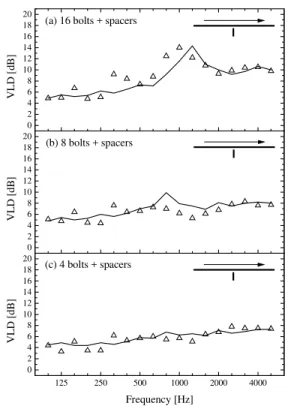
The experimental verification was carried out on the Plexiglas structure shown in Fig. 1. A stiffening rib (1.23 x 0.05 x 0.0187 m) was attached to a sheet (2.46 x 1.23 x 0.0117 m) using equally spaced bolts. Three different cases were considered by using 4, 8 and 16 bolts. Thin metal spacers (0.0187 x 0.0187 x 0.0006 m) were inserted between the sheet and the rib. The velocity level difference (VLD) was measured between both plate subsystems on each side of the stiffening rib. Measurement and prediction are compared in Fig. 2. The measured VLD for the case with 16 connections displays a pronounced peak at 1 kHz. At this frequency, an anti-resonance of the stiffening rib significantly reduces the rotation of the junction, leading to a reduction in bending wave transmission [1]. The predicted data also show a maximum in the VLD, but its location is shifted to a higher frequency. This discrepancy might be explained by uncertainties in the measured material properties or inaccuracies in the modelled boundary conditions of the plate strip. The measured results also show a less pronounced maximum at 315 Hz,
Figure 1. Experiments were carried out on a Plexiglas
sheet suspended from the laboratory ceiling using two soft springs. The stiffening rib was attached using equally spaced bolts. Thin metal spacers were inserted between the plate and the rib at each bolt.
0 2 4 6 8 10 12 14 16 18 20
(a) 16 bolts + spacers
VL D [ d B ] 0 2 4 6 8 10 12 14 16 18 20 (b) 8 bolts + spacers VLD [ d B ] 125 250 500 1000 2000 4000 0 2 4 6 8 10 12 14 16 18 20 (c) 4 bolts + spacers VLD [ d B ] Frequency [Hz]
Figure 2. Comparison between measured and
predicted VLD for the junction with spacers for three different numbers of bolts. Measurement (∆), prediction ().
which is not predicted by the model. Overall, the agreement between theoretical data and measured results is fair since both curves show a similar trend. Good agreement is achieved for the case with 8 connections in Fig. 2b, although the peak predicted at 800 Hz seems to be missing in the measured data. The 4 connection case in Fig. 2c clearly shows the best agreement between measurement and prediction.
3. EQUIVALENT CONNECTION LENGTH
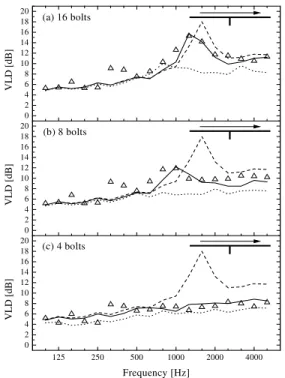
To evaluate the concept of an equivalent connection length, a parametric calculation is carried out with varying width of the connections. The equivalent connection length is determined as the connection width which minimizes the frequency averaged rms prediction error. The measured data for the junction without spacers, together with the results calculated using the equivalent connection length are shown in Fig. 3. Also shown in Fig. 3 are the results for the extreme cases considered in the parametric calculations: idealized point connection (infinitely small connection length at each bolt) and continuous line connection. The point connection and the line connection correspond to the weakest and the strongest
NRCC-44244
coupling, respectively, between the rib and the plate, and the difference between both cases increases with increasing bolt spacing.
In all three cases of bolt spacing, the best agreement between measurement and calculation is obtained when using the equivalent connection length. The measured data for the junction with 16 bolts approaches the results for a line connection, the main difference being a shift in the peak of the VLD. The junction with 8 bolts clearly represents an intermediate case between a line and a point connection. Fig. 3c demonstrates that the junction with 4 bolts can be modelled in first approximation by a point connection, although the latter approach leads to a systematic underestimation of the VLD. 0 2 4 6 8 10 12 14 16 18 20 (a) 16 bolts VL D [d B ] 0 2 4 6 8 10 12 14 16 18 20 (b) 8 bolts VL D [ d B] 125 250 500 1000 2000 4000 0 2 4 6 8 10 12 14 16 18 20 (c) 4 bolts VL D [ d B] Frequency [Hz]
Figure 3. Comparison between measured and
predicted VLD for the junction without spacers for three different numbers of bolts. Measurement (∆), calculation: equivalent connection length (), line connection (– – – –), point connection (⋅⋅⋅⋅⋅).
The results in Fig. 3 illustrate that an appropriate choice of the connection width yields calculated data which agree well with measured results. Although the equivalent connection length was assumed to be frequency independent, the calculated data matched the measured results in most of the frequency range. Consequently, it was demonstrated that a bolted plate/rib junction can be modelled by assigning an equivalent connection length to each fastener.
4. CONCLUSIONS
Structure-borne sound transmission at a bolted plate/rib joint has been studied theoretically and experimentally. By fitting numerical to experimental data, it was demonstrated that a bolted junction can be modelled using the concept of an equivalent connection length. It should be stressed that the equivalent connection length does not represent a physical parameter, since the detailed behaviour of the junction is, in reality, much more complex. The results of this paper merely show that a structure-borne sound transmission model, which incorporates the periodic boundary condition of a bolted junction, can be improved if a finite connection length is assigned to the fasteners.
REFERENCES
[1] Bosmans, I. and Nightingale, T.R.T. 1999 Build. Acoust. 6 (3&4), 289-308. Structure-borne sound transmission in rib-stiffened plate structures typical of wood frame buildings.
[2] Lyon, R.H. and DeJong, R.G. 1995 Theory and Application of Statistical Energy Analysis. Butterworth-Heinemann, Boston, second edition. [3] Heron, K.H. 1998 Proceedings NOISE-CON 98,
579-584. The wave approach to predictive Statistical Energy Analysis and equally spaced point connections with isolators.
[4] Bosmans, I. and Vermeir, G. 1997 J. Acoust. Soc. Am. 101 (6), 3443-3456. Diffuse transmission of structure-borne sound at periodic junctions of semi-infinite plates.