Publisher’s version / Version de l'éditeur:
Technical Note (National Research Council of Canada. Division of Building Research), 1963-04-01
READ THESE TERMS AND CONDITIONS CAREFULLY BEFORE USING THIS WEBSITE.
https://nrc-publications.canada.ca/eng/copyright
Vous avez des questions? Nous pouvons vous aider. Pour communiquer directement avec un auteur, consultez la
première page de la revue dans laquelle son article a été publié afin de trouver ses coordonnées. Si vous n’arrivez pas à les repérer, communiquez avec nous à [email protected].
Questions? Contact the NRC Publications Archive team at
[email protected]. If you wish to email the authors directly, please see the first page of the publication for their contact information.
NRC Publications Archive
Archives des publications du CNRC
For the publisher’s version, please access the DOI link below./ Pour consulter la version de l’éditeur, utilisez le lien DOI ci-dessous.
https://doi.org/10.4224/20338380
Access and use of this website and the material on it are subject to the Terms and Conditions set forth at Roof Surface Temperatures
Tibbetts, D. C.
https://publications-cnrc.canada.ca/fra/droits
L’accès à ce site Web et l’utilisation de son contenu sont assujettis aux conditions présentées dans le site
LISEZ CES CONDITIONS ATTENTIVEMENT AVANT D’UTILISER CE SITE WEB.
NRC Publications Record / Notice d'Archives des publications de CNRC:
https://nrc-publications.canada.ca/eng/view/object/?id=e06f1989-0e95-4ae3-bfe7-2864d61d904c https://publications-cnrc.canada.ca/fra/voir/objet/?id=e06f1989-0e95-4ae3-bfe7-2864d61d904c
DIVISION OF BUILDING RESEARCH
No.
NATIONAL RESEARCH COUNCIL OF CANADA
393
NOTlE
'fE
C
JHI
N ][ CAlL
PREPARED BY D. C. Tibbetts CHECKED BY APPROVED BY NBH
セ April 1963
PREPARED FOR Reoord Purposes
SUBJECT ROOF SURFACE TEMPERATURES
In July 1962, temperature measurements of two
types of roof surfaces were obtained at the Atlantic Regional
Laboratory in Halifax. One surface was a conventional
built-up flat roof with a gravelled surface, and the other was composed of asphalt shingles coated with white granules
involving an area .2 ft 6 in. by 4 ft 6 in. adjacent to the dark surface.
Temperature measurements were made with copper-constantan thermocouples and a Leeds and Northrup Speedomax
Reoorder. Thermooouples were embedded in both surfaoes to a
depth eqUivalent to two thioknesses of the asphalt shingles
used. To reoord air temperatures, a third thermooouple was
installed in a Stevenson soreen as was a hygrothermograph
for oomparison purposes (Table I). All installations were
exposed to the same oonditions with partiou1ar referenoe to south and west exposures.
Readings were taken from the oharts every 2 hou·rs with the maximum and minimum obtained direotly from the ohart
for eaoh 24-hour period. Readings were averaged from the
2-hour readings (Figure 2) to show the 24-hour oyo1e. Minimum
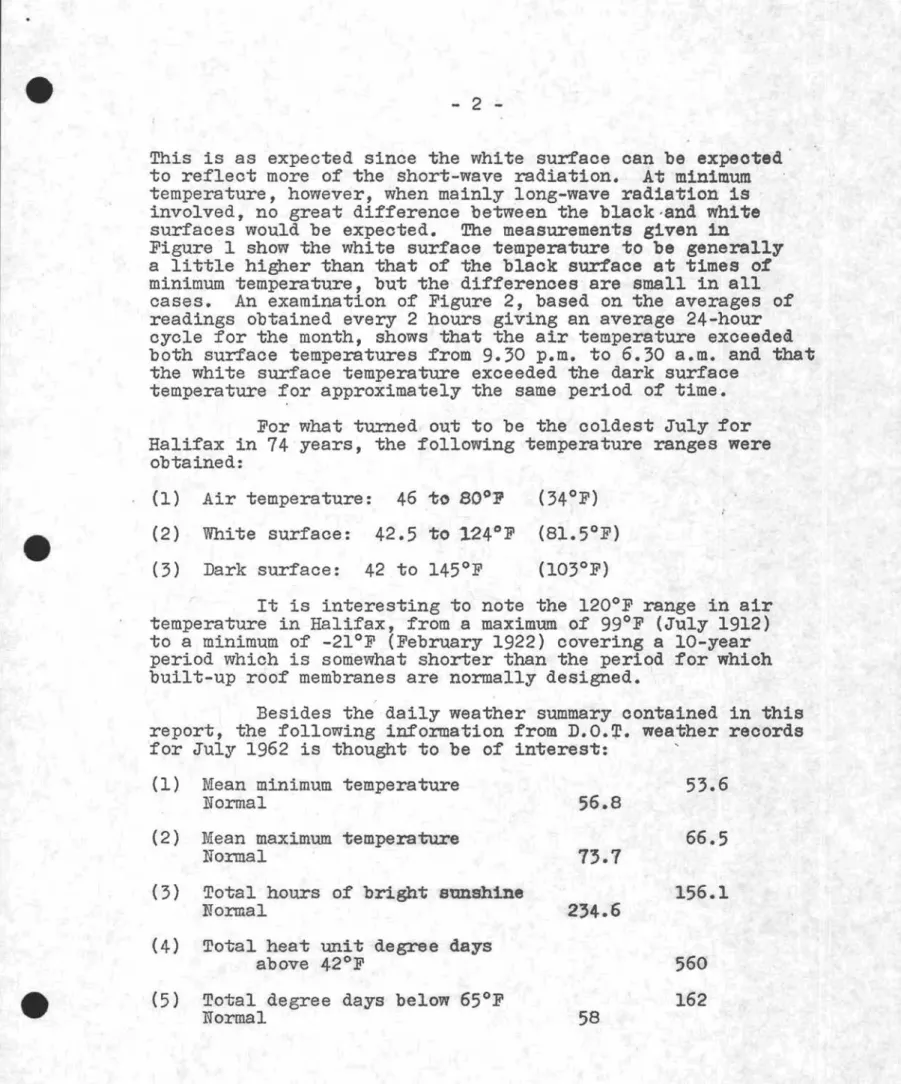
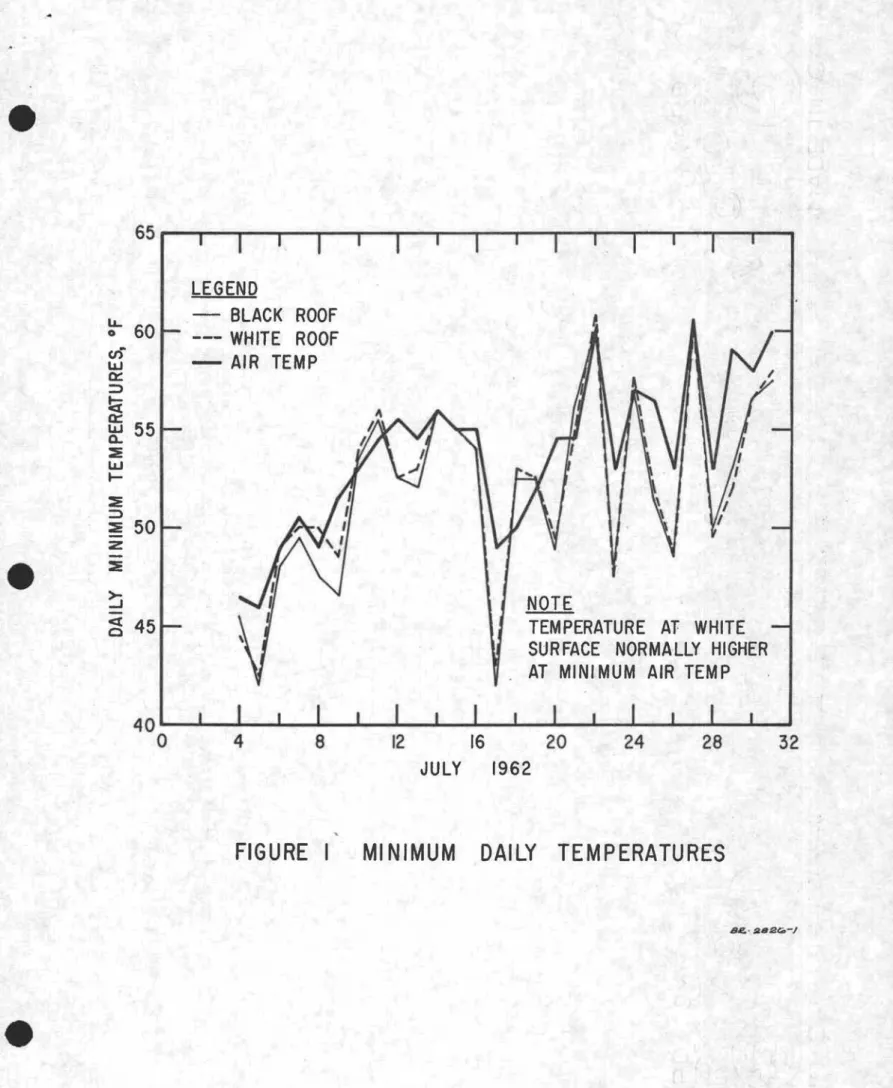
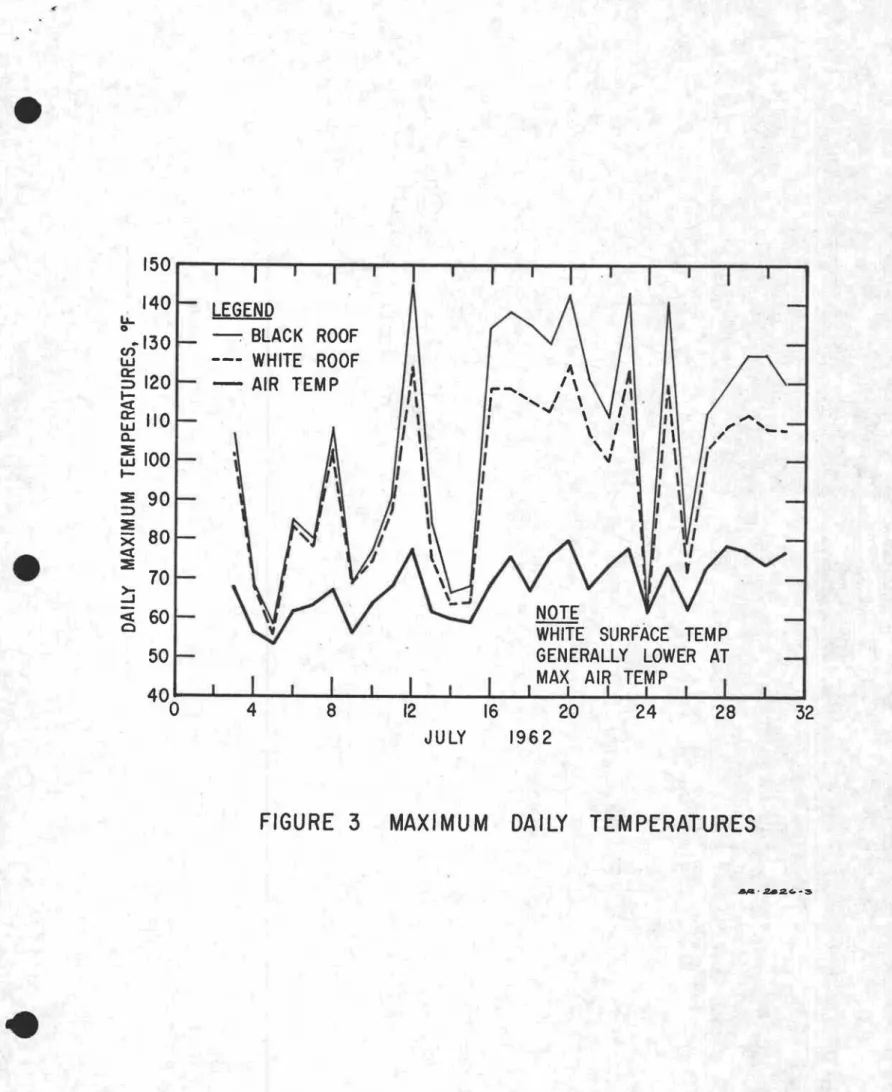
daily readings (Figure 1) and maximum daily readings (Figure 3) were plotted to show the range of oonditions for the three
installations.
Figures 2 and 3 show that the black surfaoe was
2
-This is as expected since the white surface can be expeoted
to reflect more of the short-wave radiation. At minimum
temperature, however, when mainly long-wave radiation is involved, no great difference between the black,and white
surfaces would be expected. The measurements given in
Figure 1 show the white surface temperature to be generally a little higher than that of the black surface at times of minimum temperature, but the differences are small in all
cases. An examination of Figure 2, based on the averages of
readings obtained every 2 hours giving an average 24-hour cycle for the month, shows that the air temperature exceeded both surface temperatures from 9.30 p.m. to 6.30 a.m. and that the white surface temperature exceeded the dark surface
temperature for approximately the same period of time. For what turned out to be the coldest July for Halifax in 74 years, the following temperature ranges were obtained: (1) Air temperature: 46 セッ 800P (2) White surface: 42.5 to 124°F (3) Dark surface: 42 to 145°F (34°F) (8l.5°F) (103°F)
It is interesting to note the 120°F range in air temperature in Halifax, from a maximum of 99°F (July 1912) to a minimum of -21°F (February 1922) covering a 10-year period which is somewhat shorter than the period for which built-up roof membranes are normally designed.
Besides the daily weather summary contained in this
report, the following information from dNoNセN weather records
for July 1962 is thOUght to be of interest:
(1) Mean minimum temperature 53.6
Normal 56.8
(2) Mean maximum temperature 66.5
Normal
73.7
(3) Tota1 hours of bright sunshine 156.1
Normal 234.6
(4) Total heat unit degree days
above 42°F 560
(5) Total degree days below 65°F 162
3
-(6) nッセ of days with maximum temperature above:
50°F 60°F 70°F 80°F
31 24 12. 0
(7) No. of days with minimum temperature below:
40°F 50°F 60°F 70°F
0 5 29 31
In summary, July 1962 was the dullest (Table II) July in the 21 years for whioh sunshine figures are available. There were eight sunless days, breaking the old reoord of
six set in 1947. The sun shone 33 per oent of the total
possible time.
Day-time temperatures ran 7.2 deg below normal.
Night-time temperatures were 3.2 deg below normal. On 19 days
the temperature failed to reaoh 70 deg. July 1962 was the
second coldest in 93 years of reoords with only July 1888
having been oolder. The total rainfall was 31 per oent above
normal. There were 12 foggy days and two with thundershowers.
It is commonly thought that summer monthly or daily temperature variations are not as important with regard to failure of roofing membranes as are those in oold weather. It is hoped that similar observations can be made during January or February 1963 at the same roof looations.
4
-TABLE I
AIR TEV1PERATURE COMPARISONS I
Maximum Minimum
Date Thermooouple D.O.T. Hygrothenno. Thermooouple D.O.T. Hygrothermo.
3
68
67
--
--
--
--4
56.5
57
--
46.5
47
--5
53.5
53
52
46
47
45
6
62
62
61
49
50
48
7
63.5
61
63
50.5
51
50
8
67.5
66
68
49
50
48
9
56.5
56
58
51.5
50
52
10
63.5
59
64
53
53
55
11
68
68
69.5
54.5
55
56
12
77.5
74
80
55.5
56
57
13
62
63
64
54.5
54
56
14
60
60
60
56
55
56
15
59
59
58.5
55
54
55.5
16
68
62
72
55
53
52
.
17
76
72
73
49
50
47
18
67.5
59
75
50
51
48
19
76
73
73
52
52
50
20
80
70
78
54.5
55
52
21
68
65
66
54.5
51
52
22
73.5
71
71
60
61
57
23
78
75
78
53
57
50
24
61.5
61
59
57
57
55
25
73
71
71
55.5
55
50
26
62.5
63
59
53
55
51
27
72.5
72,
70
60.5
55
53
28
78.5
79
79
53
55
51
29
77
79
76
59
61
57
30
74
67
--
58
58
--31
77
74
--
60
57
5
-TABLE II
DAILY WEATHER SUMMARY, HALIFAX, FOR JULY 1962 Date 1 2 3 4 5 6 7 8 9 10 11 12 13 14 15 16
17
18 19 20 21 22 23 24 25 2627
28 29 30 ' 31 Duration of Bright Sunshine (hours)4.8
13.5 9.8o
o
1.5 4.1 9.1o
o
2.35.8
o
o
o
5.0 12.8 8.64.7
8.5
0.9
14.0 10.4 , 0 13.0 0.17.2
12.37.8
3.0 6.9Heat Uriits - De§Xee Days Above 42 25 21 16 10 8 14 14 16 11 14 20 23 16 16 12 16 19 13 20 20 16 24 24
17
2117
21 25 28 20 23
6
-DAILY WEATHER SUMMARY FOR JULY 1962, AT HALIFAX, N.S.
1. Cloudy with showers in early morning 「・」ッュゥセァ suDny at
noon. Thunder late afternoon. Seasonable temperatures.
2. Sunny. Seasonable temperatures.
3. Variable cloudiness and cool.
4. Overcast. Rain 02h30m-23h50m. Extremely cool.
5. Overcast. Rain, drizzle and fog. Extremely cool.
6. Cloudy. Fog in early morning. Some sun near noon.
Showers in afternoon and evening. Very cool.
1. Variable cloudiness. Brief periods of 、イゥコセャ・ and
showers throughout day. Very cool.
8. Sunny. Continuing very cool.
9. Overcast. Fog. Drizzle beginning 15h40m. Extremely cool.
10. Overcast. Fog. Showers 06h35m-15h18m. Extremely cool.
11. Cloudy. Showers 16h51m-11h15m. Seasonable temperatures.
12. Variable cloudiness. Seasonable temperatures.
13. Overcast. Rain began 09h15m. Fog. Very cool.
14. Overcast. Rain, at times heavy, ending 06h08m. .Some light
drizzle during day and evening. Very cool.
15. Overcast. Drizzle 06h23m-15h50m. Showers 11h50m-19h2Om.
Very cool.
16. Cloudy clearing by evening. Very cool.
11. Sunny and cool.
18. Sunny with fog in early morning and evening. Extremely
cool.
19. Variable cloudiness. Fog in early morning. Seasonable
temperatures.
20. Variable cloudiness and cool. Fog in early morning and
late evening.
7
-22. Overcast with drizzle ending 02h30m. Gradual clearing
by late afternoon. Seasonable temperatures.
23. Sunny. Seasonable temperatures.
24. Overcast. Showers Olh45m-19h47m. Thundershower in the
afternoon. Fog. Very cool.
25. Sunny with seasonable temperatures.
26. Cloudy and very cool. Showers 04h39m..09h15m. Drizzle
08hlOm-llh15m. Rain l5h45m-2lh40m.
27. Cloudy with drizzle in morning. Clearing by mid-afternoon.
Seasonable temperatures.
28. Sunny with seasonable temperatures.'
29. Variable cloudiness and warm.
30. CloUdy and cool. Showers l4h45m-2lh30m.
31. CloUdy. Drizzle 07h50m-09h15m. Fog in evening. Seasonable
temperatures. -M セ -M M セ M -M -M セ セ -セ M M M M M -セ
65 ---,r---_ _---,r---_ _...-""'T"""...MBBGtBBBMMMイMMイMNNNNNNNLNMセ⦅イMセNNNNNNL ::- 60 en LLI a::: :::>
tt
ffi
a. 55 :E LLI I--:E :::> :E 50 z :E LEGEND - BLACK ROOF --- WHITE ROOF - AIR TEMP NOTE TEMPERATURE AT WHITE SURFACE NORMALLY HIGHER AT MINI MUM AIR TEMP32 28 24 12 16 20 JULY 1962 8 4 40L..._I....-....a..._I....-..&.----1_...---..&_....L.----L_...--1._...&...L._...J
o
'LEGEND セ BLACK SURFACE --- WHITE SURFACE - AIR TEMP 100 95 NOTE
I. AIR TEMP EXCEEDED 90 SURFACE TEMP 85 9·30 PM TO 6'30 AM 2. WHITE SURFACE 80 TEMP EXCEEDED DARK SURFACE 75 TEMP 10 PM TO セ 70 6·30 AM 65 60 55 50 45 40 0 0 0 0 0
8
0 0 0 0 0 0 0 0 セ 0 0 0 0 0 0 0 N V co 0 N V U) co 0 N 0 0 0 0-
-
-
-
N N HOURSFIGURE 2
AVERAGE TEM PERATURES FOR 24
HOURS FOR I MONTH PERIOD JULY
1962 (READINGS EVERY 2 HOURS)
セ ,. "" I \ I ...vI \\ I \ I I \ I I セ
,
I NOTE- -
.WHITE SURFACE TEMP GENERALLY LOWER AT MAX AIR TEMP
4 8 12 16 20 24 28 32 JULY 1962 LEGEND - , BLACK ROOF --- WHITE ROOF - AIR TEMP 70 セ «c 60 ::E 90 セ ::E x 80 « ::E 150.-.-...----r---r----...---.r---_...-..-_ _-""'I""'""'---r-...-_ 140 La.. o