HAL Id: hal-01949737
https://hal.archives-ouvertes.fr/hal-01949737
Submitted on 26 Dec 2020HAL is a multi-disciplinary open access
archive for the deposit and dissemination of sci-entific research documents, whether they are pub-lished or not. The documents may come from teaching and research institutions in France or abroad, or from public or private research centers.
L’archive ouverte pluridisciplinaire HAL, est destinée au dépôt et à la diffusion de documents scientifiques de niveau recherche, publiés ou non, émanant des établissements d’enseignement et de recherche français ou étrangers, des laboratoires publics ou privés.
Collective surface modes in small spherical metallic
systems within the Bloch-Jensen hydrodynamical model
J. Kupersztych, Michèle Raynaud
To cite this version:
J. Kupersztych, Michèle Raynaud. Collective surface modes in small spherical metallic systems within the Bloch-Jensen hydrodynamical model. Journal of Physics: Condensed Matter, IOP Publishing, 1994, 6, pp.10669 - 10682. �10.1088/0953-8984/6/49/010�. �hal-01949737�
Journal of Physics: Condensed Matter
Collective surface modes in small spherical
metallic systems within the Bloch-Jensen
hydrodynamical model
To cite this article: J Kupersztych and M Raynaud 1994 J. Phys.: Condens. Matter 6 10669
View the article online for updates and enhancements.
Related content
Dispersion of plasmons in metallic spheres: dipole mode
N Barberan and M Batlle
-Interface plasmons at metal-metal junctions
P Jewsbury
-Theory of surface plasmons and surface-plasmon polaritons
J M Pitarke, V M Silkin, E V Chulkov et al.
-Recent citations
Plasmon Spectra of CylindricalNanostructures Including Nonlocal Effects Afshin Moradi and Elham Ebrahimi
-Linear and nonlinear light scattering and absorption in free-electron nanoclusters with diffuse surface: General
considerations and linear response S. V. Fomichev and W. Becker
1. Phys.: Condens. Matter 6 (1994) 10669-10682. Printed in the UK
Collective surface modes in small spherical metallic systems
within the Bloch-Jensen hydrodynamical model
J Kupersztych and M Raynaud
Commissariat I'Energie Atomique, DRECAMISRSWI,, BStiment 462. Centre #Etudes de
Saclay, 91191 Gif-sur-Yvette Cedex, France
Received 29 June 1994. in final form 26 September 1994
Abstract. An exact generalization of the classical Blach-lensen hydrodynamical model for the homogeneous freeelectron gas is oboined for a two-layer spherical metal system. The dispersion relation of surface plasmons together with the analytical expression of the self- consistent electric field are calculated exactly. It is found that small and large systems exhibit notably different behaviours. In particular, the surface-plasmon frequencies stmngly depend on the layer hihickness. As is the case for the metal-vacuum interface, the electric field is shown to present a sharp maximum at the interface between the two metals. A simple physical interpretation of this effeit is provided. The present two-layer system also gives interesting indications about the part played in collective surface modes by the ion-density profile ne% the surface of small metal clusters, which may be helpful ininterpretingrecent puuling experimental data.
1. Introduction
The interest in surface plasmons (SPS) has been recently revived, particularly in relation to fragmentation measurements of small metallic clusters. For instance, recent experiments have revealed that clusters of a small number of alkali atoms (less than 10)) are characterized by unexpected SP frequencies (De Heer 1993, Brahignac Pf al 1993). Moreover, SPs have been shown to exist even for systems involving very few atoms (five to 20) (Parks and McDonald 1989, Wang et al 1993, De Heer 1993). In this context, several questions have been raised. Some authors have discussed the influence of size effects or spill-out of the electron distribution at the surface on the SP frequencies (Xu and D i g " 1992, Lipparini and Pederiva 1993, Malov and Zartsky 1993, Brack 1993). However, to our knowledge, the role of ion-density inhomogeneity near the surface has not been clearly investigated, while
it is expected to play a role, particularly for small systems such as small metal clusters. This issue is the main purpose of this paper.
At a microscopic level, the full aeatment of an ion density gradient is an extremely difficult task. In this paper, we will use the following alternative macroscopic approach.
To take inhomogeneous ion-density effects into consideration, a simple device consists in representing the surface region as a sequence of homogeneous layers of decreasing ion density (Boardman and Paranjape 1977, Boardman 1982). This method clearly amounts to solving the cumbersome problem of a metal bulk covered by a multiple-layer metal system.
On
the other hand, its advantage is that it enables us to represent each metal layer as a jellium, thus making the use of Bloch's hydrodynamical model (1933) for a homogeneous free-electron gas passible and deriving benefit from the exact solution for a single homogeneous medium obtained long ago by Jensen (1937). Obviously, the hydrodynamical model is
10670
valid provided that the collective aspects of the electron gas prevail over the collisional ones. This condition will be fulfilled when the frequency of the collective oscillations is much higher than the electron-ion prude's inverse lifetime) and electron-electron collision frequencies. In general, for a medium to be correctly described as a collisionless plasma, i.e. to neglect electron-electron collisions, the mean free path
e
should be large compared with the wavelength A of the macroscopic self-consistent electric field. For free-electron metals, the Drude inverse lifetime, the electron-electron collision frequency and the plasma frequency up are, respectively, of the order of 1014 s-', 10'O s-' (Ashcroft and Mermin 1976) and 10l6 rad s-'. Also, we havee
% V F / U ~ - ~ (where U F denotes the Fermi velocity), which is of the order of lo-* cm. Thus, SP modes having oscillation frequencies of the order of U,/& may be reasonably described within this model, provided appropriateconditions taking account of specific (kinetic) effects in the high-frequency regime are laid down (see below). This explains why the Bloch-Jensen hydrodynamical model has been successful for simple metals (Lundqvist 1983) in spite of its limitations. In addition, this approach has the advantage of analytical tractability.
In this paper, we wish to show that an exact analytical generalization of Jensen's work can be built for a spherical metallic two-layer system, thus giving the exact dispersion relation of SPS modified by the presence of a thin metal layer. Our two-layer system will also give useful indications about the role played by the surfacedensity profile in simple metal clusters. Let
us
emphasize that this problem is not exactly equivalent to that of an inhomogeneous electron sphere suchas
considered long ago by Ruppin (1976) and byBoardman and Paranjape (1977), which is not truly a two-jellium system and which therefore requires different boundary conditions. Finally, our simple model will be proven useful to show an interesting effect: the existence of an interface plasmon at the metal-metal interface enhanced by the field of the SP.
J Kuperszrych and M Raynaud
2. The Eloch-Jensen hydrodynamical model for a two-layer system
In the Bloch-Jensen hydrodynamical formalism, the collective oscillations of a homoge- neous electron gas are described by Poisson's equation
V
.
E ( r , t ) = 47re[ni,.-
n(r, t ) ] (1) the charge conservation equationan(r, t ) / a t
+
V
.
[n(r, t ) w ( r , t ) ] = 0 (2)and the fluid equation of motion
av(r,
t y a t
+
f ~ v * ( r , t ) = -eE(r, t ) / m-
V P ( ~ , t ) / m n ( r , t ) . (3)In these equations, E is the self-consistent electric field,
w
the fluid velocity andP
the kinetic pressure. nian and n denote respectively the ion and electron densities.In the case of a two-layer metal system described within the framework of a jellium model (electron densities are neutralized everywhere by uniform background ion densities) that consists of a spherical bulk (medium (I)) of radius R and electron density n a overlaid by a foil (medium
0)
of thickness h and electron density nhm, there are two electron- and ion-density singularities: one between the two metallic media and another between metal and vacuum. Now, it can be easily demonstrated (see the appendix) that the aboveBloch-Jensen model for spherical meral systems 10671
equations
(1K3)
still hold provided continuity of the normal (radial) component of the electron current is prescribed everywhere. Furthermore, since at the interface (r =~R)
between medium (Iand medium ) (IIwe deal with two perfect conductors in interaction, )
the other boundary conditions include continuity of all the components of the electric field:
(4)
and continuity of all the components of the electron current (see the appendix): j ( r , f) =
-en(r, t)v(r, t )
[ E " ( T , t ) l r = R = [E")(rs t ) l r = R
bo(",
t ) l r = R =b(')(r,
t ) l r = R . (5)At r =
R
f h,as
in the Jensen case, we deal with the interface between a perfect conductor (medium (11)) and a perfect insulator (vacuum). The corresponding boundary conditions (Jackson 1976) are continuity of all the components of the electric field(6)
vac)
[E(')(T, f)]r-=R+h = [E( ("3 t ) l r = R + h
and continuity of the sole radial component of the electron current (see the appendix)
[jy)(rv
t)lr.=R+h = 0. (7)3. The linear electron response
The following theoretical treatment of ( 1 x 3 ) is standard inasmuch as we are only interested
in the linear electron response. ( 1 ) - ( 3 ) are thus linearized by writing
n(i)(r, t ) = n!) + n(i)(r)e-:*r
with In(i)[
<<
n;), where i = I andII.
As above mentioned, in the jellium model, the ion density is assumed to neutralize the electron density at equilibrium, that is, niii = n!'. By means of this procedure, (1)-(3) take the following form:v
.
E") (T) -4xe n (i) (8)-
ion"'(r)+
v
.
[now
(r)] = 0ion!)d)(r) = eno (i' E (i) ( r ) / m
+
V P ( r ) / m .(9)
(10)
(i) (i)
According to Bloch and Jensen, we take the kinetic pressure in the form
p(i)(T) = m B ( i ) 2 n F ) ( T )
where, for the hydrodynamical approach to be valid in the high-frequency regime, we have to assume (Pines 1964) j?") = f i u : ) , where U:) = ( 3 n z n 3 ' 4 2 / m is the Fermi velocity of the electron gas.
The above equations @)-(lo) will take a pmicularly simple form when introducing the scalar potential @(T) of the electric field [E(?-) = -V@(r)]. Thus, if
k(')
=10672
(02
-
og)z)'/z/,9(i) where o$) = ( 4 1 r e ~ n ~ ' / m ) ~ / * is the plasma frequency, they reduce to the following equations:J Kupersztych and M Raynaud
[ A + k ( ' ) z ] A @ ( i ' ( ~ ) = 0
for the material medium, and for vacuum
ACJ"~'(T) = 0.
In spherical coordinates, the general form c and Hilbert 1989)
@(;)(T) = C f j 2 ( r ) y e m ( e ,
v )
e m
with
he solution of (11) is known as (Courant
In these equations, Yem@- q), j , and ye are, respectively, the surface harmonics of the fist and
Fi;
are subject to several constraints. These constraints include the requirement of no divergence of the potentialsdi)
for r=
0 and @(vac) for r+
CO together with the boundary conditions (4)-(7). Using the well known properties of the surface harmonics, these boundary conditions amount to expressing continuity of the functions& t ( r )
together with continuity of their derivatives at R and R+
h, and also continuity of the following functions gFi(r) at R together with continuity of their derivatives at R andR
+
h, where the functions &(r) are defined askind and the spherical Bessel functions. Now, the coefficients AfL, B::, Gem,
C;,,
De, (0The number of unknown coefficients determining the potentials @(I), Qm and Vac is number of equations is also ten (two for the condition of no divergence of the potential at r = 0, one for that at r -+ 03, four for continuity of the electric field and three for continuity of the electron current). Obviously, these equations are not linearly independent since (11) and (12) are linear and the potentials @ ( i ) determined up to a constant factor.
Therefore, a non-trivial solution of the system is obtained, as usual, by expressing vanishing
of its determinant, which yields the following rather complicated dispersion relation: ten: A:;, B E ,
Dj:,
FJ!, A,,,a)
B,, 0 D t m ,a)
F,, (U) C, and C;,. On the other hand, the10674
4. Results and interpretation
For the sake of simplicity, the numerical studies have been performed for the first harmonic case
(e
= 1, m = 0) (actually, as in the Jensen situation (one metallic medium), the case (1 = 0,m = 0) does not need to be considered since the potentials 0ci) reduce to a constant) for various freeelectron metal systems such as AI-Cu, Na-K and Cs-Rb. Similar tendencies have been observed in those systems and, in the present paper, we shall examine systematically the particular couple K-M, where M denotes a fictitious free-electron metal of density$r).
As we shall see, the interestof
this model is to enable us to give some comments on the role of ion- and electron-density inhomogeneities,J Kuperszrych and
M
Raymudm
-
=,&p/&)
h(rl)
0.0 2.0 4.0 6.0 8.0
2.5e+15 .O
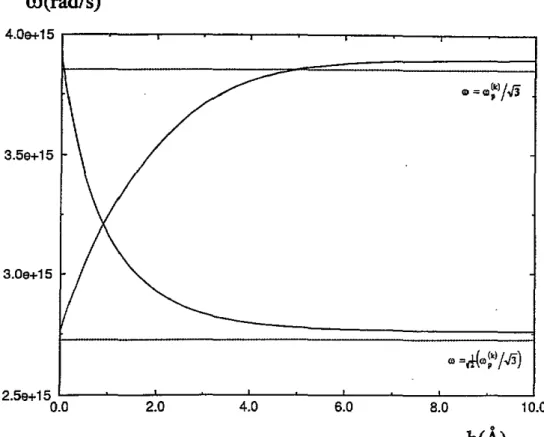
Figure 1. SP frequencies for the system KIM (upper curve) and for the system M I K (lower
curve) versus h for R = 10
A
(M denotes a fictitious freeelectron metal of density anduLK) = 6.61 x loLs nd 5-’ (from Ashcron and M&n 1976)).
In the computations, three typical values of the bulk radius, R = 10
A,
100A
and 1000A,
together with various layer thickness h (up to 10A)
have been considered. A remarkable characteristic feature is the small range over which a rapid variation of the SPfrequency w is obtained (cf figures 1-3). As can be seen, there exists a range of thickness where the SP frequency is strongly different from the classical values w ! ) / f i and
@)/A.
Reversing the role of the two metals yields symmetrical behaviours. These features can be interpreted as typical size effects:for
a simple (uncoated) system, the value of the SPBloch-Jensen model f o r spherical metal systems 10675 .O
O(rad/s)
4 . 0 ~ 1 5 2.5-15I
0.0 2.0 4.0 6.0 8.0 1Figure 2. The same as figure I but for R = 100
A.
frequency is not up/& but rather cop/& where CY < 3 and tends toward this value when
k t s R --f ca. This result just stems from the original Crowell-Ritchie dispersion relation
(15’). In this relation, the Bessel functions express the influence of opposite surfaces. When the size of the sphere is large enough
(R
>>
k‘”-’),
these influences play a negligible role and01 tends towards the asymptotic value CY = 3 as a consequence of the asymptotic behaviour
of the Bessel functions. Now, for a coated sphere, two types of size effect need therefore to be considered (i) those connected with the size of the whole system (medium (I) plus medium
(U)),
whichare
of thesame
nature as those describedFor an
uncoated system, and (ii) those connected with the layer thickness, which represent interactions between interfaces of a different kind (i.e. metal-metal and metal-vacuum). Hence, the values U$)/& (bulkregime) and
@$/A
(layer regime) appear as limit values: the bulk regime is defined whenR / h
>>
1 and h<<
!dn)-l
and the layer regime when h>>
kc”)-’.As mentioned above, the present two-layer system’may also give useful indications about
the part played for collective surface modes by the ion density profile near the surface of small metal clusters. Let
us
consider, for example, a linear ion density profile. As would bedone in a numerical treatment of this problem, such a profile may be simulated by a sequence
of small steps, each one being considered a s a homogeneous layer (see e.g. Boardman and Paranjape 1977, Boardman 1982). As a multiple-step analysis is beyond the scope of the present paper, we shall only consider here the influence of one single layer and we will
10616 J Kupersztych and M Raynaud 0
=&.$/JS)
2 . 5 ~ 1 5 1 6.0 8.0 0.0 2.0 4.0.o
Figure 3. The same as f i p I but far R = 1000
A.
simulate a linear ion density profile
of
the form no[l - ( R - r ) / h ] with R<
I<
R f h , by a single-step profile of height 0.4 and of length h, as has been considered in figures 1-3. Thisapproximation will be sufficient, however, for a qualitative estimate of the influence of an ion density gradient and an electron density gradient As is clearly exhibited in figures 1-3, the influence of the layer is to induce a red shift of the SP frequencies (see the remark below, however). It is interesting to note that this effect, which is a general tendency for free- electron metals and which was also noted by Ruppin (1976) and Boardman and Paranjape (1977), has been experimentally observed. However, it should also be emphasized that the applicability of the hydrodynamical approach in the cases of very sharp density profiles or
surface diffuseness simulated by a very thin layer corresponding to a few atomic layers is certainly questionable, as is the validity of the jellium approximation. As shown above, this situation just tallies with the domain where the plasmon frequencies shift abruptly. A microscopic investigation (see e.g. Brack 1993) of this effect is therefore unavoidable and would complete the present macroscopic analysis, particularly for small systems such as metal clusters where singular effects have been recently revealed (BrBchignac et ~l 1993). Furthermore, it should be kept in mind that the present study only holds for simple metals and cannot be considered in the case of other metals such as transition metals (e.g. Ag) where blue shifts have actually been observed. For transition metals, interband transitions play an essential part that cannot be accounted for in a free-electron-gas model (Liebsch
Bloch-Jensen model for spherical metal systems 10677
Er(a.u.)
4.0 -2.0'
I
90.0 100.0 110.0 120.0 130.0r ( 4
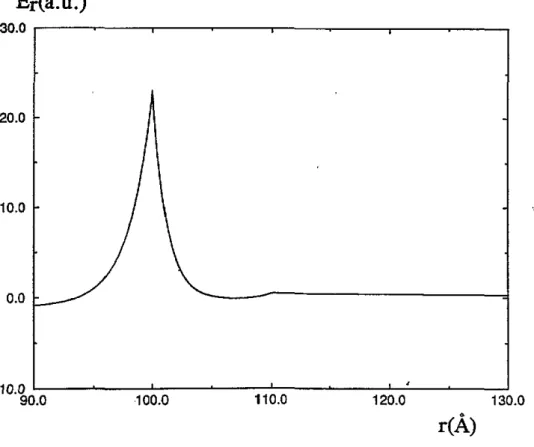
Fignre 4. The radial component of the self-consistent elecvic field at I = 0 for K and R = 100
A
versus r (the Jensen case).
In figures 4 6 are reported (in arbitrary units) the amplitude variations of the radial part of the self-consistent electric field. For h = 0 (the uncoated metal case, see figure 4), the well known resonance electric field of the SP is represented and shows the usual spatial variations of the field amplitude inside the metal bulk and in vacuum. For h = 10 A (see figures 5 and 6 ) , the self-consistent electric field exhibits a strong enhancement at the metal-metal interface (at r = R = 100
A).
This field is chmcterized by an amplitude much greater than thatof
the surface plasmon (at r = R+
h = 110A).
It is important to emphasize that this interface plasmon has the same frequency as the surface plasmon since it is found by solving the dispersion relation (15). Actually, this new effect, which represents strong charge oscillations at the interface, admits a simple physical interpretation.By combining (8). (9) and
(IO),
we can easily rewrite the linearized Poisson equation in the following form:v
.
E(') =v
.
[ ( 4 s e 2 / m o 2 ) n ~ ' ~ ( ' )+
( 4 i r e / m o 2 ) v ~ ( ' ) ( r ) lNeglecting the kinetic-pressure term between the square brackets (that is, neglecting any dissipation process), this equation becomes nothing else than
V
.
D(') 0 (1%10678 J Kuperszrych and
M
Raymud100.0 110.0 120.0 130.0 -80.0
'
90.0
Figure 5. The radial mmponent of the selfsonsisrent electric field at f = 0 for the system KIM
and R = 100
8.
versus r.is the electric displacement and
= 1 - w;)2/w2
is the plasma dielectric function for each medium (i). Now, (19) can also be rewritten as
v
.
~ ( 0 =-(ve(9).
,@i)/&(i).Taking (8) into account, this equation can finally be expressed in the form
#) = - ( e / m w 2 ) ( V n t ' )
.
E ( ~ ) ( W ) / E ( ' ) ( W )which shows that, at the metal-metal interface where the charge density varies abruptly from
n p to $), important charge Buctuations may occur, depending on whether there exists a
radial component of the electric field at this place. This electric field can be just that of an
SP existing at the edge of the metal layer. Provided the layer thickness is thin enough, the field
of
the SP tunnels into the metal-metal interface and so enhances the charge fluctuations at the same frequency as the SP. The magnitude of the enhanced field is then limited by thermal effects thatare
accounted for by the kinetic-pressure term (and by electron-electron collisions that are not considered here, however).Bloch-Jensen model for spherical metal systems 10679
&(a.
u
.
)
30.0 20.0 10.0 0.0.
-10.0Figure 6. The same as figure 5 but for the system MIK.
5. Conclusion
In this paper, we have given an exact generalization of the Bloch-Jensen hydrodynamical model for freeelectron metals to a two-layer spherical system. This system has been proven useful to show that the ion density profile near the surface of a small metal cluster plays an important part inasmuch as it can result in significant shifts of the SP frequencies. This tendency would need to be corroborated by a microscopic analysis going beyond the jellium device together with further investigations involving a multiple-step formalism taking the exact ion density profile into consideration. Besides, we have taken advantage of the generalization to show an interesting effect: the existence of metal-metal interface plasmons enhanced by the SPS. This effect would also deserve to be investigated in planar geometry for which experiments are more easily feasible. Also, the consequences of electron-electron interactions should be weighed up as they are dissipative effects. In fact, their influence is probably to modify the above form of the kinetic pressure. We hope to answer these questions in a future paper.
Acknowledgment
The authors acknowledge with thanks Mrs
N
Auby for her help in the numerical computations.10680~ Appendix
We give here a demonstration of validity of (2), taking the surface discontinuities into account (for the fluid equation of motion and the Poisson equation, the proof is in fact trivial).
J
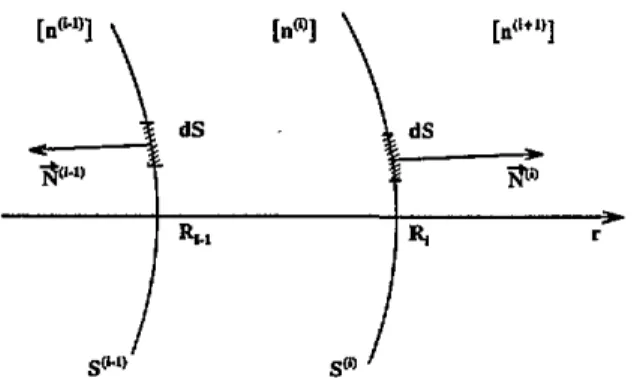
Kupersztych and M RaymudFigure Al. A schematic representation of our notations.
Let us consider a small volume VF) included between two spherical sheets located at
Rj-l and R j such that the electron density and velocity are respectively n('-l) and for
r i Ri-1,
di)
anddi)
for Ri-1 c r e Rj and n('+I) anddi+')
for r Rj. The number of electrons in volume V(') at time t is thenrvVa,
n(j) dV, where dV is an element of volume. The variation per unit time of this number isa
Jv(;)di)
dV/at, which can be also obtained,as usual, by drawing up a balance between the number of incoming and outgoing electrons in V('). If
S(')
denotes the surface of the sphere of radius RI and N(') a normally oriented unit vector of this surface (see figure AI), n ( ' ) d i ) . N ( ' ) represents the electron flow through the surface element dS ofS(').
We can thus writea
j
n(i)avlar
=T,
+
T~+
T,+
T4
(AI)VI0 where T~ =
-
4
n ( i + l ) V ( i + U.
N(9@(-V(i+l).
" i ) ) dS SI0 n ( i ) V ( i ).
N(Q@(-V(i).
N(i))dS SQ)n(i)V(O
.
N(i-l)@(-V(i).
NO-I)) dS4
4
sl1-l)To = -
T4 =
-
where @ ( x ) is the Heaviside function and where the
TI
and T2 terms represent the incoming electron flow in V") and the T, andTq
terms the outgoing one. Now, on each surface S(j), we have a density discontinuity. If we impose continuity of the normal (here radial) componentof the electron current density j = -env through
S(')
andS('-'),
that isG"
8 ).
N(i)]se, = [ j ( i + l ).
N(i)lsr,,
Bloch-Jensen model for spherical metal systems 10681 and
[jCO
.
~ ( i - l ) ] ~ ~ , . , ~ = [j(i-1) , N(i-l)+>we can regroup in (Al) the TI and T2 terms and also the T3 and T4 ones, making use of the fact that the sign of
di)
.
NF)is
the same as that of j ( j ).
N(')
and using the relationO ( x )
+
0 ( - x ) = 1. Then, (Al) becomes(A21 Now, as N('-')dS = - N ( i ) (see figure 3),and using the Ostrogradsky theorem, (AZ) can be rewritten as
dV/at =
-
n(i)w(i).
N") dS-
n(i)w(f).
hT(i-1) dS.as
VI;) $1,)#
$(2-1>V
.
( n ( i ) ~ ( i ) ) dVs
as
"(0 v(sq V ( S + ' ) )n("dV/at = -
/
V
.
(n%(i)) dV+
where V(S(')) and V(S(i-l)) are the volumes of the spheres of radius Ri and
Ri-,,
respectively. Finally, as V(') = V(S"))
-
V(S(i-')), we havewhich leads to the familiar equation of continuity in medium ( i )
adi)(v, t ) p t
+
v
.
[&I(?, t)di)(7, t ) ] = 0.In summary, validity of the equation of continuity in medium
0)
and01)
depends on the condition of continuity of the normal (radial) component of the electron current density at the metal-metal and metal-vacuum interfaces. It is worth noticing that continuity of the normal components of the electron current density j and of the electric field E ensures continuity of the n o d component of the electric displacement D defined by the equationa o l a t = a E / a t
+
4 ~ j which can be written in the present case asD = E
+
( 4 n i l u ~ ) i .The standard electrostatic boundary conditions (continuityof the potential and of the elechic displacement) are thus satisfied as a,special case.
References
Ashcroft N W and M a i n N D 1976 Solid Store Phy.vic.7 (Philadelphia, PA CBS) Blwh F 1933 Z. Phy.7. 81 363
Boardman A D 1982 Electmmgnetic Su&m Moder ed A D Boardman (New York Wiley) p 41.
Boardman A D and Paranjape B V I977 3. Phys. F: Met. Phy.v. 7 1935
Bnck M 1993 Rev. Mod Phys. 65 677 and references therein
Brechignac C Cahuzac P. Leygnier 1 and Sarfati A I993 Phys. Rev. Len. 70 2036
10682
Cmwell 1 and Ritchie R H 1968 Phys. Rev. 172 436
De Heer W A 1993 Rev. Mod Phys. 65 611 and references therein Jackson I D 1916 CIarsicoI EIectrodyNlmim 2nd edn (New York Wiley) Iensen H 1931 2 Phys. 106 620
Liebsch A 1993 Phys. Rev. 48 11 317 and references therein Lipparini E and Pederiva F 1993 Z Phys. D 27 281
Lundqvist S 1983 Theory of lhe Inhomogeneour Efecrmn Cos ed S Lundqvirt (New York: Plenum) p 149 Malov Y A and Zarersky D F 1993 Phy.7. Len. 177A 319
Parks I H and McDonald S A 1989 Phy.r. Rev. Len. 62 2301 Pines D 1964 Elementmy Excitorion in Solidr (New York Benjamin) Ruppin R 1916 J. O p Soc. Am G6 449
Wag Y, Lewedopf C, Tornanek D and Bertsch G 1993 Chem Phys. Left. 205 521
Xu M and D i p a m M I 1992 1. Chem Phys. 96 3370