CONFERENCE
PROCEEDINGS
CONFERENCE
PROCEEDINGS
BARCELONA (SPAIN)
4TH - 6TH OF JULY, 2016
8TH INTERNATIONAL CONFERENCE
ON EDUCATION AND NEW LEARNING
TECHNOLOGIES
Published by
IATED Academy
iated.org
EDULEARN16 Proceedings
8th International Conference on Education and New Learning Technologies
July 4th-6th, 2016 — Barcelona, Spain
Edited by
L. Gómez Chova, A. López Martínez, I. Candel Torres
IATED Academy
ISBN: 978-84-608-8860-4
ISSN: 2340-1117
Depósito Legal: V-1421-2016
Book cover designed by
J.L. Bernat
All rights reserved. Copyright
© 2016, IATED
The papers published in these proceedings reflect the views only of the authors. The publisher cannot be held responsible for the validity or use of the information therein contained.
COMBINING E-TECHNOLOGIES & E-PEDAGOGIES TO CREATE
ONLINE UNDERGRADUATE COURSES IN ENGINEERING – AN
EXAMPLE OF A SUCCESSFUL EXPERIENCE
Manuel Gericota
1,8, André Vaz Fidalgo
1, Denis Barataud
2, Guillaume Andrieu
2,
Renaat De Craemer
3, Mihail Cristea
4, Abdelhalim Benachenhou
5, Mohammed
Ankrim
6, Karim Bouchlaghem
7, Paulo Ferreira
11
School of Engineering/Polytechnic of Porto (PORTUGAL)
2Université de Limoges (FRANCE)
3
KU Leuven University, Ostend (BELGIUM)
4University Politehnica of Bucharest (ROMANIA)
5
University of Mostaganem (ALGERIA)
6University Cadi Ayad of Marrakech (MOROCCO)
7
University of Kairouan (TUNISIA)
8
University College of Southeast Norway, Kongsberg (NORWAY)
Abstract
The offer of online courses experienced an exponential increase in the last few years. However, this offer is mainly restricted to a cluster of areas, essentially those related with humanities and social sciences, which do not require laboratories for the execution of practical assignments. The widely available Information and Computer Technology (ICT) courses that require only a computer as a “lab” infrastructure to complete the practical assignments are the only exception.
The L3-EOLES (Electronics and Optics for Embedded Systems) course presented in this paper is the first, fully online 3rd year English taught Bachelor’s degree covering the field of electronics and optics for embedded systems, an area of engineering that requires students access to real laboratories. The use of virtual and remote real laboratories enable students to execute their practical tasks remotely over the Internet.
The course is recognized by the educational authorities of France, Morocco and Tunisia. Thus, all successful students receive a diploma accepted inside the European Higher Education Area (EHEA), with students from Morocco and Tunisia also receiving a diploma issued by one of the accredited universities of their home countries.
The huge success of the course may be measured by the number of candidates, around 400 in the first year and more than 700 in the second year, for only 35 places available.
Keywords: Online accredited undergraduate program, engineering, electronics, optics, remote laboratories.
1 INTRODUCTION
The exponential development of the information and computer technology and of the telecommunications infrastructure, namely at the data transfer level, and the more and more affordable prices of personal and portable computers facilitated the access of common people to technology and contributed to the massification of the Internet use, even in the most remote areas of the planet. However, if the technology is rapidly able to reach those remote corners, higher education access is something more difficult to spread, due to the cost of the infrastructure it requires, to poor economic and social conditions and even to political options or geopolitical instability. Anyway, even if possible, it is not feasible to install a higher education institution in sparsely populated rural and remote areas. In this case, technology may be used to shorten distances bringing higher education to those areas if the appropriate e-technologies and e-pedagogies are used and if the necessary conditions are created to meet the needs of those countries that have the least availability of material and human resources, decisively contributing to their development.
Based on previous research and development work in the area of remote and virtual labs, and on the creation and running of e-learning courses, a group of 15 Institutions:
Proceedings of EDULEARN16 Conference
• 4 from Europe
o The University of Limoges (UNILIM), coordinator of the project. In 2008 UNILIM launched a French-spoken blended learning ARTICC master [1] concerning electronics and optics topics, in parallel with the development of the “LAB-EN-VI” [2];
o The Katholieke Universiteit Leuven (KU Leuven), expert in the field of embedded systems and with a good experience in e-learning, particularly in the development of online remote laboratories [3];
o The School of Engineering of the Polytechnic of Porto with expertise in the development of remote laboratories [4];
o The University Polytehnica of Bucharest (UPB) with experience in the development of virtual laboratories, with emphasis on Physics, Mathematics and Computer Science.
• 4 from Algeria
o The Abdelhamid Ibn Badis University, Mostaganem, co-initiator of the EOLES project, and involved in the joint diploma accreditation process for the ARTICC master [1] and with a large experience in e-learning and remote laboratories;
o The University 8 Mai 1945 of Guelma, host of the Centre for Research in Embedded Systems and Robotic (CReSER);
o The University Ahmed Draia of Adrar, and;
o The University of Batna, both interested in integrate the project with the aim of developing their formative offer beyond the physical walls of the university, trying to reach potential students in remote areas of the country.
• 4 from Tunisia
o The University of Kairouan that launched a fully e-learning curriculum in project management in 2010;
o The Tunis Virtual University (UVT), responsible for coordinating e-learning development in the whole country;
o The University of Sfax, and;
o The “Institut Supérieur des Etudes Technologiques” (ISET) of Sousse. • 3 from Morocco
o The Cadi Ayyad University, Marrakech;
o The Abdelmalek Essaâdi University, Tétouan, and; o The Sultan Moulay Slimane University, Béni Mellal.
Managed to join their know-how under a 3-year European TEMPUS project to create the L3-EOLES (Electronics and Optics for Embedded Systems) course – a fully online 3rd year English taught Bachelor’s degree covering the field of electronics and optics for embedded systems.
The project joined the expertise of the partners in such areas as e-Learning 2.0 tools, simulation tools, and virtual and remote labs, to the priorities defined by Maghreb governments of developing higher education in advanced engineering fields. Designed as a specialization year, this course is oriented towards a currently expanding field in the electrical and computer engineering area, the embedded systems domain.
The main originality of this course is the possibility given to students of carrying out lab experiments remotely, using real equipment installed in different universities, and of accessing different licensed applications placed in central servers, providing they have a broadband internet connection.
2 A BIT OF HISTORY
Distance learning education is not properly an innovative idea. It has been around since the XIX century when the development of the mail services in England gave to Sir Isaac Pitman, the English inventor of shorthand, the idea of delivering correspondence courses by mail [5].
The University of London was the first university in the world to offer distance learning degrees through its External System established in 1858 [6]. Back then the number of courses on offer was
very restricted, mainly constrained by the low degree of interactivity between instructor and student due to the only communication channel possible at the time: writing paper material exchanged through the slow post services. It took more than a century for the panorama concerning distance learning start to change. Audio and television players where the first technological means used to deliver new, more engaging distance learning courses. The United Kingdom’s Open University (OU), established in 1969, implemented a mixed-media approach to teaching. And despite keeping the same way to communicate with students, the now more fast and reliable postal services, the materials were then much more diversified, ranging from carefully constructed texts and audio and video records, to conventional broadcast radio and television, in this case open to all, students and non-students. These was complemented by live individual or group sessions over the phone, between instructor and students, or among students, enabling real interactive teamwork.
However, the breakthrough that represents a truly turning point in distance learning was the introduction of the concept of e-learning during the 90s of the XX century, boosted by the two most significant advances in the telecommunications area – the Internet network and the invention of the World Wide Web. With the Internet a fast, reliable and interactive channel of communication between instructor and students or among students was now available, enabling a degree of interaction never achieved before in distance learning and comparable to face-to-face classes. On the other hand, the World Wide Web with its hypertext links enabled the construction of much more diversified and engaging materials, supported by audio, image and video, readily available and highly interactive. This revolution was accompanied by the massification of personal computers, which made them accessible and affordable. In a decade, from 1990 to 2000, these very expensive machines, complicated to operate and whose access was almost restricted to scientist and engineers and to technical university students, became an indispensable household equipment.
Despite all these advances, the undergraduate courses on offer were nevertheless restricted to non-technical areas, with one exception: Computer Sciences. And even in the non-non-technical areas there are exceptions, like the Language courses that despite being offered by some institutions, lack a fundamental part: speech interaction. Regarding the former, the main reason is that engineering courses require students to perform experimental work, be it in chemistry, physics, mechanics, electrical machines, electronics or optics, which requires the access to specific labs and real time interaction with equipment and instrumentation. The exception are the courses related to Computer Sciences where the same computer used to follow the course is the only equipment necessary for the student to complete the practical works: the development of programs in various computer languages. Concerning the latter, the main problem is the required speech interaction mandatory to develop the students’ oral skills. In this case, a schedule of online classes may be required, as totally automated speech interaction is not yet available, albeit some steps towards the creation of virtual tutors are underway with very impressive results [7].
Until recently the only solution envisaged to enable students in technical areas to perform hands-on labs work has been the use of blended learning solutions as described in [8]. In this case, the entire programs are conducted online, with the exception of lab classes, which have to be performed on campus and are usually concentrated during the summer. Other examples (from the many available) are the Bachelor of Science in Electrical Engineering at The University of North Dakota [9], or the Bachelor of Science in Engineering Technology: Electrical at The University of North Carolina at Charlotte [10]. Since you can continue to live and work in your local community while taking the course, these blended learning solutions with labs concentrated during the summer months have a very well identified target: people who are employed and have no possibility of following a full-time undergraduate program. However, blended learning have obvious disadvantages. First, the student must have the necessary time and funds to travel and spend a few weeks a year in the University campus. Summer is a good period since most of them will be on vacations, but working all year and end up staying without vacations because of the course may not be very motivating in the medium term. Second, from a pedagogical point of view, there is no synchronization among theoretical, tutorial and lab classes, which creates difficulties to the normal learning process, postponing in a certain sense the correct understanding and assimilation of the different subjects.
This reality is changing as promising steps are being taken with the help of technology. Not only virtual tutors will enable speech interaction anytime and with a level of realism close to human interaction, but also technical areas are benefiting from the proliferation of remotely accessible laboratories that enable students to perform hands-on lab work remotely, with a level of interactivity and realism never achieved before.
3 LAB WORK AND REMOTE LABS
A lot of work has being done in the past decade in the area of remote laboratories. In the specialized literature it is possible to find many examples of different labs for different areas of physics and electrical engineering [2-4, 11-17], each one allowing different degrees of freedom in the configuration of the experiment by the remote user. However, their use has been restricted, operating separately and usually as a complement of on campus lab classes. Never these labs appeared integrated as part of a fully online undergraduate program in engineering.
The EOLES project partners have an extensive experience in the area of remote labs for electronics and optics acquired in previous research and development projects. Publications in several conferences and journals show their vast experience in this fields.
The LAB-EN-VI (LABoratoire d’ENseignement VIrtuel) described in [2] is a microwave and optical laboratory that enables the remote control of different practical experiments in these technical fields allowing students to remotely work with high cost equipment (sources, analysers, receivers,...) in a safe way. The lab was first conceived to support the blended learning ARTICC Master degree [1]. The KU Leuven project described in [3] aimed to apply the principles and possibilities of distance and e-learning to traditional course materials and also to lab sessions, including the use of the computer as a virtual measurement instrument in the laboratory. Students using this alternative e-learning approach were awarded with 20 ECTUs if they successfully completed all the proposed works.
Another example is the RemotElectLab [4], a laboratory developed at the School of Engineering – Polytechnic of Porto, whose aim is to enable students to remotely work with electronic circuits that replicate, in terms of resources, facilities and functionality, those existing in a real lab. This remote lab enables students to follow the same steps in each experiment that they would follow if doing it during a normal lab class.
The EOLES project tried to unite all this knowledge towards the objective of creating a fully online undergraduate program on Electrical and Computer Engineering. In this first step, only the 3rd year of the Bachelor program is being offered. In the long term, the goal is to remotely offer the complete Bachelor program.
4 THE PROJECT EOLES
The main objective of the EOLES project was to create the L3-EOLES course, a fully online English-taught 3rd year Bachelor degree, conceived as specialization year, in Electronics and Optics for Embedded Systems.
The course was prepared during the first two years of the EOLES project and comprised several steps, namely: program definition; technical units content and schedule definition; functional e-Learning 2.0 framework definition; development of the virtual and remote labs; preparatory courses for instructors and technicians; preparation of class and study materials; preparation of the practical and lab assignments; course accreditation; and students’ selection and enrolling.
The background analysis that served as the basis for the development of the program was conducted in the three Maghreb countries participating into the project – Algeria, Morocco and Tunisia, taking into account the national priorities defined by their governments for the development of higher education in advance engineering fields. Notice however that, albeit focused on students from the Maghreb countries because the institutions actively involved in the EOLES project were from there, the proposed curriculum is available for students living anywhere in the world.
The English language is a fundamental tool in technological areas where the information, being it study materials or manufacturers’ data, is only available in this language. Thus, one of the first points to be agreed was that the training would be entirely conducted in English, contributing to improve students’ English skills. Therefore, candidate students would have to have a minimum English level evaluated through a TOEIC or a TOEFL test or equivalent, recognized by the different partners of the consortium.
Since only the 3rd year of the Bachelor degree was for now implemented in the context of the EOLES project, the target population of the course was defined as students already possessing 120 European Credit Transfer Units (ECTU) obtained in such areas as Physics, Electrical, Electronics, Automation, Optics, Telecommunications, or similar and willing to follow a career in the fields of electronics and optics.
The course is fully delivered online using e-Learning 2.0 [18-19] synchronous and asynchronous tools, allowing students to be part of a “virtual learning community” and empowering team work, even if the team members are physically far apart. During the Fall semester of the 2013-14 Academic Year, two online training courses related to the e-Learning platform, aimed at preparing future EOLES teachers, tutors and technical staff, took place using these same tools:
• “e-Learning platform use training” a course delivered to future L3-EOLES course teachers and tutors and designed to provide an insight into the available e-Learning 2.0 tools, their use and their pedagogical interest in the context of online courses;
• “e-Learning platform administration training” a course about Moodle server installation and maintenance delivered to technical staff from the Maghreb institutions where the e-Learning platform was in course of installation.
In the Spring semester, another two training courses took place designed with the sole purpose of improving teachers and tutors general and technical English.
All these training courses were organized by the University of Limoges, Katholiek Universiteit van Leuven, Virtual University of Tunis and Abdelhamid Ibn Badis University of Mostaganem.
Online and on-site courses on the EOLES experimental remote lab configuration and use were also organized by the University of Limoges and delivered to different groups from several partners, according to their future role on the L3-EOLES course organization and running, preparing them for the first edition of the course that began in the Fall semester of the 2014-15 Academic Year.
The most innovative aspect of the course is the use of a remote laboratory that allow students to perform online all the proposed practical experiments. A multi-user approach allows a group of students to work and interact in real time over the same practical work.
Two types of practical works were included in the remote laboratory:
• Real-time monitoring and control of technical equipment, with each piece of hardware equipment (function generator or oscilloscope for instance) connected to the internet. The user accesses a web page to change the hardware configuration and sees the effect of its actions via the same web page or through a high-definition camera when justifiable;
• Virtual practical works based on specific design and simulation software packages.
The accreditation of the course was also initially defined as one of the main targets of the project. After the definition of the course program, course accreditation was requested to the educational authorities of each one of the North African countries involved on the EOLES project, and also to the French educational authorities. The University of Limoges in France, coordinator of the EOLES project, demanded the course accreditation to the French educational authorities in order to guarantee that any student from anywhere in the world would be able to access the L3-EOLES course and to receive, after its successful completion, a Bachelor’s degree (Diploma) recognized in the European Higher Education Area (EHEA). The L3-EOLES course was also accredited by the national educational authorities of Morocco and Tunisia. All students from these two countries receive a Joint Diploma issued by the University where they are enrolled in their own country and by the University of Limoges. Unfortunately, in Algeria, due to insurmountable legislation barriers, it was not possible to get the course accreditation. In the other two, the cutting edge character of the L3-EOLES course raised some obstacles, namely because the current national legislations are not prepared to recognize online courses where students’ work and knowledge acquisition are assessed exclusively online as legitimate courses. Therefore, to secure the accreditation of the L3-EOLES course, Universities have to additionally perform final on campus examinations and, in the Morocco case, to add to the course program an Internship. These requirements are mandatory if a student wants to receive the Joint Diploma. Otherwise, if the student is not from Morocco or Tunisia, or if s/he is happy with the diploma issued solely by the University of Limoges, these requirements are not applicable.
5 COURSE STRUCTURE
5.1 Program
From a technical point of view, the program’s focus on electronics and optics for embedded systems responds to the current tendency for integration of hardware/software into single reconfigurable
platforms and to the increase on the amount of data produced and transferred requiring high-speed optical transmission. Thus, it responds to the need of training highly qualified professionals able to keep their countries’ pace with those new technologies.
The program is divided in fifteen technical units (TUs) and in three optional update units. The latter are preparatory TUs provided at the beginning of the 1st semester to level students’ knowledge in critical topics for the course – electronics and optics, since students with very different knowledge backgrounds may apply to be enrolled in this program.
Of the 15 TUs presented in Table 1, three appear as optional – optional 1 and optional 2. In reality, the existence of optional TUs arises from the need to accommodate in the TUs’ list the Internship, which, as explained in the previous section, is mandatory in Morocco. Therefore, to obtain there the official recognition of the course, students compulsorily have to do an Internship – optional 2 -, instead of the two TUs signalled as optional 1.
Table 1. Technical Units
TU Title ECTU Mandatory/Optional
TU01 ICT - Introduction to Virtual Learning Environment 3 Mandatory TU02 Mathematical and Analysis Tools for Physics 1 4 Mandatory
TU03 Communication Techniques in English 3 Mandatory
TU04 Analogue Electronics for Embedded Systems 4 Mandatory TU05 Digital Electronics for Embedded Systems 4 Mandatory TU06 Wave and Propagation for Embedded Systems 6 Mandatory
TU07 Power Electronics for Embedded Systems 6 Mandatory
TU08 Business Communication Techniques in English 3 Optional 1 TU09 Mathematical and Analysis Tools for Physics 2 3 Mandatory
TU10 Signal Processing 5 Mandatory
TU11 Instrumentation 4 Mandatory
TU12 Optics for Embedded Systems 6 Mandatory
TU13 Embedded Systems 6 Mandatory
TU14 Introduction to Entrepreneurship & Business Planning 3 Optional 1
TU15 Internship 6 Optional 2
UP121 Update in Optics 1 0 Optional
UP122 Update in Optics 2 0 Optional
UP041 Update in Electronics 0 Optional
For each TU it was necessary to create:
• The list of practical and lab works for the virtual experimentation, modelling and simulation platforms, or/and to be implemented on remotely operated real instrumentation equipment; • The assessment (exams, assignments) details;
• The list of teachers involved, selected according to their field of expertise.
To ensure an efficient collaborative work, the number of teachers involved in one training unit is limited to three, with at least one teacher from a European institution and one teacher from a North African institution.
This teaching division between European and North African teachers highly helped on the official accreditation of the Bachelor’s program and on the recognition of the Bachelor’s degree in the countries participating in the consortium.
5.2 Technical units content and schedule
The course runs for 31 weeks, plus 4 weeks reserved for examinations – one at the end of each semester, and two for make-up exams by course’s end.
During both semesters there are always two TUs running in parallel with an indicative schedule of 4 hours a week for lectures, 2 hours for tutorial classes and 4 hours for practical/lab work each. To always have two TUs running in parallel has two main goals:
• To avoid the monotony and pressure associated to intensive single subject classes;
• To give students time to assimilate the subjects and to correlate the new subjects with those previously studied.
The aim of the first mandatory TU - Virtual Learning environment – is to introduce the student to the learning environment platform and to the interactive tools that support the course dynamics.
The remaining 14 TUs may be divided in three groups: fundamental sciences – including mathematics and physics, applied sciences – digital and analogue electronics, electromagnetic waves, digital signal processing, instrumentation and optics, and complementary soft skills optional units, like communication techniques in English and business management or the optional Internship. These soft skills units run in parallel with the Internship. The student may opt for the soft skill units or for the Internship if s/he is not from Morocco or if being from Morocco s/he is not interested in getting the Joint Diploma.
A detailed description of the content of each one of the TUs is available in the project website [20].
5.3 Pedagogical and assessment methodology
Each TU is organized in weeks, and new study materials are released in a weekly basis, normally on Mondays. The lectures for the week are mainly pre-recorded asynchronous classes where an instructor explains the theoretical basis of a subject supported by different types of visual materials, interspersed with self-evaluation questions – multiple-choice, fill-in-the-blanks, matching exercises –, whose aim is to keep students’ interest and attention, breaking long expositive sessions. Additionally, these self-evaluation questions provide students with an immediate feedback about their degree of understanding of the subjects being taught. Students may progress at their own pace, viewing or reviewing this visual material anytime, any number of times, with only one constraint: they may only proceed to the next lecture after the successful completion of the self-evaluation questions associated to the previous one. However, compulsory assignments must be rendered by the end of each week, in order to impose a certain study cadence and to respect the course schedule. These assignments, composed by sets of problems comprising individual or group assessment work, must be uploaded into the platform by the week’s end. The TU’s set of works is worth 25% of the TU’s final grade. The lecture materials are, whenever possible depending on their nature, available to download in a printable format. A range of other materials is also available to support the study, including companion books freely downloadable from Internet, web links to other sites containing specialized information and other complementary data, depending on the TUs’ subject.
Tutorial classes are synchronous classes based on the use of a web conferencing tool, the BigBlueButton, an open source web conferencing for online learning [21]. Their aim is to enable students to clarify any doubts and ask questions related to the content of the TUs. During these classes tutor and students are required to have their cameras on to have a visual feedback of the whole class making students feel part of a group and being able to interact not only with the tutor but also among each other. These synchronous classes, with a maximum of two-hour duration, take place Mondays and Thursdays. These classes are also recorded and the records made available to students.
Apart from the final examination, to be held by the semester’s end, a compulsory one-hour online exam, which is worth 25% of the TU’s final grade, is held before the end of each TU. For control reasons, it is mandatory students to be connected and visible all along the exam or otherwise they get a zero grade in this component.
A two-hour final exam held by the semester’s end is worth 50% of the TU’s final grade.
A bonus of 10% maximum may be attributed at tutor’s discretion to each student according to his/her level of participation in the synchronous sessions, forums and live chats.
6 FUNCTIONAL E-LEARNING 2.0 FRAMEWORK
The Learning Management System (LMS) that supports TU organization, materials’ access and delivering, online assessments, weekly assignments, including any external links to virtual and/or experimental lab resources, tracking and reporting, forums and chats and all other course related activities are based on a Moodle 2.7 version platform [22].
Apart being a very versatile LMS, the greatest advantage of Moodle is to be an Open Source learning platform. This fact enables two distinct features that are very important for the EOLES project:
• The possibility of creating and adding plugins developed to enable the support of other resources, namely the access to external virtual and experimental labs designed by the EOLES team;
• Its zero initial and maintenance cost, which contributes to the long term sustainability, beyond EOLES project end, of the L3-EOLES course.
Forums and live chat resources are also available through the Moodle learning platform, with a free access BigBlueButton classroom always open and where students may meet anytime. These resources enable students to feel part of a community, giving them not only a chance to interact with fellow colleagues but also to be pro-active in their own learning progression. It also helps to counter the loss of motivation in face of difficulties, both personal or due to very demanding subjects, creating a supporting network and preventing their dropping out. Furthermore, by encouraging collaboration it is expected an improvement in students’ theoretical and practical skills, apart from their soft skills, and in their English language level.
7 THE EOLES REMOTE LABORATORY
The main originality of the L3-EOLES course is the remote laboratory used to perform online experimental work that address the main technological content described on the syllabus of each TU. All European partners involved in the EOLES project have extensive and up-to-date expertise in this topic, and use it to assist on the development and deployment of several remote experiments on several technological fields, including optics, electronics and embedded systems. As far as authors know, this remote laboratory is the first integrated remote laboratory in the world to be used as part of a fully online accredited degree in the engineering area.
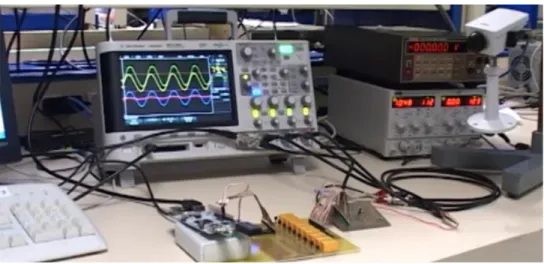
The most innovative part of the implementation is the possibility given to students of performing real-time monitoring and control of technical equipment at distance. Each hardware setup (function generator or oscilloscope, for instance) is connected to the internet. Fig. 1 shows one of those lab setups using internet-controlled instrumentation and a camera.
Fig. 1 Experimental remote lab setup at the University of Limoges.
From each TU’s Moodle page students have access to the related lab’s webpage and to the TU’s proposed lab works. Students are able to change the hardware configuration in real-time and have an immediate feedback of their actions, via the virtual instrument interfaces that are deployed remotely
and through a high-definition camera (or other interface). This enables students to see what is going on on the real lab and how the real instruments react to their remote commands. This feedback is important for students to be sure that the interface they are seeing in their own monitor is not the visible face of a virtual world but the virtual interface of a real instrument. Each student or group of students have the possibility of repeating the same experiment several times, trying different configurations in a controlled and safe environment.
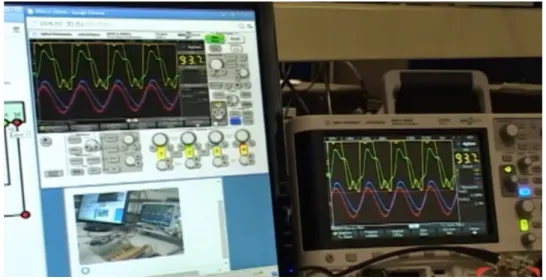
Fig. 2 shows the interface students see and through which they are able to manipulate the circuits under test in the real lab. Notice that the instrument interface, in this case an oscilloscope, mimic the real oscilloscope panel, enabling students to perform remotely the same manipulations over the circuit under test they will be able to perform in the real lab.
Fig. 2 Real and remote distance panel of an oscilloscope.
In order to reduce maintenance and installation costs, the practical works are not duplicated. The VLE (Virtual Learning Environment) servers and the remote laboratories are located in three different institutions, one in each Maghreb partner countries. However, from the student’s point of view, all the experiments are integrated on a single and unified EOLES laboratory accessible 24/7.
8 CONCLUSION
The L3-EOLES course is, as far as authors are aware, the first fully online undergraduate course in Electronics and Optics for Embedded Systems to be recognized by the educational authorities in several countries simultaneously, including countries inside and outside the EHEA, broadening the students’ future perspectives of developing a successful career in a globalized job market.
Until now, the existence of online undergraduate degree courses in Electrical and Computer Engineering was hindered by the lack of a framework for remote experimental labs. The EOLES consortium successfully addressed this issue opening new doors for the future of distance learning education in the engineering area.
The official recognition of the L3-EOLES course ensures its financial sustainability since it became part of the educational system for which institutional funds are available. The course is also now being offered as a lifelong learning course by some of the EOLES partner’s institutions, further ensuring its long term sustainability. An agreement signed by all the EOLES partners established the rules regarding the Joint Diploma, the access to the learning resources, the use of the remote laboratory and the maintenance of the equipment beyond the end of the EOLES project.
REFERENCES
[1] Master ARTICC (2016). Available at http://www.sciences.unilim.fr/physique/master-articc/ [2] Farah, S., A. Benachenhou, G. Neveux and D. Barataud. Design of a Flexible Hardware
Interface for Multiple Remote Electronic Practical Experiments of Virtual Laboratory. International Journal of Online Engineering 8(2), pp. 7-12.
[3] Priem,F., R. De Craemer, J. Calu, F. Pedreschi, T. Zimmer, S. Saïghi and J. Lilja (2011). E-Learning in Science and Technology via a Common E-Learning Platform in a Lifelong E-Learning Project. European Journal of Open, Distance and E-Learning (1), 24 pp.
[4] Sousa, N., G. R. Alves and M. Gericota (2010). An Integrated Reusable Remote Laboratory to Complement Electronics Teaching. IEEE Trans. on Learning Technologies 3(3), pp. 265-271. [5] Matthews, D. (1999). The Origins of Distance Education and its use in the United States, T.H.E.
Journal 27(2), pp. 54-67.
[6] Our history (2016). University of London International Programmes. Available at http://www.londoninternational.ac.uk/our-global-reputation/our-history
[7] Morton, H., Nancie Gunson, and Mervyn Jack (2012). Interactive Language Learning through Speech-Enabled Virtual Scenarios. Advances in Human-Computer Interaction, Article ID 389523, 14 pp.
[8] Zhu, J. (2010). A hybrid online-education strategy for delivering engineering and technology courses. Proc. 2nd Intl. Conf. on Networking and Digital Society 2, pp. 448–451.
[9] BSc in Electrical Engineering (2016). Online Electrical Engineering Degree. Available at http://und.edu/academics/extended-learning/online-distance/degrees/electrical-engineering/ [10] B.S. in Engineering Technology: Electrical (2016). Program Overview. Available at
http://distanceed.uncc.edu/programs/bs-engineering-technology-electrical
[11] Gravier, C., J. Fayolle, B. Bayard, M. Ates and J. Lardon (2008). State of the Art About Remote Laboratories Paradigms – Foundations of Ongoing Mutations. International Journal of Online Engineering 4(1), pp. 19-25.
[12] Tawfik, M., E. Sancristobal, S. Martin, G. Diaz and M. Castro (2012). State-of-the-art remote laboratories for industrial electronics applications. Proc. Technologies Applied to Electronics Teaching, pp. 359-364.
[13] Albu, M. M., K. E. Holbert, G. T. Heydt, S. Dan Grigorescu and V. Truşcă (2004). Embedding Remote Experimentation in Power Engineering Education. IEEE Trans. on Power Systems 19(1), pp. 139-143.
[14] Hercog, D., B. Gergič, S. Uran, K. Jezernik (2007). A DSP-Based Remote Control Laboratory. IEEE Trans. on Industrial Electronics 54(6), pp. 3057-3068.
[15] Restivo, M. T., J. Mendes, A. M. Lopes, C. M. Silva and F. Chouzal (2009). A Remote Laboratory in Engineering Measurement. IEEE Trans. on Industrial Electronics 56(12), pp. 4836-4843.
[16] García-Zubia, J., I. Angulo, J. Irurzun, P. Orduña, J. Ruiz, U. Hernández, M. Castro and E. Sancristobal (2010). Easily Integrable Platform for the Deployment of a Remote Laboratory for Microcontrollers. International Journal of Online Engineering 6(3), pp. 26-31.
[17] Cardoso, A. and P. Gil (2013). Online Learning in Engineering Courses Using Wireless Sensor and Actuator Networks. International Journal of Engineering Pedagogy 3(1), pp. 76-80.
[18] Bates, T. (2011). Understanding web 2.0 and its implications for E-learning. In: M. J. W. Lee, and C. McLoughlin (Eds), Web 2.0- Based E-learning: Applying Social Informatics for Tertiary Teaching, IGI Global, New York, pp. 21-42.
[19] Sbihi, B. and K. E. El Kadiri (2010). Towards a participatory E-learning 2.0. International Journal on Computer Science and Engineering 2(1), pp. 1-7.
[20] Electronic and Optic e-Learning for Embedded Systems (2016). Available at http://www.eoles.eu/
[21] BigBlueButton (2016). Available at http://bigbluebutton.org/ [22] Moodle (2016). Available at https://moodle.org/