HAL Id: hal-01363201
https://hal.inria.fr/hal-01363201
Submitted on 9 Sep 2016
HAL is a multi-disciplinary open access
archive for the deposit and dissemination of
sci-entific research documents, whether they are
pub-lished or not. The documents may come from
teaching and research institutions in France or
abroad, or from public or private research centers.
L’archive ouverte pluridisciplinaire HAL, est
destinée au dépôt et à la diffusion de documents
scientifiques de niveau recherche, publiés ou non,
émanant des établissements d’enseignement et de
recherche français ou étrangers, des laboratoires
publics ou privés.
Modelling Subordinate Conjunctions in STAG: A
Discourse Perspective
Timothée Bernard
To cite this version:
Timothée Bernard. Modelling Subordinate Conjunctions in STAG: A Discourse Perspective. 28th
European Summer School in Logic, Language & Information, Aug 2016, Bozen-Bolzano, Italy. pp.13.
�hal-01363201�
Modelling Subordinate Conjunctions in STAG:
A Discourse Perspective
Timothée Bernard Université Paris Diderot - ALPAGE
Abstract Among the discourse connectives – lexical items conveying discourse relations – are the subordinate conjunctions (SubConjs), like because, even if or although. SubConjs have generally been considered a homogeneous category, however previous work has shown they can be divided into two classes according to their syntactic and semantic properties. Similarly, attitude verbs and reporting verbs (AVs) have two different uses in discourse: evidential and intentional. Drawing from these observations, we propose a STAG model of SubConjs and AVs taking into account both their syntactic and discursive properties.
Keywords: discourse, STAG, subordinate conjunctions, syntax, semantics
1
Introduction
At the discourse level, sentences and propositions are related by discourse relations (DRs). DRs can either be implicit, i.e semantically inferred, or explicit, i.e. lexically signalled. The most common markers of explicit DRs are discourse connectives, a group mainly composed of conjunctions, prepositions and adverbs. For instance, (1a) involves an implicit Consequence relation and (1b) a Concession one explicitly signalled by the but connective. Following the conventions of the Penn Discourse
TreeBank (PDTB, [13]), we refer to the two arguments of DRs as Arg1 and Arg2
and use italics and bold face respectively to indicate the spans of text for each argument (when such spans of text appears) while the connective lexicalising the relation, if any, is underlined.
(1) a. Fred was sick. He stayed at home. b. Fred was sick. But he came to work.
We are working with Synchronous Tree Adjoining Grammar (STAG, [15]), a formalism providing a way to describe both syntax and semantics simultaneously, making explicit how they relate with each other. To our knowledge, not much attention has been paid to modelling subordinate conjunctions (SubConjs) from a discourse point of view in STAG. D-STAG [3] analyses discourse with STAG structures, and thus models discourse connectives, but does not take into account the specificities of SubConjs that are discussed here. This is however a neces-sary step toward both operational discourse parsers and convincing discourse generation systems, and also the purpose of this mainly theoretical work.
The paper is organised as follows. Section 2 presents relevant work highlighting the aspects of SubConjs that we aim to model. In Section 3, we use linguistic tests to determine more precisely the interactions of SubConjs with diverse scope operators. This leads to our STAG proposition presented in Section 4. Section 5 concludes the paper.
2
Relevant Work on Subordinate Conjunctions
2.1 Non-Alignment of Syntactic and Discourse Arguments
It has been shown by a number of works (see [5] for English and [4] for French) that the propositional content of a (syntactic) argument of a discourse connective is not always a (semantic/discourse) argument of the DR lexicalised by the connective. Such mismatches often arise with attitude verbs (to think, to know, etc.) and reporting verbs (to say, to deny, etc.), both grouped here under the label ‘AV’. When an AV together with the clause it introduces is an argument of a discourse connective, the AV may (2a) or may not (2b) be included in the
discourse argument of the corresponding DR.1 Following [1], we say the AV is
intentional in the first case and evidential in the second.
(2) a. Fred went to Peru although Sabine thinks he never left Europe.
b. Fred went to Peru although Sabine thinks he did not go to Lima. It is interesting to note that contrarily to although, not all discourse connectives can be found with such non-alignments of the syntactic and discourse arguments. It is the case, for instance, of because, as illustrated in (3). [9], using the DR hierarchy of the PDTB, observes that a connective lexicalising a COMPARISON or an EXPANSION relation can often be found with a mismatch, whereas it seems impossible for a connective lexicalising a TEMPORAL or a CONTINGENCY relation.
(3) a. Fred could not come becausehe was not in town.
b. #Fred could not come because Sabine thinks he was not in town.
2.2 Two Types of Adverbial Clauses
A distinction between two types of adverbial clauses is made by [8]. The first type is the central adverbial clause (CAC), which adds an information (time, place, etc.) about the eventuality described in the matrix clause as in (4). The second type is the peripheral adverbial clause (PAC), whose function is to structure the discourse (expressing a concession, providing background information, etc.) as in (5).
1
Why the AV is included or not in Arg2is discussed in [5] and [4]. One element is that
the AV can be felicitously removed from (2b) while it cannot from (2a). Similarly, an attributing phrase such as according to Sabine can be substituted for the AV (with no change in meaning) only in (2b) and not in (2a).
(4) a. Fred went to Brazil while he was a student. b. If it is sunny, I’ll go outside.
(5) a. Fred has been to Brazil whereas Sabine has never left Europe.
b. Ifit is sunny, why aren’t you playing outside?
Several phenomena are studied in [8] – coordination, ellipsis, ambiguity, and others related to scope, prosody, typography, etc. They all tend to show a greater integration of CACs into their matrix clause than PACs. We will expand on these observations concerning scope phenomena in the next section. It suffices for now to point out that negation and interrogation may scope over CACs but not over PACs. It should also be noted that a CAC cannot contain an epistemic modal if it is speaker-oriented (as in (6a) but not in (6c) where may is mainly ‘John-oriented’), while a PAC can (see 6b). Expressed with the terms of [9]: the syntactic and discourse arguments of a conjunction must be aligned in the case of a CAC, while there can be a mismatch with PACs.
(6) a. #Mary accepted the invitation without hesitation after John may have accepted it. (from [8])
b. The ferry will be fairly cheap, while/whereas the plane may/will probably be too expensive. (from [8])
c. John is worried because he may be ill.
3
Projection Tests Applied to Subordinate Conjunctions
In order to model SubConjs, we need to understand how they semantically relate to the other components of the sentence. We therefore study them in the context of the five following patterns2, related to the scope of diverse operators with respect to discourse connectives and their arguments:
Negation: It is not the case that A. Conditional: If A, B.
Epistemic: It is possible that A. Interrogation: A?
AV: Sabine thinks that A.
In these patterns, we replace A with ‘A1CONJ A2’, where CONJ is a SubConj
lexicalising a DR R, and try to figure out if Arg1, Arg2 and R(Arg1, Arg2) are logically implied by the resulting sentence. Note that we do not constrain the syntactic structure of the sentence; we do not know a priori whether A is made up of a unique constituent or of multiple constituents diversely attached to the rest of the sentence. In this paper, we illustrate the results for because and although – introducing a CAC and a PAC respectively – although the examples can be
extended to many other SubConjs.
2
Because (Explanation): Sentences in (7) are the result of applying the negation and the interrogation patterns to an instance of because lexicalising Explanation. (7) a. It is not the case that Fred was absent because he was sick.
b. Was Fred absent because he was sick?
Interpret (7a) in the context of Fred’s workplace. A local interpretation of the negation in the matrix clause (scoping only over Fred was absent ) would be logically incoherent (in the sense that while it is semantically well-formed, it seems impossible or at least very hard to find a situation in which it would be true), so it must have a global interpretation. This is compatible with [8], as because specifies some aspect of the event in the matrix clause and thus introduces a CAC. But what do possible continuations tell us about the semantics of (7a)?3
All sentences in (8) are possible and describe different situations:4
– with (8a), neither Arg1 (Fred is absent ), nor Arg2 (Fred is sick ), nor R
(Explanation) are true; – with (8b), only Arg1 is true;
– with (8c), only Arg2is true;
– with (8d), both Arg1 and Arg2 are true, but not R.
(8) a. He was there and in perfect shape. b. He was fine but he missed his train.
c. He still came, even if indisposed.
d. He was indeed ill, but he would have come anyway hadn’t he had to take delivery of some important package.
The negation has therefore a global scope over Arg1∧ Arg2∧ R(Arg1, Arg2) and none of these elements are semantically implied by the use of the because. We can notice that all these sentences are also acceptable answers for question (7b) when preceded by the negative no. So interrogation has the same properties as negation in terms of these conclusions.
In a similar way, the conditional pattern generates (9), which can be coher-ently followed by any sentence in (10). They illustrate the same four previous configurations: neither Arg1 nor Arg2 nor R are true with (10a), only Arg1 is true with (10b), only Arg2with (10c), Arg1and Arg2 true but not R with (10d). (9) If Fred got offended because Sabine teased him, then it would mean that
he is secretly in love with her.
3 We accept any kind of continuation, including dialogue, as long as no correction DR
nor ‘Hey, wait a minute’-style device [14] is involved.
4 It could be argued that (8a) and (8c) are no acceptable continuations of (7a),
implicitly saying that the use of because presupposes the truth of Arg1. However,
this interpretation does not seem to be shared by all English speakers, and as it may involve a specific treatment of presupposition, we have preferred to leave it for future research.
(10) a. However, Fred is in very good mood and I know Sabine, she never teases anyone.
b. However, I don’t think she was teasing him. c. However, he didn’t seemed annoyed at all.
d. However, I don’t think that this is actually the reason.
The same conclusions can be drawn from all other patterns as well: the
corresponding operators can have global scope over the whole ‘A1 because A2’
span.
Although (Concession): There has been a lot of discussion since Frege [6] about the semantics of although. According to [12], the Concession relation is not at-issue (which roughly means that while you can express it, you cannot talk about it; in particular it cannot be easily negated). It is also interesting to remark that this Concession is speaker-oriented : although cannot be used without the speaker committing herself to the relation, even if the connective is under the scope of AVs, which are presupposition plugs. Therefore, although is often cited as a conventional implicature trigger since [7].
First, let us notice that the negation pattern cannot be directly used with a coherent ‘A1although A2’.5 To produce a satisfactory utterance such as (11c),
it is necessary for the negation to be included in Arg1. The impossibility of
sentences such as (11b) shows that with although – contrary to what we have just seen with because –, a negation in the matrix clause always has a local scope. This is consistent with the analysis in [8], as although is not used to precise an event but to give some context for its interpretation and thus introduces a PAC. (11) a. Fred ate meat the other day although he is a vegetarian.
b. #It is not the case that Fred ate meat the other day although he is a vegetarian.
c. It is not the case that Fred refused to eat meat the other day although he is a vegetarian.
Let’s consider (12), from the interrogative pattern. Whereas (13a) is a perfectly
acceptable answer to it, (13b) is not.6 This tends to show that with although,
Arg2 and R are not at-issue and that the interrogation only concerns the content of the matrix clause.
(12) Did he eat meat although he is a vegetarian?
5 The examples in (11) would be more compelling if although was replaced with despite
the fact that. However, the lack of appropriateness of although comes from subtle differences in semantics and usage which are unrelated to the problem at stake. It is for the sake of simplicity and homogeneity that we have chosen to stick to although.
6 It would be possible to continue (12) with He is not a vegetarian anymore, but this
is more of a remark than an answer: the dialogue could continue with You haven’t answered my question. Also note the use of anymore, which marks a revision.
(13) a. No, he refused.
b. #No, he is not a vegetarian anymore.
Yet, saying that the Arg2 of a Concession is never at-issue would be taking
shortcuts. It seems for example that (14a), from the AV pattern, can be felicitously
followed by (14b) although it negates Arg2. So in such a case, he was sick is
under the semantic scope of Sabine thinks.
(14) a. Sabine thinks Fred came to work although he was sick. b. But she is wrong, he had recovered several days ago.
Out of context, (14a) seems intuitively to imply that Fred was actually sick;
this is a default reading. The utterance is ambiguous: the Arg2 may or may not
be under the semantic scope of the AV, the latter being the default interpretation. Summary: Tab. 1 summaries these properties and those of two other SubConjs, after and whereas, which could not be discussed here due to lack of space. although, whereas and other SubConjs are ambiguous between Contrast and Concession (at least, [13]), but they have the same properties as long as they introduce a
PAC.
It seems that conjunctions introducing a PAC (‘peripheral conjunctions’, PCs)
all share the same behaviour; they allow mismatches for Arg2, the speaker is
always committed to the relation conveyed and in the (very probable) default
reading the speaker is also committed to Arg2. Conjunctions introducing a CAC
(‘central conjunctions’, CCs) also share some properties; they do not allow any
mismatch for Arg2, the commitment of the speaker toward the relation conveyed
is always subject to the modifiers used in the patterns. The status of Arg2,
however, depends on the conjunction.
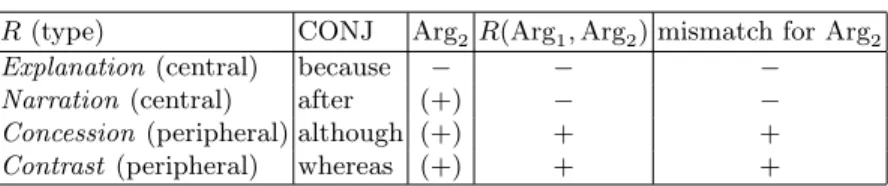
R (type) CONJ Arg2 R(Arg1, Arg2) mismatch for Arg2
Explanation (central) because − − −
Narration (central) after (+) − −
Concession (peripheral) although (+) + +
Contrast (peripheral) whereas (+) + +
Table 1. The Arg2and R(Arg1, Arg2) columns show if the truth of these propositions
are still implied by the use of CONJ in the studied patterns: ‘−’ means ‘no’, ‘+’ means ‘yes’ and ‘(+)’ means ‘yes in the default reading’; ‘+’/‘−’ in the last column indicate whether CONJ can or cannot be found with a mismatch concerning its Arg2. Arg1 is
always subject to the operators used in the various patterns.
4
Our Proposition in STAG
We now turn to STAG and propose a basic model for AVs, CCs and PCs that reflects the properties observed in the previous sections. But before that, let us explain what this formalism is and how it works.
4.1 TAG and STAG
The Tree Adjoining Grammar formalism (TAG), on which is based STAG, was introduced in [10]. In TAG, words are represented as tree structures of two kinds. On the one hand are the initial trees (named with α), whose interior nodes are labelled with non-terminal symbols and whose leaves are either labelled with a terminal symbol, either labelled with a non-terminal symbol and marked with ↓. In the last case, the leaf is said to be a substitution site. On the other hand are the auxiliary trees (named with β), which are similar to initial trees except that they have (exactly) one leaf, the foot node, that is labelled with the same non-terminal as the root and is marked with ∗ instead of ↓.
These trees are meant to combine into sentences using two operations: substi-tution and adjunction. A set of such operations is called a derivation tree and the resulting tree is called a derived tree. A substitution consists in replacing a substitution site with an whole initial tree whose root must be labelled with the same symbol that the substitution site. An adjunction consists in inserting at some interior node an auxiliary tree whose root must also be labelled with the same symbol that the target node. Both operations are illustrated in the upper part of Fig. 1 with a syntactic grammar: a substitution and an adjunction are represented on the left side while the resulting tree appears on the right side.
The idea of STAG [15] is to pair two TAGs together to perform parallel operations. Thus, in STAG, a lexical entry is a pair of TAG trees with a set of links precising the coupling between the two. A link is a pair of nodes, one from each tree, here marked as[1],[2], etc. Only on a linked node can an adjunction or a substitution be performed. When a substitution (resp. an adjunction) occurs at a node, the parallel substitution (resp. adjunction) must also occur on the other node of the link. This principle is illustrated in Fig. 1 with the coupling of a syntactic grammar (top) and a semantic one (bottom).
Note that we allow multiple adjunctions on the same node – up to one for each link on that node. In such a case, the order of the adjunctions must be specified in order to describe the resulting derived tree pair. Otherwise, the derivation tree is underspecified and is used to represent all the derived trees corresponding to all possible orders.
4.2 Lexical Entries
AVs: To take into account the two evidential and intentional uses of AVs, we propose an initial TAG pair for these verbs in addition to the auxiliary one traditionally used (Fig. 2). Auxiliary trees for AVs are motivated by long distance extractions [10], where John says is equivalent to the adjunction of according to John. But this equivalence does not hold for intentional AVs in a discourse structure. Furthermore, adjunction is generally used to indicate semantic modifiers, whereas an intentional AV provides the main predicate that is argument of a DR and does not merely indicate attribution. That is why we think it makes sense to model them with initial trees rather than auxiliary trees.
S[4] NP↓[1] VP V[3] loves NP↓[2] V Adv probably V* NP Fred S[4] NP Fred VP V Adv probably V loves NP↓[2] αloves αFred 1 βprobably 3 t ht, ti λp.probably(p) t* t[3,4] he, ti he, he, tii λos.like(s, o) e ↓[2] e ↓[1] e Fred t[4] ht, ti λp.probably(p) t he, ti he, he, tii λos.like(s, o)
e ↓[2] e Fred
Figure 1. Substitution of αFredat link [1] in αlovesand adjunction of βprobablyat link
[3]; circled in the middle is the derivation tree; the derived trees are on the right. In our model their semantics is also slightly different: evidential AVs use pre-dicates that are ‘erased’ when in a DR. This is achieved by introducing rewriting rules of the form Contrast(p, think (a, q)) → Contrast(p, q). Conversely, unnat-ural mismatches can be avoided by discarding any analysis displaying an evidential AV predicate as argument of a central DR: Explanation(p, think (a, q)) → ⊥.
S[4] VP S* V[3] thinks NP↓[1] t[3,4] E ↓[1] hE, ti t* ht, hE, tii sthinks S[4] VP S↓[2] V[3] thinks NP↓[1] t[3,4] E ↓[1] hE, ti t ↓[2] ht, hE, tii sthinks0
sthinks= λp S.S (λs.think (s, p)) sthinks0 = λp S.S (λs.think0(s, p))
Figure 2. AVs: βthinks(evidential) and αthinks(intentional)
Subordinate conjuctions: Similarly, the difference in syntax and semantics between CACs and PACs can be explained with different structures for CCs and PCs
as in Fig. 3.7 The most significant aspect of these structures is that CCs are
auxiliary trees whereas PCs are initial trees.
7 The presence of the SBAR node for CCs is necessary because of the possibility of cleft
sentences (It is because A that B ), which shows that there exists such a constituent. No cleft sentences are observed with PCs.
Indeed, consider a CC adjoined to its matrix clause. If a semantic modifier (a negation, for instance) is also adjoined to this clause, depending on where this adjunction is done relatively to the adjunction of the CC, this modifier may or may not scope over the DR. With a PC, however, because the matrix clause is substituted into the connective, any modifier is necessarily dominated by the connective and thus only the local scope is possible.
S SBAR S↓[1] IN because S* t t ↓[1] ht, ti t* ht, ht, tii sbecause S[3] S↓[1] IN although S↓[2] t[3] t ↓[1] ht, ti t ↓[2] ht, ht, tii salthough
sbecause= λp q.(p ∧ q ∧ Explanation(p, q)) salthough= λp q.(p ∧ q ∧ Concession(p, q))
Figure 3. SubConjs: βbecause(CC) and αalthough(PC)
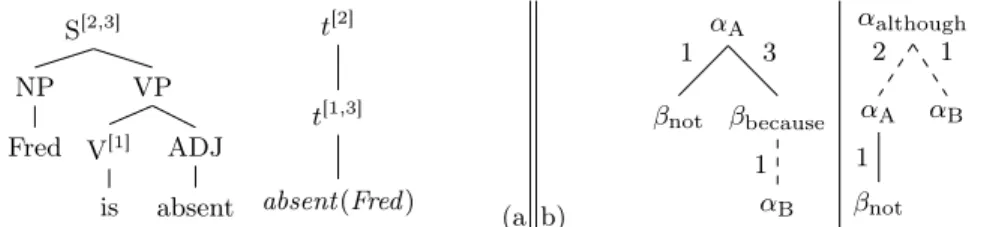
Sentence structures: [11] proposes that in sentence structures, verbal modifiers are adjoined in the semantic tree at a lower node than AVs. Doing so avoids (unnatural) interpretations of the former scoping over the latter. However, as seen in the previous section, while CCs are sentence modifiers like AVs they do present scope ambiguity when confronted with verbal modifiers such as negation. This is why, as illustrated in Fig. 4, we consider adding to sentence structures another adjunction site on the S-node (link [3]) whose semantic counterpart is at the same node as verbal modifiers’ one. We can use features to restrict the other S-site (link [2]) to AVs and conversely to force them to adjoin there.
Fig. 4 also shows the derivation trees obtained when a negation (or any other verbal modifier) is present in the matrix clause of a SubConj. As expected, the negation can either have a local or a global scope with a CC while it always has local scope with a PC.
S[2,3] VP ADJ absent V[1] is NP Fred t[2] t[1,3] absent (Fred ) (a b) αA βbecause αB 1 βnot 1 3 αalthough αB αA βnot 1 2 1
Figure 4. A typical sentence structure (a), accompanied by the derivation trees for not A CONJ B with a CC (b. left) or a PC (b. right). Because in αAlinks [1] and [3] are
at the same semantic node, the left tree is a scope neutral representation yielding one syntactic tree but two semantic ones depending on the order of the adjunctions.
5
Discussion and Perspectives
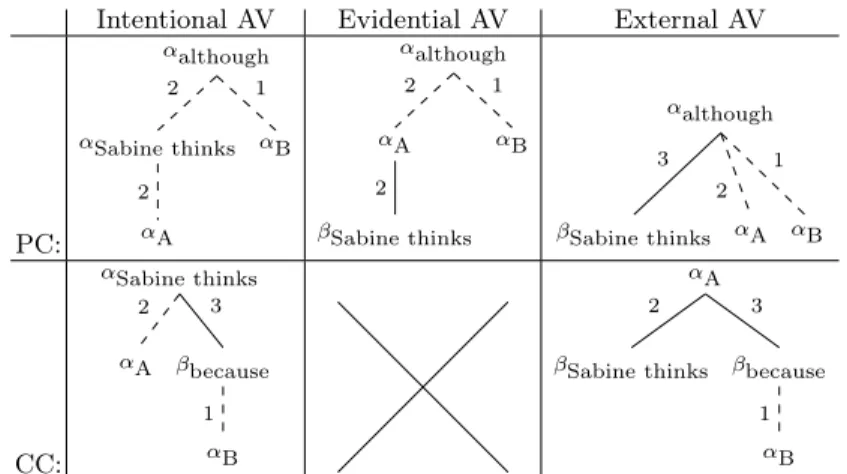
Tab. 2 shows the derivation trees for sentences of the form A CONJ Sabine thinks B as in (2). While the rewriting rules we have introduced discard the use of an evidential AV with a CC, there is an ambiguity for PC that can only be resolved using the particular semantics of the lexicalised relations.
Tab. 3 shows the derivation trees for sentences of the form Sabine thinks A CONJ B as in (14a). In this configuration, it is possible for the AV to scope over the relation. Its evidential or intentional status is then undetermined (it would depend on another discourse relation) and we have arbitrarily chosen to represent it with the traditional auxiliary structure in the ‘External AV’ column. As previously, the various ambiguities are natural ones and can only be resolved using world knowledge.
These analyses generate the expected derived trees, on both the syntactic and the semantic side (though we lack space to exhibit them here). However, our model should be refined: it does not yet account for the projection of peripheral
DRs as observed in (14b) nor for the default projection of Arg2 for some CCs
such as after (not discussed here, but that some also see in because - see note 4). Furthermore, discussing the interaction between AVs and SubConjs, we have said that evidential AVs could be replaced with attributing prepositional phrases such as according to Sabine (15a). The other way around is not true, because such expressions can be found within CACs (15b), where evidential are forbidden. In fact, it seems that in these cases the attribution not only scopes over Arg2but also over the relation itself. Attributing prepositional phrases therefore exhibit very interesting behaviours at the discourse level and will likely prove challenging to model considering their relatively free position in the sentence (15).
We also intend on extending this study to other connectives (especially adverbials, such as instead and otherwise) with the ultimate goal of building a parser capable of providing analyses coherent at the syntactic, semantic and discourse levels.
(15) a. Fred could not come even though, according to Sabine, he was really looking forward to it.
b. Fred could not come because, according to Sabine, he was not in town. c. Fred could not come even though he was, according to Sabine, really
looking forward to it.
d. Fred could not come even though he was really looking forward to it, according to Sabine.
Acknowledgements
I would like to particularly thank my supervisor Laurence Danlos for her invaluable advice, as well as my friends Rachel and Emily for their help with the English language.
Intentional AV Evidential AV PC: αalthough αSabine thinks αB 2 αA 2 1 αalthough αB βSabine thinks 2 αA 2 1 CC: αA βbecause αSabine thinks αB 2 1 3
Table 2. Derivation trees for sentences of the form A CONJ Sabine thinks B.
Intentional AV Evidential AV External AV
PC: αalthough αB αSabine thinks αA 2 2 1 αalthough αB αA βSabine thinks 2 2 1 αalthough αB αA βSabine thinks 3 2 1 CC: αSabine thinks βbecause αB 1 αA 2 3 αA βbecause αB 1 βSabine thinks 2 3
References
1. N. Asher, J. Hunter, P. Denis, and B. Reese. Evidentiality and intensionality: Two uses of reportative constructions in discourse. In Workshop on Constraints in Discourse Structure, Maynooth, Ireland, 2006.
2. G. Chierchia and S. McConnell-Ginet. Meaning and Grammar: An Introduction to Semantics. MIT Press, 1990.
3. L. Danlos. D-STAG: a Formalism for Discourse Analysis based on SDRT and using Synchronous TAG. In P. de Groote, editor, Proceedings of FG’09. INRIA, 2009. 4. L. Danlos. Connecteurs de discours adverbiaux: Problèmes à l’interface
syntaxe-sémantique. Linguisticae Investigationes, 36(2):261–275, December 2013.
5. N. Dinesh, A. Lee, E. Miltsakaki, R. Prasad, A. Joshi, and B. Webber. Attribution and the (Non-)Alignment of Syntactic and Discourse Arguments of Connectives. In Proceedings of the Workshop on Frontiers in Corpus Annotations II: Pie in the Sky, pages 29–36, Ann Arbor, Michigan, June 2005. ACL.
6. G. Frege. Sense and Reference. The Philosophical Review, 57(3):209–230, 1948. 7. H. Grice. Logic and conversation. In P. Cole and L. Jerry, editors, Syntax and
semantics 3: Speech acts, pages 41–58. Academic Press, San Diego, CA, 1975. 8. L. Haegeman. The syntax of adverbial clauses and its consequences for topicalisation.
In M. Coene, G. De Cuyper, and Y. D’Hulst, editors, Current Studies in Comparative Romance Linguistics, number 107 in APiL, pages 61–90. Antwerp University, 2004. 9. J. Hunter and L. Danlos. Because We Say So. In Proceedings of the EACL 2014
Workshop on Computational Approaches to Causality in Language, CAtoCL, pages 1–9, Gothenburg, Sweden, April 2014. ACL.
10. A. Joshi. An introduction to tree adjoining grammars. Mathematics of language, 1:87–115, 1987.
11. R. Nesson and S. Shieber. Simpler TAG semantics through synchronization. In Proceedings of FG 2006, pages 129–142, Malaga, Spain, 2006.
12. C. Potts. Presupposition and Implicature. In S. Lappin and C. Fox, editors, The Handbook of Contemporary Semantic Theory, pages 168–202. Wiley-Blackwell, 2 edition, 2015.
13. R. Prasad, N. Dinesh, A. Lee, E. Miltsakaki, L. Robaldo, A. Joshi, and B. Webber. The Penn Discourse TreeBank 2.0. In Proceedings of the 6th International Conference on Language Resources and Evaluation, Marrackech, Morocco, June 2008. 14. B. Shanon. On the Two Kinds of Presuppositions in Natural Language. Foundations
of Language, 14(2):247–249, 1976.
15. S. Shieber and Y. Schabes. Synchronous Tree-adjoining Grammars. In Proceedings of the 13th Conference on Computational Linguistics - Volume 3, COLING ’90, pages 253–258, Stroudsburg, PA, USA, 1990. ACL.
![Figure 1. Substitution of α Fred at link [1] in α loves and adjunction of β probably at link [3]; circled in the middle is the derivation tree; the derived trees are on the right.](https://thumb-eu.123doks.com/thumbv2/123doknet/14568186.539255/9.918.215.713.172.441/figure-substitution-adjunction-probably-circled-middle-derivation-derived.webp)