BBF RFC 47 BioBytes Assembly Standard
BBF RFC 47: BioBytes Assembly Standard
David Lloyd, Kelly Robinson, Erin Garside, Justin Fedor, Doug Ridgway, Michael Ellison
9/21/09
1. Purpose
The BioBytes assembly method provides a new high-throughput way of assembling plasmids as well as other large DNA constructs. Using a bead-linked assembly of genetic parts with long (12 bp) standardized sticky ends, it allows for greater speed and
efficiency in assembling these components. This document defines a standard for genetic parts compatible with the assembly system and describes detailed protocols for the
construction of such parts and their rapid assembly. Although the original motivation for the method was to produce whole synthetic genomes, the design allows for any type of DNA construction.
2. Relation to other BBF RFCs
This RFC does not amend or replace any previous RFC. However, genetic parts compatible with RFCs 10, 23, and 25 may be introduced into this system as described below.
3. Copyright Notice
Copyright © The BioBricks Foundation (2009). All Rights Reserved.
4. Definitions
The system relies on two long nonpalindromic 3' sticky ends, referred to as A and B, and their complementary ends, A’ and B’. The sequences for these regions, and their
complements are as follows:
A B
5'-AGGAAGTACGGT-3' 5'-CAATACTACAGCT-3'
A' B'
5'-ACCGTACTTCCT-3’ 5'-AGCTGTAGTATTG-3'
Region A is complementary to A', and B to B'. An A end will not bind to another A end, nor a B end to a B end. The double-stranded region resulting from annealing A to A' is referred to as an A scar, and likewise for B, a B scar.
A ‘Byte’ is defined as any linear segment of double-stranded DNA flanked by A and B 3’ sticky ends. Bytes come in two types. The first type, an AB byte, is flanked by A' and B sticky ends. The second type, a BA byte, is flanked by B' and A sticky ends. There are no limitations on the interior sequence. The interior, which contains the functional components of Bytes, may include (but are not limited to) open reading frames, promoters and terminators.
5. Motivation and Validation of Byte Design
The motivation of standardized, long sticky ends is to allow multiple assembly steps in vitro without the need to create unique primers for each DNA segment. Assembly using non-standardized sticky overhangs produced by a chewback method has been
successfully applied to large-scale construction (Gibson 2009). However,
non-standardized ends imply that the entire assembly sequence must be defined before the parts are constructed, making assembly impossible from a standardized toolbox of parts. The assembly method (described in detail below) relies on two non-complementary ends, called A and B, allowing sequential assembly of compatible parts in an arbitrary order. Two distinct ends are required because identical ends would result in uncontrolled oligomerization. The assembly is accomplished using a bead platform to define unidirectional assembly. It also allows an excess of added Byte to be used during a construction step, and then purified away from the construct by washing. The A and B overhang sequences defined here are sufficiently GC rich to have a melting temperature above room temperature, while minimizing cross-annealing and allowing multiple methods of end generation.
6. Production of Bytes
a. Producing Bytes from Natural DNA
There are three basic steps in producing Bytes. The gene of interest may be inserted into one of two specialized plasmids pAB or pBA, which contain the A and B regions. From this, PCR with universal deoxyuracil-containing primers can be used to amplify the construct along with a ribosome binding site (RBS) as well the A and B ends. Finally, USERTM digestion allows for the production of the specific sticky ends.
To insert into pAB or pBA, the sequence of interest can be amplified via PCR with specific restriction sites. The prefix MUST contain one restriction site that produces a CTAG sticky end. This includes XbaI, AvrII, SpeI, and NheI. Likewise the suffix MUST contain one restriction site that produces a TGCA sticky end. This includes PstI, BstI, and NsiI. The necessary restriction sites can be added to the sequence of interest via
PCR by incorporating the following ends into the primers (See Figure 2).
Figure 2. Primer Extension Sequences
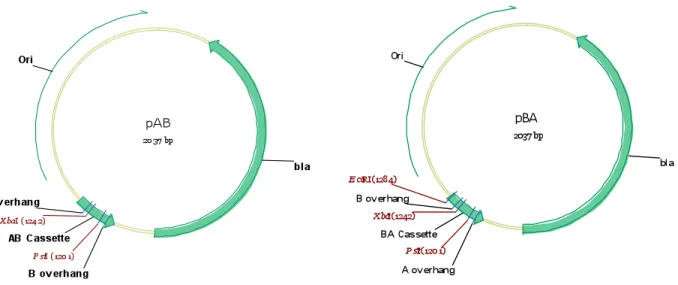
Digestion of pAB or pBA with PstI and XbaI allows sequences with the compatible sticky ends to be cloned in. The pAB and pBA plasmids are used as templates for the production of the A and B sticky ends used in the next step. With the gene contained within the pAB and pBA plasmids, Bytes can be easily stored and amplified at any time. (pAB and pBA have been submitted to the iGEM Registry of Parts) (See Figure 3).
Figure 3. Maps of the pAB and pBA plasmids.
Universal primers SHOULD be used to amplify the inserted gene product of pAB and pBA. Please see Section 7 Protocols for a detailed description of amplification of Bytes. These contain uracil deoxyribonucleotides allowing for their excision to generate single nucleotide gaps with the USERTM system, which can be purchased from New England Biolabs (NEB Cat No. M5505L or M5505S) (See Figure 4).
pAB_F 5'-AGGAAGUACGGUCTGAGGAGGT pAB_R 5'-AGCTGUAGTATUGCACTGCAG pBA_F 5'-AATACUACAGCUGAGGAGGT pBA_R 5'-ACCGUACTTCCUACTGCAG
Figure 4. Sequences of universal deoxyuracil-containing primers for AB sticky end generation.
Amplification of the insert by PCR and subsequent USERTM digestion produces A and B overhangs and completes the production of the Bytes. (Please see section 7 for USERTM Digest Protocol) The final sequences of a Byte can be seen in Figure 5.
Figure 5. Finished AB and BA Bytes.
b. Producing Bytes from Existing BioBricks:
Compatibility with RFC 10 Parts and Workflows
One immediate question concerns the compatibility of this strategy with existing standards. Several forms of compatibility can be distinguished. First, can users of this system easily take advantage of the existing 3000+ BioBrick part library? The multiple cloning site (MCS) between the linker sequences in pAB and pBA has been designed to make this straightforward: digestion of an RFC 10 BioBrick with XbaI and PstI releases a fragment with compatible ends to the pAB or pBA vector digested with XbaI and PstI, allowing directional cloning of any existing BioBrick into pAB and pBA. This works for any parts flanked by XbaI and PstI sites, including parts compliant with RFCs 23 and 25. So all existing parts can be moved into this system following a single directional cloning step, after which they can be rapidly assembled along with any other parts.
Second, can DNA produced for this system be used in RFC 10 based workflows (standard assembly, etc)? Since Bytes are much less restricted than RFC 10 BioBricks, there is no requirement for mutagenesis to remove RFC 10 restriction sites from the sequences, which may introduce incompatibilities. For sequences of interest in pAB or pBA which happen to have no restriction site incompatibilities with RFC 10, there are multiple avenues to cloning into a pSB plasmid to be incorporated into conventional workflows, including screening XbaI+SpeI clones, directional cloning using an upstream
EcoRI with the PstI in the MCS, and so on.
Thirdly, are the acceptor plasmids pAB and pBA compliant with RFC 10, and compatible with all BioBrick assembly strategies? In other words, could we simply consider them as new pSB vectors? The answer is no, since they do not contain the full RFC10 prefix and suffix. However, they do support some BioBrick assembly: once a BioBrick has been dropped in with XbaI and PstI, a full standard prefix is present and further BioBricks can be added onto the tail. In this sense, it is like the existing nonstandard vector J23018, where the standard prefix has been replaced with one with the same EcoRI / XbaI ends but with additional useful properties.
The MCS of the acceptor plasmids pAB and pBA have also been designed to enable easy cloning of open reading frames from ASKA, a genome-scale collection of E. coli open reading frames, cloned into an expression plasmid with N-terminal 6-His tags and a C-terminal GFP fusion (Kitagawa 2005). To move the ORF into our system, an ASKA plasmid is digested with SfiI, and the released fragment ligates directionally into pAB or pBA digested with BstAPI.
7. Assembly of Bytes
The Bytes can be assembled using a bead system. Three components MUST be available:
1. Paramagnetic Streptavidin Coated Beads 2. Biotinylated DNA Anchor
3. Bytes
4. A Terminator Byte (Optional Piece)
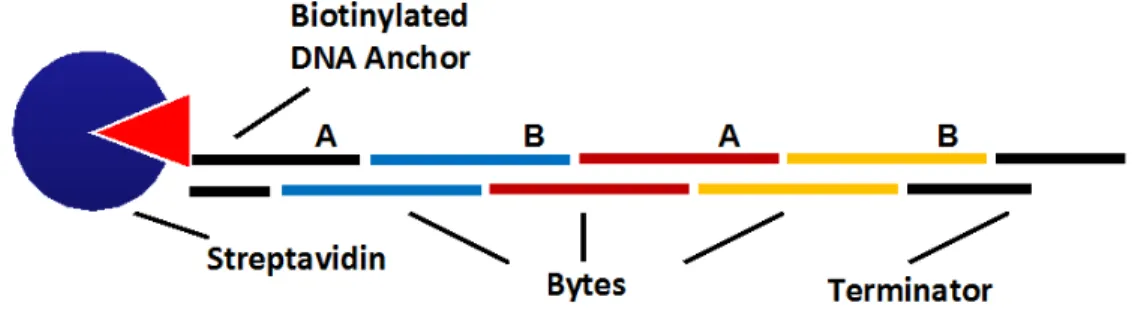
Paramagnetic streptavidin binds non-covalently but strongly to biotinylated DNA which allows for a platform to which Bytes can be added incrementally and unidirectionally to the 3' end of the growing chain. A biotinylated Anchor piece can be added onto the bead and facilitates the addition of the Bytes (See Figure 6).
Figure 6. Biotinylated Anchor sequence for on-bead assembly.
Either USERTM or I-SceI digestion MUST be used to circularize the construct after assembly. Either an A or B end can be incorporated into the Anchor allowing for either an A or B Byte respectively to be used as the first component in the construct. Please see Section 8 for protocols of a detailed description of the bead assembly system. The assembly involves a series of washes and allowing the beads to come into contact with
TATAATTGGACAATAGGGATA
BTN-(TC)7TATATUAACCUGTTAUCCCTAUAGGAAGAGCTGT
the different solutions. The beads MUST first be exposed to an Anchor piece followed by individual Bytes with washes in between. This allows for the constructs to be built with directionality and for each component to be added in the correct order (See Figure 7).
Figure 7. Assembly of Bytes, showing the individual components.
At this point Bytes may be added onto the chain. However, the bytes MUST be added in alternating order (i.e. an AB Byte followed by a BA Byte or vice versa). Ligase MUST be added into each solution to allow for the ligation of each Byte as it is being added. After the construct is completed it can be circularized through the addition of a
Terminator piece that has an overhang complementary to the cut site found in the Anchor (See Figure 8). Alternatively, the construct may be cleaved from the Anchor and remain linear without the addition of the Terminator piece.
The Terminator piece is optional, however, if used it MUST be cut in the same manner as the Anchor. For example, if the I-SceI enzyme is used on the Anchor, the Terminator must also be digested with I-SceI. USERTM digest allows for spontaneous circularization of the construct as a result of the annealing of the Anchor and Terminator.
Final constructs can be transformed, amplified and isolated in quantity via miniprep kit. This system allows for a simple high throughput approach to plasmid and operon design. The components are readily available to anyone and the assembly method can be used by any existing Bytes.
Figure 8. Terminator
8. Protocols
a. Protocol 1: Byte production via PCR and USER
TMdigestion
This procedure allows for the amplification of any gene or part in the pAB and pBA plasmids. The procedure is the same for both pAB and pBA Byte Amplification with the only difference being the universal primers (for pAB Bytes use pAB_F and pAB_R, for pBA Bytes use pBA_F and pBA_R).
Materials:
• Pfu Turbo Cx (Stratagene)
• FWD/REV Primers (pAB_F/pAB_R or pBA_F/pBA_R) • DNA Template (pAB/pBA with inserted genetic elements) • dNTPs
• ddH2O
• USER™ Enzyme Mix (1 U/µL) (New England Biolabs: M5505L or M5505S) • Agarose gel
• Gel Purification Kit • EtOH (100%, 70%)
• 3M Sodium Acetate pH 5.2
1) In an PCR Tube mix the following (Assuming a 100 µL Reaction Volume): - 4 µL Template (pAB/pBA with inserts to be amplified - 1.5 ng/µL) - 4 µL Forward Universal Primer (10 µM)
- 4 µL Reverse Universal Primer (10 µM) - 2 µL Pfu Cx DNA Polymerase
- 10 µL Pfu Cx Buffer - 10 µL dNTPs (2mM) - 66 µL ddH2O
- 95˚C (2 Minutes) - 30 Cycles:
- 95˚C (30 Seconds) - 56˚C (1 Minute)
- 72˚C (extension time depends on pAB/pBA insert size: 2 minutes per 1 kbp.) - 72˚C (5 Minutes)
3) Add 1 µL USERTM and incubate at 37˚C for 1 hour. 4) Run the PCR product on an agarose gel.
5) Gel purify to isolate PCR product; i.e. the BioByte.
(NOTE: After the gel has been dissolved and prior to adding the isopropanol, add atleast 10 µL of 3M sodium acetate pH 5.2, this increases yields).
b. Protocol 2: Rapid Bead-Based Byte Assembly
This procedure allows for the building of plasmid constructs. Any type of Byte may be used, however, the Bytes MUST alternate ends during addition. The Anchor and Terminator can be synthesized to have A or B overhangs, this only influences the first and last Byte respectively which can be added.
Materials
• Annealed Anchor • Annealed Terminator • Prepared Bytes • Rare Earth Magnet
• Streptavidin-Coated Magnetic Microsphere "Beads" (4mg/mL) (New England
Biolabs: S1420S)
• Wash/Binding Buffer • T4 DNA Ligase/Buffer
• USER™ Enzyme Mix (1 U/µL) (New England Biolabs: M5505L or M5505S)
Wash/Binding Buffer consists of: - 0.5 M NaCl
- 20 mM Tris HCl (pH 7.5) - 1 mM EDTA
Preparation:
1) Prepare X 1.5 mL microcentrifuge tubes, where X is the number of constructs to be made.
2) The beads are stored at 4ºC, vortex briefly to resuspend the beads and dispense 40 µL into each tube. Return the stock of beads to 4ºC immediately.
3) Apply the magnet, wait until solution clears completely, aspirate supernatant. 4) Wash beads by adding 75 µL of “Wash/Binding Buffer” and resuspend by
flicking.
5) Apply the magnet, wait until solution clears completely, aspirate supernatant. 6) Repeat steps 4 & 5 once more.
Anchor:
7) Apply 20 µL of Anchor (A or B) to the bead solution 8) Incubate at room temperature for 10 minutes
9) Apply the magnet, wait until solution clears completely, aspirate supernatant. 10) Wash twice as in steps 4-6.
11) Wash once more with 75 µL 1X ligase buffer. Byte Addition:
12) Add 20 µL of the first Byte, resuspend beads, then add 2.3 µL 10x Ligase Buffer + 1 µL Ligase.
13) Incubate at room temperature for 20 minutes, every few minutes resuspend the beads by flicking the tube. BE GENTLE and tap the droplets back to the bottom of the tube after mixing.
14) Wash twice as in steps 4-6 with Wash Buffer and once more with 1X Ligase buffer.
15) Repeat steps 12-14 for each Byte to be added. If you wish to circularize:
16)Add 20 µL of Terminator (A or B), resuspend beads, then add 2.3 µL 10x Ligase Buffer + 1 µL Ligase.
17)Incubate at room temperature for 20 minutes
18)Wash twice with Wash Buffer and once more with 1X Ligase buffer.
Release from the bead:
19)Resuspend beads in 20 µL dH2O.
20)Add 2.5 µL 10x Pfu Buffer + 1 µL USERTM. 21)Incubate @ 37ºC 1 hr
supernatant into a fresh tube
23)Heat to 95ºC for 1 min, cool to RT slowly (let it sit on the bench).
The released construct (circular or linear) is now ready to be transformed into competent cells.
9. Author’s Contact Information
Michael Ellison [email protected]
Doug Ridgway [email protected]
David Lloyd [email protected]
Kelly Robinson [email protected]
Erin Garside [email protected]
Justin Fedor [email protected]
10. References
1. Gibson et al. Nature Methods 6, 343 - 345 (2009) 2. Kitagawa, M. et al. DNA Res 12, 291-299 (2005).