Belowground Chemical Signaling in Maize: When Simplicity
Rhymes with Efficiency
Ivan Hiltpold&Ted C. J. Turlings
Received: 14 December 2007 / Revised: 13 March 2008 / Accepted: 18 March 2008 / Published online: 29 April 2008
# Springer Science + Business Media, LLC 2008
Abstract Maize roots respond to feeding by larvae of the beetle Diabrotica virgifera virgifera by releasing (E)-β-caryophyllene. This sesquiterpene, which is not found in healthy maize roots, attracts the entomopathogenic nema-tode Heterorhabditis megidis. In sharp contrast to the emission of virtually only this single compound by damaged roots, maize leaves emit a blend of numerous volatile organic compounds in response to herbivory. To try to explain this difference between roots and leaves, we studied the diffusion properties of various maize volatiles in sand and soil. The best diffusing compounds were found to be terpenes. Only one other sesquiterpene known for maize, α-copaene, diffused better than (E)-β-caryophyllene, but biosynthesis of the former is far more costly for the plant than the latter. The diffusion of (E)-β-caryophyllene occurs through the gaseous rather than the aqueous phase, as it was found to diffuse faster and further at low moisture level. However, a water layer is needed to prevent complete loss through vertical diffusion, as was found for totally dry sand. Hence, it appears that maize has adapted to emit a readily diffusing and cost-effective belowground signal from its insect-damaged roots.
Keywords Belowground tritrophic interactions .
(E)-β-caryophyllene . Roots . Diffusion . Entomopathogenic nematodes . Indirect plant defense . Plant–insect interactions
Introduction
Plants defend themselves against herbivores either directly with the use of toxins, repellents, or morphological struc-tures (Karban et al. 1997; Karban and Baldwin 1997; Schoonhoven et al. 1998; Agrawal and Rutter 1998; Baldwin and Preston1999; Dicke et al.2003), or indirectly by attracting the enemies of herbivores (Dicke and Sabelis 1988; Agrawal1998; Dicke and Hilker2003; Turlings and Wäcker2004). The role of volatiles in the attraction of such natural enemies was first brought to light in studies on the interactions between arthropods and plant leaves. Results revealed that herbivore attack induces emissions of volatile organic compounds (VOC) attractive to parasitoids and predators (Dicke and Sabelis1988, Turlings et al.1995; De Moraes et al. 1998), and this role of induced volatiles in tritrophic interactions has also been demonstrated under realistic field conditions (Bernasconi et al. 1998; De Moraes et al. 1998; Thaler 1999; Kessler and Baldwin 2001). While the aboveground portion of a plant is obviously essential for photosynthesis and reproduction, the root system is also of vital importance. Little is known about possible indirect defense mechanisms against root feeders, but several studies now have demonstrated that roots also are able to recruit enemies of herbivores by releasing chemical cues into soil. These chemicals can attract entomopathogenic nematodes (Boff et al.2001; van Tol et al. 2001; Bertin et al. 2003), predatory mites (Aratchige et al.2004), and even parasitoids (Neveu et al. 2002). In Zea mais L., feeding by larvae of the western corn rootworm (WCR), Diabrotica virgifera virgifera LeConte (Coleoptera: Chrysomelidae), results in the release of a few sesquiterpenoids, dominated by (E)-β-caryophyllene (EβC), which is attractive to the entomopathogenic nema-I. Hiltpold
:
T. C. J. Turlings (*)University of Neuchâtel, Institute of Biology, FARCE, Case Postale 158,
CH-2009 Neuchâtel, Switzerland e-mail: [email protected]
tode (EPN) Heterorhabditis megidis Poinar (Rhabditida: Heterorhabditidae) (Rasmann et al.2005).
Western corn rootworm is the most destructive pest of maize in the United States and its introduction in Europe (Miller et al. 2005) also has generated concern among maize growers in the Old World (Vidal et al.2005). Several strategies have been used worldwide to control WCR populations, of which crop rotation has thus far been the most effective (Levine et al. 1992). However, certain US populations have developed an extended diapause (Tollefson 1988; Levine et al. 1992) or the ability to develop on soybean roots (O’Neil et al. 2002), and other control measures are being considered. Some potential biological control agents have been identified (Toepfer and Kuhlmann 2004). Field results with such agents have been variable (Jackson 1996; Journey and Ostlie 2000; McCoy et al. 2002), but EPNs are the most promising (Gaugler et al. 1997; Kuhlmann and Burgt 1998). EPNs are obligate parasites that kill insect hosts with the aid of mutualistic bacteria (Forst and Nealson1996; Burnell and Stock2000). The effectiveness of H. megidis, a promising nematodes against WCR, is strongly correlated with the emission of EβC (Rasmann et al. 2005). A good understanding of the mechanism by which EβC attracts EPNs could help to improve their efficacy.
The release by the roots of only one dominant compound in response to herbivory contrasts strongly with insect-damaged maize leaves, which release a complex blend of green leaf volatiles, aromatic com-pounds, and various terpenoids (Degen et al. 2004). We hypothesized that this difference between roots and leaves is due to the chemical properties of EβC, which might make it particularly suitable for belowground diffusion. To test this, we compared the diffusion of EβC with those of other typical maize volatiles that the roots could poten-tially emit.
Materials and Methods
Experiments were carried out in clean sand that had been passed through a 2mm sieve and autoclaved to obtain a homogeneous, air-dried, and VOC-free medium. Deionized water was added in precise quantities to obtain specific humidity levels. Humidity was 10% in all initial experi-ments, and was obtained by adding 50ml deionized water to 450g of sand in a Teflon-box (12 × 10 × 4cm; 480cm3, internal dimensions), maintaining constant porosity at about 90%. The box was put on a thermal tray, maintaining the temperature at 12°C. A 0.2mm diameter cylinder made of ultra-fine metal mesh (2300 mesh; Small Parts Inc., USA) was inserted into the sand, thereby creating a hole in which a solid-phase microextraction (SPME) fiber could be safely
inserted. Automated sampling was performed with a 100μm polydimethylsiloxane SPME fiber (Supelco, Buchs, Switzerland) within 12h with a multipurpose sampler (MPS2, Gerstel GmbH & Co. KG, Germany) (Koziel et al. 2000; Gorecki and Namiesnik 2002; Vas and Vekey 2004). At 30min intervals, the adsorbed compounds were analyzed by retracting the fiber from the sand and inserting it for 3min in the injector of an Agilent 6890 Series gas chromatograph heated at 230°C (G1530A) coupled to a quadrupole-type mass-selective detector (Agilent 5973;
1 4 5 11 12 14 15 17 21 6 2 3 7 8 9 10 13 16 18 19 20 22 6 10 12 14 b) terpene blend a) damaged-leaf blend
retention time [min] 14 12
8 6
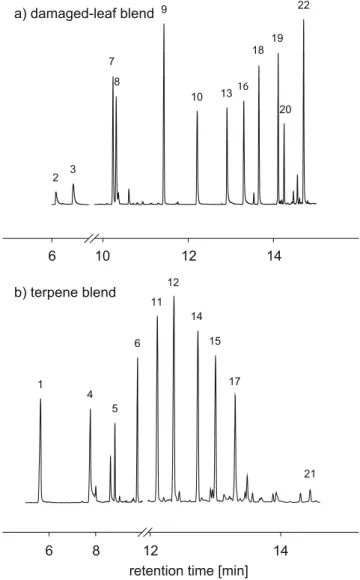
Fig. 1 Representative GC-MS chromatograms obtained by sampling just above the two synthetic blends that were used for the diffusion experiments. a analysis after collection with a 100μm polydimethylsi-loxane SPME fiber of a synthetic mix of typical leaf volatiles. b analysis after collection with a 75μm corboxen™-polydimethylsiloxane SPME fiber of a blend of selected terpenoids. Labeled peaks are as follow: (1) (+)-α-pinene, (2) (E)-2-hexenal, (3) (Z)-3-hexenol, (4) β-myrcene, (5) cis-ocimene, (6) and (9) linalool, (7) β-myrcene, (8) (Z)-3-hexenyl acetate, (10) methyl salicylate, (11) (−)-α-cubebene, (12) (−)-copaene, (13) indole, (14) and (19) EβC, (15) α-humulene, (16) methyl anthranilate, (17) valencene, (18) geranyl acetate, (20) (E)-β-farnesene, (21) caryophyllene oxide and (22) (+/
transfer line 230°C, source 230°C, ionization potential 70eV). The desorbed volatiles were separated on a polar column (HP1-MS, 30m, 0.25mm ID, 0.25μm film; Agilent Technologies, USA) using helium as a carrier gas (constant pressure of 127.9kPa). Following injection, the column temperature was maintained at 40°C for 1min and then increased 20°C min−1 to 250°C, where it was held for another 12min. After the first 30min sampling period, a synthetic mixture of typical caterpillar-induced leaf vola-tiles (0.2μg for each compound) (Turlings and Ton 2006) dissolved in 5μl of pentane (>99%; Acros Organic) (Fig.1a) was injected 3cm into the sand. The injection site was located 0.5cm from the edge of the tray, opposite the fiber insertion site. Measurements with the fiber were done at four distances (1.5, 3, 6, and 10cm) from the injection point, and were replicated 5 times for each distance.
The results of the first experiment prompted an addi-tional similar diffusion test with a blend that mainly comprised terpenoids (Fig. 1b). The set-up was the same as described above except that we sampled only at 10cm from the source and a 75μm Corboxen™-polydimethylsi-loxane SPME fiber was used, because of its higher affinity for terpenes.
Diffusion also was assessed in a standard soil (type 5M, LUFA Speyer, Germany) that was first autoclaved. Experi-ments were conducted with the two synthetic blends described above (Fig. 1) following the same experimental set-ups as for the sand experiments, but sampling was only done at 10cm of the release point.
The effect of moisture level on EβC diffusion was determined by measuring horizontal diffusion of a synthetic version injected at 0.2μg/5μl pentane. Porosity of sand was maintained constant by adding a fixed mass of medium (500g) into the Teflon box. The ratio between sand and water was adjusted to obtain moisture levels of 0%, 1%, 5%, or 10% water.
All experiments were replicated five times. Chromato-grams were analyzed with ChemStation (version D.00.00.38, Agilent Technologies), and peak areas of VOCs were compared with analysis of variance (ANOVA) and t-test. Differences among compounds and humidity levels were determined by using a Bonferroni post hoc test. All analyses were run on SigmaStat (version 2.03, Access Softek Inc.).
Results
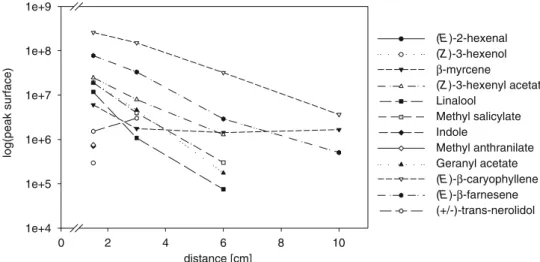
Diffusion of Typical Maize Leaf Volatiles At concentrations of 0.2μg/5μl, the amount and number of VOCs adsorbed onto the SPME fiber decreased drastically with sampling distance (Fig. 2). At 10cm, only three terpenes EβC, β-myrcene, and (E)-β-farnesene were detected (Fig. 3). Of these, EβC diffused best (one-way ANOVA, N = 5, F2,14=
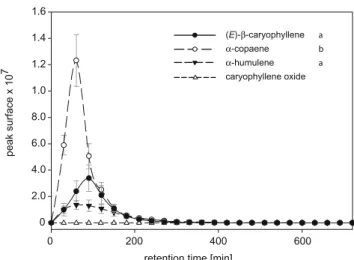
6.95, P = 0.01) and was detected longer after the injection. Diffusion of Terpenoids in Sand All terpenoids, with the exception of caryophyllene oxide diffused readily through sand and were detected 10cm from the source, but the amounts detected were considerably different for the different compounds. Data shown in Fig. 4 include only the four terpenes that are emitted by WCR-damaged maize roots (Rasmann et al.2005). Of these,β-copaene diffused best, followed by EβC, which diffused equally well as the structurally similar α-humulene (one-way ANOVA, N = 5, F2,14= 21.57, P < 0.001). As we did not detect any diffusion
of caryophyllene oxide, we omitted this compound from the statistical analyses.
Diffusion of Terpenes in Soil Differences in how the terpenes diffused in soil were similar to those in sand, but the amount of each chemical recovered at 10cm from the source was considerably lower (Fig. 4). Again,β-copaene
distance [cm] 10 log(peak surface) 1e+4 1e+5 1e+6 1e+7 1e+8 1e+9 (E)-2-hexenal (Z)-3-hexenol β-myrcene (Z)-3-hexenyl acetate Linalool Methyl salicylate Indole Methyl anthranilate Geranyl acetate (E)-β-caryophyllene (E)-β-farnesene (+/-)-trans-nerolidol 0 2 4 6 8
Fig. 2 Diffusion of a synthetic blend along 10cm in a sand medium. VOCs were sampled 1.5, 3, 6, and 10cm from the odor source. Only terpenes were diffused as far as 10cm. All the other compounds were not detected at distances of more than 6cm. Trans-nerolidol, methyl anthranilate and indole were detected only 1.5cm from the source. Detection directly at the release point was not possi-ble because of fiber saturation
diffused better than EβC (t-test, N = 5, P = 0.039). α-Humulene and caryophyllene oxide were not detected in soil.
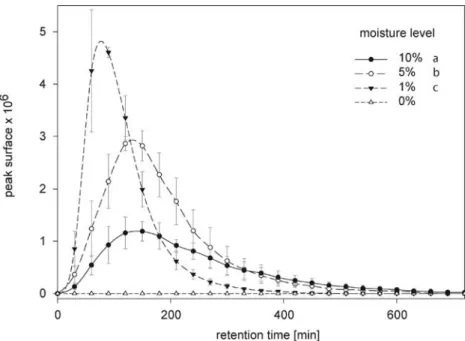
Moisture Level and EβC Diffusion The amount of water present in the sand strongly affected EβC diffusion. An almost twofold larger amount of EβC was detected at a humidity level of 1% than at 10% humidity. However, a water layer is needed to avoid loss by vertical diffusion: no EβC was detected when the sand was completely free of water (Fig.5, one-way ANOVA, N = 5, F2,14= 21.47, P <
0.001). As we did not detect EβC in dry sand, results for this treatment were omitted from the statistical analyses.
Discussion
The results support our hypothesis that EβC is particularly well-suited as a belowground signal because of its diffusion properties. The only other maize-produced compound that diffused better than EβC was α-copaene. All other compounds were consistently detected at lower amounts away from the release point or not detected at all. The limited detection of these other compounds could be explained by early evaporation (vertical diffusion), which is likely to be the case for compounds with low molecular weight (Lowell and Eklund 2004) such as (E)-2-hexanal and (Z)-3-hexanol. Besides vertical diffusion, adsorption onto colloids (polar particles) within the media could slow down or stop both vertical and horizontal diffusion. Although adsorption is expected to be relatively low in sand (Ruiz et al. 1998), silicates on the surface of sand particles, and also the aqueous phase of the medium, could adsorb many of the compounds that were tested. This was evident from a study in which a blend of induced maize volatiles was pushed through a silica-filter, and several of the volatiles that did not diffuse in the current study were found trapped on the filter (D’Alessandro and Turlings 2005). As adsorption does not alter chemical properties, adsorption of VOCs onto static silicates could enhance the establishment of a chemical gradient over a longer period of time (McGechan and Lewis2002), thus allowing EPNs to follow a chemical trail towards potential hosts.
Terpenes were the best diffusing compounds, possibly explaining why WCR-damaged maize roots exude mainly terpenes, even though maize is able to synthesize many other VOCs (Figs. 2 and 4). EβC clearly diffuses better thanα-humulene, the other sesquiterpene released by maize roots, but we detected up to two times moreβ-copaene in retention time [min]
0 200 400 600 0 2.0 4.0 6.0 8.0 1.0 1.2 1.4 1.6 (E)-β -caryophyllene α -copaene α -humulene caryophyllene oxide peak surface x 10 7 a b a
Fig. 3 Diffusion of an authentic terpenoids blend measured at 10 cm from the source. GC-MS peak surfaces of EβC, copaene and α-humulene reached their maximum at 72, 30, and 128 min (mean time) after injection, respectively. Maximum GC-MS peak surfaces differed significantly (one-way ANOVA, N=5, F2,14=6.95, P=0.01). Letters next to the compound names indicate significant differences between compounds (Bonferroni posthoc test)
α -copaene Eβ C α -humulenecaryophyllene oxide α-copaene Eβ C α -humulene caryophyllene oxide 0 4 8 12 16 0 0.04 0.08 0.12 maximal pea k surfa ce (x10 6) in sand in soil a b a b b Fig. 4 Diffusion of terpenoids
in sand and in soil. VOCs were sampled 10 cm from the odor source. In sand,α-copaene diffused significantly better than the other compounds (one-way ANOVA, N=5, F2,14=21.47, P<0.001). The same pattern of diffusion was observed in soil (t-test, N=5, P=0.039). Undetected compounds were excluded from the statistic
sand 10cm from the source than EβC, and this difference was similar in soil (Fig.4, in soil). Thatβ-copaene diffuses better than EβC (Fig. 4) may reflect their respective adsorption strengths onto the substrate. The most likely explanation why roots emit EβC rather than β-copaene as a belowground signal comes from what is known about their respective biosyntheses. While there is much speculation and some disagreement about the evolution and function of VOCs (Firn and Jones 2000; Peñuelas and Llusia 2004; Owen and Penuelas 2005, 2006; Firn and Jones 2006), researchers agree on at least one principle: production of such herbivore-induced plant volatiles can require consid-erable resource investment. It has been reported that some plants may allocate up to 10% of their carbon for the
production of VOCs (Firn and Jones 2006). Considering this potential cost, plants can be expected to have adapted the energetically cheapest solutions. The precursor for the maize sesquiterpenes is the same, farnesyl diphosphate (FPP). When WCR larvae feed on roots, this triggers a cascade of reactions that lead to the production of two different enzymes. The first reacts with FPP to catalyze the production of EβC and α-humulene, and the second reacts with the same precursor, but forms β-copaene and approximately 50 other compounds (T. Köllner, personal communication), (Fig. 6). Because of the production of these additional compounds, a plant produces nine times more EβC than β-copaene with the same number of FPP molecules. Hence, even if EβC diffusion is half as
Mevalonate Farnesyl diphosphate FPP Acetyl-CoA 3-hydroxy-3-methylglutaryl-CoA HMG-CoA Eβ C (90%) α -humulene (10%) α-copaene (8%) other (92%) α -copaene synthesis Eβ C synthesis
Fig. 6 Schematic model of the metabolic pathway for EβC synthesis. When WCR larvae feed on roots this triggers a cascade of reactions resulting in the production of two different enzymes that lead to two sepa-rate pathways of volatile syn-thesis. The ratio in which the volatiles are produced from these pathways implies a much more cost-effective production of EβC than of β-copaene (T. Köllner, personal communication)
Fig. 5 Diffusion of EβC under different moisture levels measured at 10 cm from the source. Peak surfaces of EβC with 1%, 5%, and 10% of water in sand reached their maximum at 80, 140, and 160 min after injec-tion, respectively. Diffusion velocity tended to increase with lower mois-ture levels, but there was no statistical difference among the three moisture levels (data not shown) (one-way ANOVA, N=5, F2,14=2.17, P=0.19). Maximum GC-MS peak surfaces differed significantly (one-way ANOVA, N=5, F2,14=21.47, P<0.001). Letters indicate signifi-cant differences between compounds (Bonferroni post hoc test). As no diffusion was detected in dry sand (0%), it was excluded from the statistical analyses
efficient asβ-copaene, the fact that it is far less expensive for the plant to produce should counterbalance this difference.
The moisture level of the substrate strongly affected EβC diffusion (Fig. 5). The detected abundance and the velocity of horizontal diffusion were negatively correlated with the water volume present in the sand. Porosity was maintained constant. Therefore, the addition of water reduced the gaseous phase volume. Thus, the results confirm the notion that the diffusion of EβC occurs in the gaseous phase, which was expected because of its poor solubility in water. Low moisture levels enhance horizontal diffusion of EβC, but a complete lack of water dramatically reduces it. This is best explained by a need for a thin layer of water to avoid quick vertical evaporation of the sesquiterpene.
EβC is a common compound and has been identified from various plant species (e.g., Rodriguez-Saona et al. 2001; Tholl et al. 2005; Calyecac-Cortero et al. 2007; Cheng et al.2007; Helmig et al.2007). Its function, as for most plant volatiles, remains unclear. Sesquiterpenes in general may have anti-microbial or insecticidal effects (e.g., Erasto et al.2006; Liu et al.2006; Sabulal et al.2006; Ji et al. 2007), but at the dose emitted by maize roots it is unlikely to be effective against insects (Rasmann et al. 2005). Interestingly, EβC is also emitted from maize silk and has been implicated in the attraction of adult Diabrotica beetles (Hammack2001), but recent behavioral assays suggest that other plant compounds are considerably more important for adult attraction (Tòth et al. 2007). Belowground sesquiterpenes (strigolactone) also have been found to play a role in the symbiosis between roots and arbuscular mycorrhiza as fungi branching factor (Akiyama et al. 2005) and in germination of Striga, Alectra, and Orobanche species (Butler1995). Hence, it is important to stress that multiple functions and modes of selection for EβC or other sesquiterpenes must be considered. The recently identified sequiterpene-synthase gene TPS23, which is responsible for EβC production in maize (Köllner et al.2008), was found to be highly conserved, implying an important function for the plant. There is little information about herbivore-induced root volatiles from other plants. A comparison among the emissions from maize, cotton, and cowpea roots in response to feeding by Diabrotica balteata larvae has revealed the typical release of EβC by maize roots, a more complex mixture of terpenoids emitted from cotton roots, including α-copaene, but no detectable amounts of EβC, whereas no volatiles were detected from attacked cowpea roots (Rasmann and Turlings 2008). Nematodes are most attracted to damaged maize roots and far less to damaged cowpea roots (Rasmann and Turlings 2008), which is in accordance with an important role for EβC in the attraction.
This study set out to explain why the induced emission of volatiles in maize roots is basically limited to just one dominant sesquiterpene, EβC. The hypothesized explana-tion that this compound would be particularly suited as a belowground signal because of its diffusion properties was confirmed. The only maize-produced compound that appeared to be even better at diffusing in the substrates tested was β-copaene, another sesquiterpene. A plausible reason why the plant has evolved to emit EβC is that β-copaene is more costly to produce. Given the logic behind these explanations, we should perhaps now turn the question around and wonder why the leaves emit such complex blends if they could be so much simpler.
Acknowledgments We thank all the members of the E-vol lab at the University of Neuchâtel for their support, in particular Matthias Held, Russell E. Naisbit, and Sarah Kenyon. We also thank Jean-Michel Gobat for advice on the experimental design, Violaine Jourdie for stimulating discussions and Marie-Eve Wyniger for assistance with the chemical analyses. This project was funded by the Swiss Confederation’s innovation promotion agency (CTI project no. 7487.1 LSPP-LS).
References
AGRAWAL, A. A., and RUTTER, M. T. 1998. Dynamic anti-herbivore defense in ant-plants: the role of induced responses. Oikos 83:227–236.
AGRAWAL, A. A. 1998. Induced responses to herbivory and increased plant performance. Science 29:1201–1202.
AKIYAMA, K., MATSUZAKI, K., and HAYASHI, H. 2005. Plant sesquiterpenes induce hyphal branching in arbuscular mycorrhizal fungi. Nature 435:824–827.
ARATCHIGE, N. S., LESNA, I., and SABELIS, M. W. 2004. Below-ground plant parts emit herbivore-induced volatiles: olfactory responses of a predatory mite to tulip bulbs infested by rust mites. Exper. Appl. Acarology 33:21–30.
BALDWIN, I. T., and PRESTON, C. A. 1999. The eco-physiological complexity of plant responses to insect herbivores. Planta 208:137–145.
BERNASCONI, M. L., TURLINGS, T. C. J., AMBROSETTI, L., BASSETTI, P., and DORN, S. 1998. Herbivore-induced emissions of maize volatiles repel the corn leaf aphid, Rhopalosiphum maidis. Entomol. Exp. Appl. 87:133–142.
BERTIN, C., YANG, X., and WESTON, L. A. 2003. The role of root exudates and allelochemicals in the rhizosphere. Plant Soil 256:67–83.
BOFF, M. I. C., ZOON, F. C., and SMITS, P. H. 2001. Orientation of Heterorhabditis megidis to insect hosts and plant roots in a Y-tube sand olfactometer. Entomol. Exp. Appl. 98:329–337. BURNELL, A. M., and STOCK, S. P. 2000. Heterorhabditis, Steinernema
and their bacterial symbionts—lethal pathogens of insects. Nematology 2:31–42.
BUTLER, L. G. 1995. Chemical communication between the parasitic weed Striga and its crop host—a new dimension in allelochem-istry. pp. 158–168, in KINDERJIT , and FAEINHELLIG (eds.). Insights into Allelopathy, ACS Symposium SeriesACS Books, Washington, DC.
CALYECAC-CORTERO, H. G., CIBRIAN-TOVAR, J., SOTO-HERNANDEZ, M., and GARCIA-VELASCO, R. 2007. Isolation and identification
of Physalis philadelphica Lam. volatiles. Agrociencia 41:337– 346.
CHENG, A. X., XIANG, C. Y., LI, J. X., YANG, C. Q., HU, W. L., WANG, L. J., LOU, Y. G., and CHEN, X. Y. 2007. The rice (E)-beta-caryophyllene synthase (OsTPS3) accounts for the major inducible volatile sesquiterpenes. Phytochemistry 68:1632–1641. D’ALESSANDRO, M., and TURLINGS, T. C. J. 2005. In Situ modification of herbivore-induced plant odors: a novel approach to study the attractiveness of volatile organic compounds to parasitic wasps. Chem. Senses 30:739–753.
DEGEN, T., DILLMANN, C., MARION-POLL, F., and TURLINGS, T. C. J. 2004. High genetic variability of herbivore-induced volatile emission within a broad range of maize inbred lines. Plant Physiol. 135:1928–1938.
DE, MORAES, C. M., LEWIS, W. J., PARE, P. W., ALBORN, H. T., and TUMLINSON, J. H. 1998. Herbivore-infested plants selectively attract parasitoids. Nature 393:570–573.
DICKE, M., and SABELIS, M. W. 1988. How plants obtain predatory mites as bodyguards. Neth. J. Zool. 38:148–165.
DICKE, M., and HILKER, M. 2003. Induced plant defences: from molecular biology to evolutionary ecology. Basic Appl. Ecol. 4:3–14.
DICKE, M., VAN POECKE, R. M. P., and DE BOER, J. G. 2003. Inducible indirect defence of plants: from mechanisms to ecological functions. Basic Appl. Ecol. 4:27–42.
ERASTO, P., GRIERSON, D. S., and AFOLAYAN, A. J. 2006. Bioactive sesquiterpene lactones from the leaves of Vernonia amygdalina. J. Ethnopharmacol. 106:117–120.
FIRN, R. D., and JONES, C. G. 2000. The evolution of secondary metabolism - a unifying model. Mol. Microbiol. 37:989–994. FIRN, R. D., and JONES, C. G. 2006. Do we need a new hypothesis to
explain plant VOC emissions? Trends Plant. Sci. 11:112–113. FORST, S., and NEALSON, K. 1996. Molecular biology of the symbiotic
pathogenic bacteria Xenorhabdus spp and Photorhabdus spp. Microbiol. Rev. 60:21–43.
GAUGLER, R., LEWIS, E., and STUART, R. J. 1997. Ecology in the service of biological control: The case of entomopathogenic nematodes. Oecologia 109:483–489.
GORECKI, T., and NAMIESNIK, J. 2002. Passive sampling. Trends Analyt. Chem. 21:276–291.
HAMMACK, L. 2001. Single and blended maize volatiles as attractants for diabroticite corn rootworm beetles. J. Chem. Ecol. 27:1373– 1390.
HELMIG, D., ORTEGA, J., DUHL, T., TANNER, D., GUENTHER, A., HARLEY, P., WIEDINMYER, C., MILFORD, J., and SAKULYANONTVITTAY, T. 2007. Sesquiterpene emissions from pine trees - Identifications, emission rates and flux estimates for the contiguous United States. Environ. Sci. Technol. 41:1545–1553.
JACKSON, J. J. 1996. Field performance of entomopathogenic nematodes for suppression of western corn rootworm (Coleoptera: Chrysomelidae). J. Econ. Entomol. 89:366–372.
JI, Z. Q., WU, W. J., YANG, H., SHI, B. J., and WANG, M. G. 2007. Four novel insecticidal sesquiterpene esters from Celastrus angulatus. Nat. Prod. Res. 21:334–342.
JOURNEY, A. M., and OSTLIE, K. R. 2000. Biological control of the western corn rootworm (Coleoptera: Chrysomelidae) using the entomopathogenic nematodes, Steinernema carpocapsae. Environ. Entomol. 29:822–831.
KARBAN, R., AGRAWAL, A. A., and MANGEL, M. 1997. The benefits of induced defenses against herbivores. Ecology 78:1351–1355.
KARBAN, R., and BALDWIN, I. 1997. Induced Responses to Herbivory. University Press of Chicago, Chicago.
KESSLER, A., and BALDWIN, I. T. 2001. Defensive function of herbivore-induced plant volatile emissions in nature. Science 291:2141–2144.
KÖLLNER, T., HELD, M., LENK, C., HILTPOLD, I., TURLINGS, T. C. J., GERSGENZON, J., and DEGENHARDT, J. 2008. A maize (E)- β-caryophyllene synthase implicated in indirect defense responses against herbivores is not expressed in most American maize varieties. Plant Cell 20:482–494.
KOZIEL, J., JIA, M. Y., and PAWLISZYN, J. 2000. Air sampling with porous solid-phase microextraction fibers. Anal. Chem. 72:5178– 5186.
KUHLMANN, U., and van der BURGT, W. A. C. M. 1998. Possibilities for biological control of the western corn rootworm, Diabrotica virgifera virgifera LeConte, in Central Europe. Biocontrol 19:59N–68N.
LEVINE, E., OLOUMI, S. H., and FISHER, J. R. 1992. Discovery of multiyear diapause in Illinois and South Dakota northern corn rootworm (Coleoptera: Chrysomelidae) eggs and incidence of the prolonged diapause trait in Illinois. J. Econ. Entomol. 85:262– 267.
LIU, C. H., MISHRA, A. K., and TAN, R. X. 2006. Repellent, insecticidal and phytotoxic activities of isoalantolactone from Inula racemosa. Crop Prot. 25:508–511.
LOWELL, P. S., and EKLUND, B. 2004. VOC emission fluxes as a function of lateral distance from the source. Environ. Prog. 23:52–58.
MCCOY, C. W., STUART, R. J., DUNCAN, L. W., and NGUYEN, K. 2002. Field efficacy of two commercial preparations of entomo-pathogenic nematodes against larvae of Diaprepes abbreviatus (Coleoptera: Curculionidae) in ALFISOL type soil. Fla. Entomol. 85:537–544.
MCGECHAN, M. B., and LEWIS, D. R. 2002. Transport of particulate and colloid-sorbed contaminants through soil, part 1: General principles. Biosystems Engineering 83:255–273.
MILLER, N., ESTOUP, A., TOEPFER, S., BOURGUET, D., LAPCHIN, L., DERRIDJ, S., KIM, K. S., REYNAUD, P., FURLAN, L., and GUILLEMAUD, T. 2005. Multiple transatlantic introductions of the western corn rootworm. Science 310:992–992.
NEVEU, N., GRANDGIRARD, J., NENON, J. P., and CORTESERO, A. M. 2002. Systemic release of herbivore-induced plant volatiles by turnips infested by concealed root-feeding larvae Delia radicum L. J. Chem. Ecol. 28:1717–1732.
O’NEIL, M. E., DIFONZO, C. D., and LANDIS, D. A. 2002. Western corn rootworm (Coleptera: Chrysomelidae) feeding on corn and soybean leaves affected by corn phenology. J. Econ. Entomol. 31:285–292.
OWEN, S. M., and PEÑUELAS, J. 2005. Opportunistic emissions of volatile isoprenoids. Trends Plant Sci. 10:420–426.
OWEN, S. M., and PENUELAS, J. 2006. Response to Firn and Jones: Volatile isoprenoids, a special case of secondary metabolism. Trends Plant Sci 11:113–114.
PEÑUELAS, J., and LLUSIÀ, J. 2004. Plant VOC emissions: making use of the unavoidable. Trends Ecol. Evol. 19:402–404.
RASMANN, S., KÖLLNER, T. G., DEGENHARDT, J., HILTPOLD, I., TOEPFER, S., KUHLMANN, U., GERSHENZON, J., and TURLINGS, T. C. J. 2005. Recruitment of entomopathogenic nematodes by insect-damaged maize roots. Nature 434:732–737.
RASMANN, S., and TURLINGS, T. C. J. 2008. First insights into specificity of belowground tritrophic interactions. Oikos 117:362–369.
RODRIGUEZ-SAONA, C., CRAFTS-BRANDER, S. J., PARE, P. W., and HENNEBERRY, T. J. 2001. Exogenous methyl jasmonate induces volatile emissions in cotton plants. J. Chem. Ecol. 27:679–695. RUIZ, J., BOLBAO, R., and MURILLO, M. B. 1998. Adsorption of
different VOC onto soil minerals from gas phase: Influence of mineral, type of VOC, and air humidity. Environ. Sci. Technol. 32:1079–1084.
SABULAL, B., DAN, M., ANIL, J. J., KURUP, R., PRADEEP, N. S., VALSAMMA, R. K., and GEORGE, V. 2006. Caryophyllene-rich
rhizome oil of Zingiber nimmonii from South India: Chemical characterization and antimicrobial activity. Phytochemistry 67:2469–2473.
SCHOONHOVEN, L. M., JERMY, T., and VAN, LOON, J. J. A. 1998. Insect-Plant Biology: From Physiology to Evolution. Chapman and Hall, New York.
THALER, J. S. 1999. Jasmonate-inducible plant defences cause increased parasitism of herbivores. Nature 399:686–688. THOLL, D., CCHEN, F., PETRI, J., GERSHENZON, J., and PICHERSKY, E.
2005. Two sesquiterpene synthases are responsible for the complex mixture of sesquiterpenes emitted from Arabidopsis flowers. Plant J. 42:757–771.
TOEPFER, S., and KUHLMANN, U. 2004. Survey for natural enemies of the invasive alien chrysomelid, Diabrotica virgifera virgifera, in Central Europe. Biocontrol 49:385–395.
TOLLEFSON, J. J. 1998. A pest insect adapts to the cultural control of crop rotation; Brighton Crop Protection Conference. Pests and Diseases 3:1029–1033.
TÒTH, M., VUTS, J., SZARUKÁN, I., JUHÁSZ, I., and MANAJLOVICS, F. 2007. Preliminary study of female-targeted semiochemical baits for the western corn rootworm in Europe. J. Appl. Entomol. 131:416–419.
TURLINGS, T. C. J., LOUGHRIN, J. H., MCCALL, P. J., RÖSE, U. S. R., LEWIS, W. J., and TUMLINSON, J. H. 1995. How caterpillar-damaged plants protect themselves by attracting parsitic wasps. Proc. Natl. Acad. Sci. USA 92:4169–4174.
TURLINGS, T. C. J., and TON, J. 2006. Exploiting scents of distress: the prospect of manipulating herbivore-induced plant odours to enhance the control of agricultural pests. Curr. Opin.Plant Biol. 9:421–427.
TURLINGS, T. C. J., and WACKER, F. 2004. Recruitment of predators and parasitoids by herbivore injured-plants.. pp. 21–75, in R. T. CARDÉ, and J. G.MILLAR(eds.). Advances in Insect Chemical EcologyCambridge University Press, Cambridge.
VAN TOL, R. W. H. M., VANDERSOMMEN, A. T. C., BOFF, M. I. C., VANBEZOOIJEN, J., SABELIS, M. W., and SMITS, P. H. 2001. Plants protect their roots by alerting the enemies of grubs. Ecology Lett. 4:292–294.
VAS, G., and VEKEY, K. 2004. Solid-phase microextraction: a powerful sample preparation tool prior to mass spectrometric analysis. J. Mass Spectrom. 39:233–254.
VIDAL, S., KUHLMANN, U., and EDWARDS, R. 2005. Western Corn Rootworm: Ecology and Management. p. 324. CABI, Wallingford, United Kingdom.