Publisher’s version / Version de l'éditeur:
Vous avez des questions? Nous pouvons vous aider. Pour communiquer directement avec un auteur, consultez la
première page de la revue dans laquelle son article a été publié afin de trouver ses coordonnées. Si vous n’arrivez
pas à les repérer, communiquez avec nous à [email protected].
Questions? Contact the NRC Publications Archive team at
[email protected]. If you wish to email the authors directly, please see the
first page of the publication for their contact information.
https://publications-cnrc.canada.ca/fra/droits
L’accès à ce site Web et l’utilisation de son contenu sont assujettis aux conditions présentées dans le site
LISEZ CES CONDITIONS ATTENTIVEMENT AVANT D’UTILISER CE SITE WEB.
Proceedings of the Third International Offshore Mechanics and Arctic Engineering
Symposium, 3, pp. 145-149, 1984-02-12
READ THESE TERMS AND CONDITIONS CAREFULLY BEFORE USING THIS WEBSITE.
https://nrc-publications.canada.ca/eng/copyright
NRC Publications Archive Record / Notice des Archives des publications du CNRC :
https://nrc-publications.canada.ca/eng/view/object/?id=78161f64-932d-4bf2-b403-50a97ece3167
https://publications-cnrc.canada.ca/fra/voir/objet/?id=78161f64-932d-4bf2-b403-50a97ece3167
NRC Publications Archive
Archives des publications du CNRC
This publication could be one of several versions: author’s original, accepted manuscript or the publisher’s version. /
La version de cette publication peut être l’une des suivantes : la version prépublication de l’auteur, la version
acceptée du manuscrit ou la version de l’éditeur.
Access and use of this website and the material on it are subject to the Terms and Conditions set forth at
Compressive behavior of Beaufort Sea ice under vertical and horizontal
loading
Ser
TH1
1ng.
1-1-92
1
31.
National Research
Conseil national
C .
2
Council Canada
de recherches Canada
B r n
1+-_-
-->
COMPRESSIVE BEHAVIOR OF BEAUFORT SEA ICE UNDER
VERTICAL AND HORIZONTAL LOADING
by
R.M.W. Frederking and G.W.
Timco
ANALYZED
'- I
Reprinted from
Proceedings of the Third International Offshore Mechanics
and Arctic Engineering Symposium, Volume 11
1, 1984
p. 145
-
149
L I B R A R Y
DBR Paper No. 1192
Division of Building Research
Le p r e s e n t r a p p o r t f a i t B t a t d ' e x p e r i e n c e s s u r l e t e r r a i n
e f f e c t u ' e e s s u r d e s k c h a n t i l l o n s c y l i n d r i q u e s e t p r i s m a t i q u e s
o r i e n t b p a r a l l e l e m e n t e t p e r p e n d i c u l a i r e m e n t
1 l a couche d e
g l a c e .
Ona f a i t v a r i e r l a v i t e s s e d e deformation d e
2 x 10⁵ s-11
5
x s-l;l a c h a r g e
e t l a d'eformation e t a i e n t
c o n t r a l ' e e s d e f q o n continue.
La r e s i s t a n c e d e s B c h a n t i l l o n s
v e r t i c a u x d e g l a c e columnaire 6 t a i t e n v i r o n t r o i s f o i s p l u s
grande que c e l l e d e s B c h a n t i l l o n s h o r i z o n t a w .
Pour l e s deux
6 c h a n t i l l o n s , l a r b i s t a n c e augmentait d e l a mSme £%on l o r s q u e
l a v i t e s s e d e d d f o r m a t i o n a u g m e n t a i t .
P a r c o n t r e , l a
ddformation a u p o i n t d e r u p t u r e d t a i t s i m i l a i r e pour l e s d e w
o r i e n t a t i o n s
e t
n e d e p e n d a i t p a s d e l a v i t e s s e d e d s o r m a t i o n .
La r i g i d i t ' e du s y s t b e d ' e s s a i a 8tB mesur*& e t une t e c h n i q u e
d e p r g v i s i o n d e s d e f o r m a t i o n s e s t d d c r i t e .
On
s e s e r t d e s
v a l e u r s mesur'ees d e l a r ' e s i s t a n c e u n i a x i a l e pour p r s v o i r l a
r e s i s t a n c e dans l e c a s d'une c h a r g e a p p l i q u k e s o u s 6 t r e i n t e .
COMPRESSIVE BEHAVIOR OF BEAUFORT SEA ICE UNDER VERTICAL AND HORIZONTAL LOADING
R. M. W. Fredgrking Division of Building Research
G. W. Timw
Division of Mechanical Engineering National Research Council Canada
Onawa. Ontario. Canada
ABSTRACT
F i e l d e x p e r i m e n t s on c y l i n d r i c a l and p r i s m o i d a l specimens o r i e n t e d i n t h e p l a n e of t h e i c e c o v e r and p e r p e n d i c u l a r t o i t a r e r e p o r t e d . Nominal s t r a i n r a t e was v a r i e d from 2 x l o m 5 s - I t o 5 x s-I; b o t h l o a d and s t r a i n were monitored c o n t i n u o u s l y . The s t r e n g t h of v e r t i c a l specimens of u n a l i g n e d c o l u m n a r g r a i n e d i c e was about t h r e e t i m e s t h a t of h o r i z o n t a l specimens. Both o r i e n t a t i o n s showed s i m i l a r i n c r e a s e i n s t r e n g t h w i t h i n c r e a s i n g s t r a i n r a t e . On t h e o t h e r hand, s t r a i n a t y i e l d f o r b o t h specimen o r i e n t a t i o n s was s i m i l a r and showed no dependence on s t r a i n r a t e . T e s t s y s t e m s t i f f n e s s was measured and a t e c h n i q u e f o r p r e d i c t i n g s t r a i n s i s d e s c r i b e d . The measured u n i a x i a l s t r e n g t h r e s u l t s a r e u s e d t o p r e d i c t s t r e n g t h u n d e r t h e c o n f i n e d l o a d i n g c o n d i t i o n . INTRODUCTION Knowledge of t h e mechanical p r o p e r t i e s of s e a i c e p r o v i d e s a b a s i s f o r e s t i m a t i n g d e s i g n i c e l o a d s on o f f s h o r e s t r u c t u r e s . When a n i c e c o v e r impinges on any s t r u c t u r e a complex s t r e s s f i e l d i s s e t u p w i t h i n t h e i c e , s o t h a t a f a i l u r e c r i t e r i o n f o r i c e under m u l t i - a x i a l l o a d i n g i s e s s e n t i a l . R a l s t o n
(1)
and R e i n i k e(2)
have d e m o n s t r a t e d t h e a p p l i c a t i o n of a f a i l u r e c r i t e r i o n , t o g e t h e r w i t h p l a s t i c i t y t h e o r y , t o t h e e s t i m a t i o n of i c e l o a d s f o r p a r t i c u l a r c o n d i t i o n s . More r e c e n t l y , Timco and F r e d e r k i n g(3,
6 )
have determined s t r e n g t h f o r c o n f i n e d compression of b o t h c o l u m n a r g r a i n e d and g r a n u l a r s e a i c e and have e v a l u a t e d t h e c o r r e s p o n d i n g f a i l u r e c r i t e r i a . E v a l u a t i n g a f a i l u r e c r i t e r i o n g e n e r a l l y r e q u i r e s u n i a x i a l s t r e n g t h d a t a f o r specimens o r i e n t ' e d i n s e v e r a l d i r e c t i o n s i n t h e i c e c o v e r a s w e l l a s s t r e n g t h d a t a from b i a x i a l l o a d i n g . Only l i m i t e d b i a x i a l l o a d i n g d a t a a r e a v a i l a b l e , however, b e c a u s e of t h e e x p e r i m e n t a l d i f f i c u l t i e s of performing s u c h t e s t s . As a f i r s t a p p r o x i m a t i o n u n i a x i a l compressive t e s t s on v e r t i c a l and h o r i z o n t a l specimens can g i v e some i n d i c a t i o n of e x p e c t e d m l t i - a x i a l s t r e n g t h . T e s t r e s u l t s of s t r e n g t h a s a f u n c t i o n of s t r a i n r a t e f o r v e r t i c a l and h o r i z o n t a l specimens of f i r s t - y e a r s e a i c ew i l l b e p r e s e n t e d and a p p l i e d t o a n e s t i m a t i o n of t h e c o n f i n e d compressive s t r e n g t h .
The mechanical p r o p e r t i e s measured a r e a f u n c t i o n of b o t h t h e t e s t i n g methods and t h e m a t e r i a l
c h a r a c t e r i s t i c s of t h e i c e . Two d i f f e r e n t l o a d i n g systems and specimen c o n f i g u r a t i o n s were u s e d , t h e b e t t e r t o d e f i n e t h e i r e f f e c t on measured s t r e n g t h p r o p e r t i e s . Loading s y s t e m s t i f f n e s s was measured i n b o t h c a s e s . A t e c h n i q u e f o r e s t i m a t i n g specimen s t r a i n from t h e load-time h i s t o r y of t h e specimen and t h e l o a d i n g s y s t e m s t i f f n e s s w i l l b e p r e s e n t e d .
SPECIMEN ACQUISITION AND PREPARATION
During a f i e l d t r i p t o t h e B e a u f o r t Sea, 3-6 May 1982, a number of b l o c k s and v e r t i c a l a n d h o r i z o n t a l c o r e s were c u t from a l a r g e r a f t e d p i e c e of i c e i n t h e r u b b l e f i e l d a b o u t 40 rn w e s t of T a r s i u t I s l a n d , a c a i s s o n - r e t a i n e d i s l a n d i n t h e B e a u f o r t Sea. Daytime maximum a i r t e m p e r a t u r e s were -5OC. The samples were packed i n p l a s t i c bags and c a r d b o a r d boxes and flown by h e l i c o p t e r t o Tuktoyaktuk, where t h e y were t a k e n t o a s m a l l l a b o r a t o r y and s t o r e d a t a t e m p e r a t u r e of - l l ° C f 1°C.
Both p r i s m o i d a l and c y l i n d r i c a l specimens w e r e made. The c y l i n d r i c a l ones were p r e p a r e d by c u t t i n g t h e c o r e samples t o p a r t i c u l a r l e n g t h s . They had
a
d i a m e t e r of 75 mm and p r e f e r r e d l e n g t h of 250 mm, b u t some s h o r t e r specimens were c u t t o t a k e a d v a n t a g e of t h e a v a i l a b l e p i e c e s of c o r e . The h o r i z o n t a l c o r e samples ( l o n g a x i s p a r a l l e l t o t h e i c e s u r f a c e ) were t a k e n a t a d e p t h of 0.55 m, where t h e g r a i n s t r u c t u r e was columnar. T h i n s e c t i o n s of t h e s e c o r e s s h a v e d t h a t t h e i c e had random c-axis o r i e n t a t i o n i n t h e h o r i z o n t a l p l a n e , i . e . u n a l i g n e d columnar g r a i n s , and a n a v e r a g e g r a i n s i z e of 3-
5 mm. The v e r t i c a l c y l i n d r i c a l specimens were o b t a i n e d from v e r t i c a l c o r e s ( l o n g a x i s p e r p e n d i c u l a r t o i c e s u r f a c e ) and comprised e i t h e r g r a n u l a r o r c o l u m n a r g r a i n e d i c e , depending on t h e d e p t h from which t h e y were t a k e n i n t h e i c e cover. T h i n s e c t i o n s of t h e g r a n u l a r i c e s h a v e d t h a t i t had random c-axis o r i e n t a t i o n and g r a i n s i z e r a n g i n g from 1-
2 mm. P r i s m o i d a l specimens were c u t from t h e b l o c k samples w i t h a band saw t o nominal dimensions of 190 mmlong, 100 mm wide, and 60 mm t h i c k . The l o n g a x i s of t h e v e r t i c a l specimens was p e r p e n d i c u l a r t o t h e i c e s u r f a c e and t h e l o n g a x i s of t h e h o r i z o n t a l specimens p a r a l l e l t o it. The p r i s m specimens were from a d e p t h of 0.45
-
0.65 m and were u n a l i g n e d columnar g r a i n e d . TEST PROCEDUREA m o t o r i z e d , 60 kN c a p a c i t y , s c r e w - d r i v e compression t e s t machine ( T r i - T e s t 50) was u s e d f o r t e s t i n g . A c t u a t o r r a t ; s were s e l e c t e d i n t h e range 0.2 t o 5 mm/min, p r o d u c i n g nominal s t r a i n r a t e s i n t h e range 2 x t o 5 x s'l. "Maraset" c o m p l i a n t p l a t e n s were u s e d t o e l i m i n a t e t h e e f f e c t of i r r e g u l a r i t i e s and reduce r a d i a l s t r e s s e s a t t h e e n d s of t h e c y l i n d r i c a l specimens. F o r t h e c y l i n d r i c a l specimens t h e ends were c u t w i t h t h e band saw, w i t h no f u r t h e r end p r e p a r a t i o n ; two e x t e n s o m e t e r s were f i t t e d d i r e c t l y t o e a c h specimen and t h e o u t p u t a v e r a g e d f o r s t r a i n . The p r i s m o i d a l specimens w e r e l o a d e d between s t e e l p l a t e n s and t h e i r ends f i n i s h e d w i t h f i n e emery p a p e r t o p r o v i d e a f l a t s u r f a c e ; s t r a i n s were n o t measured.
Loading was monotonic t o y i e l d , when t h e specimen was unloaded. T y p i c a l s t r e s s - t i m e and s t r a i n - t i m e c u r v e s from v e r t i c a l and h o r i z o n t a l c y l i n d r i c a l and p r i s m o i d a l specimens under a nominal s t r a i n r a t e of
2 x s-I a r e p r e s e n t e d i n F i g . 1. I n a l l c a s e s t h e f a i l u r e mode was d u c t i l e . D e f i n i t i o n s of y i e l d s t r e s s , oy, time t o y i e t d , t f , s t r a i n a t y i e l d , cy, and s t r a i n r a t e a t y i e l d ,
5 ,
a r e a l s o shown. Average s t r e s s r a t e ,kv,
i s a y / t f , and nominal s t r a i n r a t e ,,,
i snominal machine s p e e d d i v i d e d by specimen l e n g t a . T e s t i n g was done a t a t e m p e r a t u r e of - l l ° C f 1°C. Specimen s a l i n i t y v a r i e d f r o m 3.2 t o 4.5 X O , w i t h a n a v e r a g e of 4
X O .
TEST RESULTS AND DISCUSSION
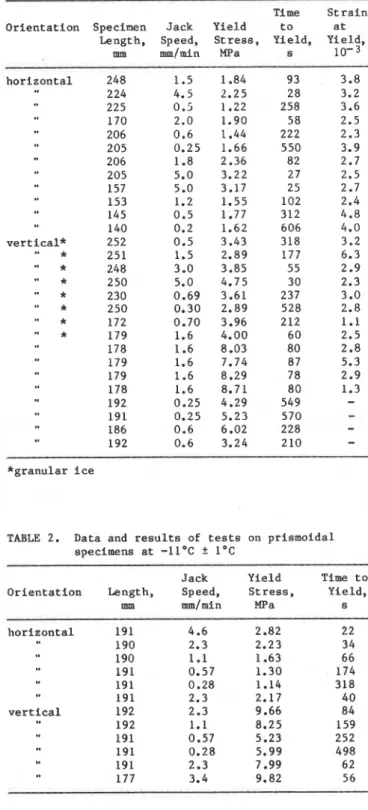
Complete t e s t r e s u l t s a r e t a b u l a t e d i n T a b l e s 1 and 2 f o r c y l i n d r i c a l and p r i s m o i d a l specimens,
r e s p e c t i v e l y . S t r e n g t h v e r s u s a v e r a g e s t r e s s r a t e f o r a l l t h e t e s t s i s p l o t t e d i n Fig. 2. The r e s u l t s f a l l i n t o t h r e e c a t e g o r i e s : one f o r t h e h o r i z o n t a l specimens of columnar-grained i c e , t h e second f o r v e r t i c a l specimens of g r a n u l a r i c e , and t h e t h i r d f o r v e r t i c a l specimens of columnar-grained i c e . C l e a r l y t h e v e r t i c a l l y o r i e n t e d specimens of u n a l i g n e d columnar-grained i c e a r e a b o u t t h r e e t i m e s s t r o n g e r t h a n t h e h o r i z o n t a l specimens, s i m i l a r t o t h e e a r l i e r f i n d i n g s of Peyton
(2).
T h i s c a n b e r e l a t e d t o t h e columnar-grain s t r u c t u r e of t h e i c e , i n which t h e l o n g a x i s of t h e columnar g r a i n s i s p a r a l l e l t o t h e l o n g a x i s of t h e v e r t i c a l specimen. Compared on a s t r e s s r a t e b a s i s , t h e r e i s no s i g n i f i c a n t d i f f e r e n c e between t h e s t r e n g t h of p r i s m o i d a l specimens t e s t e d on s t e e l p l a t e n s and t h a t of c y l i n d r i c a l specimens t e s t e d o n compliant p l a t e n s . T h i s s u g g e s t s t h a t f o r f i e l d t e s t s average stress r a t e c a n be u s e d a e a n i n d e p e n d e n t variable t o compensate f o r d i f f e r e n c e 8 i n the stiffnessof t h e l o d d i n g aystem. bs mentioned e a r l i e r ,
a
numberof
t h e v e r t i c a l specimens comprised g r a n u l a r s e a ice, and r e s u l t s f r o m t h e s e are also i n c l u d e d i n t h e p l o t .They f a l l a p p r o x i m a t e l y midway between t h e results f o r
v e r t i c a l a n d h o r i z o n t a l columnargraFned specimens.
Also p l o t r e d is t h e r e g r e s s i o n l i n e f o r t h e f i t of a
power l a w t o strength r e ~ u l t a
f o r
horizontal specimens of g r a n u l a r ice(53.
There i s v e r y l i t t l e d i f f e r e n c e i n s t r e n g t hf o r
v e r t i c a l and h o r i z o n t a l epecimenaof
g r a n u l a rice.
Given t h e e q u i a x i a l g r a i n s t r u c t u r e a n d t h e n e a ~ r a n d o m o r i e n t a t i o n o f the symmetry a x i s o f t h e g r a i n s , t h i s is t o be e x p e c t e d ,----
VERTICAL SPECIMEN q --
-
HORIZONTAL S P E C I M N vy 8-
/,+--
-
7-
-
/ 6-
-
5-
-
4-
/-
fi
3 - / /-
( a 1 2-
/ u~ - 1-
-
6-
1
?
-I
0 50 100 T I M E , s F i g u r e 1. S t r e s s - t i m e and s t r a i n - t i m e c u r v e s f o r v e r t i c a l and h o r i z o n t a l c y l i n d r i c a l specimens of columnar-grained i c e ;c
= z X 1 o - 4 , nom t e s t t e m p e r a t u r e =-
l l ° C f 1°C;iyv
= 1.1 x s-I ( v e r t i c a l specimen)E~~ = 1.0 x s - I ( h o r i z o n t a l specimen) 20 r ' " I I
'
' l " r ' l I I VERTICAL HORIZONTAL---
• -0 CYLINDER -+ ---a P R I S M z- C 0 Zz
5 -___---
+ VI a 0 u 0,002 l 0.005 0.01 0.02 0.05 0.1 0.2 0.5 A V E R A G E S T R E S S R A T E . M P a s-' F i g u r e 2. S t r e n g t h of v e r t i c a l and h o r i z o n t a l specimens of c o l u m n a r g r a i n e d i c e ( e x c e p t a s n o t e d ) a s a f u n c t i o n of a v e r a g e s t r e s s r a t e a t - l l ° C+
1°CA power f u n c t i o n h a s been f i t t e d t o e a c h s e t of s t r e n g t h v e r s u s average s t r e s s r a t e r e s u l t s . The r e s u l t i n g e q u a t i o n s , w i t h c o r r e s p o n d i n g c o r r e l a t i o n c o e f f i c e n t s , r , a r e a s f o l l o w s : Columnar-grained i c e
-
v e r t i c a l specimens h o r i z o n t a l specimens Granular i c e-
v e r t i c a l specimens h o r i z o n t a l specimens (The r e a d e r i s c a u t i o n e d n o t t o e x t r a p o l a t e t h e p r e c e d i n g e m p i r i c a l e x p r e s s i o n s beyond t h e range of t h e e x p e r i m e n t a l d a t a . ) Although n o t p l o t t e d , t h e s t r e n g t h r e s u l t s were examined i n terms of t i m e - t o y i e l d t o v e r i f y t h e s a t i s f a c t o r y performance of t h e t e s t machine(1).
A l lshowed a t r e n d towards i n c r e a s i n g y i e l d time w i t h d e c r e a s i n g s t r e n g t h , confirming t h e s a t i s f a c t o r y performance of t h i s f i e l d t e s t system.
From Fig. 1 i t may be s e e n t h a t a l t h o u g h t h e t e s t s were run a t a c o n s t a n t nominal s t r a i n r a t e of
2
x s-I, s t r a i n r a t e i s f a r from c o n s t a n t . I n i t i a l l y i t i s much l e s s t h a n t h e nominal r a t e , and only begins t o approach t h e nominal s t r a i n r a t e a t y i e l d . There i s undoubtedly some e x p e r i m e n t a lmeasurement e r r o r a t s m a l l s t r a i n s . The average s t r a i n a t y i e l d f o r b o t h t h e v e r t i c a l and h o r i z o n t a l specimens was about
3
x A very weak t r e n d towardsi n c r e a s i n g s t r a i n w i t h i n c r e a s i n g t i m e - t c r y i e l d was a p p a r e n t .
Measurements were made of t h e s t i f f n e s s of b o t h t h e t e s t machine and t h e l o a d i n g system; s t i f f n e s s of t h e e n t i r e l o a d i n g system can be q u i t e d i f f e r e n t from t h a t of t h e b a s i c t e s t machine owing t o t h e s e p a r a t e e f f e c t s of l o a d c e l l , p l a t e n s , alignment j o i n t s , e t c . I n t h i s c a s e t h e system s t i f f n e s s was determined by l o a d i n g a specimen of known c o n s t a n t e l a s t i c i t y and measuring l o a d , movement of screw j a c k , and load frame d e f l e c t i o n
(6).
The f o l l o w i n g e x p r e s s i o n was used t o determine t h e l o a d i n g system s t i f f n e s s , KLs, AP K Q s ( P ) =-
AF'L 6,- -
E
Awhere AP i s l o a d increment, 6 i s t h e corresponding
j
displacement increment of t h e j a c k , A i s t h e cross- s e c t i o n a l a r e a of t h e specimen, L i s l e n g t h , and
E
e l a s t i c modulus. KLs was determined by l o a d i n g a75-m
diam by200
mm l o n g aluminum specimen. The r e s u l t i n g l o a d i n g system s t i f f n e s s e s d e r i v e d from such t e s t s on t h e Tri-Test50
machine w i t h compliant p l a t e n s and s t e e l p l a t e n s a r e p r e s e n t e d i n Fig.3.
Loading system s t i f f n e s s i s n o t a c o n s t a n t , b u t a f u n c t i o n of l o a d , P. A s expected, s t i f f n e s s was g r e a t e r f o r t h e s t e e l p l a t e n s t h a n f o r t h e compliant p l a t e n s . J a c k speed was r e l a t i v e l y c o n s t a n t a t about75%
of t h e nominal r a t e . The b a s i c frame s t i f f n e s s of t h e machine i s about150
M N / ~ , which i s s u b s t a n t i a l l y h i g h e r t h a n t h e system s t i f f n e s s .Having determined l o a d i n g system s t i f f n e s s , i t i s p o s s i b l e t o e s t i m a t e t h e s t r a i n i n a specimen of a n o t h e r m a t e r i a l by t r a n s p o s i n g e q u a t i o n
(5)
t o make E t h e dependent v a r i a b l e :TABLE
1.
Data and r e s u l t s of t e s t s on c y l i n d r i c a l specimens(76
mm 4 ) a t-ll°C
+
1°C
Time S t r a i n O r i e n t a t i o n Specimen J a c k Y i e l d t o a t
Length, Speed, S t r e s s , Y i e l d , Yield, mm mm/min MPa s 10- 3 h o r i z o n t a l
248
1.5
1.84
9 3
3.8
2 24
4.5
2.25
2 8
3.2
225
0.5
1.22
258
3.6
170
2.0
1.90
5 8
2.5
206
0.6
1.44
222
2.3
205
0.25
1.66
550
3.9
206
1.8
2.36
82
2.7
205
5.0
3.22
2 7
2.5
157
5.0
3.17
25
2.7
153
1.2
1.55
102
2.4
145
0.5
1.77
312
4.8
140
0.2
1.62
606
4.0
v e r t i c a l *252
0.5
3.43
318
3.2
-
*
251
1.5
2.89
177
6.3
,#*
248
3.0
3.85
55
2.9
-
*
250
5.0
4.75
3 0
2.3
-
x230
0.69
3.61
237
3 .O
'a*
250
0.30
2.89
528
2.8
,# x172
0.70
3.96
212
1.1
.a*
179
1.6
4.00
6 0
2.5
178
1.6
8.03
80
2.8
179
1.6
7.74
8 7
5.3
179
1.6
8.29
7 8
2.9
178
1.6
8.71
8 0
1.3
192
0.25
4.29
549
-
191
0.25
5.23
570
-
186
0.6
6.02
228
-
192
0.6
3.24
210
-
* g r a n u l a r i c eTABLE
2.
Data and r e s u l t s of t e s t s on prismoidal specimens a t - l l ° C+
1°C
J a c k Y i e l d Time t o O r i e n t a t i o n Length, Speed, S t r e s s . Y i e l d , mm mm/min MPa s h o r i z o n t a l v e r t i c a l10 I ' I ' I I I I
stresses and loading only in the compression-
compression quadrants, these assumptions are
5 80
-
I5
/ S T E E L P L A T E N S-
acceptable. Taking x, y and z to be a right cartesian
coordinate system, with x and y in the plane of the ice
-
cover and z normal to it, and principal stresses to
correspond to this coordinate system, F, G and H can be
determined from the results of uniaxial compressive
tests on specimens oriented in the three coordinate
-
directions.
For an unaligned columnargrained ice cover the
-
structural and mechanical properties are usually
isotropic in the plane of the ice cover. The uniaxial
-
strength of a specimen oriented in the plane of the ice
-
cover (horizontal) is ox
=o
=X; for one oriented
perpendicular to the plane of the ice cover (vertical)
10 20 30 40 50
it is oz
= Z .Substituting these values for uniaxial
yield strength in equation (8) gives
LOAD kNand
Figure
3.Loading system stiffness of Tri-Test 50 at
1
mm/min nominal actuator rate
E = II
(6
Taking the jack displacement increment, 6j, as equal to
75% of the nominal jack rate, Bj, times a correspon&
ing time increment, At, and substituting in
equation (6) gives
E(p) =
a
3 '
(7)
A ( ~
d j$-
A)
KQe(P)
From a load-time plot of a test on an ice specimen of
known dimensions, modulus
E can be determined as a
function of load P (or stress).
Strain can also be
determined. Such a calculation was made for the two
cases shown in Fig.
1.The smoothed curves for loading system stiffness
in Fig. 3 were used in the calculation. In a
quantitative sense the correspondence of the predicted
strain-time curves to the measured curves is not
particularly close. The form of equation (7), with a
difference in two small terms of the denominator, makes
the modulus
E(P)quite sensitive to any uncertainties
in values for loading system stiffness and jack rate.
Nevertheless, the predicted strains are an indication
of actual strain at yield. In the two cases the
predicted strain at yield is about twice the measured
value.
It was pointed out in the introduction that
strength measurements for vertically and horizontally
oriented, uniaxial specimens can be used in estimating
the confined compressive strength. This is not possi-
ble in a rigorous sense, but a qualitative estimate is
possible. The simplest yield criterion for an
anisotropic material, proposed by Hill
(c),
is assumed
to be a quadratic in terms of the stress components
This expression assumes similar yield stresses under
tensile or compressive loading, and assumes also that
hydzostatic stresses do not influence yield. Under the
test conditions, i.e. low effective hydrostatic
Having determined the constants F,
Gand H in equation
(81, it is possible to estimate the yield strength for
combined loading conditions. The loading case of
frequent interest is confined compression in the plane
of the ice cover, i. e., ax
=aay
,
o
=0. For ideal
confined compression, a
=1 and
where oc is the confined compressive strength.
Substituting equation (9) in (8) for the loading
condition of equation (10) gives the confined
compressive strength.
At a nominal strain rate of
2 xs-l the
uniaxial yield strengths from this test series were 8.4
and
2.65MPa for vertical and horizontal specimens of
columnargrained ice, respectively. With these
results, a confined compressive strength of 8.4 MPa
would be the predicted value for biaxial loading in the
plane of the ice cover. Results of confined
compressive tests of columnargrained ice under similar
loading conditions gave an average confined compressive
strength of 9 MPa
(A).
CONCLUSIONS
1. On an average stress rate basis, the yield strength
of the ice measured in these field tests is
independent of the stiffness of the test system
(compliant platens versus steel platens).
2.
For unaligned columnar-grained ice, the uniaxial
compressive strength of vertical specimens is
slightly more than three times the uniaxial
compressive strength of horizontal specimens.
3.
For granular ice, the vertical strength is only
about 10% greater than the horizontal strength.
4. With knowledge of the stiffness of the loading
system, it is possible to estimate strain from the
load-time results.
5.
Uniaxial compressive strength results on vertical
and horizontal specimens can be used in estimating
confined compressive strength.
6. The strain at yield measured in these test for both
vertically and horizontally loaded columnargrained
specimens is about 3 x
NOMENCLATURE
REFERENCES
cross-sectional area of test specimen
elastic modulus
coefficients on yield function
loading system stiffness
specimen length
load
load increment
time to yield
time increment
uniaxial compressive strength in
plane of ice cover
uniaxial compressive strength normal
to plane of ice cover
ratio of biaxial stresses in plane of
the ice cover
displacement increment of
jacknominal jack displacement rate
nominal strain rate
strain at yield
strain rate
a tyield
confined compressive strength
normal stress components
uniaxial compressive yield strength
average stress rate
shear stress components
ACKNOWLEDGEMENTS
The authors would like to thank Gulf Canada and
Dome Petroleum for the opportunity to perform these
tests; the logistics, transportation, and accommodation
support provided by these companies is gratefully
acknowledged. The assistance of J.D. Neil, Technical
Officer, National Resarch Council of Canada, in
reducing the data is also acknowledged.
1.
Ralston, T.D., "An analysis of ice sheet
indentation," Proc. IAHR Symposium on Ice Problems,
Vol. 1, 1978,
pp.15-31.
2. Reinicke, K.M., "Analytical approach for the
determination of ice forces using plasticity
theory," &Physics
and Mechanics of Ice,
(Tryde, P., ed.), SpringerVerlag, New York, 1980,
p. 325-341.
3. Timco, G.W., and Frederking, R., "Confined
compressive strength of sea ice," Proc. 7th Int.
Conf. on Port and Ocean Eng. under Arctic
Conditions, POAC 83, Vol. 1, 1983, pp. 243-253.
4. Timco, G.W., and Frederking, R., "An investigation
of the failure envelope of granular/discontinuous
columnar sea ice," to be published.
5. Peyton, H.R.
"Sea ice strength," Geophysical
Institute University of Alaska, College, Alaska,
U.A.G.
R-182, 1966.
6.
Frederking, R., and Timco, G.W., "Uniaxial
compressive strength and deformation of Beaufort
Sea ice," Proc. 7th Int. Conf. on Port and Ocean
Eng. under Arctic Conditions, POAC 83, Vol. 1,
1983, pp. 89-98.
7. Sinha,
N.K., "Field Test
1of compressYve strength
of first-year sea ice," Annals of Glacial., Vol. 4,
1983, 253-259.
8. Hill,
R., "The mathematical theory of plasticity,"
(PP. 318-320). Oxford University Press, 1950,
355p.
reprinted from
Proceedings of the Third International Offohore Mechanics and Arctic Engineering Symposium
-
Volume IllEditor: V. J. Lunardini (Book No. 100173) published by
THE AMERICAN SOCIETY OF MECHANICAL ENGINEERS 345 East 47th Street, New York, N. Y. 10017