HAL Id: hal-00674209
https://hal.archives-ouvertes.fr/hal-00674209
Submitted on 26 Feb 2012HAL is a multi-disciplinary open access archive for the deposit and dissemination of sci-entific research documents, whether they are pub-lished or not. The documents may come from teaching and research institutions in France or abroad, or from public or private research centers.
L’archive ouverte pluridisciplinaire HAL, est destinée au dépôt et à la diffusion de documents scientifiques de niveau recherche, publiés ou non, émanant des établissements d’enseignement et de recherche français ou étrangers, des laboratoires publics ou privés.
Functionalist Approach
Evangelia Adamou, Denis Costaouec
To cite this version:
Evangelia Adamou, Denis Costaouec. Connective Constructions in the World’s Languages: A Func-tionalist Approach. La Linguistique, PUF, 2010, 46 (1), pp.43-80. �10.3917/LING.461.0043�. �hal-00674209�
2010, ADAMOU EVANGELIA ET DENIS COSTAOUEC,
“CONNECTIVE CONSTRUCTIONS IN THE WORLD’S LANGUAGES:
A FUNCTIONALIST APPROACH”
L
AL
INGUISTIQUE, VOL. 46-1, PARIS, PUF,P. 43-80
DOI : 10.3917/LING.461.0043
.
A partir de l’étude de 60 langues et en développant les travaux de Clairis et al., nous élaborons une typologie des structures syntaxiques (constructions connectives) qui permettent de satisfaire un besoin communicationnel général : l’attribution d’une qualité, l’identification ou la classification. Nous définissons les constructions connectives par la disjonction entre le noyau syntaxique et le noyau sémantique, ce qui les distingue des constructions nucléaires. Syntaxiquement les constructions connectives peuvent prendre la forme d’une connexion directe entre le qualifiant et le qualifié, d’une connexion via a un connecteur non verbal ou d’une connexion via un verbe. Plusieurs de ces possibilités peuvent être utilisées dans une langue donnée, chacune ayant ses propres contraintes. Nous proposons de classer les langues en cinq types sur la base des combinaisons possibles entre ces stratégies.
1. Introduction
This paper explores a specific domain in language communication: the attribution of a quality, identification and membership from the perspective of the syntactic constructions that express it crosslinguistically. In order to satisfy communication needs in the field of attribution, languages use syntactic resources which converge on many levels, but which also show specific constraints. Most frequently, the syntactic means used to establish attribution are not specialized. Rather, the languages adapt their general syntactic resources to the specificities of attributive constructions.
1.1. The theoretical framework
This study furthers reflections on copula clauses and non-verbal predication spanning the 20th century, beginning with Meillet1 (1906) and Benveniste2 and
more recently with the functional-typological studies by Stassen3 and Pustet4
1 Antoine Meillet, 1906, La phrase nominale en indo-européen, Mémoires de la Société de
Linguistique de Paris 14, p. 1-26.
2 Emile Benveniste 1966, ‘Être’ et ‘avoir’ dans leurs fonctions linguistiques, Problèmes de
Linguistique Générale 1, Paris, Gallimard, p. 187-207.
3 Leon Stassen, 1997, Intransitive Predication, Oxford, Clarendon Press / Leon Stassen,
2008, Zero copulas for predicate nominals, in Martin Haspelmath, Matthew Dryer, David Gil & Bernard Comrie (eds.), The World Atlas of Language structures on line (Wals), Feature 120, Munchen, Max Planck Digital Library, http://wals.info/feature/120
4 Regina Pustet, 2003, Copulas. Universals in the Categorization of the Lexicon, Oxford,
based on the traditional parts of discourse in which ‘predicate’ is a logical-semantic term.
We present here a functionalist approach, following Babiniotis & Clairis5
(1999) and Clairis et al.6. In this framework, a “connective syntax” was opposed
to a “nuclear syntax”. We suggest here a more elaborate definition of the two types of constructions, connective vs. nuclear, based on the disjunction or conjunction of the syntactic nucleus (the receiver of all the syntactic determinations) and the semantic nucleus (center of semantic specifications).
In the “nuclear constructions”, the syntactic nucleus is also the center of the semantic specifications.
Figure 1. Nuclear constructions: Conjunction of the syntactic and the semantic nucleus
1st participant
(Subject) → Syntactic nucleus ←
Other participants (Object, Circumstantial, etc.)
\\================⇗ ⇖================//
Semantic specifications
In contrast, in the “connective constructions”, a syntactic connection (direct or indirect) is established between two units, semantically corresponding to a “qualified” and a “qualifier”. In this case, the syntactic nucleus is different from the center of the semantic specifications (see in detail Figures 2-5).
In the first study by Babiniotis & Clairis (1999), based on Modern Greek, the so-called “connective syntax” was restricted to the verbal connectors. Verbal connectors included the traditional “copulas”, “semi-copulas” and, more controversially, full-lexical verbs. In Clairis et al. (2005), the study was extended to 10 more languages, and non-verbal connective constructions were added. Connective syntax thus came to cover all the processes used by languages to express quality, identification and membership7, and which form a complete
sentence.
One of the outcomes of the 2005 pilot study was a continuum of connective constructions, ranging from direct connection to connections using non specialized verbs (definitions and examples in § 3-6):
5 Georges Babiniotis & Christos Clairis, 1999, Τυπολογíα της συνδετικής σύνταξης
(Typology of connective syntax). Proceedings of the 4th international Conference on Greek
Linguistics, Nicosie-Chypre, p. 180-185.
6 Christos Clairis, Claudine Chamoreau, Denis Costaouec & Françoise Guérin (dir.), 2005,
Typologie de la syntaxe connective, Rennes, Presses Universitaires de Rennes.
7 Connective constructions are also frequently used for comparison, location (Leon
Stassen, 2008, Nominal and Locational Predication, in Martin Haspelmath, Matthew Dryer, David Gil & Bernard Comrie (eds.), The World Atlas of Language Structures on line, Feature 119, Munchen, Max Planck Digital Library. http://wals.info/feature/119.), possession or as quotatives (Tom Güldemann, 2008, Quotative Indexes in African
Languages. A Synchronic and Diachronic Survey, Berlin–New York, Mouton de Gruyter,
Table 1. The connective strategies
Direct connection Non-verbal connectors Verbs
a) specialized b) non-specialized
a) connective b) non-connective
More than one of the various connective strategies are generally used in one language. Based on the possible combinations of connective strategies crosslinguistically, five types of languages are suggested in this paper (see § 7). Moreover, this study shows that the use of the available strategies in a language is determined by constraints relative to the types of predicates, the types of clauses and the TMA markers involved (see § 6).
1.2. Corpus
This paper is based on a sample of 60 languages8, including the 11 languages
of the pilot study which were based on first-hand data (Clairis et al. 2005), and completed by data available in grammatical descriptions. As can be seen in the Map 1, the sample includes languages from a wide range of families: Africa (9), Asia (13), Eurasia (2), Europe (11), Australia and Oceania (11), North America (9), South America (7).
Map 1. The Language Sample
8 AFRO-ASIATIC Berber; Moroccan Arabic; Yemeni Arabic; Uldeme - ALACALUFAN
Qawasqar - ALTAIC Turkish - ARAWAKAN Arawak (Guyana) - AUSTRONESIAN Araki; East Futunan; Kambera; Mwotlap; Nêlêmwa; Palau; Sakalava (Malagasy); Tagalog -
AUSTRALIAN Wambaya; Yuwaalaraay - BASQUE Basque - CHON Tehuelche - CREOLES
Martinique French Creole; Nengee - DRAVIDIAN Badaga - ESKIMO-ALEUT Kalaalisut; Tinumiisut - INDO-EUROPEAN Breton; French; Modern Greek; Nashta; Romani; Russian; Spanish; Welsh - JAPANESE Japanese - KARTVELIAN Georgian - KOREAN Korean - MAYAN
Tseltal - ALGIC Cree Montagnais - NAKH-DAGHESTANIAN Chechen; Kryz - NORTH-CENTRAL
NEW GUINEA I'saka - NORTHWEST CAUCASIAN Ubykh - NIGER-CONGO Bijogo; Gbanzili;
Langi; Mankon; Nanafwe - NILO-SAHARAN Gula - OTO-MANGUEAN Ixcatec; Zapotec -
PUREPECHA Purepecha - SINO-TIBETAN Deuri; Hayu; Qiang; Thulung - TUPIAN Kamayura;
Sikuani - URALIC Hungarian; Saami - UTO-AZTECAN Classical Nahuatl - YURAKARE
2. Types of units involved in connective constructions
We observe that not all types of units can be used as qualified units and qualifiers but that most units are specialized in one use or the other. Costaouec9
establishes a hierarchy depending on the frequency of the various units used as predicates or qualified units (slightly modified here):
Table 2. The hierarchy of the types of units used as predicates and qualified units
Most frequently predicates Predicates or qualified units Always qualified units Stative predicates Adjectives Numerals
Indefinites Interrogatives Adverbs Nouns Proper nouns Personal pronouns
This syntactic hierarchy reflects a semantic specialization where the most definite, specific units –expressed by personal pronouns and proper nouns10– are
obligatorily qualified units. On the contrary, units expressing generic qualities, such as stative predicates and adjectives, are most frequently used as predicates. Nouns, on the other hand, can be used either as predicates or qualified units, with equal frequency.
3. Direct connection in the world’s languages
3.1. Definition
“Direct connection” includes all cases where a syntactic relation is established between a predicate and a qualified unit with no other item involved.
Martinique French Creole (Creoles)
(1.) b
3SG handsome
‘He’s handsome.’ (Jeannot-Fourcaud11: 128)
This connection is established between two non-verbal units which together form a complete sentence (Clairis et al. 2005). But it can also occur between a non-verbal unit and a stative predicate, or between a non-non-verbal unit and a unit with mixed characteristics, as is often the case in languages with weak “noun-verb”
9 Denis Costaouec, 2005, Eléments de synthèse typologique, Typologie de la syntaxe
connective, p. 213-233.
10 French proper nouns in sentences such as C’est un Casanova ‘He’s a Casanova’ can be
analyzed as nouns (transfer between syntactic classes) since they can be determined by an adjective C’est un vrai Casanova ‘He’s a real Casanova’, something not possible in their use as ‘true’ proper nouns.
11 Béatrice Jeannot-Fourcaud, 2005, Syntaxe connective en créole de Martinique, Typologie
opposition (“predicative adjectives” with verbal, non-verbal or mixed encoding in Stassen 200812). The qualifier unit is both the predicate and the syntactic
nucleus of the sentence, i.e. it is the bearer of the language’s syntactic determiners (TMA, adverbs), restricted in some languages, and its semantic role is to qualify another unit (see Figure 2):
Figure 2. Direct connection
Qualified unit ←→ Predicate (syntactic nucleus) (adjective, noun, stative predicate…)
⇖=======================//
Semantic specification
Direct connection appears to be a very frequent strategy crosslinguistically, having very rich means distinguishing it from adjectival constructions.
3.2. Main or secondary strategy
Direct connection can be the main strategy in some languages, i.e. the strategy used for the most unmarked contexts:
Tseltal (Mayan)
(2.) Bijteswanej -on
teacher B1
‘I am a teacher.’ (Polian13: 210)
Frequently, direct connection is the main strategy but has restrictions that require the use of other strategies. For example, in Hungarian direct connection is the main strategy but it is restricted to either connections between nouns, between a noun and an adjective or between a noun and the third person pronoun (for the other grammatical persons, a connecting verb is necessary).
Hungarian (Uralic) (3.) Ön tanár
3SG professor ‘He is a professor.’
or ‘You (Respectful) are a professor.’ (Nyéki14)
It can be a possible but secondary option, i.e. a marked strategy from a pragmatic viewpoint (e.g. exclamation):
12 Leon Stassen, 2008, Predicative adjectives, in Martin Haspelmath, Matthew Dryer,
David Gil & Bernard Comrie (eds), The World Atlas of Language structures on line (Wals), Feature 118, Munchen, Max Planck Digital Library. http://wals.info/feature/118
13 Gilles Polian, 2006, Eléments de grammaire du tseltal. Une langue maya du Mexique,
Paris, L’Harmattan.
Chechen (Nakh-Daghestanian)
(4.) isbjɑh̩ i iljexwo
impressive PROX DEM singer ‘Impressive this singer!’ (Guérin15: 70)
It can also appear in specific constructions, as in Kryz (Authier 200916), or in
Breton where it is only used in dependant clauses: Breton (Indo-European)
(5.) pemp buoc’h he d-oa ha i treut
five cow 3SG.F 3SG-be/PST and 3PL thin ‘She owned five cows and all of them (were) thin.’
litt. ‘Five cows was her own and they thin.’ (Avezard & Costaouec17: 115)
In some languages direct connection is impossible (i.e. Korean, Koh18 2005).
3.3. Types of units
Following are some examples of the types of qualified and qualifier units involved in direct connections (Qualified item-Predicate):
Proper Noun-Noun
Moroccan Arabic (Afro-Asiatic) (6.) h̩med muɛɑllɩ̄m
‘Ahmed is a teacher.’ (Chatar-Moumni 200519)
Noun-Noun Hungarian (Uralic)
(7.) Barát-om mérnök
friend-POSS1 engineer
‘My friend is an engineer.’ (Nyéki 199320)
Noun-Adjective
Yuwaalaraay (Australian)
(8.) burul nhama dhayn
big that man
15 Françoise Guérin, 2008, La syntaxe connective en tchétchène, La Linguistique 44/2, p.
67-80.
16Gilles Authier, 2009, Grammaire kryz. Langue caucasique d’Azerbaïdjan, dialecte d’Alik,
Paris-Louvain, Peeters.
17 Cécile Avezard & Denis Costaouec, 2005, Syntaxe connective en breton, Typologie de la
syntaxe connective, p. 91-106.
18 Huong-Won Koh, 2005, Syntaxe connective en coréen, Typologie de la syntaxe connective,
p. 107-123.
19 Nizha Chatar-Moumni, 2005, Syntaxe connective en arabe marocain, Typologie de la
syntaxe connective, p. 55-72.
‘That man is big.’ (Williams 198021: 69)
Personal pronoun-Noun
In some languages, direct connection can be established between a clitic and a non-verbal unit. In Curnow (2000)22 this is analyzed as an “inflectional copula
construction”:
Pipil (Uto-Aztecan)
(9.) ni- ta:kat
1SGSUBJ -man
‘I am a man.’ (Campbell 198523: 54)
Personal pronoun-Stative predicate Kambera (Austronesian)
(10.) [Na tau nuna] k nak- hàmu
ART person DEI.3S 3SN- be.good
‘That person (there) is a good (person).’ (Klamer 199824: 92)
Personal pronoun-Adjective Zapotec (Oto-Manguean)
(11.) gasgh =ba’
black =3AN
‘It is black.’ (Sonnenschein 200525: 35)
Noun-Stative predicate Gbanzili (Niger-Congo)
(12.) ndongo-nìʔ ʔá nzɛ̄lɛ̄
pepper-DEF.DEM 3SG AOR/be.strong
‘The pepper is hot.’ (Rombi & Thomas 200626: 55)
Equative constructions
A specific direct connection strategy is the equative structure. We use this term here not as a semantic term but rather to refer to a symmetric syntactic construction where the qualified unit is first presented, then qualified:
21 Corinne Williams J., 1980, A Grammar of Yuwaalaraay, Canberra, Pacific Linguistics. 22 Timothy Jowan Curnow, 2000, Towards a Cross-linguistic Typology of Copula
Constructions, in John Henderson (ed.), Proceedings of the 1999 Conference of the Australian
Linguistic Society.
23 Lyle Campbell, 1985, The Pipil language of El Salvador, Berlin, Mouton Publishers,
Mouton grammar library 1.
24 Marian Klamer, 1998, A Grammar of Kambera, Berlin–New York, Mouton de Gruyter. 25 Aaron Huey Sonnenschein, 2005, A Descriptive Grammar of San Bartolomé Zoogocho
Zapotec, Munchen, Lincom GmbH.
26 Marie-Françoise Rombi & Jacqueline M.C. Thomas, 2006, Un continuum prédicatif. Le cas
Deuri (Sino-Tibetan)
(13.) la popô-wâ su popô
this tree-TH high tree
‘This tree is a high tree.’ (Jacquesson 200527: 110)
3.4. Identification of direct connections vs. nuclear and adjectival constructions
Crosslinguistically, we observe that direct connections are distinct from the adjectival constructions through a variety of strategies:
Word order
Nashta (Indo-European, Adamou 200528: 175)
direct connection (14.a) taifa guljama
family big ‘The family is big.’
adjectival use (14.b) guljama taifa
big family ‘big family’
Predicate marker
In Deuri, a predicate marker on the qualifier indicates a connective construction:
Deuri (Sino-Tibetan, Jacquesson 200529: 111)
direct connection
(15.a) la popô-wâ su-i
this tree-TH high-P ‘This tree is high.’
adjectival use (15.b) su popô
high tree ‘high tree(s)’
Other uses of the predicate marker:
(16.) la mosi-ya ko-i
this man-TH come-P ‘This man is coming.’
Non-predicate marker
In Palau, direct connection is distinct from adjectival use for which the marker ęl is required:
27 François Jacquesson, 2005, Le deuri : langue tibéto-birmane d'Assam, Louvain-Paris,
Peeters, coll. Linguistique de la Société de Linguistique de Paris.
28 Evangelia Adamou, 2005, Syntaxe connective en nashta, Typologie de la syntaxe
connective, p. 171-182.
29 François Jacquesson, 2005, Le deuri : langue tibéto-birmane d'Assam, Louvain-Paris,
Palau (Austronesian) direct connection
(17.) Ak sméchęr
PREFSUJ be.ill
‘I am ill.’ (Lemaréchal 199130: 62)
adjectival use
(18.) Blái ęl bęchés
house * new
‘A house which is new…’ (Lemaréchal 1991: 144)
Negation marker
In Nêlêmwa a specific negation marker, kio, can be an indication of connective use:
Nêlêmwa (Austronesian)
(19.) kio pânaat ‘It’s not a stone.’ (Bril 200231: 91)
Case marker
In Russian an adjective can be predicate in a direct connection with a pronoun or a noun, in which case the qualified unit is marked by the nominative case and the predicative adjective can be unmarked:
Russian (Indo-European)
(20.) otec gord rezul'tatami
father.NOM proud.PRD-ADJ.SG.M results.INST.PL ‘Father is proud of the results.’ (Avgustinova 200632: 7)
In other sentences, both the predicate (noun or adjective) and the qualified pronoun are marked by the nominative case:
Russian (Indo-European)
(21.) on durak | tolstyj
he.NOM.SG.M fool.NOM.SG.M | fat.NOM.SG.M ‘He is a fool / fat.’ (Avgustinova 2006: 2)
30 Alain Lemaréchal, 1991, Problèmes de sémantique et de syntaxe en palau, Paris, Editions du
CNRS.
31 Isabelle Bril, 2002, Le nêlêmwa (Nouvelle Calédonie). Analyse syntaxique et sémantique,
Louvain-Paris-Dudley, Peeters, Selaf 403.
32 Tania Avgustinova, 2006, A Functional Typology of Copular ‘Be’: Towards an HPSG
Formalisation, in Stefan Müller (ed.), Proceedings of the HPSG06 Conference, CSLI Publications.
In some constructions, the genitive case is used:
Russian (Indo-European)
(22.) on vysokogo rosta
he.NOM.SG.M high.height.GEN
‘He is of a high height (i.e. tall).’ (Avgustinova 2006: 2)
In adjectival constructions, the adjective must be marked by the nominative case:
Russian (Indo-European)
(23.) gordyj otec
proud.NOM SG.M father.NOM ‘a proud father…’ (Avgustinova 2006: 8)
Personal pronoun
In Arawak (Patte 2008: 58-63) two personal pronoun paradigms exist: the first for agents of active verbs (lu in the example below); the second for patients and in stative predicates (i/no in the examples below):
Arawak (Arawakan)
(24. ) lu-fara no
3SGM-kill 3SGF
‘He kills her.’ (Patte 200833: 59)
Arawak (Arawakan) (25. ) halekhebe-ka i
happy-ACC 3SGM
‘He’s happy.’ (Patte 2008: 62)
TMA markers
In Sikuani, future and iterative markers are suffixed in verbal predication (-ena and -biaba) but are independent in connective constructions (respectively tsane and tsabiani):
Sikuani (Tupian) direct connection (26.) tahawihanü tsane
‘He will be my usual commercial partner.’ (Queixalós 200034: 33)
33 Marie-France Patte, 2008, Parlons Arawak. Une langue amérindienne d’Amazonie, Paris,
L’Harmattan.
nuclear use (27.) huna-ena
‘He will grump.’ (Queixalós 2000: 33)
(NB: Different personal paradigms also distinguish the two predication types).
Intonation
Little evidence is available for this strategy, probably due to lack of case studies. In Niger-Congo languages, different intonation patterns are realized depending on whether the utterance is a complete predicate or an incomplete sentence, a phenomenon also known as “predicative lowering”. This general strategy is found in all types of sentences, and can also serve to distinguish between a complete predicative sentence and an incomplete adjectival construction. For example in Langi:
Langi (Niger-Congo, Dunham 200535: 117)
(28.a) (28.b)
mbʊri yaanI ndudi mbʊri yaanI ndudi
‘My small goat.’ ‘My goat is small.’
Derivational processes
In Bijogo the stative predicate in the adjectival construction receives a suffix -a or -:
Bijogo (Niger-Congo) (Segerer 200236: 169)
(29.) kɔ-tɛɲ kɔ-nɔy ‘The meat is cooked.’ (30.) kɔ-tɛɲ kɔ-nɔy-ɑ ‘the cooked meat’
4. non-verbal connectors in the world’s languages
41. Definition
Non-verbal connectors play the role of syntactic bridges between the predicate and the qualified unit but do not receive any syntactic determination (e.g. TMA markers):
Figure 3. Connection through a non-verbal connector Qualified unit ← Non-verbal connector (Syntactic bridge) → Predicate (syntactic nucleus) (adjective, noun…) ⇖=======================// Semantic specification
35 Margaret Dunham, 2005, Eléments de description du langi, langue bantu F.33 de Tanzanie,
Louvain-Paris-Dudley, Peeters, Selaf 413.
36 Guillaume Segerer, 2002, La langue bijogo de Bubaque, Louvain-Paris, Peeters, Afrique et
Non-verbal connectors can be specialized to connective constructions:
Nanafwe (Niger-Congo)
(31. ) kòfi tÌ jɑ̀swɑ́
Koffi SP. CON. boy
‘Koffi is a boy.’ (Bohoussou & Skopeteas 200537: 160)
Or non-specialized (also used e.g. as a personal pronoun, demonstrative, locative, etc.):
Moroccan Arabic (Afro-Asiatic)
(32.) ɑ̄nɑ hūwɑ əl muɛɑllɩ̄m
1SG 3SG DEF teacher
‘I am the teacher.’ Litt.: I him the teacher (Chatar-Moumni 200538: 65)
4.2. Specialized connectors
Specialized connectors are very rare crosslinguistically and appear to be areal (found mostly in Africa, with some in Asia). For example, in Nanafwe, tì is a specialized connector with no other use (in other Niger-Congo languages it can be a demonstrative):
Nanafwe (Niger-Congo)
(33. ) jàswá-n tì kpâ
boy-DEF SP.CON. good
‘The boy is good.’ (Bohoussou & Skopeteas 200539: 161)
The use of specialized connectors is limited by various constraints depending on the use of TMA markers. Specialized connectors can be restricted to interrogative sentences or may only appear with specific types of qualified units. For example, in Koto and Zura, two Gula dialects, one finds a connector, dubbed a “predicative particle” , specialized in interrogative connective sentences:
Gula (Nilo-Saharan)
(34. ) sē á dè' gǝ̄ wà
2PL PRED who PL INT
‘You, who are you?’ (Nougayrol 199940: 65)
37 Amani Bohoussou & Stavros Skopeteas, 2005, Syntaxe connective en nanafwe,
Typologie de la syntaxe connective, p. 155-169.
38 Nizha Chatar-Moumni, 2005, Syntaxe connective en arabe marocain, Typologie de la
syntaxe connective, p. 55-72.
39 Amani Bohoussou & Stavros Skopeteas, 2005, Syntaxe connective en nanafwe,
In Yemeni Arabic connection is frequently effected via two specialized connectors, namely gad “declarative” and ād “durative”, which receive the personal pronoun (subject):
Yemeni Arabic (Afro-Asiatic)
(35.) ʕād-i marat-ak
PART-3SGF wife-2SGM
‘Is she still your wife?’ (Naïm 200941: 175-176)
With these connectors, negation is marked by mā… and not by the mi/u or mā used in direct connection.
Time can be lexically marked (e.g. by an adverb), but the grammatical expression of past needs connection via the verb kān ‘be’:
Yemeni Arabic (Afro-Asiatic)
(36.) mɑ̄ gɑd kɑ̄n-ʃ msɑlliħ
NEG PART be.3SGM-NEG arm.PTCP ‘He was not armed.’ (Naïm 2009: 175-176)
4.3. Non-specialized connectors
Some non-verbal units, having full lexical meaning in other contexts, can be employed as connectors: personal pronouns, demonstratives, focus particles, relative pronouns, presentatives and locatives. Non-specialized connectors generally add a focalization effect to the sentence.
Personal pronouns
In Moroccan Arabic huwa ‘him’ can be employed as a connector (loosing its properties as a pronoun) with additional focus as compared to direct connection:
Moroccan Arabic (Afro-Asiatic) (37.) ɑ̄nɑ hūwɑ əl muɛɑllɩ̄m
1SG 3SG DEF teacher
‘I am the teacher.’ Litt. : ‘I him the teacher’ (Chatar-Moumni 200542: 65)
Demonstratives
Likewise the demonstrative (formerly the imperative of the verb ‘see’), when employed as a connector receives the third person singular pronoun and introduces the notion of concomitance:
40 Pierre Nougayrol, 1999, Les parlers gula. Centrafrique, Soudan, Tchad, Paris, CNRS
Editions.
41 Samia Naïm, 2009, Yemeni, Louvain-Paris, Peeters, coll. Les langues du monde 1-
Société de linguistique de Paris.
42 Nizha Chatar-Moumni, 2005, Syntaxe connective en arabe marocain, Typologie de la
Moroccan Arabic (Afro-Asiatic)
(38.) h̩mǝd r̩ɑ̄-h muɛɑllɩ̄m
Ahmed see/IMP-3SG.M teacher
‘Ahmed is (at the moment) a teacher.’ (Chatar-Moumni 2005)
Focus particles
Another case of non-verbal units used in connective structures is the Tseltal focus particle ja’, used with definite nouns (indefinite nouns can be connected directly):
Tseltal (Mayan)
(39. ) Mach’a-Ø =a me =to
who-B3 =DIST DEM:DIST =DEIC
/ Ja’-Ø j-pat.xujk’ -Ø
/ FOC-B3 A1-neighbor -B3
‘Who is that?’ / ‘This is my neighbor.’ (Polian 200643: 214)
Relative pronouns
In some Gula dialects the relative pronoun nǝ́ can introduce predicative adjectives:
Gula (Nilo-Saharan)
(40. ) dèɓ nǝ̄ nǝ́ nábˈ
somebody DEF PRED tall
‘It’s somebody tall.’ (Nougayrol 199944: 66)
Presentatives
Some non-specialized connectors can be used in specific equative structures such as the presentative ko in East Futunan:
East Futunan (Austronesian)
(41. ) ko lona igoa ko Fakagalo
PRED his name PRED Fakagalo
‘His name is Fakagalo.’ (Moyse-Faurie 199745: 129)
Locatives
In Pulaar the locative woni is used in cases of focalization: Pulaar (Gaawoore) (Niger-Congo)
(42.) Hammo woni dimo
Hammo FOC-PRED noble
43 Gilles Polian, 2006, Eléments de grammaire du tseltal. Une langue maya du Mexique, Paris,
L’Harmattan.
44 Pierre Nougayrol, 1999, Les parlers gula. Centrafrique, Soudan, Tchad, Paris, CNRS
Editions.
45 Claire Moyse-Faurie, 1997, Grammaire du futunien, Nouméa, Centre de Documentation
‘It’s Hammo who is noble.’ (Sow 200346: 99)
5. Connection via a verb
5.1. Definition
Following Babiniotis & Clairis (1999), as well as Clairis et al. (2005), the present study of connective constructions also includes the full lexical verbs.
Figure 4. Connection via a verb Qualified unit ←→ Connective Verb or Non-connective Verb (Syntactic nucleus) ← Predicate ⇖======================================// Semantic specifications
In the present study we distinguish two categories of verbs which participate in connective constructions:
a) connective verbs, traditionally known as copulas:
a verb of the type ‘to be’ or ‘to become’ or a verb with full lexical meaning (‘to stand’, ‘to see’, etc.) but frequently used with the meaning ‘to be’;
Zapotec (Oto-Manguean)
(43.) n-ak=be maestro
STAT.be=3INF teacher
‘They are teachers.’ (Sonnenschein 200547: 178)
b) non-connective verbs:
verbs not specialized in connective constructions and adding lexical meaning to the attribution of quality (‘to work as’, ‘to elect’, etc.).
Spanish (Indo-European)
(44.) Actúa en tanto que presidente de la república ‘He acts as president of the republic.’
This is a simplification of the categories proposed in Babiniotis & Clairis (1999) and Clairis et al. (2005) which distinguish four levels: “connective verbs” (‘to be’, ‘to become’ copulas), “quasi-connective verbs” (for some verbs taking different case markings in Greek), “nuclear-connective verbs” (for transitive connective verbs) and “non-connective verbs” (for intransitive connective verbs). In practice
46 Salamatou Alhassoumi Sow, 2003, Le parler des Peuls Gaawoore. Niger Occidental,
Louvain-Paris-Dudley, Ma, Peeters.
47 Aaron Huey Sonnenschein, 2005, A Descriptive Grammar of San Bartolomé Zoogocho
though, this has proved to be far too complicated for a large scale typological project.
5.2 Connective verbs
Connective verbs can 1) be the only strategy used in a language, 2) be a secondary strategy with some specific constraints involved (e.g. TMA markers), or 3) be impossible in the language. Syntactically and semantically the use of a connective verb requires the presence of a predicate. In some cases, the predicate’s determinations are restricted when used in nuclear constructions. Morphological factors can also help identify the predicate in some languages, for example the gender and number markers which agree with the subject in French.
‘To be’, ‘to become’
The most well known strategy, although not necessarily the most frequent one crosslinguistically, is connection via a verb of the type ‘to be’ or ‘to become’, traditionally called a copula. In most studies ‘to be’ is not considered a real verb and therefore is dubbed copula or verb copula. The meaning of this term, from the Latin copula, shows that it is mostly considered for its syntactic role in connecting two units. The reason for this is that ‘to be’ frequently has no specific lexical meaning.
Various analyses have been proposed in the rich literature on the status of copulas. For Sapir48 and Bally49 the nucleus in the case of a ‘to be’ copula verb is a
complex formed by the copula verb and the predicate. This is partially Martinet’s analysis50 who identifies a “complex predicate” for constructions involving a
“full copula” (like ‘to become’), but who considers, like Meillet51, that ‘to be’ is an
“empty copula” which serves only to establish the connection between the two members. Lyons52 also considers that the copula verb is only a recipient for TMA
markers. The verb ‘to be’ is a semantically empty verb generated by the grammatical rules of the language and used as a link between the subject and the predicate in traditional logic. This is the approach followed by Dik53 (p. 132), for
whom the copula is no more than a grammatical device, and by Givón who names copular verbs “dummy verbs”, acting as the syntactic head of the verb phrase but carrying a reduced lexical-semantic load (Givón54: 119). On the
48 Edward Sapir, 1992 [1921], Le langage, Paris, Payot.
49 Charles Bally, 1920 [1932]), Copule zéro et faits connexes, Bulletin de la Société de
Linguistique de Paris 23, p. 1-6.
50 André Martinet, 1985, Syntaxe générale, Paris, Armand Colin.
51 Antoine Meillet, 1964 [1934], Introduction à l’étude comparative des langues
Indo-européennes, Paris, Hachette.
52 John Lyons, 1970 [1968], Linguistique générale, Paris, Larousse.
53 Simon Dik, 1983, Auxiliary and copula be in a functional grammar of English, in
F. Heny & B. Richards (eds), Linguistic Categories: Auxiliaries and Related Puzzles, Dordrecht, Reidel, p. 121-143.
contrary, for Benveniste55 (p. 157) a sentence with ‘to be’ is a verbal sentence just
like all other verbal sentences. This is the approach we follow here (see for a detailed discussion Clairis et al. 2005): a verb, be it a “copula” or not, is a unit belonging to a syntactic class with specific determinations (i.e. TMA) and which functions as a syntactic nucleus.
Here are some examples of connective verbs found crosslinguistically: Basque (Basque)
(45.) Etxe hori eder- ren- a
house DEM2/ABS(Ø) beautiful- most- DEF/ABS(Ø)
d- u- k
3ABS- be- AL.MASC
‘This house is the most beautiful.’ (Coyos 200556: 94)
Ixcatec (Oto-Manguean)
(46.) ʔi²na³na³ ša²ña²-ku¹-na³ na²ʔmi¹
1SG be-ACC-1SG priest
‘I am already a priest.’
(Fernández de Miranda 196157, glosses by Costaouec)
Quite often, the connective verb intervenes when TMA markers are required, i.e. as a complementary strategy. For example, in Mankon the verb bé ‘to be’ is used when temporal specification is needed or with negation:
Mankon (Niger-Congo)
(47.) à lǒ mb↑é sɯ́ŋǝ́
1SG P0-AUX C[-F]-be bird-ME
‘It was a bird (that made this noise).’ (Leroy 200758: 331)
Verbs like ‘to be’ or ‘to become’ generally serve to qualify the subject; in causative constructions, it is possible to qualify an object:
Ubykh (Northwest Caucasian) (48.) ɑ -giζɑ̈-š -qɑ
he was tall
‘He was tall.’ (Dumezil 193159: 22)
55 Emile Benveniste, 1966, La phrase nominale, Problèmes de Linguistique Générale 1, Paris,
Gallimard, p. 151-167
56Jean-Baptiste Coyos, 2005, Syntaxe connective en basque, Typologie de la syntaxe
connective, p. 73-89.
57 Maria Teresa Fernandez de Miranda, 1961, Diccionario ixcateco, Mexico, Instituto
nacional de antropología e historia.
58 Jacqueline Leroy, 2007, Le mankon. Langue bantoue des Grassfields (Province Nord-Ouest du
Cameroun), Louvain-Paris, Peeters, Selaf 437.
Ubykh (Northwest Caucasian) (49.) ɑ -giζɑ̈-nɑ-š -qɑ
they made.be tall
‘They made him tall.’ (Dumezil 1931: 22)
Example of the so-called ‘dynamic copula’, ‘to become’: Ubykh (Northwest Caucasian)
(50.) yedänä t`it-λooγusa-nǝ ašqa
very man.hero became
‘He became a hero.’ (Dumezil 1931: 22)
In Nahuatl, some superlative verbs, such as mo-cem-aquia ‘to be, to fully become’ can also be used in connective constructions (in this case the predicate follows the verb, contrary to the other types of predicative constructions):
Nahuatl (Uto-Aztecan) (51. ) Mo-cem-aquî nextic
to.be.totally grey
‘It is fully grey.’ (Launey 199460: 112)
Verbs with full lexical meaning also used as copulas
Among the connective verbs, we will mention the case of intransitive verbs which have also developed uses as connective verbs. For example in Australian languages, posture verbs –‘sit’, ‘lie’, ‘stand’- as well as motion verbs e.g. ‘go’- (Dixon 200261: 22-23) have developed a “copula” meaning ‘to be’. This is also the
case in Papuan languages where the verbs ‘say’ and ‘hit’ also function as connective verbs:
Kewa (Papuan) (52. ) ni kadipi te-a
I red say-3SG.PRES ‘I am red.’ (from the sun)
(Franklin 1981 cited in Dixon 200262)
For copulas deriving from verbs of posture in Tibeto-Burman languages see Noonan & Grunow-Hårsta63, Post64.
60 Michel Launey, 1994, Une grammaire omniprédicative. Essai sur la morphosyntaxe du
nahuatl classique, Paris, CNRS Editions.
61 Robert M. W. Dixon, 2002, Copula Clauses in Australian Languages: A Typological
Perspective, Anthropological Linguistics 44, 1, p. 1-36.
62 Robert M. W. Dixon, 2002, Copula Clauses in Australian Languages: A Typological
Perspective, Anthropological Linguistics 44, 1, p. 1-36.
63 Michael Noonan & Karen Grunow-Hårsta, 2002, Posture Verbs in Two Languages of
Nepal, in John Newman (ed.), The Linguistics of Sitting, Standing, and Lying, Amsterdam-Philadelphia, John Benjamins.
Connective verbs are very frequently non-specialized. For example in Thulung (Sino-Tibetan) the native “copula” verb, bumu ‘to be, to live, to stay’ is used in connective, locational, existential and possessive functions, and as an auxiliary to form aspectual constructions such as progressives (Lahaussois65:
174-178). Moreover, Güldemann66 shows that ‘to be’ or ‘to become’ verbs are often
used as quotative markers across the languages.
5.3 Non-connective verbs
Non-connective verbs are mostly used in nuclear constructions and although they are not specialized in connective constructions, they can be used as such. In their connective use, they add extra lexical meaning to the connection between the predicate and the qualified unit. As nuclear verbs, they can be either intransitive or transitive, or both. Non-connective verbs usually show a change in meaning when used in connective constructions as well as a change in valency, requiring an additional predicate: e.g. Il passait pour le maître du pays ‘He was considered the country’s master’ is distinct from the intransitive verb ‘passer’ as in Il passe dans la rue ‘he’s walking by in the street’. Moreover, non-connective verbs accept complementary determination such as adjectives, something not possible in their nuclear uses e.g. Il part furieux ‘He leaves furious’. This category is rarely taken into consideration in descriptive studies and was the most difficult to document.
French (Indo-European) Connective use
(53. ) Il passait pour le maître du pays
‘He was considered the Master of the country.’ (Clairis et al. 2005: 30)
Nuclear intransitive use
(54. ) Il passe dans la rue ‘He’s passing by on the street.’
Nuclear transitive use
(55. ) Passe-moi le sel ‘Pass me the salt.’
64 Mark Post, 2006, Verbs of Posture, Existence, Location and Possession and their
Grammaticalization Pathways in the Tani Languages, Paper presented at the Inaugural meeting of the Northeast Indian Linguistic Society. Gauhati.
65 Aimée Lahaussois, 2002, Aspects of the grammar of Thulung Rai: an endangered Himalayan
language, unpublished PhD thesis, University of California, Berkeley.
66 Tom Güldemann, 2008, Quotative Indexes in African Languages. A Synchronic and
Diachronic Survey, Berlin–New York, Mouton de Gruyter, Empirical Approaches to
Intransitive nuclear verbs used in connective constructions
Intransitive verbs may be used in connective constructions introducing a subject predicate:
Nashta (Indo-European) Connective use
(56. ) izlja-va-m kutʃabaʃia
come.out-imperfective-1SG village.president ‘I’m elected village president.’ (Adamou 200567: 177)
Nuclear use
(57. ) izlja-va-m vonka
come.out-imperfective-1SG outside ‘I’m going out.’ (Adamou 2005: 177)
Nahuatl (Uto-Aztecan)
(58. ) Chipac-pōl ìcac
resplendent to.be.standing.up
‘He’s standing up quite resplendent.’ (Launey 199468: 112)
Basque (Basque)
(59. ) Pepita neskame
Pepita/ABS(Ø) servante/ABS(Ø)
joa- n z- e- n
go- ACC 3SG/ABS- be- PAST
‘Pepita became a maidservant.’ (Coyos 200569: 82)
Transitive nuclear verbs used in connective constructions (subject predicate) One of the observations made in Clairis et al. (2005) was the fact that connective constructions can also be transitive, contrary to the traditional distinction between transitive and intransitive predication (Stassen 1997) or transitive, intransitive and copula clauses (Curnow 2000, Dixon 2002: 1). Clairis et al. propose calling these verbs “nucléo-connectifs”, in order to stress their ability to combine both nuclear and connective characteristics. In this case, a transitive verb can be the nucleus governing a subject and an object at the same time. Here are some examples of transitive verbs with a subject predicate:
67 Evangelia Adamou, 2005, Syntaxe connective en nashta, Typologie de la syntaxe
connective, p. 171-182.
68 Michel Launey, 1994, Une grammaire omniprédicative. Essai sur la morphosyntaxe du
nahuatl classique, Paris, CNRS Editions.
69 Jean-Baptiste Coyos, 2005, Syntaxe connective en basque, Typologie de la syntaxe
French (Indo-European) Connective use
(60. ) Ces enfants constitueront la société de demain.
‘These children will form the society of tomorrow.’ (Guérin 200570: 147)
Nuclear use
(61. ) Il constitue péniblement la dot de sa fille. ‘He is painstakingly constituting his daughter’s dowry.’
Nanafwe (Niger-Congo) Connective use
(62. ) ɔ̀ swàn kòfí
3SG learn Koffi
‘His name is Koffi.’ (Bohoussou & Skopeteas 200571: 164)
Nuclear use
(63. ) ɔ̀ swàn ānglɛ̂
3SG learn English
‘S/he learns English.’ (Bohoussou & Skopeteas 2005: 164)
Turkish (Altaic) Connective use
(64. ) Köpek güzel görün -üyor
dog beautiful be.seen PRES.PROG.
‘The dog seems beautiful.’ (Divitcioglu-Chapelle 200572: 205)
Nuclear use
(65. ) Köpeğ -i gör -üyor -um
dog -ACC. see -PRES.PROG. -1SG ‘I see the dog.’ (Divitcioglu-Chapelle 2005: 205)
The transitive verb ‘to do’ in the middle voice: Purepecha (Purepecha)
(66. ) pedru ú-kuɽi-ʃa–ti atʃati
Pedro do-MIDDLE.VOICE-prog.-ASS.3 man ‘Pedro is becoming a man.’ (Chamoreau 200573: 193)
70 Françoise Guérin, 2005, Syntaxe connective en français, Typologie de la syntaxe
connective, p.138-153.
71 Amani Bohoussou & Stavros Skopeteas, 2005, Syntaxe connective en nanafwe,
Typologie de la syntaxe connective, p. 155-169.
72 Elif Divicioglu-Chapelle, 2005, Syntaxe connective en turc, Typologie de la syntaxe
connective, p. 199-211.
73 Claudine Chamoreau, 2005, Syntaxe connective en purepecha, Typologie de la syntaxe
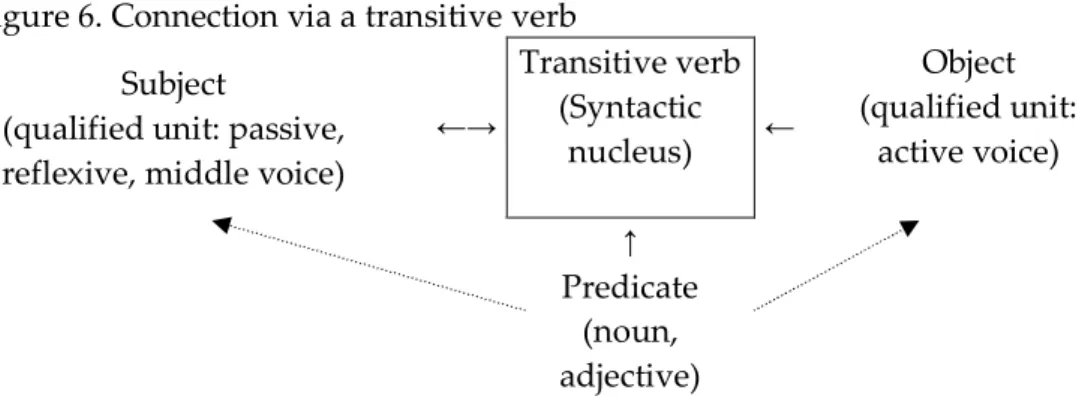
Transitive nuclear verbs with an object or subject predicate
Transitive verbs, in their connective uses, can introduce a subject or an object predicate depending on their diathesis, i.e. active/passive, active/reflexive, active/middle voice alternations.
Figure 6. Connection via a transitive verb Subject
(qualified unit: passive, reflexive, middle voice)
←→ Transitive verb (Syntactic nucleus) ← Object (qualified unit: active voice) ↑ Predicate (noun, adjective)
Thus in accusative languages such as French or Greek, these verbs, in the passive voice, may directly take an attribute function (of the subject) as a specific function, obligatorily expressed or not:
French (Indo-European)
Attribution of a quality to the subject (passive voice): (67.) Paul est élu président (par ses collègues).
‘Paul is elected president (by his colleagues).’ (Clairis et al. 200574: 28)
On the contrary, in the active voice, i.e. with a different orientation, these same verbs may take an attribute of their object (obligatory with some verbs, optional with others):
French (Indo-European)
Attribution of a quality to the object (active voice): (68. ) Ses collègues ont élu Paul président.
‘His colleagues elected Paul president.’ (Clairis et al. 2005: 29)
Korean (Korean)
Attribution of a quality to the subject (passive voice):
(69. ) pol -i banzaŋ -ɨro
Paul-AGENT class.delegate-PREDICATE
pop -hi -ʌt -da
elect-PASSIVE -PAST-DECLARATIVE
‘Paul is elected class delegate.’ (Koh 200575: 116)
75 Huong-Won Koh, 2005, Syntaxe connective en coréen, Typologie de la syntaxe connective,
Attribution of a quality to the object (active voice):
(70. ) uri -ga pol -ɨl (banzaŋ -ɨro)
1PL-AGENT Paul-OBJECT class.delegate-PREDICATE
pop -at -da
elect-PAST -DECLARATIVE
‘We elected Paul (class delegate).’ (Koh 2005: 116)
Nahuatl (Uto-Aztecan)
Attribution of a quality to the subject (reflexive construction)
(71. ) Ti-piltōntli ti-mo chīhua-z
2SG-child P2(SUBJ.)-P2(OBJ.) to.make
‘You will transform yourself into a child.’ (Launey 199476: 112)
Attribution of a quality to the object (active voice) (72. ) Ti-pochōtl t-āhuēhuētl
2SG-kapok 2SG-cypress
mitz-mo-chīhui-lia in totēucyo
to.make.you NPRED the Lord
‘The Lord transforms you into a silk-cotton tree, a cypress (= a protector).’ (Launey 1994: 112)
Spanish (Indo-European) Connective use
(73. ) Yo las encuentro muy tristes. ‘I find them very sad.’
Nuclear use
(74. ) Lo encuentro cada día. ‘I meet him every day.’
Adpositions
Quite often non-connective verbs require an adposition when used in connective constructions. It is important to distinguish between comparative sentences and attributive sentences, as the same adposition may be used in both cases. Relative constraints should also be taken into consideration, e.g. the use of a definite article. In the following example, the definite article can only be used in the comparative structure:
French (Indo-European)
(75. ) Louis travaille comme enseignant. ‘Louis works as a teacher.’
76 Michel Launey, 1994, Une grammaire omniprédicative. Essai sur la morphosyntaxe du
(76. ) Louis travaille comme un enseignant. ‘Louis works like a teacher.’ (in the same way)
In some cases, both constructions (with or without the adposition) are possible with no change in meaning:
Breton (Indo-European)
(77.) he zo wet labur
3SGF AUX go.PRF work
ba n gɛr giʃ matǝs bein
in INDEF farm as servant small
‘She went to work in a farm as a maidservant.’ (Avezard & Costaouec 200577: 101)
The equivalent sentence is also possible without an adposition:
Breton (Indo-European)
(78.) he zo wet matǝs bein ba ker
3SGF AUX go.PRF servant small in farm ‘She went as a maidservant in a farm.’ (Avezard & Costaouec 2005: 101)
Examples of non connective verbs which require an adposition:
Greek (Indo-European)
(79.) 'δulɛpsɛ ɛ'ki ɔs ɛrγɔδi'γɔs
worked.3SG there as site.foreman.NOM ‘He worked there as site foreman.’
(Babiniotis et Clairis 2005: 52)
6. Constraints in the use of the various connective constructions The connective strategies presented above are most frequently used in parallel in a given language, though it is rare to find them all in a single language (in our sample 5/60). In general, one of the processes is the main strategy, used in temporally and pragmatically unmarked sentences. When the need for extra grammatical (aspectual, temporal, person), pragmatic (focus) or lexical information is involved, a second strategy is used. Strategies are also highly dependant on the type of predicate (definite vs. indefinite, stative predicate vs. noun) and on the clause type (negative, interrogative, affirmative, dependant clause).
77 Cécile Avezard & Denis Costaouec, 2005, Syntaxe connective en breton, Typologie de la
Predicate types
Various constraints are found in the world’s languages depending on the types of predicates. Specific qualified units, such as personal pronouns and proper nouns, behave differently from generic units, such as indefinite nouns and plural nouns.
For example, in Pulaar direct connection is only possible with personal pronouns:
Pulaar (Gaawoore) (Niger-Congo)
(80.) o pullo
3SG Pular
‘He’s a Pular.’ (Sow 200378: 87)
Other types of qualified units require the connector yo:
Pulaar (Gaawoore) (Niger-Congo)
(81.) Aamadu yo Pullo
Amadou PRED Pular
‘Amadou is a Pular.’ (Sow 2003: 87)
In Nanafwe on the contrary, direct connection is impossible for personal pronouns and plural nouns (Bohoussou & Skopeteas 200579: 159).
Restrictions related to the person can also be found. For example, in Kamayura the copula is restricted to use with the first and second persons only:
Kamayura (Tupian)
(82. ) paje ere-ko
Shaman 2SG-Copula
‘You are the shaman.’ (Seki 200080: 158)
Indeed, third person pronouns behave differently in a general mannor: for example Stassen (1997) and Eriksen (2005)81 observe that there are no languages
in which zero copula contructions are licensed for first person but not third person pronouns (Eriksen 2005: 27).
Definite and indefinite nouns as well as plural nouns also may behave differently and require different strategies: this is the case in Tseltal where definite nouns may take the non-verbal connector (also used as a focus marker) while indefinite nouns require direct connection. In Moroccan Arabic, whenever
78 Salamatou Alhassoumi Sow, 2003, Le parler des Peuls Gaawoore. Niger Occidental,
Louvain-Paris-Dudley, Ma, Peeters.
79 Amani Bohoussou & Stavros Skopeteas, 2005, Syntaxe connective en nanafwe,
Typologie de la syntaxe connective, p. 155-169.
80 L. Seki, 2000, Gramática do Kamaiurá, São Paulo, Editora de Unicamp.
81 Pål Kristian Eriksen, 2005, On the Typology and the Semantics of Non-Verbal Predication,
a predicate is determined by a definite article for example, the presence of the article turns the qualifier into an apposition:
Moroccan Arabic (Afro-Asiatic, Chatar 200582: 64)
a) direct connection (83.a) h̩med muɛɑllīm
Ahmed teacher ‘Ahmed is a teacher.’
b) apposition
(83.b) h̩med əl muɛɑllīm
Ahmed DEF teacher ‘Ahmed, the teacher…’
However, in cases of topicalization, the predicate can be determined by the definite article:
(84.) h̩med əl muɛɑllīm
AHMED DEF teacher ‘It’s Ahmed the teacher.’
Moreover, in French, non connective verbs used with an adposition (comme) take on comparative meaning when a definite article determines the noun: Il travaille comme un enseignant ‘He works like a teacher’ vs. Il travaille comme enseignant ‘He works as (a) teacher’.
We should also mention that it is common for predicative adjectives to behave differently in a given language and have to be constrained in the connective strategies in which they can be involved. For example in Bijogo (Niger-Congo, Segerer 200283: 168), predicative adjectives are obligatorily linked to one sort of
strategy: while -koto ‘old’, of verbal origin, can be directly connected, -ʈiʈ ‘small’, requires the use of a copula -nam ‘be’.
TMA markers
One of the most well known constraints in connective constructions concerns the use of TMA markers. In many languages direct connection is favoured when temporal and aspectual stability is involved but is no longer possible with all or some TMA markers (in the present study 20 languages out of 60). As Eriksen (200584: 27), following Stassen (1997), observes if a language accepts a zero copula
construction in the past it will also accept it in present.
Such is the case in Hungarian, where no TMA markers are allowed in direct connection:
82 Nizha Chatar-Moumni, 2005, Syntaxe connective en arabe marocain, Typologie de la
syntaxe connective, p. 55-72.
83 Guillaume Segerer, 2002, La langue bijogo de Bubaque, Louvain-Paris, Peeters, Afrique et
Langage 3.
84 Pål Kristian Eriksen, 2005, On the Typology and the Semantics of Non-Verbal Predication,
Hungarian (Uralic)
(85.) Barát-aim mérnök-ök
friend-POSS1/PL engineer-PL
‘My friends are engineers.’ (Nyéki 198385: 54)
In Turkish on the other hand, the predicate (here an adjective) can receive a present or a past tense marker but for the future the connective verb ol- ‘to be/become’ is necessary:
Turkish (Altaic)
(86. ) ev güzel-miş
house pretty-PAST.EVID
‘(It is said that) the house was pretty.’ (Divitcioglu-Chapelle 200586)
(87.) ev güzel ol-acak
house pretty be-FUT
‘The house will be pretty.’ (Divitcioglu-Chapelle 2005)
The “tensedness” criterion was first put in relation to the non-verbal predication by Stassen (1997). This observation was developed by Eriksen (2005)87 relating tensedness to the use of a copula. Eriksen points in his study that
tensless languages generally don’t require a copula since in a tensless language a sentence doesn’t need to be about a point in time. On the contrary, in tensed languages, in which “all sentences must be assertions about a point in time” (Eriksen 2005: 63), a copula is usually required for adjectival and nominal predicates.
Clause types
It appears that connective strategies are frequently related to the type of clause: declarative, negative, or interrogative clause. For example, in Kryz (Nakh-Daghestanian) various connectors are specialized for each type of sentence: declarative -ya, interrogative –y(i)/-i, negative –da (Authier 200988).
85 Lajos Nyéki, 1988, Grammaire pratique du hongrois d’aujourd’hui, Gap, OPHRYS–POF. 86 Elif Divicioglu-Chapelle, 2005, Syntaxe connective en turc, Typologie de la syntaxe
connective, p. 199-211.
87 Pål Kristian Eriksen, 2005, On the Typology and the Semantics of Non-Verbal Predication,
Unpublished PhD Thesis, University of Oslo.
88 Gilles Authier, 2009, Grammaire kryz. Langue caucasique d’Azerbaïdjan, dialecte d’Alik,
In Thulung (Sino-Tibetan), the “copula” tsha borrowed from Nepali cannot be used in interrogative sentences following the restrictions also valid in Nepali (Lahaussois 200289: 179).
Likewise, in Badaga (Pilot-Raichoor 199190: 569-572) direct connection is the
main strategy except for negated predicates which require a copula.
Eriksen (2005) observes that the so-called “tensed” languages use one negation marker while “tenseless” languages may or may not use a specific negator for nominal predicates. Indeed, in several languages, specific negators are used in connective constructions. Vesselinova (2007)91 also notes that negation can be
expressed for some languages in the same way in declaratives, nominal sentences and existential sentences but it is common to observe that a specific negation is needed for each type of clause or for some of them.
For example, in Hayu (Sino-Tibetan), the negation marker varies according to the different uses of /no(t)/ ‘to be, to exist’: the nominal negation /maaŋ/ is used with the “copula”, while the verb negation /ma/ is used for the existential (Michailovsky 198892: 134-138).
7. Language types based on the combination of the connective constructions
Based on the combination of the connective strategies within a language we propose five types of languages:
Type A: Direct Connection (9 languages)
This type includes languages that use direct connection as an unique strategy. It usually occurs in “tensless languages”, including languages with a weak verb-noun opposition:
Araki, Berber, Mwotlap, Palau, Sakalava (Malagasy), Sikuani, Tagalog, Uldeme, Yurakaré.
Type B: Direct Connection, Non-verbal connection possible (6 languages) Type B includes languages that use direct connection as their main strategy but also that have the possibility to use a non-verbal connector as a secondary strategy:
Arawak (Guyana), East Futunan, Nêlêmwa, Tseltal, Nanafwe, Martinique French Creole.
89 Aimée Lahaussois, 2002, Aspects of the grammar of Thulung Rai: an endangered Himalayan
language, unpublished PhD thesis, University of California, Berkeley.
90 Christiane Pilot-Raichoor, 1991, Le Badaga : langue dravidienne (Inde). Description et
analyse, Unpublished PhD thesis, Paris.
91 Ljuba Vesselinova, 2007, Towards a typology of negation in non-verbal and existential
sentences, 7th Biannual Meeting of the Association for Linguistic Typology, Paris.
Type C: Direct Connection, Verbal Connection under constraints (22 languages)
This language type includes the so-called “tensed languages” that may express a permanent quality through direct connection as long as it concerns an unmarked tense such as present or aorist. But, when further TMA precision is needed, those languages require a verb:
Kambera, Qawasqar, Tehuelche, Nengee, Badaga, Cree Montagnais, I'saka, Bijogo, Deuri, Classical Nahuatl, Hungarian, Ixcatec, Kalaalisut, Kamayura, Nashta, Purepecha, Russian, Tinumiisut, Turkish, Wambaya, Yuwaalaraay, Zapotec.
Type D: Verbal Connection, Direct Connection marginal or impossible (16 languages)
This category includes the languages that function mainly with verbal connection and may use direct connection in specific contexts such as exclamative sentences. Otherwise, direct connection is not possible:
Basque, Breton, Chechen, French, Georgian, Hayu, Japanese, Korean, Kryz, Modern Greek, Romani, Saami, Spanish, Thulung, Ubykh, Welsh.
Type E: All possible (7 languages)
For some languages a wide range of connective strategies is available and naturally each strategy responds to specific pragmatic needs (e.g. focus):
Mankon, Qiang, Gbanzili, Gula, Yemeni Arabic, Langi, Moroccan Arabic.
Languages with direct connection as a main strategy are the majority. Moreover, the most common type in our sample is Type C, for languages that use direct connection as an unmarked strategy but require a verb for extra TMA markers. The second most frequent strategy concerns the almost exclusive use of verbal connection, Type D.
8. Conclusion
Based on a sample of 60 languages belonging to a wide range of stocks, this study presents the various syntactic processes used crosslinguistically to express the attribution of a quality, identification and membership: direct connection, specialized non-verbal and non-specialized connectors, and full lexical verbs, both intransitive and transitive.
More than one of these strategies can be found in a given language. The choice of a strategy depends most frequently on the type of unit, clause type, use of TMA markers other than present or aorist, and the need to add pragmatic focus or an additional lexical argument.
Based on the uses of the three connective strategies five language types have been identified:
Type A Direct connection
Type B Direct connection, non-verbal connector possible Type C Direct connection, verbal connection under constraints Type D Verbal connection, direct connection marginal or impossible Type E All possible
We believe it would be useful if future language descriptions were to include a chapter on connective constructions, which would examine all the means available in the language and the relevant constraints applying to them.
Abbreviations
1first person; 2second person; 3third person; A11st person singular/ergative (Tseltal); ABS absolutive; ACC accomplished; ADJ adjective; AL addressee; AOR aorist; ART article; ASS assertive ; B11st pers. sg. / absolutive (Tseltal); B33rd pers. sg. / absolutive (Tseltal); COP copula; D dual; DEF definite; DEM or DEM2 demonstrative or demonstrative type 2; DEIC deictic; DIST distal; EVID evidential ; F feminine; FOC focalizer; FUT future ; GEN genitive; IMP imperative; INDEF indefinite ; INST instrumental ; INT interrogative; M or MASC masculine ; N neutral; NEG negation; NOM nominative case; NPRED non predicate marker; PART predicative particle; PL plural; PRD-ADJ predicate adjective; PRED or P or SP or
SPEC.PRED predicate marker; PREFSUJ subject prefix; PRES present; PROG
progressive; PROX proximal; PST or PAST past; PTCP participle.
Acknowledgements
This paper was presented in the 8th Conference of the Association for Linguistic Typology in Berkeley (2009) and benefited from the remarks of its participants. We gratefully acknowledge support for the preparation of this paper from the CNRS Federation of Typology and Linguistic Universals, directed by Stéphane Robert. We also wish to thank the colleagues who, when needed, kindly accepted to control the analyses concerning the languages they specialize in, even though we are responsible for any mistakes in this paper: I. Bril, G. Segerer, F. Jacquesson, A. François, C. Moyse, C. Pattin, V. de Colombel, A. Lahaussois and A. Fernandez-Garay.