People’s Democratic Republic of Algeria Ministry of Higher Education and Scientific Research
University of Tlemcen Faculty of Letters and Languages
Department of English
Dissertation submitted to the Department of English as a partial fulfilment of the requirements for the degree of Master in Language Studies
Presented by:
Supervised by:
Miss. Souâd AINA
Prof. Amine BELMEKKI
Co-supervised by:
Dr. Yassamina ABDAT
Academic Year: 2015-2016
The Effect of Authentic Aural Materials Use
on EFL Learners’ Listening Skills: Case of
Second-Year LMD Students at Abou Bakr
Belkaid University -Tlemcen-
i
Dedication
I dedicate this modest work
To my lovely & dearest ‘Parents’
To my sister ‘AMINA’
To my brother ‘MOHAMMED’
To my little sweets ‘ZANOUBA’ & ‘RIHEB’
To all my best ‘Friends’
SOUAD
iiii ii
Acknowledgements
First of all, all thanks and gratitude to Allah, Lord of the world for helping and guiding me, and to whom I owe everything.
I would like to express my sincere thanks to my supervisor Prof. Amine BELMEKKI for his guidance, support, invaluable advice and constant assistance during all the investigation process.
I wish also to express my deep sense of gratitude to my co-supervisor Dr. Yassamina ABDAT who without her help and insightful suggestions, this research would not have been successfully conducted. Thanks for her patience, understanding and permanent academic and moral encouragement.
I would like to thank the board of examiners: Prof. Amine BELMEKKI, Dr. Yassamina ABDAT, Dr. Yahia ZEGHOUDI, Dr. Abdelkader BENSAFA for having devoted some of their time and accepted reading and commenting on this thesis.
My gratitude extends further to all the teachers at the English department who helped in accomplishing this research work: Dr. Faiza HEDDAM, Dr. Mohamed Nassim NEGADI, Pr. Hafida HAMZAOUI,
Dr. Abdelkader BENSAFA, MS. Nadjiya YAHIAOUI, Mr. Sliman MEGHAGHI, Mrs. Farida DRISI.
I am immensely indepted to my friends Lila BELAROUCI, Imane MERDJI KHADRA and Zineb BENDADA.
Special Thanks go to Second Year Students ‘GROUP 8’ for their collaboration and acceptance to participate in this experimental study.
Thanks also go to all the persons who have helped in one way
or
another in making this research work relizable.iii
Abstract
In the last few decades, listening as one of the most pivotal skills has been given more attention due to the significant role it plays in foreign language learning. It is, therefore, essential to prepare students for successful listening by implementing authentic listening materials in language classes to ensure their exposure to the target language and cope with real-life situations. The main objective of this investigative project is to examine the use of authentic aural materials and its impact on second year LMD students’ listening skills at the University of Tlemcen, more specifically in the department of English. For this purpose, a case study was conducted as a research field work. The data collected from 26 leaners and 11 teachers using classroom observation, questionnaire, and proficiency tests were analysed both quantitatively and qualitatively. The triangulation of results revealed that teachers use different sources to obtain authentic aural materials. Obstacles related to the speed of delivery, pronunciation, and vocabulary were found to be the most frequently encountered by students when using these materials which were found to have a positive effect on their listening comprehension and motivation. This is why, it is necessary to bring authentic listening materials to the English language classroom. Both learners and teachers were conscious about the value of authentic materials in enhancing the listening skill, and recognised its role in the EFL teaching and learning process.
iv
Table of Contents
Dedication.………...i Acknowledgments…….………....……...ii Abstract….………...……...iii Table of Contents ………...…...iv List of Tables.……….………...viii List of Diagrams..………..………...……..…...ixList of Bar Graphs.………..……...…...x
List of Pie Charts…...xi
Key to Abbreviations and Acronyms……...…...xii
General Introduction……….…………...2
Chapter One:
Authentic Aural Materials in ELT
1.1. Introduction………..71.2. Listening Process Defined………....7
1.3. Listening Types………..14
1.3.1. Extensive Listening……….….14
1.3.2. Intensive Listening………...…15
1.4. Task for Listening Comprehension………....16
v
1.5.1. The Notion of Authenticity and its Types………...23
1.6. Characteristics of Authentic and Non-Authentic Aural Materials……27
1.7. Types of Authentic Aural Materials………...28
1.7.1. Songs………28
1.7.2. Films………29
1.7.3. Conversations………...29
1.7.4. News Broadcasts………..29
1.7.5. Guest Speakers……….29
1.8. Sources of Authentic aural materials………..30
1.8.1. Radio………30
1.8.2. TV/Video……….30
1.8.3. Audio Tape………...31
1.8.4. The Internet………..31
1.9. Criteria for Selecting Authentic Aural Materials………...32
1.10. The Role of Authentic Aural Materials in Foreign Language Teaching……….34
1.11. Conclusion………..36
Chapter Two:
Situation Analysis
2.1. Introduction………...39vi
2.3. The Listening Comprehension Status at the English Language
Department……….46
2.4. Teachers’ Profile and Methodology………...48
2.5. Learners’ Profile………53
2.6. Research Instruments: Aims and Procedure………...53
2.6.1. Classroom Observation……….55
2.6.2. Questionnaire………57
2.6.3. Listening Proficiency Test………61
2.6.3.1. Pre-test Phase Description………..63
2.6.3.2. Training Phase Description……….66
2.6.3.3. Post-test Phase Description………...70
2.7. Conclusion……….….74
Chapter Three:
Results Analysis, Interpretation
& Recommendations
3.1. Introduction……….773.2. Results Analysis and Interpretation………77
3.2.1. Classroom Observation Results………77
3.2.2. Teachers’ Questionnaire Results………..79
3.2.3. Listening Proficiency Test Results………...92
vii
3.2.3.2. Training Phase Results………98
3.2.3.3. Post-test Results ………...100
3.3. Summary of the Findings………..104
3.4. Pedagogical Implications and Recommendations………106
3.4.1. Recommendations for Learners………..106
3.4.2. Recommendations for Teachers ……….107
3.4.3. Listening Comprehension as a Separate Module………108
3.4.4. Suggested Listening Activities………...109
3.5. Conclusion………115
General Conclusion.………..………...117
Bibliography………...………121
Appendices………..138
Appendix A: Classroom Observation….…...………..140
Appendix B: Teachers’ Questionnaire..…….………..151
Appendix C: Listening Proficiency Pre-test…..………..…..…………..157
Appendix D: Training Phase.………..168
Appendix E: Listening Proficiency Post-test ..………..…………..193
Appendix F: Test Question Handouts…....………..204
viii
List of Tables
Table 1.1. Characteristics of Authentic and Non- Authentic Speeches…………...27
Table 2.1. English Weekly Time Allotment in Middle School………....40
Table 2.2. ELT Load at Secondary School Level………41
Table 2.3. Teaching Units of the 2nd Year LMD Students at the English Section..44
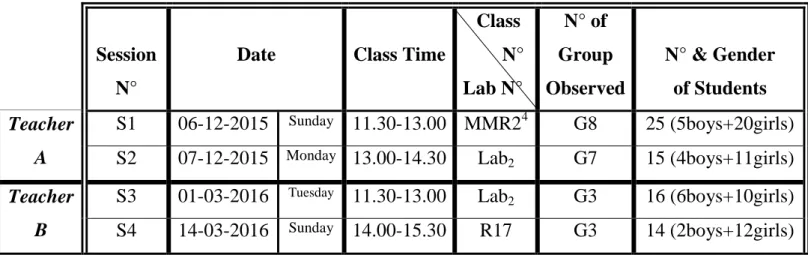
Table 2.4. Basic Information about the Four LMD2 Observed Sessions………...56
Table 2.5. Timing & Setting Description of the Two Observational Lectures……56
Table 2.6. Questionnaire Layout and Questions Distribution………..59
Table 2.7. General and Specific Information about the Training Sessions………..67
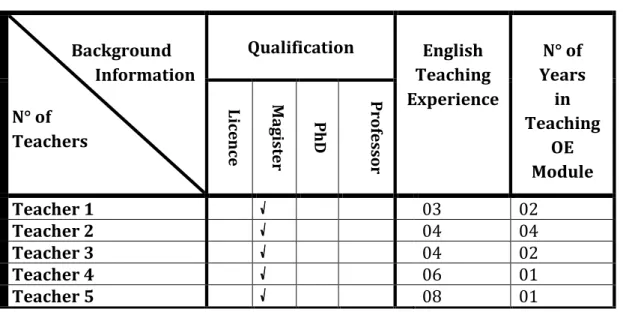
Table 3.1. Teachers’ Background Information………82
Table 3.2. Use of Authentic Aural Materials………...83
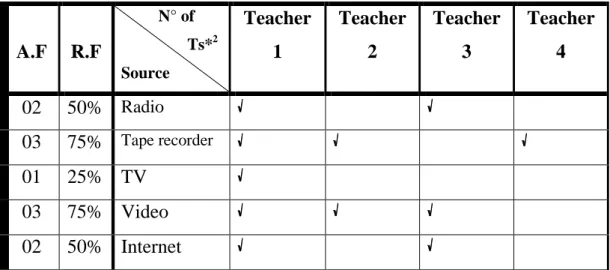
Table 3.3. Type and Number of Sources Used by Each Teacher……….85
Table 3.4. English Department Possession of Listening Equipment………...86
Table 3.5. The Need of Training in Using Authentic Aural Materials………89
Table 3.6. Importance of Establishing a Specialized Listening Module…………..91
Table 3.7. Students Pre-test Marks………...94
Table 3.8. Reflections on Pre-test Session………...98
Table 3.9. Participants Post-test Scores………..101
Table 3.10. Reflections on Post-test Session………..103
Table 3.11. Percentages of Learners’ Listening Comprehension Performance Before and After Treatment……….103
ix
List of Diagrams
Diagram 1.1. The Basic Listening Stages & their Functions……….9
Diagram 1.2. Richard’s Functions/ Processes Chart………11
Diagram 1.3. Stages of Listening Comprehension Activities………..20
Diagram 1.4. A Basic Methodological Model for Teaching Receptive Skills……21
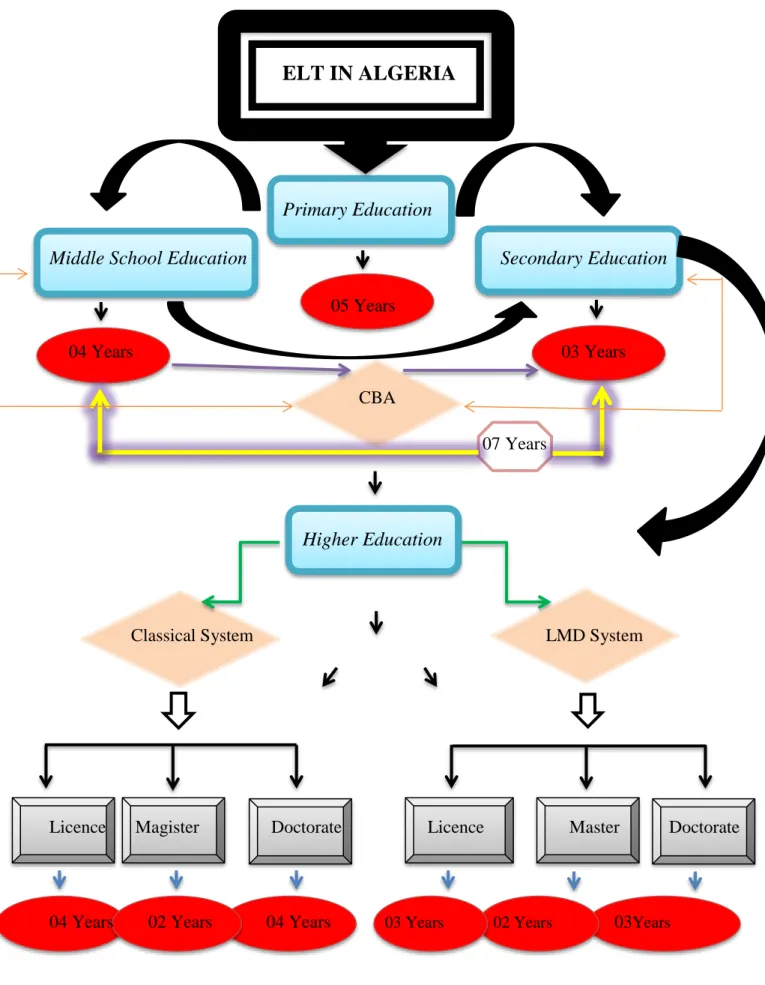
Diagram 2.1. ELT in Algeria (2015-2016)………..45
Diagram 2.2. Research Instrumentation Employed………...……..54
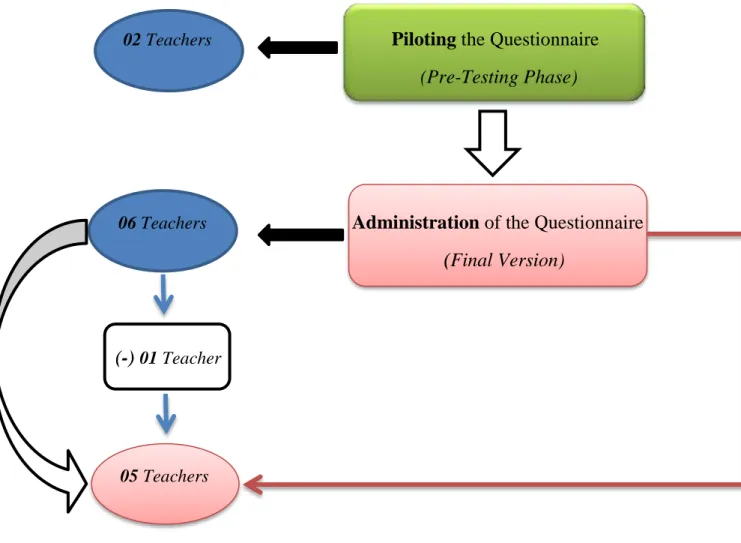
Diagram 2.3. Questionnaire Design and Steps………...….58
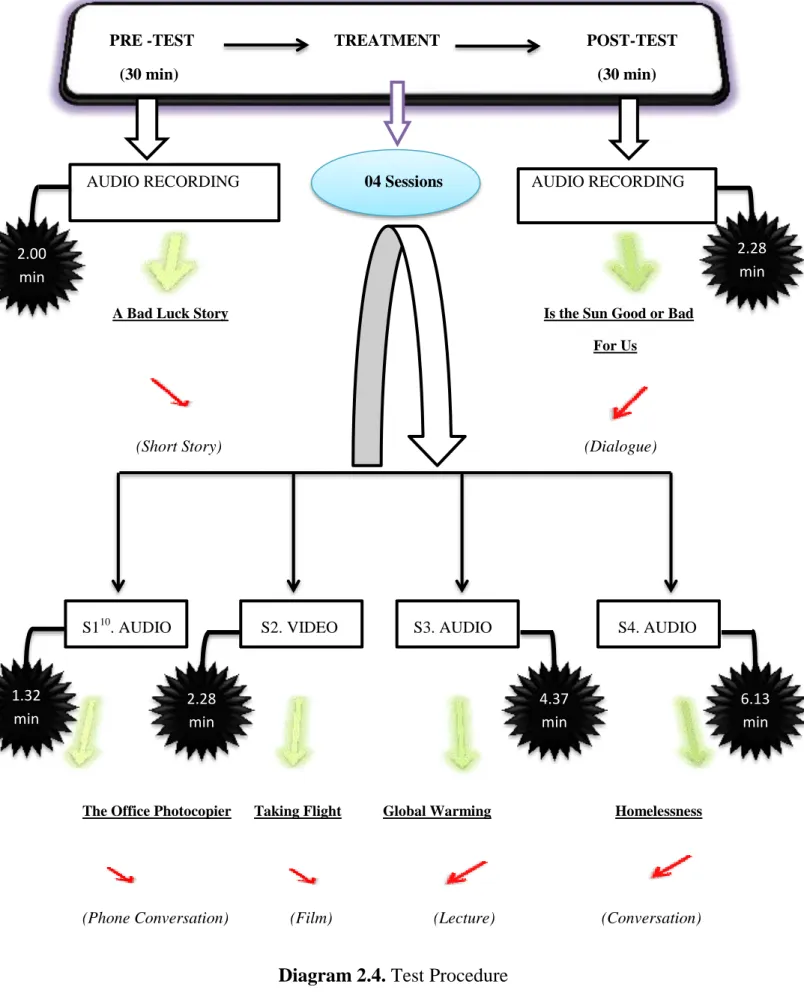
Diagram 2.4. Test Procedure………...73
Diagram 3.1. N° of Students Present in Each Test Phase………93
Diagram 3.2. Pre-test Results………...95
Diagram 3.3. Post-test Results………...102
x
List of Bar Graphs
Bar Graph 3.1. Teachers’ English Teaching Experience………80
Bar Graph 3.2. Teachers’ Oral Expression Teaching Experience………...……...81
Bar Graph 3.3. Teachers’Eexperience in English and OE (comparison)…………81
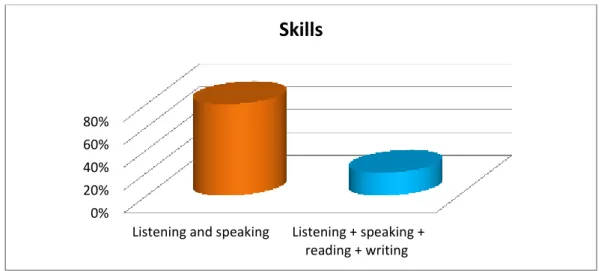
Bar Graph 3.4. The Main Focused Skills in OE Course………...…………..83
Bar Graph 3.5. Sources of Authentic Aural Materials...……….…84
Bar Graph 3.6. The Difficulties Encountered by Students When Listening to
Authentic Aural Materials……….….………...87 Bar Graph 3.7. Pre-test & Post-test Results…………...………...104
xi
List of Pie Charts
Pie Chart 3.1. Teachers’ Problems in Using Authentic Listening Materials……...88
Pie Chart 3.2. Types of Training Needed by Teachers………90
Pie Chart 3.3. Pre-test Percentages of Students’ Listening Performance……...….94
xii
Key to Abbreviations and Acronyms
A.F : Absolute Frequency BA : Bachelor of Arts BAC : Baccalaureate exam
BBC : British Broadcasting Corporation BEM : Brevet d’Enseignement Moyen CA : Classical Arabic
CD : Compact Disk
CE : Comprehension d’ Écoute CNN : Cable News Network
C.O.E : Comprehension Oral Expressite DVD : Digital Video Disk equipment Ed: Edited
EFL : Foreign language as a foreign language ELT : English Language Teaching
e-mail : Electronic mail
ESL : English as a Second Language FL : Foreign Language
G : Group
Ibid : In the same reference / in the same place
ICTs : Information and Communication Technologies IELTS : International English Language Testing System LAB : Laboratory
LC : Listening Comprehension LMD : Licence Master Doctorate Min : Minutes
MMR : Multimedia room N : Number
xiii OE : Oral Expression
OP : Oral Production
OUP : Oxford University Press Ph.D. : Doctor of Philosophy Podcast : Play on Demand Cast Qtd : Quoted R : Room R.F : Relative Frequency RP : Received Pronunciation S 1/2/3/4 : Session 1/2/3/4 SS : Students
STT : Student Talking Time T: Teacher
TED : Technology Entertainment Design
TEFL : Teaching English as a Foreign Language T.P.O : Techniques du Production Orale
TTT : Teacher Talking Time TV : Television
VOA : Voice Of America
Vodcast : Video on Demand Cast
UCLA : University of California, Los Angeles
UK : United Kingdom
General Introduction
2
General Introduction
Within the increasing accessibility and development of technology that plays a special role, especially, in education; teachers and learners, nowadays, have a wide range of opportunities to acquire a foreign language and develop a number of language skills. Listening as a very significant skill for English language learning, has come to be recognised as the most frequently used one and which can be developed through different ways.
The use of authentic aural materials, as audio-visual teaching aids, that provide EFL learners and teachers several opportunities to experience the real language with its various features, and to cope with real-life situations; are considered as beneficial educational tools for improving the skill of listening comprehension. Because of the noticeable lack and obstacles of using these materials in the EFL classrooms, and more specifically in the department of English; and because of the essential role it plays in listening, the current research work has been tackled to shed light on the aforementioned proposed issues.
The primary purpose of this work is to examine the influences of using authentic aural materials on the listening skills of second year LMD students. It further seeks to find out the sources that teachers use mostly to obtain such materials, and to discover as well, the main difficulties students face when using them. To this end a number of critical questions are raised:
1. What sources of authentic aural materials do EFL teachers generally make use of?
2. What difficulties do EFL learners encounter while using authentic aural materials during listening comprehension sessions?
3. How can the use of authentic aural materials contribute in improving EFL learners’ listening skill?
General Introduction
3
The above cited questions led to the formulation of the following hypotheses:
1. Some EFL teachers use mainly, audio, video, radio and internet resources to obtain authentic aural materials.
2. When using authentic aural materials, the majority of teachers notice that their EFL learners cannot understand some vocabulary items, pronunciation and may even fail to follow the rapid speech.
3. Learners who are frequently exposed to authentic aural input can develop their listening abilities.
To check the truthfulness of these hypotheses, an exploratory case study research is conducted with 26 EFL learners and 11 teachers in the department of English at Tlemcen University. In this way, three basic data collection research instruments are used under this investigative work; namely, a classroom observation, a questionnaire, and proficiency tests (pre-test and post-test) that were developed in a two sessions process; in addition to four other training sessions. Thus, both quantitative and qualitative data analysis methods will be relied on.
The present study is constructed and organized in three different chapters. The first chapter is devoted to the theoretical overview of authentic aural materials. It reviews theoretically some key concepts relevant to the research at hand, i.e., listening and authentic aural materials. The former relies on defining the listening comprehension process. The latter highlights and discusses, in general, the notion of authenticity and authentic aural materials and its role in English language teaching.
The second chapter reflects a situation analysis. It describes the status of ELT in Algeria and listening comprehension at the English language department. Furthermore, it attempts to display the target sample population and the implemented research instruments.
The third chapter tackles the analysis and interpretation of the various implemented research tools that are cited above, in addition to a summary devoted to the main results related to these tools. It also exhibits a number of suggestions
General Introduction
4
and recommendations that guide and promote the use of authentic aural materials in English language teaching and learning by both learners and teachers.
Chapter One
Authentic Aural Materials in ELT
1.1. Introduction
1.2. Listening Process Defined 1.3. Listening Types
1.3.1. Extensive Listening 1.3.2. Intensive Listening
1.4. Task for Listening Comprehension
1.5. Authenticity and Authentic Aural Materials 1.5.1. The Notion of Authenticity and its Types
1.6. Characteristics of Authentic and Non-Authentic Aural Materials 1.7. Types of Authentic Aural Materials
1.8. Sources of Authentic Aural Materials
1.9. Criteria for Selecting Authentic Aural Materials
1.10. The Role of Authentic Aural Materials in Foreign Language Teaching 1.11. Conclusion
Chapter One Authentic Aural Materials in ELT
7 1.1. Introduction
The need of different techniques for teaching and enhancing listening comprehension have necessitated the innovative implementation of authentic1 materials in Algerian EFL classrooms, to ensure effective communication and serve learners’ needs.
The present chapter revolves around the use of authentic aural materials in ELT context. First, it sheds light on the listening comprehension process; and the types of listening, as well, followed by the listening tasks. Second, it explores the
nature of authentic aural materials, passing through a number of potential definitions, laying stress on the notion of authenticity and its different types,
sources, and the criteria of selecting these materials. Then, special emphasis is also given to the characteristics of authentic and non-authentic aural Texts. Finally, this chapter highlights the role of authentic aural materials, dealing with both the positive and negative points surrounding its use.
1.2. Listening Process Defined
It is worth noting that the listening skill has been ignored in research and practice until quite recently. Before the 1990’s, it was viewed as a passive neglected process, and this explains why some scholars called it “Cinderella skill in language learning” (Nunan, 1997:47). In contemporary research, however, it has been given greater emphasis than in the past. In this context, Mendelsohn & Rubin (1995:93) point out that: “listening has come to be recognized as an active rather than a passive skill, and its importance acknowledged in the acquisition of language”.
In this way, different definitions have been proposed for such a skill, among them that of O’Malley et al. (1989:434) in which listening comprehension is defined as “an active and conscious process in which the listener constructs
1 Origin of ‘authentic’ : middle English : via old French from late Latin authenticus, from Greek authentikos
‘principle, genuine’ ( Concise Oxford English Dictionary (11th
ed), Soanes & Stevenson, (n.d.)). - Authentic: something real, original, genuine, true, natural... It is the opposite of artificial/ fake.
Chapter One Authentic Aural Materials in ELT
8
meaning by using cues form contextual information and from existing knowledge while relying upon multiple strategic resources to fulfill the task requirements”. With reference to the aforementioned definition, the dynamic listening skill requires a kind of concentration to build some knowledge, relying on one’s expectations and schema2 by using different strategies. Another recent definition suggested by Rost (2005:305) describes listening comprehension as a “process that helps the speaker understand spoken language”. This means, through listening one can decode the other’s speech. A more accurate and detailed definition describes listening as “a six-staged process, consisting of hearing, attending, understanding, remembering, evaluating and responding”. These stages are said to occur in sequence and rapid succession.
That is to say, listening is a process that contains six basic operations or steps. First, it involves hearing; i.e., the perception of sounds, and this does not necessitate concentration; Second, Attention, that is, the aspect of focusing on a specific matter (the brain gives special emphasis on a specific area); Third, understanding, that involves analysing and grasping what was said. The fourth step is remembering, referring to the ability to store and recall information. The next phase represents evaluation; namely, assessing what is heard (the produced message). Lastly, responding, a stage in which the spoken message is checked if it
has been received and interpreted correctly. The figure below outlines the fundamental phases of the listening process and their functions as proposed by
Nunan (2001:24):
2 Schema (plural schemata): Background or previous knowledge used to interpret a message. It was clearly
described in Cook’s terms (1989:69) (qtd in Harmer, 2007) as “our pre-existing knowledge of the world”. more accurately, it is considered as “…cognitive constructs which allow for the organisation of information in the long-term memory…” (Widdowson, 1983:34).
Chapter One Authentic Aural Materials in ELT
9
Selecting: choosing stimuli
Hearing : Attending: receiving raw data focusing attention
Responding : Understanding:
feedback assingning meaning Remembering: Evaluating:
drawing on memeory analyzing and judging
Diagram 1.1. The Basic Listening Stages & their Functions (Nunan, 2001: 24)
It can be, then, deduced that listening does not simply mean hearing, it is rather an active process that involves a sender (person, radio, TV…), a message, and a receiver (listener). Listeners, in fact, rely on two basic listening strategies3 namely, “Bottom-up” and “Top-down” processes. The former, refers to paying attention to specific details to understand the whole meaning of a listening activity (accuracy). Some examples (Rubin, 1994) of ‘bottom-up strategies’ which are text-based, involve:
Selecting key words and phrases Verifying prediction
3
Techniques or steps that help the listeners in comprehending and recalling the listening input (Sharma, 2011). Among the different listening strategies, O’Malley & Chamot (1990) gave three main types of strategies: meta-cognitive, cognitive, and social/affective (or socio-affective) strategies. In general, language strategies have been categorized in two main types: language strategies (long-term solutions) and communication strategies (short-term answers).
Chapter One Authentic Aural Materials in ELT
10
Whereas, the latter denotes grasping the general meaning relying on prior or background knowledge to decode the speaker’s discourse, without focusing on certain structures (fluency). In this context, Dedebat (2006:108) explains that: “top-down processing focuses on the background knowledge reader uses to comprehend a written text…the top-down approach is associated with schema theory”. Some ‘top-down listening strategies’ (Rubin, 1994) that are listener-based include:
Activating background knowledge Predicting
Listening for the main idea Inferring
Summarising
Students usually combine both processes in real-life listening situations, giving more emphasis to one of them, and this depends on their reason for listening. When providing students with any practice, teachers are normally supposed to link between both kinds of these language processes. Taking into consideration those two perspectives “Richards (1990) proposes a model of materials design for second or foreign language listening comprehension that combines language functions (interactional and transactional) and language processes (top-down and bottom-up)” (Celce-Murcia, 2001:74). This diagram (as it is shown below) gives teachers an idea about how a listening lesson can be constructed and classified, depending on the covered listening function and process.
Chapter One Authentic Aural Materials in ELT
11 INTERACTIONAL BOTTOM-UP TOP-DOWN TRANSACTIONALDiagram 1.2. Richards’s Functions/ Processes Chart
(Richards, 1990; qtd in Celce-Murcia, 2001:74)
Richards (1990) gives an example for each of the above four cells as follows: In the bottom-up mode:
Cell #1: listening closely to a joke (interactional) in order to know when to laugh. Cell #3: listening closely to instructions (transactional) during a first driving lesson. In the top-down mode:
Cell #2: listening casually to cocktail party talk (interactional).
Cell #4: Experienced air traveler listening casually to verbal air safety instructions (transactional) which have been heard many times before.
(Celce-Murcia, 2001:75)
As a matter of fact, whenever we listen there is normally a purpose behind any listening task, and this purpose differs each time we listen; depending on the situation. Concerning the reasons for listening, Lindsay & Knight report that listeners have four (04) different purposes when they listen. These are:
1 2
Chapter One Authentic Aural Materials in ELT
12 Listening for specific details. Listening for the main idea.
Listening for the general idea (or gist). Listening for the general meaning.
Additionally, there are other reasons for listening, including: Listening for information.
Listening for enjoyment. Listening for social reasons. Listening to learn new languages.
(Lindsay & Knight, 2006: 46)
Nonetheless, from Anderson & Lynch’s point of view (1988:15), the purpose behind listening can be either ‘transactional4’ or ‘interactional5’.
Transactional listening: involves the purpose of achieving a successful transfer or exchange of information. Examples of transactional uses encompass: instructions, descriptions, lectures, and news broacasts (Celce-Murcia, 2001:75).
Interactional listening: is used to establish and maintain social connections. For instance: greetings, small talks, jokes, and compliments. (Idem).
A thorough and obvious explanation offered for the two terms points out that: Transactional listening refers to listening to speech where the message being conveyed is very important and that a foreign language listener has to know in order to understand; whereas, interactional listening refers to speech where the message is not important but that the intention is to create social relations. (Brown &Yule, 1983: 13)
4 To assimilate new information, construct new concepts, and acquire new skills (Celce-Murcia, 2001:75). 5
To interact with the teacher and other students while accomplishing class tasks (i.e., “classroom talk”) (Idem).
Chapter One Authentic Aural Materials in ELT
13
The main aim for teaching listening comprehension is to help learners cope with listening in real-life when working with aural materials6. To achieve this outcome, teachers must provide them with opportunities to listen to different authentic materials and principally give them, at the same time, activities based on the content of these materials, taking into account three types of tasks (pre-, while- and post-listening tasks).
Finding suitable aural materials and developing activities on the basis of such materials, however, is not an easy task and requires much time, energy and creativity. Teachers, thus, have a lot of work to do before and during a listening class. They have to select appropriate listening texts in terms of, mainly, cultural content, students’ needs and especially their learning styles, i.e., visual, auditory and kinesthetic. This occurs by employing a mixture of materials types , so that they can spark their students’ interest and which will evoke more, of course, their enthusiasm about listening to authentic speech .
Listening is considered to be the most used skill. In this respect, Rivers & Temperly (1978) point out that the average adult spends approximately 9% of the time writing, 16% reading, 30% speaking, and 40% listening. This estimate emphasizes the importance of listening in communication. In this vein, Nunan (1997) maintains that listening compared with speaking, reading and writing is the most frequently used language skill in both the classroom and daily communication. Listening plays an essential role. It can help students build vocabulary, and develop both language proficiency and language usage (Barker, 1971).Through
listening to some materials (songs, films…) one can be accustomed to pronunciation, rhythm, intonation and stress; which will enhance not only the oral
skills, as (Dunkel, 1986:99) asserts “developing proficiency in listening comprehension is the key to achieving proficiency in speaking” but also reading
and writing.
6 Materials can take different forms: a textbook, a cassette, a CD-Rom, a video, a radio, a photocopied
Chapter One Authentic Aural Materials in ELT
14
It seems that there is a connected relationship between listening and the other skills, as the use of a language is based on the four skills. A strong relationship and connection exists between listening and speaking in many EFL classrooms. Because of the lack of time, English teachers believe that the only solution is to integrate both listening and speaking practice. Such integration is said to be very useful for learners. According to Bueno et al: “listening is important for speaking because it establishes the good basis for successful communicative exchanges” (2006:344).
Harmer (1988) explains that the main reason for exposing students to English speech, is allowing them listen to different varieties, dialects and accents rather than hearing, all the time, the voice of their teachers with its own idiosyncrasies. This can be done through the use of tape-recorded materials (songs, news, films, etc.) which will provide them, not only with information about grammar and vocabulary, but, also, they will be accustomed to pronunciation, rhythm, intonation, pitch and stress. Leading, in this way, to the enhancement of the four language skills. Having defined listening as a process and discovering its value; in the next section, it is essential to uncover its possible various types.
1.3. Listening Types
In fact, there are different types7 of listening, but the two major ones are: extensive and intensive listening, through which learners can experience real-life listening.
1.3.1. Extensive Listening
It is the more general and freer sort of listening that usually takes place outside classroom for pleasure or for many other reasons, among them to improve one’s listening abilities along with speaking. Listening extensively can be done
7 Other listening types involve for example: attentive listening, selective, interactive, discriminative, critical,
Chapter One Authentic Aural Materials in ELT
15
through using a set of audio/video materials, like: CDs, podcasts,8etc., as a way to enhance what students have studied in class. Concerning this latter, O’Brydn & Hagelheimer (2007) assert that one of the benefits of using this technological tools is that it allows students to spend additional time working on the concepts taught in class and outside of the classroom. Winberge et al. reported an increase in the use of lecture comprehension strategies that were presented in the podcasts.
On the whole, to be involved in such a type of listening, teachers are urged to encourage language learners to listen to different kinds of English texts (songs, movies, news, poems, radio talks…); especially the authentic ones because of their richness and naturalness.
1.3.2. Intensive Listening
In contrast to extensive listening, listening intensively is said to occur inside classes (or language laboratories) under the instructor’s guidance to overcome any difficulties students encounter during a listening activity (Harmer, 2007). This means that it is specifically done to develop the listening skill and to discover how English is spoken.
Listening intensively involves a set of techniques that focus on language components, including the bottom-up process which is essential at all proficiency levels (Brown, 1994). Intensive listening, thus, implies paying specific attention to the lexical, grammatical and pragmatic units of a language; focusing on stress, intonation, elision and assimilation, that occur in natural speech. Rost (1991) indicates that it is essential for teachers to expose students to a range of authentic types of spoken language, which can be best done through selective listening tasks; since through the frequent access to the various kinds of listening situations, learners’ listening ability can be developed. A selective listening activity is believed to make students focus on key parts of a discourse.
8
A podcast is an online audio or video file that can be downloaded and viewed or listened to on a mobile device or on a personal computer (Dudney & Hockly, 2007).
Chapter One Authentic Aural Materials in ELT
16
In short, one may say that in order to improve learners’ listening skills, in general; and to specifically prepare them for real-life listening, a combination of the two listening types along with implementing ‘authentic aural materials’ in EFL classrooms and developing a number of activities or tasks based on these materials is required. In what follows a description of the kind of tasks that can be involved in a listening class.
1.4. Task for Listening Comprehension
Listening comprehension is regarded as “a highly-complex solving activities” (Barnes, 1984; qtd in Gilakjani & Ahmadi, 2011:982) in which listeners
can benefit from different tasks and develop their aural abilities. Listening activities as claimed by Karakas (2002) (qtd in Gilakjani & Ahmadi, 2011) are said to prevent the learners’ failure and help them to succeed in interpreting and understanding the listening text. In any listening class three (03) categories of tasks should be taken into consideration which are: pre-, while-, and post-listening tasks (Rogers & Medley, 1988). Richards & Renandya (2002:245) claim that, recently, the ideal format of a listening lesson is likely to be as follows:
Pre-listening Set context. Create motivation. Listening
Extensive listening (followed by questions on context, attitude). Present task/ present questions.
Intensive listening. Checking answers. Post-listening
Examining functional language. Inferring vocabulary meaning.
Chapter One Authentic Aural Materials in ELT
17
Each of the three (03) above mentioned stages will be discussed in detail below: Pre-listening Activities:
This lead in stage acts as a warm up. It helps in motivating and preparing students for what they are going to hear. This is done by activating their prior knowledge, building up the context (providing information about place, time, number of speakers) and pre-teaching some key vocabulary, in order to help students construct meaning about the recorded tape (Otte, 2006). Teachers can also ask student to discuss the topic of the listening text or make prediction about what they are going to see or hear. (Harmer, 2007).
The pre-listening phase of a lesson, as indicated by Richards & Rinandya, “usually lasts longer than it should” (2002: 243). The pre-listening activities aim at helping students to activate their background knowledge (Karakas, 2002; qtd in Gilakjani & Ahmadi, 2011:982). Furthermore, Richards & Rinandya (2002:243) also give two other aims; namely, “to provide sufficient context to match what would be available in real-life” and “to create motivation (perhaps by asking learners to speculate on what they will hear)”. These aims as they claim can be achieved in as little as 5 minutes.
Teachers, as reinforced by Hedge (2000) need to create tasks that reflect real-world purposes. Supporting this idea Underwood (1989) also stresses the necessity for students to have authentic listening experiences. That is to say, the activities they do should be like the ones listeners do in real-life situations. According to her (1989: 23), some tasks under the pre-listening stage involve:
- Pre-viewing language.
- Looking at pictures and talking about them. - Predicting/speculating.
- Class discussion.
- Making a list of possibilities/suggestions, etc.
- Reading a list/questions (to be answered in the while listening phase). - Labeling/completing part of a chart.
Chapter One Authentic Aural Materials in ELT
18 While-listening Activities:
This lesson phase relies on establishing a set of comprehension questions that students should answer to check their understanding of the listening text, by asking them sometimes to work individually or collaboratively in pairs or groups. Students are also given the opportunity to take notes and verify their predictions. Some of the purposes of while-listening activities involve:
To focus students’ comprehension of the speaker’s language and ideas; To focus students’ attention on such things as the speaker’s organizational
patterns;
To encourage students’ critical reactions and personal responses to the speaker’s ideas and use of language
(karakas, 2002; qtd in Gilakjani & Ahmadi, 2011:982)
Examples of some tasks involved in this listening step proposed by Richards & Rinandya (2002:344) are: labeling (example: buildings on a map), selecting (example: choosing a film from three trailers), drawing (example: symbols on a weather map), form filling (example: a hotel registration form), and completing a grid. They state that “activities of this kind model the type of response that might be given to a listening experience in real-life” (Ibid). Moreover, other activities involve:
- Completing charts/grids. - Carrying out an action. - Following the root. - Storyline pictures sets.
- Pictures drawing/completing.
- Matching pictures with what is heard. - Labeling/putting pictures in order.
Chapter One Authentic Aural Materials in ELT
19 Post-listening Activities:
The third stage is regarded as an extension of the pre- and while-listening phases. It represents, primarily, an opportunity for teachers to assess their learners’ aural comprehension. It allows, as well, students to practice and develop the other skills (speaking, writing and reading). This can occurs by asking them, for instance, to summarize, read or role play, etc, the listening text.
Karakas (2002) (qtd in Gilakjani & Ahmadi, 2011:982) confirms that: “well-planned post-listening activities offer students opportunities to connect what they have heard to their own ideas and experience, and encourages interpretive and critical listening and reflective thinking”. Examples of activities that can be used at this level, as suggested by (Underwood, 1989:61) are as follows:
- Problem solving and decision making. - Summarising.
- Role play/simulation. - Jigsaw listening.
- Identifying relationship between speakers.
- Interpreting extending lists/ notes into written response.
These were some of the simple aural tasks and activities that can be used while-listening. Many other ones exist. What should be noted, here, is that when dealing with any listening comprehension task, teachers should devote enough time to explain and provide students with precise and clear instructions, so as to ensure their successfulness in performing these tasks; otherwise they may be lost and become de-motivated. In a nutshell, for better summary illustration of the whole three listening stages, the following diagram is drawn:
Chapter One Authentic Aural Materials in ELT
20
Pre-listening Activities
Introducing the topic
Warm Up
While-listening Activities
Deciding the purpose of list of listening Guided Practice
Post-listening Activities
4 skills integration Evaluating ComprehensionDiagram 1.3. Stages of Listening Comprehension Activities
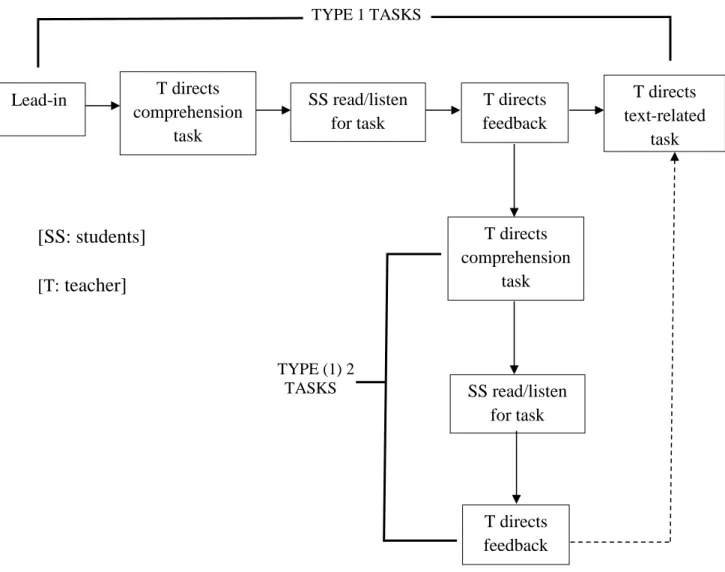
Speaking about the conduction of a listening lesson and how teachers can deal and direct students to perform the various tasks and for more guidance, it is worth providing a general picture about the procedure of teaching listening as a
3 Listeni ng S tag es Orientation/Lead in Phase Enhancement Phase Synthesis Phase
Chapter One Authentic Aural Materials in ELT
21
receptive skill. This procedure can be schematized and summarized as in figure 1.4. below: TYPE 1 TASKS [SS: students] [T: teacher] TYPE (1) 2 TASKS jjjjj
Diagram 1.4. A Basic Methodological Model for Teaching Receptive Skills (Harmer, 2007: 271)
As a matter of fact, and as stated previously, the teaching of listening along with its accompanying activities can have fruitful effects on students’ performance, comprehension and aural abilities if the implemented tasks were authentic; i.e., were introduced using authentic aural materials. So, what is meant by authentic aural materials? Lead-in T directs comprehension task SS read/listen for task T directs feedback T directs text-related task T directs comprehension task SS read/listen for task T directs feedback
Chapter One Authentic Aural Materials in ELT
22
1.5. Authenticity and Authentic Aural Materials
It should be noted that many attempts to define the concept of authentic materials have been undertaken, but no single definition seems to be formulated. According to Longman Dictionary of Applied Linguistics (1987:27):
The degree to which language teaching materials have the qualities of natural speech or writing. Texts which are taken from newspapers, magazines, etc. And tapes of natural speech taken from ordinary radio or television programs, etc., are called authentic materials.
Based on the previous idea, an authentic material is that text which contains natural genuine language that can be spoken or written. For Ellis & Johnson (1996:57) authentic materials represent “Any texts written by native English
speakers for native English speakers”. Another writer defines them as: “real-life texts, not written for pedagogic purposes” (Wallace, 1992:145). This implies, then, taking these materials as they actually are, without any modification or grading. A contrary recent view states:
An authentic text9 is the one which is produced in order to communicate rather than to teach… the text does not have to be produced by a native speaker and it might be a version of an original which has been simplified to facilitate communication. (Tomlinson, 2012:162).
With reference to the aforesaid, authentic materials are those that are not necessarily designed by a real speaker and which can be primarily modified, for the
sake of communicating and not teaching.
Indeed, each of the above mentioned definitions illustrate a specific logical point that serves the aims of this study. Therefore, each of which will be taken into Consideration during the implementation of the experiment conducted in this research. All of these definitions highlight the fact of ‘exposure to real language’.
Chapter One Authentic Aural Materials in ELT
23
According to Gebhard (1996), authentic materials are classified into three (03) categories:
Authentic printed materials, such as: newspapers, magazines, menus, advertisements, novels, poems, train tickets, etc;
Authentic visual materials, like: photographs, stamps, street signs, paintings, post cards, etc., and
Authentic listening or (listening/viewing) materials, for instance: TV commercials, radio news, cartoons, movies, songs, etc.
This last type is the main concerned subject in this research area.
In an attempt to define authentic aural materials, the UCLA International Institute (2007) explains that authentic listening texts refer to materials that are created for native speakers, including for instance: audio, video, CD, or other digital medium. In addition, it is considered as recordings of people speaking naturally and without the purpose of language learning in mind (Field, 2008).
On the basis of this, one may say that authentic aural material reflects a kind of genuine, natural and spontaneous unscripted spoken language that contain hesitations, repetitions and so on; which can take different forms (interviews, lectures, discussions…etc).
1.5.1. The Notion of "Authenticity" and its Types
For many scholars, authenticity10 is very important because it prepares learners for the real world situations in terms of using the target language. The notion of authenticity is considered as a broader and controversial concept which is associated with the communicative approach to language teaching in the 1970’s.
This complex concept has been put under discussion by many researchers
10 A state of being an authentic. According to Joy (2011:35) “the term authenticity is equivocal [i.e., open to
more than one interpretation (Concise Oxford English Dictionary (11th ed), (n.d.)] to authentic materials used for pedagogic purposes”. This explains clearly why there are various definitions given to such a type of materials.
Chapter One Authentic Aural Materials in ELT
24
(kilickaya, 2004). In this context, Widdowson (1996:30) states that “authenticity…is a term which creates confusion because of a basis ambiguity”.
This is why there are so many definitions related to authenticity.
Each researcher tries to define this term from his own perspectives. According to Tatsuki (2006), authenticity is taken as being synonymous with genuineness, truthfulness, validity and reliability of materials. Moreover, Shomoosi and Ketabi (2007) argue that it represents the materialization within an original context and the interaction of its participants. Expanding this definition, Taylor (1994) adds that authenticity is not only connected with language content, but also with the participants, the type of interaction and the interpretation of the setting and activity. Accordingly, we can distinguish four interrelated types of authenticity, as indicated by Breen (1985:67):
Text Authenticity: refers to the authentic qualities of a given text that is used to help learners in developing an authentic understanding. White (1981:20) considers an authentic text, the one which “is neither cut nor reworked or modified in any way either in its written or oral form”; it should contain all the material features of the text itself. For Lee (1995: 323-324) a text is usually regarded as textually authentic if “it is not written for teaching aims, but for real life communicative purposes where the writer has a certain message to pass on to the reader”.
Learner Authenticity: reflects the ability of students to interpret the meaning of the text, the same way native speakers do in real world, which means the ability to extract the right meaning or to comprehend the listening material proposed by the teacher, and also to respond to these materials appropriately. Task Authenticity: refers to the chosen activities given for the students to be
engaged in an authentic communication and authentic aims for learning. It is the factor of learners’ involvement in the task (Mishan, 2005). In other terms, task authenticity is the relationship between the student, the input text and his
Chapter One Authentic Aural Materials in ELT
25
response to it. “An authentic task11 is the one which engages learners in using language in a way that replicates its use in the real world outside the language classroom” (Tomlinson, 2004:7). Explaining this idea, one can say that in teaching aural skills, teachers should make listening tasks as authentic as possible, that is to say, what students are normally supposed to do while listening to a natural text, should resemble, to some extent, what native speakers do if they were listening to the same text.
Different examples can be given to illustrate the aforesaid. For instance, the aim behind listening to a train announcement is to know the time of the train (when does it arrive or leave). Also, when listening to someone giving directions, the purpose is to find a specific area or destination. For the purpose of making authentic tasks accessible and beneficial to learners, Lee (1995) suggests some points when designing these tasks:
Since the use of different language skills is a common aspect in real-life
communication situations, an integrated skill approach is recommended.
Building context for the performed tasks to allow learners to practice the skills in a more natural and relevant way.
Relevance of the task content with the selected authentic materials so as to ensure their effectiveness.
Presenting these tasks into three steps: before, during, and after listening activities.
Authentic activities have a number of features that distinguishes them from other types of activities which teachers should take into consideration and use them
as guidelines when planning their listening lessons. Herrington et al. (2010: 1426-1427), for instance, identifies 10 characteristics of authentic tasks
which can bridge the gap between the classroom and the real-world:
11
Chapter One Authentic Aural Materials in ELT
26 1. Have real world relevance.
2. Are ill-defined, requiring students to define the tasks and sub-tasks needed to complete the activity.
3. Comprise complex tasks to be investigated by students over a sustained period of time.
4. Provide the opportunity for students to examine the task from different perspectives, using a variety of resources.
5. Provide the opportunity to collaborate. 6. Provide the opportunity to reflect.
7. Can be integrated and applied across different subject areas and lead beyond domain specific outcomes.
8. Are seamlessly integrated with assessment.
9. Create polished products valuable in their own right rather than as preparation for something else.
Authenticity of the Classroom: Authenticity is not only the attribute of the outside world but also of classroom (Taylor, 1994).Therefore, teachers are responsible for creating a suitable authentic setting and enjoyable environment by presenting materials with a real communicative use through establishing authentic tasks.
What can be deduced, then, is that in authenticity, and when dealing with realistic aural materials, not only is or should the language of the text be authentic, but also its participants, its related tasks; as well as, its context. In sum, for better preparation to authentic listening, a combination of the four authenticity types, and an awareness of both authentic and non-authentic spoken language features is required.
Chapter One Authentic Aural Materials in ELT
27
1.6. Characteristics of Authentic and Non- Authentic Aural Materials
Underwood (1989: 65) identifies a number of features that distinguish authentic and non- authentic speeches12, as will be explained in the following table:
Table 1.1. Characteristics of Authentic and Non- Authentic Speeches
Authentic Speech
Non-Authentic Speech
- Real unmodified spoken language.
- Natural rhythm, speed and intonation.
- Enunciated natural pronunciation. - Some overlap between speakers
(including interruption).
- Normal rate of delivery (sometimes fast, sometimes slow).
- Relatively unstructured language. - Incomplete sentences, false starts. - Hesitations and fillers13.
- Repetitions.
- Background noise14. - Natural starts and stops.
- Less densely packed information than in written language.
- Artificial simplified speech.
- Unnatural rhythm, speed and intonation.
- Over-clear enunciation.
- Little overlap between speakers.
- Slow (and perhaps monotonous delivery).
- Structural language. - Complete sentences. - No hesitations and fillers. - No repetitions.
- No background noise. - Artificial stops and starts. - Densely packed information.
12 Non-authentic speeches or texts are specifically are specifically designed for language learning purposes.
The language involved in this type of texts is artificial and unvaried.
13
Examples of fillers include: uh, umm, er, oh, yeah, yes, well, I mean, you know…
14 To compare with non-authentic materials, authentic listening materials contain background noise.
According to Ur (1984) noise is the opposite of redundancy. It occurs when the listener cannot understand the message of the speaker.
Chapter One Authentic Aural Materials in ELT
28
Thus, an authentic text must contain all the features of speech seen above, such as: false starts, hesitations, repetition, etc. As a matter of fact, if students hear only graded materials15, they will be inadequately prepared to cope with authentic language16. In a study done by Crossley and other scholars (2007), it was found that simplified texts have more complexity than other texts.
Moreover, it was discovered that authentic texts have a positive impact, not only on listening, but also on reading, in comparison with the simplified ones (Varney and Francuili, 1992; qed in Maryam, et al, 2005). Therefore, it is important for learners to constantly receive authentic listening input which can take different types, and which will be thoroughly explained in the coming section.
1.7. Types of Authentic Aural Materials
There are different kinds that these materials can take to be used in the classroom, but the most common ones are listed below:
1.7.1. Songs
Using songs in language listening classes is very stimulating and beneficial to learners in terms of language and skills (Wilson, 2008). Allowing them, thus, to deal with different cultures, accents, vocabulary, and to focus on pronunciation aspects like stress patterns, rhythm and intonation. According to (Cakir, 1999; Gebhard, 1996) qtd in Su (2007), music could be a significant means for acquiring natural language that is understandable, entertaining and genuine in real life. Many learners prefer or like music which are addicted to. This is why, it could be a strong motive for them to acquire more and more languages, especially, with the emergence of the latest technologies, like podcasts.
15
Simplified, artificial, instructional, adapted or non-authentic materials which are made simpler for students, by modifying the content or language of the text (for example ,by adding or removing some words).
16 Real spontaneous and unmodified speech that contains hesitations, repetition of words, interruptions, false
starts, fillers, etc. It refers to any written or spoken language that is used by native speakers of the language, in which it is produced (Rogers & Modley, 1988). It is the opposite of a constructed language.
Chapter One Authentic Aural Materials in ELT
29 1.7.2. Films
Watching a film in a class represents, actually, a rich source of language input with verbal and visual stimuli that can develop the listening abilities. In this respect, Gilmore (2007) maintains that audio-visual authentic materials, like films
and TV shows… represent a rich source of input for learners which can be exploited in various ways and on different levels to improve their communicative
competence. Films, also, offer contextual support that help students to visualize words, and meanings as well (Ling, 2009). In fact, an effective use of this type lies mainly in the teachers’ ability to prepare students for receiving the film’s message (King, 2002).
1.7.3. Conversations
Live conversations which call for a real-life interaction is of paramount importance. This was called by Underwood (1989) as an “Eavesdropping”. Teachers can record a listening text or take their students to authentic situations (cafeteria, party, bus…) where many groups of people are talking together, for building later discussions.
1.7.4. News Broadcasts
It is believed that live broadcast is an essential tool that can have a positive effect on acquiring the English language (Brinton & Gaskill, 1978). Working with this sort of listening material can be hard for students; since they may feel shocked and claim that they do not understand anything. Therefore, teachers must be patient when dealing with such type.
1.7.5. Guest Speakers
Inviting a native English speaker into class, can be another efficient way to provide learners with a live and real-time listening that enables them to interact with
Chapter One Authentic Aural Materials in ELT
30
natural speech in a totally different stimulating manner than any other type of a listening material (Wilson, 2008).
Besides this, Hedge (2000) identifies other types; namely, children stories, radio plays and talks, news items, travel news, weather forecasts, airport and station announcements, debates, extracts from recorded guided tours, relaxation tapes, exercise instructions, interviews, etc. But the question to be raised here is from where can one source these listening materials?
1.8. Sources of Authentic Aural Materials
In fact, there is a limited number of sources. According to Miller (2003) the most commonly used are: TV/ Video, Radio, Audio Tape and the Internet.
1.8.1. Radio
Because of its low cost, most language teachers can have an easy access to radio and may bring it to class in order to practice listening. Different English stations are available on radio, mainly: the BBC World Service and Voice of America (VOA) which can help a lot in improving learners’ language proficiency. In spite of the greater difficulties learners face in comprehending its aural texts, listening to radio, as stated by Tomalin (1986) is a marvelous means for developing aural abilities.
1.8.2. TV/ Video
Both videotaped and TV materials provide the language learner with individual listening opportunities. It allow access to the target language and its culture, as well as, to paralinguistic17 features (facial expressions, gestures) which can aid comprehension. Video is often more preferred by language students, as it is more attractive and motivating than audio recordings. It also places language in
17 Paralanguage : the non-lexical component of communication by speech, for example: intonation, hesitation
Chapter One Authentic Aural Materials in ELT
31
context (Richards & Rod, 1990) and permits for the integration of the four language skills.
Video enables teachers to display a variety of challenging techniques18 over audio, such as: using pictures only, sound only, or pictures and sound together. These methods or activities aim at “generating new ideas and engaging in real communication” Stmpleski (1990:12). Thus, a huge amount of preparation, organization, timing, and technical training is required by instructors (Ur, 1984). Fanzy of Kentucky Educational Television (1999) (qtd in Rammal, 2006) suggests that when using video teachers can use a three-part lesson, including: pre-viewing, viewing, and post-viewing activities.
1.8.3. Audio Tape
According to Flowerdew & Miller (2005), audio-cassette players is among the simplest and cheapest ways that enable learners to experience authentic listening. Hedge (2000) points out that audio recordings expose students to a variety of listening situations, speakers, voices and speaking speeds. Consequently, their listening skills will be developed, especially replying the tape several times.
1.8.4. The Internet
It is the big source that gives easy access to an endless amount of other resources, for example: newspapers, audio materials, video clips, live radio, etc. Allowing for a real contact with authentic language. Wilson (2008) maintains that, there are a number of English language learning websites, containing different listening texts, questions, answers and explanations. One can even download some of these authentic aural materials and use it later in the class or at home. Teachers, therefore, can direct their students to some sites on the net where they can listen to different materials, as long as they have access to the appropriate computer hardware (Miller, 2003).
18
Other viewing techniques include : fast forward, silent viewing (for language), silent viewing (for music), freeze frame, partial viewing (Harmer, 2007:309).
Chapter One Authentic Aural Materials in ELT
32
However, despite of the availability of these sources, not all teachers realize how easily accessible and useful these real-life listening materials are. When using and obtaining authentic materials, one should consider a number of factors and criteria, so that students can fully benefit from exposure to such materials.
1.9. Criteria for Selecting Authentic Aural Materials
The issue of how to select authentic materials continues to be a significant process in teaching/learning the listening skill and the other language areas, as well. According to Field (2008) the aim behind selecting authentic listening materials is to give sense to the authentic input and ensure that the learner can benefit from the natural speech that is exposed to. Lee (1995:325): insists on dealing with such a selection process saying that: “a careful and wise selection of materials focused on learners is a must if we want a possible response from them”. This, simply, indicates that learners can benefit a lot from authentic materials if teachers select them appropriately, taking into account students’ variables.
The selection of authentic aural materials should be based on certain factors. The very first thing to consider before bringing such materials to the classroom is the learner’s language proficiency level. For instance, at lower levels, teachers can deal with short stories, short news, and simple songs. Unlike in the intermediate and advanced levels, in which students can be exposed to long speeches, watch movies and TV programs; dealing with formal and informal types of language.
It is also important to select materials according to students’ needs, interests and various learning styles. This can be done by providing students with a variety of topics (up to date ones), sources (a mixture of audio and video recordings) and types of materials (poems, songs, broadcasts, advertisements, train timetables…). In this regard, Berardo (2006) confirms that teachers should take into account two basic criteria when choosing authentic materials, which are: variety and presentation. A listening course can be more interesting if different text types are used. Most of the time students find it very boring and de-motivating when their teachers