Ministry of Higher Education and Scientific Research University of Mohammed Seddik Ben Yahia, Jijel
Department of English
A Dissertation Submitted in Partial Fulfillment of the Requirement for Master Degree in Didactics of Foreign Languages
Submitted by: Supervised by: Adel BOUCHERIT Mr. Mebarek AOUAMRI
Fawzi GRIMES
Board of Examiners
Chairperson: Mr. Redouane NAILI Mohammed Seddik Ben Yahia University, Jijel Examiner: Dr. Slimane BOUKHENTACH Mohammed Seddik Ben Yahia University, Jijel Supervisor: Mr. Mebarek AOUAMRI Mohammed Seddik Ben Yahia University, Jijel
Academic Year: 2018-2019
Difficulties Encountered by EFL Learners in Using and
Comprehending Phrasal Verbs:
Difficulties Encountered by EFL Learners in Using and Comprehending
Phrasal Verbs
The Case of English 3rd Year LMD Students at the English Language Department
Adel BOUCHERIT Fawzi GRIMES
Dedication
I dedicate this humble effort to;
My beloved parents for their sacrifices, love, and care in order to make me the man I am today,
My brothers and sisters for their unconditioned love and support, My friends and beloved ones for standing by my side, My partner for his contribution in this interesting experience, My class mates who walk the road with me from day one till the end,
My book friends for being such a source of inspiration, uniqueness, and development, My teachers for their guidance in all the steps of my schooling studies,
The memory of Hichame and Imene, “Though you fall apart, you always in my heart”.
Dedication
In the name of ALLAH, the Most Gracious, Most Merciful, All praise to Him alone, the Sustainer of the entire world.
I dedicate this work to:
The pillars of my life; my sympathetic MOTHER and my thoughtful FATHER whose love and support guided me all the way to success.
To all my Brothers and Sisters who always believed in me and pushed me forward and helped me in all possible ways.
To all my nephews and nieces, and all the extended family.
To my friends and classmates each one by his /her name, and the previous classmates with whom I shared the university life with all its lights and shadows.
Acknowledgements
In the Name of Allah, the Most Gracious, the Most Merciful, and the most precious. All Praise is for Allah alone, the Sustainer of the world, who guided, helped, and gave us
the capacity for doing this work.
First of all, we would like to deliver our utmost gratitude for Mr. Mebarek AOUAMRI for accepting to supervise our dissertation and to thank him for his guidance,
direction, and advice as well as his patience, motivation, and contribution while supervising our dissertation.
Special thank and appreciation for Mr. Redouane NAILI for his constant help, precious suggestions, valuable advice, insightful guidance. This thesis could not have
appeared in its final form without his help and support.
We would like to thank deeply the board of examiners: Mr. Redouane NAILI and Dr. Slimane BOUKHENTACHE for accepting to evaluate this piece of research.
We would like to show our deep thankfulness to teachers of English and third year LMD students for taking an important part in our dissertation and for being collaborative.
We would also like to express our sincere thanks to our dear mates Rida BOUDEHANE, Ahcene BOUCHEKARA, Wafa GRIDA, Fatima BOUSBIA, and Dalal
ALIOUA for devoting their valuable time, their suggestions, and their amazing ideas to help in our research.
Abstract
Despite the fact that phrasal verbs are essential linguistic items that native speakers of English constantly use in their daily conversations, informal situations, and even in their writings, EFL learners find them difficult to learn and use them less frequently. In order to tackle this issue, the present study aims at investigating EFL learners’ difficulties in comprehending and using phrasal verbs properly. It has been hypothesized that EFL learners at the University of Mohammed Seddik Ben Yahia face difficulties in comprehending and using phrasal verbs due to their semantic and syntactic properties. In this respect, a test was administered to 25 third year LMD university students of the academic year 2018/2019 to find out which semantic and syntactic types of phrasal verbs are more problematic for learners, and a questionnaire was mainly assigned to 15 teachers of oral and written expression as well as those of grammar at the same university to explore their views and perceptions on learning phrasal verbs and the main difficulties learners encounter when learning them. The findings reveal that most of EFL learners misunderstand and misuse phrasal verbs due to their idiomatic meaning. Moreover, the position of the particle and the use of the wrong verb and particle are considered to be the most syntactic problems to EFL learners. This implies that EFL learners at Mohamed Seddik Ben Yahia face difficulties in comprehending and using phrasal verbs because of their semantic and syntactic properties.
List of Abbreviations and Symbols
EFL: English as a foreign Language EModE: Early Modern English LMD: Licence, Master, Doctorate L1: First Language
L2: Second Language N: Number of students OE: Old English PVs: Phrasal Verbs
List of Tables
Table 1.1. Phrasal Verbs: The Basics ………..21
Table 1.2. Phrasal Verbs and their Equivalent One-word Verbs ... 22
Table 1.3. Distinctions of the Types of Phrasal Verbs ... 27
Table 2.1. Group-verbs in present-day English ... 39
Table 3.1. Teachers’ Gender... 50
Table 3.2. Teachers’ Teaching Experience ... 50
Table 3.3. Teachers’ Opinions about the Importance of Phrasal Verbs………...…....51
Table 3.4. Teaching Phrasal Verbs as a Whole Lesson/ Lessons to the Learners ... 52
Table 3.5. The Frequency of Phrasal Verbs’ Use in Oral Productions by Learners ... 53
Table 3.6. The Frequency of Phrasal Verbs’ Use in Writing by Learners ... 54
Table 3.7. The Use of Phrasal Verbs as a Criterion of Good Mastery of English... 54
Table 3.8. Teachers’ Notice of the Difficulties Faced by Learners in Using and Comprehending Phrasal Verbs ... 55
Table 3.9. The Main Difficulties Faced by Learners in Using and Comprehending Phrasal Verbs ... 56
Table 3.10. The Learners’ Focus While Learning Phrasal Verbs ... 57
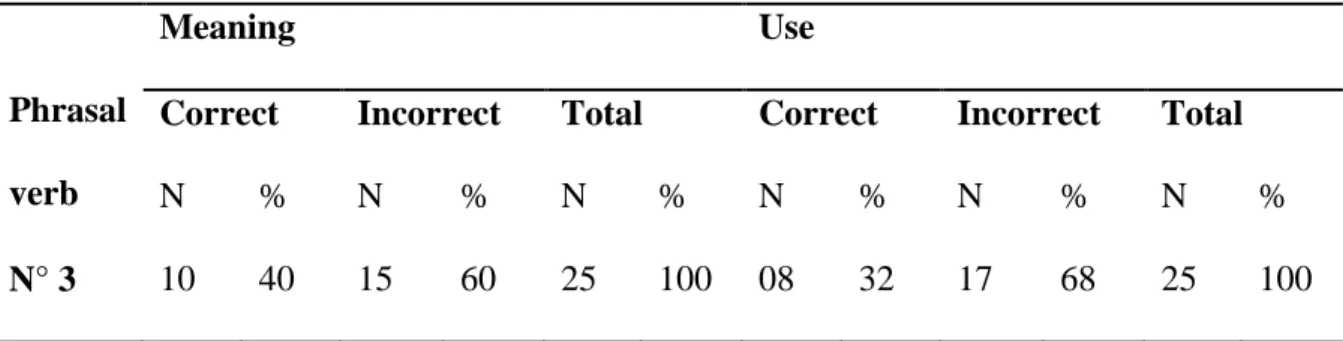
Table 3.11. Learners’ Performance in Guessing the Meaning and Using the Phrasal Verb “Fall down” ... 60
Table 3.12. Learners’ Performance in Guessing the Meaning and Using the Phrasal Verb “Climb up” ... 61
Table 3.13. Learners’ Performance in Guessing the Meaning and Using the Phrasal Verb
“Come across” ... 61
Table 3.14. Learners’ Performance in Guessing the Meaning and Using the Phrasal Verb “Walk away from” ... 62
Table 3.15. Learners’ Performance in Guessing the Meaning and Using the Phrasal Verb “Wash up” ... 62
Table 3.16. Learners’ Performance in Guessing the Meaning and Using the Phrasal Verb “Work on” ... 63
Table 3.17. Learners’ Performance in Guessing the Meaning and Using the Phrasal Verb “Read up on”... 63
Table 3.18. Learners’ Performance in Guessing the Meaning and Using the Phrasal Verb “Meet up with” ... 64
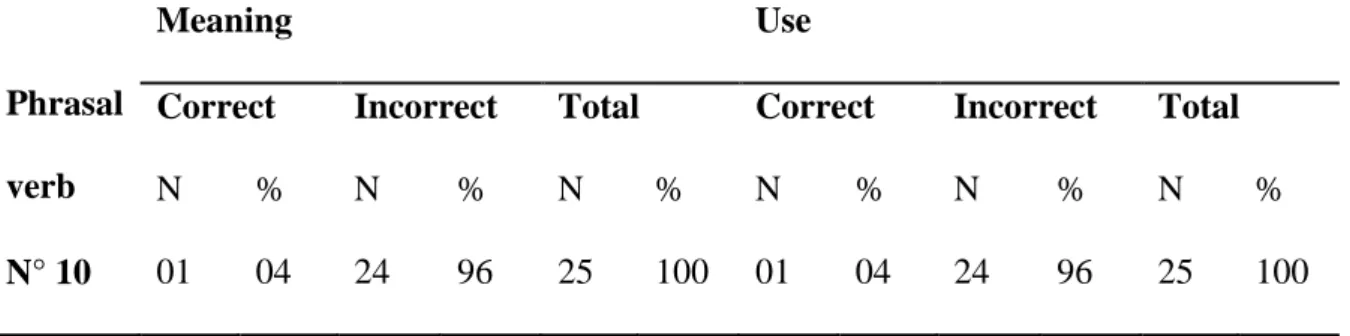
Table 3.19. Learners’ Performance in Guessing the Meaning and Using the Phrasal Verb “Make out”... 65
Table 3.20. Learners’ Performance in Guessing the Meaning and Using the Phrasal Verb “Wait on” ... 65
Table 3.21. Learners’ Performance in Guessing the Meaning and Using the Phrasal Verb “Chew out” ... 66
Table 3.22. Learners’ Performance in Guessing the Meaning and Using the Phrasal Verb “Put up with” ... 66
Table 3.23. Learners’ Performance in Using the Right Particle ... 67
Table 3.24. Learners’ Performance in Using the ight verb ... 68
Table 3.26. Learners’ Performance in Using the Right Position of the Particle ... 69
Table 3.27. Learners’ Performance in the Transitivity and Intransitivity of Phrasal Verbs 69 Table 3.28. Learners’ Performance in the Transitivity and Intransitivity of Phrasal Verbs 70 Table 3.29. Learners’ Performance in the Recognition of the Prepositional Verb ... 71
Table 3.30. Learners’ Performance in the Recognition of the Prepositional Verb ... 71
Table 3.31. Frequency of Learners’ Difficulty in the Semantic Features ... 72
Table of Contents Dedication………..1 Acknowledgements………3 Abstract………..4 List of Abbreviations………..5 List of Tables………..6 Table of Contents……….………..9 General Introduction ………...….13 Introduction………..13
1. Review of Previous Research………...………13
2. Statement of the Problem………...……15
3. Aim of the Study……….……….16
4. Research Questions………..16
5. Hypothesis of the Study……….……….…….17
6. Means of Research………...……17
7. Structure of the Study………..17
Chapter One: Overview on Phrasal Verbs………..19
Introduction………..………19
1.1. Multi-Word Items………..………19
1.2. Definitions of Phrasal Verbs………...……..20
1.3. Construction of English Phrasal Verbs………...…..21
1.4. Phrasal Verbs and One Word Synonyms………...…...……22
1.6. The Historical Rise of Phrasal Verbs………..…..24
1.6.1. Phrasal Verbs in Old English……….………24
1.6.2. Phrasal Verbs in Middle English………...….25
1.6.3. Phrasal Verbs in Early Modern English……….25
1.6.4. Phrasal Verbs in Present-Day English……….………..25
1.7. Syntactic Features of Phrasal Verbs……….….26
1.8. Semantic Features of Phrasal Verbs………..28
1.8.1. Literal Phrasal Verbs……….….29
1.8.2. Semi-transparent Phrasal Verbs……….…29
1.8.3. Idiomatic Phrasal Verbs………...…..30
1.9. Approaches to Teaching and Learning Phrasal Verbs………...…31
1.9.1. Focus on the Verb……….…..31
1.9.2. Focus on the Particle……….….32
1.9.3. Contextualization………32
Conclusion………33
Chapter Two: Difficulties in Using and Comprehending Phrasal Verbs………..34
Introduction……….………….34
2.1. Difficulties with Syntactic Properties of Phrasal Verbs………...….34
2.1.1. Problems in Using the Right Verb and Particle………...…..35
2.1.2. Problems in the Transitivity of Phrasal Verbs………35
2.1.3. Problems in the Position of the Particle……….36
2.2. Difficulties with Semantic Properties of Phrasal Verbs………37
2.2.1. Idiomaticity of Phrasal Verbs……….37
2.2.2. Multiple Meaning of Phrasal Verbs………..………….37
2.2.3. Complexity of the Phrasal Prepositional Verbs……….38
2.2.4. Idiomaticity of the Particle……….38
2.3. Phrasal Verbs and Prepositional Verbs……….39
2.4. Formality and Informality of Phrasal Verbs……….41
2.5. Register of Phrasal Verbs………..42
2.6. Phrasal Verbs Avoidance……….……….43
Conclusion………45
Chapter Three: Field Work………..………46
Introduction……….………46
3.1. Research Methodology………..46
3.1.1. Population and Sampling………46
3.1.2. Research Instruments………...…………..47
3.2. The Teachers Questionnaire………..48
3.2.1. Description and Administration of Teachers Questionnaire………..48
3.2.2. Analysis of Teachers Questionnaire……….………..49
3.2.3. Interpretation and Discussion of Teachers Questionnaire Results……….………58
3.3. The Students Test………..59
3.3.1. Description and Administration of Students Test………...59
3.3.3. Interpretation and Discussion of Students Test Results……….72
3.4. Overall Analysis of the Results……….…74
Conclusion……….…...76
General conclusion……….…77
Pedagogical Recommendations………....78
Limitations of the Study……….……..78
Suggestions for Further Research……….79 References
Appendices Résumé
Introduction
1. Review of Previous Research
2. Statement of the Problem
3. Aim of the Study
4. Research Questions
5. Hypothesis of the Study
6. Means of Research
General Introduction Introduction
In the process of second language acquisition, learners of second language (L2) acquire the capacity to comprehend language, as well as to produce and use sentences to communicate. An adequate command of English as a foreign language (EFL) largely depends on the mastery of its different aspects. One of these aspects is phrasal verbs. A phrasal verb is a combination of a lexical verb and a particle that can be either a preposition or an adverb. These items are very important to comprehend and communicate in both formal and informal situations. Cornell (1985), stated that phrasal verbs are notably essential to comprehend and communicate with native speakers since they are commonly used in spoken and in informal written language. Fletcher (2005) stressed that phrasal verbs can also be used in all types of texts, even in formal texts, when they are the most appropriate way to convey an idea. However, it is widely observable that the majority of EFL learners encounter difficulties in understanding and using the phrasal verbs. There is no doubt that phrasal verbs are considered to be an important feature of English and one which presents the learner with considerable difficulty (Crystal, 1995). Alexandra (2001) stated that phrasal verbs, as lexical items, are undoubtedly one of the most difficult tasks in learning a second language. All researchers admit that English phrasal verbs are one of the most puzzling items of the English language to be learned by EFL learners because of their features.
1. Review of the Previous Research
Identifying the difficulties and problems EFL learners face when using and comprehending phrasal verbs was considered as an interesting topic in the language teaching area, studies were carried out to investigate the common errors and the main sources of difficulties and problems faced by EFL learners in different contexts.
Liao and Fukuya (2004) investigated avoidance of English phrasal verbs by Chinese learners. They took into account learners’ level (intermediate, advanced) and phrasal verbs types (figurative, literal). Participants were divided into seven groups including six groups of Chinese learners and the control group of native speakers. Each of the six groups was asked to choose one of the three types of tests (multiple choice, translation, or recall) whereas the control group of native speakers took the multiple-choice test. The results indicate that intermediate learners avoided using phrasal verbs and preferred to use single word synonyms because their first language (L1) lacks phrasal verb structure. In contrast, advanced learners did not adopt avoidance strategy, but they used phrasal verbs less than native speakers did. Further, advanced, as well as intermediate learners tended to use literal phrasal verbs more than figurative ones.
Al- Qudah (2012) identified the main errors committed by English major undergraduates at all levels at Yarmouk University in Jordan in the acquisition of some selected phrasal verbs. The researcher designed a forty-item test to be distributed to 120 students at the department of English to assess their acquisition of the selected phrasal verbs in four areas: semantics, structure, collocations, and phonology. The findings of the study indicate that 67.5% of the participants scored above the average whereas 32.5% of them scored below the average. The students did best in the area of structure with a mean of 78.3%. Therefore, they proved to have difficulties in the acquisition of semantic and collocational features of phrasal verbs. Fadanelli (2012) conducted a corpus study to examine the similarity between the most common phrasal verbs used by Brazilian EFL learners and native speakers of English. The study also investigated the tendency of Brazilian EFL learners to avoid using phrasal verbs. The results revealed that Brazilian learners tend to adopt the strategy of avoidance in the phrasal verb usage. Moreover, a
large number of phrasal verbs found in the corpus used by Brazilian EFL learners were not the same as the phrasal verbs used by native speakers.
In addition, GarElzain (2012) tackled the uses of phrasal verbs and prepositional verbs by EFL students at Sudan University of science and technology (faculty of languages). The study is also oriented to examine learners’ attitudes towards using phrasal verbs and prepositional verbs. A test and a questionnaire were administered to collect data. The results of the study revealed that university EFL students were not able to use phrasal verbs and prepositional verbs due to their limited vocabulary. This keeps them away from getting access to the meaning of these English items. The findings also displayed that the majority of students have negative attitudes towards using English phrasal verbs and prepositional verbs. They considered phrasal verbs and prepositional verbs the most problematic part of language to be learned because of their figurative meaning.
Recently, Bronshteyn and Gustafson (2015) tackled the challenges facing EFL learners including mastery problem and avoidance. In addition, they provided a proposed approach to go beyond teaching the syntactic level and look for ways to teach the semantic understanding of these structures. They concluded with a review of literature, which proposed some innovations in teaching phrasal verbs. According to the studies they reviewed, they found that teaching phrasal verbs through using pictures and working in pairs increases interaction, talk, and feedback. This may help EFL learners to better identify and interpret phrasal verbs.
Numerous studies have been carried out to investigate the main difficulties and problems EFL learners face in learning and using phrasal verbs in different contexts. The main causes behind these problems are explained in relation to their semantic features and their context in which EFL learner’ native language is overused. The current study is an
attempt to investigate the main difficulties that EFL learners encounter in comprehending and using PVs in accordance with their semantic and syntactic features.
2. Statement of the Problem
Phrasal verbs are one of the distinctive features of native speakers. They use them in their every day conversations effectively and purposefully. However, phrasal verbs are considered to be an area of difficulty for EFL learners. The main problem in comprehending phrasal verbs is that their meaning could be too ambiguous to guess even though the learners might know the meaning of their individual parts. Moreover, restrictions in the construction of phrasal verbs could cause a problem for EFL learners in their use. In light of what is indicated above, the researchers in this study were pushed to wonder whether the semantic and the syntactic features pose difficulties for EFL learners in the comprehension and the use of phrasal verbs.
3. Aims of the Study
The aim of this study is to shed light on the difficulties faced by EFL learners when using and comprehending phrasal verbs in relation to their semantic and syntactic properties. Second, it aims at identifying the most difficult semantic and syntactic types of phrasal verbs for EFL learners. It also aims at exploring the teachers’ views and perceptions about the English phrasal verbs.
4. Research Questions
The present research raises the following main questions:
To what extent are learners at the department of English aware of the use and comprehension of phrasal verbs?
Do syntactic and semantic properties of phrasal verbs cause any difficulty for Algerian EFL learners?
How much time or lessons are devoted to teach and learn phrasal verbs at the department of English?
To what extent are phrasal verbs used by learners at the department of English in oral and written productions?
5. Hypothesis of the Study
Considering the above research questions, the following hypothesis is formulated: EFL learners at the department of English at Mohamed Seddik Ben Yahia, Jijel University, face difficulties in using and understanding phrasal verbs due to their semantic and syntactic features.
6. Research Methodology
Beiske (2002) claims that: “while factors such as time and costs certainly play an important part in deciding how to approach a particular research problem, the subject of the research itself should ultimately determine the methods used” (p.1). In line with the above statement, the researchers have opted for a quantitative method, strongly believing that it is the most suitable for conducting this research. For the purpose of data collection and in order to find some acceptable answers for the questions of this research, a questionnaire will be assigned to EFL teachers at the department of English at Mohamed Seddik Ben Yahia, Jijel University. Likewise, an exploratory test will be addressed to third year students of English. The choice of third year students is based on the assumption that being advanced learners, and supposed to have a large vocabulary in the target language. The main reason behind the use of the questionnaire and the test is to investigate the students’ difficulties in using and understanding phrasal verbs in accordance with their semantic and syntactic properties.
7. Structure of the Study
The research presented is divided into two parts, in addition to a general introduction which presents an overview about the topic, and a general conclusion that summarizes the whole study.
The theoretical part includes two chapters. Chapter one “Overview on Phrasal Verbs” provides definitions of multi-word items and phrasal verbs. Also, it emphasizes on the construction and one word synonyms as well as on the importance of phrasal verbs and its historical rise. In addition to that, it sheds light on the semantic and the syntactic features of phrasal verbs and refers to approaches to teaching and learning these items.
The second chapter entitled “difficulties in using and comprehending phrasal verbs” focuses on the difficulties related to both semantic and syntactic features and distinguishes between phrasal verbs and other multi-word items specifically prepositional verbs. Then, it tackles the issue of formality and informality of phrasal verbs and their register and ends with discussing the problem of learners’ avoidance of using phrasal verbs.
The Practical part “Fieldwork” presents the population and the sample besides the description of the research tools used. It also presents the analysis and interpretation of the teachers questionnaire and students test and ends with an overall discussion as an attempt to answer the research questions.
Introduction
1.1. Multi-Word Items
1.2. Definitions of Phrasal Verbs
1.3. Construction of English Phrasal Verbs
1.4. Phrasal Verbs and One Word Synonyms
1.5. Importance of English Phrasal Verbs
1.6. The Historical Rise of Phrasal Verbs 1.6.1. Phrasal Verbs in Old English 1.6.2. Phrasal Verbs in Middle English 1.6.3. Phrasal Verbs in Early Modern English 1.6.4. Phrasal Verbs in Present-Day English
1.7. Syntactic Features of Phrasal Verbs
1.8. Semantic Features of Phrasal Verbs 1.8.1. Literal Phrasal Verbs
1.8.2. Semi-transparent Phrasal Verbs 1.8.3. Idiomatic Phrasal Verbs
1.9. Approaches to Teaching and Learning Phrasal Verbs 1.9.1. Focus on the Verb
1.9.2. Focus on the Particle 1.9.3. Contextualization Conclusion
Chapter One: Overview on Phrasal Verbs
Introduction
Phrasal verbs are one of the distinctive features of the English language. They are widely used in spoken discourse by native speakers, and can also be a common part of written and formal English. Given the fact that phrasal verbs are important patterns of English language, a considerable amount of literature has been published in the area of phrasal verbs, notably in the field of EFL, such as Littlemore (2001), Fletcher (2005), and Littlemore (2006) who stress out the importance of phrasal verbs to language learners. This chapter provides an overview of phrasal verbs. First, it begins with a definition of multi-word items, of which phrasal verbs are a subtype as well as some definitions of phrasal verbs. Then, it deals with the importance of phrasal verbs and their historical rise. In addition to that, it includes a more detailed description of English phrasal verbs by discussing their syntactic and semantic features. Last but not least, the chapter sheds light on the different approaches to teaching and learning phrasal verbs.
1.1. Multi-word items
Grammar has been taken as an important part of language. One constituent of grammar is verbs. However, verbs are divided into two categories; single word verbs and multi-word verbs. Multi- word verbs (also known as multi-word items) is the general term in which the structure of phrasal verbs is one type. Before dealing with phrasal verbs in detail, it is worthwhile to shed light on the three classes proposed by Lindstromberg (2010) into which multi word verbs can be divided. He explained that these elements consist of a verb and one or two additional elements, which are either prepositional adverbs (also known as adverbial prepositions) or prepositions. Thus, multi-word items can be broken down into three broad categories; phrasal verbs, phrasal prepositional verbs, and prepositional verbs.
• Phrasal Verbs: for example, Look up a word, in which up is considered to be a preposition whose grammatical object is a word. Considered to be particle rather than a full-blooded preposition.
• Phrasal-prepositional Verbs: for example, Put up with bad behavior, each of which is considered to consist of a phrasal verb put up followed by a prepositional phrase with bad behavior.
• Prepositional Verbs: for example, Look after a cat, in which after is considered to be preposition whose grammatical object is a cat.
1.2. Definitions of phrasal verbs
A Phrasal verb is the kind of verb that operates more like a phrase than a word. McArthur (1992) noted that these verbs are also referred to by many other names such as: verb phrase, discontinuous verb, compound verb, adverb combination, and verb-particle construction. Crystal (1995) called this linguistic phenomenon a “Multi-word verb” that is best described as a lexeme, a unit of meaning that may be greater than a single word.
The term “phrasal verb” is still debatable among grammarians and researchers and many researchers define phrasal verbs differently. However, the term phrasal verb is broadly used to refer to a combination of verb with an adverb or a preposition to form a new word category that functions together as a whole. According to Murcia and Freeman (1999), a phrasal verb consists of two or more parts, a verb + an adverb or/and a
preposition called a particle which functions as a single word (p.426).
Riguel (2014) claimed that verb-particle construction might be “semantically more figurative” i.e. it is difficult to guess the meaning of phrasal verbs (p.113). Moreover, Wyatt (2006) mentioned that the meaning of phrasal verbs can sometimes be easy to
obtain. However, in most cases the meanings are very different from those of the basic verb they are composed of (p.4).
Schmitt and Siyanova (2007, p. 119) proposed that multi-word verbs consist of two or more orthographic words acting as a single lexical unit whose meanings sometimes are quite easy to figure out from its separable parts. For Bolinger (1971), a PV is a combination of a verb and a particle which can be either an adverb or preposition, functioning together as a new lexical unit.
From the previously mentioned definitions of the term phrasal verb, it is obviously noticed that the PV is defined from two angles which are syntactic and semantic.
1.3. Construction of English phrasal verbs
Phrasal verbs on the whole are formed from a small number of common verbs and a small number of prepositions or adverbs. “About, (a) round, at, up, to, through, over, out, on, off, into, in, for, down, back, away” are some of the most common phrasal verb particles. In addition, there are common verbs which form part of useful, everyday phrasal verbs including; “break, bring, call, come, cut, give, get, go, keep, knock, look, make, pass, pick, pull, put, run, set, take, turn”(McCarthy & O’Dell, 2004, p.6; Wyatt, 2006, p.4). The table below represents some key verbs of phrasal verbs and common particles and how they are combined together to construct a single unit with a different meaning.
Table 1.1
Phrasal verbs: the basics
Verb Particle Example Meaning
look up You can look up any new words in your dictionary.
You can find the meaning of any new words in your dictionary.
couldn’t get through. a connection. make out I just can’t make Jim out at
all.
I just can’t understand Jim’s behavior.
Retrieved from: “English phrasal verbs in use” by McCarthy & O’Dell, 2004, p. 6
The above mentioned table shows how the meaning of verbs and particles as separate units differs from the meaning of the whole phrasal verb as one unit. For example, look means to use your eyes and up means the opposite of down. However, the phrasal verb look up in the sentence “you can look up any new words in your dictionary” means to search for information in the dictionary. Moreover, the same phrasal verb can have various meanings as it is illustrated in the following examples of the phrasal verb look up (McCarthy & O’Dell, 2004, p.6):
• (5) I will look you up next time I am in London. (Look up = visit someone that you have not seen for a long time)
• (6) Things are looking up. (Look up = improve)
1.4. Phrasal Verbs and One-Word Synonyms
Phrasal verbs usually have one-word synonym that sounds more formal and preferred in formal contexts than their equivalents phrasal verbs but both can replace each other and exist in language structure. The table below shows some of phrasal verbs and their equivalent one-word verbs (McCarthy & O’Dell, 2008).
Table 1.2
Phrasal Verbs and their Equivalent One-word Verbs
Phrasal verb Synonym (one-word verb) Example Put forward
(idea, opinion,
Present In her latest article, Kaufman puts forward a theory which is likely to
view) prove contraversial.
Carry out Conduct I intend carry out a series of
experiments.
Make up Constitute Children under the age of 15 made up
nearly half of the country’s population.
Make up of Consist of Parliament is made up of 2 houses. Point out Observe Greme points out that the increase in
life expectancy has led to some economic problems.
Point up Highlight The study points up the weakness in
the current school system. Retrieved from: “Academic vocabulary in use” by McCarthy & O’Dell, 2008, p. 20
1.5. Importance of English phrasal verbs
It is said that phrasal verbs are mainly used in spoken rather than written form and they are very common in informal rather than formal language, while their one word equivalents are more often used in formal contexts. However, De Cock (2005) argues that the usage of PVs by native speakers to be greatest in conversations with over twice the frequency in academic writing. This suggests that PVs are not completely absent from formal settings and there are many instances in formal occasions in which the use of PVs is more appropriate and sound more natural in expressing certain ideas (Fletcher 2005). Apart from that, most PVs are idiomatic in meanings; and it is believed that ‘metaphoric intelligence’ has an important role to play in all areas of communicative competence and can contribute to language learning success (Littlemore 2001, 2006). This further suggests the importance of PVs to language learners and without having good knowledge of PVs
and an ability to use them appropriately, it is almost impossible for learners to gain fluency in English. Thus, it is clear that this particular language form deserves equal attention and better treatment in language teaching and learning.
1.6. The historical rise of phrasal verbs
It is well known that phrasal verbs are one of the most frequent forms in spoken and written English. They are developed throughout history to create the final combination of verb +particle used in present day English. This combination is traced back to Old English.
1.6.1. Phrasal verbs in Old English
According to Lamont (2005), phrasal verbs of the present-day English are not generally found in the same form as they are existed in OE and they are rarely used. The forms that were much more common in OE are known as “inseparable-prefix verb”, a form in which the particle was attached to the beginning of the verb. These Old English prefixed verbs are comparable to current phrasal verbs. For example, OE had the verb baernan (to burn) and the phrasal verb fbrbaernan (to burn up). Phrasal verbs of the present-day English are two separate units, whereas the old form is inseparable in which the prefix “for” is connected to the verb and could not take other position as particles of Modern English can. Akimoto (1999) stated that Old English prefixes preceded the verb for the reason that “Old English had strong object-before-verb (OV) tendencies”, meanwhile, Present-Day English is largely a VO (verb-before-object) language. Affectingly, particles become able to shift to “post-verbal positions”. In other words, Old English prefixes are attached to the verb. In contrast, the verbs and particles of the phrasal verbs of present day English form two separate units (as cited in Lamont, 2005).
1.6.2. Phrasal verbs in Middle English
Middle English witnessed the emergence of new forms of phrasal verbs. Denison (1986, p. 47) argued that the construction of “prefixes-verbs” in OE suffered from the loss of productivity. As a result, certain authors direct their attention toward adding post-verbal particles to prefixed verbs believing probably that the prefix was no longer meaningful. In addition, Fischer (1992, p. 386) indicated that the French language contributed intensely and directly to the development of phrasal verbs through the rapid borrowings of French verbs into Middle English.
1.6.3. Phrasal verbs in Early Modern English
In Early Modern English, phrasal verbs witnessed an explosion in their use. Hiltunen (1999)noted that phrasal verbs were highly used in EModE dramatic texts because of their variable feature in their meaning and their “productive capacity to be expanded to form new idioms”(as cited in Lamont, 2005). Akimoto (1999) also approved that phrasal verbs are used more frequently in letters and dramas than in essays or academic writing in the 18thand 19thcenturies (as cited in Lamont, 2005). This confirms that phrasal verbs occupied a lower social position in EModE than, perhaps, single verbs.
1.6.4. Phrasal verbs in Present-Day English
The number of phrasal verbs continued to increase since the 19th century and particularly in the mid 20th century (Olson, 2013, p.14). Thereafter, because of the productive criteria of phrasal verbs, new complex forms of verb particle combinations are constructed and created (Lamont, 2005). In present day English, the phrasal verb is a “lexeme” that takes a separable adverbial particle (Wild & Mphil, 2010, p.14), and it is more restricted by specific semantic and syntactic features (Thim, 2012, p.10).
1.7. Syntactic features of phrasal verbs
Like one-word verbs, phrasal verbs have some distinctive characteristics that differentiate them from other classes of verbs. The combination of phrasal verbs is not random; it has some restrictions on their composition. To make it clearer, types of phrasal verbs were discussed by scholars and researchers such as Wyatt, Courtney, and McCarthy and O’Dell.
Phrasal verbs are of two types: transitive and intransitive. Wyatt (2006, p.4) provided a clear definition of transitive and intransitive phrasal verbs.
• Intransitive phrasal verbs: Phrasal verbs that do not require an object, such as in: You’re driving too fast, you ought to slow down.
• Transitive phrasal verbs: phrasal verbs that require an object to come after the verb or after the particle as in: I think I’ll put my jacket on or I think I’ll put on my jacket.
If the object is a pronoun, however, it must come between the verb and the particle, as it is displayed in the following example. I think I'll put it on (not I think I'll put on it). However, transitive phrasal verbs may include the following cases:
• Transitive phrasal verbs: phrasal verbs that require an object to come between the verb and the particle, such as look up in the example below. The student looked the word up.
• Transitive phrasal verbs: phrasal verbs that require an object to come after the particle: The baby takes after his mother (not the baby takes his mother after). Why do you put up with the way he treats you? (Not why do you put with the way he treats you up).
• Phrasal verbs with two objects: one comes after the verb and the other after the particle. They put their success down to good planning.
Courtney (1983, p. 85) distinguished three types of phrasal verbs including verb+ adverb, as in my car broke down on the way to work. Verb+ preposition as in she set about making a new dress. And verb+ adverb+ preposition as in I cannot put up with him because he is always complaining.
Further, McCarthy and O’Dell (2004, p. 6) make another more detailed distinction of the types of phrasal verbs. They provide seven different grammatical patterns of phrasal verbs based on the transitivity of these verbs. These patterns are displayed in the table below:
Table 1.3
Distinctions of the Types of Phrasal Verbs Grammar
pattern
comment example
Eat out The verb is used without an object
We were too tired to cook at home so we decided to eat out. (eat in restaurant).
Not: we decided to eat out a meal. Bring back sth
or bring sth back
The verb must have a non-human object
This photograph brings back happy memories. (makes me remember or think about sth in the past).
Not: this photograph brings back my sister. Ask out sb or
ask sb out
The verb must have a human
I’d love to ask Sally out. (Invite Sally to go to a place like a cinema or restaurant). I’d love to
object askmy dog out. Look aftersb/
sth
The object can be human or non- human.
I’ll look after the babywhile you’re cooking. Will you look after my bikewhile I’m away?
Ring sb back The object must come before the particle.
I’ll ring you back later (phone you again) Not: I’ll ring back you.
Look aftersb/sth The object must come after the particle
Can you look after the dog while I’m away? Not: Can you look the dog afterwhile I’m away?
Drop off
sb/sthOrdrop sb/sth off
The object can be before or after the particle.
I dropped off the packageat her house (delivered/left). I dropped the package off at her house.
Retrieved from: “English phrasal verbs in use” by McCarthy & O’Dell, 2004, p. 6
1.8. Semantic features of phrasal verbs
Phrasal verbs possess not only syntactic features but also have semantic features. Hussein (2015, p. 285) stated that the combination of a verb followed by a preposition or an adverb bestows phrasal verbs various meanings. The meaning of phrasal verbs tends to be uncompositional. Although learners may understand both components forming a phrasal verb in isolation, once they are presented together a new meaning is derived. Celce-Murcia and Larsen-Freeman (1999) provided an account for the categorization of phrasal verbs in three different layers in relation to the degree of transparency that these entail.
• Literal (also called transparent, directional, and systematic).
• Semi-literal (also called semi-transparent and semi-idiomatic).
The division of phrasal verbs into three types is very helpful because the difficulty of the phrasal verb depends on its type.
1.8.1. Literal Phrasal Verbs
This category is composed of phrasal verbs that appear to be a combination of a verb and a directional preposition as climb up. However, they are classified as phrasal verbs, because they function syntactically like verb-particle constructions.
The particle retains its prepositional meaning and, therefore, the phrasal verb meaning is a straightforward product of their semantic components. Literal phrasal verbs are highly guessable by knowing the basic literal meaning of the component words. Thus, the meaning can be derived from the meaning of its constituent parts.
According to (Celce-Murcia & Larsen-Freeman, 1999; Dagut and Laufer 1985) here are some examples of literal phrasal verbs: sit down, stand up, hand out, and throw away.
1.8.2. Semi-Transparent Phrasal Verbs:
This is the second category where the meaning of the phrasal verb is neither literal nor idiomatic. This category consists of verbs to which certain particles describe the result of the action or reinforce the degree of the action denoted by the verb (Celce -Murcia & Larsen- Freeman, 1999). The particles in this category appear to modify the meaning of the verb rather than serve as adverbials (Fraser, 1976).
This category can be subdivided into four semantic classes, depending on the semantic contribution of the particle:
• Inceptive (to signal a beginning state) as in John took off.
• Continuative (to show that the action continues) as in His speech ran on.
• Iterative (use of over with activity verbs to show repetition) as In : He did it over and over again until he got it right.
• Completive (uses particles up, out, off, and down to show that the action is complete.)
Turns an activity verb into an accomplishment as in: He drank the milk up.
Reinforces the sense of goal orientation in accomplishment verbs as in: He closed the suitcases up.
Adds durative to a punctual achievement verb as in: He found out why they were missing.
These completive phrasal verbs are normally equivalent to the corresponding simplex verb and an expression such as to the end, completely, and all of it (Brinton, 1988).
1.8.3. Idiomatic Phrasal Verbs
This is the third category where the meaning of the phrasal verb is idiomatic.
It is difficult and may be impossible to figure out the meaning of the verb by combining the separate meanings of its parts because a new meaning has resulted from a metaphoric shift of the meaning and the semantic fusion of the individual components. Thus, idiomatic phrasal verbs have lexicalized meanings, For example, He ran up the bill. Therefore, knowing the common senses of ran, and the spatial sense of up is unlikely to help a learner guess that ran up the bill means increased the amount of money (Dagut and Laufer, 1985; Laufer and Eliasson, 1993; Celce-Murcia & Larsen-Freeman, 1999).
However, someone can understand idiomatic phrasal verbs by understanding the underlying logic of the language. For example there is a contradiction between a phrase with a verb + preposition sequence as in He ran up the hill, and with a phrasal verb as in He ran up the bill. In each sentence, run contributes a sense of motion entailing change and up contributes the meaning of higher vertical direction on some path.
The listener can use logic to infer that if one is running up a bill and something is going to change, then what is going to change is the amount of money. Because the direction is up, it means that the amount of money will increase (Celce Murcia & Larsen- Freeman, 1999). Bolinger (1971) stated that the primitive directional meaning of up is modified to the aspectual one by the direction that most physical acts of completion take and, therefore, up in is associated with increase in the example of He ran up the bill.
1.9. Approaches to teaching and learning phrasal verbs
Phrasal verbs are considered to be one of the difficult areas for EFL learners. Different approaches were introduced and developed in order to solve problems related to teaching and learning phrasal verbs. Marks (2006) proposed several approaches to be used by teachers and learners.
1.9.1. Focus on the Verb
This approach helps learners to identify the basic relationship of meaning shared by some phrasal verbs that contain the same verb. In this case, teachers are supposed to push learners to use the meaning of the basic verb in order to guess the meaning of the phrasal verb. For example, learners should be able to find out the meanings of these phrasal verbs from the meaning of the basic verb put.
• Television can be a useful way of putting across health messages. (Convey)
• One option is to put back the wedding. (Rearrange for a later time)
• Why can’t you put your past behind? (Forget)
According to the examples above, phrasal verbs are composed of the same basic verb put carried different meanings when combined with different particles such as across, back and behind. Learners would infer the meanings of these phrasal verbs from the meaning of the verb put and they should be aware of the position of the particle.
1.9.2. Focus on the Particle
The focus in this approach is on the particle rather than the verb. Learners are supposed to look for the systematic characteristics of the particle’s meaning according to its usage and its physical movement. The coming examples will show how the particle up when combined with different verbs expresses different meanings such as: beginning to happen, exist, or appear.
• The newspapers have been accused of whipping up hysteria against migrant workers. (Beginning to happen)
• The two boys cooked up a plan to steal the bike. (Exist)
• Several problems cropped up just as we were finishing. (Appear)
1.9.3. Contextualization
In this approach phrasal verbs are linked to the context they are used in. it will allow teachers to provide learners with further practice which help them memorize common phrasal verbs used in native contexts. Some phrasal verbs are mainly used according to their regional variation. For instance, speakers of British English, or even speakers from other regions of USA might understand some expressions differently because they are used in different contexts. Examples of this could be:
• An American might call you up on your cell phone. (Call up= American equivalent of crush).
• A British would ring you up to tell you he needed you to keep down (to stay temporarily) in your apartment. (Ring up= associated with telephone).
According to the examples above even though the meaning of the phrasal verbs call up and ring up is associated with telephone, the phrasal verb call up is used in the American
context to indicate a meaning that is different from the first one. It has the meaning of crush in the American context.
In addition to these three approaches, another approach is concerned with “combining the same phrasal verb with its different meanings” where learners will be able to identify the different meanings that one phrasal verb may have in different situations. For example, the phrasal verb take off can extend to more than one meaning such as:
• To take off clothes (to remove).
• To take off a person (to imitate).
• To take off £5 (to reduce £5).
Conclusion
As a conclusion and with regard to the points that have been covered in this chapter, phrasal verbs are thought to be an important feature of the English language. They play a large part in English today, particularly in spoken English. As such, being able to use them correctly is a sure way to reaching an advanced speaking level. Although they are defined differently by researchers, there is a common agreement that the term refers to a combination that consists of a lexical verb plus a particle. Based on the fact that most phrasal verbs have idiomatic meanings, their idiomaticity is believed to be the most important aspect of the English phrasal verbs; a few simple words are used to give a large number of different meanings by adding prepositions or adverbs. Phrasal verbs are also characterized by their productive capacity to invent new phrasal verbs and new meanings. The next chapter introduces the different problems and difficulties related to phrasal verbs.
Introduction
2.1. Difficulties with Syntactic Properties of Phrasal Verbs 2.1.1. Problems in Using the Right Verb and Particle 2.1.2. Problems in the Transitivity of Phrasal Verbs 2.1.3. Problems in the Position of the Particle
2.1.4. Problems in the Recognition of the Prepositional Verb 2.2. Difficulties with Semantic Properties of Phrasal Verbs
2.2.1. Idiomaticity of Phrasal Verbs 2.2.2. Multiple Meaning of Phrasal Verbs
2.2.3. Complexity of the Phrasal Prepositional Verbs 2.2.4. Idiomaticity of the Particle
2.3. Phrasal Verbs and Prepositional Verbs 2.4. Formality and Informality of Phrasal Verbs 2.5. Register of Phrasal Verbs
2.6. Phrasal Verbs Avoidance Conclusion
Chapter Two: Difficulties in Using and comprehending Phrasal Verbs
Introduction
Phrasal verbs are considered to be an important element of vocabulary in the English language. Their large number and the various meanings they carry have made English a rich and unique language in terms of vocabulary. They are classified as a distinctive feature of native speakers and mastering them will enable EFL learners to reach native like fluency or proficiency. However, phrasal verbs are very problematic and cause a high degree of difficulty for EFL learners, especially in their use and comprehension. Restrictions in the formulation of phrasal verbs and their idiomatic meaning are two of the most common factors that increase the difficulty of mastering phrasal verbs. This chapter emphasizes the problems related to syntactic and semantic properties, includes a distinction between phrasal verbs and prepositional verbs, and elaborates the formality and informality, register, and learners’ avoidance of phrasal verbs.
2.1. Difficulties with Syntactic Properties of Phrasal Verbs
Due to the syntactic properties of English phrasal verbs, their use presents one of the difficulties experienced by learners of English as a foreign language. Based on this fact, it is very important to shed light on the difficulties related to syntactic properties of English phrasal verbs. De Cock (2006) describes the difficulties learners of English as a foreign language encounter when using phrasal verbs. These include mainly the confusion in using the right verb as well as the right particle, transitive and intransitive phrasal verbs, and the confusion with prepositional verbs.
2.1.1. Problems in using the right verb and particle
In some cases, learners tend to use the right verb but the wrong particle. For example:
• You must fill up this form before we let you in. (Instead of You must fill in this form before we let you in)
• It is a task which must be carried on using the brain. (Instead of it is a task which must be carried out using the brain)
In other cases, learners tend to use the right particle but the wrong verb as in:
• We tried to come back to (instead of go back to) Los Angeles.
• Saddam Hussein had the power to shut off (instead of turn off) the heat in millions of homes.
2.1.2. Problems in the transitivity of phrasal verbs
EFL learners sometimes make errors in using transitive phrasal verbs intransitively or vice versa. The following sentences illustrate the learners’ confusion, using transitive and intransitive phrasal verbs:
• The state should help parents to grow up better generations. (Incorrect)
• He or she begins to look for another love, splitting up the relationship. (Incorrect)
The above-mentioned examples indicate that intransitive phrasal verbs grow up and split up do not require an object but they are used inappropriately as transitive. Whereas, the appropriate use of these intransitive phrasal verbs is expressed in the following examples:
• Oh do grow up! You’re acting more like children. (Intransitive)
2.1.3. Problems in the position of the particle
Phrasal verbs can also cause problems for EFL learners because of the different positions particles take. As a result, learners get confused in putting the particle in the appropriate place, especially with separate phrasal verbs (Olteanu, 2012, p.82). The following examples display how the particle can possess different positions.
• The soldiers blew up the bridge, or the soldiers blew the bridge up.
• Leave off working.
• She kept the door open.
The particle in phrasal verbs blew up, leave off, and kept open took different positions in the examples above. First, it is correct to use the particle up of the phrasal verb blew up in two different positions either to follow the basic verb blew or to come after the object. In contrast, the phrasal verb leave off must be used inseparably. However, the phrasal verb kept open has always to be used separately.
2.1.4. Problems in the recognition of the prepositional verbs
De Cock (2006) claims that phrasal verbs with prepositional particles, also known as prepositional verbs, are considered as a frequent source of difficulty for EFL learners. This is because learners may not recognize that a verb is a prepositional verb that needs to be followed by a preposition. The coming examples illustrate the misuse of the verbs comment, pay, and listen. They are used alone while they require the preposition on, for, and to respectively.
• I would also like to comment (instead of comment on) the second part of the title.
• We don't have enough money to pay (instead of pay for) a flight.
2.2. Difficulties with Semantic Properties of Phrasal Verbs:
Phrasal verbs can be difficult to understand and use by EFL learners due to their idiomatic meanings as whole units, the various meanings that one phrasal verb may have, and the different figurative meanings that particles contain.
2.2.1. Idiomaticity of phrasal verbs
The idiomatic meaning that phrasal verbs possess poses serious problems for foreign learners to predict. When learners encounter unfamiliar phrasal verbs they are able to identify what the basic verb means and what the particle means. Nevertheless, putting the two together creates a meaning that is completely different from the literal meaning of the two components. For instance, learners are aware of the meaning of the verb put and the particle off but this would not help them to deduce the meaning of the whole phrasal verb put off. Moreover, one may find it easy to understand the meaning of the sentence he put off his hat while it seems difficult to have a clear idea of the meaning of the sentences the plane took off (the plane rose into the air) or he took off his teacher (he imitated his teacher) (Rundell, 2005; Olteanu, 2012, p. 82).
2.2.2. Multiple meaning of phrasal verbs
The fact that many phrasal verbs have more than one meaning used in different contexts complicates understanding and using these forms for EFL learners. For example, the phrasal verb put down is extended to have different meanings as in:
• He finished the book and put it down on the table. (Literal meaning)
• You are always putting me down. (Criticize/humiliate)
• The police quickly put down the fights. (Stop/crush)
2.2.3. Complexity of the phrasal prepositional verbs
Some phrasal verbs, also known as phrasal prepositional verbs, have three components instead of two, as put up to, put up with, and go in for. This category is considered problematic for learners of English to understand due to its complex combination (Olteanu, 2012, p.82). These are some examples:
• What have you been getting up to lately?(To do)
• I can't put up with his rudeness anymore.(To tolerate)
2.2.4. Idiomaticity of the particle
Among the difficulties faced by foreign learners is the shift of the particles from their literal to figurative meaning. According to Rundell (2005), “most of the common phrasal verb particles are in their basic meanings words describing positions in space: up, down, in, out, on and off, and all have literal uses that relate to spatial orientation”. But most of these particles also have abstract meanings. For instance, the ideas of up and down are often associated metaphorically with high and low quantities, with status and power, and with person’s mood (happy or sad). That is, the idea of up and down can describe an amount goes up to become larger or goes down to become smaller.
Combining these particles with common verbs to form phrasal verbs affects learners’ understanding of the whole verb because of their metaphorical meaning. When someone steps down means that he leaves a powerful position, and if a dictator is removed from office he is brought down. In each case, the choice of particle is organized and governed by rules; the particle down has a negative meaning. This meaning is associated with loss of power.
As a whole, the difficulty in learning and using phrasal verbs can be summarized in relation to the unpredictability of their metaphorical meanings and the rules describing their combination and position in the sentence.
2.3. Phrasal Verbs and Prepositional Verbs
According to Olteanu (2012, p. 27), multi-word verbs are grouped into three main categories: prepositional verbs, phrasal verbs (transitive and intransitive), and phrasal prepositional verbs. Nevertheless, EFL learners find it difficult to identify the difference between these types because “the forms of particles and prepositions are identical” (Olteanu, 2012, p. 27). In addition, some verb + particle combinations can function as both phrasal verbs and prepositional verbs. The following examples illustrate how the phrasal verbs turn on and came across can function as phrasal verbs and as prepositional verbs. (Quirk, 1973, as cited in Olteanu, 2012, p. 29)
• His former friends turned on him. (Prepositional verb).
• They turned on the right. (Phrasal verb)
• I came across these letters by chance. (Prepositional verb)
• Her voice comes across very well. (Phrasal verb)
Accordingly, EFL learners need to learn how to make a clear distinction between phrasal verbs and other multi-word expressions (Abdul Sattar, 2004, p. 8). The table 2.1 below, introduced by Denison (1998, as cited in Thim, 2012, p. 37), presents the differences between phrasal verbs, prepositional verbs, and phrasal prepositional verbs: Table 2.1
Group-verbs in present-day English
(Note: Od: direct object, Oprep: prepositional object, 2ndprt: second particle)
Label Od Oprep 2ndprt Examples
1 intransitive phrasal verb -- -- -- EAT out, WISE up
2 transitive phrasal verb + -- -- CLEAN sth. out, MES sth. up 3 prepositional verb -- + -- INSIST on sth., DEAL with sth 4 phrasal-prepositional verb -- + + HANG up on sb, GET away With sth 5 + + + TAKE sth. out on sb., PUT sth. over on sb.
6 + + -- TAKE sb. for sth., SUSPECT sb of sth 7 -- -- + (COME on over, GET back in)
8 + -- + GET sth. over with, (READ sth. back out Retrieved from: “Phrasal verbs: the English verb-particle construction and its history” by S. Thim, 2012, p. 37.
According to the table above, intransitive phrasal verbs do not require a direct object, a prepositional object, nor a second particle (as in eat up), while transitive phrasal verbs need a direct object (as in clean sth out). Therefore, these two types of phrasal verbs do not have prepositional objects and second particles. Otherwise, “Prepositional verbs are those verbs that are followed by a preposition and a noun phrase representing the complement of the preposition but not the direct object of the verb” (Hussein, 2015, p. 285). That is, prepositional verbs always require a prepositional object, which comes immediately after the preposition as in:
• Jim looked at the picture. (Hussein, 2015, p. 285)
• I came across these letters by chance. (Olteanu, 2012, p. 29)
The third category known as phrasal prepositional verb is generally composed of three parts: verb, first particle, and second particle. However, phrasal prepositional verbs may vary to have:
• A prepositional object and second particle without a direct object (as in hang up on sb).
• A direct object, prepositional object, and second particle (as in take sth out on sb).
• A direct object and prepositional object without a second particle (as in take sb for sth).
• A second particle with a direct object and without prepositional object (as in come on over).
• A direct object and a second particle without a prepositional object (as in get sth over with).
2.4. Formality and Informality of Phrasal Verbs
A further problem concerning phrasal verbs appears in their style. Therefore, after shedding the light on the different problems concerning semantics and syntax of phrasal verbs, there remains one single difficulty in use.
Phrasal verbs are extremely common in English, especially in the spoken form. They are more frequently used rather than their equivalent one-word verbs synonyms. They are part of daily English use, and largely appear in spoken and casual English. Some grammarians such as McCarthy (1992, p. 774), described them as “informal, emotive, and slangy" (as cited in Blake, 2002). He mentions that such phrasal verbs could be easily replaced by their Latinate synonyms. Despite the fact that phrasal verbs occur mostly in informal contexts, they are widely spread i.e. phrasal verbs have become a part of everyday use of English; they appear in broadcast news, novels, and even in lectures.
Although phrasal verbs are used most frequently in both spoken informal and written formal contexts; yet, they are also common in the academic contexts. We usually hear them used in lectures and read them in serious journals (McCarthy & O' Dell, 2008).
Using phrasal verbs in our writing does not mean that it is too informal or wrong. Nevertheless, it is preferable to use one- word verb. However, this type does not always fit; it means there are some exceptions when phrasal verbs are likely to be the most natural sounding way of expressing ideas. For example, the verb put on looks too natural rather than its single word synonym don. For example:
1. Hurry up! Put your coat on! Put something on to dress yourself in something (Oxford, 2000, p. 1032).
2. He donned his jacket and went out. To don verb (formal) to put clothes (Oxford, 2000, P. 373).
We mean by this illustration that despite the fact that the verb don is a formal verb of English, it is neither mostly used nor does it sounds natural in use. Yet, the phrasal verb put on, on the other hand, is much more used and considered as the most natural one in application.
It is not always true that multi-word verbs are informal and their one-word verbs synonyms are natural sounding. However, there are certain cases where phrasal verbs sound more likely natural than one-word verbs which seem to be so exaggerated formal.
Most phrasal verbs have their one-word equivalents which sound more formal than phrasal verbs themselves; yet, they are both suitable whenever used in spoken or written forms and in academic subjects (McCarthy & O'Dell, 2008). Therefore, it is better to color and refresh our style of writing by using the two types together.
2.5. Register of Phrasal Verbs
The word register means the level of formality of language. However, register in linguistics has three variables: Mode, Tenor, and Field.
• Mode: has to do with the channel of communication, whether the language is written or spoken.
• Tenor: is reflected in the roles and relationships of interlocutors. For example, the choice of sentence type to express a request is governed by the nature of the relationship between the person who makes the request and the person being asked to fulfill it.
• Field: is concerned with the choices of content words (Halliday, 1994, as cited in Celce Murcia & Larsen- Freeman, 1999). Consequently, the register of phrasal