PEOPLE’ S DEMOCRATIC REPUBLIC OF ALGERIA
MINISTRY OF HIGHER EDUCATION AND SCIENTIFIC RESEARCH
UNIVERSITY OF 8 MAI 1945. GUELMA FACULTY OF LETTERS AND LANGUAGES
DEPARTMENT OF ENGLISH
OPTION: LINGUISTICS
A dissertation submitted to the Department of Letters and English Language in partial Fulfilment of the Requirements for the Masters’ Degree in Anglophone Language,
Literature and Civilization.
Submited by: Supervisor: Mrs. BISKRI Yamina. BESSIOUD Halima.
BELLIROUN Karima.
BOARD OF EXAMINERS
Chairman: Mr. CHETTIBI Mohammed Walid University of 08Mai 1945-Guelma Supervisor: Mrs. BISKRI Yamina University of 08Mai 1945-Guelma Examiner: Mrs. LASSOUED Sabrina University of 08Mai 1945-Guelma
2015-2016
The Effect of Using Authentic Materials on EFL Students’ Speaking Skill. The Case of: First Year LMD Students at the University of 08 Mai 1945, Guelma.
I dedicate this work to the memory of my dearest and only sister.
Many thanks to my sympathetic father for his unconditional support with my studies, prayers, and for being there for me every time I called for help. To the ones who gave me life and sacrificed for my happiness, to the person who filled me up with love and hope: To my father who motivated and encouraged me all the way long, the one who raised and pushed me to do my best. I am honored to have you as my father. Thank you for giving me the chance to prove and improve myself through all my walks of life.
I can hardly find the words to express my deepest thanks to my thoughtful mother, who helped me at every step to accomplish this project. Thank you for believing in me. Do not ever doubt my dedication and love for you.
To all my brothers: Djamel, Yassine and especially to my shining diamonds Louai. Hoping that with this research I have proven to you that there is no mountain higher as long as God is on our side.
To my friend Inchirah with whom I shared the university life with its lights and shadows. To all the members of my family.
To all my teachers.
To my closet friend and best sister Besma. To my sympathetic supervisor.
This work would never be accomplished without the strength and power that God Almighty had given us, and if we thank him day and night it would never be sufficient.
We would acknowledge our warmest gratitude to our lovely and empathetic supervisor Mrs. Biskri for her unaccountable guidance, support, help and patience. She had been a serious guide and a source of motivation. She always monitored our work and took effort in reading and providing us with valuable comments. We would like to thank her for her assistance and patience along all the phases of our research.
We are enormously thankful to the members of the jury: Ms. Lessouad Sabrina for providing us with different documentation and advice that really facilitated our task. We would, also, like to express our gratitude to Msr. Mohamed Walid Chetibi who stands always by our side, the one who read and correct our work with an extreme good will.
Appreciations go , also, to all who helped us in one way or another to realize this work, precisely, Miss. Chiheb Amel. Our endless gratitude and thanks to her for her kind help and support for allowing us to conduct our questionnaires and present our AMs during her sessions. We would like to thank her for examining our tests’ result and providing us with her feedback.
We gratefully thank all Oral Expression teachers and students of the first year LMD at the Department of English for their help and seriousness in completing the questionnaire and in conducting the test.
Our endless thanks and love to our parents, who always have been a source of strength and motivation.
The present study attempts to investigate the effect of the utilization of authentic materials on the students’ speaking skills. It is hypothesized in this research that the use of authentic materials in the EFL classrooms would enhance the students’ speaking skills. To test the aforementioned hypothesis, the researchers have adopted the descriptive method to depict the utility of using authentic materials for ameliorating students’ oral production. Similarly, to examine the research hypothesis two questionnaires were administrated, one for the teachers of Oral Expression, and the second one for the participants. In addition to the questionnaires, a test was designed for the students to obtain information about the effect of using authentic materials on developing the students’ speaking skills. The analysis of the questionnaires and the test revealed that both students and teachers regard authentic materials as important pedagogical tools in enhancing the speaking production. The results proved that the use of authentic materials is effective in developing students’ speaking abilities. Thus, the research hypothesis was successfully confirmed. Consequently, we strongly recommend authentic materials to be implemented in EFL classrooms in order to ameliorate the learners’ speaking skills.
List of Tables
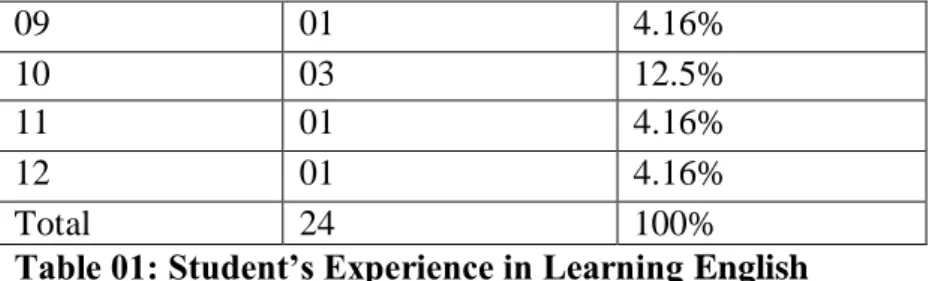
Table 01: Student’s Experience in Learning English……….49
Table 02: Students’ Choice of English………...…49
Table 03: Students’ Perception about their Skills……….50
Table 04: Students’ Interest towards the Natives’ Language……….50
Table 05: Students’ Familiarity with AMs……….………….51
Table 06: Students’ Favorite Type of Authentic Materials……….……51
Table 07: Teachers’ Use of AMs in Classrooms………..…..52
Table 08: Teachers’ Frequent Use of AMs in their Courses………..……52
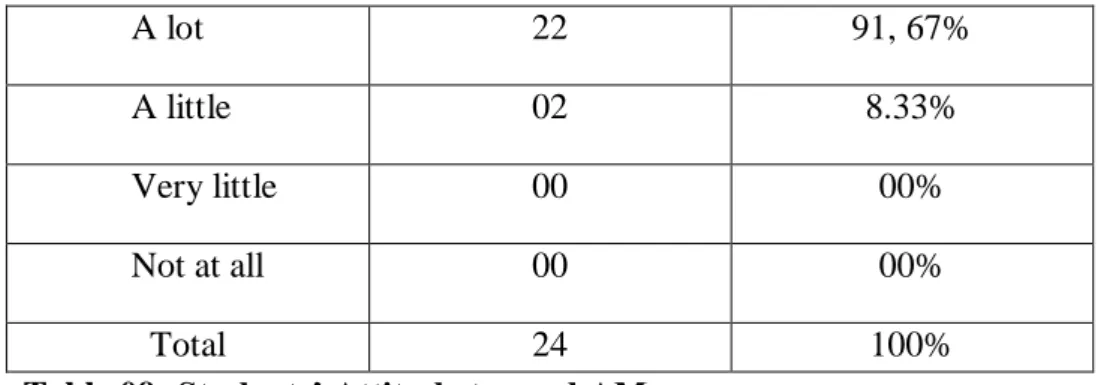
Table 09: Students’ Attitude toward AMs……….…53
Table 10: Students’ Perception to AMs’ Content ………..…….53
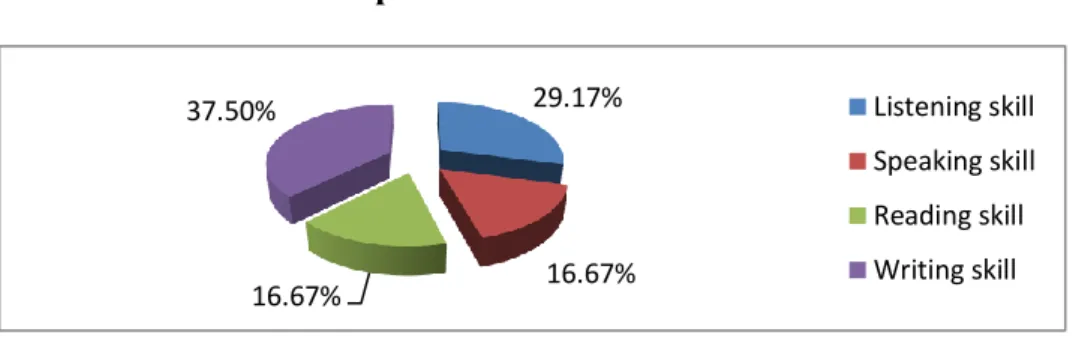
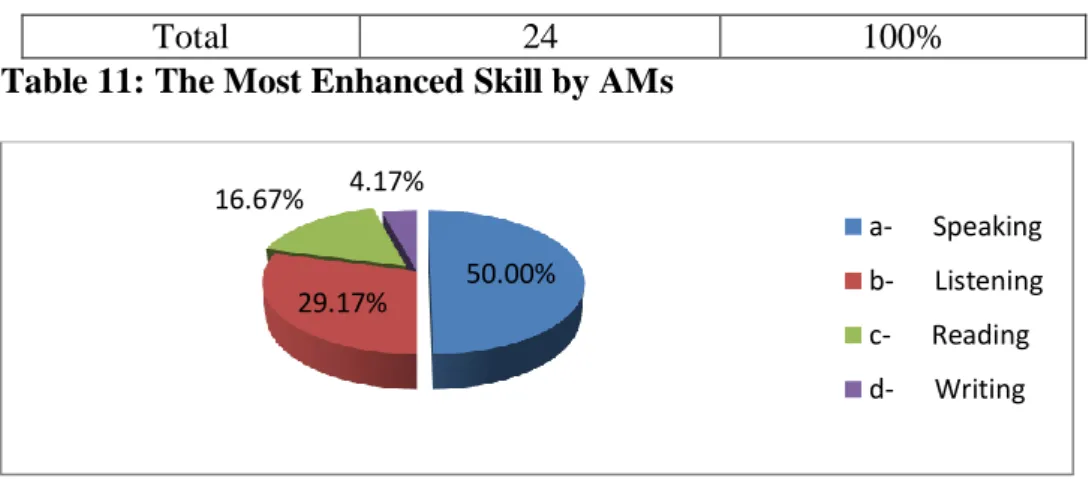
Table 11: The Most Enhanced Skill by AMs………..…………54
Table12: Teachers’ support to their Students to Speak……….55
Table 13: Students’ Attitude towards their Speaking Level………55
Table 14: Students’ Attitude toward the Importance of Speaking in Learning English…..56
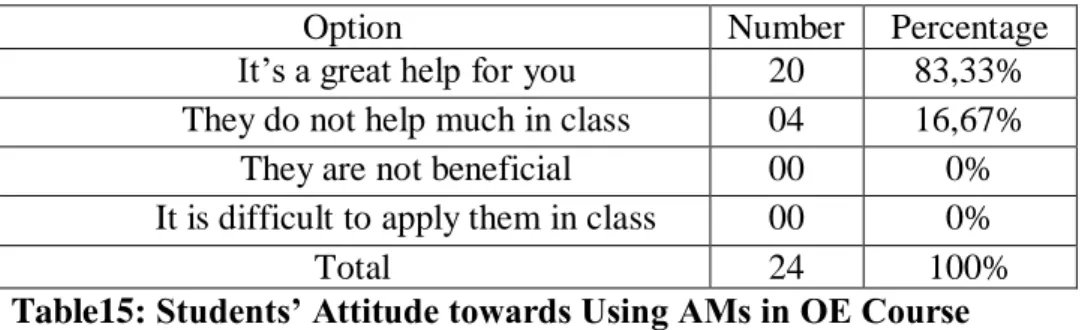
Table15: Students’ Attitude towards Using AMs in OE Course……….56
Table 16: Students’ Preferred Activity in OE Course………..57
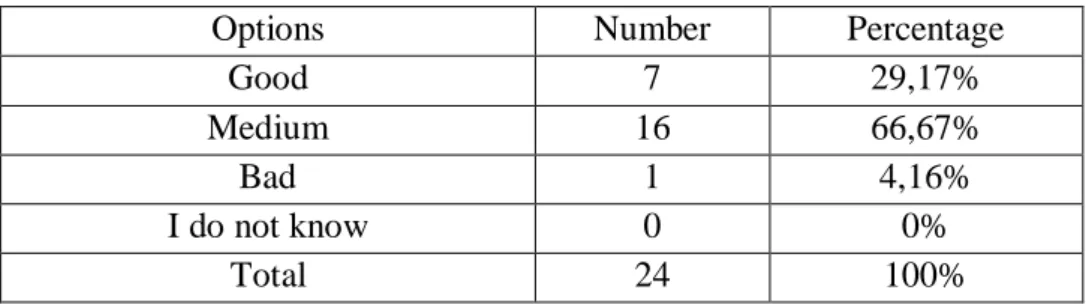
Table 17: AMs’ Effects on the Students’ Speaking Level………..…58
Table 18: Teachers’ Qualifications………...……63
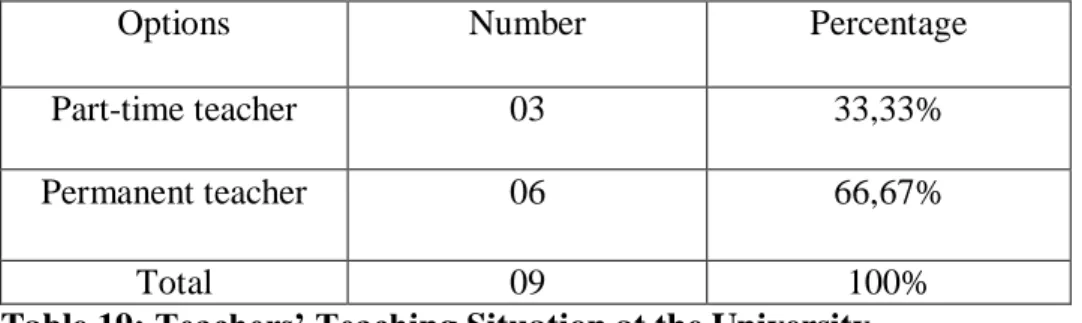
Table 19: Teachers’ Teaching Situation at the University……….………63
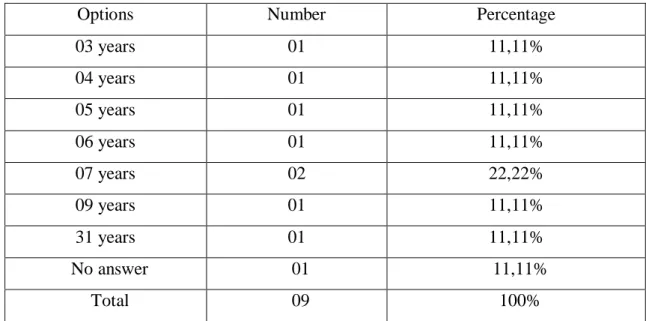
Table 20: Teachers’ Years of Teaching Experience………..64
Table 21: Teachers’ Years of Teaching the Oral Expression Course………65
Table 22: Teachers’ Attitude toward Teaching Oral Expression Course……….65
Table 23: Teachers’ Main Focused Skill while Teaching OE……….….66
Table 25: The Importance of Integrating AMs inside EFL Classes……….68 Table 26: Teachers’ Preferred Type of AMs to be used in Classes……….69 Table 27: Teachers’ Attitudes toward the Degree of Easefulness of Using AMs in OE Courses………70 Table 28: The Purpose of Using AMs………..……..…70 Table 29: The Most Influenced Skill by AMs……….…………71 Table 30: Teachers’ attitudes towards Students’ Preferred Type of AMs……….………....72 Table 31: Teachers’ Perception about the Impact of AMs on Students’ Speaking Skill……….……..72 Table 32: Representation of Students’ Gained Scores……….………80 Table 33: The Improvement of the Students Speaking Skill Mean before and after being Exposed to AMs………...……….81
List of Graphs
Graph 01: Students’ Perception about their Skills……….50
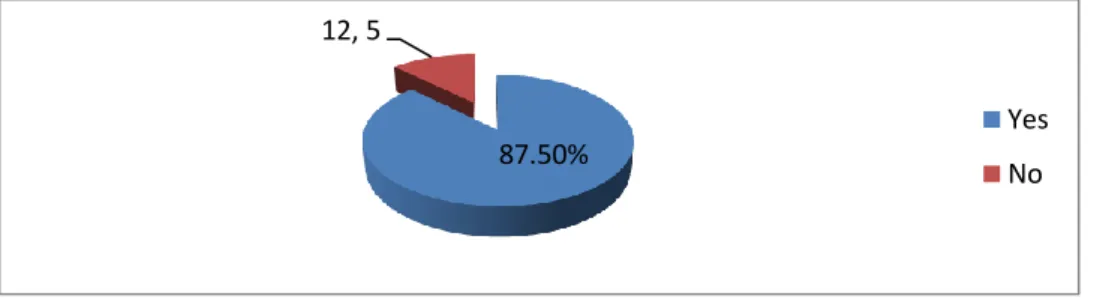
Graph 02: Teachers’ Use of AMs in Classrooms………..…52
Graph 03: The Most Enhanced Skill by AMs………...54
Graph 04: AMs’ Effects on the Students’ Speaking Level………...58
Graph 05: Teachers’ Main Focused Skill while Teaching OE……….67
Graph 06: The Most Influenced Skill by AMs……….…71
List of Figures:
General Introduction
Authentic materials, recently, are used progressively and more rapidly in language teaching field of study in terms of oral performance. Harmer (2001, p. 10) points out that “authentic materials are real texts used by native speakers, and have been designed for the foreign speaker of the language.” Authentic materials boost students and enhance their acquisition of L2 because they are intrinsically more attractive and stimulating than artificial or non-authentic materials (materials produced specifically for language students such as exercises found in coursebooks and supplementary materials).
The integration of AMs in EFL classrooms helps students to improve the different language skills by providing authentic activities that prepares them for real-life situations. AMs extend students’ ability to orally perform accurate and connected utterances that are suitable to specific contexts. One of the main concerns of most language teachers is how to help FL students to develop their language proficiency. Therefore, speaking skill has received the greatest attention among both the FL teachers as well as the FL learners.
Most of FL students consider speaking ability as the standard of knowing a language, since it is perceived as an important component in the process of the language acquisition in comparison to the other linguistic skills. According to EFL students, speaking is the most essential skill to be learnt, they evaluate their progress in terms of their achievements in real-life spoken communication.
The exposure to AMs proved to have a positive effect on both the teaching of language and students’ accomplishment for better performance in the TL. Authentic materials affect second language students’ learning achievements, specially their speaking production. The use of authentic materials such as TV channels, audio-books, songs, internet, articles …etc. will improve learners’ ability in the FL because they will engage them in real life
situation. Gilman and Moody (1984) claim that teachers who possess background knowledge about the use of AMs would train successfully their learners in speaking.
1. Literature Review
Le Dictionnaire de Didactique des Langues (1976, p. 156) indicates that “the term
« authentic » does not necessarily mean natural or spontaneous”. It, additionally, indicates that authentic materials are those “originally produced for a real communicative, informative or linguistic function, as opposed to the documents designed especially for classroom. “
Tomlinson (2001) provides a vague definition for the term ‘authentic’ as being anything that is not written for the sake of teaching English. Whereas, Khaniya (2006) narrows the definition by stating that teachers think of AMs, usually they think of informal communication the way it happens among native speakers, rather than a formal communication in the form of textbooks and articles. For example, a recipe, newspaper article, or joke would be perceived as authentic for the classroom over a traditional work of literature or a peer reviewed journal article. Ur (1996, p. 150) defines authentic material as “any material that is produced by a native speaker”.
Brown and Yule (1999, p. 16) define speaking as “a way to express, communicate, or show opinions, feelings, ideas by talking and it transfers the information of what the speaker wants”. However, Jones (1996, p. 12) claims that “in speaking we tend to be getting something done, exploring ideas, working out some aspect of the world, or simply being together”. Meanwhile, Littlewood (2002, p. 16) argues that “speaking is communicating effectively to a partner and producing certain language forms in an acceptable way. So, we can say that speaking is the ability of someone to communicate to the others.
Richards (2008) states that the main objective of learning a FL or 2L is to possess the capacity to communicate using the TL. FL teachers should make their students aware about the fact that the language they are learning is a means of communication. Students do not
really recognize that FL or 2L is even oral and exists outside the classroom. In speaking, the students have to be taught how to speak fluently. The communication takes place if the speakers can express themselves appropriately, fluently, and accurately. Hence, learning FL is learning how to speak it.
According to many researchers, AMs have a positive impact on the students’ speaking skill because they bring the real world into the classroom, contextualize language naturally, motivate the students, and familiarize them with authentic language in a controlled setting. Moreover, Arthur (1999) argues that authentic materials can provide students with realistic models to follow for authentic activities. Therefore, it can raise awareness of how FL is actually used by teaching correctness and suitability.
2. Statement of the Problem
The integration of authentic materials in foreign language classrooms is very important element in the teaching/learning process . The more students are exposed to authentic materials the more their communicative competences will be developed and the more independent they become. Students may improve their writing, reading, speaking and listening skills in different manners, especially speaking which is considered as one of the major skills to be ameliorated. Thus, EFL teachers need to take into account authentic materials as one of the main teaching aspects to improve their learners’ speaking skill. The problem we are facing in this study is the relationship between the use of AMs in the EFL classrooms and the improvement of students’ speaking skill. Therefore, the research main concern is to discover the effectiveness of authentic materials on the development of FL students’ speaking skill.
3. Aim of the Study
This research aims at stressing on the importance of authentic materials as efficient communicative tools for better oral achievements of EFL students. It investigates the use of
authentic materials in EFL classrooms that may enhance the students’ speaking skill. Therefore, we will try to discover the effect of using authentic materials on EFL students’ speaking skill.
4. Research Questions
In this research paper, we are seeking to answer the following questions: 1/ Do authentic materials affect the students’ speaking skill?
2/ To what extent can the use of authentic materials improve students’ speaking skill in the classroom?
3/ What are the most suitable authentic materials that can be used to enhance the FL students’ speaking skill?
5. Research Hypothesis
From the above-mentioned questions, our research is supposed to test the following hypothesis: If teachers integrate authentic materials within EFL classrooms, the students’ speaking skill would be developed.
6. Research Methodology
The debatable and controversial nature of the topic being discussed, lead us to make use of different data collection procedures. In this respect, we will address two formal questionnaires. While one will be handed out to first year LMD students at 8 Mai 1945 University of GUELMA, the other one will be designed for oral expression teachers. Both questionnaires will be carried out to show whether or not the use of authentic materials can improve students’ speaking skills. In addition to that, a test will be conducted to assess the effect of authentic materials on first year LMD students’ speaking skill.
Since the issue being tackled in this study is the implementation of authentic materials within EFL classrooms, therefore, we opt for a mixed method. In this study, both qualitative and quantitative methods are used. First, the questionnaire will be given to teachers of the department of English as well as to first year LMD students. The first questionnaire will be designed for oral expression teachers to consider their viewpoints about the students’ speaking level, and whether or not it is applicable to implement AMs to improve their learners’ speaking skill. The second questionnaire will be addressed to first year LMD students to discover their current level of speaking skill, and to investigate their attitudes toward the integration of authentic materials inside their classrooms. Accordingly, we will design different types of questions including: open-ended, closed-ended and rating-scale questions. The reason behind the variation of our questions is to avoid the disadvantage and the limitations that can be found with each type.
The test will be conducted in order to know the students’ speaking level after being exposed to different sorts of authentic materials including: audio/ audiovisual materials such as videos, music songs, poems…etc., and then to notice the change in their oral production, especially their communicative abilities. Then, the test will be held to discover whether there will be a real change in their speaking level or not. This approach will not rely on the description of variables but it will investigate the effects of authentic materials on speaking skill in order to compare the students’ results before and after being exposed to AMs.
7. Population and Sampling
The population we are concerned with in this research includes first year LMD students of English as well as teachers of oral expression at Guelma University. However, a number of factors may prevent us from gaining information from the whole population. These
factors include time constraints, financial means, accessibility and energy. Therefore, we need to select a sample that can be easily questioned and tested.
From one hand, the questionnaire will be distributed to one group out of ten first year LMD students’ as well as to nine out of 13 oral expression teachers at Guelma University (Department of English). Therefore, the sampling strategy that will be used is random one. On the other hand, the sample of our test will be 30 LMD first year students of English.
8. Structure of the Study
Besides the general introduction and the general conclusion, this research will be divided into two parts i.e. the theoretical part and the practical one. The theoretical part will contain two chapters; the first chapter will tackle the issue of authentic materials in EFL classrooms: its various definitions, types, the main advantages and drawbacks of authentic materials, and how teachers implement them in the EFL classrooms. The second chapter will be a detailed literature review about the speaking skill.
The second part is the practical chapter of our thesis includes a detailed description of the data gathered from the questionnaires, in addition to an accurate analysis of the results being accumulated. It will contain tables, graphs and statistics for a more clarification and credibility. It will entails an in depth analysis of the test besides to a comparison between the students’ speaking level before and after being exposed to the different sorts of AMs. Finally, it will be ended up with a list of suggestions and pedagogical implications for teachers.
In an attempt to shed light on the importance of using authentic materials in the EFL classrooms; the researchers in this chapter have introduced a brief definition of authenticity as a concept in addition to its types. Then, we have provided a detailed description of what authentic materials refer to, with an emphasis on its advantages and disadvantages, categories and sources. To understand this notion, we have presented the purpose behind using authentic materials in the EFL classes. In addition, the researchers have discussed the challenges that teachers may encounter while using them in the presentation of their courses. Finally, some solutions are provided to overcome these difficulties and to use authentic materials appropriately.
Introduction
Teaching FL becomes the main focus for many countries. The main purpose behind learning foreign languages is to use them in real life situations. Therefore, instructors started to search for the most effective teaching materials, the language teachers think about the course book tasks and their effectiveness. These tasks were designed only for the teaching purposes. However, with the spread of the Communicative Language Teaching Approach (CLT), the syllabus designers decided to take into account the learners' needs and provide them with the chance to be able to communicate the learned language in real situations outside the school walls.
EFL classrooms’ atmosphere has changed a lot in parallel with technological developments in terms of materials, strategies and methods being used. As classical methods of teaching left the way to other modern and new ones, Kilickaya (2004) claims that in order to improve students' learning process, the English language presented in the FL classrooms have to be authentic. Thus, authentic materials (AMs) found their significant role into educational settings. These AMs may be considered as basics to acquire and produce the language, and consequently to achieve effective English teaching and learning as a foreign
language. Using authentic materials in EFL courses and programs can be one of the good strategies to overcome students’ weaknesses in language learning.
Both experts Martinez (2002) and Kaprova (1999) suggest some guidelines about how to choose the appropriate materials to support students’ learning of the foreign language and help them to use it in the real world. Other experts point out the importance of using authentic materials inside EFL classes because they can encourage students to perform freely, bring the reality to the classroom and significantly revive the class, provide students with new knowledge, and expose them to the real target language, etc... Simply put, authentic materials can give students more encouragement and enthusiasm in learning the FL.
1. 1. Authenticity as a concept
Hedge (2000) claims that the term “authenticity” appeared when it is associated with communicative approach in language teaching in the 1970-s. “Authenticity” as a notion has many definitions generated from different scholars; Kilickaya (2004), for instance, states that many researchers discussed the concept of authenticity. Accordingly, Rost (2002) argues that defining authenticity is not an easy task because it is one of the terms which researchers doubtfully discussed.
According to Tatsuki (2006), the idea of authenticity is taken from the concepts of realness and validity of materials. This means that authenticity is any reliable source used in EFL classrooms through which students can be exposed to original tasks. Additionally, MacDonald et al. (2006) state that if there is a connection between the texts used in the classrooms and those texts used in the real world, this latter can be considered as authentic.
Authenticity can, also, refer to some different language related issues, as Gilmore (2007, p. 97) suggests: “Authenticity relates to the language produced by native speakers for native speakers in a particular language community or the language produced by a real speaker or writer for a real listener, conveying a real message.” Furthermore, Mishan (2004)
states that authenticity is something attained in the process of analysis or clarification, and
may be judged in terms of the level of participation of the student.
1.2. Types of Authenticity
Because of the daily routines in the classrooms Breen Michael (1985) proposes to teachers four types of authenticity. According to him, these types are interrelated during any language lesson. The types include:
1. Authenticity of the texts which we may use as input data for our learners. 2. Authenticity of the learners’ own interpretations of such texts.
3. Authenticity of tasks conductive to language learning.
4. Authenticity of the actual social situation of the language classroom. Breen discussed all the types with more emphasis on the second as follows:
1.2.1 Authenticity of Texts: is about the qualities of a given text being authentic under the context of language learning, that is to say any source of data/ information used to serve the needs of the students and help them to develop an authentic understanding and interpretation. 1.2.2 Authenticity of Learners: this kind of authenticity is derived from the interaction between the receiver and the text. Breen (1985) argues that the students’ prior knowledge and interest determine the way they understand the text. Therefore, they will be able to identify whether or not the text is authentic.
Davies (1984), quoted by Gallian (1998, p. 160), states that: “it is not that a text is understood because it is authentic but that it is authentic because it is understood… Everything the learner understands is authentic for him. It is the teacher who simplifies, the learner authenticates.” In short, students’ authenticity refers to the students’ ability to interpret texts’ meaning like natives do in the real world.
1.2.3 Authenticity of the Tasks: Breen Michael (1985) mentions that authentic task provides students with the opportunity to communicate their ideas, discuss the problems of the learning language and provide the solutions.
The most effective way to stimulate authenticity in the classroom is to implement activities which are conducive to both learning and communication. That is to say, to make a discussion about the problems that students may encounter when learning a foreign language and to provide solutions for that. In other words, authenticity of tasks conductive to language learning refers to the tasks which help learners not only to communicate like native speakers but also to be involved in language learning purposes.
1.2.4 Authenticity of the classroom: communicating is the first purpose for learning, and the classroom is the special social environment in which communication can be shared. Therefore, the authentic role of the language classroom is to enable students to share publicly the problems, achievements and all processes related to learning a language as social activity.
This is what Breen (1985. p, 67) suggests:
perhaps the most socially appropriate and authentic role of the classroom is to provide the opportunity for public and interpersonal sharing of content of language learning, the sharing of problems with such content, and revealing of the most effective means and strategies to overcome such problems.
1.3. Definition of Authentic Materials
Authentic materials are anything used to represent the foreign language being learned as it is used in the real world. Authentic materials are not created specifically to be implemented in the classroom, but they make excellent learning tools for students precisely because they are authentic.
Authentic materials are materials that we can use in the classroom and that have not been changed in any way for ESL students (Sanderson, 1999). So, authentic materials are
created for social as well as educational purposes. In the same line of thought Hitler (2005, p. 04) states that, “Authentic materials are any text written by native English speakers for native English speakers.”
In sum, authentic materials are designed for the purposes of communicating information and produced by native speakers for native speakers. In this case, authentic materials are created on the basis of native cultures which include languages, ways of life, lifestyles, customs, education, technology… etc.
Thus, when teaching a foreign language, it is important to choose authentic materials and to use them in modern ways. That is to say, using examples of language produced by natives for some real purposes of their own instead of using language designed only for learning based tasks. Also, the purpose or function of AMs often determine how teachers use them.
1. 4. Advantages of Authentic Materials
The use of AMs in foreign classes has both advantages and disadvantages. As many scholars explained, authentic materials could be applied to multiple tasks, and can be used for producing many skills. They are flexible, easily adapted in EFL/ ESL classes, effectively coped with learningobjectives, they are not bound by textbook format limitations, and if they are exploited appropriately, students will be provided with several important benefits.
Moreover, going through some empirical studies conducted in relation to the effectiveness of authentic materials; Sanderson’ (1999) results indicate that authentic materials keep students incorporated in the world; they have a great impact on students’ learning process.
AMs, thus, offer a variety of applicable and ready-to-use materials in EFL classrooms (Hwang, 2005 & Chase, 2002). Harmer (1990) claims that authentic materials have positive
impact on students. Correspondingly, they improve students’ production of the language, help them for faster acquisition, and increase their self-confidence to deal with real life situations.
Flowerdew and Peacock (2001, p. 182) claim that “non-authentic texts cannot represent real-world language use, they are considered as simplified materials which often lose some meaning and the real-world situations that can be best prepared by authentic texts.” The varied authentic materials that can be used in EFL classrooms like English newspapers, computer software, broadcast media, movies, songs… etc, provide real practices of native cultures and habits in using English language. However, EFL teachers have to choose the materials that are directly related to English skills such as speaking, listening, reading and writing, based on the teaching and learning goals. Martinez (2002, p. 165) proposes another advantage, stating that:
reading texts are ideal to teach/practice mini-skills such as scanning, e.g. students are given a news article and asked to look for specific information (amounts, percentages, etc.), basic students listen to news reports and they are asked to identify the names of countries, famous people, etc. (ability to detect key words).
The most important aspect of choosing those materials is to increase EFL learners’ abilities to use real English. Authentic materials make students aware of what is happening in the world, accumulate their knowledge, and motivate them to read for pleasure. Also, authentic materials may be inspirational for some students. Therefore, students have a very rich educational significance that is laid on the responsibility of teachers to provide the general educational development.
1.5. Disadvantages of Authentic Materials
By defining authentic materials from the opposite point of view, disadvantages as well should be highlighted. AMs, may be, are difficult to be understood because of the cultural gap between the source and the target language. Such materials will often have to be modified and edited, in order to have a relation between the student and the material learned.
Guariento and Morley (2001, p. 347) assert that “At lower levels… the use of authentic texts may not only prevent learners from responding in meaningful ways, but can also lead them to feel frustrated, confused and… de-motivated”. In other words, students may face a difficulty in using such materials in terms of vocabulary; it may not be relevant to what students need exactly, or it may be difficult especially for beginners because of the mixed structures.
It is also argued that using authentic videos or songs may confuse students in listening comprehension because of the various accents and dialects of the natives. In addition, lessons introduced in EFL classrooms, as Martinez (2002) claims, are considered culturally subjective and difficult to be understood by the EFL students.
In conclusion, we can claim that the advantages of using authentic materials in teaching students exceed the disadvantages. Therefore, teachers should consider them seriously as a successful aid in teaching a foreign language; introduce the target culture into their classrooms, making their classes a more natural environment, and to be wise by considering those negative points before choosing the type of text to be used.
1.6. Categories of Authentic Materials
Some teachers do not have a view about the different categories and classifications of AMs. For that reason, before introducing them in language teaching, they have to be careful and choose appropriately the most effective materials that are useful for the receptive skills ( reading/ listening) while others are more efficient and effective for writing and speaking (the productive skills). This will help instructors to use such materials appropriately and achieve objectives of the lesson effectively. Authentic materials, according to many scholars, could be classified into three categories as follows:
. Authentic audio-visual materials. . Authentic visual materials.
. Authentic audio materials. 1.6.1. Authentic Audio-Visual Materials
It responds from its name to all those materials which help or enable the students to see and hear the English language of native speakers in real context. Such as, cartoons, animations, video clips, movies, short stories, novels and songs…etc.
As an activity, for instance, students could be asked to watch only the beginning of a video clip, and then they will be asked to expect what is coming next. Also, teachers could present to the half of the class a video clip, whereas the other half could not see the screen; and both groups can perceive the sound. Then, the two groups come together after the split viewing, and create a story about what happened.
1.6.2. Authentic Visual Materials
According to Jacobson, Degener, and Gates (2003, p. 01): “printed materials used in ways that they would be used in the lives of learners outside of their adult education classes.” This kind of category includes all authentic visual aids students may benefit from in developing their foreign language skills. It refers to materials such as, photographs, newspapers, pictures, paintings, street signs, post cards…etc. They help instructors in the teaching process as they provide students with opportunities to communicate their ideas, use language appropriately, and express their feelings in vivid and interesting situations as natives.
1.6.3. Authentic Audio Materials
It means that any form of materials such as radio advertisements, conversations, interviews, songs…etc that can be used by students in everyday life to improve their skills especially the listening and speaking skill.
1.7. Sources of Authentic Materials in EFL Courses
Teachers of the foreign language can get many benefits through using different materials. In regard to the globalized world, sources of materials became more common in use. Such sources include for instance: newspapers, TV programs, advertisements for events, course catalogues from schools, menus, magazines, the internet, movies, songs, brochures, documentary and music videos, comics, literature (novels, poems and short stories)…etc. For more details, some examples are discussed as follows.
6.1. Literature
Since the 1980s, EFL teachers give more importance to literature as an area of study. According to Mishan (2004, p. 97) Literature is “writings that are valued for their beauty of form, specially novels and poetry and plays etc.” Using literature in the context of language learning will offer new methods and approaches to the study of literature in the native speakers’ community.
By illustrating some advantages of literature as a source of authenticity in EFL courses, literature can be used with all students’ levels to link cultures and to enhance students’ knowledge of the target language and its culture. In using any kind of literature text, the focus should be put on teaching language not literature.
In order to increase students’ awareness about the language norms, teachers can help them to examine and study morals in literary texts and to revise the substandard examples of language occurred in literary texts (Widdowson, 1998 quoted by Lazar, 1993).
1.7.2. Computer Software and CD-ROM
Under the category of audiovisual materials, computer software and CD-ROMs are considered among the most useful technology. They offer various functions; according to Martinez, 2002, Manning, 1988 and Blak, 1997 (cited in Su, 2007, p. 39) “many computer
software and CD-ROM programs encompass reading with the use of multimedia concerning sounds, different accents, outstanding image, and computer literacy.”
In the EFL classes, computer software can be used for a series of activities, primarily, by providing students a real discourse in an authentic way. According to Oxford Advanced Learners’ Dictionary, computer is “an electronic machine that can store, organize and find information.” Moreover, Lee and Winzenried (2009, p. 74) describe computer as “discrete teaching tools […] had minuscule impact on the nature of teaching and the development of traditional academic skills.”
Software, in general, is used to enable students to interact not only with the computer but with other students as well. CD-ROM, also, contains many games and programs that have excellent visuals and sounds which involve a wide range of speakers from different accents of different ages, and this make the education more attractive.
1.7.3. The Internet
Today with the spread of technology in different fields of study, students and more specificallyteachers became highly interested in using the World Wide Web for the teaching task. Endless lists of materials such as texts, magazines, live radio and TV programs, video clips and so forth are at the teachers’ disposal that can be of great benefit to their students.
The Internet is probably the biggest library in the world. It can be seen as an authentic powerful audio and visual material through which instructors can give vitality and keep students engaged in the communicative listening lessons (Su, 2007). However, teachers and students are still limited in their use of the internet because it is not available in their classrooms. Also, Chaun and Whei (2002) as cited in Miller (2003) claim that although the ESL/EFL websites can increase students attention, genuine language use, and the general understanding of the foreign language; it has some inaccurate information that can cause some
annoyance when ones wants to use it. Another factor taken into account is the cost of the internet and its use.
Therefore, teachers have to be aware about the use of such materials. For example: ask students about preferable tasks in which meaning is central and has some connection to the real world, other information searching activities are probably the most useful. Also, to implement and use some interactive AMs through which students can be in touch with natives and converse with them.
Harmer (2001) suggests that with entrance to internet instructors as well as educators begin to have a true contact with authentic English. Teachers and students can access some reading, as well as audio and video materials that are available on sites where music, news, and film can be listened to. To download any internet material, it is important to take into account the copyright restrictions. This means that students’ communicative capacity could be improved through the access to network-based communication.
1.7.4. Radio
It is important to use some authentic listening materials in EFL classrooms such as radio. It could be considered as a good source of authentic listening material that most teachers can obtain at a low cost and take it into the classroom. Scrivener (2005) advocates that there are some teachers who regularly record the radio headlines for classroom use. This authentic listening practice helps to prevail over some restrictions faced due to the lack of materials.
Mishan (2005, p. 138) claims that “using radio is one of the more easily accessible forms of authentic listening practice we can provide the learner with. Moreover, its use makes them more familiar with foreign language culture.” Radio is considered as one of the most helpful types of authentic listening materials that teachers can implement in their EFL classes.
Radio, also, provides attractiveness to the FL lessons, prepares learners for real communication in addition to the language improvement outside the classroom, and expose students into the factual world of English (Sakian, 1997).
In conclusion, the broadcasts media have more interest in acquiring foreign language, as they provide outside world into the classroom. Thus, the instructors, by using the radio, should first engage in strict planning in order to keep students interested in the classroom. 1.7.5. Video
Baltova cited in Mainenti (1997) argue that language joined with visual aids facilitates the students’ task of understanding the aural productions. It is, also, suggested that videos with its availability and the increasing accessibility provide an inventive educational p8urpose because of its low cost (Tomail, 2006).
Considerably, video enhances learners’ ability in listening. It is more attractive, exigent, inspiring, and became favored by students because it provides more language input and helps them to determine what speakers are expressing easily. According to Ur (1984, p. 23) “instructors could rely on sound effects, picture, and emotions to stir up comprehensible language input for students.”
Concerning the way of using videos in the classrooms, teachers could show them in segments with pauses and give time to discuss the content. Brophy (2004) (cited in Tomail, 2006) indicates some elements that must be incorporated in the course to make it effective; this includes: guiding the students on how to examine video, supplying them with short sections or parts from a long recording video. Tomail adds that in order to facilitate the use of videos according to the students’ level, the participants have the right to watch them more than one time before the discussion starts.
The language of the text-books cannot be valid only in a classroom environment. The requirement of real life English is different from language classrooms and this difference has not yet been closed by the use of text-books. This idea is supported by Little and Singleton (1988) assuming that the primary objective for the use of authenticity in second language learning is to provide input materials from literary culture. And students find such materials more interesting and attractive than course books prepared by the teachers.
Students and instructors can use AMs as a method to “link the formal, and to some
extent artificial, environment of the classroom with the real world in which we hope our students will eventually be using the language they are learning” (House, 2008, p. 53-70).
That is to say, AMs should be taken from the real world and not created only for educational purposes; this would ultimately facilitate the language teaching/ learning task.
The importance and benefits of using authentic materials are, also, pointed out by some other researchers. Authentic materials are required in the EFL classroom because of the broad gap that is often found between materials developed specifically for English language teaching and authentic conversation.
Through the use of authentic materials, students will have the chance to be more experienced and get more rewards of learning a language. Melvin and Stout (1987) suggest a way to make students more enthusiastic in their learning; for instance to send them to countries in which the target language is dominating. Thus, their interest would be raised towards the themes under study when authentic materials are presented in the classroom for the study of the foreign culture. This step helps students to interact positively and easily when using authentic materials. Consequently, their understanding would be increased. Students commented usefulness in practicing skills they would need outside the classroom and to be
learning about cultures beyond their own. Furthermore, Spelleri (2002) claims that when selecting AMs two main criteria should
be taken into account. The first criterion is that materials necessitate providing students with new data. The second is how those materials are adaptable; so, they should not contain complicated words; and they need to have either some pictures or clear separation of text. Moreover, McGregor (2007) believes that the type of the text can make sense only if it exists in a cultural context because the real assumption behind learning a language is culture. Hence, the activities and materials used in the EFL classes need to be planned by the teacher according to students’ needs and their cultural variety.
1.9. Teacher’ Challenges with Authentic Materials
1.9.1. The Size of the Classroom: It is difficult for teachers to manage an active and a creative session in a big and a full-size classroom. Therefore, students cannot ask for or receive the feedback because of the noise. Accordingly, this can hinder the communication as Harmer (1998, p.128) states:
In big classes, it is difficult for the teacher to make contact with the Students at the back and it is difficult for the Students to ask for and receive individual attention. It may seem impossible to organize dynamic and creative Session…Most importantly; big classes can be quite intimidating for inexperienced teachers.
1.9.2. The Lack of Materials
Materials’ availability in EFL classes is insufficient, many problems, thus, are derived. We can take as an example what Hewer and Davis (2002. p, 23) point out “Most classrooms in our country are still four walls, desks, chairs and chalk board.” There are many teachers who face a difficulty while using the technological devices, but this defeat was largely due to human failure, a lack of investment in training teachers on how to use it, and a lack of imagination.
Moreover, teachers believe that the teaching of oral expression more precisely is too difficult because of the lack of text books, as an essential aid. Consequently, the teacher
spends more time in the management of the lesson plan, in addition to the difficulty in understanding native Speakers.
1.9.3. Time Allotment
Without any doubt, the limited time can prevent the teacher, as well as the students from practicing the foreign language as it is supposed to be. For instance, time allotted for oral sessions in Algerian Foreign Language Universities, is generally about two or three hours per a week. This period of time provides students with a little opportunity to practice the language, especially when the class’ number is about thirty.
10. Solutions to Overcome the Difficulties Faced when Using AM
Although using authentic materials in teaching a foreign language is recommended by many researchers, we still have some questions to think about in order to choose carefully the appropriate material for an adequate task with the most suitable level of students. Therefore, some factors are there to be taken into account by instructors when selecting authentic materials and using them.
Hedge (2000) states that teachers who wish to expose learners to authentic text have to choose conversation with clear setting, role, relationships, topic and structures. So, when instructors choose authentic materials, students’ needs and ability should be taken into consideration.
The most substantial question teachers can ask about is: can we use AMs in spite of our students’ level? Correspondingly, Guariento & Morley (2001) state that authentic materials can be used at post-intermediate level. However, at lower levels, students cannot feel at ease while dealing with AMs because they are still beginners and it is hard for them to acquire lexis and structures used in the target language. But this does not mean that AMs cannot be used in lower-level.
According to some findings gained from Chavez’s researches (1998), most of the educators prefer to learn with the use of AMs since they facilitate for them the task and increase their interaction with the real language and its use. Pedagogically speaking, the use of AMs in the EFL classrooms is very important especially for the listening and speaking skills. Finally, students feel more comfortable with authentic materials; they help them get involved in the “real” language and provide teachers with pedagogical support.
Conclusion
As it is showed in this chapter, many researchers have conducted studies about the use of authentic materials in the EFL classrooms. They do have different views; some of them support the use of authentic materials and others are still against their use in the classroom, and they believe that they might be biased in terms of culture and contain complex words and structures. However, they all agree on the idea of “exposure”, exposure to “real language and real life”. In other words, through authentic materials, windows are opened for students into foreign culture and into real language communication. To conclude, authentic materials should be used according to the students’ level of knowledge. Furthermore, instructors should help the students to be more skillful and to defeat any difficulty they may encounter.
In this chapter, light will be shed on the speaking skill with more details. Emphasis will be given to: its definition, types, functions and components. The importance of speaking, its purpose, the characteristics of speaking performance, the different factors affecting students' speaking ability, the communicative competence model, the goals of teaching speaking, the practice of the speaking skill in classroom, the speaking assessment, the principles of teaching speaking, the characteristics of successful speaking activities, the speaking difficulties in Foreign Language Learning and solutions of speaking activity problems.
Introduction
Teaching/ learning English as a foreign language requires learners’ exposure to the foreign language four skills: reading, speaking, writing and listening. The primary goal of acquiring such language skills is to improve the learners’ receptive and productive abilities in the second language either in oral or written form. As far as speaking is concerned, it is considered as the major skill to be developed because it is necessary for revealing the language proficiency. In this respect, the emphasis is mainly on speaking since learners are going to be put in situations where communication in English is more than needed.
1.1. The Nature of Speaking 1.1. Definition of Speaking
FL learner’s oral production is characterized by a number of errors and mistakes. Consequently, speaking is not a simple skill; rather it is a complex process that requires some experience and practice. Luoma (2004.p, 1) argues that “speaking in a foreign language is very difficult and competence in speaking takes a long time to develop.” The skill of speaking is totally different from writing in its typical grammatical, lexical and discourse patterns.
Furthermore, some of the processing skills needed in speaking are completely different from the ones involved in reading and writing. Also, foreign language speaking differs from
the mother tongue speaking in terms of the lack of grammar and vocabulary knowledge of learners. That’s to say, unlike MT, the procedure of building utterances correctly and retrieving words is not automatic in TL (Thornbury, 2005).
Channey (1998.p, 13) argues that "speaking is the process of building and sharing meaning through the use of verbal and non- verbal symbols in a variety of contexts". Hence, it is as a complex process of exchanging messages through the use of verbal expressions, but it also involves non-verbal symbols such as gestures, postures and facial expressions.
Bryne (1998.p, 8) also claims that "speaking is a two way process between speaker and listener and involves the productive skill of speaking and the receptive skill of understanding". In the same respect, Nunan (2003.p, 48) agrees with Bryne that ‘’speaking is the productive oral skill and it consists of producing systematic verbal utterances to convey meaning’’.
According to Chastain (1998) speaking is a productive skill that consists of various constituents. Thus, speaking is not only about combining the right sounds, choosing and collecting the right words or getting the utterances’ buildings.
Hedge (2000.p, 261) defines speaking as “a skill by which they [people] are judged while first impressions are being formed.” That is to say speaking is one of the important skills if not the most important one which deserves more attention in both L1 and L2 because it reflects people’s thoughts, ideologies and personalities.
In addition, Tarigan (1990.p, 15) declares that “Speaking is the ability to pronounce articulation of sounds or words for expressing, stating and conveying thought, ideas and feeling’. Speaking is so complex because it includes many aspects and faculties such as grammar, pronunciation, fluency and vocabularies. The objectives of speaking are various so it can be considered as the most important human tool for social control and communication. 1.2. Types of Speaking Skill
Brown (2004) suggests five types of speaking according to the speaker’s intentions: imitative speaking, intensive speaking, responsive speaking, interactive speaking and extensive speaking.
1.2.1. Imitative Speaking: is the adeptness to repeat the other’s speech as a word, phrase, a sentence or a whole conversation. This kind of repetition may include different faculties of language such as grammar and lexis in order to convey a meaning or even to interact in a conversation, by focusing more on pronunciation as an attempt to help learners to be more comprehensible.
1.2.2. Intensive Speaking: is the production of short stretches of a discourse through which they depict competence in a narrow band of grammatical relationships such as intonation, stress and rhythm. This type of speaking also includes some assessment tasks like reading aloud, sentences and dialogue completion, and so on.
1.2.3. Responsive Speaking: “is a brief interactions like short conversations, small talk and simple requests in order to preserve authenticity with only one or two following up questions or retorts” as Brown (2004.p, 142) shown in the following short conversation:
A. Marry: Excuse me, do you have the time? B. Doug: yeah. Nine- fifteen.
1.2.4. Interactive Speaking: it involves two forms of languages; transactional language and interpersonal language. The former is aimed at exchanging specific information whereas the latter has the purpose of maintaining social ties. In the interpersonal language, oral production can become more complex with the use of colloquial language, ellipsis, slang and so on. Interactive speaking includes some assessment tasks such as interviews, role play and discussion activities.
1.2.5. Extensive Speaking: (or monologue) “includes speeches, oral presentation and story-telling, but the language style that is used in this type of speaking is more deliberative and
formal for extensive tasks. Planning is involved, and interaction is generally ruled out.” (Brown, 2004 .p, 142).
1.3. The Functions of Speaking / Speaking Purpose
Many linguists tried to classify the functions of speaking in human interaction. According to Brown and Yule (1991), as quoted in Ritchards (2007.p, 2) "The functions of speaking are classified into three; they are talk as interaction, talk as transaction, and talk as performance’’. Below are the clarifications of these functions:
3.1. Transactional Discourse: in this type of interaction, accuracy and coherence of the message is of great importance in order to maintain communication, as well as confirmation that the message has been understood. (Richards, 1990.p, 54- 55).
Burns (1998) discriminates talk as transaction into two distinctive types. One takes place in a situation where the main emphasis is on exchanging information and where the participators focus mainly on what is said or achieved such as: news broadcasts and
narrations. The second type is transactions where the emphasis is on gaining goods or services such as: instructions or descriptions.
3.2. Interactional Discourse: in order to maintain a good communication, learners should have the ability to speak in a natural way. Therefore, teachers should offer them with opportunities for meaningful communicative behavior about relevant and updated topics. Rivers (2000.p, 543) supports the above mentioned idea when he argues that "communication derives essentially from interaction" Examples of interactional uses of language are greetings, small talks, and compliments.
1.3.3. Talk as Performance: This refers to public speaking. It is the talk which transmits information publically such as morning talk, public announcements, and speeches. Talk as performance is generally delivered in a form of monologue rather than dialogue such as
giving a class report about a school trip, conducting a class debate, and giving a lecture. So, talk as performance needs to be prepared in the form of a written text (Richards, 2007).
1.4. The Components of Speaking
According to Vanderkevent (1990), there are three components in speaking which are: the speakers, the listeners and the utterances.
1.4.1. The speakers: are a people who utter the different sounds. They are useful as the means to express opinion, ideas or feelings to the listener. So if there are no speakers, the opinion, idea or the feeling will not be stated clearly.
1.4.2. The listeners: are people who get the speaker’s expressed views, thoughts or emotions. If the listeners are absent, speakers will state their opinion by writing.
1.4.3. The Utterances: are words or sentences that are uttered by the speakers to express their different ideas. If there is no utterance, both of the speakers and the listeners will use sign. 2. The Importance of Speaking
The communicative approach gives speaking more importance since oral communication encompasses speech where learners are likely to interact verbally with each other. Therefore, the teachers’ talk will be minimized, i.e. learners are boosted to talk more in the classroom. Ur (2000.p, 12) argues also that:
of all the four skills [listening, speaking, reading and writing], speaking seems intuitively the most important: people who know a language are referred to as ‘speakers’ of the language, as if speaking included all other kinds of knowing.
Many L2 learners give the speaking skill priority in their learning. In this respect, the most frequent question given to EFL learners is “do you speak English?” but not “do you write English?” which entails that most of people consider speaking and knowing a language as synonyms. Celce-Murcia (2001.p, 103) claimed that for most people “the ability to speak a
language is synonymous with knowing that language since speech is the most basic means of human communication.”
The speaking skill has a great importance especially when it comes to be integrated with the other language skills. For instance, speaking can help students to enrich their vocabulary and enhance their grammar and then improving their writing skill. With speaking, learners can express their personal feeling, opinions or ideas, i.e. through speaking; learners can present the various functions of language. Therefore, speaking is of great importance outside the classroom as well.
Companies and organizations all over the world are looking for people who master the English language and speak it fluently in order to communicate with other customers. So, speakers of FL have more prospects to get jobs in such organizations. Teachers expect from students to use the language appropriately, correctly and to speak confidently in order to draw the audience’s attention that provides a great opportunity to convey the message. In this respect Baker and Westrup (2003.p, 05) claim that “a student who can speak English well may have greater chance for further education, of finding employment and gaining promotion.”
3. Characteristics of Speaking Performance
Fluency and accuracy are of the key features of the communicative approach, and they go together in achieving a given function. Richards and Rodgers (2001.p, 157) state that “fluency and acceptable language is the primary goal: Accuracy is judged not in the abstract but in context”, and this is evident since the focus of the communicative language teaching is on the communicative process between learners-learners or teachers-learners, rather than mastery of the language structure.
The CLT theory is one of main controversial theories that many debates and questions were raised about it and the role of accuracy in this theory. In this respect, Hedge (2000.p, 61)
makes the important point that: “The communicative approach somehow excuses teachers and learners from a consideration of how to develop high levels of accuracy in the use of grammar, pronunciation, and vocabulary.”
Learners then should build up a communicative competence through classroom activities; nevertheless, they should also know how the language system functions in an accurate and appropriate way.
3.1. Fluency: Oral fluency is the primary goal teachers wish to achieve while they teach speaking; it is the major characteristics of the speaker performance. Hughes (2002) regards fluency as the capacity to express oneself in a comprehensible, rational and correct way without much hesitation; otherwise the communication will not take place because the listeners will lose their interest.
Hedge (2000.p, 54) states also that: “The term fluency relates to the production and it is normally reserved for speech. It is the ability to link units of speech together with facility and without strain or inappropriate slowness, or undue hesitation.”
Hughes (2002) claims that fluency and coherence refer to the ability to speak in a usual level of persistence, speed and effort, besides to connect the ideas in a coherent way. Speed is an important element in fluency and pausing as well, because speakers should take breath while speaking. However, a recurrent pausing indicates that the speaker has difficulties in speaking. (Thornbury, 2005)
Thornbury (2005) offers in such cases what is called ‘’tricks‟ or ‘’production strategies’’, i.e. the ability to fill the pauses. The most frequent pause fillers are “uh” and “um”, vagueness expressions such as “short of” and “I mean”. Another device for filling the pauses is the repetition of one word when there is a pause.
3.2. Accuracy: Presently, foreign language learners seek more to be fluent and they neglect the importance of accuracy. That’s why most FL teachers stressed on the term of accuracy in
their teaching. Without forming an accurate oral production, speakers will not be comprehended and the listeners will lose interest. Therefore, paying attention to correctness and completeness of language structures is of more importance for the mastery of the speaking skill.
Ellis and Barkhuizen (2005.p, 139) define accuracy as referring “to how well the target language is produced in relation to the rule system of the target language.” Therefore, EFL learners should concentrate on many aspects in their production of the spoken language, mostly, the grammatical forms, vocabulary and pronunciation.
3.2.1. Grammar: According to Hughes (2002) the grammatical accuracy stands for the variety and the appropriate use of the speakers’ grammatical structure that includes the length and the complexity of the utterances in addition to the ability to use the subordinating clauses. Thornbury (2005) lists the following features of spoken grammar: “Clause is the basic unit of construction, Direct speech favored, a lot of ellipsis, many question tags and performance effects (hesitation, repeats, false starts, incompletion, syntactic blends)”. The grammar of speech differs of that of writing.
3.2.2. Vocabulary: accuracy at the vocabulary level stands for the appropriate selection of words while speaking. FL learners often find some obstacles when they try to convey what they want to say, they lack the appropriate vocabulary. FL learners then, have to be able to use words and expressions accurately. According to Harmer (2001) the knowledge of the word classes also helps the FL speakers to produce an appropriate and accurate speech.
3.2.3. Pronunciation: FL learners who want to improve their speaking skill in English should be aware of the various sounds and their features and where they are made in one’s mouth (sounds’ articulation); they have also to be aware of words stress, raising and falling intonation. All these aspects give them more information and clarification about how to speak effectively and have a better understanding of spoken English.
Redmond and Vrchota (2007.p, 104) argue that “It is imperative that you use the correct word in the correct instance and with the correct pronunciation. Pronunciation means to say words in ways that are generally accepted or understood.”
4. Different Factors Affecting Students' Speaking Ability:
In learning speaking, there are many factors that highly influence the function of speech and that can affect negatively the acquisition of speaking skill and prevent FL learners to speak fluently. Richards and Renandya (2005) mention four factors that affect learners' oral communication ability such as:
4.1. Age or Maturational Consentraints: many linguists like Scarsella, Anderson and Krashen (1990) claim that FL learners who begin learning a TL in early infancy through natural exposure attain higher proficiency than those beginning after the age of puberty. This indicates that the age factor may affect or limit the adult foreign learners' ability to speak the TL fluently.
4.2. Aural medium listening: plays a vital role in the improvement of speaking abilities. Speaking fosters listening which precedes it. Therefore, speaking is highly related to listening which is the basic process through which the rules of language underlay.
4.3. Socio- cultural Factors language: language is an arrangement of social action because linguistic communication takes place in the context of organized interpersonal exchange. Hence, meaning is socially regulated and to speak TL, speakers should know how language is used in a social context.
4.4. Affective Factors: according to Oxford (1990.p, 140) ‘’the affective side of a learner is probably one of the most important influences on language learning success or failure’’. The affective factors involving in FL learning are: emotion, self-esteem, empathy, anxiety, attitudes, and motivation.