DOI 10.1007/s00122-013-2176-8 ORIGINAL PAPER
A series of eIF4E alleles at the Bc‑3 locus are associated with
recessive resistance to Clover yellow vein virus in common bean
John P. Hart · Phillip D. Griffiths
Received: 28 December 2012 / Accepted: 27 July 2013 / Published online: 11 August 2013 © Springer-Verlag Berlin Heidelberg 2013
allele-specific SNP genotyping assays and demonstrated their ability to accurately detect and differentiate all of the
PveIF4E haplotypes present in the germplasm, allelism testing, and in three separate segregating populations. The results contribute to an enhanced understanding and acces-sibility of the important potyvirus resistance conditioned by recessive alleles at Bc-3. The KASPar assays should be useful to further enable germplasm exploration, allelic discrimination, and marker-assisted introgression of bc-3 alleles in common bean.
Introduction
Clover yellow vein virus (ClYVV) (family Potyviridae, genus Potyvirus) infection is capable of causing significant damage to leguminous crop and forage plants around the world (CABI/EPPO 2000). The impact of the disease can be particularly severe in certain interactions with the common bean (Phaseolus vulgaris L.) because symptom expression can include severe stunting, prominent mosaic, premature defoliation, systemic necrosis, and in some cases plant death (Provvidenti and Morales 2005). The impact can be even more acute in the snap bean market class where ClYVV has the potential to devastate marketable yield by causing twisting, distortion, and necrosis of the fresh green pods (Larsen and Myers 2006; Larsen et al. 2008; Provvidenti and Morales 2005). The threat of direct economic damage is compounded when pod-distorting strains of the virus appear in processing snap bean production regions as the presence of distorted or necrotic pods above a threshold may result in the rejection of the entire harvest by the processor.
ClYVV epidemics appear to occur sporadically in numerous regions where common beans are grown (CABI/EPPO 2000; Crnov and Gilbertson 2001; Dizadji
Abstract Clover yellow vein virus (ClYVV) is capable
of causing severe damage to common bean (Phaseolus
vulgaris L.) production worldwide. The snap bean market class is particularly vulnerable because infection may lead to distortion and necrosis of the fresh green pods and rejec-tion of the harvest. Three putatively independent recessive genes (cyv, desc, bc-3) have been reported to condition resistance to ClYVV; however, their allelic relationships have not been resolved. We identified, evaluated, and char-acterized the phenotypic and molecular genetic variation present in 21 informative common bean genotypes for resistance to ClYVV. Allelism testing phenotypes from multiple populations provided clear evidence that the three genes were a series of recessive alleles at the Bc-3 locus that condition unique potyvirus strain- and species-specific resistance spectra. Candidate gene analysis revealed com-plete association between the recessive resistance alleles and unique patterns of predicted amino acid substitutions in P. vulgaris eukaryotic translation initiation factor 4E (PveIF4E). This led to the discovery and characterization of two novel PveIF4E alleles associated with resistance to ClYVV, PveIF4E3, and PveIF4E4. We developed KASPar
Communicated by B. Hulke.
The GenBank accession numbers for the sequences reported in this paper are KC417354-KC417372.
Electronic supplementary material The online version of this
article (doi:10.1007/s00122-013-2176-8) contains supplementary material, which is available to authorized users.
J. P. Hart · P. D. Griffiths (*)
Department of Plant Breeding and Genetics, Cornell University, New York State Agricultural Experiment Station, Geneva, NY 14456, USA
and Shahraeen 2011; Larsen and Myers 2006; Ortiz et al. 2009; Provvidenti and Schroeder 1973; Sasaya et al. 1997; Tu 1980, 1988), but the increased frequency of an aphid-transmitted virus disease complex of snap beans in the Great Lakes Region of the United States over the past dec-ade has been cause for concern (Larsen et al. 2002, 2008; Shah et al. 2006). Processing snap bean is a major vege-table crop in this region where the farm-gate value alone exceeds $100 million (USDA-NASS 2011). A number of aphid species are present in the region that are potential vectors of ClYVV (Nault et al. 2004), but the increased incidence of ClYVV (and other viruses) in snap bean pro-duction has been associated with the accidental introduc-tion of the soybean aphid (Aphis glycines Matsumura) to the United States in 2000 or earlier (Hill et al. 2001; Rags-dale et al. 2004). Aphid vectors transmit ClYVV in a non-persistent manner where the virus may be acquired and transmitted within seconds of stylet penetration (Nault 1997; Nault et al. 2004). For this reason and others, non-persistent aphid-transmitted viruses can be exceedingly dif-ficult to control. Host plant resistance, if available, is the most effective, efficient, and ecologically sensitive means to reduce the potential for crop damage.
Genetic variation for resistance to ClYVV in common bean has been identified. The by-3 gene was first identified in GN 1140 where it provided homozygous recessive resist-ance to a number of isolates of the severe (pod-distorting) strain of Bean yellow mosaic virus (BYMV-S) (Provvidenti and Schroeder 1973). The by-3 gene symbol was subse-quently revised to cyv by Provvidenti (1987) to reflect taxo-nomic revision of BYMV-S to ClYVV (as proposed by Bos et al. 1977, substantiated by Uyeda et al. 1991 and Tracy et al. 1992). A single gene in Kentwood that was donated by Clipper conditioned homozygous recessive resistance to a necrotic strain of ClYVV previously typed as BYMV-N from Ontario, Canada (Tu 1980, 1983). Genetic analysis of the resistance present in GN UI 31 to an isolate of BYMV-S from Oregon revealed that two recessive genes were required for resistance (Tatchell et al. 1985). Subsequent research demonstrated that the recessive cyv gene present in GN 1140 was allelic with the ClYVV resistance present in the cultivars Kentwood, Harokent, Imuna, and Amanda (Park and Tu 1991).
The mechanism of resistance present in Jolanda to the ClYVV no. 30 strain from Japan was characterized by employing a ClYVV vector that expressed green fluores-cent protein (pClYVV/C3-S65T) (Sato et al. 2003). The results demonstrated that the resistance phenotype operated on the single-cell level by completely inhibiting ClYVV replication in healthy cells (Sato et al. 2003). A sponta-neous resistance-breaking mutant of the virus (ClYVV-Br) was then utilized to develop chimeric clones and to map the avirulence determinant of the virus. The results
suggested that the viral genome-linked protein (VPg) was the avirulence determinant (Sato et al. 2003) similar to that observed in other plant-potyvirus pathosystems (Hjulsager et al. 2002; Keller et al. 1998; Nicolas et al. 1997). Genetic analysis revealed that the resistance was conditioned by a single recessive gene which was separate from the potyvi-rus resistance conferred by the Bean common mosaic vipotyvi-rus (BCMV) resistance genes I, bc-1, and bc-u which were also present in Jolanda (Drijfhout 1978; Sato et al. 2003). The resistance gene was designated desc (determinant of sus-ceptibility to ClYVV) to reflect the hypothesis that it was based on the absence of a factor necessary for viral infection and replication, and possibly analogous to the phenomenon of recessive resistance conditioned by mutations in eukary-otic translation initiation factor 4E (eIF4E) and its isoform (eIF(iso)4E) as elucidated in Capsicum spp. (Ruffel et al. 2002) and Arabidopsis thaliana (Lellis et al. 2002), respec-tively. Allelism testing with additional ClYVV no. 30 resist-ant bean cultivars Evolutie and Imuna revealed that they possessed the same desc resistance (Sato et al. 2003). The allelic relationship between desc and the previously identi-fied cyv gene reported in Imuna (Park and Tu 1991) was not established. In addition, it appears the hypothesis that muta-tions in eIF4E or eIF(iso)4E present in Jolanda conferred resistance to ClYVV no. 30 was never tested.
A novel strain of ClYVV from Wisconsin (ClYVV-WI) associated with an emerging U.S. Great Lakes virus dis-ease complex was recently discovered and characterized (Larsen et al. 2008). ClYVV-WI infection caused severe symptoms in a collection of 63 commercial snap bean cul-tivars and other common bean genotypes, including the previously reported resistant cultivars Imuna and Jolanda (Larsen et al. 2008). Complete resistance to ClYVV-WI, as well as the New York NY) and Oregon (ClYVV-OR) strains, was identified in all common bean genotypes that possessed the recessive bc-3 gene (USLK-1, USLK-2, USDK-4, USDK-5, USWK-6, 7, 8, USCR-9, and Raven) with the exception of IVT 7214 (Larsen et al. 2008). The potential involvement of bc-3 is particularly interesting given that its combination with the bc-u, and/ or I gene(s) (Ali 1950; Collmer et al. 2000) confers resist-ance to all known strains of the related potyviruses Bean
common mosaic virus (BCMV) and Bean common mosaic
necrosis virus (BCMNV) worldwide (Drijfhout 1978; Kelly et al. 1995; McKern et al. 1992), except the recombinant NL 3 K strain of BCMV/BCMNV (Larsen et al. 2005).
The bc-3 gene is one of six recessive alleles (bc-u, bc-1,
bc-12, bc-2, bc-22, and bc-3) at four independent loci, that
along with the dominant allele of the I gene act in allele-specific combinations to condition resistance, and to define seven pathogenicity groups of BCMV and BCMNV (for reviews, see Drijfhout 1978; Drijfhout et al. 1978; Kelly et al. 1995; Morales 2005; Mukeshimana et al. 2005). Full
expression of the resistance conditioned by the five strain-specific alleles (bc-1, bc-12, bc-2, bc-22, and bc-3) requires
the homozygous recessive state of the strain nonspecific
bc-u gene when the dominant allele of the I gene is absent (Drijfhout 1978). When the I gene is present in Bc-u geno-types, all resistance alleles are fully expressed except for those at the bc-2 locus (Kelly et al. 1995). The i, Bc-u, bc-3 combination is known to condition resistance to all known strains of BCMNV, but not to all strains of BCMV (US1, US3, US7), although another uncharacterized gene that interacts with bc-3 may be responsible for this resistance spectrum (Miklas et al. 1998). The allele combinations I,
bc-3 as well as bc-u, bc-3, condition resistance to all known strains of BCMV, BCMNV (except NL 3 K), and all known strains of ClYVV (Larsen et al. 2008). Due to the critical importance of the resistance spectrum conditioned by
bc-3, and its recessive inheritance, common bean breeders and geneticists have invested in the development and employ-ment of molecular markers to map bc-3 to common bean chromosome 6, and to enable marker-assisted selection and introgression of bc-3 (Johnson et al. 1997; Kelly et al. 2003; Mukeshimana et al. 2005; Naderpour et al. 2010; Pedrosa-Harand et al. 2008).
Revolutionary advances in the understanding of the molecular genetic and functional basis for resistance to the Potyviridae have led to the conclusion that naturally occurring amino acid substitutions in specific regions of eIF4E and eIF(iso)4E result in the numerous and effective recessive resistance genes common across many impor-tant monocot and dicot crop plant-potyvirus pathosystems (see reviews, Diaz-Pendon et al. 2004; Kang et al. 2005a; LeGall et al. 2011; Robaglia and Caranta 2006; Truniger and Aranda 2009; Wang and Krishnaswamy 2012). Recog-nizing this, eIF4E, eIF(iso)4E, and the novel cap binding protein (nCBP) were cloned and sequenced from a col-lection of nine common bean genotypes that represented eight different allele combinations of the I and bc- resist-ance genes (Naderpour et al. 2010). Predicted amino acid substitutions were discovered in a variant of P. vulgaris eIF4E (PveIF4E2), which was cloned exclusively from four
genotypes that possessed the bc-3 resistance allele. Align-ment of PveIF4E2 with eIF4E variants that have been
con-firmed to condition resistance to potyviruses in Capsicum
annuum (Kang et al. 2005b; Ruffel et al. 2002), Lactuca
sativa (Nicaise et al. 2003), and Pisum sativum (Gao et al. 2004) revealed analogous features of amino acid substi-tutions in the predicted cap binding pocket of the protein (Naderpour et al. 2010). A cleaved amplified polymorphic sequence (CAPS) marker diagnostic for PveIF4E2
cosegre-gated with bc-3 conditioned resistance to BCMV strain NL 1 (NL 1) in a segregating F2 population of 96 individuals (Naderpour et al. 2010). Though not confirmed by direct complementation testing, these results provided the initial
evidence towards mutated eIF4E alleles as the molecular basis for bc-3.
In light of the possibility that bc-3 resistance to ClYVV may also be confirmed by a mutant eIF4E allele, and the immediate practical need to deploy resistance to ClYVV in the Great Lakes Region of the U.S., a more thorough under-standing of the available genetic variation for resistance was needed. The objectives of this research were to evaluate, identify, and characterize the ClYVV resistance present in 21 informative common bean genotypes and establish the allelic relationships of all three previously reported reces-sive resistance genes to ClYVV (cyv, desc, and bc-3). Sub-sequent objectives were to further examine the potential association of predicted amino acid substitutions in PveIF4E with resistance to ClYVV and then to develop a set of single nucleotide polymorphism (SNP)-based markers for rapid allelic discrimination and marker-assisted selection of the recessive potyvirus resistance alleles at the Bc-3 locus.
Materials and methods
Plant materials and population development
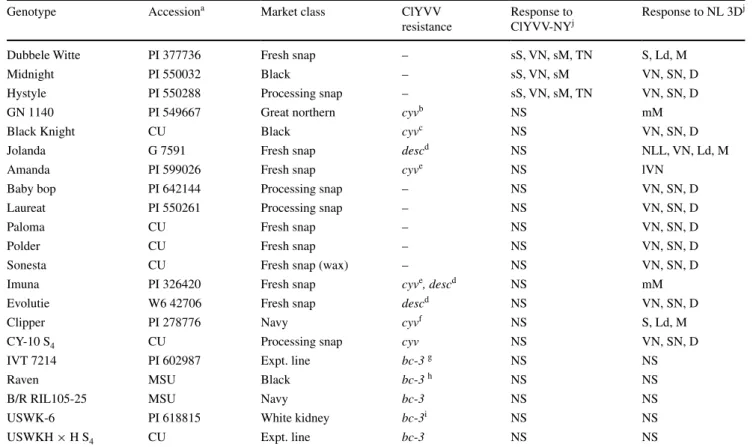
A panel of 21 common bean genotypes was assembled to include entries reported to possess the putatively independ-ent recessive resistance genes to ClYVV (cyv, desc, or
bc-3) as well as additional entries with known and/or demon-strated virus interaction phenotypes (Table 1). Five of the entries were snap bean genotypes (Baby Bop, Laureat, Pal-oma, Polder, Sonesta) that were identified to be resistant to ClYVV-NY as the result of a screen of cultivars (Hart and Griffiths, unpublished).
Populations were developed for cosegregation analysis and allelism testing. Midnight, the recurrent susceptible parent used in the development of the ClYVV resistant cultivar Black Knight was crossed to Black Knight to cre-ate F1 and F2 populations for cosegregation analysis. Black
Knight is nearly isogenic with Midnight but possesses the
cyv resistance allele (Halseth et al. 1998) from GN 1140 (Provvidenti 1987; Provvidenti and Schroeder 1973). Black Knight was also crossed to Raven (Kelly et al. 1994) that possesses the I, bc-3 allele combination to develop F1 and F2 populations for cosegregation analysis and allelism test-ing. B/R RIL 105-25, a breeding line developed at Michi-gan State University (East Lansing, MI) that possesses I,
bc-3 from Raven was crossed to the ClYVV resistant cul-tivar Clipper that possesses cyv (Tu 1983) to develop F1, F2, and F2:3 populations for allelism testing. The breeding line CY-10 S4 was crossed to USWK x H S4 to develop
F1 and F2 populations for allelism testing. CY-10 S4 is a BC8S4 line developed at Cornell University (CU) New York state agricultural experiment station (NYSAES) (Geneva,
NY) through the introgression of cyv from Clipper into the susceptible recurrent parent Hystyle. USWKH x H S4 is a BC2S4 line developed at CU through introgression of bc-3 from USWK-6 into the susceptible recurrent par-ent Hystyle. USWK-6 is a breeding line developed by the USDA-ARS that possesses I, bc-3 (Miklas et al. 2002).
Additional F1 populations were developed to investi-gate allelic relationships through complementation testing. Amanda (cyv) was crossed to Imuna (cyv/desc) and Jolanda (desc) was crossed to Clipper (cyv) to develop F1 popula-tions. All F1 hybrid plants were confirmed heterozygous by morphology, by allele-specific molecular marker assays, or both. The molecular marker assays are described in the ‘sequence analysis and design of allele-specific assays’ sec-tion of the methods below.
Seeds of all experimental material were sown in ‘Cornell mix’ (Boodley and Sheldrake 1972) in greenhouses at CU NYSAES, where routine watering, fertilization, and insect control measures were employed. Plant growth condi-tions were 24 °C day/21 °C night with a 14-h photoperiod.
Supplemental lighting was produced by 1,000 W metal halide bulbs (SunSystem III, Sunlight Supply, Inc., USA) to provide a rate of 300 μM m2 s1 of photosynthetically
active radiation at bench level. All of the plants used in the experiments were grown in 14.6 cm2 pots except for the F
2
derived F3 families (F2:3) which were grown in 18 cell flats (Speedling Inc., USA) with cells of 10 cm2.
Virus isolates, inoculation, and resistance evaluation ClYVV-NY was obtained from the Rosario Provvidenti col-lection at CU NYSAES and confirmed to be a pure isolate by host range and symptomatology, and RT-PCR (Provvi-denti and Schroeder 1973; Shail et al. 2007). The reaction of the common bean BCMV/BCMNV host differential groups and genotypes to ClYVV-NY is presented in Online Resource 1, Table 1. ClYVV-NY is identical to the strain employed by Larsen et al. (2008). ClYVV-NY was main-tained in the susceptible snap bean cultivar Hystyle. The NL 3D strain (Drijfhout 1978; Larsen et al. 2005) was obtained
Table 1 Common bean genotypes, sources, market classes, previously reported resistance genes to Clover yellow vein virus (ClYVV), and their
respective responses to the NY strain of ClYVV (ClYVV-NY) and the NL 3D strain of Bean common mosaic necrosis virus (NL 3D)
a Accessions that begin with ‘PI’ and ‘W6′ were sourced from the U.S. National Plant Germplasm System, ‘G’ international center for tropical agriculture, ‘CU’ Cornell University, and ‘MSU’ Michigan State University
Resistance genes cited in the following references: b Provvidenti and Schroeder 1973, c Halseth et al. 1998, d Sato et al. 2003, e Park and Tu 1991, f Tu 1983, g Drijfhout 1978, h Kelly et al. 1994, i Miklas et al. 2002
j Symptom legend: D plant death, Ld leaf distortion, M mosaic, mM mild mosaic, sM severe mosaic, NLL necrotic local lesions, NS no symp-toms, S stunting, sS severe stunting, SN systemic necrosis, VN vein necrosis, lVN localized vein necrosis
Genotype Accessiona Market class ClYVV
resistance
Response to
ClYVV-NYj Response to NL 3D j
Dubbele Witte PI 377736 Fresh snap – sS, VN, sM, TN S, Ld, M
Midnight PI 550032 Black – sS, VN, sM VN, SN, D
Hystyle PI 550288 Processing snap – sS, VN, sM, TN VN, SN, D
GN 1140 PI 549667 Great northern cyvb NS mM
Black Knight CU Black cyvc NS VN, SN, D
Jolanda G 7591 Fresh snap descd NS NLL, VN, Ld, M
Amanda PI 599026 Fresh snap cyve NS lVN
Baby bop PI 642144 Processing snap – NS VN, SN, D
Laureat PI 550261 Processing snap – NS VN, SN, D
Paloma CU Fresh snap – NS VN, SN, D
Polder CU Fresh snap – NS VN, SN, D
Sonesta CU Fresh snap (wax) – NS VN, SN, D
Imuna PI 326420 Fresh snap cyve, descd NS mM
Evolutie W6 42706 Fresh snap descd NS VN, SN, D
Clipper PI 278776 Navy cyvf NS S, Ld, M
CY-10 S4 CU Processing snap cyv NS VN, SN, D
IVT 7214 PI 602987 Expt. line bc-3 g NS NS
Raven MSU Black bc-3 h NS NS
B/R RIL105-25 MSU Navy bc-3 NS NS
USWK-6 PI 618815 White kidney bc-3i NS NS
from Dr. Phillip Miklas of the USDA-ARS (Prosser, WA) and was maintained in the cultivar Dubbele Witte. The virus strains were maintained by periodical transfer (~3 weeks) to the expanding primary leaves of seedlings of the suscepti-ble cultivars by mechanical inoculation. Virus inoculum was prepared by homogenizing newly expanded, symptomatic, virus-infected trifoliate leaves (1:10 w/v) in cold 10 mM phosphate buffer (3 mM K2PO4, 7 mM Na2HPO4; pH 7.0) with a mortar and pestle. The homogenate was applied with the pestle by gently rubbing newly expanded primary leaves of seedlings (7–10 days after planting) that had been dusted with carborundum (silicon carbide, 400 mesh, Sigma-Aldrich Inc., USA). The inoculated plants were then lightly rinsed with water. All plants were inoculated again 2 days after the first inoculation, and plants that did not display virus symptoms 10 days post the first inoculation (dpi) were re-inoculated to prevent escape.
At least 20 inoculated plants of each of the 21 genotypes included in the panel were inoculated and evaluated in three separate experiments. The plants were examined daily for virus symptoms, and symptom expression was evaluated in comparison to non-inoculated, susceptible, and resist-ant controls, and recorded 10, 21, 30, and 45 dpi. Symptom expression in response to inoculation with ClYVV-NY and NL 3D was evaluated qualitatively following the descrip-tors defined in the caption of Table 1. At 21 dpi, leaf tis-sue from newly expanded trifoliate leaves was collected for virus detection by enzyme-linked immunosorbent assay (ELISA). The ELISA was performed according to the manufacturer’s instructions (for ClYVV-NY:ClYVV-C81 and Pratt, AC Diagnostics Inc., USA; for NL 3D: Potyvirus Group, Agdia Inc., USA). The absorbance at OD405nm was measured with a multi-mode microplate reader (Synergy 2, Biotek Instruments Inc., USA) following the final incu-bation and after two additional 1-h intervals. Absorbance reads that were at least two times greater than that of the healthy negative control were considered to be positive for presence of the virus.
Cloning and sequencing of P. vulgaris eIF4E
Coding sequences of PveIF4E for each genotype in Table 1 were obtained as follows. Total RNA was isolated with an Ambion RNAqueous-4PCR Kit (Life Technologies, USA) following the manufacturer’s instructions. The RNA was eluted into 30 μL of elution buffer and quantified by spectrophotometry so that 1 μg of RNA could be used for cDNA synthesis. Reverse transcription was performed with an Ambion RETROscript First Strand Synthesis Kit fol-lowing the manufacturer’s instructions (Life Technologies, USA). Oligonucleotide primers capable of amplifying the entire PveIF4E coding sequence were designed prior to the release of the P. vulgaris genome sequence and thus were
designed to anneal to the extremities of the eIF4E coding sequences of pea (Pisum sativum L.) and soybean
(Gly-cine max (L.) Merr.). The primer pair was designed using Primer 3 (Rozen and Skaletsky 2000); the forward primer was designated Leg4E-F (5′-ATG GTT GTA GAA GAT ACC C-3′) and the reverse primer, Leg4E-R (5′-TCA TAC AAC GTA TTT ATT TTT AGC-3′). PCR amplification was performed in 20 μL reactions containing 0.5 μL of cDNA, 5 pmol of each primer, and 1.5 units of Platinum® Taq DNA Polymerase High Fidelity (Life Technologies, USA) using an Eppendorf Gradient Master Cycler (Eppendorf North America, USA). The PCR program consisted of 1 denaturation cycle of 3 min at 95 °C followed by 40 cycles of 30 s each of 94, 53, and 72 °C. Aliquots of the PCR products were resolved by 1.5 % TAE agarose gel electro-phoresis and visualized with ethidium bromide under UV-light to confirm that amplicons had the expected size of 693 bp. PCR products were then purified using a QIAquick PCR purification kit (Qiagen Inc., USA).
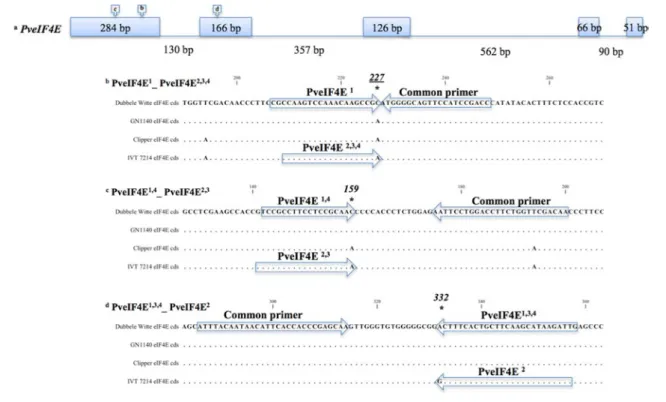
Two independently amplified PCR products from each genotype were cloned into the pCR4 vector using the TOPO TA Cloning Kit for Sequencing (Life Technologies, USA). DNA was isolated from liquid cultures of two single colony clones in selective media using the QIAprep Spin Miniprep kit (Qiagen Inc., USA). Nucleotide sequencing was per-formed with an Applied Biosystems Automated 3730 DNA Analyzer using Big Dye Terminator chemistry and Ampli-Taq-FS DNA Polymerase (Life Technologies, USA) at the CU Life Sciences Core Laboratories Center, Ithaca, NY. Sequence analysis and design of allele-specific assays The PveIF4E coding sequences and deduced proteins were aligned to detect non-synonymous SNPs and amino acid sub-stitutions. Multiple sequence alignment by ClustalW was performed with the CLC Main Workbench (CLC Bio, USA) software. PveIF4E coding sequences were also aligned to the Glycine max (L.) Merr. genomic sequence (Schmutz et al. 2010) with the ‘est2genome’ model of the Exoner-ate multiple sequence alignment program (SlExoner-ater and Birney 2005) to predict the intron–exon boundaries of PveIF4E. Non-synonymous SNPs that corresponded with defined virus resistance phenotypes were chosen for the design of KBiosciences Competitive Allele-Specific PCR (KASPar) SNP assays (LGC-KBiosciences, USA) (Fig. 1). At least 50 bp of sequence flanking both sides of the targeted SNPs was sub-mitted to the KBiosciences KASPar By Design service and the primers in Table 2 were synthesized for the assays.
DNA extraction and KASPar assays
Genomic DNA for use in KASPar assays was isolated from ~50 mg of tissue from young trifoliate leaves according
to Afanador et al. (1993). DNA was checked for purity by spectrophotometry (NanoDrop ND-1000, Thermo Scien-tific, USA) and was quantified using Quant-iT PicoGreen (Life Technologies, USA) and a multi-mode microplate reader (Synergy 2, Biotek Instruments Inc., USA). DNA was diluted with nuclease free water to 5 ng/μL. KASPar assays were performed according to the manufacturer’s instructions (Robinson and Holmes, 2011) in 8 μL reac-tion volumes containing 4 μL of DNA, 4 μL of 2 × KASP reaction mix, and 0.11 μL of the assay mix containing the common primer and the fluor-labeled allele-specific prim-ers. PCR amplification consisted of one 15 min cycle at
94 °C, followed by 10 cycles of 94 °C for 20 s, 65–57 °C for 60 s (dropping 0.8 °C per cycle), and then 30 cycles of 94 °C for 20 s, and 57 °C for 60 s using an Eppendorf Gradient Master Cycler PCR machine (Eppendorf, USA). Fluorescent endpoint analysis was performed with a ViiA7 Real-Time PCR system (Life Technologies, USA). Fluores-cent endpoint analysis data were analyzed with the ‘geno-typing experiment’ module of the ViiA7 Software package (Life Technologies, USA) and allele calls were assigned to the samples automatically by the software. In some cases, interaction with the software to infer an allele call, or to remove a failed reaction, was necessary.
Table 2 Assay ID, target SNPs, and primer sequences of the KASPar assays employed
KASPar assay ID SNP Primer Sequence
PveIF4E1 __PveIF4E2,3,4 C227A PveIF4E1 Allele (C_VIC) CGCCAAGTCCAAACAAGCCGC PveIF4E2,3,4 Allele (A_FAM) CGCCAAGTCCAAACAAGCCGA
Common GGTCGGATGGAACTGCCCCAT
PveIF4E1,4__PveIF4E2,3 C159A PveIF4E1,4 Allele (C_VIC) GTCCGCCTTCCTCCGCAAC PveIF4E2,3 Allele (A_FAM) CGTCCGCCTTCCTCCGCAAA
Common TGTCGAACCAGAAGGTCCAGGAATT
PveIF4E1,3,4 __PveIF4E2 A332G PveIF4E1,3,4 Allele (A_ VIC) CAATCTTATGCTTGAAGCAGTGAAAGT PveIF4E2 Allele (G_FAM) AATCTTATGCTTGAAGCAGTGAAAGC
Common ATTTACAATAACATTCACCACCCGAGCAA
Fig. 1 Schematic of genomic PveIF4E where boxes correspond
to exons, lines correspond to introns, and the relative positions of the non-synonymous SNPs targeted for the development of
KAS-Par assays are indicated by boxes with arrows. The KASKAS-Par assays described in Table 2 are illustrated below
Results
Allelism tests demonstrated that cyv, desc, and bc-3 are allelic
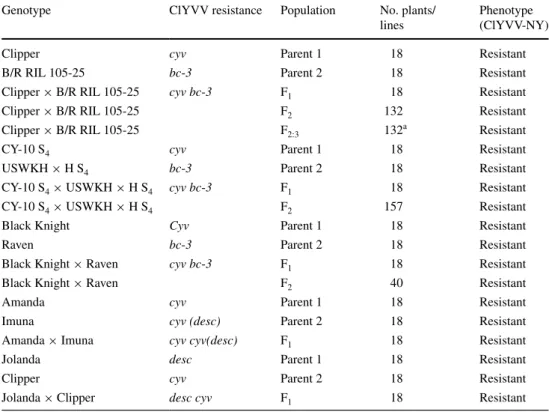
The lack of symptoms (Table 1) and negative ELISA results (data not shown) confirmed that the genotypes included in the panel that possessed cyv, desc, and bc-3 all conditioned resistance to ClYVV-NY. These results validated the use of ClYVV-NY to evaluate potential allelic relationships. All F1, F2, and F2:3 populations derived from the crosses between ClYVV resistant parents possessing either cyv,
desc, or bc-3 were uniformly resistant based on the absence of symptoms (Table 3) and negative ELISA results. In total, 90 individuals from five separate F1 populations, 289 individuals from two separate F2 populations, and 132 F2:3 lines (1,188 individuals) were resistant to ClYVV-NY. The failure of complementation to restore susceptibility pro-vides clear evidence that cyv, desc, and bc-3 are allelic and, therefore, map to the same genetic locus on chromosome 6. Resistance to ClYVV-NY in P. vulgaris is associated with an allelic series at PveIF4E
The complete coding sequences of PveIF4E were obtained from each of the 21 genotypes in Table 1 and were exam-ined for non-synonymous single nucleotide polymorphisms (Table 4; for full-length alignment see Online Resource 1). The Leg4E primer pair produced a single amplicon of the
expected size of 693 bp for all cDNA templates. BLASTn and BLASTp (http://blast.ncbi.nlm.nih.gov/) queries of the sequenced amplicons and the predicted amino acid sequences from Dubbele Witte and Raven confirmed iden-tity with PveIF4E1 (EF571267) and PveIF4E2 (EF571273),
respectively, previously cloned and sequenced from the same genotypes (Naderpour et al. 2010). This gene corre-sponds to the locus Phvul.006G168400 on chromosome six of the V1.0 release of the P. vulgaris genome (Phaseolus vulgaris V1.0 2013).
The complete PveIF4E coding sequences from Midnight and Hystyle, two genotypes (in addition to Dubbele Witte) that were susceptible to ClYVV-NY, and displayed the unprotected I gene response of systemic necrosis to NL 3D (Kelly et al. 1995), were identical to PveIF4E1. The
com-plete PveIF4E coding sequences from IVT 7214, B/R RIL 105-25, USWK-6, and USWKH x H S4, four genotypes (in addition to Raven) that were resistant to ClYVV-NY and NL 3D as conditioned by bc-3 were identical to PveIF4E2. PveIF4E2 differed from PveIF4E1 by four SNPs that each
resulted in predicted amino acid substitutions at positions 53 (N/K), 65 (F/Y), 76 (A/E), and 111 (D/G) of the pre-dicted protein (Table 4). PveIF4E2 was associated with
homozygous recessive resistance to NL 1 as conditioned by the bc-3 gene in previous cosegregation analysis (Nader-pour et al. 2010).
Two novel PveIF4E mutant alleles were identified,
PveIF4E3, and PveIF4E4, that were identical for some, but
not all of the SNPs and predicted amino acid substitutions
Table 3 Resistance to
ClYVV-NY in common bean parental genotypes and populations tested for allelism
a 9 plants per F2:3 line tested
Genotype ClYVV resistance Population No. plants/
lines
Phenotype (ClYVV-NY)
Clipper cyv Parent 1 18 Resistant
B/R RIL 105-25 bc-3 Parent 2 18 Resistant
Clipper × B/R RIL 105-25 cyv bc-3 F1 18 Resistant
Clipper × B/R RIL 105-25 F2 132 Resistant
Clipper × B/R RIL 105-25 F2:3 132a Resistant
CY-10 S4 cyv Parent 1 18 Resistant
USWKH × H S4 bc-3 Parent 2 18 Resistant
CY-10 S4 × USWKH × H S4 cyv bc-3 F1 18 Resistant
CY-10 S4 × USWKH × H S4 F2 157 Resistant
Black Knight Cyv Parent 1 18 Resistant
Raven bc-3 Parent 2 18 Resistant
Black Knight × Raven cyv bc-3 F1 18 Resistant
Black Knight × Raven F2 40 Resistant
Amanda cyv Parent 1 18 Resistant
Imuna cyv (desc) Parent 2 18 Resistant
Amanda × Imuna cyv cyv(desc) F1 18 Resistant
Jolanda desc Parent 1 18 Resistant
Clipper cyv Parent 2 18 Resistant
of PveIF4E2 (Table 4). These novel mutant alleles were
exclusive to genotypes with resistance to ClYVV-NY and susceptibility to NL 3D. PveIF4E3, first cloned and
sequenced from Clipper, also present in CY-10 S4, Evolutie,
and Imuna, possessed three of the four predicted amino acid substitutions present in PveIF4E2 at positions 53
(N/K), 65 (F/Y), and 76 (A/E), respectively. PveIF4E4, first
cloned and sequenced from GN 1140, also present in Black Knight, Jolanda, Amanda, Baby Bop, Laureat, Paloma, Pol-der, and Sonesta, possessed only one of the four predicted amino acid substitutions present in PveIF4E2 at position 76
(A/E). This result strongly suggests that the A76E mutation is a determinant for resistance to ClYVV-NY.
Only genotypes that possessed PveIF4E2 and the
pre-dicted D111G mutation were resistant to NL 3D (Table 4). Similarly, this result strongly suggests that the D111G
mutation is a determinant for resistance to NL 3D. The pattern of exclusive non-synonymous nucleotide substitu-tions present in PveIF4E2, PveIF4E3, and PveIF4E4 are
analogous to the patterns of polymorphism in the critical area of eIF4E for cap-binding and recognition where amino acid substitutions have been associated with, or directly demonstrated to condition potyvirus resistance in an exten-sive range of crop plants (Diaz-Pendon et al. 2004; Kang et al. 2005a; LeGall et al. 2011; Robaglia and Caranta 2006; Truniger and Aranda 2009; Wang and Krishnaswamy 2012).
Allele-specific genotyping and cosegregation analysis In order to progress from polymorphism discovery to allele-specific molecular markers as rapidly as possible,
Table 4 Resistance of 21 common bean genotypes to ClYVV-NY and NL 3D and their corresponding nucleotide polymorphisms and predicted
amino acid substitutions in PveIF4E
a S susceptible, SN systemic necrois, VN vein necrosis, r resistant; confirmed by screening 5 to 10 plants of each cultivar in three independent experiments, with ‘r’ confirmed by ELISA
b A dash (–) in the table represents an identical nt or aa as PveIF4E1
c PveIF4E alleles are numbered by superscript in the order in which they were discovered d PveIF4E1 first cloned and sequenced from Dubbele Witte and others in Naderpour et al. 2010 e PveIF4E2 first cloned and sequenced from Raven in Naderpour et al. 2010
Genotype ClYVV-NYa NL 3Da Position of nucleotide (nt) polymorphism and amino acid (aa)
substitutionsb PveIF4E alleles
c
nt aa nt aa nt aa nt aa
159 53 194 65 227 76 332 111
Dubbele Witte S S C N T F C A A D PveIF4E1(d)
Midnight S S – – – – – – – –
Hystyle S S – – – – – – – –
GN 1140 r (cyv) S – – – – A E – – PveIF4E4
Black Knight r (cyv) SN – – – – A E – –
Jolanda r (desc) VN – – – – A E – – Amanda r (cyv) VN – – – – A E – – Baby Bop r SN – – – – A E – – Laureat r SN – – – – A E – – Paloma r SN – – – – A E – – Polder r SN – – – – A E – – Sonesta r SN – – – – A E – –
Imuna r (cyv/desc) S A K A Y A E – – PveIF4E3
Evolutie r (desc) SN A K A Y A E – –
Clipper r (cyv) S A K A Y A E – –
CY-10 S4 r (cyv) SN A K A Y A E – –
IVT 7214 r (bc-3) r (bc-3) A K A Y A E G G PveIF4E2 (e)
Raven r (bc-3) r (bc-3) A K A Y A E G G
B/R RIL105-25 r (bc-3) r (bc-3) A K A Y A E G G
USWK-6 r (bc-3) r (bc-3) A K A Y A E G G
three KASPar SNP genotyping assays were developed to differentiate and confirm the allelic state of all of the
PveIF4E alleles (Table 2). The assays were employed to investigate genotype–phenotype relationships, to confirm allelism, and to validate the utility of the assays for allelic discrimination across the germplasm.
KASPar assay ‘PveIF4E1__PveIF4E2,3,4’ targets the
SNP227 (C227A) mutation that corresponds to the pre-dicted A76E amino acid substitution that is present in the PveIF4E2,3,4 alleles, all associated with resistance to
ClYVV-NY (Table 4). This assay was employed to inves-tigate genotype–phenotype relationships in parental, F1, and F2 populations of the Midnight × Black Knight cross (Table 5). An example of the allele calls made by the soft-ware is illustrated in Online Resource 1, Fig. 4, for 88 Mid-night × Black KMid-night F2 individuals. The genotypic and
phenotypic segregation ratios fit that expected of a single recessive locus, and the homozygous state of the mutant allele (AA) was in complete linkage with the resistance phenotype in 49 F2 individuals (Table 5).
KASPar assay ‘PveIF4E1,3,4__PveIF4E2’ targets the
SNP332 (A332G) mutation that corresponds to the pre-dicted D111G amino acid substitution present only in
PveIF4E2 and that is associated with bc-3 resistance to
ClYVV-NY, ClYVV-WI (Larsen et al. 2008), NL 3D, and NL 1 (Naderpour et al. 2010) (Table 4). This assay was employed to investigate genotype–phenotype relation-ships in the parental, F1, and F2 populations of the Black Knight × Raven cross (Table 6). The genotypic and pheno-typic segregation ratios fit that expected for a single reces-sive locus, and the homozygous state of the mutant allele (GG) was in complete linkage with the resistance pheno-type in 50 F2 individuals (Table 6).
KASPar assay ‘PveIF4E1,3,4__PveIF4E2’(A332G) was
also employed to demonstrate its ability to discriminate alleles at the molecular genetic level in the parental, F1, and F2 allelism testing populations of the Clipper x B/R RIL 105-25 cross where all phenotypes were identical (Table 7).
The genotypic segregation ratio fit the expectation of a sin-gle locus (Table 7). The phenotypic segregation ratio could not be ascertained because the population was inoculated and evaluated only for resistance to ClYVV-NY. KASPar assay ‘PveIF4E1,4__PveIF4E2,3’ (C159A) was designed
for the purposes of allelic discrimination and haplotype analysis.
The KASPar assays were employed for haplotype anal-ysis across the 21 common bean genotypes. Table 8 dem-onstrates the assays’ ability to discriminate between the
PveIF4E alleles and to ultimately predict the resistance allele and spectrum. The KASPar assays consistently and accurately identified the correct haplotypes for all of the
PveIF4E alleles.
Discussion
The germplasm evaluation (Table 1), the allelism testing (Table 3), the complete association between unique non-synonymous SNPs in PveIF4E alleles and resistance to ClYVV and/or NL 3D (Table 4), and the KASPar allele-specific assays (Tables 5, 6, 7, 8) all contribute to the evi-dence that cyv, desc, and bc-3 comprise a series of reces-sive resistance alleles at the Bc-3 locus. This allelic series conditions strain- and species-specific resistance spectra to the potyviruses ClYVV, BCMV, and BCMNV in com-mon bean. In light of this, the nomenclature for the Bc-3 locus should be revised in accordance with the guidelines for gene nomenclature set forth by the Bean Improvement Cooperative (BIC) (Porch 2012).
The first genetic symbol designated to an allele at this locus was by-3, identified in GN1140 (Provvidenti and Schroeder 1973), although it was subsequently revised to
cyv (Provvidenti 1987). It was previously demonstrated that
desc from Jolanda was allelic with the ClYVV resistance present in the cultivar Imuna (previously reported as cyv (Park and Tu 1991)) (Sato et al. 2003). We also demonstrate
Table 5 Cosegregation of KASPar SNP PveIF4E1 (C) allele with susceptibility and KASPar SNP PveIF4E2,3,4 (A) allele with resistance to ClYVV-NY as conditioned by cyvcyv in the Midnight x Black Knight populations
a Expected genotypic ratio for F2 population of 1 AA: 2 AC: 1 CC; χ2 = 0.046, P = 0.977 (df = 2)
b Expected phenotypic ratio for F2 population of 1 resistant: 3 susceptible; χ2 = 0.015, P = 0.902 (df = 1)
Genotype Population ClYVV
resistance
PveIF4E1__PveIF4E2,3,4 No. Phenotypeb No. SNP (C227A)
Midnight Parent 1 CyvCyv PveIF4E1 (C) PveIF4E1 (C) 18 Susceptible 18
Black Knight Parent 2 cyvcyv PveIF4E4 (A) PveIF4E4 (A) 18 Resistant 18
Midnight × Black Knight F1 Cyvcyv PveIF4E1 (C) PveIF4E4 (A) 18 Susceptible 18
Midnight × Black Knight F2 cyvcyv PveIF4E4 (A) PveIF4E4 (A) 49 Resistant 49
Cyvcyv PveIF4E1 (C) PveIF4E4 (A) 97 Susceptible 144
that the resistance from Jolanda is allelic with that pos-sessed by Clipper and Amanda (previously reported as
cyv by Tu 1983, and Park and Tu 1991, respectively). The assignment of the independent gene status and symbol desc was not warranted, nor does it appear to have ever been for-mally accepted by the BIC (Porch 2009). As the bc-3 gene symbol, first identified in IVT 7214 (Drijfhout 1978) was assigned prior to the designation of cyv, it retains priority as the gene symbol for the locus. The original bc-3 allele from IVT 7214 retains its designation as bc-3, and it con-ditions the widest spectrum of resistance to BCMV and BCMNV when in combination with bc-u or I (Kelly et al. 1995). The cyv allele first reported in GN 1140 should be designated bc-32 (Table 9) to reflect its recessive resistance
to ClYVV-NY, its differential susceptibility to NL 3D, and the order in which it was discovered.
A causative relationship between mutations in PveIF4E and bc-3 resistance is probable based on the clear precedent of recessive potyvirus resistance conferred by amino acid substitutions in eIF4E. This can be the result of as few as one amino acid substitution, or in many cases, an allelic series of eIF4E is present where various subtle signature amino acid substitutions in the surface loops of the eIF4E protein confer unique strain and species-specific resistance
spectra [the pvr2 alleles in Capsicum annuum (Charron et al. 2008; Kang et al. 2005b; Ruffel et al. 2002), the
pot-1 allele in Solanum lycopersicum (Ruffel et al. 2005), the
mo1 allele in Lactuca sativa (Nicaise et al. 2003), the sbm
1 alleles in Pisum sativum (Andrade et al. 2009; Bruun-Rasmussen et al. 2007; Gao et al. 2004), the rym4 and
rym5 alleles in Hordeum vulgare (Hofinger et al. 2011; Stein et al. 2005), and the zym–FL allele in Citrullus
lana-tus (Ling et al. 2009)]. The pattern of predicted amino acid substitutions in the surface loops of PveIF4E and the com-plete association with differential resistance presented here closely resembles the numerous other pathosystems char-acterized. In addition, there is close alignment of mutations in PveIF4E with mutations in eIF4E that confer potyvirus resistance alleles present in the plant species C. annuum (Kang et al. 2005b; Ruffel et al. 2002), L. sativa (Nicaise et al. 2003), and P. sativum (Bruun-Rasmussen et al. 2007; Gao et al. 2004) (Naderpour et al. 2010). Here we provide strong evidence for an association between a single amino acid substitution at position 76 (A76E) and resistance to ClYVV-NY, and for a single amino acid substitution at position 111 (D111G) and differential resistance to NL 3D.
This result parallels previous research that has revealed a co-evolutionary ‘arms race’ where positive Darwinian
Table 6 Cosegregation of KASPar SNP PveIF4E1,3,4 (A) allele with systemic necrosis and KASPar SNP PveIF4E2 (G) allele with resistance to NL 3D as conditioned by bc-3 in the Black Knight × Raven populations
SN Systemic necrosis
a Expected genotypic ratio for F2 population of 1 AA: 2 AG: 1 GG; χ2 = 1.392, P = 0.498 (df = 2) b Expected phenotypic ratio for F2 population of 1 resistant: 3 susceptible; χ2 = 0.464, P = 0.496 (df = 1)
Genotype Population NL 3D
resistance
PveIF4E1,3,4__PveIF4E2 No.a Phenotypeb No.b SNP (A332G)
Black Knight Parent 1 cyvcyv PveIF4E1,3,4 (A) PveIF4E1,3,4 (A) 18 SN 18
Raven Parent 2 bc-3bc-3 PveIF4E2 (G) PveIF4E2 (G) 18 Resistant 18
Black Knight × Raven F1 cyv bc-3 PveIF4E1,3,4 (A) PveIF4E2 (G) 18 SN 18
Black Knight × Raven F2 bc-3bc-3 PveIF4E2 (G) PveIF4E2 (G) 50 Resistant 50
cyv bc-3 PveIF4E1,3,4 (A) PveIF4E2 (G) 84 SN 134
cyvcyv PveIF4E1,3,4 (A) PveIF4E1,3,4 (A) 50
Table 7 Allelic discrimination of KASPar SNP PveIF4E3 (A) and PveIF4E2(G) alleles in the Clipper × B/R RIL105-25 populations
a Expected genotypic ratio for F2 population of 1 AA: 2 AG: 1 GG; χ2 = 0.166, P = 0.921 (df = 2)
Genotype Population ClYVV
resistance
PveIF4E1,3,4__PveIF4E2 No.a Phenotype No. SNP (A332G)
Clipper Parent 1 cyvcyv PveIF4E1,3,4 (A) PveIF4E1,3,4 (A) 18 Resistant 18
B/R RIL 105-25 Parent 2 bc-3bc-3 PveIF4E2 (G) PveIF4E2 (G) 18 Resistant 18
Clipper × B/R RIL 105-25 F1 cyvbc-3 PveIF4E1,3,4 (A) PveIF4E2 (G) 18 Resistant 18
cyvcyv PveIF4E1,3,4 (A) PveIF4E1,3,4 (A) 32
Clipper × B/R RIL 105-25 F2 cyvbc-3 PveIF4E1,3,4 (A) PveIF4E1,3,4 (G) 65 Resistant 132
selection has acted on single amino acid sites of eIF4E to create recessive virus resistance genes as the result of coev-olution with the virus, where the viral-encoded VPg func-tions as the pathogenicity determinant and is also under positive selection (Cavatorta et al. 2008; Charron et al. 2008; Moury et al. 2004). Statistical methods for infer-ring positive selection in combination with the a priori data available from eIF4E resistance alleles in C. annuum (Charron et al. 2008), S. lycopersicum (Ruffel et al. 2005),
and P. sativum (Gao et al. 2004) demonstrated high pre-cision and power to positively identify the single amino acid sites involved in potyvirus resistance (Cavatorta et al. 2008). Remarkably, out of the ten amino acid positions examined, positions 76 and 110 were identified with the highest posterior probabilities (Cavatorta et al. 2008). In C.
annuum, P. sativum, and P. vulgaris, resistance to a poty-virus is either confirmed, or associated with the substitu-tion of an alanine amino acid residue at posisubstitu-tion 76 with either an aspartic residue (C. annuum, P. sativum), proline residue (P. sativum), or a glutamic acid residue (A76E) (P.
vulgaris). The D111G amino acid substitution in PveIF4E2,
and associated with differential resistance to NL 3D, is also remarkably close to position 110. Previous research has revealed that the pathogenicity determinant of the cyv resistance breaking strain (ClYVV-Br) maps to the central region of the VPg and is likely responsible for the restora-tion of pathogenicity (Sato et al. 2003).
Direct functional conferral of resistance and restoration of susceptibility is warranted, but common bean has lacked efficient transformation capabilities. A Bean pod mottle
virus (BPMV) (family Comoviridae, genus Comovirus)-based virus induced gene-silencing (VIGS) vector for
Table 8 PveIF4E haplotype analysis as enabled by the three KASPar assays employed in the research
a S susceptible, r resistant; confirmed by screening 5–10 plants of each cultivar in three independent experiments, with ‘r’ confirmed by ELISA Genotype ClYVVa
resistance
PveIF4E allele KASPar SNP assays
PveIF4E1__PveIF4E2,3,4 PveIF4E1,4__PveIF4E2,3 PveIF4E1,3,4__PveIF4E2
SNP (C227A) SNP (C159A) SNP (A332G)
Dubbele Witte S PveIF4E1 PveIF4E1 (C) PveIF4E1,4 (C) PveIF4E1,3,4 (A)
Midnight S PveIF4E1 PveIF4E1 (C) PveIF4E1,4 (C) PveIF4E1,3,4 (A)
Hystyle S PveIF4E1 PveIF4E1 (C) PveIF4E1,4 (C) PveIF4E1,3,4 (A)
GN 1140 cyv PveIF4E4 PveIF4E2,3,4 (A) PveIF4E1,4 (C) PveIF4E1,3,4 (A)
Black Knight cyv PveIF4E4 PveIF4E2,3,4 (A) PveIF4E1,4 (C) PveIF4E1,3,4 (A)
Jolanda desc PveIF4E4 PveIF4E2,3,4 (A) PveIF4E1,4 (C) PveIF4E1,3,4 (A)
Amanda cyv PveIF4E4 PveIF4E2,3,4 (A) PveIF4E1,4 (C) PveIF4E1,3,4 (A)
Baby Bop r PveIF4E4 PveIF4E2,3,4 (A) PveIF4E1,4 (C) PveIF4E1,3,4 (A)
Laureat r PveIF4E4 PveIF4E2,3,4 (A) PveIF4E1,4 (C) PveIF4E1,3,4 (A)
Paloma r PveIF4E4 PveIF4E2,3,4 (A) PveIF4E1,4 (C) PveIF4E1,3,4 (A)
Polder r PveIF4E4 PveIF4E2,3,4 (A) PveIF4E1,4 (C) PveIF4E1,3,4 (A)
Sonesta r PveIF4E4 PveIF4E2,3,4 (A) PveIF4E1,4 (C) PveIF4E1,3,4 (A)
Imuna cyv, desc PveIF4E3 PveIF4E2,3,4 (A) PveIF4E2,3 (A) PveIF4E1,3,4 (A)
Evolutie desc PveIF4E3 PveIF4E2,3,4 (A) PveIF4E2,3 (A) PveIF4E1,3,4 (A)
Clipper cyv PveIF4E3 PveIF4E2,3,4 (A) PveIF4E2,3 (A) PveIF4E1,3,4 (A)
CY-10 S4 cyv PveIF4E3 PveIF4E2,3,4 (A) PveIF4E2,3 (A) PveIF4E1,3,4 (A)
IVT 7214 bc-3 PveIF4E2 PveIF4E2,3,4 (A) PveIF4E2,3 (A) PveIF4E2 (G)
Raven bc-3 PveIF4E2 PveIF4E2,3,4 (A) PveIF4E2,3 (A) PveIF4E2 (G)
B/R RIL105-25 bc-3 PveIF4E2 PveIF4E2,3,4 (A) PveIF4E2,3 (A) PveIF4E2 (G)
USWK-6 bc-3 PveIF4E2 PveIF4E2,3,4 (A) PveIF4E2,3 (A) PveIF4E2 (G)
USWKH × H S4 bc-3 PveIF4E2 PveIF4E2,3,4 (A) PveIF4E2,3 (A) PveIF4E2 (G)
Table 9 Revised gene symbol nomenclature for the Bc-3 locus
a In the absence of direct functional complementation, PveIF4E remains as the candidate gene for Bc-3
b Proposed here and under review by the Bean Improvement Coop-erative Genetics Committee
Genotype Accession # ClYVV resistance
PveIF4E
allelea Gene symbol Dubbele Witte PI 549695 Susceptible PveIF4E1 Bc-3
IVT 7214 PI 602987 bc-3 PveIF4E2 bc-3
Clipper PI 278776 cyv PveIF4E3 bc-32b
GN 1140 PI 549667 cyv PveIF4E4
common bean has recently been developed (Diaz-Camino et al. 2011) and may prove to be a useful tool for con-firming the function of PveIF4E in potyvirus resistance in future research. Functional analysis of PveIF4E-potyvirus VPg interactions through protein–protein interaction exper-iments may also be warranted to better characterize, under-stand, and predict resistance spectra.
Establishment of the allelic relationships between the known sources of resistance to ClYVV in common bean directly informs the definition of the target genotype for the most effective resistance, at least in terms of the strains known in the United States. The possibility of pyramiding the previously identified putative independent genes is no longer possible, but it is clear that the original bc-3 allele from IVT7214 conditions the widest spectrum of resist-ance. The bc-3 allele is the only allele that conditioned resistance to all strains of ClYVV, including ClYVV-WI and ClYVV-OR, except when in the IVT 7214 background (Larsen et al. 2008), whereas bc-32 (present in Jolanda and
Imuna) did not. It is difficult to speculate as to why IVT 7214 may be the exception, as it possesses the bc-u allele that should condition the full expression of bc-3 (Drijfhout 1978). In addition, the genotype USCR-8 that possesses
bc-3 in the absence of both the I gene and bc-u (Miklas and Hang 1998) was resistant to ClYVV-WI and ClYVV-OR (Larsen et al. 2008). It is still somewhat unclear whether
bc-3 or bc-32 are effective for resistance to ClYVV in
the absence of bc-u and/or I because all of the genotypes investigated in this research possessed one, or both genes. Another exception is GN 1140, as while it possesses
bc-32, and is mildly susceptible to NL 3D, it was resistant to ClYVV-WI and ClYVV-OR (Larsen et al. 2008). The gen-otype GN UI 31 may be an analogous case as it was the source of two recessive genes that conditioned resistance to the BYMV-S strain from Oregon (Tatchell et al. 1985), so it is feasible that GN 1140 and GN UI 31 possess an additional resistance gene, perhaps an alternate allele of
bc-u (Strausbaugh et al. 2003) that widen their strain-specific resistance spectrum to include ClYVV-WI and ClYVV-OR where other bc-32 genotypes do not (Larsen et al. 2005).
GN UI 31 has been demonstrated to have mixed reac-tions to specific BCMV/BCMNV strains potentially due to admixture or residual heterozygosity in previous research (Forster et al. 1994; Miklas et al. 2000). Additional effort is needed to obtain a more thorough characterization of the spectrum of resistance to ClYVV and BCMV/BCMNV pathogenicity groups provided by bc-32 alone, and in
com-bination with bc-u and/or I.
The three KASPar assays developed here provide a suite of rapid, user-friendly, putatively functional molecular markers that have the capability to detect and differentiate all four of the PveIF4E alleles characterized thus far. These assays are an improvement over the RsaI CAPS marker
associated with bc-3 resistance (Naderpour et al. 2010) because in addition to the PveIF4E2 allele, the RsaI site at
position 193 of the coding sequence is also present in the
PveIF4E3 allele (Online Resource 1, Fig. 1, Fig. 3), which
is not associated with resistance to NL 3D. The PveIF4E KASPar assays are also more convenient to employ in marker-assisted selection (MAS) because they do not require enzymatic digestion or gel electrophoresis; how-ever, they do require fluorescent endpoint detection capa-bilities. The RsaI CAPS marker, therefore, remains useful when this capability is absent, but the resistance to NL 3D of the donor parent must be known or confirmed. The discrimination capability of the KASPar assays developed here may also have the potential for rapid characterization of germplasm through the detection of mutant alleles, par-ticularly for detecting predicted amino acid substitutions at positions 76 and 111. Table 8 summarizes the employment of the three assays for allelic discrimination in the 21 com-mon bean genotypes studied and simultaneously provides a guide on how to use the KASPar assays for allelic discrimi-nation and MAS.
This research contributes to an enhanced understanding of the gene-for-gene relationships between potyviruses and resistance alleles associated with mutations in PveIF4E at the Bc-3 locus in common bean. This knowledge combined with the KASPar assays continues in the development of a platform to elucidate the role of eIF4E-mediated recessive resistance in common bean. Advanced research in this area in other crop plants has been rewarding, with new insights into the biology [e.g. complementation interactions with mutations in eIF(iso)4E for an enhanced resistance spec-trum (Hwang et al. 2009; Rubio et al. 2009; Ruffel et al. 2006)], the demonstration of new tools for rapid identifica-tion of novel alleles by allele mining [e.g. High-resoluidentifica-tion melting analysis (HRM) (Hofinger et al. 2009; Hofinger et al. 2011)], and to even create novel resistance alleles by mutagenesis (Piron et al. 2010). The research presented here provides a foundation on which to advance similar research in common bean. The KASPar assays developed here should also assist in the utilization of bc-3 resistance, important to common bean growing regions around the world.
Acknowledgments The authors wish to thank James Kelly, Phil
Miklas, Elise Vendeuvre, and Molly Welsh for provision of bean germplasm. A special thanks is due to Jason Cavatorta for his ini-tial assistance with preliminary research and Michael Mazourek for providing laboratory space. We acknowledge the technical assistance of Matt Wavrick, and Sarah Durkee. We also thank two anonymous reviewers whose suggestions helped to improve the manuscript. This research was supported through funding from the New York State Vegetable Research Association. John Hart was provided with support from Pioneer Hi-Bred Intl. through Cornell University’s Department of Plant Breeding and Genetics, a Cornell Graduate School Fellow-ship, and the Bullis Fellowship of the NYSAES.
References
Afanador LK, Haley SD, Kelly JD (1993) Adoption of a mini-prep DNA extraction method for RAPD marker analysis in common bean (Phaseolus vulgaris L.). Annu Rep Bean Improv Coop 35:10–11
Ali MA (1950) Genetics of resistance to the common bean mosaic virus in the bean (Phaseolus vulgaris L.). Phytopathol 40:69–79 Andrade M, Abe Y, Nakahara KS, Uyeda I (2009) The cyv-2
resist-ance to Clover yellow vein virus in pea is controlled by the eukar-yotic initiation factor 4E. J Gen Plant Pathol 75:241–249 Boodley JW, Sheldrake R (1972) Cornell peat-lite mixes for
commer-cial plant growing. Cornell Info Bull 43:1–8
Bos L, Lindsten K, Maat DZ (1977) Similarity of Clover yellow vein
virus and Pea necrosis virus. Neth J Plant Pathol 83:97–108 Bruun-Rasmussen M, Moller IS, Tulinius G et al (2007) The same
allele of translation initiation factor 4E mediates resistance against two Potyvrius spp. in Pisum sativum. Molec Plant Microb Interact 9:1075–1082
CABI/EPPO (2000) Clover yellow vein potyvirus. Distribution maps of plant diseases. CAB International, Wallingford, p 811
Cavatorta JR, Savage AE, Yeam I, Gray SM, Jahn MM (2008) Posi-tive darwinian selection at single amino-acid sites conferring plant virus resistance. J Mol Evol 67:551–559
Charron C, Nicolai M, Gallois JL et al (2008) Natural variation and functional analyses provide evidence for co-evolution between plant eIF4E and potyviral VPg. Plant J 54:56–68
Collmer CW, Marston MF, Taylor JC, Jahn M (2000) The I gene of bean: a dosage- dependent allele conferring extreme resist-ance, hypersensitive resistresist-ance, or spreading vascular necrosis in response to the Potyvirus Bean common mosaic virus. Molec Plant-Microbe Interact 13:1266–1270
Crnov R, Gilbertson RL (2001) Outbreak of Clover yellow vein virus in a bean field in Colusa County, California. Plant Dis 85:444 Diaz-Camino C, Annamalai P, Sanchez F et al (2011) An effective
virus-based gene silencing method for functional genomics stud-ies in common bean. Plant Methods 7:16
Diaz-Pendon JA, Truniger V, Nieto C et al (2004) Advances in under-standing recessive resistance to plant viruses. Molec Plant Pathol 5:223–233
Dizadji A, Shahraeen N (2011) Occurrence, distribution and seasonal changes of viruses infecting common bean in northwestern Iran. Arch Phytopathol Plant Prot 44(17):1647–1654
Drijfhout E (1978) Genetic interaction between Phaseolus
vul-garis and Bean common mosaic virus with implications for strain identification and breeding for resistance. Agric Res Rep 872:1–98
Drijfhout E, Silbernagel MJ, Burke DW (1978) Differentiation of strains of Bean common mosaic virus. Neth J Plant Pathol 84:13–26
Forster RL, Strausbaugh CA, Stewart-Williams K, Myers JR (1994) Determination of resistance to BCMV in dry edible bean culti-vars and breeding lines. Annu Rep Bean Improv Coop 37:1–8 Gao A, Johansen E, Eyers S et al (2004) The potyvirus recessive
resistance gene, sbm1, identifies a novel role for translation ini-tiation factor eIF4E in cell-to-cell trafficking. Plant J 40:376–385 Halseth DE, Myers JR, Stewart-Williams K, Scully B (1998)
Regis-tration of ‘Black Knight’ black bean. Crop Sci 38:883
Hill JH, Alleman R, Hogg DB, Grau CR (2001) First report of trans-mission of Soybean mosaic virus and Alfalfa mosaic virus by
Aphis glycines in the New World. Plant Dis 85:561
Hjulsager CK, Lund OS, Johansen IE (2002) A new pathotype of pea seed-borne mosaic virus explained by properties of the P3-6K1 and viral genome-linked (VPg) coding regions. Mol Plant Microb Interact 15:169–171
Hofinger BJ, Jing HC, Hammond-Kossack KE, Kanyuka K (2009) High-resolution melting analysis of cDNA-derived PCR ampli-cons for rapid and cost-effective identifications of novel alleles in barley. Theor Appl Genet 119:851–865
Hofinger BJ, Russell JR, Bass CG et al (2011) An exceptionally high nucleotide and haplotype diversity and a signature of positive selection for the eIF4E resistance gene in barley are revealed by allele mining and phylogenetic analyses of natural populations. Molec Ecol 20:3653–3668
Hwang J, Li J, Liu W et al (2009) Double mutations in eIF4E and eIFiso4E confer recessive resistance to Chilli veinal mottle virus in Pepper. Mol Cells 27:329–336
Johnson WC, Guzman P, Mandala D, Mkandawire ABC, Temple S, Gilbertson RL, Gepts P (1997) Molecular tagging of the
bc-3 gene for introgression into Andean common bean. Crop Sci 37:248–254
Kang BC, Yeam I, Jahn MM (2005a) Genetics of plant virus resist-ance. Annu Rev Phytopathol 43:581–621
Kang BC, Yeam I, Frantz JD et al (2005b) The pvr1 locus in Cap-sicum encodes a translation initiation factor eIF4E that interacts with Tobacco etch virus VPg. Plant J 42:392–405
Keller KE, Johansen IE, Martin RR, Hampton RO (1998) Potyvirus genome-linked protein VPg determines pea-seed borne mosaic virus pathotype-specific virulence in Pisum sativum. Molec Plant Microb Interact 11:124–130
Kelly JD, Hosfield GL, Varner GV, Uebersax MA, Haley SD, Tay-lor J (1994) Registration of ‘Raven’ black bean. Crop Sci 34: 1406–1407
Kelly JD, Afanador L, Haley SD (1995) Pyramiding genes for resist-ance to bean common mosaic virus. Euphytica 82:207–212 Kelly JD, Gepts P, Miklas PN, Coyne DP (2003) Tagging and
map-ping of genes and QTL and molecular-marker assisted selection for traits of economic importance in bean and cowpea. Field Crops Res 82:135–154
Larsen RC, Myers JR (2006) A pod necrosis disease (‘chocolate pod’) of snap bean (Phaseolus vulgaris) in Oregon caused by a strain of
Clover yellow vein virus. Phytopathol 96:S169
Larsen RC, Miklas PN, Eastwell CR et al (2002) A virus disease com-plex devastating late season snap bean production in the Mid-west. Annu Rep Bean Improv Coop 45:36–37
Larsen RC, Miklas PN, Druffel KL, Wyatt SD (2005) NL-3 K strain is a stable and naturally occurring interspecific recombinant derived from Bean common mosaic necrosis virus and Bean
com-mon mosaic virus. Phytopathol 95:1037–1042
Larsen RC, Miklas PN, Eastwell KC, Grau CR (2008) A strain of
Clover yellow vein virus that causes severe pod necrosis disease in snap bean. Plant Dis 92:1026–1032
LeGall O, Aranda MA, Caranta C (2011) Plant resistance to viruses mediated by translation initiation factors. In: Caranta C et al (eds) Recent advances in plant virology. Caister Academic Press, Nor-folk, pp 177–194
Lellis AD, Kasschau KD, Whitham SA, Carrington JC (2002) Loss-of-susceptibility mutants of Arabidopsis thaliana reveal an essen-tial role for eIF(iso)4E during potyvirus infection. Curr Biol 12:1046–1051
Ling KS, Harris R, Meyer JDF (2009) Non-synonymous single nucle-otide polymorphisms in the watermelon eIF4E gene are closely associated with resistance to Zucchini yellow mosaic virus. Theor Appl Genet 120:191–200
McKern NM, Mink GI, Barnett OW, Mishra A, Whittaker LA, Silber-nagel MJ, Ward CW, Shukla DD (1992) Isolates of bean common mosaic virus comprising two distinct potyviruses. Phytopathol 82:923–928
Miklas PN, Hang AN (1998) Release of cranberry dry bean germ-plasm lines USCR-7 and USCR-8 with resistance to bean