To be presented at GlobeCom'91 in December 1991.
LIDS-P-2049
Design of optical matched filters
Pierre A. Humblet *
Massachusetts Institute of Technology Laboratory for Information and Decision Systems
Room 35-203
Cambridge, Massachusetts 02139-4307
Abstract This paper studies the design and the per- In the case of homodyne coherent reception (zero in-formance of receivers using optical matched filters and termediate frequency) with known signal phase (syn-direct detection, when the basic pulse shape consists a chronous detection) the effect of the additive noise rectangular pulse of monochromatic light. The modula- can be optimally combatted by using electronic filters tion format can be ASK, FSK or DPSK. Such receivers matched to the envelope of the optical signals (a filter is are useful when amplifier noise is the main source of un- matched to a signal if its impulse response is proportion-certainty as they optimally reject additive white Gaus- al to the time reversed signal). The situation is similar sian noise. The performances of ASK and FSK receivers in the case of heterodyne coherent reception (non zero are reported, taking into account shot noise and the ef- intermediate frequency), with the proviso that a front fects of post detection filtering. end optical filter must be used to eliminate the addi-tive noise in the image band. This filter must have a passband wide enough to pass the desired signal, and it
1
Introduction
must cutoff signals in the image band, two intermediatefrequencies away. A 3 dB penalty is incurred with het-In traditional receivers for optical fiber communication erodyne detection if the front end filter is absent. The the shot noise and the electronic thermal noise are the need for that filter can be avoided by using a quadrature main sources of uncertainty. The advent of optical am- receiver and rejecting the image band at the internledi-plifiers, which are expected to dramatically affect optical ate frequency.
communication systems, profoundly changes the situa- If the phase is unknown but constant during one sym-tion. An optical amplifier of power gain G can be mod- bol, then envelope (for heterodyne) or quadrature re-eled as an ideal noiseless linear optical field amplifier ceivers (for homodyne or heterodyne) should be used. together with a source of additive white Gaussian noise For binary Amplitude Shift Keying (ASK, or with two-sided spectral density (G- 1)Nphv/2 per mode ON/OFF) modulation , coherent synchronous receivers over the bandwidth of interest [1]. In that formula Nsp have a probability of error given by Q(VJ7SN), where is a coefficient greater than 1 (typically about 2) aris- E is the average energy of the signal at the receiver ing from imperfections in the amplifier, such as partial (half the ON energy), and No/2 is the two-sided spec-population inversion and losses, h is Planck's constan- tral density of the noise. The exact probability of error t and v is the optical frequency. This additive noise for envelope detection cannot be expressed easily, but often dominates the other sources of noise, both in di- the penalty for using envelope detection is slight. For a rect detection receivers and in coherent systems where proalili of error of 10-9 E/o must be about 36 for the received signal is mixed with that of a local oscil- synchronous detection, and 38.3 for envelope detection.r must be about 36 for lator. In the following discussion we assume that only
In the context of optical amplifiers the ratio E/No the additive noise is present and recall some well known
can be interpreted as the number of signal photons at results of communication theory. They can be found in
the input of an ideal high gain amplifier that is the only source of noise in the system. The reader will recognize -rie athlor gratefully acklnowledges slpport. for this research that these "numbers of photons" are similar to those fromt NSF (grant. NC't-8802991), DARPA (grant FI.9-28-(-C- usually quoted for heterodyne detection in absence of
noises in both an ideal amplifier and an ideal heterodyne exactly like coherent receivers with envelope detection, receiver are equivalent when referred to the input. except that the absence of a local oscillator typically re-The probability of error for orthogonal binary Fre- duces the effective intensity of the phase noise by 50%. quency Shift Keying (FSK) with synchronous detection To the contrary, frequency stabilization is probably more is given by Q(ER71N) (E is energy of each signal, thus critical for optical filters, because they cannot readily also the average energy), and for envelope detection it track frequency fluctuations in the transmitter. The is .5 exp(-E/2No). These schemes requires E/No to be previous discussion has implicitly assumed that the sig-respectively 36 and 40 for a probability of error of 10- 9. nal was polarized and that the other polarization was For binary Phase Shift Keying (PSK) the probability filtered out. Allowing both polarizations decreases the of error is Q(v/2E7No), and E/No is equal to 18 for a performances somewhat, but not nearly as much as a probability of error of 10-9, twice as good as FSK. Of polarization mismatch degrades coherent receivers. For course, synchronous detection is mandatory. example, the error probability for FSK with envelope de-For binary Differential Phase Shift Keying (DPSK) tection would increase to .5 exp(-E/2No)(1 + E/8No) (which only makes sense when synchronous detection [4]. Only 44 photons are necessary to achieve a proba-is not possible), the probability of error proba-is given by bility of error of 10-9.
.5 exp(-E/No), ignoring error propagation. E/No needs to be only 20 for a probability of error of 10-9, which is
only slightly more than for PSK.
2
Optical matched filters
Instead of using coherent receivers one can also
em-ploy bandpass matched filters followed by either syn- Suppose we have a rectangular pulse s(t) of monochro-chronous or envelope detection. Their performances are matic light at frequency v, with length T and energy identical to those of corresponding coherent receivers, E: s(t) = x,/T7Tcos(27rvt), t E [0, T], as in figure l.a. synchronous or envelope. Our goal in this paper is to s- For mathematical convenience we will first assume that tudy the performance of direct detection receivers using v = 2k/T for some moderately large integer k. Assume optical bandpass match filters. We review some of their one divides the signal equally in two branches, which are fundamental limitations. recombined after undergoing a differential delay of ex-Synchronous matched filter receivers must sample the actly T/2. The envelope of the recombined field would output the filter with a timing precision measured in then be as in figure 1.b. It has length 1.5T, with 2 up fraction of the period of the carrier. This is not possible steps and 2 down steps.
at optical frequencies because detectors respond only to the envelope of the signal. Thus we can only hope to do as well as envelope detectors. Another problem with optical detection is that few photons will be collected
during the infinitesimal sampling interval called for by ) T the classical theory, thus causing significant "shot noise".
To prevent this noise from becoming dominant it is al-ways necessary to integrate the output of the detector b)
(i.e the square of the matched filter output) for some T 1.5 T
time, thus degrading the performances.
The main contribution of this paper is to design
op-tical filters that are almost perfectly matched to rect- c) I
angular pulses of monochromatic light, and which could o T 1.75 T
be used in ASK, FSK and DPSK systems when chirp-ing and phase noise are not significant. We also report on the penalty that is caused by the shot noise and by d)
integrating the output of the matched filter. Before ad- o T 2 T dressing these issues we make a few more comparisons
between coherent and direct detection systems. 2 a T
Many optical sources have significant linewidth and the signal phase changes during the transmission of one
The device that would realize what we have just
de-scribed is simply a Mach-Zehnder filter with differential 1.0 delay T/2. In figure 2 we use the output branch that
produces the sum of the input signal and its delayed u
version. The other output branch produces the differ- m
ence. Changing the length of the delay branch by half 0.5 a wavelength would interchange the role of the two
out-puts, which gives an idea of the tight control that is
necessary. M
= 0.0
If the output signal is split again and recombined after 0
a differential delay of T/4, the envelope will be as in' figure 1.c. Note that there are 4 up steps and 4 down steps and the length is now 1.75 T. If one use k stages, o using differential delays that decrease by a factor of 2 every time, the recombined field will have 2k up steps, as V,
many down steps, and a length (2-2-k)T. Note that the i !:
amplitude at the center is constant in all these figures. . ,
One sees that the output converges geometrically to the -10 -5 5 t10 triangle of base 2 T that would be produced by a true fT
matched filter (figure l.d). If v
$
2kT then the delaysmust be adjusted around their nominal value so that the signals add in phase at the Mach-Zehnder outputs.
been proposed before, although their optical noise
rejec-"h '"3 _, tion properties have apparently not been pointed out. The best known such filter is the grating' with N = 2k
I-eh-Z-- hnd-r Faltelines and effective width Ndl sin(0,)- sin(Oi)I equal to
Mmoh-Z~hnder Filter
cT, where d is the line spacing, the
O's
are the angles of incidence, and c is the speed of light. If T = 1 n-Figure 2: Structure of the matched filter s the grating would have to be about 30 cm wide. A design that conforms more closely to the structure out-The process can also be visualized in the frequency lined above is the Lyot-Ohman filter [8], [9]. It uses adomain.
The k stage filter has a frequency response gi birefringent material to obtain the differential delays. A en by .k=lcos(2-k
rfT)
= sin(mrfT)/2k sin(2-krfT). more direct implementation using Mach-Zelmlder struc-en-byt cos(2-%r fT) = sin(ir fT)/2k sin(2-%r fT). tures has been proposed recently as a channel selectionThis is displayed in figure 3 for k = 3, together with the tures has been proposed recently as a channel selection response sin(lrfT)/'rfT of a matched filter (of course
those responses are actually centered at ±v). Note that [10]. Integrated versions of the filter have been realized the approximate filter is close to ideal for frequencies s-13] using silica on silicon technologies. One implementation had k = 7, T = 0.1 ns and an insertion response magnitude is periodic with period 2k/T, thus loss of about 6 dB. Such a loss affects the additive noise response magnitude is periodic with period 2k/T, thus
letting in the noise in
the undesired periods. In prac- as well as the signal and thus it is not very significant when the additive noise is the main source of uncer-tice our filter would be cascaded with another optical when the noise is the main source of uncer-bandpass filter of bandwidth 2k/T, thus eliminating the taintv. The next section will provide more quantitative
undesired noise and smoothing the output signal. The statements.
The previous filter can be used alone with ASK modu-other filter could be a grating, or a thin film interference
filter possibly grown directly on the facet of a fiber, as is lation together with a single photodiode. After filtering, commonly done in fiber Fabry-Perot interferometers [6], the output current must be compared to a threshold to [7]. For example if T is 1 ns and k is 7, the bandwidth arrive at a decision (see figure 4.a).
of the other filter would be about 1 mn if v is in the 1.5 In the case of binary FSK modulation, two matched
inn band. 1 under plane wave illumiination, and assuming a spatially snmall
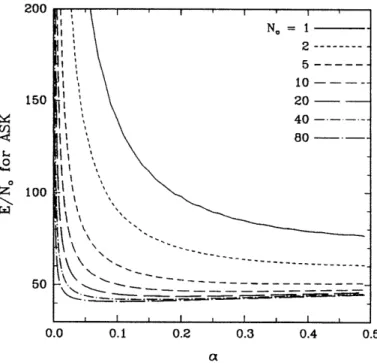
filters would be needed, one for each tone, together with with an integration time from -aT to aT. Thus a small a balanced receiver consisting of two photodiodes as in a corresponds to weak electronic filtering. a cannot be figure 4.b. Decisions can be based on the sign of the larger than 0.5 without causing too much intersymbol current, no energy dependent threshold is necessary. interference.
In the case of DPSK we can view the signal as con- For binary ASK we plot in figure 5 the necessary E/No sisting of two parts: a reference part (actually the pre- for a 10- probability of error as a function of a for vious bit) followed by a signal part, which is either the various values of No. No is expressed in photons. For reference signal delayed by T or its negative. The fil- example if the only source of noise is an ideal optical ter matched to one signal should thus have response amplifier with G = 101 placed just before the detector,
s(-t) + s(-t + T), while the other filter should have then No = G - 1 100. If there is a 6dB loss between response s( -t) - .s( -t + T). Of course the implenenta- the amplifier and the detector then No decreases to 25.
tion of those operations is very simple: the matched filter Similar numbers appear in figure 6 for binary FSK with
s(-t) for an isolated pulse should be followed by a Mach- wide frequency deviation.
Zehnder filter with differential delay T (figure 4.c). One output branch has impulse response 0.5(6(t) - 6(t - T))
while the other branch has response 0.5(6(t) + 6(t - T)), 200
so that the cascade has the desired response. The re- ' '
suiting structure is simply a matched filter for pulses of 2
---length 2T, with two outputs being used! Again a bal- 5
anced photoreceiver is called for. 0 ---
_-150 20 -i h aSK 40 ---a)
~~~~~~~
~ASK
~
80
b) FSK El. flter Poet dteetoen |\ .\ ) DPSK---WW->hod Me,|
~-'Po·-st
d den0.0 0.1 0.2 0.3 0.4 0.5
Figure 4: Structure of receivers
Figure 5: Signal to noise ratio for ASK, P, = 10- 9 In the next section we focus on some fundamental
is-sues for ASK and FSK: the effect of post filtering and
of shot noise. More complete studies will be reported For low a the increase in required E/No is due to elsewhere. the shot noise. At larger a the penalty comes from the fact that the collected signal energy increases more
slow-3
Shot noise and post filtering
ly than the average noise energy. Thermal noise is
ne-glected in this analysis. We expect it to cause the same As already indicated shot noise imposes fundamental general effect as the shot noise, but with a different mag-limitations on optical systems. In particular the output nitude. Similarly the effect of intersymbol interference of the matched filter cannot be sampled using a pho- will magnify the penalty for using a large a.
todetector; the output from the detector must be low We expect small deviation FSK to behave in the same pass filtered. This causes some deviation from the clas- way for small a, but its performance for larger a might sical theory. We have performed an analysis, too long to be somewhat different. Similarly DPSK should follow be reported here, of the degradation. We assume that the FSK curve, except that it requires only half as many the low pass filter is an ideal integrate and dump filter, photons.
[3] H. L. Van Trees, Detection, Estimation, and
Mod-N 1200 __No_=_I 4 1ulation Theory. New York: John Wiley & Sons,
2i,', \ 1968.
5'I
-5- -- [4] J. G. Proakis, Digital Communications.
McGraw--- \ Hill, 1983.
150 20
-,1 \40 --- [5] M. Schwartz, Information Transmission,
Modula-o l l \
80 I tion and Noise. McGraw-Hill, 1990.
100 ,,,,
100
Kl
[6] J. Stone, "Optical-fibre Fabry-Perot interferometerz too00(' with a finesse of 300," Electron. Lett., vol. 21, p-p. 504-505, 1985.
!\ -\ ...--- [7] J. Stone and L. Stultz, "Pigtailed high-finesse tun-- -\ __ able fibre Fabry-Perot interferometers with large,
50 …- -.- … medium and small free spectral ranges," Electron.
I II I
Lett.,
vol. 23, pp. 781-782, July 1987.0.0 0.1 0.2 0.3 0.4 0.5 [8] B. Lyot in Comptes Rendus de l'Academie des
Sci-a ences, vol. 197, p. 1593, 1933.
F e6: Signal to noise :ratio for FSK, P = 10-9 [9] W. Driscoll and W. Vaughan, eds., Handbook of
Op-Figure 6: Signal to noise ratio for FSK, Pe = 10
- 9tics. McGraw Hill, 1978.
4
Conclusion
[10] H. Toba et al., "A conceptional design on
frequency-division- multiplexing distribution with optical tun-able filters," IEEE J. Select. Areas in Comm., This paper has outlined the structure of optical filters vol. 4, pp. 686-694, 1986.
matched to pulses of monochromatic waves. They could
be used with ASK, FSK and DPSK modulations in sys- [11] K. Inoue et al., "A four-channel optical waveguide temns where chirp and phase noise are negligible, and multi/demultiplexer fabricated for 5 ghz spaced op-where the main source of uncertainty is spontaneous tical FDM transmission," J. Lightwave Technol., amplifier noise. For wide deviation FSK and ASK we vol. 6, no. 6, pp. 339-345, 1988.
have shown the effects of the unavoidable penalty
aris-ing in direct detection optical systems from shot noise [12] B. Verbeek et al., 'Integrated four-channel Mach-and from the need to integrate the output of the pho- Zehnder multi/demultiplexer fabricated with phos-todetector. These effects are small when the electronic phorous doped SiO2 waveguides on Si," J.
Light-filters are appropriately chosen. wave Technol., vol. 6, pp. 1011-1015, June 1988.
[13] N. Takato et al., "Silica-based integrated
op-Acknowledgements Many thanks to Murat Azi- tic Mach-Zehnder multi/demultiplexer family with zoglu, now with George Washington University, for his channel sopacing of 0.01-250 nm," IEEE J. Selec-careful reading of the paper and his stimulating remarks. t. Areas in Comm., vol. 8, pp. 1120-1127, August
1990.
References
[1] A. Yariv, Optical Electronics. Holt, Rinehart and Winston, 1985.
[2] J. M. Wozencraft and I. M. Jacobs, Principles of
Communication Engineering. New York: John