HAL Id: hal-00934622
https://hal.archives-ouvertes.fr/hal-00934622v3
Preprint submitted on 13 Nov 2015
HAL is a multi-disciplinary open access
archive for the deposit and dissemination of
sci-entific research documents, whether they are
pub-lished or not. The documents may come from
teaching and research institutions in France or
abroad, or from public or private research centers.
L’archive ouverte pluridisciplinaire HAL, est
destinée au dépôt et à la diffusion de documents
scientifiques de niveau recherche, publiés ou non,
émanant des établissements d’enseignement et de
recherche français ou étrangers, des laboratoires
publics ou privés.
Distributed under a Creative Commons Attribution| 4.0 International License
,pdfcreator=HAL,pdfproducer=PDFLaTeX,pdfsubject=Computer Science [cs]/Logic in Computer
Science [cs.LO], Computer Science [cs]/Formal Languages and Automata Theory [cs.FL]
Adding modular predicates to first-order fragments
Luc Dartois, Charles Paperman
To cite this version:
Luc Dartois, Charles Paperman. Adding modular predicates to first-order fragments. 2015.
�hal-00934622v3�
Adding modular predicates to first-order fragments
Luc Dartois
1,2Charles Paperman
31
LIF, Aix-Marseille Universit´e, France
2
Universit´e Libre de Bruxelles, Belgium
3
Warsaw University, Poland
We investigate the decidability of the definability problem for fragments of first order logic over finite words enriched with modular predicates. Our approach aims toward the most generic statements that we could achieve, which successfully covers the quantifier alternation hierarchy of first order logic and some of its fragments. We obtain that deciding this problem for each level of the alternation hierarchy of both first order logic and its two-variable fragment when equipped with all regular numerical predicates is not harder than deciding it for the corresponding level equipped with only the linear order and the successor. For two-variable fragments we also treat the case of the signature containing only the order and modular predicates.
Relying on some recent results, this proves the decidability for each level of the alternation hierarchy of the two-variable first order fragment while in the case of the first order logic the question remains open for levels greater than two.
The main ingredients of the proofs are syntactic transformations of first order formulas as well as the algebraic framework of finite categories.
Keywords: First order logic, automata theory, semigroup, modular predicates
1
Introduction
The equivalence between regular languages and automata (Rabin and Scott, 1959) as well as monadic second order logic (B¨uchi, 1960) and finite monoids (Nerode, 1958) was the start of a domain of research that is still active today. In this article, we are interested in the logic on finite words, and more precisely the question we address is the definability problem for fragments of logic. Fragments of logic are defined as sets of monadic second order formulas satisfying some restrictions, and are equipped with a set of predicates called a signature. Then the definability problem of a fragment of logic F consists in deciding if a regular language can be defined by a formula ofF.
This question has already been considered and solved in many cases where the signature con-tains only the predicate <, which denotes the linear order over the positions of the word. For instance, a celebrated result by Sch¨utzenberger (1965) and McNaughton and Papert (1971) gave an effective algebraic characterization of languages definable by first order formulas. The de-cidability has often been achieved through algebraic means, showing a deep connection between
algebraic and logical properties of a given regular language. This is the approach privileged in this article.
We investigate the question of the behaviour of the decidability of some fragments when their signature is enriched with modular predicates. These predicates allow to specify the congruence of the position of a variable modulo an integer. They form with the order and the local predicates the set of regular numerical predicates. These predicates are exactly the formulas of monadic second order logic without letter predicates. Intuitively they correspond to the maximal class of numerical predicates that can enrich the signature of a fragment of MSO, while keeping the definable languages regular. This question was already considered in the case of first order logic (FO) by Barrington et al. (1992) and one of its fragments, the formulas without quantifier alternation, by P´eladeau (1992).
The enrichment by regular numerical predicates arose in the context of the Straubing’s
conjec-tures (Straubing, 1994). Roughly speaking, these conjecconjec-tures state that deciding the definability
of a regular language in a fragment of enriched logic corresponds to deciding its circuit complex-ity. It is known (P´eladeau, 1992; Straubing, 1994) that an enrichment of the classical fragments by regular numerical predicates is equivalent to an enrichment by the signature [<,+1,MOD], where+1 denotes the local predicates and MOD the modular predicates. A first step toward the study of fragments of logic with these predicates was initiated by Straubing (1985). He obtained that adding the local predicates preserves the decidability for a large number of fragments. As a corollary of this work, Straubing obtained that the decidability of the alternation hierarchy of first order logic (BΣk) equipped with [<,+1] reduces to the decidability of the simpler one [<].
More recently, Kufleitner and Lauser (2013) proved the decidability of the alternation hierarchy of the two-variable first order fragment (FO2k) equipped with [<,+1] by extending the recent
results by Krebs and Straubing (2012) and Kufleitner and Weil (2012) on the decidability of this hierarchy with[<].
In this context, the case of modular predicates is poorly understood. The study of this enrich-ment was first considered for first order logic by Barrington et al. (1992), and had been extended to the first level of its alternation hierarchy with the successor predicate by P´eladeau (1992), and later without it by Chaubard et al. (2006). The enrichment by a finite set of modular pred-icate was considered by ´Esik and Ito (2003). Finally, the authors provided a characterization of the two-variable first order logic over the signature[<,MOD] (Dartois and Paperman, 2013). In this paper, we focus on the enrichment by all regular predicates as well as the question of the enrichment by modular predicates only. This latter one surprisingly turns out to be more intricate.
To study this enrichment in a generic setting, we offer a definition of fragment as a set of formulas satisfying some syntactic properties. This allows for some generic proofs instead of a one by one situation. The main applications of our theorems are then the quantifier alternations hierarchies of the first order logic and its two-variable counterpart. Our main results state that for both of these hierarchies, the decidability of each level equipped with regular numerical predicates reduces to decidability of the same level with the signature [<,+1]. Then by using the recent decidability result of Kufleitner and Lauser (2013), as well as the decidability ofBΣ2[<] by Place
and Zeitoun (2014), we deduce that the fragments FO2[<,MOD] and FO2k[Reg], for any positive
k, as well as BΣ2[Reg] are decidable. Our settings also reproves known results and apply to
Proofs methods. The proofs of the main results can be decomposed in two major steps. The first part is rather classical and shows that the information given by a finite number of modular predicates can be put into the alphabet and thus we can reduce the problem to a question on the fragment over a bigger alphabet. The second part is dedicated to finding a systematic way to select, for a given regular language and a fragment, a finite number of modular predicates that can serve as witnesses of its definability. This is done through the use of the algebraic framework of varieties, using two mains approaches. The first one uses finite categories and the global of a variety, while the second one introduces a new notion for varieties of semigroups that we call the infinitely testable property. Under some assumptions, we show that this property allows us to find such a witness set for modular predicates.
Organization of the paper. The next section is dedicated to the basic logical and algebraic definitions, and the main applications of our results to logic are presented in Section 4. Then Section 3 deals with adding a finite number of modular predicates. This is done through an easy reduction to adding predicates modulo a given congruence. In Section 5, we then deal with the delay problem, which can be quickly stated as computing a finite set of congruences that can serve as a witness for the definability problem of a language. More specifically, we first introduce the framework of categories as an extension of the monoids theory, and use it to prove a delay for differents classes of fragments. In Subsections 5.2 and 5.3, we rely on an algebraic description of the global of a variety, which is a variety of finite categories. Then Subsection 5.4 solves the delay for a class of fragments satisfying a given algebraic property, the so-called infinitely testable
property.
2
Preliminary definitions
2.1
Languages and Logic
We consider the monadic second order logic on finite words MSO[<] as usual (see Straubing (1994) for example). We denote by A an alphabet and by a a letter of A. A word u over an alphabet A is a set of labelled positions ordered from 0 to∣u∣ − 1, where ∣u∣ is an integer denoting the length of u. The set of words over A is denoted A∗and a subset L of A∗ is called a language. We also denote by A+the set of non-empty words. A language is said to be defined by a formula if it corresponds exactly to the set of words that satisfy this formula. It is said to be regular if it is defined by a MSO[<] formula. When syntactic restrictions are applied to MSO[<], one defines fragments of logic that characterize subclasses of regular languages. The most well-known fragment is probably the first order logic, whose expressive power was characterized thanks to the results of McNaughton and Papert (1971) and Sch¨utzenberger (1965). The first order logic itself gave birth to its own zoo of fragments. These were defined using syntactical restrictions such as limiting the number of variables, or by enrichment of its signature. A fragmentF with signature σ will be denotedF[σ] and will refer to the formulas as well as the class of languages it defines.
We first define the different signatures that will appear through this paper, and then formally define the quantifier alternation hierarchies, as they form the main focus of the applications of our theorems.
Signatures. We are interested in regular numerical predicates, which are numerical predicates that can only define regular languages. Simultaneously, Straubing (1994) and P´eladeau (1992) defined three sets of regular numerical predicates that can be used as a base for all the regular nu-merical predicates. The first set is the singleton order{<} which is a binary predicate correspond-ing to the natural order on the positions of the input word. The second set is{min,max,Sk}
and is called the local predicates. The predicates min and max are unary predicates that are satisfied respectively on the first and last positions. The predicate Sk, the kth-successor, is a
binary predicate satisfied if the second variable quantifies the kth-successor of the first one.
Example 1. The formula∃x∃y min(x)∧S(x,y)∧a(x)∧a(y) defines the regular language aaA∗.
We alternatively use the descriptive local predicates. These predicates are of the form a(x + k) (resp. a(min +k), a(max −k)) for k ⩾ 0, holding if the position at x + k (resp. min + k, max − k) is labelled by an a.
Example 2. The previous formula can be rewrite by the following quantifier-free formula: a(min)∧ a(min +1).
Most of the time, both descriptive and classical local predicates provides the same expressive power. However the descriptive predicates are proved to be more convenient for abstract frag-ments since they don’t bound two variables together. For the sake of simplicity we will denote in the following by+1 this class of descriptive local predicates. This notation is justified thanks to the close relation between descriptive local predicates and the successor function. Also note that the presence or absence of the equality predicate is important since FO[+1] is strictly less expressive than FO[=,+1].
Finally, we define, for each positive integer d, the modular predicates on d, denoted MODd, as the set, for i < d, of predicates MODd
i(x) which are unary predicates satisfied if the position
quantified by x is congruent to i modulo d, and the predicates Dd
i which are constants holding
if the length of the input word is congruent to i mod d. We denote by MOD the union of the classes MODd, for any positive d.
Example 3. The language (A2)∗aA∗ is defined by the formula: ∃x a(x) ∧ MOD2 0(x) .
The signatures that we will consider for our fragments are unions of these three sets of regular numerical predicates, and will always contain the letter predicates. Abusing notations, we will also write Reg ={<} ∪ +1 ∪ MOD.
Fragments. A fragment of logic F[σ] with signature σ is a set of closed formulas of MSO[σ] that contains the quantifier-free formulas and that is closed under the following operations : Conjunction If ϕ and ψ are formulas ofF, then ϕ ∧ ψ is also a formula of F.
Disjunction If ϕ and ψ are formulas ofF, then ϕ ∨ ψ is also a formula of F.
Quantifier-free substitutions If ϕ is a formula ofF and ψ(x1, . . . , xn) a quantifier-free
subfor-mula of ϕ with free variables x1, . . . , xn, then any formula obtained by replacing ψ(x1, . . . , xn)
by another quantifier-free formula with the same set of free variables is also in F.
If F[σ] is a fragment of logic and σ′ is a class of predicates, then the enrichment of F[σ] by σ′ is denoted by F[σ,σ′] and corresponds to the closure of F[σ] under the quantifier-free
substitutions, where predicates range over the signature σ∪ σ′. As a closed formula defines a language, a fragment of logic defines a class of languages. Abusing notations, we will denote by F[σ] a fragment of logic, as well as the class of languages it recognizes. It is worth noting that Kufleitner and Lauser (2012) defined another notion of fragment of logic as sets of formulas closed under some syntactical substitutions ensuring algebraic characterisation of the fragment.
The fragment FO2is the subclass of formulas of FO using only two symbols of variables which
can be reused (see Example 4). Here, the class of languages defined by FO2[<] is strictly contained in FO2[<,+1] and FO2[<,MOD] (see Th´erien and Wilke (1999); Dartois and Paperman (2013)). Example 4. The language A∗aA∗bA∗aA∗ can be described by the first order formula
∃x∃y∃z x < y < z ∧ a(x) ∧ b(y) ∧ a(z) .
This formula uses three variables x, y and z. However, by reusing x we get an equivalent formula that uses only two variables:
∃x a(x) ∧ (∃y x < y ∧ b(y) ∧ (∃x y < x ∧ a(x))) . (a) Alternation hierarchies. Given a first order formula, one can compute a prenex normal form using the De Morgan’s laws. We define the quantifier alternation depth of a formula as the number of blocks of quantifiers ∀ and ∃ in its prenex normal form. For example, the formula ∃x∃y∀z x < z < y ∧ a(x) ∧ a(y) ∧ c(z) has a quantifier depth of 2. It describes the language A∗ac∗aA∗. Then given a signature σ and a positive integer k, we denote byBΣk[σ] the set of
prenex normal formulas of FO[σ] whose quantifier depth is smaller or equal to k. They form the levels of the quantifier alternation hierarchy over FO[σ].
When σ is reduced to {<}, this hierarchy is called the Straubing-Th´erien hierarchy (Straub-ing, 1981; Th´erien, 1981). Only the first (Simon, 1975) and second (Place and Zeitoun, 2014) levels are known to be decidable. For σ ={<} ∪ +1, this hierarchy is called the Dot-Depth hier-archy (Cohen and Brzozowski, 1971). The decidability of each level reduces to the decidability of the corresponding level of the Straubing-Th´erien hierarchy (Straubing, 1985). In both cases, the hierarchies are known to be strict, and cover all Star-Free languages. In this article, we also consider the alternation hierarchy of FO2. To define formally the number of alternations of a formula, we cannot rely on the prenex normal form since the construction increases the number of variables. In particular, remark that FO2[<] is equivalent to Σ2[<]∩Π2[<] which is a subclass of
BΣ2[<] (Diekert et al., 2008). That said, the number of alternations is still a relevant parameter
that could be defined as follows: Consider the parse tree naturally associated to a formula. For instance, (a) has∃ as a root and the atomic formulas as the leaves. In a two-variable first order formula we count the maximal number of alternations appearing on a branch, i.e. between the root and a leaf, once the negations have been pushed on to the leaves. A more precise definition can be found in Weis and Immerman (2009). We denote by FO2k[σ] the formulas of FO2[σ] that have at most k−1 quantifier alternations. The hierarchy induced by FO2k[<] is known to be strict (Weis and Immerman, 2009) and its definability problem is decidable (Krebs and Straub-ing, 2012; Kufleitner and Weil, 2012). Note that the hierarchy FO2k[<,+1] is also known to be
decidable (Kufleitner and Lauser, 2013).
Remark: The classes of formulas FO and FO2as well as each level of the alternation hierar-chies are fragments of MSO as defined previously.
2.2
Varieties of languages, monoids and semigroups
We quickly present here the fundamental notions used by the article and refer the reader to the book of Pin (1997) for a detailed approach. A (finite) semigroup is a finite set equipped with an associative internal law. A semigroup with a neutral element for this law is called a monoid. Recall that a semigroup S divides another semigroup T if S is a quotient of a subsemigroup of T . This defines a partial order on finite semigroups. Given a finite semigroup S, an element e of S is idempotent if ee = e. We denote by E(S) the set of idempotents of S. For any element x of S, there exists a positive integer n such that xn is idempotent. We call this element the idempotent power of x and denote it by xω. One can check that the application x→ xω is well defined.
A semigroup S recognizes a language L over an alphabet A via a morphism η∶ A+→ S. Given
a regular language L, we can compute its syntactic semigroup as the smallest semigroup that recognizes L, in the sense of division. A subset T of S is an ideal if the sets T S and ST are both included in T . A (pseudo-)variety of semigroups (resp. monoids) is a non empty class of finite semigroups (resp. monoids) closed under division and finite product. Finally, a local monoid of S is a monoid of the form eSe where e is an idempotent of S.
A fragment of logic is characterized by a variety if they recognize the same languages. By extension, a variety V will also refer to the class of languages it recognizes. The most famous example is the equality FO[<] = A (McNaughton and Papert, 1971; Sch¨utzenberger, 1965), where A denotes the class of aperiodic semigroups, which are finite semigroups that are not divided by any group. As for FO[<], the definability problem for a fragment of logic has often been solved thanks to an algebraic characterization (Simon (1975); Th´erien (1981); Th´erien and Wilke (1999) for example). This decidability is sometimes obtained through profinite equations. We refer the reader to Pin (2009) for a survey on the profinite background. The algebraic characterisations of most the fragments that we consider are given in Figure 1.
Fragment Variety Equations FO[<] A xω=xω+1 FO[=] ACom xω=xω+1, xy = yx FO2[<] DA (xy)ω=(xy)ωx(xy)ω
FO1[∅] J1 x2=x, xy = yx
BΣ1[<] J y(xy)ω=(xy)ω=(xy)ωx
FO2k[<] Vk See Example 6
Fig. 1: Algebraic characterisations
Stability index. One important tool to study modular predicates is the stability index. For a monoid morphism ϕ∶ A∗→ M, the set ϕ(A) is an element of the powerset monoid of M. As
such it has an idempotent power. The stability index of a morphism is the least positive integer s such that ϕ(As) = ϕ(A2s). This set forms a subsemigroup called the stable semigroup of ϕ. The
language is the stable monoid (resp. semigroup) of its syntactic morphism.
3
Adding finitely many modular predicates
We consider here the question of adding the modular predicates associated to a finite set of congruences. First, let us remark that ifF[σ] is a fragment of logic and d and p are two positive integers, thenF[σ,MODd,MODp] ⊆ F[σ,MODdp]. This can be proved by some basic arithmetic reasoning and some quantifier-free substitutions. Then as a formula only uses a finite number of modular predicates, for any language ofF[σ,MOD], there exists an integer d such that it belongs toF[σ,MODd]. The consequence is that adding a finite set of modular predicates is equivalent to adding the predicates relating to one specific congruence. The remainder of this section deals with this question.
3.1
Alphabet enriched by modular counting
In order to deal with modular predicates, we now define enriched modular alphabets. These notions come naturally in the context of wreath product and instantiated for instance in Dartois and Paperman (2013, 2015). We now fix a positive integer d and an alphabet A. Let Zd be the
cyclic group of order d.
Definition 1 (Enriched alphabet). We call the set Ad=A× Zd the enriched alphabet of A, and we denote by πd∶ A∗d→ A∗ the projection defined by πd(a,i) = a for each (a,i) ∈ Ad. For example, the word (a,2)(b,1)(b,2)(a,0) is an enriched word of abba for d = 3. We say that abba is the
underlying word of(a,2)(b,1)(b,2)(a,0).
Definition 2 (Well-formed words). A word (a0, i0)(a1, i1)⋯(an, in) of A∗d is well-formed if for
0 ⩽ j ⩽ n, ij=jmod d. We denote by Kd the set of all well-formed words of A∗d. We also note
Ad(i,j) the set of well-formed factor such that the first letter is labelled by i and the last by j. For any i < d, let αi
d ∶ A∗ → A∗d be the function defined for any word u = a0a1⋯an ∈ A∗ by
αi
d(u) = (a0, i)(a1, i+ 1 mod d)⋯(an, i+ n mod d). We simply denote α0d by αd and the word
αd(u) is called the well-formed word attached to u.
Note that the restriction of πd to the set of well-formed words is one-to-one. For instance,
the enriched word (a,0)(b,1)(b,2)(a,0) is a formed word for d = 3. It is the unique well-formed word having the word abba as underlying word. Finally, given a language L, we write Ld=πd−1(L) ∩ Kd.
3.2
A first transfer theorem
Using the enriched alphabet and the well-formed words, the next theorem links a fragment with its enrichment by congruences modulo one integer. It transfers the expressiveness of modular predicates to the alphabet. An aware reader could notice that it is very similar to the wreath product principle of varieties. It is in fact not a coincidence, since this operation matches with a wreath product by the length-multiplying variety MOD (see Chaubard et al. (2006) for more details).
Theorem 3. Let F[σ] be a fragment of logic, L a regular language and d a positive integer.
(1) L is definable by a formula of F[σ,MODd],
(2) there exists some languages L0, . . . , Ld−1 ofF[σ] over A∗d such that:
L = d−1 ⋃ i=0((A d)∗ Ai∩ πd(Li∩ Kd)) (a)
To prove the result, we need an auxiliary result which gives a decomposition of the language defined by a formula into smaller pieces.
Lemma 4. LetF[σ,MOD] be a fragment of logic and ϕ a formula of F[σ,MODd]. Then there
exists d formulas ψi of F[σ,MODd] that do not contain any predicate Djd and such that
ϕ ≡ d−1 ⋁ i=0(ψ i∧ Ddi). Moreover, we have: L(ϕ) = d−1 ⋃ i=0((A d)∗ Ai∩ L(ψi)).
Proof: For i < d, we define the formula ψito be the formula ϕ where we replaced every predicate
Dd
i by true and every Ddj with j ≠ i by false. One should notice that, by definition of a fragment,
the formulas ψiare inF[σ,MODd]. We can conclude the proof since the formula (Ddi) recognizes
the language(Ad)∗Ai.
Proof of theorem 3: Let ϕ be a formula of F[σ,MOD]. Then ϕ belongs to F[σ,MODd] for some d > 0. Using Lemma 4, we know it is sufficient to consider a formula ϕ without any length predicate. We transform it into a formula ψ by doing the following transformation:
MODdi(x) is replaced by ⋁
a∈A(a,i)(x),
a(x) is replaced by ⋁
0⩽i<d(a,i)(x).
The resulting formula ψ is inF[σ](A∗d) and L(ϕ) = πd(L(ψ) ∩ Kd). Conversely, we transform a
formula ψ ofF[σ](A∗d) into a formula ϕ of F[σ,MOD
d] by replacing every predicate (a,i)(x) in
ψby a(x) ∧ MODdi(x). We also get L(ϕ) = πd(L(ψ) ∩ Kd).
The previous theorem provides a semantic counterpart to the action of adding modular predi-cates to a fragment of logic. In the case where the fragment is expressive enough, this counterpart provides a transfer of decidability, as stated in the next corollary.
Corollary 5 (The transfer result). LetF[σ] be a fragment of logic. If F[σ] is decidable and if
both Kd and max are definable inF[σ], then F[σ,MODd] is decidable.
Proof: The result comes from the fact that if max is definable, then using modular predicates the languages(Ad)∗Aiare definable inF[σ,MODd]. If furthermore we can define the language of
F[σ] over the enriched alphabet. This language being computable from L, we get decidability. Remark: Corollary 5 applies to fragmentsBΣk[σ], FO[σ], when k ⩾ 2 and σ contains either
+1 or the order. It also applies to fragmentsBΣ1[σ], FO2k[σ], or FO2[σ] when +1 is contained
in σ.
4
Main results
As stated in the previous section, any language defined by a fragment with modular predicates can be done so with a formula using only congruences to one specific integer. In fact, there exists an infinite number of such witnesses. The remaining of the article is dedicated to the problem of deciding one witness, given a language. We call it the delay problem and can be explicitly stated as follows:
The delay question: Given a regular language L and a fragmentF[σ], is it possible to compute an integer d such that L belongs toF[σ,MOD] if, and only if, it belongs to F[σ,MODd]? Remark that such an integer d could depend of L and F[σ]. The denomination stems from the Delay Theorem of Straubing (1985) that solves a similar question for the enrichment by the successor predicate. Section 5 is devoted to solve the delay problem for different classes of varieties. It relies heavily on algebraic notions, in particular the framework of categories. We present here the main applications to fragments of logic, which are summed up in Figure 2. This figure does not include decidability of the smaller fragments of FO equipped with modular predicates: FO[MOD] (Theorem 6), FO[+1,MOD] (Theorem 7), FO[=,MOD] (Theorem 8) and FO[=,+1,MOD] (Theorem 9).
The first decidability results comes from the local property. Although it does not bring many new results, mainly reproving Barrington et al. (1992) and Dartois and Paperman (2013), it gives a unified proof for these fragments. Local varieties have a particular role in the previous work of Straubing, where they are identified as varieties that behave gently compared toward+1. In the context of modular predicates, they also have this good property that allows us to state a fairly generic statement under this assumption. A formal definition of locality can be found in Section 5.2.
Theorem 6 (Local case, for monoids varieties). Let F[σ] be a fragment equivalent to a local
variety V. Now let L be a regular language and s its stability index, then the following statements are equivalent.
• L belongs to F[σ,MOD]. • L belongs to F[σ,MODs].
• the stable monoid of L belongs to V.
Furthermore, ifF[σ] is decidable, then so is F[σ,MOD].
Example of interest includes FO1[∅], FO2[<] or FO[<], which are equivalent to J1, DA and
A respectively. The locality of J1and A can be found in the article of Tilson (1987), the locality
[<] [<,MOD] [Reg] BΣ1=FO21
Simon (1975)
Chaubard et al. (2006) Maciel et al. (2000) Thomas (1982)
FO2k
Krebs and Straubing (2012)
New result New result Kufleitner and Weil (2012)
FO2 Th´erien and Wilke (1999) Dartois and Paperman (2013) New result BΣ2 Place and Zeitoun (2014) New result New result
BΣk Open Reduces to[<] Reduces to[<]
New result New result FO McNaughton and Papert (1971) Straubing (1994) Barrington et al. (1992)
Sch¨utzenberger (1965)
Fig. 2: Decidability results of first-order fragments
When the initial variety is local, we can nest our approach with the one with the successor predicates. It is no longer needed to use the intricate framework of categories since in this case, we can apply Corollary 5 to slightly simplify the question.
Theorem 7 (Local case, for semigroups varieties). Let F[σ] be a fragment corresponding to
a local variety V Now let L be a regular language and s its stability index, then the following statements are equivalent.
• L belongs to F[σ,+1,MOD]. • L belongs to F[σ,+1,MODs].
• the local monoids of the stable semigroups belongs to V.
Furthermore, ifF[σ] is decidable, then so is F[σ,+1,MOD].
This theorem is a consequence of Proposition 29. Note that both FO[+1,MOD] and FO2[< ,+1, MOD] fall into the scope of this theorem. In the case of full first order logic, the successor predicate being definable with the order, the expressiveness remains unchanged. The reduction to logic of these results can be found in Subsection 5.4 for Theorem 7 and Subsection 5.2 for Theorem 6. Note that this provides decidability.
A generalized approach of the previous results brings fresh ones, although we fail to obtain a delay independent from the fragment. We need to assume some properties on the varieties of
categories generated by the initial variety. In particular, we assume that the path-equations of
the so called global of a variety use a bounded number of vertices. Under this assumption we successfully compute a delay.
Theorem 8 (Finite rank case). Let F[σ] be a fragment corresponding to a variety V of rank k. Now let L be a regular language and s its stability index, then the following statements are equivalent.
• L belongs to F[σ,MOD]. • L belongs to F[σ,MODks].
Furthermore, ifF[σ,+1] is decidable, then so is F[σ,MOD].
Example of application of this theorem include FO[=] which is known to be equivalent to the variety of rank 2 of aperiodic and commutative monoids, as well as the alternation hierarchy of FO2[<] whose kth level is of rank 2k. This approach is detailed in Section 5.3. In those cases,
this last theorem also provides decidability by reducing to decidability of the fragment with the successor predicate.
Finally, the next theorem provides a delay for all fragments containing the successor predicates. In particular, it reduces the decidability of F[Reg] to the decidability of F[<,+1] providing decidability for the fragment FO2k[Reg] and a reduction of the decidability of BΣk[Reg] to the
decidability of BΣk[<,+1], which itself reduces to decidability of BΣk[<] thanks to Straubing
(1985).
Theorem 9 (Infinitely testable case). LetF[σ] be a fragment corresponding to a variety V which
is not a variety of groups. Now let L be a regular language and s its stability index, then the following statements are equivalent.
• L belongs to F[σ,+1,MOD]. • L belongs to F[σ,+1,MODs].
Furthermore, ifF[σ,+1] is decidable, then so does F[σ,+1,MOD].
The condition thatF[σ] is not equivalent to a group variety is necessary to apply the simpli-fication of Corollary 5. However, in the case whereF[σ] is indeed a variety of groups, then both F[σ,+1] and F[σ,MOD] are decidable since varieties of groups are known to be local as variety of monoids but seems intricate when both+1 and MOD are in the signature since groups are not local as varieties of semigroups (for instance see book (Rhodes and Steinberg, 2009, page 104)). The proof of this last theorem is given in Subsection 5.4.
5
Solving the Delay problem
This section is devoted to solve the delay question for different classes of varieties.
We first present the framework of finite categories as well as some known results, and use it to reduce the combinatoric characterisation of Theorem 3 to the decidability of the global of a variety, an algebraic notion from the framework of finite categories.
The remainder of the section then uses this characterisation to solve the delay question for different classes of varieties. The first case is the simplest one of local varieties, where we get a clear characterisation of F[σ,MOD]. The second case, the finite rank, is a generalisation of the local case, where an algebraic characterisation of the global is known. Finally, the last case
solves the delay for a class of varieties where little is known about the global. It is the class of varieties of semigroups expressive enough and satisfying an extra property: the infinitely testable
property, which is a new notion.
5.1
A derived category theorem
Finite categories: a short introduction. In this section, we present the theory of finite categories, as an extension of finite monoids. Informally, a category can be seen as a partial monoid where only some products are allowed. Nonetheless, notions from monoids can be cor-rectly lifted, and we will consider varieties of categories. The framework of variety of categories has been successful to obtain algebraic characterizations of wreath products of varieties (Tilson, 1987). For example, the enrichment by modular predicates can be seen as a wreath product by a variety of morphisms. This comes from an adapted version of the Wreath Product Principle, that is evoked by Chaubard et al. (2006). We chose not to focus on this, since it would require to introduce additional definitions and proofs that are not necessary and would burden the article.
A graph X is a set of objects denoted Ob(X) such that for any couple of objects (x,y) ∈ Ob(X),
we associate a set X(x,y) of arrows from x to y. Two arrows e,f are coterminal if there exists x, y ∈Ob(X) such that e,f ∈ X(x,y). They are consecutive if there exists x,y,z ∈ Ob(X) such that e ∈ X(x,y) and f ∈ X(y,z). An arrow e is a loop from x if e ∈ X(x,x). A composition law associates to each pairs of consecutive arrows, e, f an arrow ef . This law is said to be associative if for any consecutive arrows e, f, g we have(ef)g = e(fg).
A category C is a graph with an associative composition law and containing for each object x an identity denoted 1x. Thus the set of loops around a given object, equipped with the composition
law, forms a monoid, called the local monoid of that object. Note that the terminology of local monoids of a category clashes with the terminology of local monoids of a semigroup. In fact, the two coincide when we consider the idempotent category of a semigroup, which is defined later.
Here we only consider categories as a generalization of finite monoids, since a monoid can be viewed as a one-object category. A morphism of categories η ∶ C → D is an application η ∶ Ob(C) → Ob(D) and for each pairs of object (x,y) ∈ Ob(C), an application η ∶ C(x,y) → D(η(x),η(y)) such that
(1) for any consecutive arrows e, f we have η(ef) = η(e)η(f), (2) for any x ∈ Ob(C), η(1x) = 1η(x).
A division of categories τ ∶ C → D is given by a mapping τ ∶ Ob(C) → Ob(D), and for each pair of objects e and f , by a relation τ ∶ C(e,f) → D(τ(e),τ(f)) such that
(1) τ(x)τ(y) ⊆ τ(xy) for consecutive arrows x,y, (2) τ(x) ≠ ∅ for any arrow x,
(3) 1τ(e)∈τ(1e) for any object e of C.
We remark that the inverse of an onto morphism of categories is a division of a categories (but the converse is not true). Then a variety of categories is a class of categories closed under direct product and division.
Definition 10. Given a variety of monoids V, the global of V, denoted gV, is the class of all
Remark: Since the division of categories is a partial order and a variety is closed under product, the class of categories gV is closed by division and by product, and it is therefore a variety of categories.
Definition 11 (Consolidated semigroup, consolidated stamp). Let C be a finite category and
Arr(C) the set of arrows of C. We denote by Ccd the semigroup defined on the set
E =Arr(C) ∪ {0} with for any x ∈ E, 0x = x0 = 0, and for x, y ∈ Arr(C),
x.y =⎧⎪⎪⎨ ⎪⎪⎩
xy if x and y are consecutives arrows,
0 otherwise.
The following proposition is a well-known result stating that the membership of a category in gV reduces to the membership of V is the variety is expressive enough. This is a category version of Corollary 5 which means that the membership of a language to an expressive enough fragment enriched with a finite set of modular predicates reduces to the membership of a different language to the fragment without them.
Background: the local predicates and derived category for locally testable language. In this section, we recall some known results that we will be using in the remainder of the article and give some intuitions about their significance. We first give the definition of the derived category for definite languages and provide the delay theorem of Straubing (1985) as well as its improvement by Tilson (1987). Let S be a semigroup, n an integer and η∶ S+→ S the canonical
semigroup morphism of S. The n-derived category of S with respect to definite languages, denoted Dn(S), is the category with S⩽nas set of objects, and the arrows from u to v are the elements s
of S such that there exists a word w ∈ S+ that η(w) = s and the suffix of size n of uw is equal to v. The n-derived category with respect to definite languages, of a regular language L, denoted Dn(L), is the category Dn(ηL(A+)). Finally we also introduce the idempotents’ category of a
semigroup S, denoted by SE and defined by Tilson (1987) as follows. Its set of objects are the
idempotents of S. And for e and f two idempotents, we set SE(e, f) = eSf. We do not recall the
definition of the wreath product of a variety V by D, denoted by V∗ D. However, as our only use of this product is given by the following theorem, an unfamiliar reader can take the following theorem as a definition.
Theorem 12 (Delay theorem for definite languages). Let V be a variety and S a semigroup.
The following conditions are equivalent.
(1) The semigroup S belongs to V∗ D.
(2) There exists an integer n such that Dn(S) belongs to gV.
(3) For n =∣S∣, Dn(S) belongs to gV.
(4) The category SE belongs to gV.
For sufficiently expressive fragments, the operation of adding the local predicates corresponds to mapping the equivalent variety V to V∗D. In fact, it will not be the case only if the fragment cannot use these predicates properly. In all cases, it is equivalent to adding the descriptive
local predicates defined in Section 2. The proof of the following proposition follows the proof of Theorem 3, by using an adapted notion of enriched alphabet. We omit the proof, that could be find in Paperman (2014).
Proposition 13. Let F[σ] be a fragment of logic equivalent to a variety V and L a regular
language with S as syntactic semigroup. The following conditions are equivalent.
(1) L is definable in F[σ,+1]. (2) S belongs to V∗ D. (3) SE belongs to gV.
The derived category relatively to modular languages. Following the preceding para-graph, we give the definition of the derived category adapted to modular languages which was largely inspired by the article of Chaubard et al. (2006).
Let ϕ∶ A∗→ M be a morphism and d an integer. The d-derived category of ϕ, denoted C d(ϕ),
is the category with Zd as set of objects, and the arrows from i to j are the elements m of
M such that there exists a word u satisfying ϕ(u) = m and i + ∣u∣ ≡ j mod d. The d-derived category of a regular language L, denoted Cd(L), is the category Cd(ηL). The following lemma
is a straightforward consequence of the definition that will be of some use.
Lemma 14. Let d be a positive integer, and L be a regular language of stability index s. Then the
local monoids of Cd(L) are isomorphic to ηL((Ad)∗). In particular, the local monoids of Cs(L) are isomorphic to the stable monoid of L.
Example 5. The 4-derived category of the language (aa)∗ab(bb)∗ is given below. Let η be its syntactic morphism and S its stable monoid. Its stability index is 4.
0 1 2 3 S0=S ={1,aa,bb,aabb,ba} S1=S3={a,b,aab,abb} S2={aa,bb,aabb,ba} for 0 ⩽ i ⩽ 3, Si=η((As)∗Ai) S S3 S3 S1 S1 S3 S3 S1 S2 S S S S
Proposition 15. Let L be a regular language. For any 0 < d ⩽ d′, if d divide d′, then Cd′(L)
divides Cd(L).
Proof: Let L be regular language and 0 ⩽ d < d′ be integers such that d divides d′. We
define the relation τ ∶ Cd′(L) → Cd(L). The object application Ob(τ) ∶ Zd′ → Zd is defined by
Ob(τ)(x) = x mod d for any x ∈ Zd′. Let (x,m,y) be an arrow of Cd′(L). By definition, there
Then, since d divides d′, ∣u∣ ≡ b − a mod d. Thus, the arrow (a,m,b) is in Cd(L). We define
τ(x,m,y) = (a,m,b). The application τ is a morphism and for any (x,m,y) ≠ (x,m′, y), we have τ(x,m,y) ≠ τ(x,m′, y). Therefore, τ defines a division from Cd′ to Cd.
The derived category theorem was originally proved by Tilson (1987) for varieties of monoids and semigroups. Unfortunately the case of modular languages can not be dealt with the frame-work of Tilson since they do not form a variety of language. However it has been extended to length-multiplying varieties in the PhD thesis of Chaubard (2007). Since this work is only available in french, we provide a proof inspired by the work of Chaubard, but adapted to our framework.
Theorem 16. LetF[σ] be a fragment of logic equivalent to a variety of monoids V, L a regular
language and d a positive integer. Then the following properties are equivalent:
(1) L is definable by a formula of F[σ,MODd],
(2) there exists some languages L0, . . . , Ld−1 ofF[σ] over A∗d such that:
L = d−1 ⋃ i=0((A d)∗ Ai∩ πd(Li∩ Kd)) (a)
(3) the category Cd(L) belongs to gV.
Proof: The equivalence between the two first points is obtained directly by Theorem 3. We only prove the equivalence between (3) and (2). As always, we denote by ηL∶ A∗→ ML the syntactic
morphism of L and P = ηL(L) its accepting set.
(3)→ (2): Assume that Cd(L) belongs to gV. By definition, it means that there exists a
division of categories τ ∶ Cd(L) → M, where M is a monoid of V seen as a one object
category. We need to define some appropriate languages Li for 0 ⩽ i < d. To this end, we
construct an adequate morphism from A∗ d to M .
Let then β ∶ A∗
d → M be defined by β(a,i) = m where m is any element in τ(i,η(a),i +
1 mod d). For 0 ⩽ i < d, let Ei =⋃m∈Pτ(0,m,i) and Li =β−1(Ei). Because M is in V,
these languages are all in F[σ].
It remains to verify that these languages satisfy the hypothesis. This is equivalent to check that for all i < d
αd(L ∩ (Ad)∗Ai) ⊆ Li and αd(Lc∩(Ad)∗Ai) ∩ Li=∅.
Let u =(a0,0)⋯(an, p) be a well-formed word of A∗d, by construction of β, we have
β(u) = m = m1⋯mn∈τ(0,ηL(a1),1)⋯τ(p,ηL(an),p + 1) ⊆ τ(0,ηL(a1⋯an),p + 1)
Therefore, we have
β(αd(L ∩ (Ad)∗Ai)) ⊆ Ei.
Furthermore, since τ is a division, for all u ∈ αd(Lc∩(Ad)∗Ai), β(u) /∈ τ(0,m,i) for all
(2)→ (3): Let L0, . . . , Ld−1be languages ofF[σ] as stated by (2). Then each of them is definable
by a monoid of V, and since varieties are closed by product, there exists a morphism β ∶ A∗d→ M that recognizes them all, with M ∈ V. We now prove that Cd(L) divides M.
Let τ ∶ Cd(L) → M be defined by
τ(i,x,j) = {β(u) ∣ ∃u ∈ Kd(i,j) s.t. ηL(πd(u)) = x}
The application τ satisfies the first three axioms of a division of categories. (1) We have 1 ∈ τ(i,1,i) for any i of Z/dZ.
(2) Let (i,x,j) be an arrow of Cd(L). By definition, there exists v in (Ad)∗Aj−i such
that ηL(v) = x. Let u = αid(v) ∈ Kd(i,j). By definition, β(u) ∈ τ(i,x,j) and thus
τ(i,x,j) ≠ ∅.
(3) Let (i,x,j) and (j,x′, k) be two arrows in C
d(L) and m ∈ τ(i,x,j), m′∈τ(j,x′, k).
By hypothesis, there exists u ∈ Kd(i,j) and u′ ∈ Kd(j,k) such that β(u) = m and
β(u′) = m′, and such that ηL(πd(u)) = x and ηL(πd(u′)) = x′. Then, mm′belongs to
τ(i,xx′, k) since mm′=β(uu′), uu′∈Kd(i,k) and ηL(πd(uu′)) = xx′.
Unfortunately, it could happen that τ does not satisfy the last condition. Without detailing, this is due to the fact that some elements of the syntactic congruence of L might merge when appearing at some specific congruences, leading to non empty intersection of images of arrows. In the following, we use the idea that for any pair of elements there exists a congruence that separates them by definition of the syntactic congruence.
Thus, we now introduce a twisted product of τ , denoted by⊗dτ∶ Cd(L) → Mdand formally
define it by
⊗dτ(i,x,j) = (τ(i,x,j),τ(i + 1,x,j + 1),... ,τ(i + d − 1,x,j + d − 1))
Because ⊗dτ is a product of τ by it self d times, it satisfies immediately the first three
axioms of a division of categories. We now prove that ⊗dτ is a division by proving the
separation axiom.
(4) Let x, x′ be two distinct elements of ML such that (i,x,j) and (i,x′, j) are arrows
of Cd(L). We first prove that there exists r,t satisfying r − t = j − i and such that
τ(t,x,r) ∩ τ(t,x′, r) = ∅ and then conclude by using ⊗dτ. Let v and v′ in(Ad)∗Aj−i
such that ηL(v) = x and ηL(v′) = x′.
Since x ≠ x′, and by definition of M
L, the syntactic monoid of L, we can assume
that there exists p, q ∈ A∗ such that pvq ∈ L if and only if pv′q/∈ L. Let y = η L(pvq)
and y′ =η
L(pv′q). We remark that (0,y,k) and (0,y′, k) are arrows Cd(L) for k =
∣pvq∣ mod d = ∣pv′q∣ mod d. Without loss of generality, we assume pvq to be in L, the
other case being symmetrical. By hypothesis, we have the following: η−1L (y)∩(Ad)∗Ak⊆Lk
η−1L (y′)∩(Ad)∗Ak∩ Lk=∅
However
τ(0,y,k) = β ○ αd(ηL−1(y) ∩ (Ad)∗Ak)
Since Lk is recognized by M through the morphism β we have
τ(0,y,k) ∩ τ(0,y,k) = ∅. To conclude, it suffices to notice that
τ(0,s,t) ⋅ (τ(t,x,r) ∩ τ(t,x′, r)) ⋅ τ(r,t,k) ⊆ τ(0,y,k) ∩ τ(0,y,k) = ∅,
where s = ηL(p), t = ∣p∣, r = t + j − i and t = ηL(q). Since both τ(0,s,i) and τ(j,t,k)
are nonempty, we conclude that τ(t,x,r) ∩ τ(t,x′, r) = ∅. We proved that for every arrow (i,x,j) and (i,x′, j) in Cd(L), there exists r,t r − t = j − i and such that
τ(t,x,r) ∩ τ(t,x,r) = ∅. Therefore, we obtain that ⊗dτ(i,x,j) ∩ ⊗dτ(i,x′, j) = ∅ for
every coterminal arrows(i,x,j) and (i,x′, j) in C
d(L), which concludes the proof.
5.2
local case
For any variety V, we define QV to be the class of morphisms (lm-variety of morphisms to be precise, see the article of Pin and Straubing (2005) for more details) whose stable monoid is in V. Following the article of Tilson (1987), we denote by ℓV the variety of categories whose local monoids are all in V. A variety of monoids V is said to be local if gV = ℓV. The next theorem makes explicit the link between QV and ℓV.
Theorem 17. Let V be a variety and L a regular language of A∗ of stability index s. The following properties are equivalent:
(1) L is recognized by a morphism in QV,
(2) there exists an integer d such that Cd(L) is in ℓV,
(3) Cs(L) is in ℓV.
Proof:
1→ 3. If L is recognized by a stamp in QV, then its syntactic stamp is also in QV and its stable monoid is in V. But, thanks to Lemma 14, the local monoids of Cs(L) belong to V, and thus
Cs(L) is in ℓV.
3→ 2. Is obvious.
2→ 1. Suppose that Cd(L) is in ℓV. Then the local monoids of Cd(L), which are isomorphic to
ηL((Ad)∗) by Lemma 14, belong to V. Thus ηL((Ads)∗), which is a submonoid of ηL((Ad)∗), also
belongs to V. Finally, by definition of the stability index, the monoid ηL((As)∗) = ηL((Ads)∗)
is in V and thus ηL is in QV.
Observe that any monoid of V, viewed as a one-object category, belongs to ℓV. Therefore by definition of gV, any category of gV divides a category of ℓV, and thus gV ⊆ ℓV. The varieties satisfying gV = ℓV are exactly the local varieties. Combining this with Theorem 16 and since the stability index and the stable monoid of a given regular language are computable, one gets the following corollary.
Corollary 18. LetF[σ] be a fragment equivalent to a local variety V. Then F[σ] is decidable if
Adding modular predicates does not always coincide with the Q operation. A counterexample is the variety J, which is known to be nonlocal. Chaubard et al. (2006) proved the decidability ofBΣ1[<,MOD], using the characterization of gJ given by Knast (1983) (see Figure 3). Using
this characterization, we can prove that the language(aa)∗ab(bb)∗, whose stable monoid is in J
does not satisfy Knast’s equation since
(m1m2)ω(m3m4)ω=(aa)ω(bb)ω=aabb
≠ab =(aa)ωab(bb)ω=(m1m2)ωm1m4(m3m4)ω
It is therefore not definable inBΣ1[<,MOD] (see Example 5).
i j
m1, m3
m2, m4
(m1m2)ω(m3m4)ω=(m1m2)ωm1m4(m3m4)ω
Fig. 3: Path equation of gJ by Knast.
5.3
Finite rank
Although the local property gives a nice algebraic characterisation, it only applies to a few varieties. Nonetheless, we can still obtain a delay when the global is well-understood. To be more precise, we now prove a delay for varieties where equations for the global are known. As the global is a variety of categories, we first extend the framework of profinite equations to categories. Note finally that this is the only case where we obtain a delay that is greater than the stability index. The main applications on fragments of logic are given in Corollary 26.
Path equations The theory of profinite equation of varieties of monoids extends naturally to path equations on graphs, characterising varieties of categories. The complexity of a variety of categories is given by its rank, which is the minimal size required to describe the variety in terms of path equations. Let X be a graph and E the set of arrows of X. Then X∗ is the set of words
on u = u0⋯un ∈E∗ such that for all i < n, ui and ui+1are consecutive arrows. X∗ is named the
free category on X. Let u and v be coterminal paths of X∗. Then
r(u,v) = min {n ∣ ∃ϕ ∶ X∗→ C with n =∣C∣ and ϕ(u) ≠ ϕ(v)}
where ϕ is a category morphism and C a finite category. We define d(u,v) = 2−r(u,v) which is
an ultrametric distance on X∗. The completion of X for this metric is called the profinite free
category on X and is denoted by ̂X∗. The following proposition is very standard in the framework of (pseudo-)varieties of monoids and categories.
Proposition 19. Let X be a graph, C a finite category and ϕ ∶ X∗→ C a morphism of categories. Then, there exists a unique continuous function ̂ϕ ∶ ̂X∗ → C that extends ϕ. Furthermore, for any u ∈ ̂X∗, there exists v ∈ X∗ such that ̂ϕ(u) = ̂ϕ(v).
Let X be a graph and u, v ∈ ̂X∗ coterminal profinite paths. We say that the finite category C
satisfy the equation(X,u = v) if for any morphism ϕ ∶ X∗→ C, we have ̂ϕ(u) = ̂ϕ(v).
Theorem 20 (Tilson). Every non trivial variety of finite categories is defined by a set of
equa-tions.
Definition 21 (Rank of a variety). We say that a variety of monoids V has a rank k if its global
is defined by a set of bounded path equations with at most k vertices. If V has a finite rank, we denote by rank(V) the minimal k such that V has a rank k.
We remark that the varieties of rank one are exactly the local ones. Furthermore, most of the known fragments of logic are equivalent to a variety of finite rank. The question remains however open in some cases, as for instance for the levels of the dot-depth hierarchy.
Example 6. We now give several varieties where equations for the global are known.
1. Several varieties are known to be local. For instance, the variety of semilattice monoids
J1 = Jxy = yx, x2=xK, the variety DA = J(xy)ωx(xy)ω=(xy)ωK, the variety of aperiodic monoids A = Jxω=xω+1K.
2. The variety of commutative monoids Com = Jxy = yxK. The variety of categories gCom is defined below and thus is of rank 2.
xyz = zyx x, z
y
3. A recent algebraic description of the languages definable by formulas ofBΣ2k+1[<] was estab-lished in Krebs and Straubing (2012); Kufleitner and Weil (2012). In the subsequent we will denote by Vk the equivalent variety of monoids. This result was extended toBΣ2k+1[<,LOC] in Kufleitner and Lauser (2012). From this latter result we derive the following description of gVk, giving a rank of at most 2k.
Theorem 22 (A Delay Theorem for finite rank varieties). LetF[σ] be a fragment equivalent to a
variety V rank k. A language L belongs toF[σ,MOD] if and only if L belongs to F[σ,MODks].
Proof: First notice that since the if condition is trivial, we only need to prove the only if implication. Remark now that if rank(V) = 1 then the variety is local and we know that we can restrict to congruence modulo the stability index. For the rest of the proof we assume that rank(V) = k > 1.
Let now d be such that Cd(L) ∈ gV. Without loss of generality, we assume that d is greater than
k. Indeed if d ⩽ k, we consider d′=dk. Then by Proposition 15 C
d′(L) divides Cd(L) and thus
also belongs to gV.
So in the remainder of the proof we will assume that ds > ks. Since Cd(L) ∈ gV we know that
Cds(L) ∈ gV. Then Cds(L) satisfies every path equation (X,u = v) defining gV. The goal of
this proof is to show if Cks(L) does not satisfy a path equation defining gV, then Cds(L) cannot
We define U1=(sx1)ωs(y1t)ω and V1=(sx1)ωt(y1t)ω
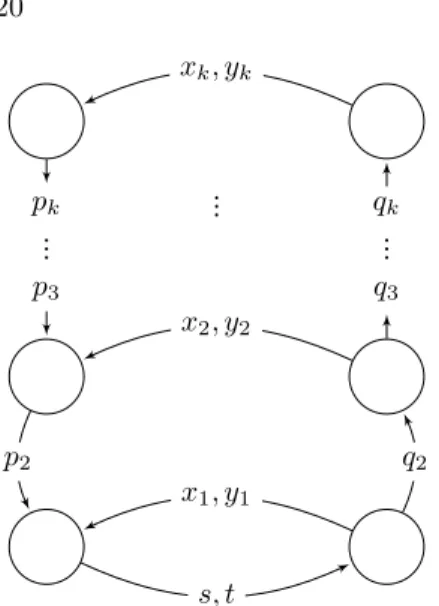
Uk=(pkUk−1qkxk)ωpkUk−1qk(ykpkUk−1qk)ω
Vk=(pkUk−1qkxk)ωpkVk−1qk(ykpkUk−1qk)ω
gVk satisfies the equation Uk=Vk
p3 q3 pk ⋮ qk ⋮ ⋮ s, t x1, y1 q2 x2, y2 xk, yk p2
Fig. 4: An equation for gVk.
So assume that there exists a path equation(X,u = v) of rank k defining gV that is not satisfied by Cks(L). Then, there exists a category morphism ϕ ∶ X∗→ Cks(L) such that ̂ϕ(u) ≠ ̂ϕ(v). We
define V = ϕ( Ob(X)) the set of objects of Cks(L) that have a preimage by ϕ, and
E ={(i,m,j) ∈ Cks(L) ∣ ∃e ∈ X ϕ(e) = (i,m,j)}
the set of arrows that have a preimage by ϕ. Notice that E ⊆ V × ML×V.
We will construct a category morphism ψ ∶ X∗→ C
ds(L) such that ̂ψ(u) ≠ ̂ψ(v). In order to
do that, we define a map θ ∶ V → Cds(L) such that for all (i,m,j) in E, (θ(i),m,θ(j)) is an
arrow of Cds(L).
Lemma 23. There exists a smallest integer iV <kssuch that{iV+1, . . . , iV+s−1 mod ks}∩V = ∅.
Proof: As the size of X is k, the size of V is at most k. Then the maximal distance between two consecutive vertices of V is at least ks/k = s.
We define θ ∶ V → Ob(Cds(L)) as follow :
θ ∶⎧⎪⎪⎨ ⎪⎪⎩
i↦ i mod ds if i ⩽ iV
i↦ ds + i − ks otherwise.
The idea behind this is that i = θ(i) if i appears before the gap and ks − i = ds − θ(i) if i appears after it. Then each arrow from E will either appear directly as it does for Cks(L) if it does not
go over the gap, and since the gap is of size s, we will be able to pump the arrows that go over it. Lemma 24. For any arrow(i, m, j) of E, (θ(i), m, θ(j)) is an arrow of Cds(L).
Proof: Let (i, m, j) be an arrow of E. Then there exists a word u such that ηL(u) = m and
• If ∣u∣ ⩾ s, then we know, by definition of the stability index, that for any positive integer ℓ, there exists a word uℓ such that ℓs ⩽∣uℓ∣ < (ℓ + 1)s, ∣u∣ = ∣uℓ∣ mod s and u ≡L uℓ. Then
as θ preserves the congruence modulo s,(θ(i), ηL(uℓ), θ(j)) = (θ(i), m, θ(j)) is an arrow of
Cds(L).
• If∣u∣ < s, then we have to treat several subcases:
– If θ(i) = i and θ(j) = j, then θ(i) + ∣u∣ = θ(j) mod ds. Thus (θ(i), m, θ(j)) is an arrow of Cds(L).
– If θ(i) = ds + i − ks and θ(j) = ds + j − ks, then as u has a size smaller than s, we have i < j and θ(j) − θ(i) = j − i. Consequently θ(i) + ∣u∣ = θ(j) mod ds and (θ(i), m, θ(j)) is an arrow of Cds(L).
– If θ(i) = ds+i−ks and θ(j) = j, then i+∣u∣ = j +ks. So θ(i)+∣u∣ = ds+i−ks+∣u∣ = j +ds. The same word u labels an arrow from θ(i) to j and thus (θ(i), m, θ(j)) is an arrow of Cds(L).
– Finally, the case where θ(i) = i and θ(j) = ds + j − ks cannot happen since it implies that i ⩽ iV and j > iV +s, and that ∣u∣ = j − i > s mod ks which contradicts the ∣u∣ < s
hypothesis.
We now define a new morphism ψ ∶ X∗→ C
ds. We proceed as follow:
– First we define Ob(ψ) to be θ○ Ob(ϕ).
– We now have to define ψ on arrows. Let e be an arrow of X and ϕ(e) = (i, m, j). We set ψ(x) = (θ(i), m, θ(j)). This is well defined thanks to Lemma 24.
Lemma 25. Let u be a path in X∗. If ϕ(u) = (i, m, j), then ψ(u) = (θ(i), m, θ(j)).
Proof: Let u = u1⋯un∈X∗such that ϕ(uℓ) = (iℓ, mℓ, jℓ) and ϕ(u) = (i, m, j). Therefore, ψ(uℓ) =
(θ(iℓ), mℓ, θ(jℓ)). However, since for all 1 ⩽ ℓ < n jℓ = iℓ+1, we have φ(u) = (i1, m1⋯mn, jn) =
(i, m, j) and ψ(u) = (θ(i1), m1⋯mn, θ(jn)) = (θ(i), m, θ(j)).
Recall that ϕ̂(u) ≠ ̂ϕ(v). Then we can find u′, v′ ∈ X∗ co-terminal paths of X∗ such that ϕ(u′) = ̂ϕ(u), ϕ(v′) = ̂ϕ(v), ψ(u′) = ̂ψ(u) and ψ(v′) = ̂ψ(v). We set u′ =u1⋯un with ui ∈ X
for any i and v′=v
1⋯vp with vi∈X for any i. To conclude we show that ψ(u′) ≠ ψ(v′) which
is absurd. Indeed, if ϕ(u′) = (i, m, j) ∈ C
ks(L) and ϕ(v′) = (i, m′, j) ∈ Cks(L), then m′ ≠ m
sinceϕ̂separates u and v. Furthermore, by Lemma 25, we also have ψ(u′) = (θ(i), m, θ(j)) and
ψ(v′) = (θ(i), m′, θ(j)) in Csd(L). Finally ψ(u′) ≠ ψ(v′) and thus Cdsdoes not satisfy(X, u = v),
holding a contradiction.
Combining the previous theorem with the decidable path equations given in Example 6 yields the following corollaries.
Corollary 26. Given a regular language L of stability index s and an integer k > 0. We have
• L belongs to FO2k[<,MOD] if, and only if, it belongs to FO 2
k[<,MOD2ks].
• L belongs to FO[=,MOD] if, and only if, it belongs to FO[=,MOD2s].
As the corresponding global varieties are decidable, we get that the fragments FO[=,MOD] and
FO2k[<,MOD] for any k > 0 are decidable.
5.4
Infinitely testable case
In this Section, we present the infinitely testable property. We then prove that for any expressive enough fragment equipped with all regular predicates, this property holds, leading to a delay. In fact, Proposition 27 proves that, given Proposition 13, as soon as a fragment contains the local predicates, it will be infinitely testable. Theorem 28 then proves that a delay can be computed in this latter case. Informally, a variety is infinitely testable if the membership of a language to the variety only depends on words long enough.
Definition. Given a semigroup S, the idempotents’ ideal of S, denotedIE(S), is the ideal of S
generated by its idempotents, i.e. IE(S) = SE(S)S, where E(S) denotes the set of idempotents
of S. Note also that given a morphism η ∶ A+ → S, it is the semigroup of all elements of S
having an infinite number of preimages by η. An aware reader could notice thatIE(S) is the set
of all elements of S that are J -below an idempotent. A variety of semigroups V is said to be
infinitely testable if the membership of a semigroup to V is equivalent to the membership of its
idempotents’ ideal. Informally, a variety is infinitely testable if its membership can be reduced to an algebraic condition on the idempotents’ ideal. By extension, we say that a fragment of logic is infinitely testable if it is characterized by an infinitely testable variety.
Example 7. The fragment FO[=] is equivalent to the aperiodic and commutative variety ACom.
This fragment is also described by the equations xy = yx and xω+1 =xω. This fragment is not infinitely testable. For instance the language equal to the singleton{ab} has a trivial idempotents’ ideal while it is not definable in FO[=].
Example 8. The fragment FO[+1] is equivalent to the languages whose syntactic semigroup
belongs to the variety: ACom ∗ D (Straubing, 1994, Theorem VI.3.1). This fragment is also described by the profinite equation
xωuyωvxωwyω=xωwyωvxωuyω . (a)
We now show that it is an infinitely testable fragment. Let L be a regular language and S its syntactic semigroup. We simply prove that if the equation (a) is not satisfied by S, then it is not satisfied by IE(S). Suppose that there exists x,y,u,v,w ∈ S such that the equation (a) is not satisfied. Then by setting: x′=xω, y′=yω, u′=xωuyω, v′=yωvxω, w′=xωwyω. All new variables belong toIE(S) and they also fail to satisfy (a).
In fact, the approach given in the last example can be generalised to any variety of the form V ∗ D. This is proved by Proposition 27.
Proposition 27. Let V be a variety. The variety V ∗ D is infinitely testable.
Proof: Let L be a regular language with η ∶ A∗ → ML its syntactic morphism and S = ηL(A+)
belongs to gV. To conclude, we just notice that by definition, (IE(S))E = SE, and therefore
V ∗ D is infinitely testable.
We finally prove here that if a fragment is equivalent to a variety whose global is infinitely testable, then we can effectively compute a delay, which furthermore is independent from the fragment. For varieties of the form V∗D, this also gives the decidability thanks to Proposition 27 and Corollary 5.
Theorem 28. Let F[σ] be a fragment equivalent to a variety V which is not a group variety
and let L be a language of stability index s. Then L belongs toF[σ,+1,MOD] if and only if L belongs toF[σ,+1,MODs].
Proof: First by Theorem 3, a language L belongs to F[σ,+1,MOD] if and only if there exists d >0, L0, . . . , Ld−1in F[σ,+1] such that
L =⋃
i<d(A d)∗
Ai∩πd(Li∩Kd).
BecauseF[σ] is a fragment which is a variety of monoids but not a group variety, the language Kdand max belongs toF[σ,+1]. We recall that Ld=πd−1(L) ∩ Kd for any d > 0. Thus, for i < d,
Li∩Kd belongs toF[σ,+1] and we have the equality
L=⋃ Li∩Ad(0,i) ∩ Kd∈F[σ,+1].
Therefore, L belongs to F[σ,+1,MOD] if and only if there exists d such that Ld belongs to
F[σ,+1]. Thus, it suffices to prove that if Ldsis definable inF[σ,+1], then Ls is inF[σ,+1] as
well. We set ηs∶A+s→ Ssand ηds∶A+ds→ Sdsthe syntactic morphisms of Lsand Ldsrespectively.
Claim. The semigroupIE(Ss) divides IE(Sds).
Before proving this claim, let us remark that since a variety of semigroups is closed by division, this claim ends the proof. Since if L belongs to F[σ,MODds] then S
ds belongs to V ∗ D and
thereforeIE(Sds) belongs to V ∗ D as well. By division, IE(Ss) belongs to V ∗ D, and thanks
to Proposition 27, Ssbelongs to V ∗ D. Finally, we deduce that Ls belongs toF[σ + 1].
We now aim to construct a division fromIE(Ss) to IE(Sds). This is done through the enriched
alphabet. We introduce the following projection h∶{ A
+
ds → A+s
(a,i) ↦ (a,i mod s)
and Fd the language of well-formed factors, which is the set of well-formed words that do not
necessarily start by a letter (a,0). Note that Lds=h−1(Ls) ∩ Ks. Let us remark also that the
image of a word not in Fs (resp. Fds) by ηs (resp. ηds) has an absorbing zero as image by ηs
(resp. ηds). This zero being idempotent, it belongs to IE(Ss) (resp. IE(Sds)). Finally, if two
words of Fshave the same image by ηs, then they have the same length modulo s and their first
(and consequently last) letters have the same enrichment. Consider then x a non-zero element ofIE(Ss). We show that
Since x belongs toIE(Ss), there exists a word u of A+s of length greater than s in the preimage
of x. And since ηs(Ass) = ηs(A2ss ) by definition of the stability index, for any k > 0 there
exists a word vk of A+s of length greater than ks such that u ≡L vk and ∣u∣ = ∣vk∣ mod s, since
ηs(u) = ηs(vk). Then for k sufficiently large, there exists a word w in h−1(vk), such that ηds(w)
belongs to IE(Sds). Note that by taking k as a multiple of d, we obtain a word w such that
∣u∣ mod s = ∣w∣ mod ds. Thus for each element x ∈ IE(Ss), we can choose such an element, that
we denote wx. This justifies the definition of the following function:
f ∶⎧⎪⎪⎪⎨ ⎪⎪⎪⎩
IE(Ss) → IE(Sds)
x ↦ ηds(wx) if x ≠ 0
0 ↦ 0 otherwise.
We conclude by proving that f is an injective morphism, and thusIE(Ss) is a subsemigroup of
IE(Sds).
The application f is a morphism. Let x, y ∈ IE(Ss). We show that f(xy) = f(x)f(y). First,
we can assume without loss of generality that x ≠ 0 and y ≠ 0. We remark that since ∣wx∣ mod ds = ∣h(wx)∣ mod s, the concatenated word wxwy is well-formed if, and only if,
h(wx)h(wy) is well-formed too. If xy ≠ 0.Then, xy have a well-formed preimage and wxwy
is well-formed. Then as wxyand wxwyare syntactically equivalent with respect to both Fds
and h−1(Ls), ηds(wxy) = ηds(wxwy) = ηds(wx)ηds(wy), meaning that f(xy) = f(x)f(y).
Now if xy = 0, then either xy has no well-formed preimage or xy is a zero for π−1s (L). In
the latter case, then f(x)f(y) = 0 according to the previous point. If xy has no well-formed preimage, then wxwy is not well-formed and consequently f(x)f(y) = 0.
The application f is injective. Let x, y ∈IE(Ss) be such that x ≠ y. Without loss of generality,
we assume that x ≠ 0. Necessarily, there exist p, q ∈ Ss such that pxq ∈ ηs(Ls) if, and only
if, pyq /∈ ηs(Ls). Let u and v be words from the preimage of p and q respectively. Then
there exists two words u′∈h−1(u) ∩ F
dsand v′∈h−1(v) ∩ Fdssuch that u′wxv′∈Ldsif, and
only if, u′w
yv′/∈ Lds. Therefore, we have f(x) ≠ f(y) and f is injective.
The following proposition deals with fragments which are not varieties of groups. Varieties of groups are notoriously ill behaving with respect to their global. Indeed Auinger (2010) exhibited a variety of group H such that g(LH) is undecidable (as a variety of semigroupoids). However, for a local variety V which is not a variety of groups, the variety of semigroups LV is local, as proved in Paperman (2014). Since this article does not deal with the framework of varieties of
semigroupoids, we provide a self contain proof extracted from this latter result.
Proposition 29. Let F[σ] be a fragment equivalent to a local variety V which is not a variety
of groups. Then F[σ,+1,MOD] is equivalent to QLV.
Proof: First we remark that sinceF[σ] is equivalent to a local variety, by Proposition 13, and by definition of locality, F[<,+1] is equivalent to LV = V ∗ D. Furthermore, since V is not a variety of groups,(ab)∗ belongs to LV. Therefore, we obtain the following:
L ∈F[<,+1,MOD] if and only if ´¹¹¹¹¹¹¹¹¹¹¹¹¹¹¹¹¹¹¹¹¹¹¹¹¹¹¹¹¹¹¹¹¹¹¹¹¹¹¸¹¹¹¹¹¹¹¹¹¹¹¹¹¹¹¹¹¹¹¹¹¹¹¹¹¹¹¹¹¹¹¹¹¹¹¹¹¹
By Theorem 28
L ∈F[<,+1,MODs] if and only if ´¹¹¹¹¹¹¹¹¹¹¹¹¹¹¹¹¹¹¹¹¹¹¹¹¹¹¹¹¹¹¹¹¹¹¹¹¹¹¸¹¹¹¹¹¹¹¹¹¹¹¹¹¹¹¹¹¹¹¹¹¹¹¹¹¹¹¹¹¹¹¹¹¹¹¹¹¹
By Theorem 3