Climbing the tower of babel: Unsupervised multilingual learning
The MIT Faculty has made this article openly available.
Please share
how this access benefits you. Your story matters.
Citation
Snyder, Benjamin, and Regina Barzilay. “Climbing the Tower of
Babel: Unsupervised Multilingual Learning.” Proceedings of the
27th International Conference on Machine Learning (ICML-10).
Haifa, Israel:29-36.
As Published
http://www.icml2010.org/papers/905.pdf
Publisher
Omnipress
Version
Author's final manuscript
Citable link
http://hdl.handle.net/1721.1/61698
Terms of Use
Article is made available in accordance with the publisher's
policy and may be subject to US copyright law. Please refer to the
publisher's site for terms of use.
Benjamin Snyder [email protected]
Regina Barzilay [email protected]
MIT Computer Science & Artificial Intelligence Lab, 32 Vassar Street, Cambridge, MA 02139 USA
Abstract
For centuries, scholars have explored the deep links among human languages. In this pa-per, we present a class of probabilistic mod-els that use these links as a form of naturally occurring supervision. These models allow us to substantially improve performance for core text processing tasks, such as morpho-logical segmentation, part-of-speech tagging, and syntactic parsing. Besides these tradi-tional NLP tasks, we also present a multilin-gual model for the computational decipher-ment of lost languages.
1. Overview
Electronic text is currently being produced at a vast and unprecedented scale across the languages of the world. Natural Language Processing (NLP) holds out the promise of automatically analyzing this growing body of text. However, over the last several decades, NLP research efforts have focused on the English guage, often neglecting the thousands of other lan-guages of the world (Bender, 2009).
Most of these languages are currently beyond the reach of NLP technology due to several factors. One of these is simply the lack of the kinds of hand-annotated lin-guistic resources that have helped propel the perfor-mance of English language systems. For complex tasks of linguistic analysis, hand-annotated corpora can be prohibitively time-consuming and expensive to pro-duce. For example, the most widely used annotated corpus in the English language, the Penn Treebank (Marcus et al.,1994), took years for a team of profes-sional linguists to produce. It is unrealistic to expect such resources to ever exist for the majority of the world’s languages.
Appearing in Proceedings of the 27thInternational Confer-ence on Machine Learning, Haifa, Israel, 2010. Copyright
2010 by the author(s)/owner(s).
Another difficulty for multilingual NLP is that lan-guages exhibit wide variation in their underlying lin-guistic structure. A model that has been developed for one language may not account for the kinds of struc-ture found in others. In fact, there exists an entire academic discipline devoted to studying and describing systematic cross-lingual variations in language struc-ture, known as linguistic typology (Comrie,1989). At first glance, it may seem that linguistic diver-sity would make developing intelligent text-processing tools for the world’s languages a very daunting task. However, we argue that in fact it is possible to harness systematic linguistic diversity and use it to our advan-tage, utilizing a framework which we call multilingual
learning. The goal of this enterprise is two-fold: • To induce more accurate models of individual
lan-guage structure without any human annotation.
• To induce accurate models of the relationships
be-tween languages.
The multilingual learning framework is based on the hypothesis that cross-lingual variations in linguistic structure correspond to variations in ambiguity. As an example, consider the syntactically ambiguous English sentence: “I ate pasta with cheese.” The prepositional phrase “with cheese” can be interpreted as attaching the noun “pasta” (meaning the pasta had cheese), or could be interpreted as attaching to the verb “ate” (meaning perhaps that the pasta was eaten by means of a cheese-based utensil). As humans, we know that the first of these is the only plausible interpretation, but there is nothing in the sentence itself to indicate the correct parse. In contrast, the parallel sentence in Japanese uses an explicit genitive marker to mark the fact that the word for “pasta” is being modified. This example is an instance of a more general phe-nomenon: what one language leaves implicit, and thus ambiguous for computers or humans, another will ex-press directly through overt linguistic forms. In the framework of multilingual learning, we treat these
vari-Climbing the Tower of Babel
ations in ambiguity as a form of naturally occurring
supervision: by jointly modeling multiple languages,
the idiosyncratic ambiguities of each can be wiped out by information explicit in the others.
The multilingual formulation presents great promise, but also poses novel technical challenges. One such challenge is the discovery of shared cross-lingual struc-ture while allowing significant language-specific id-iosyncrasies. To allow an effective balance, our models explain parallel sentences as a combination of multi-lingual and language specific latent variables in a hi-erarchical Bayesian framework. Even so, the scope of the shared explanatory mechanism is often unknown: some sets of languages exhibit a much larger degree of shared structure than other. For example, parallel phrases in related language pairs like Hebrew and Ara-bic tend to mirror each other in morphological struc-ture much more than unrelated language pairs (such as English and Hebrew). To account for this variability in shared structure, we employ non-parametric statistical methods which allow for a flexible number of shared variables, as dictated by the languages and data at hand.
Finally, we set scalability in the number of languages as one of our design goals. Massively multilingual data-sets exist (e.g. the Bible, which has been trans-lated into over 1,000 languages) and an ideal multilin-gual learning technique would scale gracefully in the number of languages. For the task of part-of-speech tagging, we developed a model and learning algorithm that scale linearly in the number of languages in terms of both time and space complexity.
We have applied unsupervised multilingual learning to the fundamental NLP tasks of morphological segmen-tation (Snyder & Barzilay, 2008a;b), part-of-speech tagging (Snyder et al., 2008; 2009b; Naseem et al.,
2009), and parsing (Snyder et al., 2009a). We have focused on the use of parallel corpora (texts that have been written in one language and translated into other languages). We treat each parallel corpus as a
com-putational Rosetta Stone which can help expose the
latent structure of each language present. We assume the existence of such a corpus at training time with no human annotations. We do however, assume that reasonably accurate sentence- and word-level align-ments have been induced using standard NLP tools (Och & Ney, 2003). At test time, we apply our mod-els to monolingual data in each language. For all three tasks, multilingual learners consistently outper-form their monolingual counterparts by a large mar-gin. Remarkably, in the case of part-of-speech tagging, we found that model accuracy continues to increase as
I love fish J’ adore les poisson
ani ohev dagim Mujhe machchli pasand hai
I
s2 s3
s1
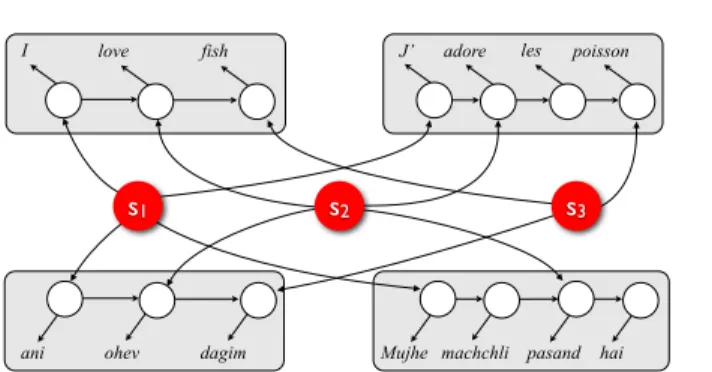
Figure 1. Part-of-speech graphical model structure for
ex-ample sentence. In this instance, we have three
superlin-gual tags: one for the cluster of words corresponding to
English “I”, one for the cluster of words corresponding to English “love”, and one for the cluster of words correspond-ing to English “fish.”
more languages are added to the mix. We believe these results point towards a future of ubiquitous and accu-rate text processing tools for hundreds of the world’s languages which lack annotated resources.
In the sections that follow we sketch the multilingual models that we have developed for three classical NLP tasks: Part-of-speech tagging (Section2), morphologi-cal segmentation (Section3), and parsing (Section4). In section5we describe a model for the decipherment of lost languages.
2. Part-of-speech Tagging
The goal of part-of-speech tagging is to automatically determine the part-of-speech (noun, verb, adjective, etc) of each word in the context of a given sentence. For example, the word “can” in English may func-tion as an auxiliary verb, a noun, or a regular verb. However, many other languages express these differ-ent senses with three distinct lexemes. Thus, at the lexical level, a word with part-of-speech ambiguity in one language may correspond to an unambiguous word in the other language. Languages also differ in their patterns of structural part-of-speech ambiguity. For example, the presence of a definite article (e.g. the) in English greatly reduces the ambiguity of the succeed-ing tag. In languages without definite articles, how-ever, this explicit structural information is absent. We first describe the structure of our model. We posit a separate Hidden Markov Model (HMM) (Merialdo,
1994) for each language, with an additional layer of la-tent cross-lingual variables. See Figure1 for a graph-ical model depiction. A single cross-lingual variable,
Superlingual value “2” Noun Verb Determiner English French Hindi 0.9 0.1 0.0 0.8 0.1 0.1 1.0 0.0 0.0
Noun Verb Determiner English French Hindi 0.5 0.4 0.1 0.4 0.6 0.0 0.5 0.5 0.0 Superlingual value “5”
Figure 2. Two stylized examples of superlingual tag values.
Each provides a distribution over parts-of-speech for each language.
in our terminology a superlingual tag, is present for each cluster of aligned words across languages. These superlingual tags exert influence on the part-of-speech decisions of each word in the associated cluster. In a standard HMM, we can write the joint probability of a sequence of words w and part-of-speech tags y as product of transition and emission probabilities:
P (w, y) =∏
i
P (yi|yi−1)P (wi|yi)
Under our latent variable model, the probability of bilingual parallel sentences (w1, w2), bilingual part-of-speech sequences (y1, y2), and superlingual tags s is given by: ∏ i P (si) ∏ j P(y1j|y1j−1, sf (j,1) ) P (w1j|yj1) ∏ k P(y2k|y2k−1, sf (k,2) ) P (w2k|y2k),
where f (m, n) gives the index of the superlingual tag associated with word m in language n. Notice that the part-of-speech tagging decisions of each language are independent when conditioning on the superlingual tags s. It is this conditional independence which gives our model some of its crucial properties. Superlin-gual variables promote cross-linSuperlin-gual regularities (more on this below), yet word order, part-of-speech selec-tion, and even part-of-speech inventory are permitted to vary arbitrarily across languages. In addition, this architecture allows our model to scale linearly in the number of languages: when a language is added to the mix we simply add new directed edges from the existing set of superlingual tags for each sentence. Intuitively, the value of a superlingual tag represents a particular multilingual context that influences each language’s part-of-speech selection. Formally, each su-perlingual value provides a set of multinomial proba-bility distributions — one for each language’s part-of-speech inventory. See Figure2 for two stylized exam-ples. The first shows a superlingual value which
pre-!" !# !$ !% !& '()( '*+,-.& ./ .0 .. .! .1 # $ % & / 0 . ! Number of Languages Tag accuracy
Figure 3. Average part-of-speech prediction accuracy as
the number of languages varies (averaged over all subsets of languages for each size).
dominantly favors nouns across languages, while dis-playing a slight secondary preference for other parts-of-speech. The second example shows a more complex pattern of part-of-speech preferences, with nouns and verbs almost equally preferred across languages. Give a superlingual tag s and a previous part-of-speech
yi−1, we define the generative probability of
part-of-speech tag yi as:
P (yi|yi−1, s) =
P (yi|yi−1)· P (yi|s)
Z ,
where the first factor is the language-specific transition distribution, the second factor is the part-of-speech distribution provided by the superlingual tag s, and
Z is a normalization constant obtained by summing
over all possible part-of-speech tags. This parameteri-zation allows a trade-off between language-specific and cross-lingual cues while avoiding the sparsity of a non-factored distribution.
In order to learn repeated cross-lingual patterns, the number of superlingual values must be constrained in some way. Intuitively, we would like to set the number of values to the number of multilingual part-of-speech patterns. However, the number of such patterns is not known a priori and may, in fact, depend on the num-ber and properties of the languages under question. Rather than fixing the number of superlingual val-ues to some arbitrary number, we leave it unbounded. To encourage sparse cross-lingual regularities we use a Dirichlet process prior (Ferguson,1973). Under this non-parametric prior, the distribution over superlin-gual values must be highly skewed, such that a small finite subset receives a lion’s share of the probability mass. The precise number of realized superlingual val-ues will be dictated by the data. In practice we find
Climbing the Tower of Babel
that the number of induced values ranges from 11 (for pair of languages) to 17 (for eight languages).
We evaluate our model on a parallel corpus of eight languages: Bulgarian, Czech, English, Estonian, Hun-garian, Romanian, Serbian, and Slovene (Erjavec,
2004). We perform inference using Markov Chain Monte Carlo sampling and always test on held out monolingual data for each language. We ran our in-ference algorithm over all 255 subsets of the eight lan-guages in our corpus, so we could examine the aver-age change in performance as the number of languaver-ages increases. In the monolingual scenario, our model re-duces to the Bayesian HMM ofGoldwater & Griffiths
(2007). When a complete part-of-speech dictionary1
is available and our model is trained using eight lan-guages, average tag prediction accuracy increases from 91.1% for monolingual models to 95%. In more realis-tic cases, where the tag dictionary is restricted to only frequently occurring words, we see even larger gaps be-tween monolingual and multilingual performance. In one such scenario, where dictionary entries are only available for words occurring more than five times in the corpus, average multilingual performance increases to 82.8% from the monolingual baseline of 74.8%. As seen in Figure3, accuracy gains steadily as languages are added to the mix.
3. Morphological Segmentation
In the task of morphological analysis, the goal is to segment words into morphemes, the smallest units of meaning (e.g. “misunderstanding” segments into three morphemes: “mis understand ing”). While the mor-phology of English is fairly simple, many languages exhibit a richer and more productive set of logical patterns. In the unsupervised setting, morpho-logical segmentation consists of finding recurrent prefix and suffix patterns which allow a more compact rep-resentation of the many possible derived word forms. Our multilingual model for this task automatically in-duces a segmentation and morpheme alignment from a multilingual (unannotated) corpus of short parallel phrases. For example, given parallel phrases meaning
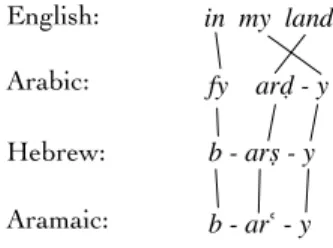
in my land in English, Arabic, Hebrew, and Aramaic,
we wish to segment and align morphemes as shown in Figure4.
This example illustrates the potential benefits of un-supervised multilingual morphological analysis. The three Semitic languages use cognates (words derived from a common ancestor) to represent the word land.
1
i.e. entries indicating the set of potential parts-of-speech for each word
fy arḍ - y b - arṣ - y b - arʿ - y in my land English: Arabic: Hebrew: Aramaic:
Figure 4. Morphological segmentation and alignment.
They also use an identical suffix (-y) to represent the first person possessive pronoun (my). These similar-ities in form should guide the model by constraining the space of joint segmentations and alignments. The corresponding English phrase lacks this resemblance to its Semitic counterparts. However, in this as in many cases, no segmentation is required for English as all the morphemes are expressed as individual words. For this reason, English should provide a strong source of disambiguation for highly inflected languages, such as Arabic and Hebrew. More generally speaking, our model exploits the fact that each language distributes morphemes across words in a unique pattern. Note that morphemes expressed in one language often have no counterpart at all in some other languages, so mor-phemes must be allowed to remain unaligned.
The technical difficulty when compared to the part-of-speech model of Section2is that the units of alignment now depend on the results of the model’s segmentation predictions. Whereas before we could treat word-level alignments as fixed and observed (as the result of pre-processing with standard NLP word-alignment tools), we must now fold alignment uncertainty into the mor-phology model itself.
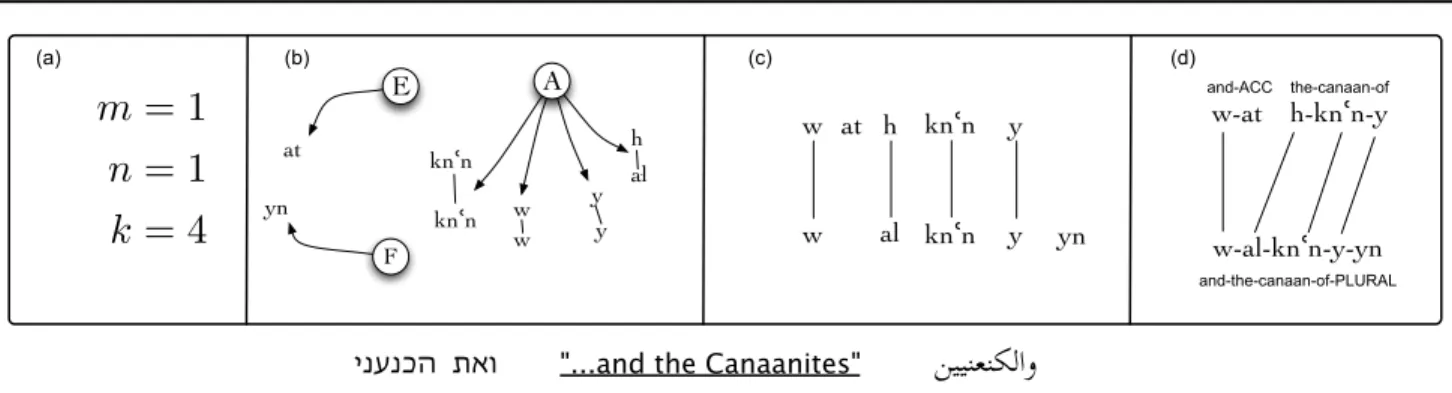
We start with a sketch of the probabilistic process posited by our model for the generation of short bilin-gual phrases (see Figure5for an accompanying exam-ple). First, the numbers of unaligned language-specific morphemes (m and n), and the number of aligned mor-pheme pairs (k) are drawn from a Poisson distribution. These are the number of morphemes that will ulti-mately compose the bilingual parallel phrase. Next, the morphemes are drawn from the appropriate distri-butions: m and n morphemes are respectively drawn from language-specific morpheme distributions E and
F , and k bilingual morpheme pairs are drawn from A.
The resulting morphemes for each language are finally ordered and fused into words.
As in the previous section, the scope of cross-lingual connections (now in the form of aligned morpheme pairs) is not known a priori. Indeed, even the num-ber of morphemes in each language is not known in
وا#
$
%&
%''
(
ו א ת ה כ נ ע ני "...and the Canaanites"
w-at h-knʿn-y w-al-knʿn-y-yn and-ACC the-canaan-of and-the-canaan-of-PLURAL at knʿn knʿn yn w w y y al h at knʿn knʿn yn w w y y al h E F A
m = 1
n = 1
k = 4
(a) (b) (c) (d)Figure 5. Morphological generation process for a parallel bilingual phrase, with Hebrew shown on top and Arabic on
bottom. (a) First the numbers of isolated morphemes (m and n) and aligned morphemes pairs (k) are drawn from a Poisson distribution. (b) Isolated morphemes are then drawn from E and F (language-specific distributions) and aligned morpheme pairs are drawn from A. (c) The resulting morphemes are ordered. (d) Finally, some of the contiguous morphemes are fused into words.
the unsupervised setting. We therefore employ non-parametric Dirichlet process priors on the three mor-pheme distributions E, F (language-specific), and A (bilingual). In this manner, the data itself can dictate the number of induced cross-lingual morpheme tuples as well as the number of isolated, language-specific morphemes which remain unaligned.
In addition, this model formulation allows us to con-sider various prior base distributions over aligned mor-pheme tuples (distribution A). In the case of unrelated languages, the base distributions can simply model morpheme length, encoding the fact that shorter phemes tend to be more frequent than longer mor-phemes. However, if the languages are related and the phonetic relationship between the writing systems is known, we can employ a probabilistic string-edit
dis-tance over string tuples. In this way, a segmentation
and alignment which align phonetically similar strings will be encouraged.
We test our model on a multilingual corpus of short parallel phrases drawn from the Hebrew Bible and Arabic, Aramaic, and English translations. The Semitic language family, of which Hebrew, Arabic, and Aramaic are members, is known for a highly pro-ductive morphology. Our results indicate that cross-lingual patterns can indeed be exploited successfully for the task of unsupervised morphological segmenta-tion. When modeled in tandem, gains are observed for all language pairs, reducing error by as much as 24%. Furthermore, our experiments show that both related and unrelated language pairs benefit from mul-tilingual learning. However, when the phonetic cor-respondences between related languages are explicitly modeled using the string-edit base distribution, related languages provide the most benefit.
4. Syntactic Parsing
Now we turn to the task of syntactic parsing. The goal of this task is to induce the underlying gram-matical structure of each sentence in the form of a parse tree. In the monolingual setting, learning accu-rate parsing models without human-annotated texts has proven quite difficult (Charniak & Carroll, 1992;
Klein & Manning, 2002). Here we consider the unsu-pervised multilingual scenario, where parsing models are induced simultaneously for pairs of languages using parallel texts. Again, our key premise is that ambigu-ous syntactic structures in languages may correspond to less uncertain structures in another language, due to systematic differences in word order and manner of expression. Thus, even in the absence of human-annotated trees, we hope to induce an accurate parsing model. Consider the following pair of parsed sentences in English and Hindi/Urdu:
John climbed Everest John Everest on climbed
English Hindi
If we know the correspondence between the words of the sentences (but nothing else about the languages in question), we can immediately pick up some important parsing cues. For example, we can rule as unlikely the possibility of parsing “John climbed” as a constituent subtree in English by the fact that the corresponding words in Hindi appear far apart. Likewise, we can avoid parsing “John Everest” in Hindi as a constituent,
Climbing the Tower of Babel
(i)
(ii)
(iii)
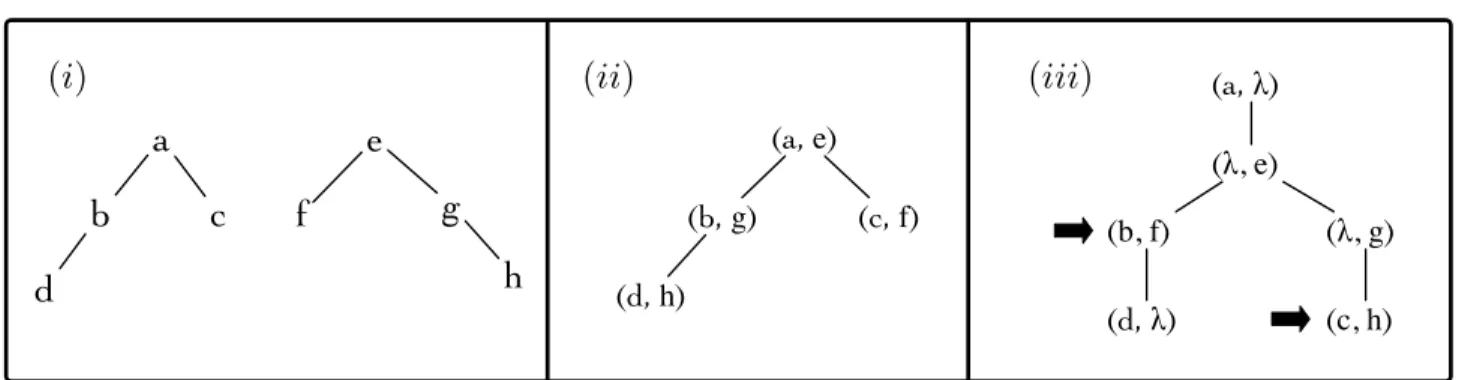
Figure 6. A pair of trees (i) and two possible alignment trees. In (ii), no empty spaces are inserted, but the order of one
of the original tree’s siblings has been reversed. In (iii), only two pairs of nodes have been aligned (indicated by arrows) and many empty spaces inserted.
through a similar comparison to the English sentence. However, even in this simplest of sentence pairs, we no-tice syntactic divergence. While the English sentence uses the simple transitive verb “climbed” to express the fact that John completed his climb of Everest, the verb in the Hindi/Urdu sentence takes the post-positional argument “Everest on.” The syntactic di-vergence in real-life examples becomes only more se-vere. The key challenge then is representational. We need to parse both sentences with possibly quite di-vergent trees, while recognizing shared syntactic struc-ture. In effect, we seek to produce two loosely bound trees: node-to-node alignments need only be used where repeated bilingual patterns can be discerned in the data.
We achieve this loose binding of trees by adapting
un-ordered tree alignment (Jiang et al., 1995) to a prob-abilistic setting. Under this formalism, any two trees can be aligned using an alignment tree. The alignment tree embeds the original two trees within it: each node is labeled by a pair (x, y), (λ, y), or (x, λ) where x is a node from the first tree, y is a node from the second tree, and λ is an empty space. The individual structure of each tree must be preserved under the embedding with the exception of sibling order (to allow variations in phrase and word order).
The flexibility of this formalism can be demonstrated by two extreme cases: (1) an alignment between two trees may actually align none of their individual nodes, instead inserting an empty space λ for each of the original two trees’ nodes. (2) if the original trees are isomorphic to one another, the alignment may match their nodes exactly, without inserting any empty spaces. See Figure6 for an example. An addi-tional benefit of this formalism is computaaddi-tional: The marginalized probability over all possible alignments for any two trees can be efficiently computed with a
dynamic program in bi-linear time in the size of the two trees.
We formulated a generative Bayesian model which seeks to explain sentence- and word-aligned paral-lel sentences through a combination of bilingual and monolingual syntactic parameters. Our model views each bilingual pair of sentences as having been prob-abilistically generated as follows: First an alignment
tree is drawn uniformly from the set of all such trees.
This alignment tree specifies the structure of each of the two individual trees, as well as the pairs of nodes which are aligned and those which are not aligned (i.e. paired with a λ). For each pair of aligned nodes, a corresponding pair of sentence constituents are jointly drawn from a bilingual distribution. For unaligned nodes (i.e. nodes paired with a λ in the alignment tree), a single sentence constituent is drawn, in this case from a language-specific distributions. Finally word-level alignments are drawn based on the struc-ture of the alignment tree.
To perform inference under this model, we use a Metropolis-Hastings within-Gibbs sampler. We sam-ple pairs of trees and then compute marginalized prob-abilities over all possible alignments using dynamic programming.
We tested the effectiveness of our bilingual grammar induction model on three corpora of parallel text: English-Korean, English-Urdu and English-Chinese. The model is trained using bilingual data with auto-matically induced word-level alignments, but is tested on purely monolingual data for each language. In all cases, our model outperforms a state-of-the-art base-line: the Constituent Context Model (CCM) (Klein & Manning,2002), sometimes by substantial margins. On average, over all the testing scenarios that we stud-ied, our model achieves an absolute increase in F-measure of 8.8 points, and a 19% reduction in error
G
0G
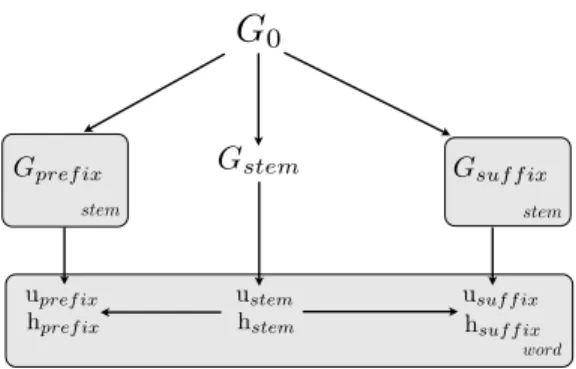
stem Gpref ix stem Gsuf f ix stem word ustem hstem hsuf f ix upref ix hpref ix usuf f ixFigure 7. Plate diagram of the decipherment model. The
base distribution G0 defines probabilities over string-pairs
based solely on character-level correspondences. The morpheme-pair distributions Gstem, Gpref ix, Gsuf f ix
di-rectly assign probabilities to highly frequent morpheme pairs. Each stem pair provides a separate distribution over prefix and suffix pairs.
relative to a theoretical upper bound.
5. Lost Language Decipherment
The models discussed in the previous three sections all assumed the existence of multilingual parallel text. For traditional NLP tasks this is a reasonable assump-tion, as parallel texts are readily available for many of the world’s languages. In contrast, our present work focuses on the decipherment of lost languages, where parallel texts are not available.
Several lost languages have been manually deciphered by humans in the last two centuries. In each case, the decipherment has been considered a major intel-lectual breakthrough, often the culmination of decades of scholarly efforts. So far, computers have played lit-tle role in this enterprise, even for recently deciphered languages. Skeptics argue that computers do not have the “logic and intuition” required to unravel the mys-teries of ancient scripts.2 We aim to demonstrate that
at least some of this logic and intuition can be suc-cessfully captured by computational models.
Our definition of the computational decipherment task closely follows the setup typically faced by human de-cipherers (Robinson,2002). Our input consists of texts in a lost language and a corpus of non-parallel data in a known related language. The decipherment itself in-volves two related sub-tasks: (i) finding the mapping between alphabets of the known and lost languages,
2“Successful archaeological decipherment has turned out
to require a synthesis of logic and intuition . . . that comput-ers do not (and presumably cannot) possess.” A.
Robin-son, “Lost Languages: The Enigma of the World’s Unde-ciphered Scripts” (2002)
and (ii) translating words in the lost language into corresponding cognates of the known language. While there is no single formula that human decipher-ers have employed, manual efforts have focused on sev-eral guiding principles. A common starting point is to compare letter and word frequencies between the lost and known languages. In the presence of cog-nates the correct mapping between the languages will reveal similarities in frequency, both at the character and lexical level. In addition, morphological analy-sis plays a crucial role here, as highly frequent prefix and suffix correspondences can be particularly reveal-ing. In fact, these three strands of analysis (charac-ter frequency, morphology, and lexical frequency) are intertwined throughout the human decipherment pro-cess. Partial knowledge of each drives discovery in the others.
We capture these intuitions in a generative Bayesian model. This model assumes that each word in the lost language is composed of morphemes which were gener-ated with latent counterparts in the known language. We model bilingual morpheme pairs as arising through a series of Dirichlet processes. This allows us to as-sign probabilities based both on character-level corre-spondences (using a character-edit base distribution) as well as higher-level morpheme correspondences. In addition, our model carries out an implicit morpholog-ical analysis of the lost language, utilizing the known morphological structure of the related language. This model structure allows us to capture the interplay be-tween the character- and morpheme-level correspon-dences that humans have used in the manual decipher-ment process. See figure 7for a graphical overview of the model.
We have applied our decipherment model to a corpus of Ugaritic, an ancient Semitic language discovered in 1928 and manually deciphered four years later, using knowledge of Hebrew, a related language. As input to our model, we use the corpus of Ugaritic texts (con-sisting of 7,386 unique word forms) along with a He-brew lexicon extracted from the HeHe-brew Bible. Our model yield an almost perfect decipherment of the Ugaritic alphabetic symbols. In addition, over half of the Ugaritic word forms with Hebrew cognates are correctly deciphered into their Hebrew counterparts.
6. Conclusions and Future Work
In Sections2,3, and4, we described our application of multilingual learning to three traditional NLP tasks. In all cases, we assumed unannotated parallel text at training time and applied the resulting models to
Climbing the Tower of Babel
monolingual test data. We believe this to be a realistic scenario for a large number of the world’s languages, as parallel texts are widely available. Finally, in Sec-tion5, we considered the special case of lost language decipherment, where parallel text is not present, but information about a closely related language is avail-able.
For future work, we pose the following two questions: (i) Can multilingual learning be used to triangulate the information content of sentences in multiple lan-guages? (ii) Can knowledge of linguistic typology (and universal features of language) be used to induce more accurate unsupervised models, even without the use of parallel text?
References
Bender, Emily M. Linguistically na¨ıve != language independent: why NLP needs linguistic typology. In Proceedings of the EACL 2009 Workshop on the
Interaction between Linguistics and Computational Linguistics, pp. 26–32, Morristown, NJ, USA, 2009.
Association for Computational Linguistics.
Charniak, Eugene and Carroll, Glen. Two experi-ments on learning probabilistic dependency gram-mars from corpora. In Proceedings of the AAAI
Workshop on Statistically-Based NLP Techniques,
pp. 1–13, 1992.
Comrie, Bernard. Language universals and linguistic
typology: Syntax and morphology. Oxford:
Black-well, 1989.
Erjavec, T. MULTEXT-East version 3: Multilingual morphosyntactic specifications, lexicons and cor-pora. In Fourth International Conference on
Lan-guage Resources and Evaluation, LREC, volume 4,
pp. 1535–1538, 2004.
Ferguson, T.S. A Bayesian analysis of some nonpara-metric problems. The annals of statistics, 1:209–230, 1973.
Goldwater, Sharon and Griffiths, Thomas L. A fully Bayesian approach to unsupervised part-of-speech tagging. In Proceedings of the ACL, pp. 744–751, 2007.
Jiang, T., Wang, L., and Zhang, K. Alignment of trees – an alternative to tree edit. Theoretical Computer
Science, 143(1):137–148, 1995.
Klein, Dan and Manning, Christopher D. A genera-tive constituent-context model for improved gram-mar induction. In Proceedings of the ACL, pp. 128– 135, 2002.
Marcus, M.P., Santorini, B., and Marcinkiewicz, M.A. Building a large annotated corpus of English: The Penn Treebank. Computational linguistics, 19(2): 313–330, 1994.
Merialdo, Bernard. Tagging english text with a prob-abilistic model. Computational Linguistics, 20(2): 155–171, 1994.
Naseem, Tahira, Snyder, Benjamin, Eisenstein, Ja-cob, and Barzilay, Regina. Multilingual part-of-speech tagging: two unsupervised approaches.
Jour-nal of Artificial Intelligence Research, 36(1):341–
385, 2009. ISSN 1076-9757.
Och, Franz Josef and Ney, Hermann. A systematic comparison of various statistical alignment models.
Computational Linguistics, 29(1):19–51, 2003.
Robinson, Andrew. Lost Languages: The Enigma of
the World’s Undeciphered Scripts. McGraw-Hill, 2002.
Snyder, Benjamin and Barzilay, Regina. Unsupervised multilingual learning for morphological segmenta-tion. In Proceedings of the ACL/HLT, pp. 737–745, 2008a.
Snyder, Benjamin and Barzilay, Regina. Cross-lingual propagation for morphological analysis. In
Proceed-ings of the AAAI, pp. 848–854, 2008b.
Snyder, Benjamin, Naseem, Tahira, Eisenstein, Ja-cob, and Barzilay, Regina. Unsupervised multilin-gual learning for POS tagging. In Proceedings of
EMNLP, pp. 1041–1050, 2008.
Snyder, Benjamin, Naseem, Tahira, and Barzilay, Regina. Unsupervised multilingual grammar induc-tion. In Proceedings of the ACL, pp. 73–81, 2009a. Snyder, Benjamin, Naseem, Tahira, Eisenstein, Jacob,
and Barzilay, Regina. Adding more languages im-proves unsupervised multilingual part-of-speech tag-ging: a bayesian non-parametric approach. In