A CASE STUDY IN SCIENCE AND TECHNOLOGY DIPLOMACY: UNDERSTANDING DIPLOMATS' TECHNICAL COMPETENCY AND
INTERACTION WITH TECHNICAL EXPERTS
by
SHERRICA SHAWNYAE NEWSOME
Bachelor of Science in Aerospace Engineering and Mathematics Minor Virginia Polytechnic Institute and State University, 2007 r
ARCHIVES
Submitted to the Engineering Systems Division
JUN 2
9
2010
in partial fulfillment of the requirements for the Degree ofLIBRARIES
MASTER OF SCIENCE IN TECHNOLOGY AND POLICY at the
MASSACHUSETTS INSTITUTE OF TECHNOLOGY June 2010
@
2010 Massachusetts Institute of Technology. All rights reservedSignature of Author_
Certified by_
Engineering Systems Division May 7, 2010
Jeffrey A. Hoffman, Ph.D. Professor of the Practice, Aeronautics and Astronautics Thesis Supervisor
- A
Accepted by
Dava J. Newman, Ph.D.
Professor of Aerona tics and Astronautics and Engineering Systems Director, Technology and Policy Program
A CASE STUDY IN SCIENCE AND TECHNOLOGY DIPLOMACY: UNDERSTANDING DIPLOMATS' TECHNICAL COMPETENCY AND
INTERACTION WITH TECHNICAL EXPERTS by
SHERRICA SHAWNYAE NEWSOME Submitted to the Engineering Systems Division
on May 7, 2010
in partial fulfillment of the requirements for the Degree of Master of Science in Technology and Policy
ABSTRACT
As science and technology are increasingly at the center of global issues, diplomats are less capable of effectively completing their work without heavily relying on scientists and engineers for clarification and insight. This thesis is motivated by a desire to determine if convincing evidence exists that the lack of diplomats' technical knowledge and/or existing relational difficulties between the diplomat and the technical expert have negative effects on international agreements.
The first required step, the focus of this thesis, is to gain an understanding of the technical expert and the diplomat's relationship. This thesis has examined, as a case study, the National Aeronau-tics and Space Administration Office of External Relations' (OER) diplomats - officially known as international program specialists (IPS). The IPSs were interviewed and the data was analyzed using the grounded theory coding process. Statistics and charts were produced from pre-interview ques-tionnaires and competency data and used as supporting evidence for the interview data. The thesis question is expressed and answered through its three sub-questions: What is the IPS's working relationship with scientists and engineers? How do IPSs go about writing the technical content of agreements? What is the IPS' technical competence? The collective answer is that an IPS does not generate the technical content of agreements, but relies heavily on the technical expert for both the content and its clarification. This lack of technical competence is supported by the fact that only 1% of reported OER's employees' competencies are technical (hard math and science) and only 4% are technically related.
Additionally, hypotheses were drawn: An evaluation of the current IPS orientation process and OER training procedures may show that, despite perceived difficulties, the practices are the best available; An increased understanding of the IPS's role, on behalf of the technical experts -especially the field experts, should improve the relationship between the IPS and the technical expert; The technical competence of an IPS is, to some degree, dependent on both (1) the working relationship an IPS has with the technical expert and (2) the IPS' capability, capacity, and desire to learn. The study largely implies that the lack of understanding of the diplomat's role may also be apparent in other technical organizations where the method of diplomacy aiding science and technology is practiced.
Thesis Supervisor: Jeffrey Hoffman, Ph.D.
BIOGRAPHICAL NOTE
Sherrica Newsome is a native of Franklin, Virginia. She graduated from Virginia Polytechnic Insti-tute and State University in 2007 with a Bachelor of Science in Aerospace Engineering, minor in Mathematics. Soon after, she was hired as the Operations Manager of the 2008 NASA Academy at the NASA Goddard Space Flight Center in Greenbelt, Maryland. Interested in international space policy and engineering systems, she entered as a student at the Massachusetts Institute of Technology the fall of 2008 to study to receive a Master of Science in Technology and Policy.
The summer of 2009, Newsome worked as an intern with in NASA's Office of External Relations. It was this experience that sparked the motivation for her thesis research. Also, as a member of the MIT Space, Policy, and Society Research Group, Newsome helped in the production of "The Future of Human Space Flight," a well know report meant to inform the Obama's Administration of the benefits of humans in space.
A Robert E. McNair Post-Baccalaureate Scholar Alumni and NACME Scholar Alumni, Sherrica has been selected to join a fine group of MIT graduate women as a Graduate Woman of Excellence. Nominated by her peers and faculty, Sherrica has been recognized for taking a proactive and in-novative approach toward finding sustainable solutions to research challenges. Sherrica's hobbies include singing, playing the piano, cooking, traveling, reading, and spending time with loved ones.
ACKNOWLEDGMENTS
I would like to thank my thesis supervisor, Jeffrey Hoffman, for his guidance and support. Without our common interests and your willingness to take me on as a student, this novel research would not have been possible and would have suffered immensely without your insight. I have enjoyed being able to brag about working with such an amazing individual who has flown on the Space Shuttle five times and who performed the unprecedented, highly improvisational first Hubble Space Telescope repair mission.
I must also thank the NASA OER management, who allowed me to interview the international program specialists of the office. Their generosity, willingness to cooperate, and willingness to be open has enabled me to produce this thesis.
Special thanks to members of the Technology and Policy Program's staff and faculty: Dava New-man, Sydney Miller, and Ed Ballo, along with Dean Blanche Staton of the Office for Graduate Education, whose support, advice, and extra care kept me financially stable so that I could perform my duties as a student worry-free. Also, I would like to thank my fellow Technology and Policy Program cohorts who have provided the environment for academic scholarship, friendship and sup-port.
Last but not least, I would like to thank my family, friends and loved ones for their undying love and support. A special thanks is owed to Justin. Thank you for all of your support during this process; it has meant so much. Your support includes, but is not limited to, allowing me to use your computer to aid this research and write this thesis! I would also like to extend another special thanks to my parents, Ray and Katherine. There has been no important moment in my life that you both were not present, eagerly and proudly supporting me. My achievements and my development as a woman are a reflection of your choice to raise me in a God-centered, God-fearing environment. For this, I am forever grateful.
This thesis is dedicated to the loving memory of my maternal grandmother Catherine E. Goodwin. Losing her during this process was difficult. She will forever be loved and missed.
Disclaimer - Unless otherwise noted, the views expressed in this thesis are those of the author and do not reflect the official policy or position of the United States Government or the National
Contents
ABSTRACT 3
BIOGRAPHICAL NOTE 5
ACKNOWLEDGMENTS 6
CHAPTER 1: INTRODUCTION 15
The American Science and Technology Diplomacy Workforce ... 15
Thesis Motivation and Formation ... 17
Thesis Structure ... ... 19
CHAPTER 2: SCIENCE, TECHNOLOGY, AND DIPLOMACY 21 Science and Technology Aiding Diplomacy ... 22
Diplomacy Aiding Science and Technology ... 24
Proposed Study ... . ... 26 Chapter Summary ... ... 27 CHAPTER 3: METHODOLOGY 29 Data Sources ... ... ... . ... ... ... 29 Data Analysis ... 30 Analysis Procedures ... ... 32
Reliability and Validity ... ... ... 33
CHAPTER 4: RESULTS AND ANALYSIS 35 Competency Data ... 35
Pre-Interview Questionnaires ... ... 38
Interviews: Grounded Theory Coding Process ... 40
Step One: Summary of Raw Data ... . 40
Step Two and Three: Relevant Data and Repeating Ideas ... 47
Step Four: Themes ... ... 49
Step Five and Six: Theoretical Constructs and Theoretical Narratives . . . . 52
CHAPTER 5: DISCUSSION 57
Method Validation: Thesis Question Answered ... 57
What is the IPS's working relationship with scientists and engineers? . . . . 57
How do IPS go about writing the technical content of agreements? . . . . 58
What is the IPS' technical competence? . . . . 59
Validation and Implications of Hypotheses . . . . 59
Training and Orientation . . . . 59
Interaction... . . . . . . . . 61
Technical Competence . . . . 62
Final Thoughts . . . . 63
CHAPTER 6: CONCLUSIONS 65 Thesis Contribution .. . . . . . . . 66
Lim itations of Study . . . . 66
Future W ork . . . . 66
Appendix A: Pre-Interview Questionnaire 71
Appendix B: Interview Questions 72
List of Figures
1 Visual Explanation of the Study's Grounded Theory Coding Process Validity . . . . 34 2 Overall Competency Composition of the Mission Support Divisions of NASA OER . 35 3 Technical Competency Composition of the Mission Support Divisions of NASA OER 37
List of Tables
1 Members of the Congressional Science Committees: Senate's Committee on Com-merce, Science, and Transportation and the House of Representatives Committee on
Science and Technology [6, 7]. . . . . 17
2 Competencies of the Mission Support Divisions of NASA OER. . . . . 36
3 NASA Leadership Competency Breakdown.... . . . . . . . . 36
4 International Program Specialists: Educational Backgrounds . . . . 38
5 Region of U.S. Degree Was Obtained . . . . 38
6 Further Educational Goals... . . . . . . . . 39
7 NASA Career Summary of Interviewees . . . . 39
8 Work Effective Trainings: Technical Relativity . . . . 41
Nomenclature
CAETS The Council of Academies of Engineering and Technological Sciences CMS Competency Management System
COUHES Committee on the Use of Humans as Experimental Subjects DOA United States Department of Agriculture
DOE United States Department of Energy DOS United States Department of State
EPA United State Environmental Protection Agency
Euro-CASE The European Council of Applied Sciences and Engineering IAC The InterAcademy Council
IPS International Program Specialist ISS International Space Station
NASA, HQ National Aeronautics and Space Administration, Headquarters NIH National Institute of Health
NRC National Research Council NSF National Science Foundation
NSTC National Science and Technology Council OER Office of External Relations
OHCM Office of Human Capital Management OSTP Office of Science and Technology Policy TWAS The Third World Academy of Sciences UKRAE The UK Royal Academy of Engineering UN United Nations.
CHAPTER 1: INTRODUCTION
The American Science and Technology Diplomacy Workforce
In the early years after the founding of the United States, science and technology were closely tied to American diplomacy. The first Secretary of State, Thomas Jefferson, administered the Nation's first patent law and helped to establish a bureau of weights and measures that was associated with the Department of State. Eventually this close relationship between diplomats and scientists would diminish, but science and technology would regain a prominent role in the State Department during
World War II [1].
Today, in addition to the United States Department of State (DOS), the American S&T diplomacy workforce is comprised of the White House, a number of cabinet-level and independent federal agencies, and congressional committees. The White House has advisory groups that help guide the President on science and technology issues. The Office of Science and Technology Policy (OSTP), established by the National Science and Technology Policy, Organization, and Priorities Act of 1976, was created to advise the President on domestic and international S&T issues, policies, and cooperation. Two other advisory groups, both administered by OSTP, are the National Science and Technology Council (NSTC) and the President's Council of Advisors on Science and Technology (PCAST). NSTC is the principal Cabinet-level means to coordinate science and technology policy across the diverse entities that make up the federal research and development enterprise. PCAST is an advisory group of the nation's leading scientists and engineers who directly advise the Pres-ident and the Executive Office of the PresPres-ident by making policy recommendations in the many areas where understanding of science, technology, and innovation is key to strengthening the U.S. economy and forming policy that works for the American people [2}.
The DOS sets the overall policy direction for diplomacy and is the lead federal agency in de-veloping S&T agreements. The DOS sets its policy direction using the diplomatic perspective of American leadership in science and technology as used to enhance another country's development and to improve understanding by other nationals of U.S. values and ways of doing business. The DOS Bureau of Bureau of Oceans and International Environmental and Scientific Affairs, Office of Science and Technology Cooperation (OES/STC), coordinates international S&T cooperative
activities throughout the federal government
131.
A number of independent federal agencies are also involved in international S&T policy. About 40 U.S. government departments and agencies have bilateral and regional programs involving devel-oping countries, and S&T are prominent themes in many of these programs
[4].
These include, but are not limited to, National Aeronautics and Space Administration (NASA), National Science Foun-dation (NSF), National Institutes of Health (NIH), Department of Energy (DOE), Department of Agriculture (DOA), Environmental Protection Agency (EPA), National Oceanic and Atmospheric Administration (NOAA) and United States Agency for International Development (USAID) [3}. USAID, playing a big role in sustainable international development, receives foreign policy guid-ance from the Secretary of State - a position currently held by Hillary Rodham Clinton. USAID, desiring to provide a better future for all, supports long-term growth and advances in U.S. foreign policy objectives by supporting agriculture, democracy & governance, economic growth, the envi-ronment, education, health, global partnerships/conflict prevention, and humanitarian assistance in more than 100 countries [5].The United States Congress has two science and technology committees: the Senate's Committee on Commerce, Science, and Transportation and the House of Representatives Committee on Science and Technology. The Senate's Committee is responsible for the regulation of consumer products and services. The Committee is also in charge of the nation's science, engineering, and technology policy. This encompasses the jurisdiction over non-military aeronautical and space science policy includ-ing surroundinclud-ing transportation issues. The Committee comprises seven subcommittees: Aviation Operations, Safety, & Security; Communications, Technology, and the Internet; Competitiveness, Innovation, and Export Promotion; Consumer Protection, Product Safety, and Insurance; Oceans, Atmosphere, Fisheries, and Coast Guard; Science and Space; and Surface Transportation and Mer-chant Marine Infrastructure, Safety, and Security. The House of Representatives Committee on Science and Technology also plays an important role in much of the legislation Congress considers in domestic and international science, technology, standards and competitiveness. The Committee has jurisdiction over the exploration of outer space, astronautical research and development, scien-tific research and development, and science scholarships, legislation relating to scienscien-tific agencies, and legislation related to the atmosphere, the National Weather Service, civil aviation research and development, energy, and the environment. The Committee comprises five subcommittees: Energy & Environment; Technology & Innovation; Research & Science Education; Space & Aeronautics: and Investigations & Oversight.
Thesis Motivation and Formation
The White House advisory groups and the independent federal agencies provide the majority of the technical expertise within the American S&T diplomacy workforce, while congressional members, even with its large share of jurisdiction over American S&T diplomacy, lack technical expertise. As shown in Table 1, of the congressional members of the Science Committees, 1 out of the 25 Senators and 9 out of the 41 House Representatives has obtained a degree in some sort of hard math or science field. To assist in the matter, these congressmen have staff members with technical backgrounds; however, only about 9 out of 76 Senate Science Committee staff members and about 12 out of the 36 House Science Committee staff members have technical backgrounds [6, 7]. Due to legislative objectives, this lack of technical expertise is expected among congressional members; however, it may not be expected within a technical independent agency such as NASA.
Table 1: Members of the Congressional Science Committees: Senate's Committee on Commerce, Science, and Transportation and the House of Representatives Committee on Science and Technol-ogy [6, 7].
Congress Member Profession/Degree
Sen. John Ensign Veterinarian
Rep. Eddie Bernice Johnson Nurse
Rep. David Wu Medical Degree
Rep. Brian Baird Clinical Psychology Rep. Dan Lipinski Mechanical Engineering
Rep. Paul Tonko Mechanical/Industrial Engineering Rep. Roscoe Bartlett Anatomy, Physiology, and Zoology
Rep. Vern Ehlers Nuclear Physics Rep. Todd Akin Management Engineering Rep. Paul Broun Chemistry, Medical Doctor
NASA's Office of External Relations (OER) is responsible for establishing NASA's cooperative agreements and setting NASA's international relation strategies. OER's diplomats, who write the agreements, are formally known as international program specialists (IPS). Cooperation, legalized by agreements, includes working with both domestic and international entities, such as other space agencies, foreign governments, federal agencies, companies, universities, and national labs. OER's organization directly reflects NASA's mission directorates: Science, Exploration Systems, Aeronau-tics Research, and Space Operations. As a support office for NASA, OER is organized to reflect the four NASA mission directorates; although not entirely. OER has three divisions whose purpose is mission directorate support: Science, Exploration Systems and Aeronautics Research, and Space Operations. The cooperative agreements produced reflect the work of the mission directorate. For example, in the Aeronautics Mission Directorate an agreement may consist of NASA allowing the European Space Agency (ESA) to use a NASA airplane for the employment of a telescope during flight to conduct space research.
As an intern at OER the summer of 2009, it was observed that an IPS supports and represents NASA, serves the mission directorates, and serves as a link between the mission directorates and its programs. However, it was also observed that an IPS does not have a technical background, and new IPS employees are not offered an official OER, orientation program. This fact raised ques-tions. Without a formal technical education and orientation program, are IPSs tasked with writing agreements consisting of content they do not understand? If not, then how is it that new IPSs are efficiently negotiating agreements on NASA's behalf? The average IPS, before OER employment, did not know much about NASA, its organization, its history, or its mission. Even if aware, there were technical processes and phrases that are particular to NASA's mission directorates and orga-nizations that needed to be learned.
In spite of these observations, NASA is obviously a thriving force for American S&T diplomacy, collaborating with many nations on an a range of activities, such as satellite and human exploration missions. In order to be such a thriving force, NASA OER's conduction of diplomacy is obviously working, and because of the IPS' lack of technical expertise, there must be heavy interaction be-tween the IPS and the technical expert. Therefore, one can conclude that technical expertise used for American S&T diplomacy is solely provided by technical experts.
However, this reliance on technical expertise is not specific to American S&T diplomacy. As science and technology are increasingly at the center of global issues, diplomats - who generally lack tech-nical backgrounds - are less capable of effectively completing their work without having to heavily rely on scientists and engineers for clarification and insight. Therefore, the efficiency of a diplomat's work depends in large part on the efficiency of the diplomat's working relationship with scientists and engineers.
Using this as motivation, there is a need to examine the relationship between to diplomat and the technical expert to determine if implications of negative affects on international agreements exist. The first step towards this goal is to gain an understanding of the diplomat's technical com-petencies and abilities. There is also a need to examine the relationship between the technical expert and the diplomat to determine how the expertise is provided.
This is accomplished by using NASA OER as a case study to answer the following question and sub-questions: What are the technical interactions of international program specialists at NASA's
Office of External Relations?
9 What is their working relationship with scientists and engineers? 9 How do they go about writing the technical content of agreements?
What is their technical competence (is it really non-technical)?
The answers will help to define OER's diplomatic processes and interactions with technical experts.
Thesis Structure
The thesis is organized strategically and logically to present the answers to the proposed questions. The next chapter, the literature review, will present an overview of the field of diplomacy involving science and technology. Chapter 3 will (1) present the research study design, (2) define the data needed for collection, and (3) identify the procedures for collection, analysis, and validation. Chapter 4 presents the study results and hypotheses, which are are discussed in Chapter 5. The thesis concludes with Chapter 6. Here the study is summarized and the study's contributions are presented. The study's limitations and future work are also discussed in Chapter 6.
CHAPTER 2: SCIENCE, TECHNOLOGY, AND DIPLOMACY
An overview of the field of diplomacy involving science and technology is presented in this chapter. The review of current research and methods only includes the sources best considered for their argument, most convincing of their opinions, and making the greatest contribution to the under-standing and development of their area of research. The chapter concludes with a presentation of the proposed study.
Diplomacy is a political means, employing the art of negotiation, in which states pursue foreign activities
191.
Science and technology is a diverse and enormously inter-disciplined area within the field of diplomacy because all entities of science and technology are represented. Scientific and technological research includes a widely diverse set of issues, methods, schools of thought, implica-tions, et cetera. Research areas can span from cell phone and laptop recycling to outer space debris clean-up to climate change. Varying degrees of scientific input is needed for science-based activi-ties conducted by international agencies. Such activiactivi-ties include, creating policy, setting standards, conducting assessments, and monitoring and researching scientific phenomenon.Literature identifies two major methods in which science and technology are represented in diplo-macy: the method of science and technology aiding diplomacy and the method of diplomacy aiding science and technology. The method of science aiding diplomacy, where science includes engineer-ing, technology, the social sciences, health, agriculture, is the inclusion of scientific knowledge in the international diplomacy decision making process [10]. There is extensive literature on this method. The major source of information on science aiding diplomacy is the Knowledge and Diplomacy: Science Advice in the United Nations System written by the National Research Council's (NRC) Committee for Survey and Analysis of Science Advice on Sustainable Development to International Organizations [10]. The NRC's study highlights the inherent difficulty of using credible scientific knowledge to influence the political process of diplomacy.
The method of diplomacy aiding science and technology is the use of diplomatic processes to es-tablish or further science and technology collaboration. An extensive literature search yielded no empirical studies on this method. Therefore to find out more about how America conducts its inter-national science and technology policy collaboration, the U.S. Department of State's (DOS) public
documents were searched. The DOS, as head of all American foreign activities and policies, has a set of procedures for international science and technology cooperative agreements. Understanding this process will help to shine light on how the method of diplomacy aiding science and technology is conducted in America.
Science and Technology Aiding Diplomacy
Literature is clear that the method of science and technology aiding diplomacy has its inefficiencies. Science searches for truth through means that conflict with politics [11]. As Weingart [121 states in his 1999 Science and Public Policy journal article:
Two paradoxes form the nucleus of the problems of scientific expertise and policy-making. The first is the simultaneous scientification of politics and the politicisation of science. This has destructive effects: the increased use of scientific expertise by policy-makers has not increased the degree of certainty, in fact it becomes de-legitimating. This gives rise to the second paradox: despite the loss of authority of scientific expertise, policy-makers do not abandon their reliance on existing advisory arrangements, nor do the scholars adapt their ideas on science and its relation to politics. How can this stability be achieved? How can science-politics be institutionalised? [12]
The body of scientific knowledge evolves with time through experiment, discovery, and new theoret-ical ideas. The scientific community places great pride in peer review, where research or recommen-dations of a group of scientists are reviewed and criticized, usually anonymously by other scientists of equal expertise and standing. The original group is then expected to respond to the their crit-icisms. These processes, which are intended to embody expertise, independence, and objectivity, ensure what is known as scientific credibility, where bias and conflicts of interest are eliminated or balanced [101. On the other hand, political processes rest on different foundations. The political organizations are representative bodies, and use the interplay of the interests of constituents and stakeholders for decision making. Expertise is frequently given less weight than balance of interests. This is the opposite of the independence prized by scientists. In advisory bodies, weight is also given to geographical, economic, and even religious balance [10].
However, in spite of this oil-water type of relationship that science and politics have, the avail-ability of quality scientific input for science-based decision making by the international diplomacy community (governing bodies, governments, and the UN) is necessary. Over the decades, the UN has focused on geographical representation with little concern for scientific credibility. For exam-ple, most scientists work in the Western industrialized countries and Japan. A recruitment of the
world's best experts in many technical areas will result in an expert group with a majority of Vest-erners; such a body is given little credence with the UN system [101. As a result of such issues, the National Research Council (NRC) conducted a study that surveyed and analyzed the institutional arrangements for science advice to international agencies specific to those involved in international sustainable development. The study focused on improving science advice in the area of sustainable development because "the global environmental movement has been an important source of expe-rience on the use of science advice in international diplomacy [10]." The study's purpose was to evaluate the quality and effectiveness of the UN's science advice procedures and recommend ways to improve the scientific input.
The NRC originally asked the following questions:
" How is scientific information sought and utilized by international, multilateral and bilateral organizations in the following areas: energy, freshwater quality and use, oceans, and fisheries? " What is the role of existing scientific bodies, governmental, intergovernmental, and
nongovern-mental, in providing such information?
" To what extent does the scientific information come from peer-reviewed and independent sources, and how open is the process?
However, after initial research, the NRC realized that these questions did not have simple answers. The initial research yielded an overwhelming amount of examples of science advice in the UN's bod-ies; however, the number of examples lacked apparent patterns or quality standards or evaluation procedures. The Committee decided that in order to make a valuable contribution it was best to examine established science advice mechanisms outside of the UN system. This would allow for the extraction of a set of principles that would be useful for assessing the mechanisms and processes
within the system
110].
To obtain information for the study, a qualitative research method was used. The UN operates through a wide range of organs including the General Assembly, commissions, programs, research institutes, agencies, treaty bodies, forums, and conferences [10]. Science advisory mechanisms of one sort or another are found throughout the system. Some of these organizations and affiliate organi-zations were emailed questionnaires requesting information regarding procedures they had adopted for developing science advice. The organizations questioned were the Inter-Academy Council (IAC), the Council of Academies of Engineering and Technological Sciences (CAETS), the Third World Academy of Sciences (TWAS), the European Council of Applied Sciences and Engineering (Euro-CASE), and the UK Royal Academy of Engineering (UKRAE). The procedures reported found to
be consistent. They consisted of the following process: knowing when science advice is needed, stating the science advisory task, identification and recruitment of a study committee, balance of regions, disciplines, and views, management of bias and conflict, management of data and role of staff, drafting a report consisting of the science advice, report consensus and dissent, report review, choice of delivery of advice, implications of the process, and follow-up and impact. Best practices and insights were also presented with the synthesized procedure reporting from the organizations questioned. The NRC in turn used the procedures as a foundation upon which to assess the role of the science advice in the United Nations system [10].
Outside of findings specific to the UN, the study concluded that:
9 The real task of the science advisor is to serve as an intermediary to engage the broad scientific community in the service of the organization or the decision maker.
9 The participation of the science advisor can make the difference between successful use of science and the failure of an action because of scientific constraints.
9 Best known experts with experience on expert committees providing science advice in most fields is likely to find more candidates from the industrialized countries and few from developing nations. Such a politically incorrect imbalance could affect the legitimacy of science advice provided by such groups.
e It is easier to improve the functioning of science advice while enhancing scientific credibility by broadening the input base and introducing or strengthening the peer review processes than by just promoting interactions between science and policy while maintaining scientific credibility.
The most significant finding of the study is that science advice mechanisms function most effectively where a balance between scientific credibility and policy involvement has been achieved. Weingart, on the other hand, believes that the interacting mechanisms, which constitute the coupling of science and politics, will never come to a stable state and that the boundary between science and politics has to be constantly redrawn and reiterated [12].
Diplomacy Aiding Science and Technology
With no research conducted in the area of diplomacy aiding science and technology, the DOS' doc-uments were searched. The DOS has a established the "Circular 175 (C-175) procedure," which "seeks to confirm that the making of treaties and other international agreements by the United States is carried out within constitutional and other legal limitations, with due consideration of the
agreement's foreign policy implications, and with appropriate involvement by the State Department [13]." The C-175 process allows for the DOS to coordinate and oversee major science and technology agreements and activities between the United States and foreign entities. An international agree-ment may not be signed or concluded on behalf of the U.S. governagree-ment without prior consultation with the Secretary of State [14].
The process begins when the originating agency determines that a cooperative activity with a foreign government entity is desirable or necessary. The agency then drafts an agreement and conducts an internal review and clearance process, including review by its general counsel or legal adviser. Part of the review should include a determination of whether the agency wishes the text to be legally binding under international law [14]. After the internal review is conducted, the government agency will submit a C-175 request or an action in memorandum form to the State Department seeking
authority to negotiate, conclude, amend, extend, or terminate an international agreement [13].
A Circular 175 memorandum will generally address the following issues [13]:
" The proposed agreement's principal features, indicating any special problems that may be encountered and, if possible, the contemplated solutions to those problems;
" The policy benefits to the United States, as well as potential risks;
" Whether congressional consultations on the agreement have been or will be undertaken; * The funding sources that will be committed by execution of the proposed agreement;
" Whether the proposed agreement reasonably could be expected to have a significant regulatory impact on domestic entities or persons; and
" The environmental impact that may arise as a result of the agreement.
Each Circular 175 memorandum is accompanied by a separate Memorandum of Law, prepared by the Office of the Legal Adviser. This legal memorandum generally will include [131:
" A discussion and justification of the designation given to the proposed agreement (treaty vs.
executive agreement);
" An explanation of the legal authority for negotiating and/or concluding the proposed agree-ment, including an analysis of the Constitutional powers relied upon as well as any pertinent legislation;
* An analysis of the issues surrounding the agreement's implementation as a matter of domestic
law (e.g., whether the agreement is self-executing, whether domestic implementing legislation or regulations will be necessary before or after the agreement's execution).
Upon receipt of the agency's draft agreement with supporting documents, the documents are first logged into a register to acknowledge receipt and permit subsequent tracking. An action officer is subsequently chosen to manage the proposed agreement through the C-175 inter-agency clearance and authorization process [14]. While at the DOS, the request is passed through an inter-agency review of the proposed agreement and bilateral memoranda of understanding is conducted.
Ultimately, the C-175 process only includes routine international science and technology agree-ments, where "routine" refers to those agreements which do not have such significant budgetary, legal, or political implications as to warrant extensive legal, political, or other high level review and approval. The process is not designed to cover agreements related to defense or large multilateral undertakings (e.g., the agreement covering the International Space Station) [14].
Proposed Study
It is apparent that very little is known about the method of diplomacy aiding science in comparison to what is known about the method of science and technology aiding diplomacy. Any research con-ducted to help fill this substantial knowledge gap must use a hypothesis-generating research method because there is little or no prior knowledge of an area. In the literature search it was discovered that science advice mechanisms function most effectively where a balance between scientific credibility and policy involvement has been achieved. How would diplomatic advice function most effectively? To answer this question, there is a primary need to understand the role that both diplomats and technical experts play, and this is the proposed area of study for this thesis.
The purpose of this study is to employ the grounded theory, a qualitative method of the same concept as the method used in the UN study, to explore and gain an understanding of the rela-tionship that exists between the technical expert and the diplomat. This study is also looking to understand the diplomat's technical competency. The National Aeronautics and Space Administra-tion's Office of External Relations will be examined as a case study. The study has been narrowed to the perspective of the diplomat written to address a technical audience.
It is hoped that the results of the study will include: insight into the method in which techni-cal expertise is provided when diplomacy is aiding science and technology, information to help better the communication and relationship between NASA's diplomats and technical experts, im-plications of general diplomat-technical expert behavior to be tested, inspiration for diplomats and
technical experts to build better relationships for the sake of developing the best solutions to global and societal issues.
Chapter Summary
This chapter has given a general overview of the topic of science and technology in diplomacy. There are two major methods in which science and technology are represented in diplomacy: the method of science and technology aiding diplomacy and the method of diplomacy aiding science and technology. The method of science aiding diplomacy, supported by extensive research, is the in-clusion of scientific knowledge in the international diplomacy decision making process. The method of diplomacy aiding science, with no empirical study support, is the use of diplomatic processes to establish or further science and technology collaboration. Even though it was discovered that science advice mechanisms function most effectively where a balance between scientific credibility and policy involvement has been achieved, science and politics will seem to always have an apparent oil-water type of relationship due to the conflicting process to truth in their respected areas.
With no existing literature on the method of diplomacy aiding science, this study proposes to use a hypothesis-generating method to help fill the knowledge gap. This study is specifically looking to understand the technical interaction and the technical competence of NASA's diplomats, known as international program specialists, to gain insight into the technical competencies and abilities of all American diplomats and their working relationship with technical experts.
CHAPTER 3: METHODOLOGY
The following chapter presents the research design used in answering the proposed research ques-tions. There are three major secques-tions. The data sources and the purpose for these sources are provided in the first section. The second section provides the data analysis, including the method of choice, and the analysis procedures. The third and final section finishes the chapter with an explanation of the validity check for the study's methodology.
Data Sources
All research involving humans that is performed at Massachusetts Institute of Technology (MIT) is first reviewed and approved by Committee on the Use of Humans as Experimental Subjects (COUHES) before any data can be collected [15]. Therefore, prior to data collection, the author required training, and the pre-interview and interview questions were approved.
Open interviews were chosen as a method of data collection to allow honest answers and insight. The pre-interview and interview questions were designed to gain an understanding of the IPS' tech-nical competencies, day-to-day techtech-nical interactions, and educational and training backgrounds. The questionnaire requested information pertaining to educational training, on-the-job training, and further education or schooling (see Appendix A for a sample of the pre-interview questions). This questionnaire was issued to help cut down on the in-person interview time and to allow more time for the interviewee to reflect on personal experiences. The interview questions were designed to gain an understanding of the skills and abilities of the IPS's job, the interaction with the technical content of the agreements, and real examples of technical challenges faced by the IPS in writing agreements. There were three versions of interview questions; however, the third and final version is shown in Appendix B. The changes were made as a result of the learning curve effect; the more interviews conducted, the more poorly designed questions or poorly asked questions were recognized and improved.
There are approximately 18 international program specialists and 3 mission support division di-rectors in NASA OER. After gaining approval from OER management, an initial mass email was sent to the IPSs requesting participation in the study. After a limited response, every IPS was
contacted directly via phone; inquiring directly about interest to participate in the study. Twelve of the eighteen IPSs, and one of the three division directors agreed to participate. Upon agreement, interview dates were arranged to be conducted in person, at separate times at NASA Headquarters in Washington, D.C. Subsequently, a COUHES interview participation form and the pre-interview questionnaire were emailed to each participant.
In order to supplement the data collected from interviews and to gain an understanding of the IPSs' technical competencies, an anonymous competency list of OER's employees was provided by NASA's Office of Human Capital Management (OHCM). OHCM uses a Competency Management System (CMS), which is a collection of business processes and tools that are used to measure and monitor the Agency's corporate knowledge base. The CMS is also used as a means of strategic hu-man capital hu-management, business processes integration, employee development, expertise locator, knowledge management, and a communication tool. NASA's Human Resources define a compe-tency as a conceptual representation of a body of knowledge. The competencies in the CMS are used to categorize the capabilities of an employee, identify the knowledge requirements of a job po-sition, forecast the workforce requirements for a project, and stimulate the interaction and sharing of knowledge across the Agency. The CMS is not designed or used as an Agency employment and selection system. When defining a job, competencies relate to, and can help define, the knowledge requirements for the position. But there are several other qualifications factors (such a duties, skills, abilities, location, job environment, etc.) that are defined and used during the competitive selection process. Furthermore, the competencies of CMS are not used for pay setting, employee performance evaluation, nor for determining task/work assignments [16].
Data Analysis
This thesis employs both quantitative and qualitative techniques. Statistics and charts were pro-duced using the pre-interview questionnaire and the competency data. The data are used as sup-porting evidence to gain insight into and perspective on the interview data.
The qualitative research method of grounded theory, used to analyze the interview data, is a hypothesis-generating research method originally developed by two sociologists, Barney Glaser and Anselm Strauss [171. This method was chosen because there is little or no prior knowledge of an area. As sources support, this research method is chosen when a researcher does not know enough to state meaningful hypotheses or when subjective information is needed [181. Furthermore, it is well noted that this research method is best suited for the type of research question that is related to the interaction between "persons or among individuals and specific environments
1191."
The subjectivity of qualitative research is often dismissed as unreliable and irrelevant as compared to the traditional objective scientific way of thinking. Qualitative research involves an inescapable
element of interpretation and is complementary to quantitative research despite what traditional-ists may think. The main issue is that each researcher's interpretations must be transparent or understandable to others." [18] Grounded theory excels at "teasing" out experiences by employing two principles: (1) listening rather than measuring, and (2) generating hypotheses using theoretical coding. Theoretical coding involves analyzing and interpreting texts and interviews in order to dis-cover meaningful patterns descriptive of a particular phenomenon
1181.
However, the fragmentation of the data through coding can lead to a loss of the bigger picture [19]. According to Auerbach and Silverstein [18], grounded theory coding consists of the following steps:1. Summarize raw data (Raw Data).
2. Separate relevant data from the irrelevant data (Relevant Text). 3. Identify repeating ideas (Repeating Ideas).
4. Group the repeating ideas into themes (Themes).
5. Group the themes into theories, seeking literature to fill any knowledge gaps (Theoretical Con-structs).
6. Express the theories as related to the study's research concerns developed in forms of narratives (Theoretical Narratives).
This grounded theory coding process, which is consistent with open coding literature [171, ap-pears to be contradictory to the purpose of the grounded theory method; the process yields theories instead of hypotheses. However, the authors do acknowledge that hypotheses can also be drawn during this process. Searching for the authors' definition of theory for clarification, it is discov-ered that Auerbach and Silverstein are not particularly clear about their theory definition; but it appears that their implication of the definition is what others in the field have defined as social the-ory or "the use of abstract concepts to describe some aspects of social structure or social change [20]."
Social theory, however, is controversial. Slawski [20] argues that a concept, an abstraction ob-served from a recurrence of some phenomenon, or classification of concepts cannot in itself explain why a social structure exists. Nor can concepts alone explain change in the structure of relations between people. At best, these can only give information to help to begin to explain what has happened [20]. Only a hypothesis, the relationship between two or more concepts together in a statement that tells us something about the casual relationship between the concepts, can begin to explain why something has happened. When a set of hypotheses are put together in a deductive interrelated way, a theory is formed [20]. Therefore, according to Slawski, Auerbach and Silver-stein's coding process does not yield theories, but concepts and hypotheses. In turn, this study uses Auerbach and Silverstein's coding process to derive concepts and hypotheses for further study, not theories. Furthermore, because this thesis is of limited scope, generalization would not be possible (even if deriving theories were the objective). A single case study cannot prove a general theory;
however, it can disprove a general theory.
Analysis Procedures
The interviews were either audio recorded or summarized by note-taking. Instead of transcribing each of the audio recorded interviews, the information given for each question was summarized. During this summary process, duplicate answers were combined to establish a more well-rounded answer. Strauss and Corbin [171 supports this and states that the general rule of thumb is to tran-scribe as much as needed, according to the particular demands of the research study. Transcribing the first interviews conducted is helpful so that they can be analyzed before more interviews are
conducted [17].
The following are the altered Auerbach and Silverstein's grounded theory coding procedures that were employed during this study:
1. Summarizing the raw data.
2. Separating the relevant data from the irrelevant data. 3. Identifying the repeating ideas.
4. Grouping the repeating ideas into themes.
5. Grouping the themes into theoretical constructs or hypotheses, and seeking literature to fill any knowledge gaps.
6. Explicitly writing the hypotheses as related to the study's research concerns developed.
The raw text is the raw data supplied by the interviewees. This raw text is subsequently summa-rized. Relevant data are data in line with research concerns. It is common in open-ended interviews that interviewees tend to diverge from the question asked. This irrelevant data are to be discarded; it is important. The irrelevant data is set aside to be addressed in Chapter 6 as the basis for future research.
In forming the themes, the repeating ideas and the insightful ideas are complied into a list, in no particular order. Next, the first listed repeating idea is used as the starter or anchor idea. The anchor idea is removed from the list and is compared to each of the repeating and insightful ideas on the list one by one. When an idea is found to be related to this anchor idea, it is removed from the list as well and grouped with the anchor idea. The reasoning for its relation is also noted. After each idea is compared to the anchor idea, the resulting group of extracted ideas form the first theme and the similarities noted form the conceptual basis for the theme. This first round is now finished. The next repeating idea on the list becomes the new anchor idea. It is removed from the
list and is compared to each of the remaining ideas. This new anchor is not compared the ideas constituting the newly formed theme because the comparison was done in the first round. After each idea is compared to the new anchor idea, the resulting group of extracted ideas form the second theme and the similarities noted form the conceptual basis for the theme. This process continues until all ideas are grouped into themes [181. This same process and logic is used in forming the theoretical constructs in Step 5. The method of grouping the repeating ideas is left to the discretion of the evaluator; therefore, the evaluator must be explicit about the biases, logical reasoning, and theoretical framework that is used during the process. In this study, the research concerns and the theoretical framework - Chapter 2 - provides the conceptual basis for the logical reasoning behind the grouping of the repeating ideas.
In Step 6, the study's hypotheses are formally stated. The hypotheses are presented with liter-ature support and research study design recommendations in Chapter 5.
Reliability and Validity
Reliability is the repeatability of the same phenomenon from one observer. Validity checks whether or not the observer is actually observing the phenomenon stated to have been observed {20].
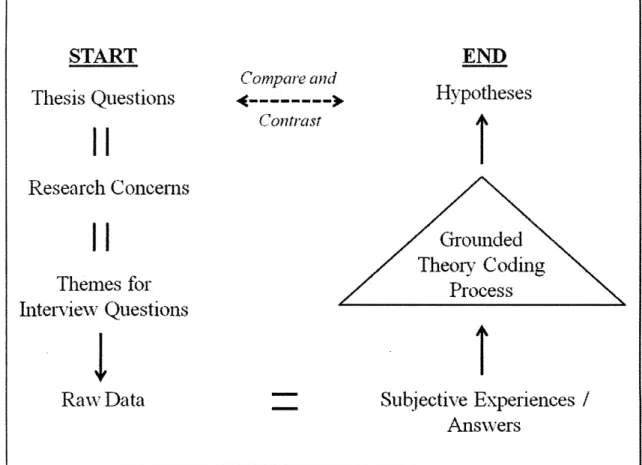
The reliability of the grounded theory coding process, as used in this study, is supported by the evaluation of the raw data for repeating ideas in Step 1 of the process. The process' validity check is in the comparison between the research concerns and the resulting hypotheses (see Figure 1). The thesis questions are the research concerns. These research concerns become the themes of the interview questions. The interview process presents inefficiencies in the interpretation of the ques-tions asked and the interpretation of the answers given. Therefore the yielding raw data should not be predictive. Next, this raw data are subjective answers that then become coded using the five steps previously explained. After the subjective answers are coded, the resulting hypotheses are conditionally related to the study's research concerns. This is done in the sixth step of the coding process. The linkage between the research concerns and the hypotheses is the validity test of the analysis process.
START
Thesis Questions
I I
Research Concerns
II
Themes for
Interview Questions
Raw Data
Compare and
Contrast
END
Hypotheses
I
Grounded
Theory Coding
P rocess
Subjective Experiences /
Answers
CHAPTER 4: RESULTS AND ANALYSIS
This chapter presents the raw competency, pre-interview, and interview data. The results of the grounded theory coding process of the interview data, which are hypotheses, are also presented at the end of the chapter.
Competency Data
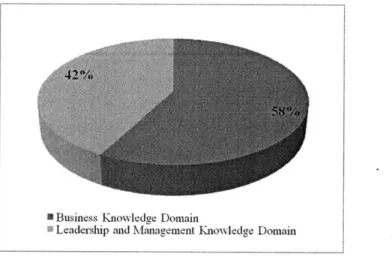
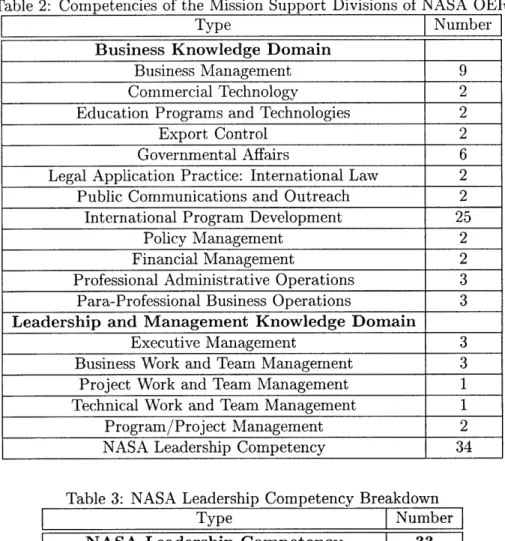
The competency data from NASA Headquarter's Office of Human Capital Management (OHCM) provided an overall synopsis of the competency composition of NASA OER (everyone included from the administrative assistants to the international program specialists). Of the CMS compe-tency domains, there are two domains in which the competencies of OER fall. These domains are the Business Knowledge and Leadership and Management Knowledge Domains. Figure 2 shows that 42% of the competencies are Leadership and Management Knowledge related and the remain-ing 58% are Business Knowledge related. The specific competencies and the number of people in
OER possessing them are shown in Table 2. The last competency in Table 2, the NASA Leadership Competency, is further broken down into four subgroups, as seen in Table 3.
N Business Knowledge Domain
O Leadership and Management Knowledge Domain
Figure 2: Overall Competency Composition of the Mission Support Divisions of NASA OER
Table 2: Competencies of the Mission Support Divisions of NASA OER
Type Number
Business Knowledge Domain
Business Management 9
Commercial Technology 2
Education Programs and Technologies 2
Export Control 2
Governmental Affairs 6
Legal Application Practice: International Law 2 Public Communications and Outreach 2 International Program Development 25
Policy Management 2
Financial Management 2
Professional Administrative Operations 3 Para-Professional Business Operations 3 Leadership and Management Knowledge Domain
Executive Management 3
Business Work and Team Management 3 Project Work and Team Management 1 Technical Work and Team Management 1
Program/Project Management 2
NASA Leadership Competency 34
Table 3: NASA Leadership Competency Breakdown
Type Number
NASA Leadership Competency 33
Employee and Team Leadership 7
Knowledge and Communication Management 3 Work Performance Leadership 4
International Relations 19
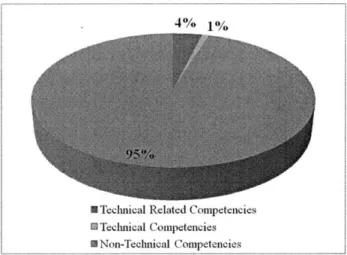
roughly be grouped as technical aiding). In other words, only 1% of these competencies are tech-nical and only 4% are techtech-nically related (see Figure 3). In this thesis, to qualify as a techtech-nical competency, practical knowledge of a mechanical and scientific subject must be required. To qual-ify as a technical related competency, only a theoretical technical knowledge is required. The only technical competency is the Technical Work and Team Management competency. This competency is described as knowledge, capabilities, and practices associated with individuals that must under-stand and manage both the aspects of technical work, as well as management of employees and/or teams. This competency requires the supervisor or lead to have the following competencies: Tech-nical Management, Employee & Team Leadership, Work Performance Leadership. The TechTech-nical Management competency includes the knowledge to manage technical activities during the life cy-cle of projects that include: technical planning, requirements, management, interface management,
technical risk management, configuration management, technical data management, technical as-sessment, and decision analysis [16]. The technical management process is one of the technical sub-processes within the systems engineering approach as used by NASA [?].
4% 1%
0 Technical Related Competencies * Tecimcal Competencies * Non-Techmical Competencies
Figure 3: Technical Competency Composition of the Mission Support Divisions of NASA OER
The two technical related competencies are Commercial Technology and the Education Programs and Technologies. The Commercial Technology competency is the knowledge and ability associ-ated with transferring current and future NASA technology to external entities in order to meet broad NASA vision and missions, and extend the life-cycle and broaden the usefulness of NASA technologies. This competency also involves expertise in business practices pertaining to intellec-tual property, patents, licenses and partnerships as well as general business knowledge for assessing potential partners. A broad understanding of NASA's technologies and programs, as well as famil-iarity with external entities and markets, are also needed [16].
The Education Programs and Technologies competency encompasses the knowledge, capabilities and practices associated with the research and application of education programs, standards, require-ments, activities and services relevant to the fields and disciplines of science, technology, engineering, and mathematics (STEM) within the contexts of pre-college, higher education, and non-traditional learning. A knowledge of education concepts and principles, curriculum development, infrastruc-ture, audiences, instructional technologies and distance learning tools, and trends in order for NASA to appropriately influence and contribute to national and state education initiatives and require-ments through the use of NASA's unique assets, is needed. Furthermore, a knowledge of NASA Enterprise and Center-based research and technology needs, and ability to align education activities
and programs with these needs, is also needed. Lastly, a knowledge of demographic and geographic dynamics that influence the educational effectiveness and success within the various student and educator communities, is also needed.
Pre-Interview Questionnaires
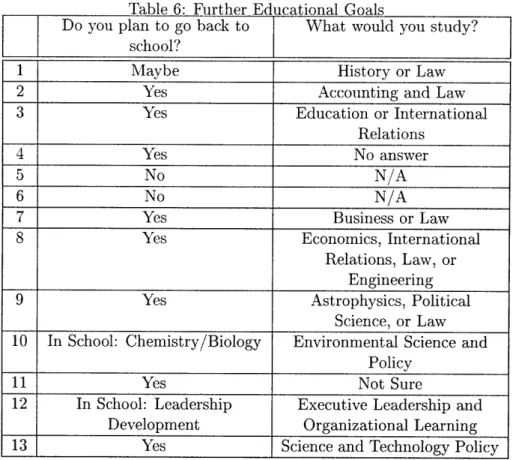
The educational backgrounds of the interview participants are shown in Table 4. Each degree ob-tained is counted separately; for example, if someone has both a bachelors and masters in business, it is counted twice. Additionally, if the degree fits into more than one category, such as international business, it is counted twice (international studies and business). Table 5 shows the region of the U.S. where the degrees were obtained. Once again, each degree is counted separately. Table 6 shows the interest in returning to school and desired fields of study. See Appendix C for full data listing.
Table 4: International Program Specialists: Educational Backgrounds
Degree Field Number
International Studies 11
Economics 2
Business 6
Public Policy Management and Administration 3
Foreign Language 4
Political Science 5
Sociology and Social Policy 3
History 3
Communications 1
Table 5: Region of U.S. Degree Was Obtained U.S. Region Number of Degrees
Northeast 5
Midwest 6
South 8
West 8
Outside of U.S. 1
The NASA career summary of the interview participants can be seen in Table 7. Each inter-viewee has been sorted by their career level. An interinter-viewee serving between one and ten years total at NASA is considered to be in the entry level career category. An interviewee having served 11 to 20 years total at NASA is considered to be in the mid-level career category. An interviewee having served 21 years or more total at NASA is considered to be in the senior level career category. The time spent as an international program specialist (IPS) includes time served as an officer represen-tative at a partner foreign space agency.
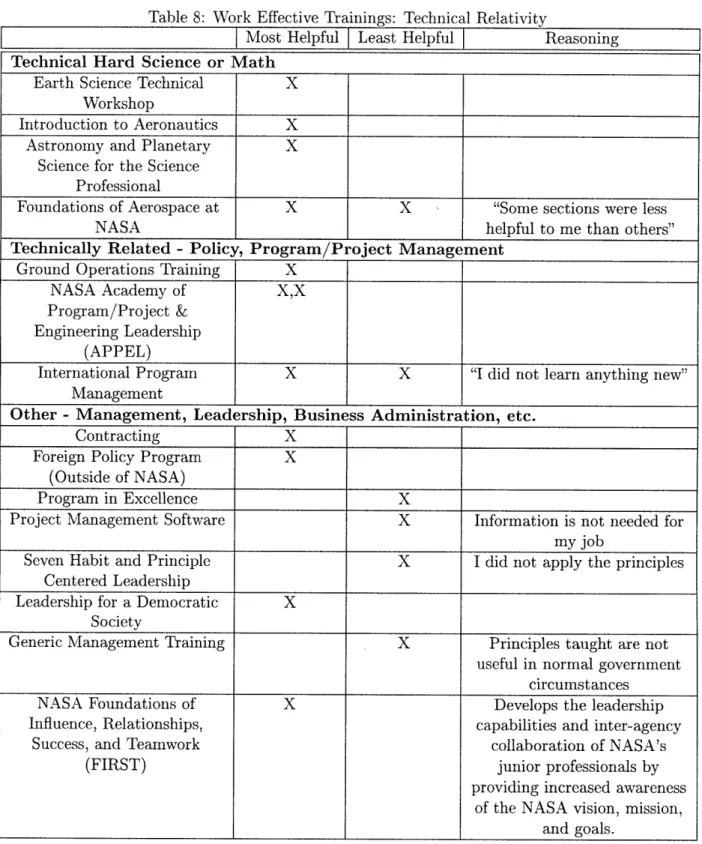
The last few questions of the pre-interview questionnaire requested information regarding the train-ing courses taken by the interviewees. The interviewee's opinion about the effectiveness of traintrain-ing
![Table 1: Members of the Congressional Science Committees: Senate's Committee on Commerce, Science, and Transportation and the House of Representatives Committee on Science and Technol-ogy [6, 7].](https://thumb-eu.123doks.com/thumbv2/123doknet/14203712.480487/17.918.214.709.481.721/members-congressional-committees-committee-commerce-transportation-representatives-committee.webp)