READ THESE TERMS AND CONDITIONS CAREFULLY BEFORE USING THIS WEBSITE. https://nrc-publications.canada.ca/eng/copyright
Vous avez des questions? Nous pouvons vous aider. Pour communiquer directement avec un auteur, consultez la première page de la revue dans laquelle son article a été publié afin de trouver ses coordonnées. Si vous n’arrivez pas à les repérer, communiquez avec nous à [email protected].
Questions? Contact the NRC Publications Archive team at
[email protected]. If you wish to email the authors directly, please see the first page of the publication for their contact information.
NRC Publications Archive
Archives des publications du CNRC
This publication could be one of several versions: author’s original, accepted manuscript or the publisher’s version. / La version de cette publication peut être l’une des suivantes : la version prépublication de l’auteur, la version acceptée du manuscrit ou la version de l’éditeur.
Access and use of this website and the material on it are subject to the Terms and Conditions set forth at
Water vapor transmission and moisture accumulation in cellular
plastics
Schwartz, N. V.
https://publications-cnrc.canada.ca/fra/droits
L’accès à ce site Web et l’utilisation de son contenu sont assujettis aux conditions présentées dans le site LISEZ CES CONDITIONS ATTENTIVEMENT AVANT D’UTILISER CE SITE WEB.
NRC Publications Record / Notice d'Archives des publications de CNRC:
https://nrc-publications.canada.ca/eng/view/object/?id=cecc7c84-ebfb-4721-9bf5-9600fee0e19d https://publications-cnrc.canada.ca/fra/voir/objet/?id=cecc7c84-ebfb-4721-9bf5-9600fee0e19d
Ser
TI31N21d
National Research
Consell national
no.
1573
)+I
c. 2
ouncil Canada
de recherches Canada
BLDG
Institute for
lnstitut de
Research in
recherche en
Construction
construction
Water
Vapor
Transmission and Moisture
Accumulation in Cellular Plastics
by N.V. Schwartz
Reprinted from
"Polyurethanes
88"
Proceedings of the SPI 31st Annual Technical1
Marketing Conference
Philadelphia, PA, October 18-21, 1988
p. 316-318
(IRC Paper No. 1573)
NRCC 29771
B I B L ~ O T H ~ Q U E
On a mesure I'accumulation d'humidite dans un certain nombre d'isolants de polyu6thane pmjete, de polysty?i?ne exmtdt et de mousse phSnoIir1ue .wus un gndierit de temptnlure.
On a aussi d&tennint la dtpendance de In permeance A In vapeur d'eau du polystyrkne
extrudt et dt la mousse phPnolique j. i'fgard de In tempdrattrre. Les mesures
d'accumulation d'humidite dans Ie polyu&hanc projet6 se t~ouvant dnns un mur A osszttrure
de bois d'un bitiment d'essni exposk & un hiver. i Ottawa, n'ont pas rev616 d'accumulation
importante d'hurniditt dnns la mousse I q u e le revetement situi du c6t6 froid de I'isolant
Water Vapor Transmission and Moisture Accumulation
in Cellular Plastics
N. V. SCHWARTZ
National Research Council of Canada Institute fir Research in Construction Montreal Road, Building M-24 Ottawa, Ontario, CANADA KIA OR6
ABSTRACT
The moisture accumulation in a number of sprayed-in- place polyurethane (PUR), extruded polystyrene (XEPS), and phenolic foam insulations under a temperature gradi- ent has been measured. The temperature dependence of the water vapor permeance of the XEPSs and the pheno- lics has also been determined. Field measurements on the accumulation of moisture in sprayed-in-place PUR in a wood frame wall of a test building exposed to an Ottawa winter has shown no significant moisture accumulated in the foam when the sheathing on the cold side of the insula- tion was permeable to the transmitted moisture.
INTRODUCTION
T
he temperature dependence of water vapor permeanceand moisture accumulation of ~olvurethane and
.
"polyisocyanurate foams under the condition of a tempera-
ture gradient were recently reported by the author 111.
This work has now been extended to an examination of the moisture accumulation in a number of sprayed-in-place polyurethanes (PUR), extruded polystyrenes (XEPS), and two closed cell phenolic insulations, and to the tempera- ture dependence of water vapor permeance of XEPS and phenolics. Field measurements on the accumulation of moisture in sprayed-in-place PUR in a wood frame wall ex- posed to an Ottawa winter have also been carried out. The paper summarizes the results of both studies.
EXPERIMENTAL Materials
Five XEPS, six PUR and two closed cell phenolics were
used in this study. The XEPS samples were 25 mm boards
and measurements were carried out on these materials
with their skins intact. XEPS 1, 2 and 3 came from one
manufacturer and had densities of 30.3, 32.3 and 45.6
kg/m3 respectively, while XEPS 4 and 5 came from a sec-
ond manufacturer and had densities of 30.1 and 25.2 kghn'
respectively.
The PUR samples were sprayed-in-place foams supplied
by a single supplier as buns approximately 600 mm square
by 100 to 150 mm thick. The densities of the PUR were all
nominally 32 kg/m3. One of the components in the
PUR
formulation was varied in a systematic fashion. The speci- mens used were cut from the core of the buns.
The phenolics came from two different manufacturers,
and each had a density of 40 kg/m3. The facings on each
were removed before testing.
Temperature Dependence of Water Vapor Permeance Water vapor permeance measurements were made using
the modified cup method described previously 111. An open
ended cylinder in which the specimen (144 mm diameter
x
25 mm thick) was sealed in place with RTV silicone wasclamped between containers of water and calcium chloride
respectively (Figure 1). The desiccant was separated from
the specimen by a highly permeable layer of spunbonded polyolefin. The assembly was maintained at constant tem- perature and separated periodically in order to weigh the desiccant. The procedure was repeated for a number of con- stant temperatures.
Temperature Gradient Measurements
The specimens, 300 mm
x
25 mm thick were sealed atthe edges into polymethyl methacrylate ( P M M A ) frames
with
RTV
silicone. The specimen container was sand-wiched between a cold plate a t 5°C and a pool of water
maintained a t 50°C by a hot plate (Figure 2). An air gap of
40 mm separated the surface of the water from the bottom
surface of the specimens, and a gap of 2-3 mm separated
the top surface of the specimens from the cold plate. The specimen containers were periodically removed from the assembly and weighed to determine the amount of mois- ture picked up by the specimens
REPRINTED FROM POLYURETHANES 88
Figure 1. Schematic of the modified cup.
Field Test on Moisture Performance of Sprayed-in-Place PUR
A field test on the moisture performance of a typical 32 kg/m3 sprayed-in-place PUR was also carried out. Four stud spaces 2.1 m x .37 m with 13 mm waferboard sheath- ing were filled with 75 mrn of the PUR in a test building. The exterior of the sheathing was covered with 6 mm ply- wood panels that acted as weather screens. These were hinged a t the top to allow easy access to the sheathing for observation. The interior of the wall was covered with 13 mm gypsum board with two coats of latex paint. A 75 mm diameter hole to simulate air leaks in the gypsum board due to such things as electrical boxes was cut in the gyp- sum board on the center line between the studs at 150 mm from the floor on stud space 2. Similarly a 75 mm hole was cut 150 mm from the ceiling in the gypsum board covering stud space 3 and two holes, one 150 mm from the floor and one 150 mm from the ceiling were cut in the gypsum board covering stud space 4. Each of the holes was covered with coarse copper wool. The gypsum board covering stud space
1 was left intact. The interior of the test building was maintained a t 20°C and 40% RH from the end of October to the beginning of the following May. The plywood weather screen was raised periodically and the exterior of the waferboard examined for condensation. At the end of the observation period pieces of the insulation along with the attached sheathing were cut from the top and bottom of each stud space and the insulation was examined for moisture both gravimetrically and by scanning in a gamma spectrometer [21.
RESULTS AND DISCUSSION
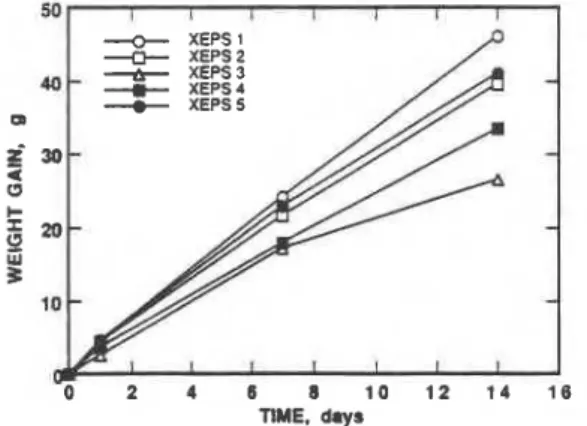
There were distinct differences observed among the three types of cellular plastics in the rate at which they ac- cumulated moisture under a temperature gradient (Figure 3). The phenolics accumulated moisture most rapidly, while the XEPS displayed the lowest rate of moisture accu- mulation. Within the XEPS the rate of moisture accu- mulation had a n inverse dependence on the density within materials from the same source, e.g., XEPS 1, 2 and 3 in Figure 4, but material of the same density from different sources had different rates of moisture accumulation, e.g.,
1 and 4. The sensitivity of the PUR's to moisture accu- mulation varied from sample to sample and was probably dependent on their composition (Figure 5).
The temperature dependence of the water vapor per- meance of two of the XEPS and the two phenolics were de- termined and compared to those found for the PUR and
U
Figure 2. Schematic of the temperature gradient method.
TIME, days
Figure 3. Moisture accumulation of cellular plastics under a tempera-
ture gradient of 5OC on the cold side and 50°C on the warm side.
I l I t 1 I l
*
XEPS 10 2 4 6 8 1 0 1 2 1 4 1 6
TIME. days
Figure 4. Moisture accumulation in XEPS's under a temperature gra-
dient of 5OC on the cold side and 50°C on the warm side.
'0 2 4 6 8 10 1 2 1 4 1 6
TIME, d y a
Figure 5. Moisture accumulation in PUR's under a temperature gradi-
-
XEPS t*
XEPSZ + PqENOW; r-
PHENOLIC2'4
0 5 1 0 1 5 20 2 5 3 0 35 4 0 4 5 5 0 55 TEMPERATURE, "CFigure 6. Temperature dependence of the water vapor perrneance of
cellular plastics.
1
PIR reported earlier [I]. The results are shown in Figure 6.The materials with the higher rates of moisture accumula- tion also had the higher permeance values. It is also in-
I
teresting to note that the water vapor permeance of theI XEPS does not change much with temperature unlike the
I two isocyanate-based materials, and the phenolics. The
I
rapid rate of moisture accumulation of the phenolics isI reflected in their relatively high water vapor permeances.
In the field test of the sprayed-in-place PUR it was observed that frost build-up occurred on the outside of the waferboard sheathing under the plywood weather screen. This frost was likely the result of moisture moving through the PUR, and occurred in roughly oval shaped patches at the top of the four stud spaces This condensa- tion was most pronounced on the exterior of stud spaces 2, 3 and 4, i.e., the stud spaces with the holes in the gypsum board. When samples of the foam and sheathing were removed it was found that the waferboard from the top of stud space 4 showed some delamination but the others were unaffected. No significant moisture was found in any of the foam samples, however.
The absence of moisture accumulation in the PUR in the field while PUR exposed to temperature gradients in the laboratory accumulate considerable moisture can be ex- plained, at least partially, by referring to Figure 6. In the laboratory experiments the temperature gradient was from 50°C on the warm side to 5°C on the cold side. This range includes the temperature region in which the water vapor permeance of the PUR rises rapidly with tempera- ture. Moisture entering the foam from the warm side can move through the first few layers relatively rapidly but as
lower temperatures are encountered the permeance de- creases and the moisture does not move out a s rapidly and
hence accumulates. In the case
of
the PUR in the field thetemperature gradient ranged from 20°C on the mom side to as low as -25°C on the weather side. In this tempera- ture range the water vapor permeance of the PUR is fairly constant a t the low value and the potential for moisture accumulation is low.
CONCLUDING REMARKS
In contrast to the water vapor prmeance of PUR and PIR, the water vapor permeance of the XEPS changes lit- tle with temperature up to 45°C. The rate of moisture ac- cumulation of the various cellular plastics studied is higher for materials with higher permeance values. Under service conditions, sprayed-in-place PUR insulation in a wood stud wall did not accumulate ariy moisture over a winter heating season when the sheathing on the cold side of the insulation was fairly permeable, allowing transmit- ted moisture to escape.
REFERENCES
1. Schwartz, N. V., M. Bomberg and M. K. Kumaran.
'Water Vapor Transmission and Moisture Accumula- tion in Polyurethane and Fblyisocyanurate Foams:' ASTM Symposium on Water Vapor, Bal Harbour, Florida (December 1987).
2. Kumaran, M. K. and M. Bomberg. "A Gamma-
Spectrometer for Determination of Density Distribu- tion and Moisture Distribution in Building Materials:'
Proceedings of the International Symposium on Mois-
ture and Humidity, p p 485-490 (1985).
BIOGRAPHY Norman V. Schwartz
Norman Schwartz received his B.A. and Ph.D. in chemis- try from the University of 'Ibronto. In 1960- 1961 he was European Research Associates Fellow a t Oxford Univer- sity. Between 1962 and 1985 he was a Research Chemist then Senior Scientist a t Dunlop Research Centre in Mis- sissauga, Ontario. He became the SPI Fellow a t the Insti- tute for Research in Construction, National Research
Council of Canada a t Ottawa in April 1986.
T h i s p a p e r