HAL Id: tel-01483480
https://tel.archives-ouvertes.fr/tel-01483480
Submitted on 6 Mar 2017HAL is a multi-disciplinary open access archive for the deposit and dissemination of sci-entific research documents, whether they are pub-lished or not. The documents may come from teaching and research institutions in France or abroad, or from public or private research centers.
L’archive ouverte pluridisciplinaire HAL, est destinée au dépôt et à la diffusion de documents scientifiques de niveau recherche, publiés ou non, émanant des établissements d’enseignement et de recherche français ou étrangers, des laboratoires publics ou privés.
When Your Culture Advocates You : the Effect of
Cultural Work Values on Performance
Shiva Taghavi
To cite this version:
Shiva Taghavi. When Your Culture Advocates You : the Effect of Cultural Work Values on Perfor-mance. Business administration. HEC, 2015. English. �NNT : 2015EHEC0004�. �tel-01483480�
i
ECOLE DES HAUTES ETUDES COMMERCIALES DE PARIS
Ecole Doctorale « Sciences du Management/GODI » -‐ ED 533
Gestion Organisation Décision Information
« When Your Culture Advocates You: The Effect of Cultural Work
Values on Performance »
THESE
présentée et soutenue publiquement le 5 mars 2015 en vue de l’obtention du
DOCTORAT EN SCIENCES DE GESTION
Par
Shiva TAGHAVI
JURY
Président du Jury: Monsieur Simon DOLAN
Professor
ESADE Business School Barcelone – Espagne
Co-‐Directeurs de Recherche : Monsieur Michael SEGALLA Professeur
HEC Paris – France
Monsieur José ALLOUCHE Professeur des Universités
Institut d’Administration des Entreprises, Université Paris 1 Panthéon Sorbonne – France
Rapporteurs : Monsieur Simon DOLAN
Professor
ESADE Business School Barcelone – Espagne
Monsieur Lee ROSS Professor
Stanford University Californie – USA
ii
Ecole des Hautes Etudes Commerciales
Le Groupe HEC Paris n’entend donner aucune approbation ni improbation aux opinions émises dans les thèses ; ces opinions doivent être considérées
comme propres à leurs auteurs.
iii
Résumé Général en Français
“La France est une République indivisible, laïque, démocratique et sociale. Elle assure l'égalité devant la loi de tous les citoyens sans distinction d'origine, de race ou de religion. Elle respecte toutes les croyances.”1
Comment la version français de le sécularisme, Laïcité, interagir avec les identités religieuses? Est-ce que Laïcité est en conflit avec les croyances religieuses? Comment la culture française réussie à créer un équilibre entre les valeurs de la République, parmi eux la laïcité est le plus important, et les valeurs religieuses? Est-ce que cet équilibre existe? Comment les individus en France perçoivent la société, ses valeurs, sa structure, et comment interagissent-ils avec ces éléments dans l'environnement de travail?
Ce sont les questions que à l'origine j'avais dans la tête, tout en commençant la thèse. À évidence, trouver les réponses à ces questions nécessite beaucoup plus de ressources et de connaissances interdisciplinaires. Dans cette thèse j'essaie d'explorer certains aspects dans les quels les croyances, les identités et les perceptions des individus contribuent à leur comportement, en particulier dans le contexte des valeurs culturelles françaises. Principalement, des valeurs telles que la laïcité et de l'égalitarisme sont les grands intérêts dans la recherche actuelle. Cette thèse vise à explorer la mesure dans laquelle ces valeurs influencent les perceptions
iv
des gens et leurs croyances implicites, et par conséquent les effets de ces croyances sur leurs attitudes au travail et de la motivation.
Tout d'abord, l'importance de la Laïcité dans la culture française et les perceptions de la méritocratie et de la mobilité en France sont discutées. Et enfin, le contour de chaque essai serait décrit.
SECULARISME EN FRANCE
Nous devons rechercher les origines de la laïcité française à la Révolution française et son conflit avec la tradition catholique. Dans ce conflit, la révolution , d'abord, a essayé de contrôler le catholicisme (1790), puis de se transformer en une religion (les cultes révolutionnaires de 1793, accompagnés par la persécution politico-religieuse), avant d'établir une courte durée de séparation l'Église et l'État (1795 ). Cependant, coexister avec la ferveur révolutionnaire quasi-religieux, n'a pas résolu le conflit (Baubérot, 2000a, 2000b).
Napoléon a essayé de stabiliser les principes de la laïcité en excluant dispositions religieuses du Code civil français. Par exemple, l'enregistrement des naissances, des mariages et des décès a été sécularisé et l'Eglise catholique a dû accepter un régime d'égalité avec le protestantisme et Judaïsme- les «autres religions officielles". Toutefois, la société française ne pouvait pas maintenir sa pluralité religieuse, plutôt a tourné à être plus dichotomique à la suite d'un conflit entre deux groupes: le «camp clérical» qui soutenaient la France de redevenir "la fille aînée de l'Eglise», et le «camp anticlérical" qui a considéré que la France soit la «fille de la révolution" sur la base des «valeurs de 1789" (Baubérot, 2000a). En d'autres termes, la France comme une nation catholique oppose la France comme une nation moderne qui n'a pas s'identifier en termes d'engagement religieux.
v
Alors que la transition vers une séparation complète de l'Église et de l'État est passé, pacifiquement et lentement, à travers la liberté de conscience et la liberté de l'éducation, il est resté loin de l'idéal. Bien que le catholicisme est pas considéré comme la religion officielle de la France, les traditions catholiques laissés par le rôle public de la religion sont toujours traçables dans le calendrier officiel. Dans la troisième république, "le lundi de Pâques" et "Lundi de Pentecôte " ont été ajoutés à la précédente jours fériés religieuses- Noël , Toussaint, l'Ascension et l'Assomption. "La France, donc, n'a pas se couper de ses racines religieuses, mais les jours sacrés des autres religions- comme le judaïsme, l'islam ou bouddhisme- ne sont reconnus que dans l'octroi d'un congé individuel pour les fonctionnaires et les écoliers" (Baubérot, 2000b, p. 4).
À cet effet, la laïcité en France ne peut pas être réduit à un système juridique et politique, "il est aussi une culture, une philosophie, une émancipation de tous « cléricalisme », entendu comme le contrôle de l'esprit par un discours établi qui rejette tout débat" (Baubérot, 2000b , p. 6). Cette philosophie a été loué, admiré et même aimé par les dirigeants français et par la société (Gunn, 2004). Par exemple, dans un discours sur la prévention des écoliers de porter des vêtements religieux, le président Jacques Chirac a déclaré: « La laïcité est inscrite dans nos traditions. Il est au cœur de notre identité républicaine [...] Ces valeurs fondent la singularité de notre Nation. Ces valeurs portent notre voix haut et loin dans le monde.
Ce sont les valeurs qui font France [...] La laïcité garantit la liberté de conscience. Elle protège la liberté de croire ou de ne pas croire. Elle assure à chacun la possibilité d'exprimer et de pratiquer sa foi, paisiblement, librement, sans la menace de se voir imposer d'autres convictions ou d'autres croyances ».
vi
de s'identification (Gunn, 2004, p. 429) et il ne doit pas être confondue avec la «liberté des religions". Bien que la liberté de conscience est le principe de la laïcité, il a souvent été critiqué pour ne fournie pas un environnement convivial pour l'établissement et la pratique de la liberté des religions, ni la «culture de la religiosité» (Norris et Inglehart, 2011). Par exemple, la France et les Etats-Unis sont très similaires dans leur attitude envers les droits de l'homme et de sa supposition courante- l'homme a des droites héritées. Ainsi, en ce qui concerne les croyances absolues et les dossiers des droits de l'homme, les Américains et les Français sont fiers qu'ils sont des modèles pour le reste du monde. De même, les deux nations croient en la laïcité, mais dans les façons différentes -laïcité pour les français et « liberté de religion » pour les Américains.
Bien que ces concepts semblent partager les mêmes valeurs, il y a une différence fondamentale culturelle entre les façons conçoive à la française et les Américains conçoivent ces valeurs. Par exemple, les votes législatifs écrasants sur les vêtements religieux en France et le Serment d'allégeance aux États-Unis, initialement suggèrent une différence frappante entre les deux pays. En 2004, l'Assemblée nationale et du Sénat français ont voté de façon disproportionnée pour l'adoption d'une nouvelle loi interdisant les enfants dans les écoles publiques de porter des vêtements et insignes que « manifester ostensiblement une appartenance religieuse. » 2
Deux ans plus tôt, La Chambre des Représentants et le Sénat des États-Unis ont voté, fortement, à réaffirmer la langue de Serment d'Allégeance au drapeau des États-Unis en gardant les mots «sous l'autorité de Dieu» (Gunn, 2004). Ainsi, en France, les écoliers sont interdits de se livrer à l'expression religieuse dans leur choix de vêtements, tandis qu'aux Etats-Unis, le Congrès a insisté pour que le langage religieux
vii
reste dans le Serment, qui vise à être récité dans les écoles publiques à travers le pays.
La culture française pourrait être considérée laïque à la fois dans les aspects politiques et sociétaux. Bien que la culture française est très influencée par les traditions catholiques, les fête catholique, -les fêtes du prénoms basé sur le calendrier, etc.- la pratique de la religion dans la société est principalement limité à l'espace privé et la publicité de toute les traditions religieuses dans les organismes publics, y compris les écoles, sont interdits par la loi et non toléré par les normes sociales.
En termes de déclaration de croire en Dieu, pratiques, et l'engagement religieuse personnelle, la France est classée beaucoup plus proche des pays laïques d'Europe du Nord (soit la Grande-Bretagne, le Danemark et Pays-Bas) que de ceux du Sud (Willaime, 1998). En ce sens, la France semble être l'un des pays les plus laïques en Europe. En d'autres termes, la laïcité, est devenu une religion civile dans ce pays (Chelini-Pont, 2009). Pendant ce temps, l'islam est la deuxième religion en France (Willaime, 1998) et environ huit à dix pour cent de la population est constituée d'origine musulmane d'Afrique du Nord et sub-saharienne et de Moyen-Orient (United States Department of State, 2012), pour lesquels le les valeurs religieuses ont été profondément intériorisé par les coutumes et les traditions de la famille, les médias et les études religieuses dans les écoles ou les collèges.
À cet égard, la France fournit un contexte ambigu pour l'étude de l'identité religieuse. Dans le premier essai de cette thèse, je tente de saisir l'impact des croyances religieuses sur les attitudes et le comportement de travail dans un cadre comparatif culturel - la culture de la religiosité contre la laïcité.
viii STRUCTURE SOCIALE EN FRANCE
Basé sur la théorie de la classe de Bourdieu (1977; 1990) - l'une des théories les plus influents sur la mobilité sociale en France - Goux et Maurin (1997) ont analysé l'Enquête nationale française sur l'éducation et la qualification et ont découvert une interaction à trois entre l'origine sociale, éducation, et la destination sociale en France. En d'autres termes, leurs résultats montrent que les personnes ayant une éducation identique commencent avec plus ou moins le même niveau social, mais leurs cheminements de carrières pourraient être très différents selon qu'ils proviennent de les couches supérieures ou les couches inférieures de la société. De plus, «la manière dont les membres d'une cohorte de naissance spécifique atteignent leur destination- d'abord à l'école, puis dans la société- a peu évolué pendent du XXe siècle» (Goux et Maurin, 1997, p. 173). Ainsi, la France ne correspond ni à l'hypothèse du modèle inégalitaire méritocratique, ni l'hypothèse d'un modèle non-méritocratique. Le développement du système éducatif français n'a pas été accompagnée par une augmentation de la malléabilité de la structure sociale.
La méritocratie est un système social "dans lequel les individus aller de l'avant et de gagner des récompenses en proportion directe de leurs efforts et de capacités individuelles" (McNamee & Miller, 2009, p. 2). Le cœur de cette idéologie est de croire que le système social fournit toutes les chances de la réussite, étant donné le travail acharné. Ainsi, la méritocratie guide les gens à croire que la mobilité asc en montant est réalisable se ils investissent suffisamment d'efforts et travaillent dur, qui peut être conceptualisée comme éthique de travail. On définit la mobilité sociale comme un mouvement vers le haut ou vers le bas au long de l'échelle sociale. Dans les différentes sociétés, les personnes qui appartiennent à une strate
socio- ix
économique spécifique ont l'opportunité d'améliorer leur situation socio-économique et passer à une classe sociale supérieure. Ces opportunités varient en qualité et en quantité, en fonction des caractéristiques culturelles, politiques et socio-économiques de la société (Andrews et Leigh, 2009; Causa et Johansson, 2010).
Des recherches enceins ont révélé que dans les pays comme la France, la Norvège, la Suède, l'Israël et l'Irlande, les gens perçoivent le gouvernement à être plus responsable de la fourniture des besoins par rapport à des pays comme les Etats-Unis et l'Australie; et cette perception est médiée par des conceptions de causalité externes, à savoir, les causes structurelles et fatalistes (Shirazi & Biel, 2005). Remarquablement, comparé à la moyenne, la relation entre l'attribution de causalité externe des causes de la pauvreté et de la responsabilité du gouvernement est beaucoup plus forte pour les Américains. Cette perception signifie que «l'importance attachée à possibilités offertes par la société a déterminé support attendu du gouvernement plus que les attributions internes de la pauvreté" (Shirazi & Biel, 2005). On peut se attendre que les gens attribuent une importance particulière aux facteurs structurels dans la société, par exemple, la réussite et l'échec.
Dans cette thèse, je explore la façon dont les gens perçoivent la réalité de la structure sociale en tant que malléable contre fixé et son impact sur leurs attitudes envers la méritocratie.
Est-ce que les gens travaillaient plus fort si elles croient que la structure sociale est malléable? En substance, le plus les gens croient qu'ils ont la possibilité de briser la structure sociale, le plus ils cherchent mérite grâce au travail acharné comme un moyen pour l'accomplissement. Les gens augmenteraient leur effort si elles croient que le déplacement vers le haut dans la hiérarchie sociale est probable parce qu'ils se rendent compte que le travail est la clé qui ouvre les portes et les déplace vers le
x
haut. Cependant, lorsque les individus estiment que la structure sociale est rigide, ils ont tendance à l'auto-handicap et retiennent leur effort. Croyant qu'ils ne seraient jamais en mesure d'améliorer leur situation socio-économique, ils retirent leur effort.
GRANDES LIGNES DE LA THÈSE Essai 1
Cette recherche tente de se lancer dans une nouvelle perspective sur la notion d'éthique de travail: l'impact positif des croyances religieuses qui ne tient que dans les cultures qui adhèrent aux valeurs de la foi. Prenant la culture nord-africaine comme l'un des contextes les plus idéologiques et orienté vers la religion, et la culture française comme l'un des plus laïques, j'examine cette hypothèse de découvrir si dans les cultures religieuses telles que la culture nord-africaine, ci-après dénommés _ maghrébin, par rapport aux cultures les plus laïques européennes, les croyances religieuses seraient prédiraient l'éthique de travail individuel. Ainsi, je suggère et soutiens que la culture interagit avec des pensées religieuses, de prédire l'attitude et le comportement des individus concernant le travail. Plus précisément, je prends une approche différente de fournir des preuves pour les hypothèses ci-dessus en réalisant des expériences de laboratoire dans lequel je contrôle les variables socio-économiques et d'évaluer le sens de la causalité.
Ainsi, à travers trois études, cette recherche vise à éclairer la relation causale entre les croyances religieuses et l'éthique de travail. En adoptant une approche interculturelle, on compare des individus du Maroc et de la France (étude 1) et franco-maghrébine biculturels (Étude 2) par l'impact des pensées religieuses sur leur éthique de travail. Dans l'étude 3, nous faisons un étape en avant pour explorer l'impact des pensées religieuses et l'identité culturelle sur le comportement de travail,
xi
à savoir les efforts sur l'exécution d'une tâche. Je crois que l'impact de la spiritualité est limité au milieu culturel, que ce soit en étant extrêmement laïque dans le cas des normes sociétales français, ou plutôt religieuse dans le cas de la culture maghrébine. Par conséquent, je prédis que la spiritualité mène à un niveau plus élevé de l'éthique de travail uniquement lorsque la culture intègre et intériorise les valeurs religieuses. Essai 2
Dans cette recherche, je explore la relation entre les causes structurelles (par exemple, l'échec de la société à fournir l'égalité des chances de réussir) et les croyances pro-méritocratie (i.e. répartition de la valeur de l'effort et la réussite est le résultat du travail dur). La mesure dans laquelle la structure sociale est considérée comme favorable à la mobilité conduirait les individus à être plus méritocratique. Plus précisément, j'examine si les individus français qui croient en la malléabilité, pas la rigidité, de la structure sociale répartiraient plus d'importance aux éléments primaires de la méritocratie, à savoir, l'éthique du travail et de l'effort. Je soutiens que, indépendamment des taux réels de la mobilité sociale, les individus perçoivent la structure de la société d'être sur une gamme allant de très rigide à très malléable, et cette perception aura un impact significative sur leurs attitudes envers le travail et le comportement au travail. Notamment, je prédis que ceux qui éprouvent la mobilité et ceux qui ont une opinion plus malléable de la société endossent les attitudes méritocratiques plus fortes et par conséquent attachent plus d'importance et de valeur pour le travail acharné et investissent plus d'efforts dans l'exécution d'une tâche. Essai 3
L'objectif de cette recherche était d'étudier les conséquences de l'activation des valeurs implicites liés au travail concernant l'attitude et le comportement de travail
xii
des individus. De plus, ce travail examine les conséquences cognitives de l'activation de croyances religieuses. Il démontre que les pensées religieuses sont capables de déclencher des niveaux plus élevés de construal qui peuvent conduire les individus à traiter l'information et prendre des décisions d'une manière plus abstraite. Selon la théorie du niveau de construal, la mentalité abstraite conduit les individus à se concentrer davantage sur l'objectif de niveau supérieur et de se comporter en plus de manière autoréglementation. Ainsi, il est proposé que le niveau de construal se fait le médiateur entre les valeurs de travail activés et le comportement au travail.
xiii
RÉFÉRENCES
Andrews, D., & Leigh, A. (2009). More inequality, less social mobility. Applied
Economics Letters, 16(15), 1489-1492.
Bauberot, Jean. (2000a). Histoire de la laïcité française. Paris, PUF.
Bauberot, Jean. (2000b). The Secular Principle. Paper presented at the conference paper.
Bourdieu, P. (1977). Cultural reproduction and social reproduction. InJ. Karabel & AH Halsey (Eds.), Power and ideology in education (pp. 487-511): New York: Oxford University Press.
Bourdieu, Pierre, & Passeron, Jean Claude. (1990). Reproduction in education,
society and culture (Vol. 4): Sage.
Causa, O., & Johansson, √Ö. (2010). Intergenerational Social Mobility in OECD Countries. OECD Journal: Economic Studies, 2010(1).
Chelini-Pont, B. (2009). Is Laicite the Civil Religion of France. Geo. Wash. Int'l
L. Rev., 41, 765.
Goux, Dominique, & Maurin, Eric. (1997). Meritocracy and social heredity in France: some aspects and trends. European sociological review, 13(2), 159-177. Gunn, T Jeremy. (2004). Religious freedom and Laïcité: A comparison of the
United States and France. BYU L. Rev., 419.
McNamee, Stephen J, & Miller, Robert K Jr. (2009). The meritocracy myth: Rowman & Littlefield Publishers.
Norris, Pippa, & Inglehart, Ronald. (2011). Sacred and secular: Religion and
xiv
Shirazi, Rez, & Biel, Anders. (2005). Internal-External Causal Attributions and Perceived Government Responsibility for Need Provision A 14-Culture Study.
Journal of Cross-Cultural Psychology, 36(1), 96-116.
United States Department of State, Bureau of Democracy, Human Rights and Labor. (2012). International Religious Freedom Report for 2012.
http://www.state.gov/j/drl/rls/irf/religiousfreedom/index.htm?year=2012&d lid=208314 - wrapper.
Willaime, Jean-Paul. (1998). Religious and secular France between northern and southern Europe. Social compass, 45(1), 155-174.
xv Abstract
When Your Culture Advocates You: The Effect of Cultural Work Values on Performance
Cultural values and their impact on people’s attitudes and behavior have long been a place for debate. Globalization, migration and expatriation have contributed to the conflict caused by the interaction among multiple cultural identities, particularly when it comes to organizations with diverse workforce. Specifically, France is a unique case that provides a historically and culturally rich, yet very ambiguous context for studying this topic. The dominant culture in France emphasizes on egalitarianism and secularism. However, a great part of the population has adopted distinct cultural values with regard to their religious beliefs. Moreover, the perception about ‘equal opportunities’ provided by the society varies considerably across the cultures. The topic is specifically important at workplace, where individuals with diverse and sometimes divergent beliefs take part in collective activities.
The objective of this dissertation is to discover the mechanisms by which cultural attributes predict work ethic and productivity- first, through their interaction with religious beliefs; and second through the implicit theories about the societal structure.
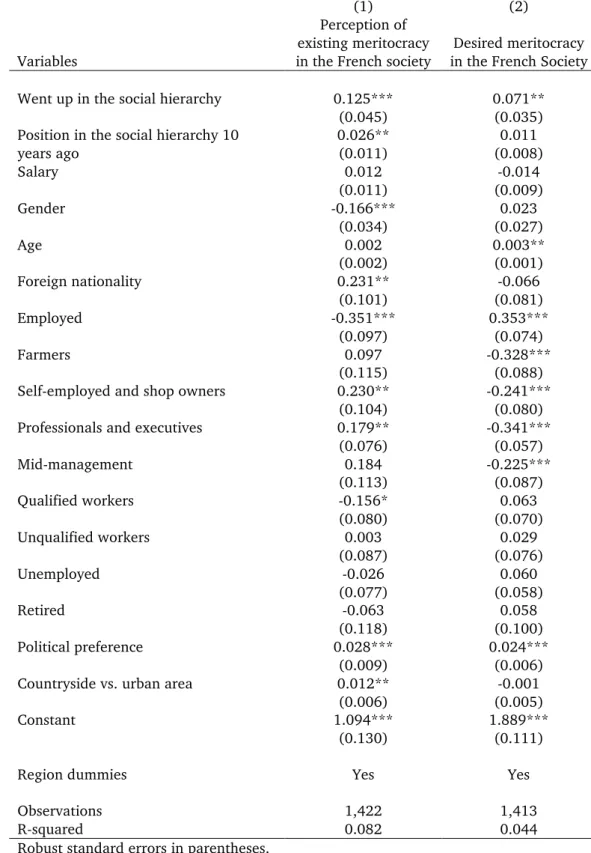
Specifically, chapter 2, The Impact Of Religious Beliefs And Cultural Identity On Work Ethic, attempts to explore the impact of religious beliefs on work ethic, with an emphasis on the moderating effect of culture. In this chapter, three studies provide evidence that thoughts related to religiosity impact individuals’ work ethic. In a comparative setting, Moroccan participants who were primed with religious thoughts exhibited greater work ethic, while French participants endorsed lower degree of work ethic in the religious condition (study 1). For North African-French participants, religious stimuli interacted with cultural identity to predict work ethic (study 2). Moreover, we found a significant effect of the religious thoughts and cultural identity on work behavior, namely the level of effort (study 3). Religious thoughts influenced work ethic and behavior positively when the North African cultural identity, a culture of religiosity, was salient and negatively when the French cultural identity, a laïque culture, was salient. In chapter 3, How do Beliefs about the Malleability of Social Structure Impact Meritocratic Attitudes and Behavior?, I try to explore the link(s) between beliefs about the malleability of social structure and individuals’ attitudes towards meritocracy. When individuals believe that the society in which they live offers them developmental and fair opportunities, are they more likely to adopt meritocratic attitudes and behavior? Individuals who have actually experienced progression in the social hierarchy tend to perceive society as meritocratic and express the desire to be meritocratic (study 1). Those who believed that social structure is flexible, rather than rigid, endorsed a stronger work ethic and valued hard work as the key to success (study 2a) and invested more effort on a given task (study 2b). Study 3 manipulated beliefs about social structure and demonstrated that these beliefs are changeable. Finally, chapter 4, Religious Stimuli at Workplace and Individual Performance: The Role of The Abstract Mindset, is a conceptual paper in which I tried to explore the psychological mechanism that underlies the link between religious thoughts and work attitudes. I propose that religious stimuli activate the abstract mindset, resulting in conceiving concepts related to work in a higher level of construal.
Across three essays, this dissertation addresses a particularly important issue as faced by employers and policy makers, specifically in France. It provides a compelling understanding about a number of antecedents of work ethic and work behavior; namely, the cultural and religious values, perceptions about the malleability of social structure, and mindsets.
xvi
Acknowledgement
Five years ago, when I parted from the people I love to peruse a dream, I never thought it would be the most fruitful journey of my life- a journey of
personal growth. The PhD provided me with tremendous amount of intellectual
resources and academic knowledge, as well as the life-changing challenges; from the long hours of non-stop reading and writing in solitude, to adapting to a new life style in a new culture. Over the course of the PhD I have come to learn how to think and analyze more constructively and contribute- even if it looks insignificant in non-academic scale! - to making the society less unjust. Yet, above and beyond all the experiences the PhD offered me, I praise it most for the amazing people it brought to my life; as friends, as academic mentors and as colleagues. I would have not been able to get through this marathon event without the aid and support of the great number of people over the past years. It is a pleasure to convey my gratitude to them in this acknowledgment.
Frist and above all, I offer my sincerest gratitude to my advisor Michael Segalla who has supported me in numerous ways: by sharing time and insights on theoretical and empirical aspects of my research projects, by providing resources for data collection, conferences and visiting periods; but most importantly, by being the moral support at the time the journey appeared to be extremely challenging. I know, sometimes I may have been a ‘difficult and stubborn’ child! You have been extremely patient with me and moreover, you thought me how I could benefit from being patient and trusting the judgments of my seniors. Thank you for believing in me. Without this immense amount of positive energy, encouragement, inspiration and trust, I would have not been able to successfully reach the end line. I hope I have been able to live up to your expectations!
I would also like to thank my co-advisor professor José Allouche, who has been a great source of brilliant comments; and the committee members, professors Lee Ross and Simone Dolan, whose contribution in stimulating suggestions and encouragement, helped me to progress in my research.
xvii
Specifically, I am deeply indebted to professor Lee Ross for arranging my visit at Stanford University, which was an indispensible episode during my PhD. Thank you for having been available to mentor me and to share time and insight with me, despite your busy schedule.
I thank my institution, HEC Paris, and La Fondation HEC for financially supporting me during the PhD, and I acknowledges the generous support of the research center: Investissements d'Avenir (ANR-11-IDEX-0003/Labex Ecodec/ANR-11-LABX-0047). I would especially thank all the professors and staff members of the PhD office and the Management and Human Resources Department who dedicated a great amount of time and energy to make this journey more enjoyable: Dr. Laoucine Kerbache, Dr. Ulrich Hege, Dr. Francoise Chevallier, Sylvie Rocher, Caroline Meriaux, Mélanie Romil, Cécile Marty, and Françoise Dauvergne.
This dissertation would have not been possible without the support of all the people and organizations that helped me in collecting data. First, I would like to thank professor Yasmina Bennis and Unversity of Casablanca for their hospitality and for providing the participants and logistics for the first round of data collection of essay 1. Second, INSEAD Behavioral Lab had been of great help in conducting my experiments. Specifically, thank you very much Liselotte Pettersson, Dimitri Vasiljevic and Hoai Huong Ngo for being tremendously cooperative and diligent over the course of two rounds of data collection. Third, a special thank to Dr. Thomas Roulet for providing the dataset for the first study of essay 2 and for enormously collaborating in completing and submitting this paper. And finally, I am very thankful to the students in HEC Paris, IAE Université Paris I Sorbonne, University of Casablanca, Institut Catholique de Paris, and all those who took part in the studies.
I am using this opportunity to express my gratitude to all my friends who supported me throughout the course of this PhD. I embarked upon this journey in 2009 together with my fellow PhD batch mates; and ever since, they have always remained the main pillars of encouragement and inspirations: Marco Clemente, Panikos Georgallis, Martin Goossen, Jonathan Hayes, Moumita Das, Thomas Roulet, and Sebastien Stenger. I am also very thankful to all the amazing people I met in HEC and in the Bibliothéque Nationale de France;
xviii
without their love and friendship this dissertation would have not been possible: Navid Bazzazian, Sebastian Becker, Patricia Biron, Claudine Grisard, Asli Kozan, Patrick Lam Le, Daniela Laurel-Fois, Yi Li, Anisa Shyti, Tatiana Sokolova, and Samuel Touboul. Finally, I take this opportunity to say a great thank you to my friends- Baharaque Aghamohammadi, Rana Jalali, Mahin Lahoutifard, Shora Moteabbed, Navid Nekoui, Kousha Owrang, Arash Pahlavan, Soudeh Rad, Saurabh Saxena, and my best friends all around the world (in Iran, the Netherlands, and the US)- with whom I shared many moments of happiness as well as frustration! Thanks for being patient with my ups and downs and for keeping faith in me. I was truly blessed for having you besides me during the past five years, and I am extremely grateful for your support despite all the madness I brought to your life! A special thank to Pooyan Khashabi for being such incredible friend- whether by guiding me through the confusing moments of data analysis, or by super long phone conversations at the moments of frustration- trying to boost my confidence when I most needed to believe in myself, and by traveling miles and miles in order to look after me during the crazy paper submission periods!
Last but not least, my greatest debt of gratitude would go to my family who have done more than I could ever imagine. I cannot begin to describe the enormous amount of dedication my parents have done to support me during these years. Maman, Baba, Sohail, Fatemeh, and Ali, I am deeply grateful for you always encouraged me to peruse my dream, despite the fact that it required being quite distant from home and not being able to share important moments with you. You guys have been the source of my strength during all the difficult periods of the past years. Every time, missing birthdays, new years, weddings, and many other events brought tears to my eyes, you reminded me how much you believe in me and in the life path I chose. I am thankful for the immeasurable amount of love and faith you dedicated, for me to indulge in this dream.
xix
Dedication
I dedicate this thesis to
my family.
xx
List of Tables
Chapter 2
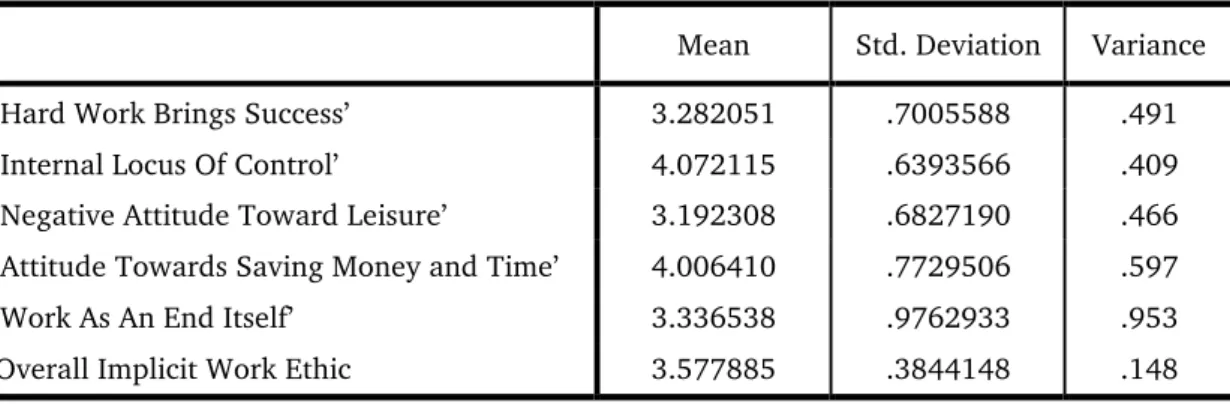
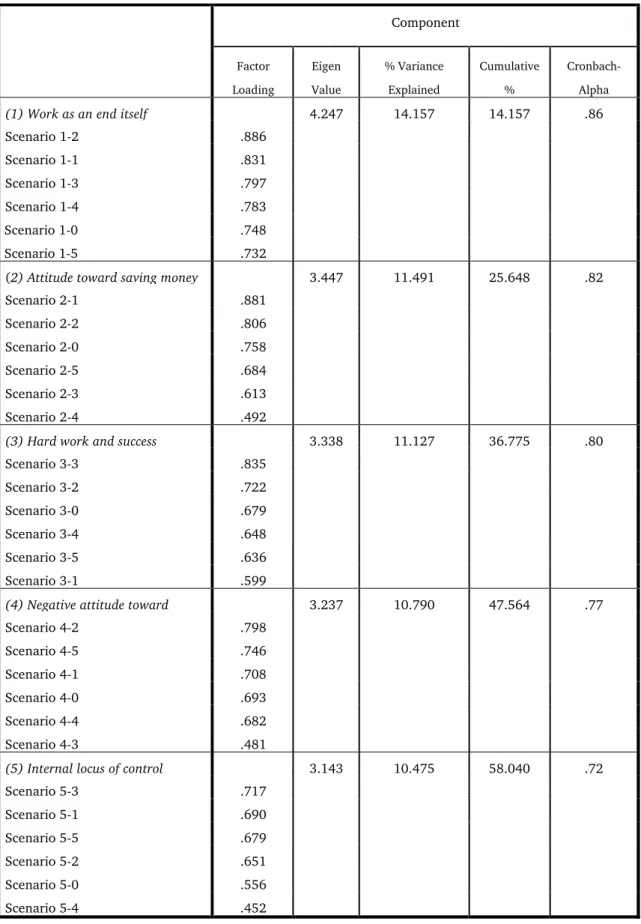
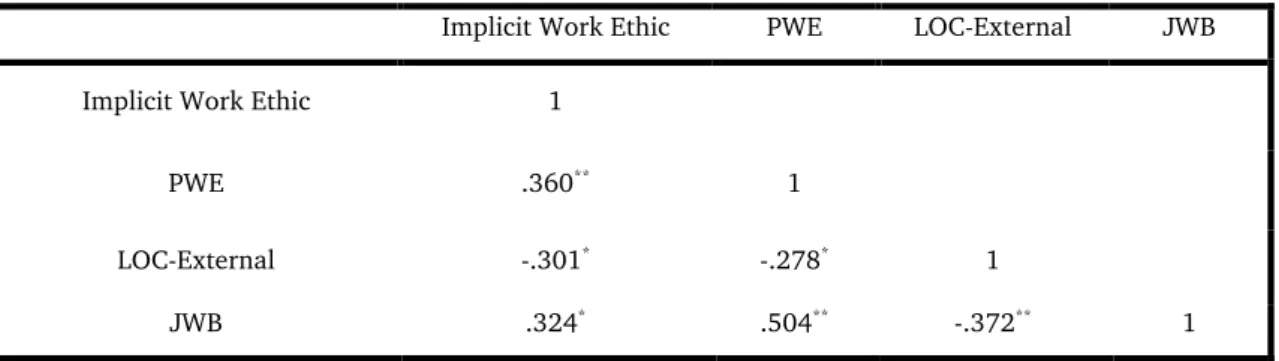
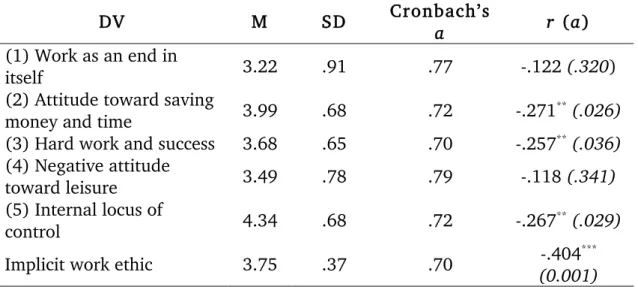
Table 1 Descriptive Statistics of each dimension and the over measure of implicit work ethic ... 31 Table 2 Principal components factor analysis with varimax rotation. ... 34 Table 3 Correlations ... 35 Chapter 3
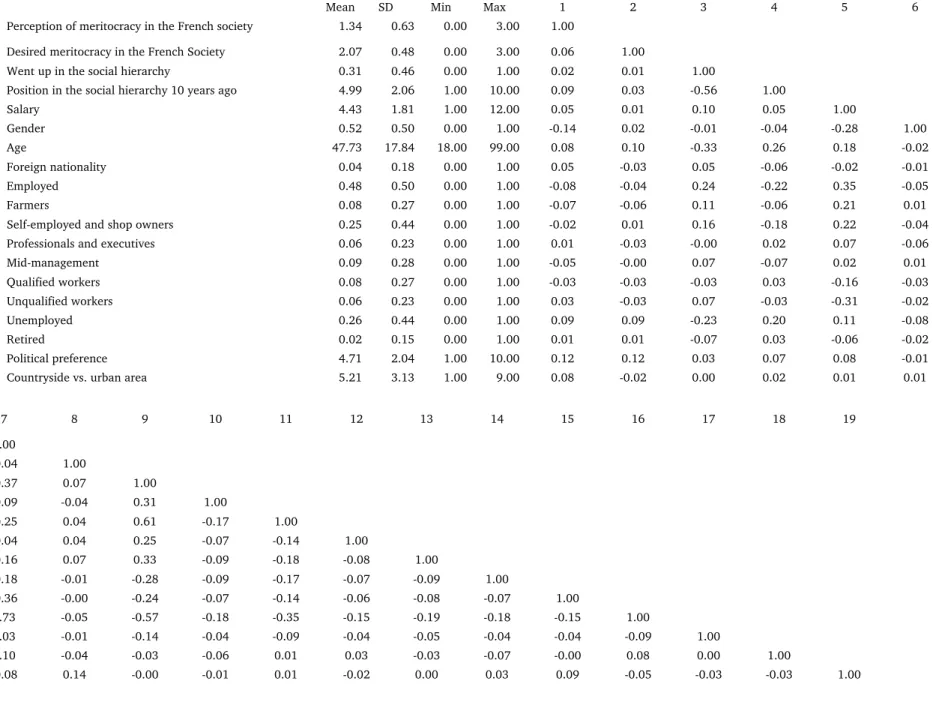
Table 1 Correlation and descriptive statistics ... 79 Table 2 OLS regression of positive evolution on the social hierarchy on the
perceptions of actual and desired meritocracy in the French society,
heteroscedastic robust standard errors ... 81 Table 3 Correlations between beliefs about the fixedness of the social structure and
dimensions of implicit work ethic. ... 86 Table 4 Changing people’s view about the social structure would change their work
behavior. Participants in the malleable condition are more persistent in performing the task than those in the fixed condition. ... 92
xxi
List of Figures
Chapter 2
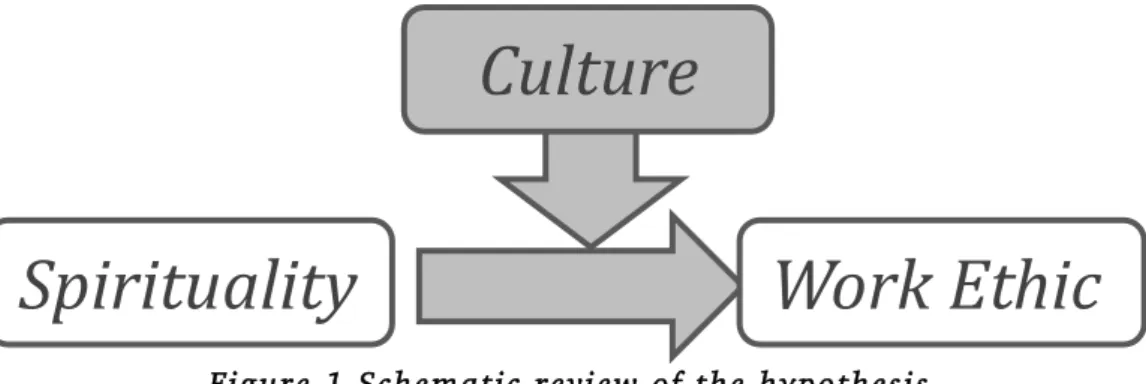
Figure 1 Schematic review of the hypothesis ... 24 Figure 2 Spirituality has positive and significant effect on work ethic for Moroccan
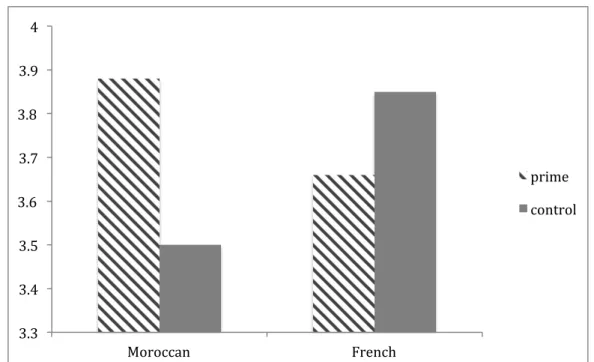
participants, but not for the French participants. Higher numbers indicate more positive attitude towards work ethic ... 38
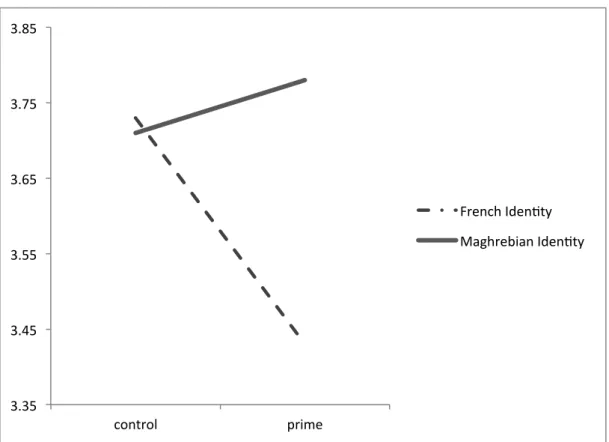
Figure 3 Franco-Maghrebian participants' work ethic after having one of their cultural identities salient and receiving either the religious or neutral prime. Higher numbers indicate more positive attitude towards work ethic. ... 43 Figure 4 Franco-Maghrebian participants' level of effort after having one of their
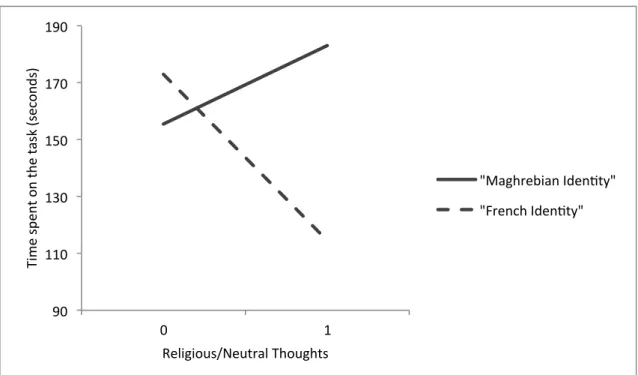
cultural identities salient and receiving either the religious or neutral prime. Higher numbers indicate more time they spent on the task. ... 48 Chapter 4
Figure 1 Mindset mediates the link between religious stimuli and work attitude and behavior ... 107
1
Content
Résumé Général en Français………...………iii Abstract ... xv Acknowledgement ... xvi Dedication ... xix List of Tables ... xx List of Figures ... xxi Content ... 1
Chapter 1 ... 4 When Your Culture Advocates You: An Introduction
A. Secularism In France ... 6 B. Social Structure In France ... 10 C. Thesis Structure ... 12 Refferences ... 15
Chapter 2 ... 17 The Impact Of Religious Beliefs And Cultural Identity On Work Ethic
A. Abstract ... 17 B. Introduction ... 18 C. Conceptual Background ... 20
a. Is Work Ethic Religious, Secular Or Culture-Specific Construct? ... 20 b. Implicit Impact of Religious Thoughts on Behavior ... 24 c. Importance of Cultural Setting ... 26 d. Overview of the Studies ... 29
2
Measuring Work Ethic: Pilot Study ... 30 Study 1 ... 35 Study 2 ... 40 Study 3 ... 45 D. General Discussion ... 49 References ... 56 APPENDIX ... 62 Chapter 3 ... 65 The American Dream Effect: How do Beliefs about the Malleability of Social Structure Impact Meritocratic Attitudes and Behavior?
A. Abstract ... 65 B. Introduction ... 66 C. Conceptual Background ... 68
a. Implicit Beliefs and Their Impact on Motivation and Behavior ... 68 b. Beliefs about the Malleability of the Social Structure ... 71 c. Overview of the Studies ... 74
D. Empirical Design ... 75 Study 1 ... 75 Study 2 ... 82 Study 3 ... 89 E. General Discussion ... 93 References ... 97 APPENDIX A ... 102 Theories of the Social Structure Scale ... 102 APPENDIX B ... 103 Manipulation Materials for Study 3 ... 103
3
Chapter 4 ... 105 Religious Stimuli at Workplace and Individual Performance: The Role of The Abstract Mindset
A. Introduction ... 105 B. Implicit Religious Thoughts and Work Attitude ... 107
Situational Religious Cues ... 110
C. Religious Thoughts and Mental Construal ... 113
Construal Level Theory ... 113
D. Discussion ... 117 References ... 119
When Your Culture Advocates You: An Introduction
4
Chapter
1
When Your Culture Advocates You:
An Introduction
“La France est une République indivisible, laïque, démocratique et sociale. Elle assure l'égalité devant la loi de tous les citoyens sans distinction d'origine, de race ou de religion. Elle respecte toutes les croyances.” 3
How does the French version of secularism, Laïcité, interact with values of people who strongly believe in religion and how does this interaction predict attitudes and behaviors? How does the French culture manage to create a balance between the values of French republic, among them Laïcité is the most important, and the religious values? How do individuals in France perceive the society, its values, its structure, and how do they interact with these elements in work environment?
These are the questions I originally had in mind while started writing this thesis. Clearly, addressing these questions requires much more resources and interdisciplinary knowledge. In this dissertation I attempt to explore some aspects
3 “France is a Republic that is indivisible, laïc, democratic, and social. France assures the equality before the law of all its citizens without any distinction based on origin, race, or religion. It respects all beliefs.”
When Your Culture Advocates You: An Introduction
5
in which individuals’ beliefs, identities and perceptions contribute to their behavior, specifically in the context of the French cultural values. Mainly, values such as secularism and egalitarianism are of great interests in the current research. This dissertation aims at exploring the extent to which these values influence people’s perceptions and implicit beliefs, and consequently the impacts of these beliefs on their work attitudes and motivation.
Work Ethic has been a topic of research for many years. Enormous amount of research have been dedicated in discovering its religious vs. secular nature. However, the debate is still alive and it is even more important given that globalization, migration and expatriation contribute to the increased complexity of the cultural-religious elements in the society. In my dissertation I began with comparing French and North-African cultures in the way they attribute religion to work attitude- considering one as a ‘secular culture with Catholic background’ and the other as a ‘culture of religiosity’. However, the French version of secularism appeared to be much more influential on the implicit beliefs people hold about religion. Thus, it is important to have a better insight about the difference between secularism as it is implied in other countries and Laïcité as it is practiced in France. The first part of this chapter is dedicated to this topic.
As part of this dissertation, I also explored the different perceptions of the social structure and their impact on meritocratic attitudes. Once more, studying this topic in France sheds light to the different mechanisms in which social mobility works through. Values of French republic emphasize on socialist and egalitarian attitudes, yet, France appears to be elitists and to some extent rigid in
When Your Culture Advocates You: An Introduction
6
its social structure. Although, in my dissertation I mainly explore people’s perceptions, rather than the real rate of social mobility, having a better understanding of the social structure in France seems to be important. In the second part of this chapter, I try to describe how French social structure manages issues such as equality of opportunities.
Following, the importance of Laïcité in the French culture and the perceptions of malleability of social structure, meritocracy and mobility in France are discussed. And finally, I briefly describe the outline of each essay in this dissertation.
A. Secularism In France
We need to search for the origins of French secularism in the French Revolution and its conflict with the Catholic tradition. In that conflict, the revolution tried first to control Catholicism (1790), then to turn itself into a religion (the revolutionary cults of 1793, accompanied by politico-religious persecution), before establishing a short-lived separation of Church and State (1795). However, coexisting with the quasi-religious revolutionary fervor, did not resolve the conflict (Bauberot, 2000a, 2000b).
Napoleon tried to stabilize principles of secularism by excluding religious provisions from the French Civil Code. For example, the registration of births, marriages and deaths was secularized and the Catholic Church had to accept a regime of equality with Protestantism and Judaism- the “other official religions”. However, French society could not maintain its religious plurality; instead, turned
When Your Culture Advocates You: An Introduction
7
to be more dichotomous as a result of a conflict between two groups: the “clerical camp” who argued for France to once again become “the elder daughter of the church”, and the “anticlerical camp” who considered France to be the “daughter of revolution” based on the “values of 1789” (Bauberot, 2000a). In other words, France as a Catholic nation opposed France as a Modern nation that did not identify itself in terms of religious commitment.
While the transition to a complete separation of church and state happened, peacefully and slowly, through freedom of conscious and freedom of education, it remained far from ideal. Although Catholicism is not considered as the official religion of France, catholic traditions are still traceable in the official calendar. In the third republic, “Easter Monday” and “White Monday” were added to the previous religious holidays- Christmas, All Saint Day, Ascension and Assumption. “France has not therefore cut herself off from her religious roots, but the holy days of other religions- such as Judaism, Islam or Buddhism- are recognized only in the granting of individual leave of absence for civil servants and school children” (Bauberot, 2000b, p. 4).
Therefor, Laïcité in France cannot be reduced to a legal and political system, “it is also a culture, an ethos, an emancipation from all ‘clericalism’ understood as control of the mind by an established discourse rejecting all debate” (Bauberot, 2000b, p. 6) that has been praised, admired and even loved by the French leaders and consequently the society (Gunn, 2004). For example, in a speech about preventing schoolchildren from wearing religious clothing, President Jacque Chirac stated, “Laïcité is inscribed in our traditions. It is at the heart of our
When Your Culture Advocates You: An Introduction
8
republican identity […] Its values are at the core of our uniqueness as a Nation. These values spread our voice far and wide in the world. These are the values that create France […] Laïcité guarantees freedom of conscience. It protects the freedom to believe or not to believe. It assures everyone of the possibility to express and practice their faith peaceably, freely, though without threatening others with one’s own convictions or beliefs.”
Thus, in France one’s particular understanding of Laïcité is tied to one’s sense of identity (Gunn, 2004, p. 429), yet it should not be confused with “freedom of religions”. Although freedom of conscious is the main tenant of Laïcité, it has been often criticized as not being able to provide a friendly environment for establishing and practicing the freedom of religions, nor the “culture of religiosity” (Norris & Inglehart, 2011). For example, France and the United States are very similar in their attitude towards the human rights and its common assumption- the human beings have inherent rights. Thus, regarding the absolute beliefs and records of the human rights, both Americans and French take pride that they are models for the rest of the world. Similarly, both nations believe in secularism but in different ways- Laïcité for French and “Freedom of Religion” for Americans.
Although these concepts appear to share the same values, there is fundamental cultural difference in the way French and Americans conceive these values. For instance, the overwhelming legislative votes on religious clothing in France and the Pledge of Allegiance in the United States initially suggest a striking difference between the two countries. In 2004, French National Assembly and Senate voted disproportionately for adopting a new law prohibiting children in public schools
When Your Culture Advocates You: An Introduction
9
from wearing clothing and insignia that “conspicuously manifest a religious affiliation.”4
Two years earlier, the American House of Representatives and Senate voted strongly to reaffirm the language of the American Pledge of Allegiance by keeping the words “under God” (Gunn, 2004). Thus, in France, schoolchildren are prohibited from engaging in religious expression in their choice of clothing, while in the United States, Congress has insisted that religious language remains in the Pledge, which is designed to be recited in public schools throughout the country.
French culture could be considered as secular both in political and societal aspects. Although French culture is extremely influenced by catholic tradition- catholic holiday, name days based on the catholic calendars, etc.- the practice of religion in the society is mostly limited to the private space and advertising any religious tradition in public organizations including the schools are forbidden by law and not tolerated by social norms. France is ranked much closer to the northern European secular countries (i.e. Great Britain, Denmark, and Holland) than to the southern ones in terms of declaration of believing in God, practices, and personal religious commitment (Willaime, 1998). In this sense, France appears to be one of the most secular countries in Europe. In other words, Laïcité, has become a civil religion in this country (Chelini-Pont, 2009). Meanwhile, Islam is the second religion in France (Willaime, 1998) and about eight to ten percent of the population consists of Muslim background from North and Sub-Saharan Africa and Middle East (United States Department of State, 2012), for whom the
When Your Culture Advocates You: An Introduction
10
religious values have been deeply internalized through the family customs and traditions, media and religious studies at schools or colleges.
In this regard, France provides an ambiguous context for studying religious identity. In the first essay of this dissertation, I attempt to capture the impact of religious beliefs on work attitudes and behavior in a comparative cultural setting- culture of religiosity vs. Laïcité.
B. Social Structure In France
Based on Bourdieu’s Class theory (1977; 1990) - one of the most influential theories about social mobility in France - Goux and Maurin (1997) analyzed the National French Survey on Education and Qualification and discovered a three-way interaction between social origin, educational attainment, and social destination in France. In other words, their findings exhibit that individuals with identical education begin with more or less social level, but their career paths might be quite different depending on whether they come from the upper or the lower strata of the society. Moreover, “the manner in which members of a given birth cohort reach their destination- first in school, then in society- has barely evolved during the twentieth century” (Goux & Maurin, 1997, p. 173). Thus, France fits neither the assumption of inegalitarian meritocratic model nor the assumption of non-meritocratic model. The development of French educational system has not been accompanied by an increased malleability of social structure.
Meritocracy is a social system “in which individuals get ahead and earn rewards in direct proportion to their individual efforts and abilities” (McNamee & Miller,
When Your Culture Advocates You: An Introduction
11
2009, p. 2). The core tenet of this ideology is to believe that the social system provides every opportunity for success, given hard work. Thus, meritocracy leads people to believe that upward mobility is achievable if they invest sufficient effort and work hard, which can be conceptualized as work ethic. We define social mobility as upward or downward movement along the social ladder. In different societies, individuals who belong to a specific socio-economic stratum are given the opportunity to improve their socio-economic situation and move up to a superior social class. These opportunities vary in quality and quantity, depending on the cultural, political and socio-economical characteristics of the society (Andrews & Leigh, 2009; Causa & Johansson, 2010).
Past research revealed that in countries such as France, Norway, Sweden, Israel and Ireland, people perceive the government to be more responsible for the provision of needs compared to countries such as the United States and Australia; and this perception is mediated by external causal conceptions, i.e., structural causes (Shirazi & Biel, 2005). Remarkably, compared to the average, the relationship between the external causal attribution of the causes of poverty and the government’s responsibility is significantly stronger for Americans. This perception means that “importance attached to opportunities provided by society determined support expected from the government more than the internal attributions for poverty” (Shirazi & Biel, 2005). We can expect that people allocate particular importance to the structural factors in society.
In this dissertation, I explore the way people perceive the reality of the social structure as malleable vs. fixed, and its impact on their attitudes towards
When Your Culture Advocates You: An Introduction
12
meritocracy.
In essence, the more people believe that they have the likelihood to break through the social structure, the more they seek merit through hard work as a means for achievement. People would increase their effort if they believed that moving upward in the social hierarchy is likely because they realize that hard work is the elemental key that opens doors and moves them upward. However, when individuals believe that the social structure is rigid, they tend to self-handicap and withhold their effort. Believing that they would never be able to improve their socio-economic situation, they would withdraw their effort.
This dissertation is composed of three standalone papers.
C. Thesis Structure
Chapter 2
This research attempts to venture into a new perspective on the very notion of work ethic: the positive impact of religious beliefs that holds only within the cultures that embrace values of faith. Taking the North-African culture as one of the most ideological and religious oriented contexts, and French culture as one of the most secular ones, I test this hypothesis to discover whether in religious cultures such as North-African culture, hereafter referred as Maghrebian5,
compare to the more secular European cultures, religious beliefs would predict
5 Maghrib, (Arabic: “West”), also spelled Maghreb, region of North Africa bordering the Mediterranean
Sea. It comprises essentially the Atlas Mountains and the coastal plain of Morocco, Algeria, Tunisia, and Libya.
When Your Culture Advocates You: An Introduction
13
individual’s work ethic. Thus I suggest and argue that culture interacts with religious thoughts, to predict individuals’ attitude and behavior regarding work. More specifically, I take a different approach to provide proofs for the above hypotheses by conducting lab experiments in which I control for socio-economic variables and assess the causality direction.
Thus, across three studies, this research aims to shed light on the causal relationship between religious beliefs and individual’s work ethic. By taking a cross-cultural approach, we compare individuals from Morocco and France (study
1) and Franco-Maghrebian biculturals (Study 2) in the way religious thoughts
impact their work ethic. In study 3, we take a step ahead to explore the impact of religious thoughts and cultural identity on work behavior, namely effort on performing a task. I believe that the impact of spirituality is limited to the cultural milieu, whether being extremely secular in the case of French societal norms, or rather religious in the case of Maghrebian culture. Therefore, I predict that spirituality results in a higher level of work ethic only when the culture incorporates and internalizes the religious values.
Chapter 3
In this research, I explore the relationship between structural causes (e.g., failure of society to provide equal opportunity to succeed) and pro-meritocracy beliefs (i.e., allocation of value to effort and success is a result of hard work). The extent to which the social structure is viewed as supportive of mobility would lead individuals to be more meritocratically oriented. More specifically, I examine whether French individuals who believe in the malleability, not the rigidity, of the
When Your Culture Advocates You: An Introduction
14
social structure would allocate greater importance to the primary elements of meritocracy, namely, work ethic and effort. I argue that regardless of the actual rates of social mobility, individuals would perceive the structure of society to be on a spectrum ranging from very rigid to very malleable, and this perception will significantly impact their attitudes towards work and work behavior. I particularly predict that those who experience mobility and those who hold a more malleable view of society endorse stronger meritocratic attitudes and consequently attach more importance and value to hard work and invest more effort in performing a task.
Chapter 4
The goal of this research was to explore the consequences of activating the implicit values related to work regarding individuals’ work attitude and behavior. Furthermore, this work examines the cognitive consequences of activating religious beliefs. It demonstrates that religious thoughts are able to trigger higher levels of construal that can lead individuals to process information and make decisions in a more abstract way. According to construal-level theory, the abstract mindset leads individuals to focus more on the superordinate goal and behave in more self-regulatory manner. Thus, it is proposed that the construal level will mediate the link between activated work values and work behavior.
When Your Culture Advocates You: An Introduction
15
REFERENCES
Andrews, D., & Leigh, A. (2009). More inequality, less social mobility. Applied
Economics Letters, 16(15), 1489-1492.
Bauberot, Jean. (2000a). Histoire de la laïcité française. Paris, PUF.
Bauberot, Jean. (2000b). The Secular Principle. Paper presented at the conference paper.
Bourdieu, P. (1977). Cultural reproduction and social reproduction. InJ. Karabel & AH Halsey (Eds.), Power and ideology in education (pp. 487-511): New York: Oxford University Press.
Bourdieu, Pierre, & Passeron, Jean Claude. (1990). Reproduction in
education, society and culture (Vol. 4): Sage.
Causa, O., & Johansson, √Ö. (2010). Intergenerational Social Mobility in OECD Countries. OECD Journal: Economic Studies, 2010(1).
Chelini-Pont, B. (2009). Is Laicite the Civil Religion of France. Geo. Wash.
Int'l L. Rev., 41, 765.
Goux, Dominique, & Maurin, Eric. (1997). Meritocracy and social heredity in France: some aspects and trends. European sociological review, 13(2), 159-177.
Gunn, T Jeremy. (2004). Religious freedom and Laïcité: A comparison of
the United States and France. BYU L. Rev., 419.
McNamee, Stephen J, & Miller, Robert K Jr. (2009). The meritocracy myth: Rowman & Littlefield Publishers.
When Your Culture Advocates You: An Introduction
16
Norris, Pippa, & Inglehart, Ronald. (2011). Sacred and secular: Religion and
politics worldwide: Cambridge University Press.
Shirazi, Rez, & Biel, Anders. (2005). Internal-External Causal Attributions and Perceived Government Responsibility for Need Provision A 14-Culture Study. Journal of Cross-Cultural Psychology, 36(1), 96-116. United States Department of State, Bureau of Democracy, Human Rights and
Labor. (2012). International Religious Freedom Report for 2012.
http://www.state.gov/j/drl/rls/irf/religiousfreedom/index.htm?year=201 2&dlid=208314 - wrapper.
Willaime, Jean-Paul. (1998). Religious and secular France between northern and southern Europe. Social compass, 45(1), 155-174.
The Impact Of Religious Beliefs And Cultural Identity On Work Ethic
17
Chapter
2
The Impact Of Religious Beliefs And Cultural
Identity On Work Ethic
A. Abstract
The cultural and religious antecedents of work ethic have long been a place for debate. This research attempts to explore the impact of religious beliefs on work ethic and the moderating effect of culture. Three studies provide evidence that thoughts related to religiosity impact individuals’ work ethic. In a comparative setting, Moroccan participants who were primed with religious thoughts exhibited greater work ethic, while French participants endorsed lower degree of work ethic in the religious condition (study 1). For North African-French participants, religious stimuli interacted with cultural identity to predict work ethic (study 2). Moreover, we found a significant effect of the religious thoughts and cultural identity on work behavior, namely the level of effort (study 3). Specifically, religious thoughts influenced work ethic and behavior positively when the North African cultural identity was salient and negatively when the French cultural identity was salient. We argue that implicit religious beliefs can predict work ethic; however the effect is contingent on cultural setting. In cultures that historically embrace and encourage religious values, work ethic can be considered as a religious construct. In the secular cultures, however, religiosity diminishes work ethic. The contributions and implications are further discussed.
Keywords: Work Ethic, Religious Beliefs, Secular Culture, Franco-Maghrebian Biculturalism, Experimental Method
The Impact Of Religious Beliefs And Cultural Identity On Work Ethic 18 B. Introduction
Cross-cultural psychology has long been interested in how different cultures influence the way individuals construe the work values. Research on work ethic, following the tradition inspired by Max Weber (Weber, 1905), has focused on the impact of religiosity and religious values on the way individuals perceive work values.
Although this trend of research has discovered significant correlations between religious affiliations and work ethic, it mainly concentrated on specific religious denominations and did not take into account the role of the cultural settings. More specifically, the impact of believing in spirituality on individuals’ work attitude and behavior has remained relatively unexplored. Moreover, almost all of these studies concentrated on the correlation between religiosity and work ethic and left the question of causality unanswered. We are interested in inquiring whether implicit beliefs in religion predict work ethic. Specifically, this research is trying to investigate the nature of work ethic and its religious and cultural antecedents.
Beliefs in religion and spirituality have always been recognized as drives for various attitudes and behaviors (Saroglou, 2011). Particularly, research on cultural and social psychology has revealed that ideological values are associated with many positive and negative psychological and behavioral outcomes. For instance, there are evidences that religious thoughts and values would directly impact psychological well-being, prosocial behavior and altruism, and
self-The Impact Of Religious Beliefs And Cultural Identity On Work Ethic
19
regulatory behavior (Laurin, Kay, & Fitzsimons, 2011; Norenzayan & Shariff, 2008; Pichon, Boccato, & Saroglou, 2007). Moreover, research has shown that religiosity not only could shape, be part of, and be influenced by culture, it could interact with cultural values to influence cognition, emotions and actions (Saroglou & Cohen, 2011).
This research attempts to venture into a new perspective on the very notion of work ethic: the positive impact of religious beliefs that holds only within the cultures that embrace values of faith. Taking the North-African culture as one of the most ideological and religious oriented contexts, and French culture as one of the most secular ones, we test this hypothesis to discover whether in religious cultures such as North-African culture, hereafter referred as Maghrebian6,
compare to the more secular European cultures, religious beliefs would predict individual’s work ethic. Thus we suggest and argue that culture interacts with religious thoughts, to predict individuals’ attitude and behavior regarding work. More specifically, we take a different approach to provide proofs for the above hypotheses by conducting lab experiments in which we control for socio-economic variables and assess the causality direction.
Thus, across three studies, this research aims to shed light on the causal relationship between religious beliefs and individual’s work ethic. By taking a cross-cultural approach, we compare individuals from Morocco and France (study 1) and Franco-Maghrebian biculturals (Study 2) in the way religious
6 Maghrib, (Arabic: “West”), also spelled Maghreb, region of North Africa bordering the Mediterranean
Sea. It comprises essentially the Atlas Mountains and the coastal plain of Morocco, Algeria, Tunisia, and Libya.