
Pathogens and genome normalization for literature-based knowledge discovery
2
0
0
Texte intégral
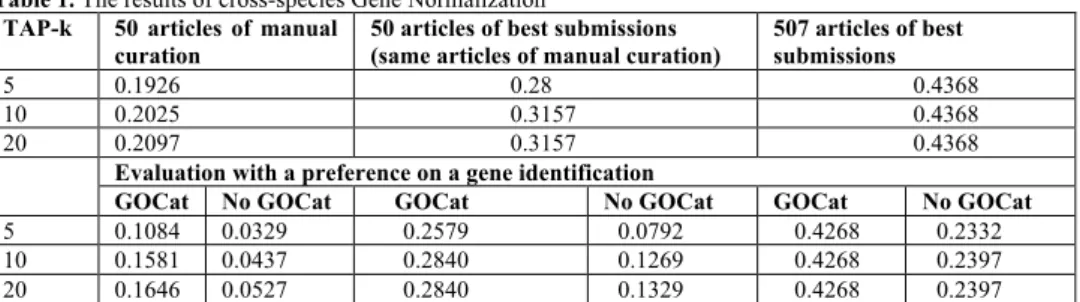
(2) 1.2. Methods The approach of pathogen and its genome normalization can be split into three subtasks. The first subtask is to detect entity names. In the second subtask we validate detected candidates with a dictionary. The third subtask filters false positives (FPs) by applying some empirical rules. For Species Detection we have used simple rule-based approaches and have created recognition modules for a dozen of the most common pathogens. In order to refine the scope of studied species in the text we used Ontology-Lookup Service (OLS), which provides an expanded list of entities belonging to the family of a current pathogen. For solving the ambiguity problem of gene names (e.g. homonyms and synonyms) we use a hybrid gene name recognition module. All gene candidates are approved by GPSDB [2]. Elaboration of GOCat boosts correct ids on the top of the results list [3].. 2. Results and Conclusion We extracted species names from BCIII test data for evaluating the efficiency of the Pathogen Normalization (PN). The result of PN shows 95% of precision and 93% of recall. The species sub-type provided by OLS is able to disambiguate the species name and genus name, which both occurred in the same text. The results of Gene Normalization (GN) of our approach are evaluated with a proposed metric called Threshold Average Precision (TAP-k) [3]. Table 1. The results of cross-species Gene Normalization TAP-k 50 articles of manual 50 articles of best submissions curation (same articles of manual curation) 5 0.1926 0.28 10 0.2025 0.3157 20 0.2097 0.3157 Evaluation with a preference on a gene identification GOCat No GOCat GOCat No GOCat 5 0.1084 0.0329 0.2579 0.0792 10 0.1581 0.0437 0.2840 0.1269 20 0.1646 0.0527 0.2840 0.1329. 507 articles of best submissions 0.4368 0.4368 0.4368 GOCat 0.4268 0.4268 0.4268. No GOCat 0.2332 0.2397 0.2397. The results provided in Table 1 showed that a correct identification of the species could decrease the ambiguity of orthologous genes. The impact of GOCat is appeared to be effective. The overfitting phenomena are avoided mainly because GOCat has not been originally designed for gene recognition and normalization. Acknowledgements. This work is supported by grant of DebugIT. The DebugIT project (http://www.debugit.eu) is receiving funding from the European Community’s Seventh Framework Programme under grant agreement n°FP7-217139. References [1] GOCat – Gene Ontology Categorizer [http://eagl.unige.ch/GOCat] [2] Gene and Protein Synonym DataBase [http://www.expasy.ch/gpsdb/] [3] The proceedings for the BioCreative III Workshop, 2010, Bethesda, Maryland, USA. ISBN: 978-1-45073685-5.
(3)
Figure
Documents relatifs
In this paper, we study methods for analyzing time series data describing the user- news item interactions.. Separating different types of biases furthers our understanding of
We have evidence that the RACE array normalization will often, though not necessarily, lead to the overall homogenization of transcript abundances (since transcripts within an
For BioCreative II, the task was to list the Entrez Gene identifiers for human genes or gene products mentioned in PubMed/MEDLINE abstracts.. We selected abstracts associated
Conclusion: After experiments were carried out on the BioCreative III Gene Normalization Task’s data-set to investigate the contribution of the additional species mentions to the
If we can de- termine that every possible population of a given relation scheme has one of these da- ta dependencies, and that it is a “nontrivial” dependency and not enforced by a
However, all nodes in the XSEM-H view schemes that represent P roduct lead to local redundancies and the storage node for P roduct must be cre- ated.. This node is a new stor- age
First Normal Form = all attributes are atomic Second Normal Form (2NF) = old and obsolete. Boyce Codd Normal Form (BCNF) Third Normal
Let c Rn be an irreducible algebraic variety. We will consider on X the structures of Nash set and of real analytic variety, which.. The compact case.. We give an
