J
OURNAL DE
T
HÉORIE DES
N
OMBRES DE
B
ORDEAUX
K
ARMA
D
AJANI
C
OR
K
RAAIKAMP
On approximation by Lüroth series
Journal de Théorie des Nombres de Bordeaux, tome
8, n
o2 (1996),
p. 331-346
<http://www.numdam.org/item?id=JTNB_1996__8_2_331_0>
© Université Bordeaux 1, 1996, tous droits réservés.
L’accès aux archives de la revue « Journal de Théorie des Nombres de Bordeaux » (http://jtnb.cedram.org/) implique l’accord avec les condi-tions générales d’utilisation (http://www.numdam.org/conditions). Toute uti-lisation commerciale ou impression systématique est constitutive d’une infraction pénale. Toute copie ou impression de ce fichier doit conte-nir la présente mention de copyright.
Article numérisé dans le cadre du programme Numérisation de documents anciens mathématiques
On
approximation
by
Lüroth
Series
par KARMA DAJANI ET COR KRAAIKAMP
RÉSUMÉ. Pour x
~]0, 1] ,
on notepn/qn
la suite des convergents de la série de Lürothassociée,
et on définitpar 03B8n
= qnx - pn, n ~ 1ses coefficients
d’approximation.
Dans[BBDK],
on déterminela fonction de
répartition
limite de la suite(03B8n),
en utilisantl’extension naturelle du
système
ergodique
sous-jacent
audévelop-pement en série de Lüroth. Nous montrons ici que cela peut être fait sans cette considération. Plus
précisément,
nous démontrons que pour tout n, larépartition
de03B8n
coincide avec larépartition
limite. On étudiera aussi la
répartition
pour presque tout x de la suite(03B8n, 03B8n+1)n~1,
ainsi que celles issues de suites telles que(03B8n
+03B8n+1)n~1.
On obtiendra que pour presque tout x, la suite(03B8n, 03B8n+1)
possède
une fonction derépartition
continue etsin-gulière.
On observera deplus
que 03B8n et03B8n+1
sontpositivement
corrélés.
ABSTRACT. Let x ~
(0,1]
andpn/qn, n ~
1 be its sequence of Lüroth Series convergents. Define theapproximation
coefficients03B8n
=03B8n(x)
by 03B8n
=qnx -
pn, n ~
1. In[BBDK]
thelimiting
distribution of the sequence(03B8n)n~1
was obtained for a.e. xusing
the natural extension of the
ergodic
systemunderlying
the Lüroth Seriesexpansion.
Here we show that this can be done withoutthe natural extension. In fact we will prove that for each n, 03B8n is
already
distributedaccording
to thelimiting
distribution.Using
the natural extension we willstudy
the distribution for a.e. xof the sequence
(03B8n, 03B8n+1)n~1
and related sequences like(03B8n
+03B8n+1 )n>1.
It turns out that for a.e. x the sequence(03B8n, 03B8n+1 )n~1
is distributedaccording
to a continuoussingular
distributionfunc-tion G. Furthermore we will see that two consecutive 03B8’s are
positively
correlated.1. Introduction
Let x E
(0,1],
thenwhere an
>2, n
> 1. J.Lfuoth,
who introduced the seriesexpansion
(1)
in
1883,
showed(among
otherthings)
that every irrational number x hasa
unique
infiniteexpansion
(1)
and that each rational either has a finite or an infiniteperiodic expansion,
see also[L]
and[Pe].
The seriesexpansion
(1)
of x is called the Liiroth Series of x.Dynamically
the Lüroth seriesexpansion
(1)
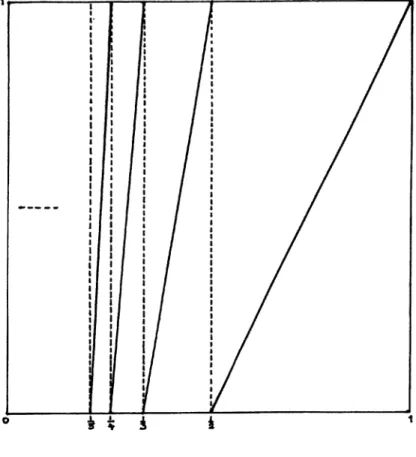
of x isgenerated by
theoperator
T :[0, 1]
2013~ [0,1],
definedby
(see
alsofigure 1),
where[g J
denotes thegreatest
integer
notexceeding 6.
For x E[0,1~
we definea(x) :
:= +1, ~ ~ 0;
a(0)
:= oo andfor n > 1. From
(2)
it follows that Tx =al(al - 1)x - (al - 1),
and therefore
- - -
--Putting
where ql := ai ; qn =
al (al -1) · · ’
2,
it follows from(3)
thatFrom an >
2 and 0 1 it follows that the series from(1)
convergesto x. We will write
In
[JdV],
H.Jager
and C. de Vroedt showed that the stochastic variables... ,
an(x), ...
areindependent
with= k) _
for 1~ >2,
and that T’ is measure
preserving
andergodic
withrespect
toLebesgue
measure. Here and in the
following
An
will denoteLebesgue
measure onnumber of results were
obtained,
analogous
to classical results on continuedfractions,
e.g.Here and in the
following
a.e. will be withrespect
toLebesgue
measure.FIGURE 1. The map T
In view of
(4)
it is natural to define andstudy
the so-calledapproximation
coefficients On
=1,
definedby
As in the case of the
regular
continued fraction these 8’sgive
an indicationof "the
quality
ofapproximation
of xby
its n-thconvergent
Pn/qn",
see1,
wherepn/qn
is the n-thregular
convergent
ofx).
Note that the absolute valuesigns
are in factsuperfluous
here. In view of(4)
one has
Putting
T.~
:= it follows from(2)
and(5)
thatWe say that
Tn
is thefuture of
x at time rt.Similarly
isthe
past
o f x
at time n.Putting
Yo
:=0,
from(6)
one seesthat On
isexpressed
in terms of both thepast
(viz. an)
and the future.Therefore,
in order to obtain the distribution of the sequence for a.e. x the
natural extension of the
ergodic
system
((0,1],
Bi, À1,
T) (here
~31
is the collection of Borel sets of(0,1])
was constructed in[BBDK].
THEOREM 1.
([BBDK])
Let Q :=~0,1~
x~0,1~
and82 be
the collectionof
Borel sets Let T : 0 -+ Q be
defined
by
then the
system
is the natural extension
of
([0, 1],
B1, "B1,
T~ .
Moreover,
([0, 1]
x[0, 1],
L32, A2,
T)
is Bernoulli.From this theorem we have the
following
lemma.LEMMA 1. For almost all x the two-dimensional sequence
is
uniformly
distributed over S2 =[0, 1]
x[0, 1].
The distribution of the sequence now follows from lemma 1. THEOREM 2. For almost all x and
for
every z E(0,
1]
the limitexists and
equals
F(z),
whereTaking
the firstmoment,
theorem 2yields
that for a.e. xwhere
((s)
is the zeta-function.Remarks. In fact one needs not use the natural extension to
study
the distribution of the sequence(B",)n>1·
Sincesee also
(2),
it follows thatand therefore
(6)
yields
thati.e. the distribution of the sequence can be obtained from
([0, 1],
B, À,
T) .
It was
pointed
outby
one of the referees that Lemma 1 and Theorem2 above can also be obtained as
simple
Corollaries of astrong
resultby
J.
Galambos,
see[G],
Theorem 6.2.Furthermore,
using
(6)
and Galambos’ Theorem6.2,
one can calculate the exact distribution of each of thenot
only
the limiting
distribution.In
fact,
from(9)
and the fact thatTn
isuniformly
distributed on theunit interval for each n, one has
thus we see that F from
(7)
is the distribution function for each0n.
As acorollary
we also have thatE(8n)
=In this paper we will
study
the distribution for a.e. x of the sequence and related sequences like(On
+ We will show thattwo consecutive 8’s are
positively
correlated.2. On the relation
between 0n
and0n+1
From
(6)
and(9)
it is natural to define theQ, given by
Obviously
one has(10)
Putting
one finds
For
(x, y)
EVA,B
one has~Y(x,y) _
(Bx 1,
Ax -1) (where 1/A
x1/(A -
1)).
Henceputting
yields
Thus we see that w maps the
rectangle
VA B
onto the linesegment
LA,B,
which hasendpoints
and( ~A-iy~s-y , A11 ) ~
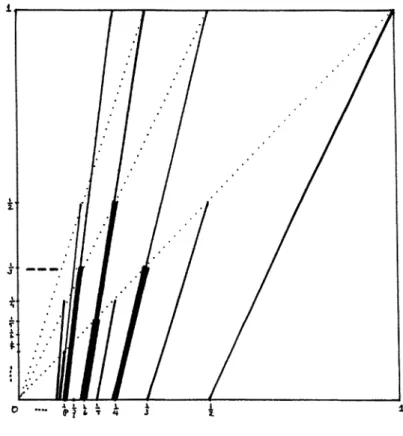
Notice that from(10)
and(11)
one hasand E
8,
wheresee also
figure
2.FIGURE 2. The set
Note that
figure
2 shows that aVahlen-type
theorem as one has for thecontinued fraction
(see
[JK])
is notpossible
for Lfuoth Series. Thatis,
there does not exist a constant c1,
such that for every x one has(recall
that for continued fractionsalways
08n(x)
1 and1/2).
However,
it is also clear fromfigure
2,
thatand
We have the
following
proposition,
which followsdirectly
from lemma 1PROPOSITION 1. For almost all x one has with
probability
3/4
that8n
2
and with
probability
7/8
thatFurthermore,
given
that On
1/2
one has withprobability
5/fi
that1/2.
The same holdswhen On
and0n+1
areinterchanged.
Remarks. In view of
(12)
it is obvious that for a.e. x two consecutive 0’s are NOTindependent.
In factproposition
1suggests
that two consecutive arepositively
correlated. That this is the case almostsurely
is shown in section3.2. The situation here is similar to that for the
regular
continuedfraction;
there Vahlen’s theoremsuggests
that two consecutive O’s arenegatively
correlated. This is indeed the case as was shown
by
Vincent Nolte in anunpublished
document,
see also[N].
3. On the distribution of
(On,
In this section we will show in 3.1 that for almost all x the sequence
(On,
is distributedaccording
to a continuoussingular
distributionfunction G. Before
stating
the result we first recall the definition of acontinuous distribution
function,
see also[T],
p. 20. In 3.2 we willstudy
for a.e. x the distribution of the sequence
(0n
+ which will then be used to show that two consecutive 0’s arepositively
correlated.3.1. A continuous
singular
distribution function.DEFINITION 1. A
distribution function G is
said to be continuoussingular
if it is
continuousand if
there exists a Borel set S withLebesgue
measure zero such thattcG(S)
=1. Here J-LG denotes theLebesgue-Stieltjes
measuredetermined by
G.We have the
following
theorem.THEOREM 3. For almost all x
and for all
(zi, z2)
E[0,1~
x[0, 1]
the limitexists and
equals
G(zi, Z2),
where G isgiven by
Proof.
The first assertion follows from(6),
(9)
and lemma 1. In order toshow that G is a continuous distribution function we have to
show,
see also[T],
section 2.2 :(i)
G(XI,X2)
- 1 asmin(xI,x2)
- 00.(ii)
For each i E{1,2}, G(xi,
X2)
-~ 0 as Xi - -00.(iii)
G(xi, X2)
is continuous.(iv)
Let a =(a1, aZ), b
=(bl, b2),
where aibi,
i E~1, 2~
andput
(a, b]
:=fX
=(XI,X2)
ER2 :
aixi :5
bi,
i Efl,2}}.
Then for each cell
(a,
b]
CR2
we must havewhere
Notice that
(i)
and(ii)
follow from the definitionof G;
clearly
G is monotone in each of itscoordinates,
and in case Xi 0(for
i Ef 1, 2})
one has thatG(Xl,X2)
= 0. In case 1 it follows thatG(Xl,X2)
=1. That Gis continuous
clearly
follows from(13).
In order to prove(iv)
we introducefor
A,
B > 2 a functionGA,B : Q -
R, given by
where
VÂ,B(Ç,17)
is as in(14).
Notice thatIt is now sufficient to show that for all
A,
B > 2 and each cell(a, b]
C ~one has
Fix
A, B >
2 and letand = :=
(B - 1)~, 7r2(Ç,1/) =
7r(A,B),2 :=~,
one has thefollowing,
possibly
overlapping,
cases.(Ia) m(a1, a2)
Notice that the
monotonicity
of 7r2
as a function of its firstcoordina-te
yields
thatand therefore
m(ai, b~)
=a2),
from which itfollows, by
defini-tion of
(Ib) meal, a2)
=m(bi,
a2).
In this case one has
(II) m(al, bz)
=rrz(bl, b2),
whichimplies
that~r2(al, b2) 7rl(al,b2),
which in turnyields
thatBut then we
only
can have thatfrom which it at once follows that
(III)
m(b1, a2)
m(b1, b2) :
see case(I).
(IV)
=?~(&i~2) :
see case(II).
In order to show that =
1,
orequivalently
that =0,
it issufficient to show that for each cell
(a,
b~
C!1,
for whichone has that
b~)
=0,
which isequivalent
withNotice that we may assume that
(a,
b]
is contained inSk
for some k >2,
where , ,
Obviously
there areonly finitely
many values of A and B such thatLA,B n
Sk ~
0.
Let A and B two suchvalues,
then(a, bJ
either "lies above"LA,B
or "below"
LA,B.
Let Ll =U(a, b)
be the collection of allpairs
(A, B)
forClearly
one haswhere a* :=
(ai,0)
and b* :=(bl, a2).
For(A, B)
E Ll we now defineLÀ B
by
A,B
then
from which the theorem foUows.D
3.2. On the correlation
between 0n
and0n+1.
In section 2 we sawthat it is
likely
that9n
and arepositively
correlated. In order to showthis,
we firstgive
some definitions.where
E(Bn)
is theexpectation
of
On,
asgiven
in(8)
andV(Bn)
is thevari-ance
of On,
defined by
The numerator of
0n+1)
equals
the covariance ofOn
and8n+1.
DEFINITION 3. Let X and Y be two stochastic variables. Then the
covarian-ce
C(X, Y)
of X
and Y isgiven by
Notice that
C(X,Y)
> 0 indicates that whenever X(resp. Y)
isbigger
or smaller than its mean
E(X) (resp. E(Y)),
the same islikely
to hold for Y(resp. X ),
i.e. X and Y arepositively
correlated.Similarly C(X, Y)
0 tells us that X and Y arenegatively
correlated. In caseC(X,Y)
= 0 wesay that X and Y are uncorrelated. One has that
X and Y are
independent #
X and Y areuncorrelated,
THEOREM 4. For almost all x one has that
and
therefore
On
and arepositively
correlated a.s.Since
E(On+,)
andE(0fl)
= one hasNotice,
that from theorem 2 one has that F hasdensity f ,
whereTaking
second moments thusyields
But then it follows from
(8)
thatIn order to find
E(0n0n+1 )
we will determineE((0n
+6n+1)2),
sinceHence we find for Luroth series that
From
(6)
and(9)
one hasand from the definition of
LA,B
it follows thatTHEOREM 5. For almost all x and
for
every z E(0, 2~
the limitexists and
equals
S(z),
where S is a continuous distributionfunction
withdensity
s,given
by
Here
(z)
is the indicatorfunctions of
the interval(a,
#],
i. e.Theorem 6 now at once
yields
thatBut then
and therefore the first assertion of theorem 5 is immediate. It follows that
8n
and8n+1
are indeedpositively
correlated.DNotice that the
proof
of theorem 6 caneasily
beadapted
to derive the distribution for a.e. x of the sequence(On -
We leave this to thereader,
but mention one -surprising -
case : one has that theprobability
P(On
On+l)
that 8n
is smaller than0n+1
is0.391... ,
i.e. has thetendency
to be smaller than itspredecessor.
To be moreprecise,
we havethe
following
proposition.
Proo f .
From(6)
and(9)
it followsthat 0n
0n+1
isequivalent
withBut then lemma 1
yields
that 1j
N :0j(z)
exists for a.e. x, and
equals
a~D),
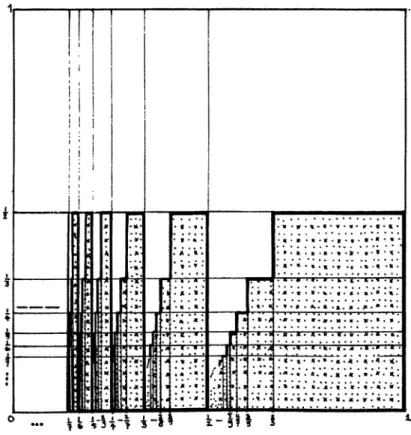
where D isgiven by
see also
figure
3. Theproposition
now follows fromwhere 1
is Euler’s constant andO(x)
=r,(x)lr(x)
-EiFinal remarks.
Recently
JoseBarrionuevo,
Bob Burton and thepresent
authorsgeneralized
the wholeconcept
of L3rothSeries,
see also[BBDK] .
A new class of series
expansions,
the so-called Generalized Lüroth Series(or
GLS),
was introduced and theirergodic
properties
were studied.Examples
of these GLS are the recent
alternating
LürothSeries,
as introducedby
S.Kalpazidou
and A. and J.Knopfmacher,
but also familiarexpansions
like r-adicexpansions
(for
r EZ,
r >2).
Although #-expansions
are not inthis
class,
it turned out that manyimportant
ergodic
properties
of theseexpansions
can be obtainedusing
theappropriate GLS-expansion,
see also[DKS].
Here we
only
want to mention that theapproach
of this paper can be carried over toGLS-expansions.
In order tokeep
theexposition
clear and easy weonly
dealt with the "classical" Liirothexpansion.
Details are left to thereader,
see also section 3.1 of[BBDK].
Acknowledgement s.
We want to thank the referees and J. Shallit for severalhelpful suggestions concerning
thepresentation
of this paper. Inparticular
we want to thank one of the referees forpointing
out reference[G]
to us.REFERENCES
[BBDK]
Barrionuevo, Jose,
Robert M.Burton,
KarmaDajani
and CorKraaikamp - Ergodic
Properties
of
Generalized LürothSeries,
ActaArithm.,
LXXIV(4) (1996), 311-327.
[DKS]
Dajani,
Karma,
CorKraaikamp
and BorisSolomyak -
The naturalex-tension
of the 03B2-transformation,
Acta Math.Hungar.,
73(1-2) (1996),
97-109.[G]
Galambos,
J. -Representations
of
Real numbersby Infinite Series,
Springer
LNM502,
Springer-Verlag,
Berlin,
Heidelberg,
NewYork ,
1976.[JK]
Jager,
H. and C.Kraaikamp -
On theapproximation by
continuedfractions,
Indag.
Math.,
51(1989),
289-307.[JdV]
Jager,
H. and C. de Vroedt - Lüroth series and theirergodic
properties,
Indag.
Math. 31(1968),
31-42.[L]
Lüroth,
J. - Ueber eineeindeutige Entwickelung
von Zahlen in eine unendlicheReihe,
Math. Annalen 21(1883),
411-423.[N]
Nolte,
Vincent N. - Someprobabilistic
results oncontinued
fractions,
Doktoraal
scriptie
Universiteit vanAmsterdam, Amsterdam, August
1989.
[Pe]
Perron,
O. -Irrationalzahlen,
Walter deGruyter
&Co., Berlin,
1960.[T]
Tucker,
H. G. - A Graduate Course inProbability,
AcademicPress,
Karma DAJANI Universiteit Utrecht
Dept.
of MathematicsBudapestlaan 6,
P.O. Box 80.000 3508TA Utrecht the Netherlands[email protected]
Cor KRAAIKAMPTechnische Universiteit Delft
Thomas