Finger Rapid Automatized Naming (RAN) predicts the development of
numerical representations better than finger gnosis
Abstract
Fingers have been recurrently associated with number development and mathematical achievement. Specifically finger gnosis have been considered as a potential precursor of numerical learning. However recent findings cast doubt on the existence of a link between finger gnosis and numerical skills. In fact, finger gnosis and canonical finger representations are both different aspects that could influence numerical development but have not been distinguished in previous research. The current study aimed at dissociating the specific contribution of both aspects in a longitudinal setting. Children were tested twice: at the end of kindergarten and nine months later, in first grade. We used two specific finger tasks a finger gnosis task and a rapid-automatized-naming of finger numeral configurations (finger RAN). Numerical representation was assessed by number line estimations in kindergarten and first grade. Results showed that finger gnosis were not related to numerical representation accuracy at any time point. Finger RAN performances though were uniquely related to the numerical representation accuracy one year later, even out of the range of finger counting. The visual recognition of numbers as supported by finger configuration thus seems to be important when fingers support numerical representations. The present findings have theoretical implications about the link between fingers and number(s) across development.
Keywords
Numerical Cognition; Finger gnosis; Development; Finger-based representations; Numbers; Finger Rapid Automatized Naming
Highlights
• Finger Rapid Automatized Naming (finger RAN) predict number representation accuracy one year later
• Finger gnosis do not predict number representation accuracy one year later • Visual coding of finger patterns mediates the relation between counting skills and
1. Introduction
Gerstmann reported for the first time a co-occurrence of finger agnosia and acalculia after stroke (1940). Although an association of symptoms is always difficult to interpret in neuropsychology (Rusconi, Pinel, Dehaene, & Kleinschmidt, 2010), the link between fingers and numerical thinking has been broadly documented during the last decades. Fingers have been recurrently connected to numerical development and more specifically to counting and arithmetic activities (Butterworth, 1999). Some authors recently suggested to integrate finger-based representations at different levels of existing models of numerical development (Roesch & Moeller, 2015). Despite the abundant literature about the links between “fingers” and numerical development, little is known about the specific contribution of finger gnosis (i.e., the ability to distinguish one's own fingers) vs. visual finger pattern recognition (i.e., identifying a number from seeing an amount of fingers in a hand) to numerical development. Are finger gnosis, or visual representation of a number as a finger configuration, or both processes, equally related to the development of numerical representations? The current study aims at dissociating the specific contribution of each aspect in a longitudinal setting allowing to track numerical development.
Finger counting has been linked to arithmetic achievement as evidenced by several studies. In a recent longitudinal study following children from 1st to 5th grade, early finger counting abilities have been highlighted as one of the important predictors of later mathematical achievement (Geary 2011). At the brain level, mental arithmetic, number representations and finger representations share common neural substrates in the parietal cortex that persist into adulthood (Krinzinger et al., 2011; Andres, Michaux, & Pesenti, 2012, Penner-Wilger, & Anderson, 2013). Finger counting provides a concrete tool to both represent and manipulate the abstract quantities contained in the verbal number names (Fayol & Seron, 2005) and could
thus contribute to an efficient transition between non-symbolic and symbolic systems (Andres, Di Luca, & Pesenti, 2008). A recent review of literature suggested that fingers allow an analogical representation of the magnitude in a part of body that can be easily internalized (Guedin, Thevenot, & Fayol, 2017). In other words, finger representations could work as an intermediary step toward symbolic representation of numbers but we currently ignore what precise aspect of fingers counts for numerical representations. However, empirical evidence linking "fingers" to arithmetic development refers to a range of various finger-related processes depending on the studies. They usually intermix visuo-spatial, sensory-motor, and numerical aspects: Finger gnosis, matching finger configurations with a number, finger counting performances, observations of finger-related strategies to solve arithmetic problems, etc. We therefore decided to focus on two extremes of this continuum: finger gnosis in a task of recognizing the touched finger (tactile modality, with no explicit numerical aspects) and finger pattern recognition (visual modality, with no explicit sensory aspects).
Finger gnosis refers to the ability to become aware of and identify/distinguish one's own fingers (Wasner, Nuerk, Martignon, Roesch, & Moeller, 2016). Finger gnosis have been associated with counting and mathematical learning in the literature. Fayol, Barrouillet, and Marinthe (1998) showed that finger recognition and other sensory-motor skills at 5-6 years constitute a better predictor of arithmetic one year later than intelligence. Counting difficulties and math acquisition delays have been observed in hemiplegic children with impaired finger motor abilities (Thevenot et al., 2014). Lower finger gnosis have been found in children with mathematical learning difficulties compared to controls (Costa et al., 2011). Case studies further reported associations between impaired finger gnosis and weak numerical skills (Turconi & Seron, 2002; Rousselle, Dembour, & Noël, 2013). Moreover, longitudinal studies have highlighted correlations between finger gnosis and later arithmetic achievement (e.g.,
Costa et al., 2011; Reeve & Humberstone, 2011). However, recent studies showed that finger gnosis only explained a small part of the variance of arithmetic performances (Wasner et al., 2016) and that other factors such as counting abilities or symbolic magnitude judgments were better predictors of arithmetic development than finger gnosis (Long et al. 2016). The latter findings contradict preceding results on the contribution of finger gnosis to numerical development (Noel, 2005) and question the potential transferability of finger training on numerical competences (Gracia-Bafalluy & Noël, 2008). Finger gnosis and tactile locations are still not mature when children start to learn numbers and arithmetic. Finger gnosis has a co-occurring developmental trajectory with numbers. Finger gnosis precision increases with age, though with important inter-individual differences (Benton 1955, Chinello, Cattani, Bonfiglioli, Dehaene, & Piazza, 2013).
With respect to the visual aspect of fingers, experiments showed that finger pictures were more efficiently associated with the corresponding quantity when the fingers were shown in a configuration that is canonical for the person than in non-canonical configurations (Di Luca, Granà, Semenza, Seron, & Pesenti, 2006). Canonical configurations of fingers are able to prime fast number naming whereas non-canonical configurations are not (Di Luca, Lefèvre, & Pesenti, 2010). Crollen and colleagues (2011) showed that blind children use fingers less spontaneously and in a less canonical way for counting, though achieving similar numerical performances than sighted controls. This suggests that seeing one's fingers enhances the use of fingers. The use of fingers and the representation of numbers linked to fingers seems thus to have a visual component. Recently, researchers developed a measure targeting this visual component under the form of a visual finger pattern recognition: the finger Rapid Automatized Naming (finger RAN). Rapid automatized naming tasks consist in naming familiar visual stimuli (e.g., pictures, letters, etc.) as fast as possible (Denckla & Rudel, 1974).
RAN performances have been linked to different domains of academic achievement depending on the nature of the visual stimulus to name and they are considered as a marker of the automaticity to access representations in long term memory (Georgiou, Tziraki, Manolitsis, & Fella, 2013). Finger RAN predicts unique variance in arithmetic performances at the beginning of formal instruction, even after controlling for general processing speed (Hornung, Martin, & Fayol, 2017), and has also been linked to other early numerical skills such as counting (Cornu, Schiltz, Martin, & Hornung, 2018). Therefore, we used finger RAN to assess the visual aspect of finger-based numerical representations.
The present study assesses the link between finger gnosis and finger RAN performances and their relation to numerical development. What is the respective contribution of sensory skills related to fingers (i.e., finger gnosis) and of the visual coding of numbers as finger configurations to numerical representations? We used two specific tasks allowing to dissociate both aspects of fingers by targeting the former with a finger gnosis task and the latter with rapid-automatized-naming of finger configurations (finger RAN). We aimed at disentangling purely finger gnosis aspects, which are not explicitly linked to numbers, from visual finger pattern recognition, which are not explicitly linked to finger's tactile locations. We focused on the specific contribution of these both aspects of fingers to numerical representations in kindergarten and their predictive value for one year later numerical representations. Children's numerical representations were evaluated during the last year of kindergarten and nine months later in first grade with a number line estimation (i.e., number-to-position task, Siegler & Opfer, 2003). We deliberately choose number line estimation tasks to directly assess the accuracy of numerical representations rather than specific arithmetic performances as it has often been the case in the previous literature. This present task choice is not disconnected from other aspects of numerical cognition though, as according to a recent
meta-analysis by Schneider and colleagues (2018) number line estimation is strongly linked to broader mathematical competence and constitutes a robust tool to assess them.
2. Method 2.1 Participants
Children were tested the first time between February and March of their last year of kindergarten (T1) and the second time between November and December of the first year of primary school (T2), resulting in a longitudinal setting with nine months interval between T1 and T2. Children at T1 had learned to count, to recognize the one-digit symbols, and they were introduced to the principle of additive and subtractive transformations. At T2, they had entered formal education since at least two months so that we assumed that those children had learned to count to any number (at least until 60) and to perform basic written and mental symbolic arithmetic problem solving. We thus assumed that their numerical skills improved a lot during that time window. We recruited a total of 92 children. Seventeen children could not be tested in T2 because they left the schools, and additional seven children did not perform the entire experiment. We considered as outlier any child performing below or above 3.5 SD from the group mean for one of the tasks, this led to the exclusion of one participant, resulting in a final sample of 67 children completing both testing phases (29 females, i.e., 43%). Mean age of the children was 5 years and 8 months in T1, and 6 years and 5 months in T2 (SD = 4.2 months). All children were native French-speakers from homogeneous middle socio-economic background recruited in two kindergarten and primary schools in the region of Paris.
2.2 Finger-related measures 2.2.1 Finger gnosis
We assessed finger gnosis with a method inspired from the study of Gracia-Bafalluy and Noël (2008) and adapted to younger children of the current sample. The task consisted in
recognizing which finger was touched by the experimenter. The dominant hand was hidden behind a cardboard screen so that the child could not see it. The palm of the hand was positioned flat on the table with the fingers slightly spaced. The experimenter pressed on the tip of one or two fingers of the dominant hand. Then, the cardboard was removed and the child designated the touched finger(s) with the other hand’s forefinger. The pressing on the fingers were presented in the following randomized order: one finger (3-5-1-4-2-5-2-4-3-1), two simultaneous fingers 1-3 / 2-5 / 3-2 / 4-1 / 5-4, and two sequential fingers 1-3 / 4-2 / 3-4 / 5-2 / 4-5 (i.e., 1 corresponds to the thumb, 2 to forefinger, 3 to middle finger, 4 to the ring finger, and 5 to the little finger). For the one-finger trials, one point was attributed to each finger correctly identified, leading to a maximal total score of 30. For the sequential pressing, order had to be respected to get the point.
2.2.2 Finger Rapid Automatized Naming (RAN)
The finger RAN task was directly inspired from Hornung and colleagues (2017), who showed a test-retest reliability over 0.75 . Fingers raising canonical counting configurations ranging from 1 to 4 were represented on two paper sheets of 5 lines of 4 items in the following order: 1 2 4 3 / 2 3 1 4 / 4 1 2 3 / 2 4 1 3 / 2 4 1 3 and 3 2 1 4 / 2 1 3 4 / 4 2 1 3 / 1 3 4 2 / 2 4 3 1 . Children were instructed to name the number of fingers as fast as possible. Children were instructed to name the number of fingers as fast as possible. Experimenter collected the naming speed with a chronometer. One point was attributed for each correctly named item leading to a maximal total score of 40. All participants scored with 40, except 6 children who scored with 38, and 3 children who score with 39, showing that the task was indeed assessing the naming speed. We computed an efficiency score by dividing each participant's score by the total response time.
2.3 Numerical representation measures
Number line estimation: Participants performed a number-to-position task (Siegler & Opfer, 2003) where they had to position a number on a line ranging from 0 to 10 at T1 and from 0 to 100 at T2. At both T1 and T2, the number lines were 25 cm long. During T1, the number lines consisted in a paper-pencil test. Each sheet depicted one line ranging from 0 to 10. The two first items were used as a training, and were followed by the 18 test items. The experimenter provided feedback on the two training trials and ensured that the participant understood the task. The number to position was written in at the top-middle in a red square. Each number between 1 and 9 was presented twice, order of presentation of the numbers was randomized for all participants. During T2, the same task was presented on computer with Eprime and the number lines ranged from 0 to 100. Responses were given with a computer mouse that was initially positioned in the center of the screen at the start of each trial. The numbers to position were the following: 25 58 2 71 84 11 20 3 67 32 7 28 44 86 98 47 51 91. We computed the Percentage of Absolute Error (PAE) for each participant, which is a classical measure consisting in calculating the percentage of deviation from the exact position of a number on the line in centimeters (also see Hornung, Schiltz, Brunner, & Martin, 2014). Alternatively, we could have computed the linear fit (R2lin) of the number line estimations for each
participant but we choose the PAE. According to Simms and colleagues (2016), PAE and R2lin
cover different constructs: PAE but not R2lin remained a significant predictor of math
achievement after controlling for visuo-motor integration and visuospatial skills. PAE is thus a measure of numerical representations less confounded with visuospatial and motor skills than R2lin is. Therefore, PAE was calculated for each participant.
Counting skills As a control, counting skills were assessed with a procedure based on the Tedi-Math divided in five subtasks. Each subtask was granted 0 (failure at both attempts), 1 (success at the second attempt) or 2 (success at the first attempt) points: counting as far as
they could up to 30, counting from 1 to N, counting from n onwards, counting from N to N, and backward counting starting at 20. The maximum total score was 10.
2.5 Procedure
Children performed the tasks individually in a quiet room at school. The order of the tasks was counterbalanced. Both finger-related skills and counting were assessed at T1. Number line estimations were assessed both at T1 and T2 but with a different range of numbers. Informed consent was obtained for all participants and their parents. The study was conducted in compliance with national and European ethical norms related to research with human participants.
3. Results
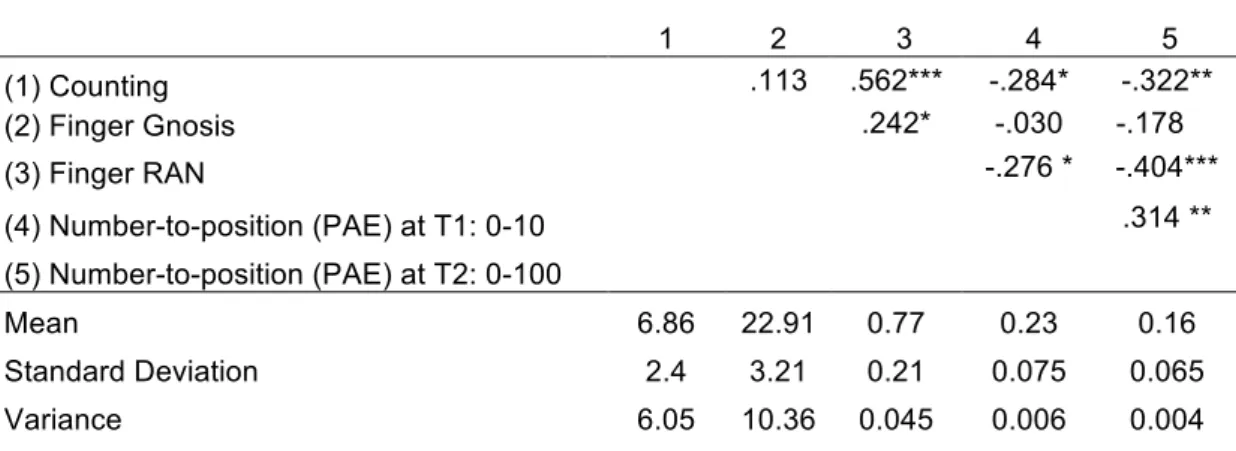
The correlations and descriptive statistics are reported in Table 1. At both measurement points (T1 and T2), number line estimations (i.e., ranging from 0 to 10 at T1 and from 0 to 100 at T2) correlated both with counting skills and with finger RAN but not with finger gnosis. Counting correlated with finger RAN. Finger gnosis did not correlate with any other variable but finger RAN.
Table 1: Pearson correlation coefficients and descriptive statistics.
1 2 3 4 5 (1) Counting .113 .562*** -.284* -.322** (2) Finger Gnosis .242* -.030 -.178 (3) Finger RAN -.276 * -.404*** (4) Number-to-position (PAE) at T1: 0-10 .314 ** (5) Number-to-position (PAE) at T2: 0-100 Mean 6.86 22.91 0.77 0.23 0.16 Standard Deviation 2.4 3.21 0.21 0.075 0.065 Variance 6.05 10.36 0.045 0.006 0.004
Minimum Maximum 0.00 10 14 29 0.25 1.21 0.12 0.46 0.04 0.39
Note: Correlation coefficients significant at p < .05 * and p < .01 **. PAE =
percent of absolute error, RAN = rapid automatized naming
Hierarchical regression analyses were calculated to assess the amount of unique variance in number line estimation that was explained by both finger-related measures (finger RAN, and finger gnosis), controlling for basic counting skills (see Table 2). In step 1, counting was entered into the model to control for the potential effect of counting abilities. In step 2, we included finger gnosis to examine the potential contribution of finger gnosis to the later number line estimations. Finally, finger RAN was entered into the model. Model did not reach significance when the outcome variable was number line estimation at T1,F(3,63) = 2.37, p = .08. However, when number line estimation at T2 was the outcome variable, results revealed that finger RAN uniquely predicted a significant amount of variance in children’s number line estimation one year later, even after controlling for counting and finger gnosis.
Table 2. Summary of the hierarchical regression analysis predicting the number line estimations at T2.
Step Predictor Coefficients t R2
1 Counting skills -.32 -2.74** .10
2 Finger gnosis -.14 -1.214 .12
3 Finger RAN -.30 -2.15* .18
Note: * p < .05, ** p < .01. Model statistics: F(3,63) = 4.72, p = .005.
In order to measure the role of finger RAN as a mediator between counting and later numerical representations, we ran a mediation analysis (Baron & Kenny, 1986). The
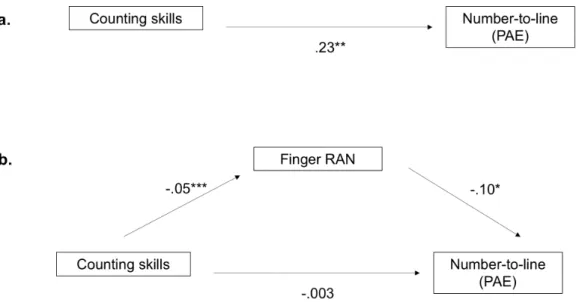
mediation analysis was performed with the PROCESS Procedure version 2.16.3 for SPSS by Hayes (2012) and consisted in testing the direct effect of counting on number line estimations (one year later) and the potential or indirect effect through Finger RAN performances. In a first step, we observed from the simple regression analysis that counting skills predicted number line estimation at T2, R2 = 10%, F (1,65) = 7.50, p = .008, which corresponds to the total effect of the mediation model, Figure 1.a.
In a second step finger RAN was added as mediator variable into the model. Counting skills predicted finger RAN, R2 = 32%, F (1,65) = 30.01, p < .001. Number line estimation at T2 was significantly predicted by Finger RAN (the mediator), t (66) = -2.38, p =.02, but not by counting skills, t (66) = -1.01, p > .10 (see Figure 1b). In other words, finger RAN mediated the direct effect of counting skills on later number line estimation.
Figure 1. Mediation model. a. Counting skills significantly predict number line estimation at T2 (total effect). b. Standardized coefficients of direct effect and indirect effect mediated through finger RAN. Statistical significance is marked as following: * p < .05, ** p < .01, *** p < .001 .
To evaluate the significance of the indirect effect, we relied on the 95% Bias Corrected Bootstrap Confidence Intervals (number of bootstrap samples: 5000), considering that there is an effect when CI does not include zero. There was an indirect effect through the mediator, b
= -.18 CI [-.37, -.04]. The percentage of mediation (PM) obtained by dividing the indirect
effect by the total effect was of 57%. The effect size of the mediator was k2 = .169, which can
be considered as a medium mediation effect (Preacher & Kelley, 2011). Thus, finger RAN clearly mediated the relation between counting skills and number line estimation as counting skills was not predictive of number line estimation at T2 when Finger RAN was added as a mediator variable to the model.
4. Discussion
Previous studies reported inconsistent results regarding the relationship between finger knowledge and numerical representations. A potential source for such inconsistencies could come from the range of various finger-related tasks chosen by different studies. The current study aimed at comparing two measures related to fingers: finger gnosis and finger pattern recognition (i.e., finger RAN) in order to assess the specific contribution of those two different aspects of fingers to number representation development. Our results showed that the finger RAN mediated the predictive relation between counting skills and number line estimations in a number range exceeding the finger range (i.e., 0-100). Indeed, the finger RAN uniquely predicted number line estimation one year later. Although finger RAN and finger gnosis were correlated with each other, finger gnosis did not predict number line estimation. Finger gnosis only correlated with finger RAN. The current study thus highlights that the visual representation of a number as a finger configuration helps to develop accurate numerical representations.
Despite the relation between finger gnosis and finger RAN, we did not find any link between finger gnosis and other numerical skills (i.e., counting and number-to-position tasks). This
result is consistent with recent findings reporting no or very little contribution of finger gnosis to arithmetic skills (Wasner et al., 2016; Long et al. 2016). Those authors concluded that fingers are not relevant to predict arithmetic skills. Similarly, the current results also failed to observe a link between finger gnosis and number skills, though we targeted numerical representations rather than arithmetic skills. The only task that correlated with finger gnosis was the other finger-related task: the finger RAN. This is not so surprising as finger gnosis tasks per se have nothing explicitly numerical but are addressing general sensory identification skills. The seminal study by Fayol and colleagues (1999) concluded that finger skills predicted later arithmetic outcome in a longitudinal setting with similar ages as the current study. However, in that study, finger gnosis assessment consisted in designating the touched fingers by saying aloud the corresponding number. This numerical association to fingers might be at least partially responsible for the predictive aspect of their task for later arithmetic. Another parameter to take into account is the age of the children. Indeed, tactile locations are still not completely mature in 5-year-olds (Benton 1955, Chinello et al., 2013). The only study assessing finger gnosis without a “numerical” response and still showing a link to arithmetic skills was done in older children who performed finger gnosis nearly at ceiling (Noël, 2005). Identifying one’s own fingers may thus refine over time and potentially enhance with numerosity acquisition. Indeed, following the same idea that acquiring symbolic numbers refines the numerical representations in general (Piazza, Pica, Izard, Spelke, & Dehaene, 2013), learning the correspondence between visual finger configurations and numerosities could enhance finger gnosis in return, though further research will be needed to test this hypothesis.
We found that visual finger pattern recognition was linked to the accuracy of number representations. A study with hemiplegic children, who have limited use of their fingers and
thus both weaker finger gnosis and visual pattern recognition, showed that these children had also poorer numerical symbolic representations but preserved arithmetic and non-symbolic numerical skills (Thevenot et al. 2014). More precisely, their dominant hand was preserved in terms of finger gnosis and these results do not completely disentangle the association of finger gnosis or visual finger configurations and numerical representations. In the current study, we found no direct link between finger gnosis and numerical representations, but the relationship between visual finger pattern recognition and numerical representations suggests that at least an efficient identification of numbers presented as visual finger configuration recognition is associated to accurate representations of number symbols. The fact that non-symbolic and arithmetic skills were not different for hemiplegic children compared to controls in the study of Thevenot and colleagues (2017) supports the idea that the principle of representing small magnitudes as a configuration of fingers rather than “counting on fingers” is specifically helpful to ensure a smooth transition from non-symbolic to symbolic numerical representation.
An apparent limitation of the finger RAN is the fact that it does not dissociate visual finger pattern recognition from subitizing (i.e., accessing directly the number of "items" for numbers below 5). A previous study using both finger RAN and dice RAN (i.e., visual dice pattern recognition) showed that finger RAN but not dice RAN was a unique predictor of first graders' arithmetic performance (Hornung et al., 2017). Moreover, another study by Lafay and colleagues (2013) compared three groups of children ranging from 4 to 7 years old in a task of canonical vs. non-canonical finger pattern recognition. Their younger group was slower for both canonical and non-canonical finger configurations, suggesting a potential mixture of counting and recognition. However, children of the intermediate group onwards showed much faster response times for canonical than non-canonical finger configuration
suggesting that they did not longer need to count the fingers in the canonical configurations. Crucially, as the children of the current study were tested at almost the same age as Lafay and colleagues’ intermediate group (M = 5.6 years vs. M = 5.7 years), children of that age should be able to recognize canonical finger configurations as those presented in our study. According to these results, it is unlikely that the finger RAN can be reduced to counting or subitizing processes, at least in 5 year-olds.
It is important to mention that Finger RAN uniquely predicted accuracy to represent larger numbers one year later, even out of the range of the presented finger configurations (i.e., 0 to 100). Finger RAN even mediated the relation between counting and later number line estimations. Crucially, counting as assessed in the current study is a combination of reciting the number list and being able to go backward and forward this list. In any case, this task was only verbal without any link to the number symbols. Counting might be necessary but not sufficient to accurately relate number symbols to the quantities they represent. The recognition of small finger patterns might be the first stage of transition between non-symbolic and non-symbolic numerical quantity abstraction leading to cardinal principle understanding. One quantity is represented by one fixed configuration of fingers, and later by a precise digit symbol or combination of symbols. Indeed, learning the association between number names and small quantities up to 4 is a long process (Sarnecka & Carey, 2008; Benoit, Lehalle, Milona, Tijus, & Jouen, 2013) partially due to the difficulty to understand the concept of cardinality. Previous authors suggested that fingers could ensure an efficient transition between non-symbolic and symbolic systems (Seron & Fayol, 2005; Andres et al., 2008). Guedin and colleagues (2017) suggested that representations of fingers constitute an analog support to the abstract concept of cardinality. Our results corroborate this hypothesis by showing that efficient processing of visual finger patterns contributes to future accurate
number representations. Our results are also coherent with the idea that visual finger patterns could work as an additional visual code that is intuitive and “analogic” to discrete quantities ensuring an optimal transition to symbolic numbers. Fingers are an easy way to visualize quantities in an analogic way. From the age of 5 years onwards, children also become sensitive to the “canonicity” of finger patterns: usual finger patterns are better recognized than unusual finger patterns (Di Luca et al. 2010; Lafay, Thevenot, Castel, & Fayol, 2013). Importantly, although finger-related skills are linked to some extent to numerical development, the use of fingers is rather useful than mandatory to achieve successful numerical learning. When fingers are used, they could have an intermediate status in between a non-symbolic (analogic) and symbolic visual code.
Roesch and Moeller (2015) recently proposed to integrate “fingers” to existing numerical development models because they are relevant at each stage of numerical development. In this line, our results further suggest that finger gnosis and visual coding of finger patterns have distinct relation to numerical representation development. More specifically, the present results support that visual finger pattern recognition at 5-year old may play a crucial role in numerical development, as we found a relationship between visual finger-based representations and the development of numerical representations, even out of the 0-10 range corresponding to the number of fingers. Although visual recognition of finger patterns might play a role since early on (5 year olds), we did not find any association between finger gnosis and numerical representations at that age. This does not preclude finger gnosis from any role in numerical learning, namely later with the maturation of the tactile locations. Indeed, Lafay and colleagues (2013) showed that spontaneous use of fingers increased with age so that most children used fingers in primary school (one year later as the children in T1 of the current study). Thus, at the age of 5, the role of fingers might be to ensure a transition between
non-symbolic and non-symbolic numbers by providing a support that is in between both: a finger configuration has a certain number of fingers depicted but the visual canonicity becomes important shifting to something more symbolic than non-symbolic around the end of kindergarten. As fingers may support different functions at different stages, it remains possible that finger gnosis support other aspects of numerical learning at later stages. Tracking the relationship between visual finger representations and finger gnosis in future longitudinal studies could shed new light onto the developmental trajectories of numbers ‘embodiment’ in fingers.
In conclusion, the current study highlights the link between visual finger pattern recognition and accurate number representations. We used finger RAN to complete the classical assessment of finger gnosis in order to link fingers to numerical development. We provide evidence that visual finger patterns help to establish accurate symbolic numerical representations, which constitute an important step in numerical development.
5. Acknowledgment
We gratefully thank Michèle Menez and Thérèse Vuong for her careful data collection. We thank the children, their parents and schools for their participation. This research did not receive any specific grant from funding agencies in the public, commercial, or not-for-profit sectors.
6. References
Andres, M., Di Luca, S., & Pesenti, M. (2008). Finger counting: The missing tool? Behavioral and Brain Sciences, 31(6), 642. doi: 10.1017/S0140525X08005578
Andres, M., Michaux, N., & Pesenti, M. (2012). Common substrate for mental arithmetic and finger representation in the parietal cortex. Neuroimage, 62(3), 1520-1528. doi:
10.1016/j.neuroimage.2012.05.047
Baron, R. M., & Kenny, D. A. (1986). The moderator-mediator variable distinction in social psychological research: Conceptual, strategic and statistical considerations. Journal of Personality and Social Psychology, 51, 1173-1182.
Benoit, L., Lehalle, H., Molina, M., Tijus, C., & Jouen, F. (2013). Young children’s mapping between arrays, number words, and digits. Cognition, 129(1), 95–101. doi:
10.1016/j.cognition.2013.06.005
Benton, A. L. (1955). Right-left discrimination and finger localization in defective children. Archives of Neurology & Psychiatry, 74, 583–589.
doi:10.1001/archneurpsyc.1955.02330180001001
Berteletti, I., & Booth, J. R. (2015). Perceiving fingers in single-digit arithmetic problems. Frontiers in Psychology, 6. doi: 10.3389/fpsyg.2015.00226
Butterworth, B. (1999). The mathematical brain. London: Macmillan.
Chinello, A., Cattani, V., Bonfiglioli, C., Dehaene, S., & Piazza, M. (2013). Objects, numbers, fingers, space: clustering of ventral and dorsal functions in young children and adults. Developmental Science, 16(3), 377–393. https://doi.org/10.1111/desc.12028
Cornu, V., Schiltz, C., Martin, R., & Hornung, C. (2018). Visuo-spatial abilities are key for young children’s verbal number skills. Journal of Experimental Child Psychology, 166, 604–620. doi: 10.1016/j.jecp.2017.09.006
Costa, A. J., Silva, J. B. L., Pinheiro-Chagas, P. P., Krinzinger, H., Lonneman, J., Willmes, K., Wood, G., & Haase V. G. (2011). A hand full of numbers: a role for offloading in arithmetics learning? Frontiers in Psychology, 2, 368. doi: 10.3389/fpsyg.2011.00368
Crollen, V., Mahe, R., Collignon, O., & Seron, X. (2011). The role of vision in the development of finger–number interactions: Finger-counting and finger-montring in blind children. Journal of Experimental Child Psychology, 109(4), 525–539. doi: 10.1016/j.jecp.2011.03.011
Denckla, M. B., and Rudel, R. (1974). Rapid “automatized” naming of pictures, objects, colors, and letters, and numbers by normal children. Cortex 10, 186–202. doi: 10.1016/S0010-9452(74)80009-2
Di Luca, S., Granà, A., Semenza, C., Seron, X., & Pesenti, M. (2006). Finger–digit compatibility in Arabic numeral processing. Quarterly Journal of Experimental Psychology, 59(9), 1648-1663. doi: 10.1080/17470210500256839
Di Luca, S., Lefèvre, N., & Pesenti, M. (2010). Place and summation coding for canonical and non-canonical finger numeral representations. Cognition, 117(1), 95-100. doi:
10.1016/j.cognition.2010.06.008
Fayol, M., Barrouillet, P., & Marinthe, C. (1998). Predicting arithmetical achievement from neuro-psychological performance: a longitudinal study. Cognition, 68, B63–B70. doi: 10.1016/S0010-0277(98)00046-8
Fayol, M., & Seron, X. (2005). About numerical representations: Insights from
neuropsychological, experimental, and developmental studies. In J. I. D. Campbell (Ed.), Handbook of mathematical cognition (pp. 3-22). New York, NY, US: Psychology Press.
Geary, D. C. (2011). Cognitive predictors of achievement growth in mathematics: A 5-year longitudinal study. Developmental Psychology, 47(6), 1539–1552. doi: 10.1037/a0025510 Georgiou, G. K., Tziraki, N., Manolitsis, G., & Fella, A. (2013). Is rapid automatized naming
related to reading and mathematics for the same reason(s)? A follow-up study from kindergarten to Grade 1. Journal of Experimental Child Psychology, 115(3), 481–496. https://doi.org/10.1016/j.jecp.2013.01.004
Gerstmann, J. (1940). Syndrome of finger agnosia, disorientation for right and left, agraphia and acalculia: local diagnostic value. Archives of Neurology & Psychiatry, 44(2), 398. doi: 10.1001/archneurpsyc.1940.02280080158009
Gracia-Bafalluy, M., & Noël, M. P. (2008). Does finger training increase young children’s numerical performance? Cortex, 44, 368–375. doi: 10.1016/j.cortex.2007.08.020
Guedin, N., Thevenot, C., & Fayol, M. (2017). Des doigts et des nombres. Psychologie Française. doi: 10.1016/j.psfr.2017.07.001
Hayes, A. F. (2012). PROCESS: A versatile computational tool for observed variable mediation, moderation, and conditional process modeling. Retrieved from
http://is.muni.cz/el/1423/podzim2014/PSY704/50497615/hayes_2012_navod_process.pdf Hornung, C., Martin, R., & Fayol, M. (2017). General and Specific Contributions of RAN to
Reading and Arithmetic Fluency in First Graders: A Longitudinal Latent Variable Approach. Frontiers in Psychology, 8. doi: 10.3389/fpsyg.2017.01746
Hornung, C., Schiltz, C., Brunner, M., & Martin, R. (2014). Predicting first-grade mathematics achievement: the contributions of domain-general cognitive abilities, nonverbal number sense, and early number competence. Frontiers in Psychology, 5, 272. doi:
10.3389/fpsyg.2014.00272
Imbo, I., Vandierendonck, A., & Fias, W. (2011). Passive hand movements disrupt adults’ counting strategies. Frontiers in Psychology, 2. doi: 10.3389/fpsyg.2011.00201
Lafay, A., Thevenot, C., Castel, C., & Fayol, M. (2013). The role of fingers in number processing in young children. Frontiers in Psychology, 4. doi: 10.3389/fpsyg.2013.00488
Krinzinger, H., Koten, J. W., Horoufchin, H., Kohn, N., Arndt, D., Sahr, K., … Willmes, K. (2011). The Role of Finger Representations and Saccades for Number Processing: An fMRI Study in Children. Frontiers in Psychology, 2. https://doi.org/10.3389/fpsyg.2011.00373 Long, I., Malone, S. A., Tolan, A., Burgoyne, K., Heron-Delaney, M., Witteveen, K., & Hulme, C.
(2016). The cognitive foundations of early arithmetic skills: It is counting and number judgment, but not finger gnosis, that count. Journal of Experimental Child Psychology, 152, 327–334. doi: 10.1016/j.jecp.2016.08.005
Noël, M. P. (2005). Finger gnosia: A predictor of numerical abilities in children? Child Neuropsychology, 11, 413–430. doi: 10.1080/09297040590951550
Penner-Wilger, M., & Anderson, M. L. (2013). The relation between finger gnosis and
mathematical ability: why redeployment of neural circuits best explains the finding. Frontiers in Psychology, 4. https://doi.org/10.3389/fpsyg.2013.00877
Piazza, M., Pica, P., Izard, V., Spelke, E. S., & Dehaene, S. (2013). Education Enhances the Acuity of the Nonverbal Approximate Number System. Psychological Science, 24(6), 1037–1043. doi: 10.1177/0956797612464057
Preacher, K. J. & Kelley, K. (2011). Effect sizes measures for mediation models: Quantitative strategies for communicating indirect effects. Psychological Methods, 16(2), 93-115. doi: 10.1037/a0022658
Reeve, R., & Humberstone, J. (2011). Five-to 7-year-olds’ finger gnosia and calculation abilities. Frontiers in Psychology, 2, 359. doi: 10.3389/fpsyg.2011.00359
Roesch, S., & Moeller, K. (2015). Considering digits in a current model of numerical development. Frontiers in Human Neuroscience, 8. doi: 10.3389/fnhum.2014.01062
Rousselle, L., Dembour, G., & Noël, M.-P. (2013). Magnitude Representations in Williams Syndrome: Differential Acuity in Time, Space and Number Processing. PLoS ONE, 8(8), e72621. doi: 10.1371/journal.pone.0072621
Rusconi, E., Pinel, P., Dehaene, S., & Kleinschmidt, A. (2010). The enigma of Gerstmann’s syndrome revisited: a telling tale of the vicissitudes of neuropsychology. Brain, 133(2), 320– 332. https://doi.org/10.1093/brain/awp281
Sarnecka, B. W., & Carey, S. (2008). How counting represents number: what children must learn and when they learn it. Cognition, 108, 662–674. doi: 10.1016/j.cognition.2008.05.007 Sato, M., Cattaneo, L., Rizzolatti, G., & Gallese, V. (2007). Numbers within our hands:
modulation of corticospinal excitability of hand muscles during numerical judgment. Journal of Cognitive Neuroscience, 19(4), 684–693. doi: 10.1162/jocn.2007.19.4.684
Schneider, M., Merz, S., Stricker, J., De Smedt, B., Torbeyns, J., Verschaffel, L., & Luwel, K. (2018). Associations of Number Line Estimation With Mathematical Competence: A Meta-analysis. Child Development. doi: 10.1111/cdev.13068
Siegler, R. S., & Opfer, J. E. (2003). The development of numerical estimation: Evidence for multiple representations of numerical quantity. Psychological Science, 14(3), 237–250. doi : 10.1111/1467-9280.02438
Simms, V., Clayton, S., Cragg, L., Gilmore, C., & Johnson, S. (2016). Explaining the relationship between number line estimation and mathematical achievement: The role of visuomotor integration and visuospatial skills. Journal of Experimental Child Psychology, 145, 22–33. doi: 10.1016/j.jecp.2015.12.004
Thevenot, C., Castel, C., Danjon, J., Renaud, O., Ballaz, C., Baggioni, L., & Fluss, J. (2014). Numerical Abilities in Children With Congenital Hemiplegia: An Investigation of the Role of Finger Use in Number Processing. Developmental Neuropsychology, 39(2), 88–100. doi: 10.1080/87565641.2013.860979
Turconi, E., & Seron, X. (2002). Dissociation between order and quantity meanings in a patient with Gerstmann syndrome. Cortex, 38(5), 911–914. doi : 10.1016/S0010-9452(08)70069-8 Wasner, M., Nuerk, H. C., Martignon, L., Roesch, S., & Moeller, K. (2016). Finger gnosis
predicts a unique but small part of variance in initial arithmetic performance. Journal of Experimental Child Psychology, 146, 1–16. doi: 10.1016/j.jecp.2016.01.006