HAL Id: hal-01765187
https://hal.univ-lorraine.fr/hal-01765187
Submitted on 20 Nov 2020
HAL is a multi-disciplinary open access
archive for the deposit and dissemination of
sci-entific research documents, whether they are
pub-lished or not. The documents may come from
teaching and research institutions in France or
abroad, or from public or private research centers.
L’archive ouverte pluridisciplinaire HAL, est
destinée au dépôt et à la diffusion de documents
scientifiques de niveau recherche, publiés ou non,
émanant des établissements d’enseignement et de
recherche français ou étrangers, des laboratoires
publics ou privés.
Distributed under a Creative Commons Attribution - NoDerivatives| 4.0 International
License
Abnormal lithium isotope composition from the ancient
lithospheric mantle beneath the North China Craton
Yan Tang, Hong-Fu Zhang, Etienne Deloule, Ben-Xun Su, Ji-Feng Ying, M.
Santosh, Yan Xiao
To cite this version:
Yan Tang, Hong-Fu Zhang, Etienne Deloule, Ben-Xun Su, Ji-Feng Ying, et al.. Abnormal lithium
isotope composition from the ancient lithospheric mantle beneath the North China Craton. Scientific
Reports, Nature Publishing Group, 2015, 4 (1), pp.4274. �10.1038/srep04274�. �hal-01765187�
Abnormal lithium isotope composition
from the ancient lithospheric mantle
beneath the North China Craton
Yan-Jie Tang
1, Hong-Fu Zhang
1,2, Etienne Deloule
3, Ben-Xun Su
1, Ji-Feng Ying
1, M. Santosh
4& Yan Xiao
1 1State Key Laboratory of Lithospheric Evolution, Institute of Geology and Geophysics, Chinese Academy of Sciences, P.O. Box9825, Beijing 100029, China,2State Key Laboratory of Continental Dynamics, Department of Geology, Northwest University,
Xi’an 710069, China,3Centre National de la Recherche Scientifique, CRPG, BP20, 54501 Vandoeuvre- Les-Nancy Cedex, France, 4School of Earth Science and Resources, China University of Geosciences, Beijing 100083, China.
Lithium elemental and isotopic compositions of olivines in peridotite xenoliths from Hebi in the North
China Craton provide direct evidence for the highly variable d
7Li in Archean lithospheric mantle. The d
7Li in
the cores of olivines from the Hebi high-Mg# peridotites (Fo . 91) show extreme variation from 227 to
121, in marked deviation from the d
7Li range of fresh MORB (11.6 to 15.6) although the Li abundances of
the olivines are within the range of normal mantle (1–2 ppm). The Li abundances and d
7Li characteristics of
the Hebi olivines could not have been produced by recent diffusive-driven isotopic fractionation of Li and
therefore the d
7Li in the cores of these olivines record the isotopic signature of the subcontinental
lithospheric mantle. Our data demonstrate that abnormal d
7Li may be preserved in the ancient lithospheric
mantle as observed in our study from the central North China Craton, which suggest that the subcontinental
lithospheric mantle has experienced modification of fluid/melt derived from recycled oceanic crust.
L
ithium has proven to be an important geochemical tracer for fluid-related processes in the Earth’s surface as
well as crust-mantle recycling
1,2because of its moderate incompatibility during mantle melting
3, strong fluid
mobility
4, and the large mass fractionation, with up to 80% variation of
7Li/
6Li in terrestrial samples
1. In
contrast to the large variations in Li isotope compositions of the Earth’s surface environments, the d
7Li of mantle
is more restricted, in the range of about 14 6 2 as inferred from relatively pristine olivines and fresh MORB
5–8.
The Li isotopic heterogeneity in the mantle caused by fluid/melt-rock interaction can be rehomogenized by
diffusion over geologically short time periods due to the fast diffusion of Li
7,9–14, and thus the mantle is broadly
characterized by homogeneous Li isotope composition. However, several studies have suggested the existence of
abnormal d
7Li in the mantle, such as high d
7Li (up to 17.9) of HIMU lavas
15,16, and low d
7Li (lower than 27.0) of
mantle-derived minerals
17–20and lavas
21, which are considered to result from isotope fractionation during the
dehydration of subducted oceanic crust
22,23. To date, the data on abnormal d
7Li are mainly recorded from indirect
samples of the mantle or directly on clinopyroxene separates in peridotites, although the latter are susceptible to
recent diffusive fractionation of Li isotopes during the entrainment and transportation of the xenoliths by host
magma due to the much faster diffusion of Li in pyroxene than in olivine
9,24,25. In contrast, the Li isotope
compositions in the cores of large olivine grains from peridotite xenoliths, which represent direct samples of
the upper mantle, provide more robust signature of the lithospheric mantle.
In this study, we report the anomalous Li isotope compositions of olivines in a suite of peridotite xenoliths from
the Hebi locality in the central North China Craton, one of the world’s oldest continental nuclei
26(Fig. 1). Our
data bring out the largest variation in d
7Li values among those published for olivines from peridotite
xeno-liths
7,27,28, and demonstrate the existence of abnormal d
7Li in the ancient subcontinental lithospheric mantle.
Results
The peridotite xenoliths in the Hebi Cenozoic basalts (about 4 Ma) of present study are remarkably fresh and
about 5 cm in diameter. They are coarse-grained with olivine grains typically ranging in size from 3 to 6 mm in
diameter, with a maximum up to 10 mm. Compositionally, the rocks are dominantly high-Mg# (Fo . 91)
harzburgites with one low-Mg# (Fo , 91) lherzolite (HB29; Supplementary Table 1). The high-Mg# harzburgite
xenoliths have been interpreted as shallow relics of the Archean cratonic mantle beneath the North China Craton
and the low-Mg# lherzolite may represent the newly-formed
29or modified lithospheric mantle
30. The olivines in
SUBJECT AREAS:
GEOCHEMISTRY GEOLOGY SOLID EARTH SCIENCES
Received
20 December 2013
Accepted
14 February 2014
Published
4 March 2014
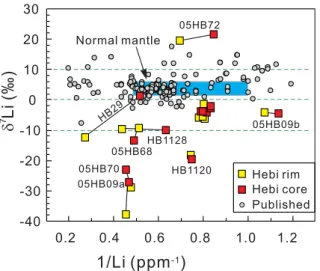
Correspondence and requests for materials should be addressed to Y.-J.T. (tangyanjie@ mail.igcas.ac.cn)the high-Mg# harzburgites show highly variable d
7Li. The grain cores
have Li abundances of 0.9 to 2.2 ppm and d
7Li ranging from 227 to
122 and of the rims show 0.9 to 2.3 ppm and d
7Li of 238 to 120,
respectively. The Li abundance and d
7Li of olivine in the low-Mg#
lherzolite are 1.9 ppm and 11.2 in the core and 3.6 ppm and 213 in
the rim, showing high-d
7Li core with lower Li abundance as
com-pared to the low-d
7Li rim (Fig. 2).
Discussion
The
6Li is predicted to have high diffusivity, about 3% faster than
7Li
based due to a mass difference of 16.7%
31. Thus, large Li isotopic
fractionations can be produced by diffusion during processes of
fluid/melt-rock reaction
7,10,32. Hence, diffusion-driven fractionation
of Li isotopes has been invoked to explain the Li isotopic variations in
peridotites, a process that could occur during rock-melt/fluid
reac-tion prior to or coincident with the entrainment into host magmas
and the transport of the mantle xenolith to the surface
10,13,33–35, as well
as during the cooling of peridotites
12,14,36. The results of diffusive
fractionation are reflected in the variations of d
7Li from meter to
micron scale
7,9,19,32,37. Thus, an important point to evaluate is whether
the d
7Li values obtained from the olivines provide robust signature of
the lithospheric mantle.
Modeling of diffusive fractionation of Li isotopes generally
assumes ingress of Li into rocks or minerals from a source of Li, such
as Li diffusing into peridotite from melt
32, Li diffusing into country
rocks from Li-rich pegmatite
37, or into clinopyroxene from
coexist-ing olivine durcoexist-ing coolcoexist-ing of peridotites
14. In the case of Li addition to
peridotites, the mantle minerals first become enriched in
6Li because
of its greater diffusion rate than
7Li, leading to low d
7Li relative to its
precursor. This mechanism can account for the observations of
iso-topically heavy cores with lower Li concentrations than the light rims
of minerals
7,10,25, such as the case of the low-Mg# sample HB29 in our
present study (Fig. 2), and suggest recent diffusive ingress of Li into
the rim of olivine. However, the model of diffusive ingress of Li does
not adequately explain the characteristics of Li abundances and d
7Li
of olivines in the high-Mg# peridotites because (1) the Li content
does not show enrichment, and the values are close to that of the
normal mantle of 1–2 ppm
38,39; (2) there is no apparent difference in
Li abundances and d
7Li between the rims and the cores of most
olivines from the high-Mg# samples; and (3) olivine from the sample
05HB72 has a Li abundance of 1 ppm and much higher d
7Li (120)
than the normal mantle, further excluding the possibility of recent
diffusive ingress of Li.
In the case of Li diffusion into clinopyroxene from coexisting
olivine during the cooling of peridotites, the olivine should have a
d
7Li value that is significantly higher than the normal mantle
36.
However, most of the samples in our study show very low d
7Li in
olivines. This contradiction excludes the possibility that the d
7Li of
olivines are the results of diffusive fractionation of Li isotopes during
the cooling of peridotites.
We therefore conclude that the d
7Li in the cores of large olivine
grains from the Hebi peridotites reflect the signatures of the
litho-spheric mantle beneath the North China Craton. Compared to the
published d
7Li of olivines from worldwide peridotites (Fig. 3), the
d
7Li in the cores of olivines from the Hebi peridotites show extreme
variation from 227 to 121, far beyond the d
7Li range (11.6 to 15.6)
of fresh MORB
8. These observations suggest the existence of
abnor-mal d
7Li in the old lithospheric mantle beneath the craton.
Another important question to be addressed relates to whether the
survival of d
7Li anomaly in the mantle over a long time scale is
theoretically possible. Equilibration temperatures for the Hebi
peri-dotites have been estimated using two-pyroxene thermometer of
Wells
40as recommended in Zheng et al.
29. The estimated equilibrium
temperatures of the harzburgites vary from about 900 to 1150uC and
that of the lherzolite is 1020uC, which are consistent with those
estimated previously for the peridotites from the same locality
29.
The partitioning experiments of Li between plagioclase and
clino-pyroxene showed that Li preferentially partitions into clinoclino-pyroxene
as temperature decreases between 900 and 1200uC
41. As a result, we
infer that the estimated equilibrium temperatures exceed the closure
temperatures for Li in clinopyroxene and the system of Li in the
peridotite remains open although the closure temperature for Li in
olivine is unknown. At the estimated mantle temperatures, Li
hetero-geneities are likely to be rehomogenized through time
11. However,
based on experimental studies, Dohmen et al.
24proposed two
mechanisms of Li diffusion, a fast (interstitial site) mechanism and
a slow (vacancy, octahedral site) mechanism, and suggested that the
former is unlikely to be dominant in most natural systems. The
diffusion of Li in the slow mechanism is about an order of magnitude
faster than that of Fe, Mg and most other divalent cations in olivine;
such diffusion of Li in olivine will be much slower than that in
clinopyroxene at the same conditions
24. Another study of an olivine
xenocryst suggested that the diffusion coefficients of Li in olivine fell
within a factor of three of the Mg-Fe interdiffusion coefficient
42. This
Western
Block North
Trans-China Orogen Eastern Block Yangtze Block Qinling-Dabie UH P Belt
Central Asia Orogenic Belt
Beijing Fuxian Mengyin 200 km 110°E 110°E 30°N 40°N 120°E 130°E Bohai Sea 1000 km NCC Hebi Paleozoic kimberlite Cenozoic basalt 40°N
Figure 1
|
Sketch map showing the major tectonic units of the North China Craton and the localities of Hebi xenolith and Paleozoic kimberlites (tectonic units revised after Zhao et al.48. The inset shows location of the North China Craton (NCC).Figure 2
|
Variation of d7Li with Li abundances of olivines in the Hebi xenoliths compared to the published data for olivines from worldwide peridotites. Data sources: Seitz et al.5, Magna et al.6, Jeffcoate et al.7, Rudnick and Ionov10, Halama et al.34, Tang et al.18–20, Wagner and Deloule49, Ionov and Seitz12, Aulbach and Rudnick13, Zhang et al.46, Gao et al.36. The field for normal mantle is based on the compositions of relatively pristine olivines and fresh MORB5–8. The dashed lines link the core and rim of each olivine.is generally in agreement with the experimental observations that the
diffusion of Li into olivine is similar to that of divalent cations
9,24,43.
Calculations based on the diffusion coefficient of Li in clinopyroxene
suggested that a kilometer-thick altered oceanic crust could lose most
of the excess Li in a few tens of millions years
11. On the other hand,
the rocks can preserve
7Li/
6Li distinctive from the ambient mantle
over a time period over 1,500 Ma
16regardless of the model based on
the fast mechanism of diffusion
41. A recent experimental study shows
that very large Li isotopic fractionations persisted after the Li
con-centration had become effectively homogenized, which suggests that
it takes much longer for the isotopic composition to become uniform
compared to the time it takes for diffusion to homogenize the Li
concentration
25. Therefore, the survival of d
7Li anomaly in the
man-tle over a relatively long time scale is possible, as also evidenced from
Li isotopic variations in the Trinity Ophiolite
32and peridotite
xeno-liths from the northeastern North China Craton
20.
It has been proposed that abnormal d
7Li in lithospheric mantle
could be produced by infiltration of mantle peridotites by
isotopi-cally normal fluid/melt derived from the asthenosphere
10,13,32and
d
7Li-anomaly melt/fluid related to subducted slab
16–18,20,21. For the
first possibility, the normal mantle-derived fluid/melt could produce
the d
7Li of olivines higher than 210 (published data in Figs. 2 and 3),
which cannot account for the low d
7Li of 230 in the cores of olivines.
Furthermore, olivines in the peridotites/pyroxenites metasomatized
by the normal mantle-derived fluid/melt should have higher Li
con-tents than that of the normal mantle
20, which is contrast to our
observations. Therefore, the d
7Li-anomaly can be related to the
ducted slab because the fluids released by the dehydration of
sub-ducted slab are rich in
7Li, whereas the slab tends to be depleted in
7Li.
The low-d
7Li component is subducted into the deeper mantle to form
a low-d
7Li reservoir, which could be the potential source of low
d
7Li
22,23. However, it has been proposed that dehydration can only
produce d
7Li decrease of up to 3%, and that the deeply subducted
eclogites possess higher d
7Li than the mantle
44. Thus, the isotopic
composition of the upper mantle with contributions of recycled
components by subduction remains speculative and the mechanism
of origin of abnormal d
7Li in the lithospheric mantle is equivocal.
However, experiments have shown that d
7Li of recycled components
depend on the compositions of subducted materials, and
concom-itant dehydration of metabasic oceanic crust, containing chlorite and
clinopyroxene with Li in six-fold coordination, releases fluids
enriched in Li and
7Li into the fore-arc mantle and thus introduces
a low d
7Li component into the deeper mantle
23,45. Therefore, the
abnormal d
7Li of olivines in the harzburgites indicate that the
sub-continental lithospheric mantle experienced the modification of
fluid/melt derived from recycled oceanic crust.
Methods
Li concentrations and isotopic ratios were measured on gold-coated thin sections using Cameca IMS-1280 ion microprobe at the Institute of Geology and Geophysics, Chinese Academy of Sciences, following the procedures described in Zhang et al.46. Li
isotope compositions are expressed as d7Li (5[(7Li/6Li)
sample/(7Li/6Li)standard21] 3
1000) relative to the National Institute of Standards and Technology standard L-SVEC with7Li/6Li of 12.0192 and shown in Supplementary Table 1. The olivine
sample BZ2947and in-house standard of our Lab, Ol334, were used as standards to
correct the measured data. For the two standards our d7Li are 14.9 6 0.9 and 23.1 6
0.9, respectively, well consistent with the recommended values (14.4 and 23.2) within analytical error. The external 2s errors of the isotope compositions for both the standards and the samples are less than 2.7%, with the majority less than 2.0%. The measured olivine grains in our samples are homogeneous in major elemental compositions at a mineral scale and show Fo values similar to that of the standards. Thus, matrix effect can be excluded in our measurements and the obtained data are reliable.
1. Tomascak, P. B. Developments in the understanding and application of lithium isotopes in the earth and planetary sciences. in Geochemistry of non-traditional stable isotope: Reviews in Mineralogy and Geochemistry, Vol. 55 (eds. Johnson, C. M., Beard, B. I. & Albarede, F.) 153–195 (Mineral Soc. Am., Washington, D.C., 2004).
2. Elliott, T., Thomas, A., Jeffcoate, A. & Niu, Y. L. Lithium isotope evidence for subduction-enriched mantle in the source of mid-ocean-ridge basalts. Nature 443, 565–568 (2006).
3. Brenan, J. M. et al. Behaviour of boron, beryllium and Lithium during melting and crystallization: constraints from mineral-melt partitioning experiments. Geochim. Cosmochim. Acta 62, 2129–2141 (1998).
4. Brenan, J. M., Ryerson, F. J. & Shaw, H. F. The role of aqueous fluids in the slab-to-mantle transfer of boron, beryllium, and lithium during subduction: experiments and models. Geochim. Cosmochim. Acta 62, 3337–3347 (1998).
5. Seitz, H. M., Brey, G. P., Lahaye, Y., Durali, S. & Weyer, S. Lithium isotopic signatures of peridotite xenoliths and isotopic fractionation at high temperature between olivine and pyroxenes. Chem. Geol. 212, 163–177 (2004).
6. Magna, T., Wiechert, U. & Halliday, A. N. New constraints on the lithium isotope compositions of the Moon and terrestrial planets. Earth Planet. Sci. Lett. 243, 336–353 (2006).
7. Jeffcoate, A. B. et al. Li isotope fractionation in peridotites and mafic melts. Geochim. Cosmochim. Acta 71, 202–218 (2007).
8. Tomascak, P. B., Langmuir, C. H., le Roux, P. J. & Shirey, S. B. Lithium isotopes in global mid-ocean ridge basalts. Geochim. Cosmochim. Acta 72, 1626–1637 (2008). 9. Parkinson, I. J., Hammond, S. J., James, R. H. & Rogers, N. W. High-temperature lithium isotope fractionation: Insights from lithium isotope diffusion in magmatic systems. Earth Planet. Sci. Lett. 257, 609–621 (2007).
10. Rudnick, R. L. & Ionov, D. A. Lithium elemental and isotopic disequilibrium in minerals from peridotite xenoliths from far-east Russia: Product of recent melt/ fluid-rock reaction. Earth Planet. Sci. Lett. 256, 278–293 (2007).
11. Halama, R., McDonough, W. F., Rudnick, R. L. & Bell, K. Tracking the lithium isotopic evolution of the mantle using carbonatites. Earth Planet. Sci. Lett. 265, 726–742 (2008).
12. Ionov, D. A. & Seitz, H. M. Lithium abundances and isotopic compositions in mantle xenoliths from subduction and intra-plate settings: Mantle sources vs. eruption histories. Earth Planet. Sci. Lett. 266, 316–331 (2008).
13. Aulbach, S. & Rudnick, R. L. Origins of non-equilibrium lithium isotopic fractionation in xenolithic peridotite minerals: Examples from Tanzania. Chem. Geol. 258, 17–27 (2009).
14. Gallagher, K. & Elliott, T. Fractionation of lithium isotopes in magmatic systems as a natural consequence of cooling. Earth Planet. Sci. Lett. 278, 286–296 (2009). 15. Chan, L. H., Lassiter, J. C., Hauri, E. H., Hart, S. R. & Blusztajn, J. Lithium isotope systematics of lavas from the Cook-Austral Islands: Constraints on the origin of HIMU mantle. Earth Planet. Sci. Lett. 277, 433–442 (2009).
16. Vlaste´lic, I., Koga, K., Chauvel, C., Jacques, G. & Te´louk, P. Survival of lithium isotopic heterogeneities in the mantle supported by HIMU-lavas from Rurutu Island, Austral Chain. Earth Planet. Sci. Lett. 286, 456–466 (2009). 17. Nishio, Y. et al. Lithium isotopic systematics of the mantle-derived ultramafic
xenoliths: implications for EM1 origin. Earth Planet. Sci. Lett. 217, 245–261 (2004).
Figure 3
|
Histograms of d7Li for olivines in the Hebi xenoliths and those from worldwide peridotites. Data sources as in Fig. 2.18. Tang, Y. J. et al. Lithium isotopic systematics of peridotite xenoliths from Hannuoba, North China Craton: Implications for melt-rock interaction in the considerably thinned lithospheric mantle. Geochim. Cosmochim. Acta 71, 4327–4341 (2007).
19. Tang, Y. J., Zhang, H. F., Nakamura, E. & Ying, J. F. Multistage melt/fluid-peridotite interactions in the refertilized lithospheric mantle beneath the North China Craton: constraints from the Li–Sr–Nd isotopic disequilibrium between minerals of peridotite xenoliths. Contrib. Mineral. Petrol. 161, 845–861 (2011). 20. Tang, Y. J. et al. Slab-derived lithium isotopic signatures in mantle xenoliths from
northeastern North China Craton. Lithos 149, 79–90 (2012).
21. Agostini, S., Ryan, J. G., Tonarini, S. & Innocenti, F. Drying and dying of a subducted slab: Coupled Li and B isotope variations in Western Anatolia Cenozoic Volcanism. Earth Planet. Sci. Lett. 272, 139–147 (2008). 22. Zack, T., Tomascak, P. B., Rudnick, R. L., Dalpe´, C. & McDonough, W. F.
Extremely light Li in orogenic eclogites: the role of isotope fractionation during dehydration in subducted oceanic crust. Earth Planet. Sci. Lett. 208, 279–290 (2003).
23. Wunder, B. et al. Lithium isotope fractionation between bearing staurolite, Li-mica and aqueous fluids: An experimental study. Chem. Geol. 238, 277–290 (2007).
24. Dohmen, R., Kasemann, S. A., Coogan, L. & Chakraborty, S. Diffusion of Li in olivine. Part I: Experimental observations and a multi species diffusion model. Geochim. Cosmochim. Acta 74, 274–292 (2010).
25. Richter, F., Watson, B., Chaussidon, M., Mendybaev, R. & Ruscitto, D. Lithium Isotope Fractionation by Diffusion in Minerals. Part 1: Pyroxenes. Geochim. Cosmochim. Acta 126, 352–370 (2014).
26. Liu, D. Y., Nutman, A. P., Compston, W., Wu, J. S. & Shen, Q. H. Remnants of $3800 Ma crust in the Chinese part of the Sino-Korean craton. Geology 20, 339–342 (1992).
27. Bell, D. R., Hervig, R. L. & Buseck, P. R. Li isotope heterogeneity in mantle-derived xenoliths. EOS 85, V51C–0591 (2004).
28. Bell, D. R., Hervig, R. L., Buseck, P. R. & Aulbach, S. Lithium isotope analysis of olivine by SIMS: Calibration of a matrix effect and application to magmatic phenocrysts. Chem. Geol. 258, 5–16 (2009).
29. Zheng, J. P. et al. Relict refractory mantle beneath the eastern North China block: significance for lithosphere evolution. Lithos 57, 43–66 (2001).
30. Tang, Y. J. et al. Highly heterogeneous lithospheric mantle beneath the Central Zone of the North China Craton evolved from Archean mantle through diverse melt refertilization. Gondwana Res. 23, 130–140 (2013).
31. Richter, F. M., Davis, A. M., Depaolo, D. J. & Watson, E. B. Isotope fractionation by chemical diffusion between molten basalts and rhyolite. Geochim. Cosmochim. Acta 67, 3905–3923 (2003).
32. Lundstrom, C. C., Chaussidon, M., Hsui, A. T., Kelemen, P. & Zimmerman, M. Observations of Li isotopic variations in the Trinity Ophiolite: Evidence for isotopic fractionation by diffusion during mantle melting. Geochim. Cosmochim. Acta 69, 735–751 (2005).
33. Aulbach, S., Rudnick, R. L. & McDonough, W. F. Li-Sr-Nd isotope signatures of the plume and cratonic lithospheric mantle beneath the margin of the rifted Tanzanian craton (Labait). Contrib. Mineral. Petrol. 155, 79–92 (2008). 34. Halama, R., Savov, I. P., Rudnick, R. L. & McDonough, W. F. Insights into Li and
Li isotope cycling and sub-arc metasomatism from veined mantle xenoliths, Kamchatka. Contrib. Mineral. Petrol. 158, 197–222 (2009).
35. Pogge von Strandmann, P. A. E. et al. Variations of Li and Mg isotope ratios in bulk chondrites and mantle xenoliths. Geochim. Cosmochim. Acta 75, 5247–5268 (2011).
36. Gao, Y., Snow, J. E., Casey, J. F. & Yu, J. Cooling-induced fractionation of mantle Li isotopes from the ultraslow-spreading Gakkel Ridge. Earth Planet. Sci. Lett. 301, 231–240 (2011).
37. Teng, F.-Z., McDonough, W. F., Rudnick, R. L. & Walker, R. J. Diffusion-driven extreme lithium isotopic fractionation in country rocks of the Tin Mountain pegmatite. Earth Planet. Sci. Lett. 243, 701–710 (2006).
38. Seitz, H. M. & Woodland, A. B. The distribution of lithium in peridotitic and pyroxenitic mantle lithologies - an indicator of magmatic and metasomatic processes. Chem. Geol. 166, 47–64 (2000).
39. Woodland, A. B., Seitz, H. M. & Yaxley, G. M. Varying behaviour of Li in metasomatised spinel peridotite xenoliths from western Victoria, Australia. Lithos 75, 55–66 (2004).
40. Wells, P. R. A. Pyroxene thermometry in simple and complex systems. Contrib. Mineral. Petrol. 62, 129–139 (1977).
41. Coogan, L. A., Kasemann, S. A. & Chakraborty, S. Rates of hydrothermal cooling of new oceanic upper crust derived from lithium-geospeedometry. Earth Planet. Sci. Lett. 240, 415–424 (2005).
42. Qian, Q., O’Neill, H. S. C. & Hermann, J. Comparative diffusion coefficients of major and trace elements in olivine at ,950uC from a xenocryst included in dioritic magma. Geology 38, 331–334 (2010).
43. Spandler, C. & O’Neill, H. Diffusion and partition coefficients of minor and trace elements in San Carlos olivine at 1,300uC with some geochemical implications. Contrib. Mineral. Petrol. 159, 791–818 (2010).
44. Marschall, H. R., Pogge von Strandmann, P. A. E., Seitz, H. M., Elliott, T. & Niu, Y. The lithium isotopic composition of orogenic eclogites and deep subducted slabs. Earth Planet. Sci. Lett. 262, 563–580 (2007).
45. Wunder, B., Meixner, A., Romer, R. L. & Heinrich, W. Temperature-dependent isotopic fractionation of lithium between clinopyroxene and high-pressure hydrous fluids. Contrib. Mineral. Petrol. 151, 112–120 (2006).
46. Zhang, H. F., Deloule, E., Tang, Y. J. & Ying, J. F. Melt/rock interaction in remains of refertilized Archean lithospheric mantle in Jiaodong Peninsula, North China Craton: Li isotopic evidence. Contrib. Mineral. Petrol. 160, 261–277 (2010). 47. Decitre, S. et al. Behavior of Li and its isotopes during serpentinization of oceanic
peridotites. Geochem. Geophy. Geosys. 3, 10.1029/2001GC000178 (2002). 48. Zhao, G. C., Wilde, S. A., Cawood, P. A. & Sun, M. Archean blocks and their
boundaries in the North China Craton: lithological, geochemical, structural and P-T path constraints and tectonic evolution. Precam. Res. 107, 45–73 (2001). 49. Wagner, C. & Deloule, E. Behaviour of Li and its isotopes during metasomatism of
French Massif Central lherzolites. Geochim. Cosmochim. Acta 71, 4279–4296 (2007).
Acknowledgments
This work was financially supported by the National Science Foundation of China (grants: 91214203, 91014007 and 41073028). We thank Xian-Hua Li, Guo-Qiang Tang, Yu Liu and Yan Hu for their assistance in measurement of Li isotopes.
Author contributions
Y.J.T., H.F.Z. and E.D. contributed equally to idea development. Y.J.T. wrote the main text. B.X.S., J.F.Y., M.S. and Y.X. contributed equally to the intellectual growth of this paper.
Additional information
Supplementary informationaccompanies this paper at http://www.nature.com/ scientificreports
Competing financial interests:The authors declare no competing financial interests. How to cite this article:Tang, Y.-J. et al. Abnormal lithium isotope composition from the ancient lithospheric mantle beneath the North China Craton. Sci. Rep. 4, 4274; DOI:10.1038/srep04274 (2014).
This work is licensed under a Creative Commons
Attribution-NonCommercial-ShareAlike 3.0 Unported license. To view a copy of this license, visit http://creativecommons.org/licenses/by-nc-sa/3.0