HAL Id: insu-03093701
https://hal-insu.archives-ouvertes.fr/insu-03093701
Submitted on 4 Jan 2021
HAL is a multi-disciplinary open access
archive for the deposit and dissemination of
sci-entific research documents, whether they are
pub-lished or not. The documents may come from
teaching and research institutions in France or
abroad, or from public or private research centers.
L’archive ouverte pluridisciplinaire HAL, est
destinée au dépôt et à la diffusion de documents
scientifiques de niveau recherche, publiés ou non,
émanant des établissements d’enseignement et de
recherche français ou étrangers, des laboratoires
publics ou privés.
Distributed under a Creative Commons Attribution - NoDerivatives| 4.0 International
License
Abiotic hydrogen generation from biotite-rich granite: A
case study of the Soultz-sous-Forêts geothermal site,
France
Jesica Murray, Alain Clément, Bertrand Fritz, Jean Schmittbuhl, Vincent
Bordmann, Jean-Marc Fleury
To cite this version:
Jesica Murray, Alain Clément, Bertrand Fritz, Jean Schmittbuhl, Vincent Bordmann, et al.. Abiotic
hydrogen generation from biotite-rich granite: A case study of the Soultz-sous-Forêts geothermal site,
France. Applied Geochemistry, Elsevier, 2020, 119, pp.104631. �10.1016/j.apgeochem.2020.104631�.
�insu-03093701�
Applied Geochemistry 119 (2020) 104631
Available online 3 June 2020
0883-2927/© 2020 The Authors. Published by Elsevier Ltd. This is an open access article under the CC BY-NC-ND license
(http://creativecommons.org/licenses/by-nc-nd/4.0/).
Abiotic hydrogen generation from biotite-rich granite: A case study of the
Soultz-sous-For^ets geothermal site, France
Jesica Murray
a,b,*, Alain Cl�ement
a, Bertrand Fritz
a, Jean Schmittbuhl
c, Vincent Bordmann
d,
Jean Marc Fleury
daLHYGES, Universit�e de Strasbourg, EOST, CNRS, 1 rue Blessig, 67084, Strasbourg, France
bCONICET, Instituto de Bio y Geo Ciencias del NOA, Universidad Nacional de Salta, Av. 9 de Julio 14, Rosario de Lerma, Salta, Argentina cIPGS, Universit�e de Strasbourg, EOST, CNRS, 5 rue Ren�e Descartes, 67084, Strasbourg, France
dTOTAL, 2 place Jean Millier, La D�efense 6, 92400, Courbevoie, France
A R T I C L E I N F O
Handling editor. Dr M Liotta
Keywords: Native hydrogen Granitic basement Biotite oxidation Geochemical modelling KIRMAT
Enhanced geothermal system
A B S T R A C T
Investigations on geochemical processes involved in H2 generation in natural reservoirs are important for the
present energy transition from fossil fuels. Most studies related to native H2 focus on the serpentinisation of ultra-
mafic rocks, in which the source of H2 is linked to oxidation of Fe2þ-bearing minerals and a reduction of H2O. In
this study, we investigate abiotic H2 generation from a biotite-rich granite using an approach based on a study
case of the Soultz-sous-For^ets geothermal site in France. Using a geochemical and reactive transport model and an existing database, we simulated the hydrothermal alteration of the granite at 130–200 �C with a redox
po-tential from 100 mV to 300 mV. The simulations show that generation of native H2 is possible in an open
system by hydrothermal alteration of biotite as a source of Fe2þ, which oxidises to Fe3þleading to precipitation
of Fe3þminerals and reduction of Hþ
. The amount of H2 produced depends on the type of Fe2þ/3þminerals which
precipitate. The optimal conditions for H2 generation are related to magnetite precipitation as in the
serpenti-nisation process. We assessed that the upper bound for H2 production for this site is 102 kt per km3 of granite.
This is in case of complete oxidation of all the ferrous iron contained in the biotite of the geothermal reservoir. In practice, only part of this potential may be attained owing to the limited current exploitation methods which are unlikely to result in a complete disequilibrium of the whole biotite. Future research needs to focus on how to reach most of the H2 potential. Simulations with increasing CO2 pressures suggest that CO2 injection can
stim-ulate the H2 production. This study has implications for possible coupling of heat extraction and future
exploitation with H2 production.
1. Introduction
In the new world scenario of global warming and energy transition from fossil fuels, new CO2-free energy sources are necessary. Hydrogen-
gas (H2) can play an important role as either an energy vector or a zero-
carbon source of energy. Research on native H2 generation has been
conducted in different contexts such as the origin of life in submarine environments, the serpentinisation process, and methanogenesis (Charlou et al., 2002; Kelley et al., 2005; McCollom and Seewald, 2013; McDermott et al., 2015; Etiope et al., 2017; Vacquand et al., 2018). The generation process of H2 by serpentinisation in mid-oceanic ridges or in
ophiolitic systems has been studied most often. Several geochemical modelling and batch laboratory experiments using ultramafic rocks have
been conducted to better understand and explain the H2 generation that
occurs during the serpentinisation process (McCollom and Bach, 2009; Klein et al., 2009, 2013; McCollom et al., 2016; Mügler at al., 2016; Miller et al., 2017; Bachaud et al., 2017). Such studies indicate that serpentinisation promotes the formation of H2 under strongly reducing
conditions in which water is reduced to form H2 as Fe2þis oxidised to
Fe3þand is then precipitated in secondary minerals. The generation of
H2 during the serpentinisation process can be represented by reaction 1
(R1) as follows (Klein et al., 2013):
(Mg,Fe)2SiO4 þvH2O ¼ w(Mg,Fe)(OH)2 þx(Mg,Fe)3–Fe(III)(SiFe)2–Fe (III)O5(OH)4 þy Fe3O4 þzH2 (R1)
(olivine þ water ¼ brucite þ serpentine þ magnetite þ H2)
* Corresponding author. 10 rue de Verdun, 67000, Strasbourg, France.
E-mail addresses: [email protected], [email protected] (J. Murray).
Contents lists available at ScienceDirect
Applied Geochemistry
journal homepage: http://www.elsevier.com/locate/apgeochem
https://doi.org/10.1016/j.apgeochem.2020.104631
Other crustal contexts in which abiotic H2 is generated have been
explored less often. An example of this is the Precambrian continental crust. Sherwood Lollar et al. (2014) reported that abiotic processes such as radiolysis and hydration of the Precambrian continental lithosphere (also rich in mafic minerals) have caused global H2 production rates
comparable to those from serpentinisation. Other examples include Precambrian crust fracture systems and thinned-crust basins such as failed-arm rifts, where H2 is associated with the serpentinisation of deep
crust and an alkaline igneous complex (Apps and van de Kamp, 1993; Smith et al., 2005, 2014; Larin et al., 2015; Zgonnik et al., 2015; Gu�elard et al., 2017).
In the present study, we explore specific reactions that could lead to native abiotic H2 generation by hydrothermal alteration of a biotite-rich
granite using an approach based on a case study of the deep granitic basement of the Soultz-sous-For^ets geothermal site in the Upper Rhine Graben, France (Fig. 1a). The Soultz-sous-For^ets site hosts an enhanced geothermal system in which three deep wells 5000 m in depth have been drilled into the granite basement to create a heat exchanger to produce electricity (Fig. 1b; Bresee, 1992; G�erard et al., 2006; Genter et al., 2010; Huenges and Ledru, 2011; Olasolo et al., 2016; Lu, 2018). Several studies indicate the presence of H2 at 0.25–46.3 vol% in the gas phase of
hydrothermal fluids (e.g. Sanjuan et al., 2010). However, its origin is poorly understood, with some interpretations relating its origin to re-actions between the metal tubing material and the brine (Naumann et al., 2000; Pauwels et al., 1993). Our study focuses on biotite-rich granites in which specific primary and secondary minerals have the potential to be oxidised to reduce available protons and produce H2. This
process is similar to that occurring in serpentinisation, in which the oxidation of Fe2þminerals leads to H2 generation. The objective of this
study is to explore the possibilities of abiotic H2 generation by
hydro-thermal alteration of the biotite-rich granite at the Soultz-sous-For^ets site with focus on the alteration of biotite. We use an approach based on geochemical and reactive transport modelling to simulate the reactions between the granite and the in situ saturation of the deep hot brine. The
abundant data available for this site enabled us to build and calibrate our conceptual model and to investigate the effects of temperature, redox conditions, and partial pressure of CO2 (PCO2) variations on H2
generation. Simulations increasing PCO2 values were performed to
simulate artificial injection of CO2.
In this study, we verify whether H2 generation is enhanced by
anthropogenic forced circulations of deep geothermal fluids designed for heat extraction. Accordingly, we focus on the potential production of H2 considering only fluid–mineral interactions and assuming no
inter-action between the CO2 and H2 phases. This configuration assumes that
the H2 phase is trapped in a volume that is spatially different from that of
the CO2 phase. However, both phases, whether in gas, liquid, or super-
critical states, are expected to be in contact with the same mobile aqueous phase. A future study will address the possible mixing of the phases if the storage volume is common for both phases. In this case, the combination of CO2 with H2 could lead to CH4 formation following
Fischer–Tropsch-type (FTT) reactions (Etiope and Sherwood Lollar, 2013).
2. Geological setting
The Soultz-sous-For^ets site was proposed in the late 1980s as a deep geothermal energy pilot site (Villemin and Bergerat, 1987; Bresee, 1992; Le Carlier et al., 1994; G�erard et al., 2006; Genter et al., 2010; Huenges and Ledru, 2011, Olasolo et al., 2016; Lu, 2018). This site exhibits a high heat flux related to a large temperature gradient up to 110 �C/km in the
first kilometre of depth (Pribnow and Schellschmidt, 2000). The tem-perature at depths of 2000–5000 m in the geothermal reservoir, which consists of fractured granite (Fig. 1b), is 130–200 �C according to the
temperature logs of deep wells GPK2, GPK3, and GPK4 (Schindler et al., 2010; Vallier et al., 2019).
Below a Triassic–Quaternary sedimentary sequence of 1400 m in thickness, the basement is composed of three different types of Carboniferous granite, of which porphyritic granite is the most abundant
Fig. 1. (a)-Location of the Soultz-sous-For^ets site in the Upper Rhine graben, France (after Sanjuan et al., 2010). (b)- Lithology profile with depth including the
(Fig. 1 b). All granites have abundant biotite and show different grades of fractured and hydrothermal alteration (Hooijkaas et al., 2006; Dezayes et al., 2005). Two main types of hydrothermal alteration have been identified: propylitic and vein alterations (Traineau et al., 1991; Genter and Traineau, 1992; Led�esert et al., 2010 ; Hooijkaas et al., 2006). The propylitic alteration is related to the last stage of granite crystallisation. It occurs in the granitic matrix and is characterised by replacement of biotite and hornblende with chlorite (chamosite) and transformation of plagioclase into illite, sericite, and calcite. Epidote and hydrogarnet are also present. The vein alteration process is related to water–rock interaction that occurred in the natural fractured system. It strongly modifies the petrographic and petrophysical characteristics of the granite, in which illite, haematite, goethite, quartz, carbonates, and sulphides are typical secondary minerals (Traineau et al., 1991).
The granite hosts a strongly saline Na–Cl brine with total dissolved solids (TDS) values at 99–107 g/l, pH values close to 5, and a maximum temperature of 200 �C measured in situ at 5000 m in depth (Sanjuan
et al., 2010, 2016). The brine is believed to have multiple origins including a mixture of dilute meteoric water and primary brine formed by advanced evaporation of seawater until the halite precipitation stage, with contributions from halite dissolution following successive marine transgression–regression cycles from the Triassic to the Oligocene (Sanjuan et al., 2010, 2016). This geothermal fluid likely originated from Triassic sedimentary formations located at great depth (�4 km) with temperatures close to 225 � 25 �C in the centre of the Rhine
Graben. The He isotopic signatures of the gases associated with these fluids indicate that the thermal anomalies are mainly crustal and not mantle-derived (Sanjuan et al., 2016). According to the U–Th isotope system, the minimum transit time of these deep geothermal brines is about 1000 years (Sanjuan et al., 2016).
In general, the brine has quantities of gas in which the gas/liquid volume ratio at 20 �C and 25 �C is ~20% or higher (Sanjuan et al., 2010,
2016). Among the gases, CO2 with an apparent mixed
sedimentar-y–mantle origin is dominant, at 14.2–89.7 vol % (Sanjuan et al., 2016), followed by N2 at 7.2–48.6 vol %, H2 at 0.83–46.3 vol %, CH4 at 1.2–6.8
vol %, and He at 0.45–2.2 vol %. No trace of H2S was found (Sanjuan
et al., 2010, 2016).
3. Modelling approach
3.1. Conceptual model and modelling strategy
To test the generation of H2 by hydrothermal alteration of the granite
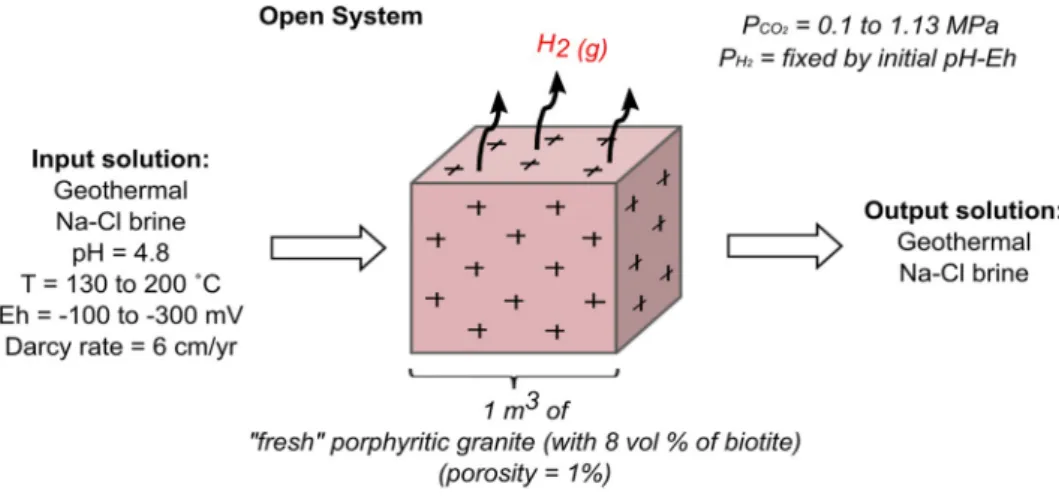
basement at Soultz-sous-For^ets, we simulated the circulation of the hy-drothermal Na–Cl brine through a 1 m3 cube of fresh porphyritic granite
considered to be a representative reactive cell (Fig. 2). We selected porphyritic granite as the reactive rock because this type is the most
abundant granite at the site. The ‘fresh’ designation assumes the granite contains no prior propylitic or vein hydrothermal alterations.
Fig. 3 illustrates the simulations performed in this work. We began with a ‘reference simulation’ considering the composition of a brine at 165 �C and an initial Eh of 245 mV as calculated by Fritz et al. (2010)
for the brine circulating at 3500 m depth in the porphyritic granite domain (Table 1). In subsequent steps, were tested the effects of tem-perature, redox conditions, and PCO2 on H2 generation (Fig. 3). The
effect of temperature was evaluated by exploring the minimum and maximum temperatures of the site, respectively at 130 and 200 �C, using
an initial Eh equal to that of the reference simulation, at 245 mV. In the simulations, the initial Eh value is given as an input parameter. How-ever, this value can vary during simulation depending on the evolution of the solution composition. The effect of the redox potential was tested using the maximum and minimum values, respectively at 100 mV and 300 mV as initial Eh while maintaining constant temperature at 165
�C. The upper limit of 100 mV for the Eh corresponds to the value
estimated by Sanjuan et al. (2010), whereas 300 mV is the lowest value calculated by Fritz et al. (2010). Finally, simulations combining the entire range of temperatures and Eh values were conducted with tem-perature and Eh increments of 10 �C of 50 mV, respectively.
All simulations were conducted considering an open system with respect to the solution and the gas phases. The PCO2 value in the
geothermal system was calculated from the pH and alkalinity of the brine, at 4.8 and 15 meq/kg, respectively (Fritz et al., 2010), according to the thermodynamic equilibrium condition represented in Eq. (1), where [Hþ] is the activity of protons, [CO
3
2 ] is the activity of dissolved
carbonate, and K CO2 is the equilibrium constant for reaction 2 (R2):
[PCO2] ¼ [Hþ]2 [CO32 ]/[KCO2] [H2O] [1]
CO2(g) þ H2O → 2HþþCO32 (R2).
The calculated PCO2 was 0.1 MPa. To evaluate the effect of increased
CO2 in the system as well as its effect on H2 production, simulations were
conducted with increasing values of PCO2. As such, the initial value of
alkalinity was increased successively from 15 meq/kg to 30 meq/kg, 60 meq/kg, and 90 meq/kg (Fig. 3).
In this framework, the partial pressure of H2 (PH2) is assumed to be
constant during the simulations. Under thermodynamic equilibrium,
PH2 is determined at the beginning of the simulation from the initial Eh
and pH, represented in Eq. [2] by the activities of protons [Hþ] and
electrons [e ]. Reaction 3 (R3) describes H2 generation in equilibrium
with a given equilibrium constant (KH2):
[PH2] ¼ [Hþ]2 [e ]2/K H2 [2]
H2 ¼2Hþþ2e (R3)
The concentration of O2 was considered to be very low because we
simulated conditions at depths greater than 3000 m below the surface. The concentrations of N2, CH4, and He were neglected to simplify the
simulations.
3.2. Kinetics of Reaction and Mass Transfer code
Simulations were conducted using the Kinetics of Reaction and Mass Transfer (KIRMAT) numerical code, which couples chemical reaction and mass transfer (G�erard et al., 1998). This code simulates the geochemical reactions that occur during one-dimensional (1D) circula-tion of a fluid through a determined reactive cell to evaluate changes in the mineral composition, porosity, permeability, temperature, Darcy velocity, fluid–rock interaction, thermodynamic equilibrium, precipi-tation and dissolution of minerals. The code also accounts for the feedback effects of the chemical and mineralogical evolutions on the variation of porosity. The KIRMAT code is monophasic, which means that it resolves the mass balance equations for transport associated with geochemical reactions in the liquid phase but does not simulate the transport of the gas produced by the reactions. In open systems, any gas produced is exported outside from the reactive cell (Fig. 2).
3.2.1. Kinetic data
To calculate the dissolution rates of the primary minerals at different pH values KIRMAT uses the following reaction:
rd ¼kdSeffm anHþ[ 1 ((Qm/Km)na)nb] [3]
where rd is the dissolution rate of a mineral m (mol year 1 kg 1w); kd is
the dissolution rate constant (mol m 2 year 1; Table 2); Seffm is the
reactive surface area of the mineral (m2 kg 1w); aHþis the activity of
protons; n is an experimental power, where na and nb are experimental
exponents depending on the pH of the solution; Qm is the ion activity product of the mineral for a given composition of the aqueous solution; and Km is the equilibrium constant for the hydrolysis reaction of the mineral at a given temperature and pressure.
For the kinetic precipitation of minerals, KIRMAT code considers the following expression:
rp ¼kpSeffm [(Qm/Km)p – 1]q [4] where kp is the kinetic rate constant of precipitation (mol m 1 year 1),
and p and q are experimental values describing the dependence of the reaction on the saturation state (Table 3). The kinetic precipitation approach was used for quartz at temperatures lower than 150 �C in
which the initial oversaturation of the mineral was detected by calcu-lating the chemical speciation.
3.2.2. Thermodynamic data
In geochemical modelling, the precipitation of minerals is generally considered to be in thermodynamic equilibrium with the aqueous so-lution. This premise is made owing to the lack of data for kinetic rate laws of precipitation for many minerals and to the assumption of long- term processes at the geological time scale that would enable the sys-tem to return to equilibrium. The thermodynamic data for the minerals selected in this study were taken from the Thermoddem database updated by the French Geological Survey (BRGM Blanc, 2017).
3.3. Input parameters
3.3.1. Primary minerals in the granitic reactive cell
The sets of primary minerals and volume fractions selected for the model are based on the composition of the standard porphyritic granite occurring at the site (Hooijkaas et al., 2006). We consider that the fresh porphyritic granite is composed of plagioclase (albite 35 vol %; anor-thite 4 vol %), quartz (27 vol %), K-feldspar (24 vol %), biotite (8 vol %) and amphibole (2 vol %) (Table 4). Biotite is the most important source of Fe2þ that accounts for H
2 generation in the basement of the
Soultz-sous-For^ets granitic reservoir. Our model uses pure ferrous annite (KFeII3(AlSi3)O10(OH)2) as an end-member of the solid solution
(Table 4). This approximation was used to calculate the maximum possible amount of Fe2þthat could be hosted in biotite and therefore the
maximum potential amount of H2 production.
Fig. 3. Diagram illustrating the simulations performed with KIRMAT for H2 production in the geothermal reservoir of Soultz-sous-For^ets.
Table 1
Initial composition of the hydrothermal brine considered in this model after Fritz et al. (2010). The concentration of Fe and Al were decreased one and two orders of magnitude respectively in order to prevent initial oversaturation of some secondary minerals.
Parameter Molality (mMol/Kg H2O)
Na 1190 K 65.5 Ca 166 Mg 4.17 Cl 1580 Fe 0.0116 Al 7.44 E 05 Alkalinity 15 (meq/Kg) Si 1.8 Temperature 165 (�C) pH 4.8 Eh 245 (mV)
3.3.2. Secondary minerals by hydrothermal alteration of the granite
Secondary minerals are those precipitated by hydrothermal alter-ation of the fresh granite during the simulalter-ations. We selected a set of secondary minerals that have been previously identified in the two types of hydrothermal alteration of the granite, i.e. propylitic and vein alter-ations (Table 5). The number of minerals considered in the simulations should not force the reaction pathways. Accordingly, we introduced numerous phases for the Fe secondary minerals: Fe2þphases including
nontronite, chamosite, and epidote; Fe3þphases including haematite and goethite; and Fe2þ/Fe3þphases including magnetite (Table 5). Thus
if the dissolution of biotite is achieved and Fe2þis released to the
so-lution, the code will choose between the precipitation of Fe2þand Fe3þ secondary minerals according to the Fe speciation (Eh–pH conditions) and the saturation indices of the minerals.
To reduce the complexity of the system related to redox reactions caused by S species, the simulations were made without considering sulphide and sulphates in the sets of secondary phases.
3.3.3. Composition of the geothermal brine
Very little research analyzed the deep geothermal fluids at Soultz- sous-For^ets with no contamination by drilling fluids or injected water (Sanjuan et al., 2010, 2016). In the case of the fluids extracted with a deep auto-sampler, it could have experienced changes between the in situ reservoir and ex situ lab conditions caused by i) equilibration with atmospheric conditions and dissolution of atmospheric O2 with strong
evolution of redox conditions after extraction and sampling; ii) strong temperature evolution between ~165 �C at depth and 20 �C in the lab;
iii) CO2 degassing and consequent evolutions of pH and alkalinity in the
presence of carbonate precipitation. Therefore, the composition of the fluid used in this study corresponds to the values calculated by Fritz et al. (2010) at thermodynamic equilibrium with the mineral phases of the partly cemented hydrothermalised granite facies (Table 1). The Table 2
Kinetic constants for dissolution reactions of primary minerals. Data assessed by the authors from Palandri and Kharaka (2004) data base.
Ka kn kb pHa pHb na nb Ea En Eb
mol m-2 year-1 kJ/mol
T ¼ 130 �C
Quartz 4.84Eþ00 1.86E-02 1.43E-04 4.83 5.83 0.5 0.5 99.2 90.1 108.4 Microcline 6.29E-01 6.67E-04 3.92E-10 5.95 7.60 0.5 0.82 51.7 38 94.1 Anorthite 5.69Eþ04 1.55E-01 1.37E-05 3.95 7.11 1.41 0.57 16.6 17.8 71 Albite 2.02Eþ00 1.33E-02 1.37E-05 4.74 5.24 0.46 0.57 65 69.8 71 Annite 4.64E-02 8.96E-05 8.96E-07 5.12 9.09 0.53 0.22 22 22 22 Tremolite 9.14E-01 1.61Eþ01 – – – – – 18.9 9.44 –
T ¼ 165 �C
Quartz 5.15Eþ01 1.59E-01 1.90E-03 5.02 6.02 0.5 0.5 Microcline 2.16Eþ00 1.65E-03 3.69E-09 6.23 6.89 0.5 0.82 Anorthite 8.46Eþ04 2.37E-01 7.46E-05 3.94 6.14 1.41 0.57 Albite 9.49Eþ00 7.00E-02 7.46E-05 4.64 5.21 0.46 0.57 Annite 7.84E-02 1.51E-04 1.51E-06 5.12 9.09 0.53 0.22 Tremolite 1.43Eþ00 1.52Eþ02 – – – – –
T ¼ 200 �C
Quartz 3.86Eþ02 9.93E-01 1.71E-02 5.18 6.18 0.5 0.5 Microcline 6.16Eþ00 3.57E-03 2.49E-08 6.47 6.29 0.5 0.82 Anorthite 1.18Eþ05 3.40E-01 3.16E-04 3.93 5.32 1.41 0.57 Albite 3.55Eþ01 2.89E-01 3.16E-04 4.54 5.20 0.46 0.57 Annite 1.23E-01 2.37E-04 2.37E-06 5.12 9.09 0.53 0.22 Tremolite 2.11Eþ00 1.04Eþ03 – – – – –
a ¼ acid mechanism. n ¼ neutral mechanism. b ¼ basic mechanism.
E ¼ Arrhenius activation energy.
Note: Due to the lack of valid data of pH limits for tremolite, only kd for acid conditions was used during the simulations.
Table 3
Kinetic constants for precipitation of secondary minerals.
Kp p q
Mineral mol m-2 year-1
Quartz 1.16E-01 (130 �C) 1 1
Quartz 1.67E-01 (140 �C) 1 1 Kinetic constants were calculated following the micro-reversibility law using data from Ganor et al. (2005) and Rimstidt and Barnes (1980).
Table 4
Primary minerals of the granite considered in this study. The ideal stoichiometry is taken from the Thermoddem (BRGM) data base (June-2017). The volume fraction values were taken from the descriptions of the porphyritic granite. Plagioclase is described as albite and anorthite end-members.
Primary mineral Stoichiometry Volume fraction (%) Quartz SiO2 27
Feldespar- K K(AlSi3)O8 24
Anorthite Ca(Al2Si2)O8 4
Albite Na(AlSi3)O8 35
Biotite (annite) KFeII
3(AlSi3)O10(OH)2 8
Amphibole (tremolite) Ca2Mg5Si8O22(OH)2 2
Table 5
Secondary minerals selected for this study, based on the description of vein and propylitic alterations at Soulz-sous-For^ets. The ideal stoichiometry was acquired from Thermoddem (BRGM) data base (June-2017).
Secondary mineral Stoichiometry Alteration type Quartz SiO2 Vein/propylitic
Illite-Al K0.85Al2.85Si3.15O10(OH)2 vein
Montmorrillonite (MgCa) Ca0.17Mg0.34Al1.66Si4O10(OH)2 vein
Montmorrillonite (MgNa) Na0.34Mg0.34Al1.66Si4O10(OH)2 vein
Nontronite (K) K0.34Fe1.67Al0.67Si3.66O10(OH)2 vein
Magnetite-III FeIII
2 FeIIO4 vein
Haematite-III FeIII
2O3 vein
Goethite-III FeIIIO(OH) vein
Epidote Ca2FeIIIAl2Si3O12(OH) propylitic
Chamosite (Chlorite group) FeII
5Al(AlSi3)O10(OH)8 propylitic
Kaolinite Al2Si2O5(OH)4 vein
Calcite CaCO3 propylitic
Dolomite CaMg(CO3)2 vein
calculations were based on the composition of the hydrothermal fluid at 165 �C and pH ¼ 4.8 measured at 3500 m in depth during the 1997
circulation test with no contact with the atmosphere.
To calculate the activity coefficients of the ions, the extended Debye–Hückel law was used. It could be argued that simulations with heavy brine should include Pitzer equations; however, this approach can be applied only in geochemical models for major ions at low or inter-mediate temperatures. In our case, calculations for aqueous trace element activities (Al3þ, Fe2þ, Fe3þ) were needed because they are
crucial for simulating iron and clay mineral–solution interaction. For this reason, we considered that the extended Debye–Hückel law was a better method for calculating the ion activity. In our simulations, the ionic strength values remained almost constant at �1.5, which limited the risk of cumulative error.
3.3.4. Reactor size, porous media, and reactive transport parameters
The volume of rock in the simulation was 1 m3, which is considered
to be a relevant scale for describing the fault network and the major fault thickness in which the fluid circulation is expected to be active. In the simulation, we considered a proxy of the natural fractured granite as a reactive cell in which the minerals and the porosity were homoge-neously distributed throughout the volume (Fig. 2). The average porosity was set to 1% because the porosity of the granite at Soultz-sous- For^ets varies at a wide range of 0.1–10%, where the lowest values correspond to the less-altered zones of the granite, and the highest values correspond to high pervasive and vein alteration zones (Kohl et al., 1995; Surma and G�eraud, 2003; Rosener and G�eraud, 2007; Magnenet et al., 2014). The Darcy velocity selected for this simulation was 6 cm/yr which is a characteristic value of the Darcy velocity dis-tribution in the hydrothermal system (Vallier et al., 2019). The maximum time of the simulation was 250 years. Rather than repro-ducing long-term geological processes of thousands to millions of years, the duration of the simulation was designed to reproduce shorter time scales related to the geothermal exploitation of the wells, at tens to hundreds of years.
3.3.5. Reactive surface area of primary minerals
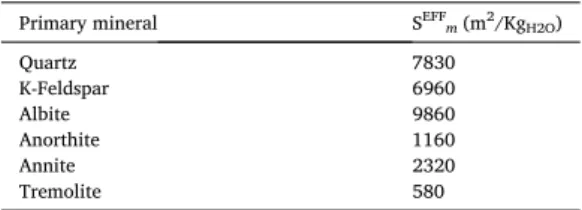
In this study, the reactive surface areas of the primary minerals m (SEFFm in m2/kgH2O) were calculated using Eq. (5) with the specific
surface area of the granite (Ssg in m2/m3 of rock) measured by Rosener
and G�eraud (2007), the volume fraction (Vfm) of each primary mineral, and the granite porosity (ω):
SEFF m ¼Vfm * (Ssg)/(1000 *ω) [5]
The SEFFm values calculated for the primary minerals are shown in
Table 6 and were considered as constant during the simulation. The 1000 conversion factor in Eq. (5) was used to convert the aqueous so-lution from cubic metres to cubic decimetres.
4. Results
4.1. Production of H2 at 165 �C and 245 mV
Generation of H2 was observed in the reference simulation, in which
the brine circulated through the granitic reactor at T ¼ 165 �C and an
initial Eh value of 245 mV (Fig. 4a). The Fe-bearing mineral phases involved in the generation of H2 were biotite and magnetite (Fig. 4b and
c). Biotite dissolves and releases Fe2þto the solution. In an aqueous
solution, the partial or total oxidation of Fe2þto Fe3þprovides electrons
(e ) (R4) which in an O2-free environment will reduce protons (Hþ) and
produce H2 (R5 and R6).
Fe2þ→ Fe3þþe (R4) H2O ↔ HþþOH (R5)
Table 6
Reactive surface of primary minerals calculated with a spe-cific surface of the granite of 2.90Eþ05 m2 m 3 and a porosity
of 1%.
Primary mineral SEFF
m (m2/KgH2O) Quartz 7830 K-Feldspar 6960 Albite 9860 Anorthite 1160 Annite 2320 Tremolite 580
Fig. 4. Results of the reference simulation with a brine at T ¼ 165 �C and Eh ¼
-245 mV. (a)- Production of H2. (b)- Volume fraction variation for primary
Hþþ1e ↔ 0.5H2 (R6)
In other terms, H2 is produced by the reduction of protons provided
by the dissociation of water. Because of the increase of Fe2þor Fe3þ
activities in solution owing to biotite dissolution, secondary Fe-bearing minerals can precipitate. Depending on the degree of oxidation of the aqueous Fe and the type of secondary mineral precipitated, the amount of H2 produced can vary widely:
(1) Total oxidation of aqueous Fe2þ:
1 mol of biotite (KFe32þ(AlSi3)O10(OH)2) dissolved →
1 mol of haematite (Fe23þO3) or goethite (Fe3þO(OH)) precipitated þ 1.5 mol
of H2 produced (R7)
(2) Partial oxidation of aqueous Fe2þ:
1 mol of biotite (KFe32þ(AlSi3)O10(OH)2) dissolved →
1 mol of magnetite (Fe23þFe2þO4) precipitated þ 1 mol of H2 produced (R8)
(3) No oxidation of aqueous Fe2þ:
1 mol of biotite (KFe32þ(AlSi3)O10(OH)2) dissolved →
1 mol of chamosite (Fe2þ5Al(AlSi3)O10(OH)8) precipitated þ no H2 produced
(R9)
In our reference simulation, we observed the second case (R8) with the formation of magnetite, in which the amount of dissolved biotite and precipitated magnetite influenced the amount of H2 produced during the
simulation. At 165 �C and 245 mV, the total amount of biotite initially
present in the reactor, 51.3 mol, was dissolved after about 147 years. All of the Fe released by the biotite was consumed by the precipitation of 51.3 mol of magnetite and the production of a total amount of 51.3 mol of H2.
4.1.1. Evolution of primary and secondary minerals
In the reference simulation, all primary minerals were initially un-dersaturated in the solution and were able to dissolve. However, microcline and albite rapidly reached equilibrium and began to pre-cipitate, whereas quartz, biotite, tremolite, and anorthite continued to dissolve over time (Fig. 4b). The anorthite was completely dissolved and removed from the reactive cell very early in the simulation. The disso-lution of biotite, which is involved in the H2 generation process,
pro-gressed with time until about 147 years, at which time it was removed completely (Fig. 4b).
Regarding the secondary minerals, beidellite-K, calcite, and magne-tite reached equilibrium successively during the simulated circulation of the brine and began to precipitate (Fig. 4c). The precipitation of calcite at the very beginning of the simulation was favoured by the dissolution of CO2 and the dissolution of anorthite, which is the main source of Ca2þ
for calcite. Because the precipitation of calcite was limited by the complete dissolution of anorthite, once this mineral was removed from the cell, calcite began to re-dissolve progressively over time induced by CO2 dissolution (section 4.3). The precipitation of beidellite-K was
favoured at the very beginning of the simulation by the initial dissolu-tion of the silicates. However, the beidellite-K formadissolu-tion was limited later by the precipitation of microcline during the simulation. As described in section 4.1, biotite is the source of Fe2þ, which was partially
oxidised and precipitated in the magnetite. The precipitation of magnetite progressed until about 147 years and ceased because the biotite was completely dissolved in the reactive cell and the source of Fe disappeared, which limited the production of magnetite and conse-quently the production of H2.
4.1.2. Evolution of the physical–chemical composition of the brine
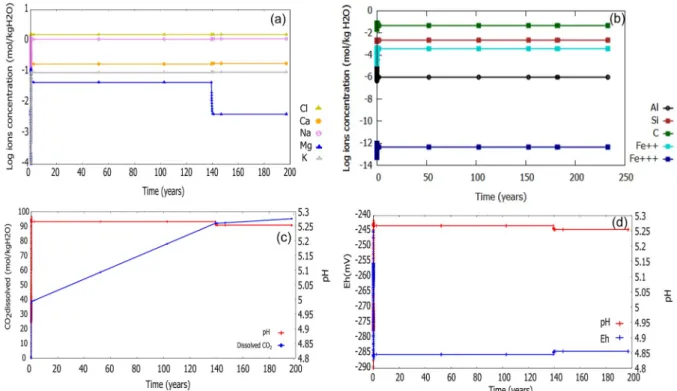
The concentration of ions in the solution remained almost constant
during the reference simulation (Fig. 5a and b). The changes were observed at the beginning of the simulation when the fluid entered the granitic cell. Once the system was equilibrated, no changes were observed in the amounts of Cl, Si, Al, Na, Ca, K, Mg, and C circulating through the reactive cell during the simulation. Similarly, no changes were observed in the concentrations of Fe2þand Fe3þ; the initial
con-centration of Fe was very low, and the Fe released to the solution by biotite dissolution was immediately precipitated in the magnetite.
At the very beginning of the simulation, the pH became less acidic, evolving from 4.8 to 5.25 but remaining constant and low during the rest of the simulation. This initial pH change is attributed mainly to the initial equilibration with CO2 and the hydrolysis of silicates (biotite,
tremolite, microcline, anorthite, albite) consuming protons (Table 7). Although the production of H2 contributes to proton consumption
throughout the simulation, the pH of the system is mainly controled by the equilibrium between CO2 and the dissolution of calcite (Fig. 5c). The
Eh value became more negative during the simulation, with an initial value of 245 mV to a final value of 285 mV at the end of the simu-lation (Fig. 5d).
4.2. H2 generation at different temperatures (Tmin ¼130 �C; T
max ¼200
�C)
This section describes the effect of temperature on H2 generation and
on the main mineral phases at 130 �C and 200 �C, which are respectively
the minimum and maximum temperatures in the geothermal reservoir. At 130 �C and 245 mV, which is the same initial Eh value as that used
in the reference simulation, a considerable reduction was noted in the H2
production. This result is attributed to the type of secondary Fe mineral precipitating in the reactive cell, which in this case was chamosite (Fe2þ5Al(AlSi3)O10(OH)8) (Fig. 6a and b). Under this condition, the Fe2þ
released from biotite was not oxidised but remained as Fe2þto precip-itate as chamosite (R9). Without a source of e for the reduction of protons, no H2 is produced. Moreover, we observed that at 130 �C, the
timing for the dissolution of biotite increased to 246 years.
By increasing the temperature to 200 �C and maintaining the initial
Eh value of the reference simulation ( 245 mV), the dissolution of biotite was faster and was completed in about 91 years. The precipita-tion of secondary phases such as epidote (Ca2Fe3þAl2Si3O12(OH)) was
observed at the beginning of the simulation during the first 20 years (Fig. 6c). In this case, the Fe3þreleased from biotite was oxidised and
precipitated as a pure Fe3þphase. The production of H2 associated with
this secondary phase (i.e. the epidote phase) was 5.9 mol. However, its precipitation did not continue over time, and it was re-dissolved in the cell (Fig. 6c). At that point, the magnetite reached equilibrium and precipitated until the end of the simulation as the main Fe secondary mineral. The Fe3þreleased by epidote was re-used in the system and was
precipitated as magnetite, which reached an amount of 51.3 mol at the end of the simulation. The total production of H2 was 51.3 mol, which is
the same amount as that obtained in the reference simulation (R8).
4.3. H2 generation at different initial Eh (Ehmax ¼ 100; Ehmin ¼ 300
mV)
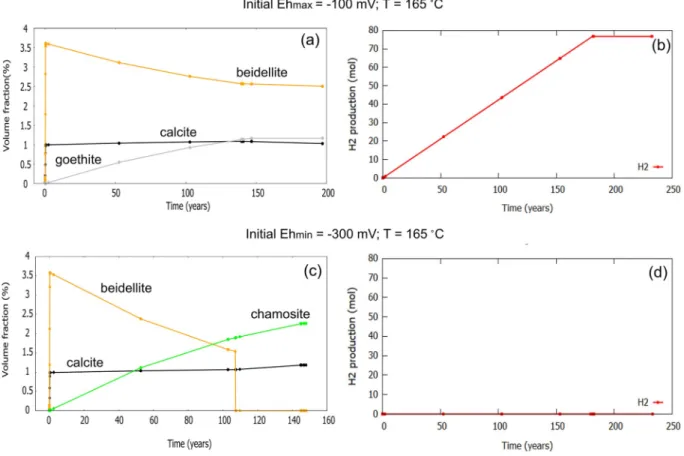
The effect of the redox potential on the H2 generation was studied by
comparing simulations at two different initial Eh values set to 100 mV and 300 mV. The temperature was maintained at 165 �C. The complete
dissolution of biotite was achieved in 147 years, which is similar to that observed in the reference simulation with an Eh ¼ 245 mV. This result indicates that the dissolution rate is controlled mainly by temperature. With an initial Eh of 100 mV, goethite (Fe3þO(OH)) was the main
secondary Fe mineral precipitated, which corresponds to a significant increase in H2 production, from 51.3 mol to 76.9 mol (Fig. 7a and b). In
this case, all of the Fe2þreleased from the biotite was transformed into
Fe3þ, which changed the stoichiometry of the reaction to 0.5 H2 mol
precipitated was again chamosite, with a very low H2 production of
0.003 mol (Fig. 7c and d) indicating that very reductive conditions also favour the precipitation of chamosite (R9).
4.4. Eh-T map of H2 production
Fig. 8 shows an Eh–T map for H2 production for the entire range of
temperature (T ¼ 130–200 �C) and redox potential (Eh ¼ 100 to 300
mV). The temperature and redox potentials were evaluated at in-crements of 10 �C and 50 mV, respectively. Three main domains were
observed according to the rate of H2 production. The first is a low H2
production domain at low temperatures and low Eh. In this domain, the oxidation of Fe2þand the H2 generation were limited, and the
precipi-tation of chamosite (Fe2þphase) was favoured. At low temperatures
(130 �C), the rate of biotite dissolution was low, leading to a dissolution
time of 246 years. The second domain is an intermediate H2 production
domain at high temperatures and intermediate to low Eh values. This is the most extended domain. The oxidation of Fe2þwas favoured but not complete, the magnetite (Fe2þ/Fe3þphase) precipitation was dominant
and the amount of H2 produced tended to be intermediate. Here, the rate
of H2 generation was higher because the dissolution of biotite was faster
with the increasing temperature. The third domain is characterised by high H2 generation at high Eh values. In this case, a strong tendency
existed for Fe oxidation; all Fe2þreleased from the biotite was oxidised to Fe3þ, favouring high amounts of H2 generation. The precipitation of
pure Fe3þsecondary phases such as haematite was favoured.
4.5. H2 generation with different PCO2
The simulations with increasing PCO2 from 0.1 MPa (alkalinity ¼ 15
meq/kg) to 0.21 MPa (alkalinity ¼ 30 meq/kg) showed no difference in the amount of H2 generation. However, when the PCO2 increased to
0.55 MPa (alkalinity ¼ 60 meq/kg), an increase in H2 from 51 mol to 75
mol was observed (Fig. 9). This is related to the precipitation of haematite (Fe3þ2O3) instead of magnetite (Fe23þFe2þO4). The increase in
CO2 in the solution decreased the pH and thus increased the Eh
favouring more oxidative conditions. Because pH and Eh are closely connected parameters, when the pH decreases, the Eh increases, generating a less reductive environment and favouring the oxidation of Fig. 5. Evolution of the physical and chemical parameters of the brine during the reference simulation at T ¼ 165 �C and Eh ¼ -245 mV. (a)- Major ions. (b)- Trace
elements. (c)- pH and dissolved CO2. (d)- Eh and pH.
Table 7
Reaction stoichiometry for primary, secondary minerals, and hydrogen.
Mineral Reactions
Primary minerals
Quartz SiO2 þ2H2O ⇌ H4SiO4
Feldespar- K K(AlSi3)O8 þ4Hþþ4H
2O ⇌ Al3þþKþþ3H 4SiO4
Anorthite Ca(Al2Si2)O8 þ8Hþ⇌ 2Al3þþCa2þþ2H4SiO4
Albite Na(AlSi3)O8 þ4Hþþ4H
2O ⇌ Al3þþNaþþ3H 4SiO4
Biotite (annite) KFeII
3(AlSi3)O10(OH)2 þ10Hþ⇌ Al3þþ3Fe2þþKþþ
3H4SiO4
Amphibole (tremolite) Ca2Mg5Si8O22(OH)2 þ14Hþþ8H
2O ⇌ 2Ca2þþ5 Mg 2þ þ8H4SiO4
Secondary minerals
Illite-Al K0.85Al2.85Si3.15O10(OH)2 þ9.4Hþþ0⋅6H2O ⇌ 2.85Al3þ
þ0.85 Kþþ3.15H 4SiO Montmorrillonite (MgCa) Ca0.17Mg0.34Al1.66Si4O10(OH)2 þ6Hþþ4H 2O ⇌ 1.66Alþ3 þ0.17Caþ2 þ0.34 Mgþ2 Montmorrillonite (MgNa) Na0.34Mg0.34Al1.66Si4O10(OH)2 þ6Hþþ4H 2O ⇌ 1.66Alþ3 þ0.34 Mgþ2 þ0.34Naþ Nontronite (K) K0.34Fe1.67Al0.67Si3.66O10(OH)2 þ7.36Hþþ2.64H2O ⇌ 0.67Alþ3 þ1.67Feþ3 þ0.34Kþ Magnetite-III FeIII 2 FeIIO4 þ8Hþ⇌ 2Feþ3 þFeþ2 þ4H 2O Haematite-III FeIII 2O3 þ6Hþ⇌ 2Feþ3 þ3H 2O
Goethite-III FeIIIO(OH) ⇌ þ 3Hþ⇌ Feþ3 þ2H 2O
Epidote Ca2FeIIIAl2Si3O12(OH) þ 13Hþ⇌ 2Alþ3 þ2Caþ2 þFeþ3 þ
3H4SiO4
Chamosite (Chlorite group) Fe
II
5Al(AlSi3)O10(OH)8 þ16Hþ⇌ 2Al3þþ5Fe2þþ 3H4SiO4 þ6H2O
Kaolinite Al2Si2O5(OH)4 þ6Hþ⇌ 2Alþ3 þ2H4SiO4 þ H 2O
Calcite CaCO3 þHþ⇌ HCO 3þCa2þ Dolomite CaMg(CO3)2 þ2Hþ⇌ 2HCO
3 þCa2þþMg2þ Beidellite-K K0.34Al2.34Si3.66O10(OH)2 þ7.36Hþþ2.64H 2O ⇌ 2.34Alþ3 þ0.34Kþþ3.66H 4SiO4 Gases H2 Hþþe ⇌ 0.5H2
Fe2þ to Fe3þ, thus inducing a higher H2 amount. When the PCO2
increased to 1.13 MPa (alkalinity ¼ 90 meq/kg), haematite continued to be the dominant phase, reaching equilibrium at pH ¼ 4.7 and Eh ¼
241 mV.
5. Discussion
5.1. Hydrogen production
In this work, the results of simulations of the fluid–rock interaction in a 1 m3 granitic cell that included the circulation of a natural heavy brine, revealed that abiotic H2 can be generated during the hydrothermal
alteration of the granite over a time scale of 100–200 years. Considering the influence of temperature on the kinetics of biotite dissolution, the time could vary from 91 years to 246 years according to the temperature range of the reservoir (130–200 �C). The alteration of biotite and the
oxidation of Fe2þto Fe3þfollowed by the precipitation of Fe3þphases in
secondary minerals such as magnetite or haematite generated the needed redox reactions for H2 generation. This H2 generation process,
which is generally referred to as ‘reduction of water’, is actually a reduction of protons (R6).
The evolution of primary and secondary minerals in the simulations were in agreement with the mineralogical descriptions of the natural hydrothermal alteration of the granitic rock. This corresponds to the dissolution of biotite, plagioclase, K-feldspar, and quartz associated with the precipitation of clay minerals (mainly illites, smectites, chlorites), carbonates (calcite and dolomite), and Fe oxides (Traineau et al., 1991; Genter and Traineau, 1992; Hooijkaas et al., 2006; Led�esert et al., 2010). In our simulations, we applied different values of temperature and Eh for the geothermal brine as imposed variable conditions to test the behaviour of the mineral reactions, Fe2þ/Fe3þredox reaction, and H2
generation. Three domains were identified for the deep geothermal
reservoir of Soultz-sous-For^ets. The first includes low Eh and low tem-peratures, in which Fe oxidation is limited; secondary Fe2þphases such
as chamosite precipitate, and H2 generation is not possible. The second
domain has higher Eh values, where Fe oxidation is favoured, and Fe3þ
secondary phases such as haematite and goethite occur with the highest amount of H2 produced, at 77 mol/m3 of granite. In the third domain, at
high temperatures and intermediate to low Eh values, which are domi-nant conditions of this site, the precipitation of Fe2þ/Fe3þsecondary
phases such as magnetite is dominant with an intermediate H2
produc-tion ratio of 51 mol/m3 of granite.
Our simulations showed that the characteristic time scale for the alteration of biotite in the granite of Soultz-sous-For^ets, at 100–200 years, is considerably shorter than the age of the granite, at 330 Myr. Moreover, the present granite composition of Soultz-sous-For^ets is very rich in fresh or non-altered biotite (Hooijkaas et al., 2006). The biotite minerals show evidence of transformation into secondary minerals such as Fe oxides or chlorite only in the fractured zones of the granite and in propylitic alteration areas (Dezayes et al., 2005). This result indicates that if the granite is not exposed to disequilibrium conditions owing to fractures, temperature changes, and changes in the chemistry of fluids, the biotite remains in equilibrium. Accordingly, the potential of H2
production is preserved until disequilibrium conditions are introduced.
5.2. Evolution of the brine
The minimal variation in the brine composition observed during the simulations is related to the equilibrium between the dissolution of primary minerals and the precipitation of secondary minerals. In all cases, the pH of the brine increased slightly from its initial value of 4.8 but remained in the range of the measured values of the in situ brine, at pH ¼ 5 (Sanjuan et al., 2010). On the contrary, the initial Eh value of 245 mV tended to decrease to more negative values in all the Fig. 6. Temperature effect on secondary minerals precipitation and H2 production.
simulations. The values of hydrothermal fluids measured during the last 20 years of exploration of the Soultz-sous-For^ets site do not show strong variation in the Eh value (Sanjuan et al., 2010, 2016). Therefore, H2
generation does not appear to have a strong impact on the composition of the geothermal brine.
5.3. CO2 effect
CO2 is the dominant gas in the collected fluids from the granitic
reservoir at Soultz-sous-For^ets. In this work, the calculated PCO2 of the
system was 0.1 MPa. With this pressure and the open system assump-tion, unlimited CO2 is available to be dissolved in the solution.
There-fore, CO2 strongly regulates the pH of the brine and the
precipitation–dissolution of calcite and clays. Although the production of H2 contributes to proton consumption, the dissolution of CO2 over
time and the buffering effect by the re-dissolution of calcite and clays (beidellite-K) contribute to maintain a constant pH of about 5, which is in the range of the in situ brine (Sanjuan et al., 2010). By increasing the Fig. 7. Redox potential effect on secondary minerals precipitation and H2 production.
Fig. 8. Production of H2 in the geothermal reservoir of Soultz-sous-For^ets
combining different values of T and Eh.
Fig. 9. Effect of PCO2 variation on H2 production at T ¼ 165 �C and Eh ¼
PCO2 in the system, the control on the pH is even stronger, and its effect
on the increase of H2 generation is observed. Indeed, this forces a
decrease in pH and thus an increase in Eh to generate more oxidative conditions, which enhance Fe oxidation and H2 generation. By
increasing the PCO2 (e.g. 0.55 MPa), a step was observed in the H2
production with a significant increase in the rate over time (Fig. 9). The results of these simulations demonstrate that artificially increasing the
PCO2 of the system (i.e. by injection of CO2) could improve the H2
production.
5.4. Implications of the open system assumption
The open system assumption and constant PH2 considered in this work implies that the amount of H2 produced in the system can be
calculated but with no control on the gas pressure changes or accumu-lation in the reservoir. As mentioned in section 3.1, the PH2 value was calculated at the beginning of each simulation from the initial Eh and pH of the solution (Eq. (2)). In an Eh versus pH diagram for an open system (Fig. 10), PH2 is represented as a line with a slope depending on tem-perature, which subsequently remained constant during the simulation even if the final pH and Eh changed from their initial values. In terms of minerals reactions, the assumption of an open system and constant PH2 provides the conditions so that each time the H2 gas is produced, it is
exported from the system and thus maintains a constant PH2. Consid-ering reaction R8, if H2 is exported, the reaction will tend to the right
with the resulting biotite destabilization, magnetite precipitation, and H2 production. The current hydrothermal forced circulation on the site
allows us to consider that an open system and a constant PH2 are valid assumptions for H2 extraction.
In the case of a closed system assumption, any production of hydrogen will increase the local PH2 partial pressure. As a feed-back effect, the reaction R8 would be pushed back to the left and biotite alteration would be inhibited preventing the production of H2. This
corresponds to what happened over the geological times in the geothermal reservoirs where the ferrous iron “survived”. Therefore, a better understanding of the conditions that can lead to biotite destabi-lization to a large extent in the reservoir is needed. In simulations of H2
production from ophiolites, the systems are open and the problem of partial gas pressure is sometimes resolved in modelling by using artifi-cial modification of the solubility product of the involved gases. As such, a bi-phasic fluid is reduced to a monophasic fluid by considering H2 not
as a gas but as an aqueous specie dissolved in the solution (H2(aq);
Bachaud et al., 2017). Mügler et al. (2016) used a thermodynamic model for the H2 production coupled with a transport model for the bi-phasic
fluid considering an open system with constant pressure. In our simu-lations we accounted for the amount of H2 generation assuming an open
system but with a mono-phasic fluid transport model. The H2 modelling
revealed the necessity of developing a two- or three-dimensional bi-phasic transport model whereby fluids and gases can be transported for undergoing thermodynamic and kinetic reactions.
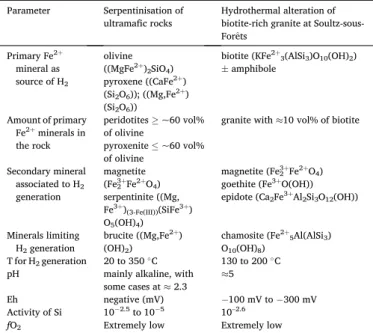
5.5. Comparison with H2 production during serpentinisation of ultramafic
rocks
Similarity was noted in the H2 production processes during
hydro-thermal alteration of the granite and that of mafic rock during serpen-tinisation (Table 8). In both cases, the source of H2 is related to the
oxidation of Fe2þ-bearing minerals and the precipitation of Fe3þ in
secondary minerals. In ultramafic rocks, the Fe2þminerals are olivine
(MgFe2þ)2SiO4 and pyroxenes including clinopyroxene (CaFeSi2O6) and
orthopyroxene (Mg,Fe2þ)(Si2O6), whereas that in granite is biotite
(KFe2þ3(AlSi3)O10(OH)2). Amphibole can also be a source of Fe2þin
granites, although Mg-rich hornblende is the dominant amphibole type at Soultz-sous-For^ets. Because these mafic minerals contain different amounts of Fe2þin their stoichiometry, the potential for H2 generation is
intrinsically different. When considering only the stoichiometry, biotite containing 3 mol Fe2þper mol of biotite is richer in Fe2þthan olivine
and pyroxenes containing 1 mol Fe2þper mol of olivine or pyroxene in
the richest Fe extreme of their crystallographic series. Therefore, the biotite has a greater potential for H2 production. However, when
considering the whole rock, peridotites have �60 wt% olivine, which is equivalent to �60 vol%, and pyroxenite rocks have �60 wt% olivine. In contrast, the maximum amount of biotite in the biotite-rich granite at Soultz-sous-For^ets is only 10 vol%, which is significantly lower.
The initial amount of Fe2þ in the primary rock is not the only
important factor for H2 production during serpentinisation in both deep
mid-oceanic ridge and shallow ophiolite environments. Certainly, it is a complex process that depends on several parameters such as the phys-ical–chemical composition of the circulating fluid, including tempera-ture, pH, and silica activity; the primary mineral assemblage, including olivine/pyroxene ratio; and the water-to-rock ratio. These parameters determine the oxidation of the Fe2þprimary minerals, the partitioning
of Fe in the secondary phases, the type of Fe (Fe2þ/Fe3þ) secondary
mineral precipitation, and thus the H2 production. Field and
petro-graphic observations, laboratory experiments, and simulations of the serpentinisation process revealed that magnetite is a common secondary
Fig. 10. pH-Eh diagram for an open system where PH2 is represented as a line
with a slope depending on temperature. PH2 remains constant during the
simulation from the beginning (i) to the end (f).
Table 8
Comparative table for native H2 production by serpentinisation of ultramafic
rocks versus hydrothermal alteration of biotite-rich granite at Soultz-sous- For^ets.
Parameter Serpentinisation of
ultramafic rocks Hydrothermal alteration of biotite-rich granite at Soultz-sous- For^ets Primary Fe2þ mineral as source of H2 olivine ((MgFe2þ) 2SiO4) pyroxene ((CaFe2þ) (Si2O6)); ((Mg,Fe2þ) (Si2O6)) biotite (KFe2þ 3(AlSi3)O10(OH)2) �amphibole Amount of primary Fe2þminerals in the rock peridotites � ~60 vol% of olivine pyroxenite � ~60 vol% of olivine
granite with �10 vol% of biotite
Secondary mineral associated to H2 generation magnetite (Fe23þFe2þO4) serpentinite ((Mg, Fe3þ) (3-Fe(III))(SiFe3þ) O5(OH)4) magnetite (Fe23þFe2þO4)
goethite (Fe3þO(OH))
epidote (Ca2Fe3þAl2Si3O12(OH))
Minerals limiting H2 generation brucite ((Mg,Fe2þ) (OH)2) chamosite (Fe2þ 5Al(AlSi3) O10(OH)8) T for H2 generation 20 to 350 �C 130 to 200 �C
pH mainly alkaline, with some cases at � 2.3
�5
Eh negative (mV) 100 mV to 300 mV Activity of Si 102.5 to 10 5 10–2.6
mineral associated with H2 generation, whereas brucite ((Mg,Fe2þ)
(OH)2) and serpentinite ((Mg,Fe3þ)(3-Fe(III))(SiFe3þ)O5(OH)4) can limit
or favour the production of H2 accordingly (Charlou et al., 2002;
McCollom and Bach, 2009; Marcaillou et al., 2011; Klein et al., 2013; McCollom et al., 2016; Bachaud et al., 2017; Miller et al., 2017; Vac-quand et al., 2018). Similarly, at Soultz-sous-For^ets the most favourable conditions for H2 are associated with magnetite precipitation, and the
occurrence of Fe2þphases such as chamosite at low temperatures inhibit the generation of H2.
In serpentinisation, the low silica activity in the fluids of ultramafic rocks, on the order of 10 2.5 to 10 5, results in the formation of alter-ation minerals, particularly serpentines and brucite. These minerals tend to largely exclude Fe2þfrom their structure, leading to the formation of
magnetite and thus H2 (Frost and Beard, 2007; McCollom and Bach,
2009). In more silica-rich rocks such as basalts, a greater proportion of Fe2þis sequestered in silicate alteration minerals such as chlorite and
amphibole which allow Fe2þinto their structures. As a result,
hydro-thermal alteration of basalt generates significantly lower amounts of H2
than that by serpentinisation of ultramafic rocks even though the Fe2þ
content of basalt is typically much higher (McCollom and Bach, 2009). The silica activity in the aqueous fluid of the Soultz-sous-For^ets granite is about 10 2.6, which is higher than that in ultramafic rocks. In the
granite, the precipitation of chlorite could be related to the higher silica activities, which limit H2 generation. However, at temperatures �140 �C
and Eh � -250 mV, the silica activity does not appear to be a limiting condition for H2 production because Fe oxides, specifically magnetite
and haematite, are the dominant precipitation phases.
A wide range of temperature is possible for H2 generation during
serpentinisation. High temperatures of about 350 �C are found in mid-
oceanic ridge vents (Charlou et al., 2002; McCollom et al., 2016), whereas those of about 20 �C can be found in ophiolite outcrops
(Bachaud et al., 2017; Vacquand et al., 2018). In this sense, the range of temperatures at Soultz-sous-For^ets, 130–200 �C, reflects intermediate
values compared with those occurring in serpentinisation.
Serpentinisation environments are dominated by alkaline solutions attributed to the dissolution of olivine and pyroxene (Seyfried et al., 2015, and references therein). However, H2 is also produced in low-pH
environments such as the Rainbow hydrothermal vent field, where exceptional pH values of �2.3 occur together with one of the highest H2
concentrations detected in the Mid-Atlantic Ridge (MAR) system (Charlou et al., 2002). According to Allen and Seyfried (2003), the low pH at Rainbow is related to serpentinisation of pyroxene-rich lithologies rather than olivine. At Soultz-sous-For^ets the in situ brine has also a low pH of about 5, which has remained constant over time (Sanjuan et al., 2010). In all of our simulations, the pH remained at about 5, which produced H2 at different temperature and Eh values accordingly.
Moreover, when lower pH values were induced by increasing the PCO2,
higher H2 generation was possible. In this case, a decrease in the pH
value led to an increase in Eh. This resulted in less reductive conditions that favoured Fe2þoxidation and the precipitation of Fe3þsecondary phases such as haematite and high amounts of H2.
Low oxygen fugacity (fO2) is also a distinctive condition during
serpentinisation (Frost and Beard, 2007). In the Soultz-sous-For^ets case, the system had a very low O2 content considering its depth of about
3500 m.
The values of H2 produced by serpentinisation of ultramafic rocks in
oceanic environments such as MAR vary at 0.02–16 mmol/kg (Charlou et al., 2002, and references therein). The calculated H2(aq) values in
ophiolite systems such as those in Oman are about 0.008–0.01 mol/L (Bachaud et al., 2017). The amount of H2 which could be produced by a
granite reservoir is likely less than that produced by serpentinisation. However, the advantage of Soultz-sous-For^ets lies in its relative acces-sibility to the geothermal reservoir and the existence of a potential basement, where unaltered biotite occurs as a source of primary Fe2þ
oxidation to produce H2 as a by-product of the actual heating exchange
system exploited to generate electricity.
5.6. Potential for abiotic H2 generation at Soultz-sous-For^ets
In the intermediate H2 production domain shown in Fig. 8, the
amount of H2 produced at high temperatures and intermediate to low Eh
values is 51.2 mol per m3 of granite. This quantity can be considered as
the maximum potential of 1 m3 of granite assuming complete dissolution
of biotite and precipitation of magnetite. Under this assumption, an extrapolation can be made to the entire geothermal reservoir at Soultz- sous-For^ets. In this enhanced geothermal system, the volume of granite reached by the geothermal wells is approximately 1 km3 (Fig. 11; Sausse
et al., 2010). Therefore, the total potential of 1 km3 of granite after the dissolution of all biotite and the precipitation of magnetite would be 51� 109 mol or 102 kt H2. This represents 0.2% of the total amount of H2
produced and consumed worldwide annually, which is more than 55 Mt (Hydrogen Council, 2017).
However, this consideration is an upper bound because the condi-tions of temperature and Eh vary in the reservoir, and the natural circulating fluids and current exploitation methods will probably not achieve a complete disequilibrium of the whole volume of granite to extract all the calculated H2 potential. Nevertheless, this is a valid and
important data since it helps to dimension the potential of the site and to think about the production methods. For instance, artificial changes of
PCO2 by CO2 injection could improve the amount of H2 production as
shown in simulations with increasing PCO2 values (section 5.3.). The
following question is then posed: how can an enhanced geothermal system serve as an active destabiliser of the biotite in a reservoir given that this mineral has survived over geological time in the quasi-closed system?
5.7. Other possible natural sources of H2 at Soultz-sous-For^ets
5.7.1. Precipitation of sulphide (pyrite)
Pyrite, a sulphide mineral associated with hydrothermal alteration, occurs at Soultz-sous-For^ets at about 1 vol%. Despite the fact that pyrite is the most common sulphide on Earth, its formation involves compli-cated organic as well as inorganic mechanisms (Rickard and Luther, 2007). For inorganic reactions, it is widely accepted that pyrite is a secondary precipitated phase having an important influence on redox reactions. One common method for expressing this is described in re-action 10, in which pyrite is expected to form via nucleation and growth in solution. This reaction is favourable at about 300–350 �C (Rickard,
1997).
Fe2þþ2S2 → FeS2 þ2e (R10)
In other cases, pyrite precipitation can occur from an existing S precursor reacting with sulphidic acid (R11). In this case, pyrite and H2
can be produced in the presence of H2S. Reaction 11, known as the
Berzelius reaction, is favourable below 300 �C and can occur in aquatic
sedimentary systems, buried sediments, and submarine fumaroles (Rickard, 1997; Rickard and Luther, 2007).
Fig. 11. Conceptual model for the maximum amount of H2 production in the
granitic geothermal reservoir of Soultz-sous-For^ets (1 km3) in case of a