VERNON WILLIAMS The Counseling Center University of Nebraska at Lincoln
Abstract
Preparation Time and Sex in Test Interpretation
In view of inconclusive results obtained in previous test interpretation studies, a more highly controlled study at a simpler level seemed desirable. Subjects completing a master's degree in counseling with prior counseling experience served as client and counselor under two different conditions. In the first, the counselor had twenty minutes to examine the profile; in the second, a minimum of one hour. Of six hypotheses, the one con-firmed held that when more prepared, the counselor would communicate in "expert" fashion; when less prepared, in equalitarian fashion. Results were examined also from the point of view of counselor and client sex. Résumé
La recherche dans le domaine de l'interprétation de tests a, jusqu'à présent, abouti à des résultats incertains. C'est pourquoi une étude ayant de meilleurs contrôles et poursuivie à un niveau moins complexe s'avère désirable. Des étudiants terminant leur maîtrise en consultation et possédant déjà une certaine expérience dans ce domaine ont agi comme conseiller et comme client sous deux différentes conditions. Sous la première condition, le conseiller disposait de vingt minutes pour étudier le profil; sous la deuxième, un minimum d'une heure. Des six hypothèses à l'étude, la seule qui fut confirmée affirmait que le conseiller mieux pré-paré communiquait avec le client dans le style d'un expert. Cependant, quand il disposait de moins de temps, sa communication empruntait un ton plus égalitaire. Le point de vue du conseiller et le sexe du client ont également servi de points de repère dans l'étude des résultats. The counseling literature abounds with
sug-gestions for interpreting tests to clients ( Bixler & Bixler, 1946; Kirk, 1952; Faries, 1957; Rudikoff & Kirk, 1959; Saper, 1961). Few studies have explored the effects of the differing methods used to present test results and other data to clients (Dahle, 1954; Holmes, 1964; Folds & Gazda, 1966). These investigations have revealed few clear-cut differences resulting from the different approaches explored. The techniques examined in these studies involved relatively complex vari-ables. Since research conducted at this more complex level produced largely inconclusive re-sults, a more promising approach at this point would seem to involve using simpler measures of both independent and dependent variables.
Thus the question asked in the present study was simply, does time for preparation prior to test interpretation make a difference in the effects of that interpretation? One might suppose that either of the following alternatives could yield a
desirable outcome. Having little time to examine the test results before discussing them with the client might be expected to lead to a more spon-taneous approach. On the other side it might be anticipated that the counselor who has more time to prepare his presentation would be better able to attend to the client's unique concerns and to do a more thorough job of discussing the results.
In the present work an effort was made to use the simplest sort of assessment, as well as the most basic level of difference in method of pre-sentation. The simplest level of observation would seem to include several behavioral indices. One would like to know something about the nature of the interaction between counselor and client. One should like also to know the extent to which the client attempts to analyze the test data and other information in relation to the question(s) he brings to counseling. The length of the counsel-ing interview might also indicate somethcounsel-ing about the client's reaction to the presentation.
Still another element which may account for the failure of earlier studies to demonstrate dif-ferences between test interpretation methods is the degree of control exercised over distracting and irrelevant variables. The general lack of control over irrelevant variables has prevented a more direct interpretation of differing results. A more direct test of some of the various interpreta-tions can only be made if irrelevancies are ruled out.
Campbell and Stanley (1966) have pointed out quite graphically the issue of greater experimental control versus closer approximation of real life. The present study, rather obviously, seeks experi-mental control. It does not purport to approxi-mate closely the actual conditions of a counseling interview. If some rather basic differences be-tween methods of test interpretation can be demonstrated under controlled conditions, these differences may be tested later under conditions more nearly approximating "real" counseling. If such differences cannot be demonstrated when a high degree of control is used, the chances should be diminished that those differences exist in an actual counseling situation.
METHOD Subjects
The subjects consisted of twenty-two students completing a master's degree in counseling at the University of Nebraska. Each subject had some professional counseling experience prior to the period during which data were collected. Even though they were not professional counselors, this group had more counseling experience than the typical practicum student has had. Half of the group was male; half, female. Numbers vary from table to table because the study's partici-pants did not provide complete data. One or more persons failed to complete each of the measures used.
Measures
Client ratings employed included client ratings of the counselor's skill and quality of counseling communication (from "expert" to equalitarian). Another dependent measure consisted of the number of times the topic changed during the interview.
The three variables referred to in the introduc-tion represent the three qualities of major interest in this study. The rate of interaction between counseling participants was assessed by counting the number of times each person talked. This assessment was made in three three-minute
seg-ments selected at random from the beginning, middle, and end of the interview.
Client analysis was assessed in the same three three-minute segments. The counselor judged his own interview, with the "client" checking that judgment. In a separate study two other groups of counselors judged interview segments in terms of all categories of behavior involved in the analytic scheme from which this variable was drawn. (This scheme consists of five categories applied to both participants: cue, analysis, reflec-tion, and positive and negative reinforcement.) The counselor-judges placed each client or coun-selor statement in turn into one of the five categories. Agreement was examined across ten consecutive client-counselor interchanges. One group reached 70 per cent agreement on the selected segment; the other, 71 per cent. The length of each interview was determined, of course, simply by counting the number of minutes elapsed from beginning to end.
Design
This experiment involved having each subject serve as client and as counselor under each of two conditions, "prepared" and "unprepared". The "clients" were assigned randomly to a counselor. One of the assigned clients was selected, again at random, to interact with the counselor in the "prepared" mode; one, in the "unprepared". Half of the "prepared" clients were chosen randomly to interact with the counselor first; the remaining half, of course, interacted after the counselor worked with the "unprepared" client. While no attempt was made to randomize the assignment of client by sex, counselor-client sex match-ups were almost perfectly evenly distributed across the four possibilities. Female clients interacted first and in the prepared condition slightly more often than was true for males.
Procedures
Each counselor presented the results of the "client's" Strong Vocational Interest Blank (SVIB) in the sessions investigated here. The prepared condition involved the counselor's perusing the Strong blank for a minimum of one hour. In the unprepared condition the counselor was not allowed to see the blank more than twenty minutes prior to the interview. The client was not aware, of course, of the amount of preparation the counselor had had. The client saw his profile for the first time when it was presented to him by the first counselor. The Strong in each inst-ance had actually been taken by the client, but he was instructed to play a role in the interview.
The client played the same role with both coun-selors.
The counselor was to write down the hypotheses he developed in examining the Strong profile when he was given ample time to prepare for the interview. This procedure was employed in an attempt to insure that the counselor had done a systematic job of preparing. Interviews were tape recorded so that judgments could be made later concerning variables such as number of topic changes and client analysis of data. HYPOTHESES
While a case certainly might be made in each instance for the opposite prediction, the author's examination of the two conditions investigated here seemed logically to lead to the hypotheses offered below. To explain fully the rationale for each hypothesis would require more length than this brief article permits.
1. If less preparation yields a less planned, more spontaneous approach, interviews in which counselors have had less opportunity to examine the SVIB will produce more topic changes than will interviews conducted by counselors with more time to examine the test.
2. Again, assuming less planning and more spontaneity with less preparation, it is hy-pothesized that more interaction will occur between client and counselor when the latter has spent less time perusing the test profile than when he has spent more time.
3. Assuming that increased preparation leads to greater thoroughness on the part of the counselor, interviews involving more coun-selor preparation will be longer than those involving less.
4. Similarly, when he has spent more time with the blank before counseling, the counselor will be seen as more skilled than when he has spent less time.
5. The more thorough counselor preparation resulting from having more time to examine the profile should result in the client's en-gaging in more analysis of his experience than should occur when the client works with the less prepared counselor.
6. Finally, the prepared counselor will be seen by the client as communicating in "expert", highly technical fashion; in the spontaneous condition, in "open" or equalitarian fashion.
RESULTS
Since half the counselors were assigned first to each of the two conditions of preparedness, it was possible to determine whether the order of the discussion of test results could be examined in an effort to insure that order of presentation did not affect the outcomes studied here. For this purpose, counselors playing the "prepared" role first were compared to those initially "un-prepared" on each dependent variable. A similar series of tests was conducted comparing partici-pants who served as counselors first with those who played the client role initially. Since none of these tests was significant, one can feel more confident that neither order of presentation carried an advantage.
The only difference due to preparation concerns communication. As table one shows, the more prepared counselor tended to communicate in expert terms; the less prepared one in open, equalitarian fashion.
Table 1. Differences in Client Perception of Counselor Communication
("Expert" vs. Equalitarian)* When the Counselor is Prepared and When
He/She is Unprepared Unprepared Prepared N 20 ' 2Ï~ Mean 5.65 4.76 Standard Deviation 0.81 1.55 t= -2.28 df= 39 p<.05 *Equalitarian = 7; Expert = 1 Differences in Sex
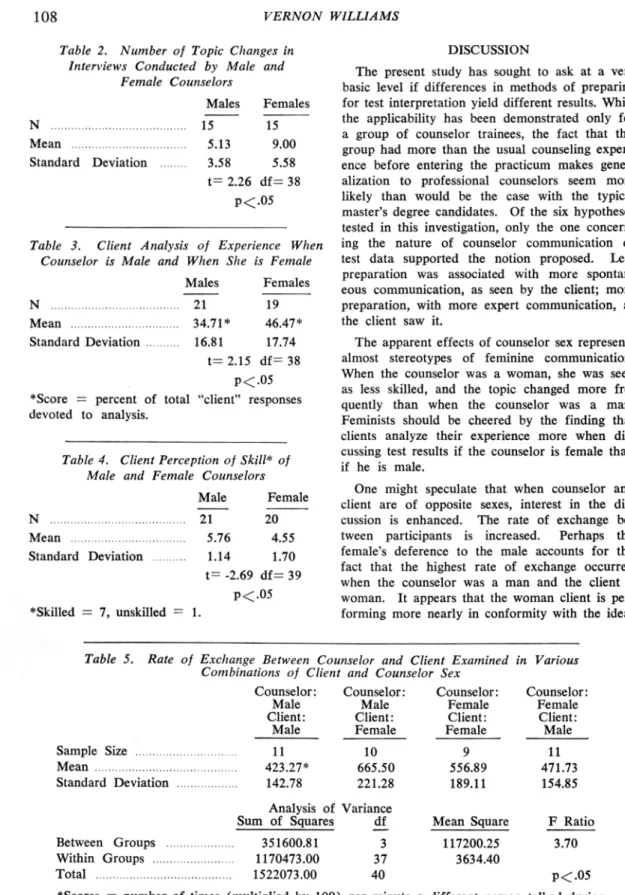
While the major interest in this study concerned the counselor's preparation, the effects of sex seemed also worth exploring. This exploration yielded several significant results. Women coun-selors produced more topic changes than men. (See table two.) Clients of female counselors engaged in more analysis of their behavior than did clients of male counselors (table three). Male counselors were seen (in table four) as more skilled than female counselors. Finally, when the sex of the client, as well as that of the coun-selor, was considered, the mixed sex pairs pro-duced a high rate of client-counselor exchange than did same-sex pairs. Male counselor-female client interaction produced the highest rate; male-male, the lowest.
Table 2. Number of Topic Changes in Interviews Conducted by Male and
Female Counselors Males Females N 15 Mean 5.13 Standard Deviation 3.58 15 9.00 5.58 t= 2.26 df= 38 p<.05
Table 3. Client Analysis of Experience When Counselor is Male and When She is Female
Males Females N 21 19 Mean 34.71* 46.47* Standard Deviation 16.81 17.74 t= 2.15 df= 38 p<.05 •Score = percent of total "client" responses devoted to analysis.
Table 4. Client Perception of Skill* of Male and Female Counselors
Male Female N 21 20 Mean 5.76 4.55 Standard Deviation 1.14 1.70 t= -2.69 df = 39 p<.05 •Skilled = 7, unskilled = 1. DISCUSSION
The present study has sought to ask at a very basic level if differences in methods of preparing for test interpretation yield different results. While the applicability has been demonstrated only for a group of counselor trainees, the fact that this group had more than the usual counseling experi-ence before entering the practicum makes gener-alization to professional counselors seem more likely than would be the case with the typical master's degree candidates. Of the six hypotheses tested in this investigation, only the one concern-ing the nature of counselor communication of test data supported the notion proposed. Less preparation was associated with more spontan-eous communication, as seen by the client; more preparation, with more expert communication, as the client saw it.
The apparent effects of counselor sex represents almost stereotypes of feminine communication. When the counselor was a woman, she was seen as less skilled, and the topic changed more fre-quently than when the counselor was a man. Feminists should be cheered by the finding that clients analyze their experience more when dis-cussing test results if the counselor is female than if he is male.
One might speculate that when counselor and client are of opposite sexes, interest in the dis-cussion is enhanced. The rate of exchange be-tween participants is increased. Perhaps the female's deference to the male accounts for the fact that the highest rate of exchange occurred when the counselor was a man and the client a woman. It appears that the woman client is per-forming more nearly in conformity with the ideal Table 5. Rate of Exchange Between Counselor and Client Examined in Various
Combinations of Client and Counselor Sex
Counselor: Counselor: Counselor: Counselor: Male Male Female Female Client: Client: Client: Client: Male Female Female Male Sample Size 11 10 9 11 Mean 423.27* 665.50 556.89 471.73 Standard Deviation 142.78 221.28 189.11 154.85 Analysis of Variance
Sum of Squares df Mean Square F Ratio Between Groups 351600.81 3 117200.25 3.70 Within Groups 1170473.00 37 3634.40
Total 1522073.00 40 p<.05 •Scores = number of times (multiplied by 100) per minute a different person talked during
client behavior; i.e., more extensive interaction with the counselor.
One conclusion seems clear: sex of counselor had broader effects upon the outcome measures used in this study than did amount of counselor preparation time. Perhaps future research can build upon the minimal effect of preparation de-monstrated here. In any event the present results cannot be regarded as clearly encouraging the view that a way can be found to demonstrate that one means of presenting test data is superior to others.
References
Bixler, R.H. & Bixler, V.H. Test interpretation in vocational counseling. Educational and Psychological Measurement, 1946, 6, 145-155. Campbell, D. T. & Stanley, J. C Experimental
and Quasi-experimental Designs for Research. Chicago: Rand McNally & Co., 1966.
Dahle, T. L. An objective and comparative study of five methods of transmitting information to business and industrial employees. Speech Monograph, 1954, 21, 21-28.
Faries, M. A therapeutic approach to test in-terpretation. Personal and Guidance Journal, 1957, 35, 523-526.
Folds, J. H. & Gazda, G. M. A comparison of the effectiveness and efficiency of three methods of test interpretation. Journal of Counseling Psychology, 1966, 13, 318-324.
Holmes, J. E. The presentation of test informa-tion to college freshmen. Journal of Coun-seling Psychology, 1964, 11, 54-58.
Kirk, B. A. Individualizing of test interpretation. Occupations, 1952, 30, 500-505.
Rudikoff, L. C & Kirk, B. A. Test interpreta-tion in counseling. Journal of Counseling Psy-chology, 1959, 6, 223-229.
Saper, B. The interpretation of tests in coun-seling students. Educational Record, 1961, 42, 117-121.