Democratic and Popular Republic of Algeria
Ministry of Higher Education and Scientific Research
University of Mostaganem
Faculty of letters and foreign language
English Department
Psycholinguistic issues in English learning
CHILD LANGUAGE DEVELOPMENTAN ANALYSIS OF THE FACTORS INFUENCING THE CHILD LANGUAGE IN THE PRE-SCHOOL STAGE.
Submitted by: BOUCHAKOUR Fatiha
Member of jury:
President: Ms KHAROUBI university of Mostaganem Examiner: Ms ADNANI university of Mostaganem
Supervisor: Ms BENOSMANE university of Mostaganem
Dedications
Full of tears of happiness and joy, my gratitude and praise goes to god. I dedicate this modest work to the pearl of my life (my mother) and to the source of power (my father) for their efforts and sacrifices along 24 years. All the words will stand frozen When it comes to their estimation.
I dedicate this dissertation to my dear sisters and my brother that god blesses them and my sweet and close friends Nesrine, Meriem, wahiba, hanan who helped me all the way long of
my study journey.
Special dedication to the light and bright of my life husband Raselma soufyan I dedicated in the name of all the years
of study and hard work, all the ups and downs I went through, to all my mates in university And all who helped me to achieve this work, especially my teacher if i don’t say my brother
dekkiche khaled...
Acknowledgments
We deeply believe that nothing can be fulfilled without Allah’s will we also believe that nothing can be done without hard work and strong will. So first of all, we thank god for the accomplishment of this work, hoping that it will be helpful for other students. First and for most our best thanks and compliments are expressed to my supervisor Mrs Benosmane for her help, stimulating suggestions an encouragements which helped me all time and for her longstanding patience which made me appreciate my research. Much gratitude goes also to all who helped to achieve this work.
Special thanks go to the members of the jury who accepted to examine and evaluate this humble work. Finally I would like to thank all our teachers from primary school to the university without exception.
List of tables
Table 2-
1………p26
Table 2-
2………p27
Table 2-
3………p28
Table 2-
4………p29
Table2-
5………p30
Table 2-
6………p31
Table 2-
7………p32
List of figures
Figure 1-
1……….…p10
Figure 2-
1……….p22
Figure2-
2………...p24
Figure2-
3………...p27
Figure2-
4………...p28
Figure2-
5………p29
Figure2-
6………p30
Figure2-
7………p31
Figure2-
8………p32
Figure2-
9……….p33
Table of content
Dedication ………I
Acknow
ledgement………II
Abstract………III
List of figures………..IV
List of tables……….V
Table of content………..VI
General introduction
………p1
Chapter one
Introduction………p3
1- Competence……….p3
2- Performance……….p4
3- The pre-linguistic stages……….p4
3-2: the cooing stage
………p6
3-3: the babbling stage
……….p6
4- The linguistic stage………p7
4-1: the one word stage
………p8/p10
4-2: the two word stage
………p10/13
4-3: the three or more word stage
………p13/15
5-the handicaps and twins children langu
age acquisition………p15
5-1: the twins children
……….p15
5-2: the deaf child
ren……….p16
5-3: the blind childre
n………p16/17
Conclusion………...p17
Chapter two: data analysis
Introduction
………p19
1-
The analysis of doctor’s interview……….p19
1-1: crying stage
………p20
1-2: cooing stage
………p20
1-3: babbling stage
……….P20
2-
The stages of early language………p21
2-1: the one word stage
………p21
2-2: the two word stage
………p22
2-3: the three or more word stage
………p23
Conclusion
………p33
Chapter three: results and recommendations
Introduction
………p35
1-Discussion of results and findings
………....P35
1-1: discussion of results (parents and children questionnaires)
…………p35
1-2: discussion of results (doctors interview)
………p35
2-Description of place of investigation
……….p36
The samples
………p36
2-1: the parents
………..p36
2-2: the children
………p36
2-
3: the doctors………p36
3-The recommendations and suggestions
………P36/40
4-The methods and materials
………p40
5- Research tools……….p40
5-
1: Description of parents questionnaires………p41
5-2: description of children questionnaires
………p41
5-3: description of doctor interview
………p41
Conclusion………p41
Conclusion……….p43
Bibliography
………..…p45
Abstract
The purpose of this work is to check the stages of child language development which are necessary to parents especially mothers to know more about their children and their language. In addition this work contains other titles which are the pre-linguistic stages and linguistic stages. To go deeper, the objectives of this research are : to know more about children especially in pre-school stage, and get knowledge about factors that influence the child’s language acquisition in that period. Moreover, the method used in this research is interview and data collection from books and articles related to psychology and ask questions to pediatricians, children and their mothers. In this work, there are three chapters; the first chapter speaks about the psycholinguistic stages of language acquisition, the second is the factors of language acquisition and the third one and the last is about the psycholinguistic stage of language acquisition in Algeria (case study). Through our research we tried to explain the first language and to show the means of developing language. So, language acquisition is both cognitive and social and the most important influence is the social one i.e. the family that has the direct impact on child’s ability of learning.
General introduction
This research paper is about child language development, specifically in the pre-school stage. The development of language has several stages, through which all infants fallow them in the same order. It can be divided into two parts, the pre-linguistic stage and early language stage.
The pre-linguistic stage is on introducing and preparation language that has three stages, first: crying stage, second cooing, and then babbling stage. The linguistic stages are the one word stage, the two word stage and the three or more words stage. In these stages, we notice the child develops his speech. In chapter two, it mentioned the factors of language acquisition, there are three factors, the physiological, mental and individual, and social factors.
The aim of this research is to know how children develop their language and what the different stages that they fallow are. The parents recognize what are the factors that contribute to the development of child of child language or influence it.
The method in this research is qualitative method and analyzing data that we gather from books, articles and asking doctors, parents and observing children that live with us. Also ask some question to children to test their level. Moreover, this research paper tackles main questions, first, are all children the same? And how parents recognize that their infant in learning language and how can they deal with him or her? Also another question; do children acquire language at the same age and in the same way?
So, the work at hand suggests some hypotheses: child, who speaks early, he learns language quickly. And about the factors, the parent is the most important element that influence the child language acquisition, because when they speak to him, he learns and acquires by imitating them, the child puts new word in his mind and uses it in his daily speech and remembers it.
Through our research, we tried to explain the first language and to show the means of developing language, the three main factors; physiological, mental and individual and social factors. So, language acquisition is both cognitive and social.
Chapter
One
Introduction
Language development is a process starting early in human life. Infants start without language, yet by 10 months, babies can distinguish speech sounds and engage in babbling. Some research has shown that the earliest learning begins in uterus when the fetus starts to recognize the sounds and speech patterns of his mother’s voice and differentiate them from other sounds after birth. Usually, productive language is considered to begin with a stage of preverbal communications in which infants use gestures and vocalization to make their intents known to others. According to a general principle of development, new forms then take over old functions, so that children learn words to express the same communicative functions they have already expressed by preverbal means. Verbal communication requires productivity, i.e. the ability to create an infinite number of utterances we have never heard before. This endless novelty requires that some aspects of language knowledge be abstract. Ultimately, “rules” for combining words cannot be rules about particular words, but must be rules about classes of words such as nouns, verbs or prepositions. Once these abstract blueprints are available, the speaker can fill the “slots” in a sentence with the words that best convey the message of the moment. Chomsky’s key point was that since abstractions cannot ever be directly experienced, they must emerge from the child’s own mental activity while listening to speech.
1-Competence:
Social competence uses the ability to integrate thinking, feeling and behavior to achieve social tasks and outcomes valued in the host context and culture. In school setting, these tasks and outcome would include accessing the school curriculum successfully, meeting associates personal, social and emotional needs, and developing transferable skills and attitudes of value begin school.
“Very different social competencies are required and valued in different context. Behavior which are dysfunctional and disapproved of in one context night be functional and approved of in another .Through thinking and feeling, the socially competent person is able to select and control which behavior to emit and which to suppress is any given context, to achieve any given objective” .(internet source). The communicative capacity that the speaker needs is so vast and general than competence for Chomsky. Ta his, ‘’It is the knowledge that native speakers have of their language as a system of abstract formal relations.
It includes what is general, not only vocabulary items, but also the use of these items in a correct way.
The infant acquires his or her communicative capacity:
When does he speak? When does not he speak? About what does he speak? Where and how does he speak? If the communicative capacity generalizes all the kinds of capacities that represent the successful speech .So it must include all what is in competence.
2-Performance:
The most basic definition of performance ‘’action’ could be verbal and or physical while not a prerequisite for action to be a performance, per formative action are often presented to an audience and involve heightens esthetic sensibilities.
“performance studies rely on concept that we can know more about texts when we examine them within the contexts in which they are used .Because I Jacobson’s variables are bound to change no two performances are the same ,although they may use the some text score ,or choreography .The performance of a play ,for example will be different at three in the afternoon that at eight at night .Although the actors and the audience will change that every performance is a new creator unique from all other performance is a new creator unique from all other performance of the same material” .
Content alone does not distinguish per formative moments various set performance all from every day speech as well .According to Chomsky, performance is the actual behavior although performance must clearly be projected from competence.
The development of language has several stages, through which all infants follow them in the same order .It can be divided into two parts, the pre-linguistic stage and the early language stage.
3-The pre-linguistic stages:
Pre-linguistic language development is when a child is learning to control the sounds he can produce and to string these sounds together in vocal play. In this stage, the child is not yet able to manipulate these sounds into proper words.
There are four categories of pre-linguistic development that can be distinguished. Vegetative sounds occur at 0-2 months of age and include the natural sounds that babies make, such as burping or crying. Cooing and laughter occur at 2-5 months of age. These are vocalizations that the baby makes when it's happy or content and can be made up of vowel or consonant sounds. Vocal play begins around the ages of 4-8 months. During vocal play, the baby begins
to string together longer vowel or consonant sounds. Finally, babbling occurs around the ages of 6-13 months. At this time, the child begins to produce a series of consonant-vowel syllables and may develop utterances, such as ma-ma and da-da.
It is introducing and a preparation language that has three stages. -First: crying stage.
-Second: cooing stage. -Third: babbling stage.
3-1: The crying stage
At birth, there is no language but a cry .Crying is a kind of language .Without speech, Infants communicate in away without using normal speech sounds .In a sense, that helps the child to learn how to produce linguistic sounds, crying (is largely) response is hard wined to the child, and crying is initially a spontaneous reaction .Unaffected by intentional control from the voluntary nervous system.
Indeed, crying is on introducing to vocal communication. Through crying, infants control their breathing, they learn to play their lungs like bog pipes, with quick in ha lotions of ser followed by long, slow exhalations to feel their vocal cords with prolonged wailing.
Crying is iconic; there is a direct link between the physical sounds and its communicative intent. For example, the longer and the louder the crying, is the hungrier the child becomes .So that, the degree of the discomfort is directly proportional to the intensity of the acoustic signal.
During the first two months ,crying is bubbly indirectly and all mast randomly associates with its needs .Thus the cries become more symbolic .The child cries to elicit attention .So, it is not relates to his needs .He transforms from iconic to symbolic .
Even new babies are aware of the sounds in the environment .They listen to the speech of those close to them, and startle or cry if there is an unexpected noise .Loud noises make them, and they become still response to new sounds. During this early age of vocalization, children pass in another stage which is « cooing »that is followed by babbling stage.
3-2: The cooing stage
The earliest stage of linguistic development which begins several weeks after birth and consits of phonemes of variable duration. It emerges at about two month of ages; or several weeks of
extensive interaction with its care taker. The child starts ‘’to coo’’ making soft gurgling sounds, seemingly to express disaffection .It is difficult to surmise whether the coos and gurgles of a just fed baby reinforce the mother contentment in caring it. There is a similarity between child’s sound and his mother first. The sounds of crying and cooing stages made by the infant cannot be considered language. For they are indirect response to internal and extend needs; such as hunger, pain…
“ Astoundingly, between 0 -3 months babies learn to turn to you when you speak ,and smile when they hear your voice .In fact , they seem to recognize your familiar voice ,and will quite at the sound of it if they are crying .Tiny babies under three months will also stop their activity and stand closely to the sound of an unfamiliar or not .The baby smiles at you when you come into view .He or she repeats the same sound a lot and ‘’coos and goos’’ when content” .( internet source).
During the third month of life ,the baby begins to display the intention to communicate in order to fulfill his needs .So, the cooing stage is considered as the first stage and the child’s language learning and the use of cooing sounds is not arbitrary but it is by listening, and babbling and learning ‘’.
3-3: The babbling stage
It emerges approximately at the sixth month of age, with a huge member of sounds; consonants, vowels, syllable clusters. Infants produce consonants that are not of their mother tongue at the canonical stage .Indeed, they seem to play with kinds of segments at this stage, and frequently produce consonants of other languages.
Babbling is the first psycho-linguistic stage, which is on evidence of the child influence by all those months of exposure to their mother tongue.
Then ,sometimes between 4 to 6 months babies respond to the word ‘’no’’.They are also responsive to changes in your tone of voice, and to sound other than speech .For example, they can be fascinated by toys that make sounds .Enjoy music and rhythm ,and look in an interested or apprehensive way for the source of all sorts of new sounds such as the toaster ,birdsong, the clip-clop horses ,hooves or the whirr of machines .Gurgling sounds or ‘’vocal play’ occur while you are playing with your baby or when they are occupying themselves happily. Babbling really gets going in this age range, and your baby will sometimes sounds as though he or she is ‘’talking ‘’.This speech like babbling includes many sounds including the bilabial (two lips)
sounds ‘’P’’, ‘’B’’ and ‘’N’’ .The baby can tell you ,using sounds or gestures that they want something ,or want you to do something .They can make very ‘’urgent’’ noises to prompt you into action”.(internet source)
The first consonants that child utters are (m) ,(p).At this stage the child does not necessary produce only the sounds of his mother tongue ,but he can also produce consonants that are found in other languages.
4-The linguistic stages
Linguistic language development is the stage of language development signaled by the emergence of words and symbolic communication. Prior to this stage, most of the sounds a child produces are no more than the practice of sound manipulation and sound sequencing in order to gain the motor skills necessary to create words. There are six periods of linguistic language development.
Before a child masters the ability to form words, they will first begin to use specific sound combinations consistently with specific meaning. This is the early one-word period that begins around 12-19 months of age. An example of this would be a child saying 'baba' every time he wants a bottle of milk. Even though this is not the exact same as the word 'bottle,' the child is using 'baba' in the same manner as you would use the word 'bottle.'
The later one-word period begins around 14-24 months of age. In this stage, the words used by the child are readily identifiable, and he begins to name and label people and objects in his environment. A child's typical vocabulary during this period will consist of words like 'dog,' 'go,' 'daddy' and 'bye-bye.'
Next comes the two-word period of language development. As the name implies, this is when he will begin to combine two words together to make simple phrases, such as 'mommy go' or 'shoe on.' The two word period typically begins from 20-30 months of age.
The three-word period begins around the ages of 28-42 months of age. During this period, a child adds at least one more word to their phrases and begins to use pronouns. They may also begin to use articles and simple prepositions. Examples would be: 'me go daddy,' 'you on chair' or 'he kick a ball.'
At around 34-48 months of age, the four-word period begins. At this time, the child will begin to use combinations of four to six words. They will use more prepositions, and adjectives begin to appear in speech. Examples would be: 'Suzy has a little dog' or 'I sleep on the top bunk.'
The last period of linguistic language development is the complex utterance period. It begins around the ages of 48-60 months. At this time, a child regularly produces phrases longer than six words in length, and they begin to express concepts of past and future time. Examples are: 'Daddy comes home from the trip tomorrow' and 'I saw a dog at the park yesterday.' They may also begin to use contractions, such as 'can't' or 'don't.' Researchers do not agree on when this period is completed and adult sentence structure is achieved. Opinions range from 5 years of age to 12 years of age.
4-1:The one word stage
Some parents think that their child starts to pronounce words that do not differ from the adult’s speech in a very early age .But indeed, they have any sense in reality. However, many linguists had limited this stage in over one year, according to the majority of children. And about the first word the infant produces in most of time is with two seconds
as (mama), (dada) , (baba).
These single words function as sentences .The one word stage is sometimes called holophrastic because by one word he can express a brooder meaning.
For example: he says (baba) and he means; to look at the dolly. And, it is for the adults to know what he wants to say from his gestures, his voice or even from his face traits.
According to some studies of Smith in 1926, the child knows three words when he has one year old.
This period is exciting and fun as the baby now obviously listens when spoken to turns and looks at your face when called by name, and discover the fun games like : ‘’round and round the garden peep-oh’’ ,I see and pat-a-cake’’ (these simple games and finger plays will have regional names and variants .It is in ‘’daddy, cat ,eyes ,phone ,key’’)and begins to respond to requests « give me Granny » and questions « more juice ? » Baby’s first words (probably not spoken very clearly have appeared (MAMA, Doggie, Night Night, Bye Bye). (Psy-education D.FOKHER AKIL page 106). From the first week, we observe that the infant presents a genetic program. We remark he /she follows the look (there are same movements of fixation and pursuit at the first week) ;he /she reacts at a bell sound, he /she stops crying when we come up to me to get a better look at me (i .e the environment and the infant begin to react from one to another.
From the second week: The mother from a total visual perception ,she distinguishes then in the additive and emotional domain ,gestures limitation and drown laughing .There is an interest for the meaning of parole.
From the fourth month: He /she start to call things, he /she hide under the sheet and he /she laughs at roar.
He /she turns his or her head to look who is calling him or her. From the 8th months: He /she answers for his or her mother absence.
From the 9th month :-He /she says the first word of two syllables .We note the appearance of the first word which is going to serve of calling all .
From the 10th month: The infants repeat when he/she hears .he /she can learn to speak actually.
From the12th month: He/she says 09 words.
From the 21stmonth: He /she assoc ides two words.
From the 24thmonth: He /she does sentences of a lot of words.
From the 30th month: There is a development mainly in: The smelling to sit .The walk
The language →The first word. The first sentence.
The importance of oral activity: “There is a relation between the mother and the baby (Brest ,feed) ,with himself or herself……The beginning of learning has a desire of parents and variable considerably following the cases(from the excite of clinical till 4th years /5thyears with the necessity of school” .(p 32 –33-34 -35 precis de psychology de l’enfant 1990).
In the following figure we are going to show a general summary of the different stages of the child’s speech.
AGE LANGUAGE/EXPRESSIONS
3rdmonth vocalization
6thmonth No repeated verbs
9thmonth Comprehension of gestures and objects.
11thmonth Repeated syllables
One year 5 words
18thmonth 10 to 12words
21thmonth 100 words,beginning of sentences of two
words
30thmonth Words with articles,substantive
words ,incorrect tenses.
3rdyears Says his/her sex ,verb tenses,words,
accumulation
4th years Knows his /her age.Logical conjunctions
6th years Know his /her adress ,telephone,vocabulary
extension,correct language,syntaxes amelioration.
FIGURE N°1-1.THE MAIN STAGES OF THE CHILD’S LIFE
(P58.Dossiers.Médico-chirurgicaux de l’infirmiere pediatrie 1981)
4-2: The two words stage
The two word utterances begin around the age of two years old .All children begin to produce sentences after the holophrastic stage. First with two words stage in this stage children demonstrate a surprising amount of grammatical precocity and ,it is quite rare for children to repeat the same word twice in forming their sentences, and they make each word count.
“At this stage the child points to pictures in a book when you name, and can point to flew body parts when asked .He or she can also follow simple commands (‘’push the bus’’) and understand simple questions (‘’where’s the bunny?’’) .Your toddler now likes listening to simple tarries and enjoys it when you sing songs or says rhymes .This is a stage in which they will want the same story, rhythm or game repeated many times”.(internet source)
Now your baby is accumulating more words as each month posses. He or she will even ask two word questions like ‘’where ball?’’ what’s that? More chippies? What that?, and combine two words in other ways to make the stage one sentence types” Birdie go’’,No doggie. More push).Words are becoming clearer as more initial consonants are used in words. Certain words (pivots) tend to be used initially or finally, there are other words could be used to fill in the slat either after or before this so called pivots.eg: a child may say thing like: -Turn on-Put on.-Fix on.-Look over.
Bloom field’s work provides us with an analysis of two words stage in children’s utterances that it is organized by some sort of phrase, structure which suggests that the child’s internal representation of his language is for richer than one would have supposed from the pivot +open .This is important because, if blooms analysis is correct we shall have to make correspondingly rich assumptions about the character of the learning at this stage. Bloom’s grammar can thus represent a variety of features of the child’s use of two-words sequences that constituent structure grammar cannot .It is very rich picture of the child’s language learning mechanisms that it implies.
So, the word (on) is a land of pivot which occurs in the second position and many words can precede it in first position. The child can say.(More milk),(more bread),(more cold),is this case the word more is a pivot, in the first position, which is followed by a many other words, in the child speech-both of (on) and more are called pivots because they are linked to other words.
“Mc Neil suggests that in a child’s subsequent development, the differentiation of (pivot) and (open) may consist of moving down the hierarchy to more narrowly. But the question is how the child’s primary linguistic data interacts with his innate endowment to insure that he constructs the transformations characteristic of the language of his speech community. It might be supposed that we child does hare such a metric available to him, but that ascension lacks any force as explanation to how the child learns. The child always has his own system. He does not in imitate the adult speech”. (Internet source)
There are many funny examples of such child utterances. For examples: 1. Mama shoe (meaning: this is the shoe of mother).
2. Me give (meaning: give me)
3. Milk hot (meaning: the milk is hot).
4. Mom out (meaning: my mother is outside). 5. Other put (meaning: put the other one). 6. More sing (meaning: do not stop singing).
We can notice that the same word can appear on both pivot and open class.
Both pivot and open denote word classes. The pivot class is smaller than the open class….the child who produces pivot +open do not produce open+ pivot and vice versa.
The analysis on which the claims for pivot +open grammars are based are purely distributional. The child’s language, even at the pivot + open stage suggests for more structure. Bloom finds no less than five distinct relations which can be expressed by the surface N+N in corpus of a child at the pivot +open stage
1. Conjunction: eg.”Umbrella boot “.→Meaning of:” I see an umbrella and a boot”. 2. Attribution: e.g. Party hot.→ Meaning: this a party hot
3. Possession: e.g.: Kathryn sock.→ Meaning of: This is Kathryn sock 4. Location: eg sweater choir→ Meaning ofsweater is on the choir
5 .Subject –Object: Eg: Kathryn ball.→ Meaning of: Kathryn will throw the ball.
With bloom’s view we are provided with an analysis of the two word stage in children’s utterances which suggests that the child’s internal representation of his language is for richer than one would have supposed from the pivot +open Grammars.
In short, at this stage, one gets a reasonable characterization of the distribution of overt utterances by assuming that there is a complex underlying structure from which the child must choose not more than about two elements in producing a surface from.
4-3:The three or more word stage
It emerges at the age about two years and a half to three years of age .In this stage children use more grammatical items, a complete sentence. They can do dialogues with adults, that we can understand them.
From the third year, it is the age of affirmation of personality. The infants uses the personal pronouns.(I),(my),(mine). It is called the cries of three years which is an actual pushing to pragmatism. Language develops and he/she can understand the foreign person in his/her direct environment.
“As the child grows older, his performance gets better on sentences in which the nouns is the actor, and he gets worse on sentences in which it is not, in both cases irrespective of the noun’s immediate adjacency to the main verb. Parallel to this noun as the actor in both the VNN and the NNV sequences, this tendency speaks to correctly on all constructions while persisting in the first-noun-equals-logical subject interpretation of NNV+VNN.
These results we originally obtained by Bever, Mehler Valian Epstein and Morrissey (in preparation) (replicated in narrators (1972); for discussion, see Bever (1970).
The nation that the output of a language acquisition device is a transformational grammar has been common ground for almost all recent researches on the problem of syntax learning.
“Children in this age range enjoy stories and can answer simple questions about them. He /she hears and understands nearly everything that is said to them at home or at pre-school or day care. Your child speaks clearly and frequently in an easy to listen to voice. He or she can construct long and detailed sentences (we went to the zoo but we had to come home early because Josie was not feeling well). He/she can tell a long and involved story to the topic, and using grammar like adult. Most sounds are pronounced correctly, though he/she may lisping as a four year old or at five still have difficulty with (r),(v) and (th) your child can communicate easily with familiar adults and with other children. They may tell fantastic tell stories and engage strangers in conversation when you are out together.”(internet source)
Brown and Hanlon investigated the appearance of light different constructions in the child’s speech. They are related in claims by the following transformations:
Questions, negative and sentence traction:
1. Simple, active, affirmative, declarative sentence: -e.g.: we had a ball.
2. Simple, active, affirmative, interrogative sentence: -e.g.: « did we have a ball?”.
3. Simple, active, negative, declarative sentence: -eg:” we didn’t have a ball”.
4. Simple, active, affirmative, declarative, trancted sentence: -eg: we did.
5. Simple, active, negative, interrogative sentence: -eg: Didn’t we have a ball?
-e.g.: “did we?”
7. Simple, active, negative, declarative, truncated sentence: -e.g.: “we did not”.
8. Simple, active, negative, interrogative, truncated sentence: -e.g.: “Did not we?”
If we speak about the linguistic and the pre-linguistic stages, we are referring to the normal children, so what about the handicaps and twins children?
At first children begin to use the regular forms of the post tense correctly like asked help and so on and then they extend this rule to the irregular verbs. In other words, as soon as the child learns only one or two regular past tense forms, like walked and talked, he immediately replaces the correct irregular past tense forms with their incorrect overgeneralization from the regular forms. Thus, the use of the rule (verb+ past) for the regular and the irregular verbs, as in (walked),(does),etc….but this is false.
Plural add (s/es) to all words. For example: Children also use another sort of regulation, which is of the plural is in (foots,mouses) and the like. There are children who say (foot)and other who say (feets).The fact that these children learned syllabic plural such as (box/boxes) and replaced the earlier over regularization plural with a new analogue form. There are also other children, upon learning the pluralization (glass/glasses replaced “foots with feets”
5-
The handicaps and twins children’s language acquisition
5-1: Twins children
It seems to be many more multiple births nowadays than used to be. There is a widespread belief that twins are more likely to be delayed in speech and more prone to impaired language of their own and that is the reason for the delay.
“Twins on the whole are between six and eight months behind in their language development than single children. It is a fact that premature and low birth weight babies are often to be delayed in their speech and language development. When studying normal speech and language development in children, care is taken to exclude or those who have problems either in speech or language learning. When twins were two, parents were given a list of one hundred
words which are commonly used by the two years olds. They found that the average number of words used by twins from the whole sample was forty eight words with some using more and less, of course, but five persons of the children did not produce any recognizable words”.( internet source)
5-2:The deaf children
They severe hearing losses prevent them from learning spoken language and whose hearing parents have not exposed them to a sign language might be expected to fail to communicate, or to communicate in non-language like ways. But, in fact children in these circumstances do communicate with those around them and they use gesture to do so. Although it would certainly be possible to convey information in a mine like fashion according a segment and combinatorial format a kin to the format that characterizes all natural language, be they signed or spoken.
The deaf children did not invent this structural complexity to serve a single function. Rather, they used their gestures for a wide variety of functions typically served by language to convey information about current past and future events, and to manipulate the world around them. In addition, to the major function of communicating with other, one deaf child used gesture when no one was paying attention is talking to him.
The gestures strings that the deaf children generate can be described in terms of very simple rules. The rules predict on a probabilistic basis which semantic elements are likely to be gestured and where in the gesture string those elements are likely to be produced. The children’s gesture sentences were characterized by recursion, the concatenation of two or more one proposition predicate frames into a single, complex sentence. The children were likely to produce a gesture for the patient, as opposed to the actor, in a sentence about eating and were likely to place that gesture in the first position of their two gesture sentences. In addition, the surface from the deaf children’s complex is characterized by the systematic reduction of elements.
In trying to understand how spatial experience is used during language hearing, we began with the simple by photoset of John Locke (1960).
If we will observe how children learn language, we shall find that, to make them understand what the names of simple ideas or substances stand for people daily ,or show them, repeat to them the name that stands for it, as(white, sweet, milk, cat, dog).
In our empirical studies of the blind child, however we made some rather surprising discoveries that could not be explained by Locke’s hypothesis: the blind child develops a normal vocabulary complete with rich representations of visual terms spatial terms, color terms, and visual verbs such as look and see, which clearly could have had no basis in “showing, thing and repeating the name”. At the end of language and experience we concluded with a much more complex hypothesis about word learning.
Thus for object names and for action verbs, it appears that the developmental course begins with children interpreting new words in concert with their perceptual and conceptual bases, especially, when these correspond to the interpretation offered by the syntactic context. Overruling preferred perceptual interpretation. The great genius of language, of course, is to carry us beg and our perceptual bases. At the same time, the great genius of perceptual bases may be to allow learners a wedge into the linguistic system at all.
Conclusion
The child’s language is very simple and every mother understands it automatically, and it is gestures, sounds and vowels. Research has shown that a baby of 3 months can speak and produce a language, when he/ she pronounce some vowels as one word. By the time, child can develop his language, first, he produces syllable, then two words in one word to mean something , and while he is growing up, he develops his language , this why the language development has several stages which infants fallow them in the same order. Moreover, Learning to talk is one of the most visible and important achievements of early childhood. In a matter of months, and without explicit teaching, toddlers move from hesitant single words to fluent sentences and from a small vocabulary to one that is growing by six new words a day. New language tools mean new opportunities for social understanding, for learning about the world, and for sharing experiences, pleasures and needs.
Chapter
Two
Introduction:
Noam Chomsky believes that children are born with an inherited ability to learn any human language. He claims that certain linguistic structures which children use so accurately must be already imprinted on the child’s mind. Chomsky believes that every child has a ‘language acquisition device’ or LAD which encodes the major principles of a language and its grammatical structures into the child’s brain. Children have then only to learn new vocabulary and apply the syntactic structures from the LAD to form sentences. Chomsky points out that a child could not possibly learn a language through imitation alone because the language spoken around them is highly irregular – adult’s speech is often broken up and even sometimes ungrammatical. Chomsky’s theory applies to all languages as they all contain nouns, verbs, consonants and vowels and children appear to be ‘hard-wired’ to acquire the grammar. Every language is extremely complex, often with subtle distinctions which even native speakers are unaware of. However, all children, regardless of their intellectual ability, become fluent in their native language within five or six years.
1- Interview analysis: 1 -1: Crying
Madam Boughari Hamida answered that the first cry is a sign of happiness to come to a new life. Then, he adds that I can distinguish easily my baby’s cries. For example, cry of hunger, each three hours I give him milk. Then, when he is discomfort, he cries with stopping-e, he doesn’t cry loudly. And to express pain his cries looks like a moon. Finally she says that as all infants, he wants to elicit attention is no more than flirting and coquetry. This is why I consider this kind of sounds as a language of his manner that is without speech.
Misses Bouchakour Amel says that, my child is called Med Amine. He cries at birth. In my opinion, the child before birth is in a vast environment, and by birth he comes into narrow world. I can understand him when he cries of hunger or to express discomfort e.g. to change nappies, but ,as a habit, he doesn’t cry a lot ,he is very calm. This is why; I think that speaking has a particular age not the cries that show his needs.
According to Beldjilali Ouicha who is a doctor in that nursery, she is a mother of two children. Scientifically, the first cry is an indication of his health data. More precisely, when the baby cries at birth, his heart is in good form i.e. the hole of Boatel closes it will have no mixture of blood there. The circulation is normally done and when the baby doesn’t cry, the circulation is badly done.
The babies’ cries have to do with psychology, that we can consider these around as a language of their own but without linguistic sounds.
1-2:cooing stage:
This stage is called also the age of language. It is the way that children show their happiness and pleasure. What we have done is to give sweets and toys to some babies that have an age between 8to20 weeks. They start producing some different sounds with a laugh face that attract us to them as if they want to say something.
From a very early period in development, babies pay attention to language. They turn their heads towards sounds. They prefer language to other sounds. They particularly like the sounds of their mother’s voice and will learn a behavior that will keep her voice talking to them. They will stop moving and listen when someone is talking, and move again when there is a pause. As a baby matures, he/ she begin to play with sound.
The first sounds that are not crying are called cooing. While these sounds do not appear to communicate much, they allow the baby to practice making a variety of sounds.
1-3:Babbling:
“Approximately, at the age of 25 till50 weeks”
The infant starts to babble some sounds such as phonemes that are different from our native language that we cannot understand them. Throw these noises; we can guess that the baby is playing no more. This is why we can hear some funny sounds in which he uses his vocal cords, hard palate, tongue and his teeth.
Soon the baby begins to babble. The sound the baby produces that form the basis of most languages. All babies babble alike, even babies who are born deaf make the same sounds as babies who can hear.
What we have remarked, is that the majority of children produce first (m), (t), (d).
In this age, the infant can utter syllables as(mama), (tata),(baba). And this is his/her language to communicate because his/her vocal cords are not ready yet to speak as adults do.In that nursery, we have met Fatima, has two years old, she is from chlef. We were very surprised because she utters for first time at this age, she produces only the following syllables as;(ba), (pa), (na), according to her mother, she means coffee by(bou). This is why we can consider these sounds as babbling.
2-1: The one word stage:
By the age of one year, all Algerian children use the” Holophrastic speech”. They produce one word to mean a sentence. Long before the baby produces a recognizable word, he/she begins responding the language meaningfully. Understanding of language comes before language production. Then the first words appear. These first words are similar in most languages and are made up of sounds that are easy for baby to produce. Eventually, the words became more recognizable as the sounds that are of the language of the baby hear every day
Most of the words used by the children refer to their needs. They know and see everything in their environment. They hear and understand us but, they cannot speak because they are not ready, but they only one word instead of one sentence.
In this stage, they use gestures by their hands, heard and eyes. What we have noticed is to say one word by referring to their parents as(mama), (go) to mean different things as by saying (milk), he probably means “give me milk mama”, where is mama’’, let me go with mama’’ or perhaps he means “I am ill”.In that nursery, we remarked that all children immediate the adults. The children who live only with mother and children who live in a large family say more words than the other children. We noticed also, children who are playing with toys, they speak more than who are staying alone.
The Algerian children use Idiamorphs in speech. Which are words that they invent by themselves? In the following figure, there are some of the Idiamorphs that the infants use.
Idiomorphs Meaning in Algerian
dialect
Meaning in English language
Toto voiture car
/ drahem money
/ lahm meat
Ninny rgad sleap
/ / injured
Bapa khobz bread
Haba halwa sweet
Figure No 2-1: The idiomorphs of the Algerian children
As we have said before, all children imitate adult’s language, but sometimes they cannot pronounce all the words correctly. The infant of this stage are not able to pronounce all the sound and all the alphabets. In general, they produce the plosives, the nasals and the
fricatives without forgetting the approximants (f), (s) and (w). We noticed that these infant do not produce the sound(w) when it occurs in the middle of the word for example;
(Seet) they mean(candy)(meaning of sweet) (baby) they mean(baby)(meaning of my son).
We remarked also these children do not or cannot produce all the syllables of the one words. (Boo) instead of book
(Eye) instead of eyes. (Tab) instead of table.
2-2: The Two word stage
Around the age of two years, the child begins to combine two words to express a though by adding an action and changing the order of the words to express different ideas. Speech becomes more complex with age.
In the second year of life, children start producing the two word utterances. In case, this can help them to learn their language many words, even from their creativity. For example, the names, things, verbs, but they still ignore colors and shapes.
Like the English children, all the Algerian children (except dump and deaf children) can use the pivot words and open class, which can be in the first or in the second position.
/me sweet/→meaning of give me sweet /me money/→meaning of give me money /some meat/→meaning of give me some meat /me eat/→meaning of I want to eat
This pivot can also be in the second position as in: /mama out/→meaning of my mother goes out. / Dog out/→meaning of the dog is out.
/the car out/→meaning of the car is not here.
Children can also combine one noun with other noun: /mama milk/→meaning of give me some milk, mother.
/mama dirty/→meaning of this is dirty, mother.
Moreover, children combine noun with verb or verb with verb: /the care gone/→meaning of the car has gone.
/mama out/→meaning of my mother goes out. /me sweet/→meaning of give me some sweet. /me out/→meaning of I want to go out. And they can use it in form of questions as:
/ Where my shoes? /→meaning of where is my shoes? /where the dog? /→meaning of where is the dog?
2-3: The three or more words stage
A three years old is likely to be able to use three words together to express a though. Words that refer to people in general, such as /Ana/or /anta/ don’t appear until later words that give the language structure that are also later to develop. Probably the most amazing thing about language is the speed at which a child learns new words. By the time the child is five years old, sentence structure is usually correct, though not always complex and typical child has a vocabulary of many words.
Like English children, the Algerian children have the same stages of language acquisition. The social environment has great impact on the child’s language development. This is why; the family is the principal source of knowledge to all children can learn their mother tongue.
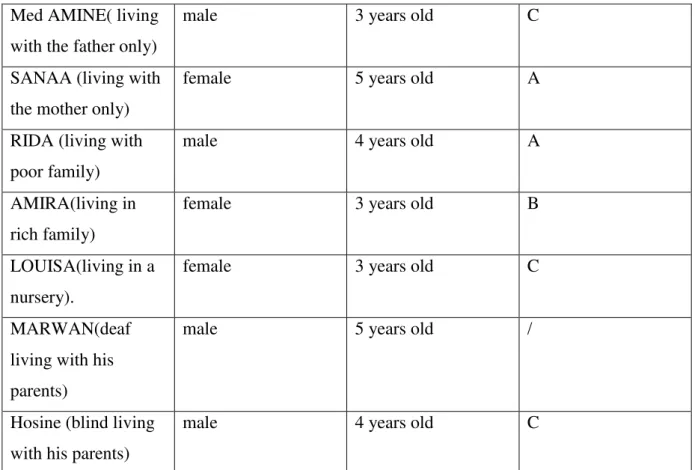
The following experiment shows how could be all children influenced by the family status.
The name sexe age Language acquisition
level Manel(living in a
large family)
female 3 years old B
Ahmed(living with both parents who are workers)
Med AMINE( living with the father only)
male 3 years old C
SANAA (living with the mother only)
female 5 years old A
RIDA (living with poor family)
male 4 years old A
AMIRA(living in rich family)
female 3 years old B
LOUISA(living in a nursery).
female 3 years old C
MARWAN(deaf living with his parents)
male 5 years old /
Hosine (blind living with his parents)
male 4 years old C
Figure 2-2: the children’s levels of language acquisition. The levels:
A- Intelligent in answering, very quick in speaking B- Calm, could hardly speak.
C- Very upset, speaking with great difficulty.
Dialogue :
Parent and Child (3 years old) Parent: What did you do today?
Child: Me drawed a cat. (applies –ed suffix rule but gets wrong)
Parent: You drew a cat?
Child: Yeah. (Understands correction)
Parent: Who did you play with at break time?
Child: Me played with Sarah and Helen. (Wrong pronoun – not learnt passively)
Parent: That sound fun. Now what do you want for tea? Child: Dunno. What you having?
Parent: Daddy and I are having fish.
Parent: Yes. I’ll do you some fish fingers and if you’re a good girl and eat them all you can have a sweetie. (Applying plural noun rule)
Child: Me want two sweeties.
Parent: Alright then. Now go and watch Postman Pat while I start the tea. Child: When Daddy coming home? (Gets SVO order correct all the time)
Parent: He’ll be here soon.
3-The analysis of children questionnaires
Manel: Her acquisition of language is quiet bad. She is unable to express herself. She is most of the time calm. Manel is living in a large family. She is isolated although she has three brothers; she likes playing with toys and singing alone. She can develop her language acquisition.
Ahmed: His parents are workers, he likes isolation, and he doesn’t like answering questions. He often uses gestures by his head to show(no) or (yes). He suffers from his parents’ absence. MOHAMED AMINE: He speaks with great difficulty, he is very upset because he suffers from his mother affection, he is shame then he cannot answer our questions; he spends most of the time with toys.
SANAA:Unlike Manel, Ahmed and Mohamed amine, she seems able to express herself. Her acquisition of language is perfect. She speaks rapidly, and she is intelligent in her answers, she prefers to play with toys which develop her imagination. She does not take care of her father absence.
RIDA:He is forth years old, he is living with poor family, his family status doesn’t influence in his language acquisition. He is vey intelligent that he can answer any question in short time and very quickly. He has vast imagination. He hopes to be a doctor and to have a car and many toys.
AMIRA: She is most of the time silent. Even her family’s standard of living is very good, she prefers playing alone with toys. She is shame; she speaks with hesitating and gives short answers with no more details.
MARWAN: He is deaf child, who lives with his parents, and he is five years old, he does not speak, he is always alone, he prefers stay in place and sees people.
HOSINE: He is a blind child, lives with his parents, he is very upset and he speaks with difficulty, he is most of time alone and doesn’t speak a lot .
4-
Baby’s hearing and communicative development
4-1: From birth to 3 months:Q1: does your child recognize your voice and calm down if crying and smile when sees you?
answers yes no total
Number of parents 28 2 30
percentage 93,33 6,67 100
Table01: crying is to express different needs.
Figure 01: knowing sounds of parents.
The majority of parents answer the first questions about from birth to 3 months by saying yes, because according to them as parent and their experiences with children they say that the child in that period starts recognizing the world and especially knowing the sounds of his parents.
4-2:From 4 to 6 months:
Q2: Does your child babble and make sounds?
answers yes no total
Number of parents 29 1 30
percentage 96,67 3,33 100٪
Table02: Baby babbling and using many different sounds.
yes no
Figure 02: Production of many sounds.
We noticed that most of parents answer by yes, so; according to them, the infants in that period start produce new sounds this why we can hear funny sounds in which they use their vocal cords, tongues and their teeth. Soon the baby begins to babble. The sounds that the baby produces are from the basis of most languages. And they add that all babies babble alike. 4-3:From7 months to 1 year:
Q3: Does your child respond to requests?
answers yes no total
Number of parents 29 1 30
percentage 93,67 3,33 100
Table03: Child’s listening and communication.
yes no
yes no
Figure 3: child’s imitation of sound and communication with gestures
This figure explains how the child develops in the period of 7 months to 1year.most of parents response positively by saying that the enfant turns and looks in the direction of sounds and listen when spoken to, also the mothers add that the child responds to requests (come here), and he communicates using gestures such as waving or holding up arms. And there are some families said that their children do not behave as others who are in the same age, and this what we call the delay in development, may be do not respond to simple question or do not use gestures with hands.
4-4:From 1 to 2 years:
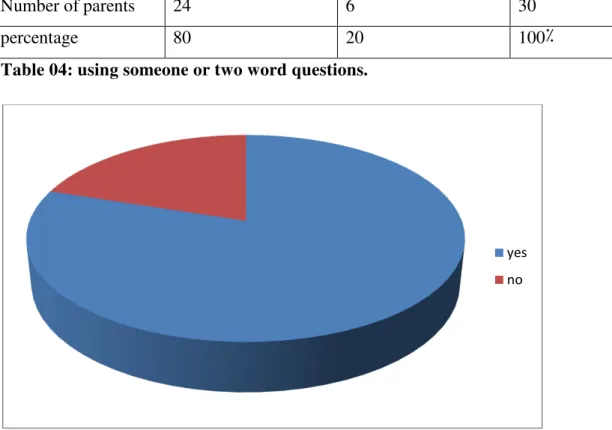
Q4: Does your child acquire some words and use them?
answers yes no total
Number of parents 24 6 30
percentage 80 20 100٪
Table 04: using someone or two word questions.
Figure04: child knowing few parts of the body.
In the period from 1 year to 2 years, we noticed that 20٪ of parents answered by no, because their infants do not develop, and even they don’t know their parts of body when ask to them, and they said that other children understand simple question, and other families respond by saying yes to most questions and they said that the child in the age between one year and two years uses some one or two word questions and puts two words together.
4-5:From 2 to 3 years:
yes no
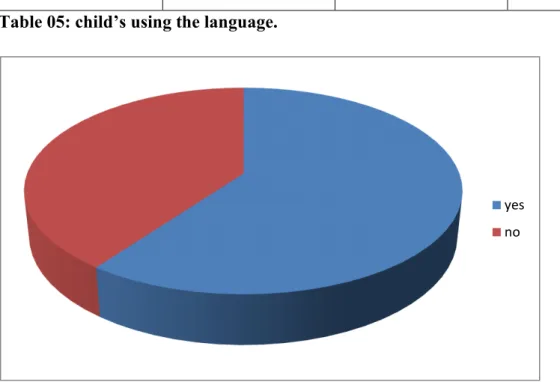
Q5: Does your child speak in a way that understood by friends and family members?
answers yes no total
Number of parents 18 12 30
percentage 60 40 100
Table 05: child’s using the language.
Figure 05: child’s production of 2 or 3 words phrases to ask for things.
We noticed that 40٪of parents answered by no, and 60٪ said yes, and this is because children from 2 to 3 years come to be different. The mothers said if the infant grow up as normal children do, he will speak in way that is understood by family members and friends, and he can name objects to ask for them. And about the parents who said no this related to their children, maybe they have difficulties, disorder or delay and they have to see what the problem is. In other hand, the family plays a role and influences the child language. 4-5:From 3 to 4 years:
Q6:Does your child answer simple question, who,what,where and why questions?
answers yes no tatal
Number of parents 15 15 30
percentage 50 50 100
Table 06:Ability of children to use sentences with four or more words.
yes no
Figure06:Speaking without having to repeat syllables or words
In the period from 3 to 4 years, the child goes to the nuresery ,because according to his parents ,he can answer simple questions ; who,what and why question and the infant uses sentence with four or more words ,also he speaks easily without having to repeat syllabled and words. And 50٪of parents their children can not answer even a simle question( what is your name)or (where do you live).
4-6:From 4 to 5 years:
Q7:do your children understand what happens at home and in school?
answers yes no total
Number of parents 27 3 30
percentage 90 10 100
Table07:child’s ability to name some letters and numbers.
yes no
Figure07:child’s using of sentences that give many details.
We remarked that 90٪ of parents answered owr questions by saying yes, because their children grow up as normal as other children do,and they explain the development of their children by saying that in that period the infant pays attention to short answer and responds to simple question. Also ,the parents add that the child in that age understands most of what happen at home and in school,and in his speech he uses sentences that give many details, and he can go to the primary school to learn names and letters and use adult grammar. But the group of parents who answer by no, their children may have problem in their tongue ,vocal cord or their ears or they have disorder or delay in speech, and they have to see
arthophoniste. Conclusion:
From the data collection and this research work, we find that there are many factors which influence the child language development from birth until his growth, and these factors have a great impact, especially the social factors i-e the parents and family. So they should think about their children and pay attention to them and be aware about what happening around them, in order to their infants grow in a good atmosphere.
yes no
Chapter
Three
Introduction
This chapter is as the conclusion of our work, because it includes the results and the findings about the topic and our hypothesis and discussion of our results, which are related to the child language development and the factors that influence the child language or contribute to the development of this later.
1-Discussion of results and findings:
The research mainly examined both parents and children, the results show that the parents play a great role in the child development, we notice that the main factor that that influence the child is the environment especially the family we have conducted two types of data gathering tools, two questionnaire one has been administrated to children the to parents and an interview with doctors.
Considering the result we got from interview and analyzing the two questionnaires, we confirm that our hypothesis. The finding goes hand in hand with our hypothesis which emphasizes that the parents or family is essential element to help to develop his language.
1-1: Discussion of results (parents and children questionnaires)
We have the yes/ no questionnaire for both children and parents. Some parents said yes because their children grow up as normal children do and develop in each stage and fallow the stages one by one and in the other hand some of them said no because their children may have problem or it related to the family treatment.
Considering children, some of them answer by yes because they recognize and they have idea about what’s happening around them. In contrast, some other said no because they still don’t know many things.
1-2: Discussion of results (doctors interview)
Both parents and doctors agree that crying is something good for the child’s health, and this stage starts from birth to 3 months, then cooing which starts from 4to6 months, after that babbling from 7to 1year. Even the caretakers in the nursery said the same thing, and they add that there are many factors that influence the child language development, and the most important one is the family and parents.
Description of place of investigation:
In fact, it is very important to describe the place and the sample in which the research work takes place, this research was conducted in my small village (I asked some of my neighbors who have children), and in chlef (some pediatricians) and in some nurseries in mostaganem to explore and describe the effectiveness of family in the child life and how it influences the language development.
The samples:
2-1: The parents
The sample consists of 30 families, each one of these families has children in different ages. And some parents are workers, and other are poor
2-2: children
We examined about (20) twenty child, each one has his own answer, they are different, even they are in the same age.
2-3: Doctors:
This investigation is done through interviewing (3) three doctors, we asked them about the different stage that child fallow or go through them before the old of six years.
2-Recommondations and suggestions:
After analyzing the answers of parents, we found out that the main factor that helps the child to develop his language is the society, in other word, the family and parents.
We recommend that the child suffers from many psychological troubles that influence on his language with a negative position; it is a part from his influence of his family and what is around him.
It is seemed that the children who live in the nursery speak later than the other children from the same stage, and other words are less than the children who live with their families Also the speech is delayed for the children who live in isolation for healthy causes. Where as the other children who live in large family, they speak early and also the second child learns early from the first one. (P93 lights on child’s education 1963).
The family quality has a big role in developing the children language, the good circumstances of the family, the calm environment at home. It helps the child to hear and to distinguish his mother’s sound and all other members of the family.
In the beginning of life, the infant laughs when he or she sees a known or unknown person at the age of 2 months, the possibilities of discrimination between the different faces at the age of 6 and 8 months. The infant laughs and manifest his or her happiness in front of know person . The father takes the more and more importance for the small infant, most of the time the youth fathers participate in nursing their babies
The means of communication with the external words ; are three types, the gestures and the language . The gesture is the first contact with the environment, progressively; the infant uses his or her index it show the objects that are around him or her, in order to know what is , at The acquisition of language is an essential means of communication. The acquisition of phonemes is done very early. It is very quick during the sixth month of life. He /she acquire the vowels at first, then the consonants. The social environment has a determinate role in the constitution of language of the infant but it is not only a passive imitation, the infant chooses and elaborates his language.
The syllabic apposition is situated around 6 month. Thanks to the environment that has on echo and double monosyllables by the infant. They become the first word, at the same time; the infant acquires the comprehension of gestures and intonations.
The relations with others stay dominated by the relations with the familial situation. The relation with the mother is the first place. It is her who helps the baby to learn the mother tongue, by the plays, she develops his/ her intelligence, she represents for her baby the protection from danger that menace him/ her.
The father has an essential role. He stays at the second person in the world of the infant. The personality of the father has on intermediate role. The mother and the father contribute to form a parental image for the infant.
The relations with the brother and sisters are variable. The infant of 6 month of life distinguishes between the infants and adults, and he or she manifests happiness by he contacts with that are older than him.
The relations with the foreign person’s in the family are very variable from one child to another during this period of life. The infant is shame and anxious from the foreign persons in