HAL Id: hal-02441951
https://hal-cea.archives-ouvertes.fr/hal-02441951
Submitted on 16 Jan 2020
HAL is a multi-disciplinary open access archive for the deposit and dissemination of sci-entific research documents, whether they are pub-lished or not. The documents may come from teaching and research institutions in France or abroad, or from public or private research centers.
L’archive ouverte pluridisciplinaire HAL, est destinée au dépôt et à la diffusion de documents scientifiques de niveau recherche, publiés ou non, émanant des établissements d’enseignement et de recherche français ou étrangers, des laboratoires publics ou privés.
validation on the large mass prototypic PLINIUS-2
platform
J. Haquet, L. Buffe
To cite this version:
J. Haquet, L. Buffe. Modeling of corium spreading under water layer - validation on the large mass prototypic PLINIUS-2 platform. NUTHOS-11 - The 11th International Topical Meeting on Nuclear Reactor Thermal Hydraulics, Operation and Safety, Oct 2016, Gyeongju, South Korea. �hal-02441951�
1/9
MODELING OF CORIUM SPREADING UNDER WATER
LAYER-VALIDATION ON THE LARGE MASS PROTOTYPIC PLINIUS-2
PLATFORM
JF. Haquet
*, L. Buffe
Commissariat à l’Energie Atomique, CEA-Centre de Cadarache
113115 St Paul les Durance
FRANCE
jean-franç[email protected], [email protected]
ABSTRACT
Corium coolability after a postulated severe accident involving core meltdown and RPV failure is an important issue
.
This article deals with spreading and cooling of a corium in a water layer.Currently, the THEMA code, developed at CEA with EDF sponsorship, deals only with the spreading of corium on dry surface with a radiative-convective exchange coefficient. The spreading is then mainly controlled by inertial and viscous forces.
In the presence of a water layer in the reactor pit, corium spreading is principally controlled by the yield stress in crust at the flow front. This required the development of a dedicated model.
First, the corium crust formation modeling (upper and flow front) was needed. Thanks to this model, the crust thickness evolution with time can be described. An analogy with Fink&Griffiths [1] model of volcanic lava was made.
Parametric studies show that for a given flow rate, higher yield stresses gives higher height and smaller radius, and with the same stress, the larger the flow rate is, the smaller the height is and the larger the radius is.
The aim is to improve the THEMA code taking into account the corium spreading in a water layer. For this, the following modifications should be done:
- The forces related to the yield stress in crust at the flow front have to be implemented in the momentum balance equation of THEMA;
- The power associated with the tensile strength of the crust has to be added in the energy balance equation of THEMA.
Finally, to validate the model, some experiments with large mass of prototypic corium are proposed. Indeed, as crust yield stress values and conductivity of corium crust are essential but very poorly known, first, dedicated experiments will be considered to measure these thermophysical data used in the model. Then, the validation of this new version of THEMA will require experiments in more representative conditions which could be carried out in the future PLINIUS-2 experimental platform in Cadarache.
KEYWORDS
Corium-Spreading under water-Modeling-THEMA-PLINIUS2
2/9
1. INTRODUCTION
Corium coolability after a severe PWR accident involving core meltdown and RPV failure is one of the main issues in nuclear safety. The case considered here is a situation in which the corium is assumed to spread over a concrete floor covered with shallow water. The main question that has to be addressed is to identify the forces which influence the extent of the spreading.
Development of a core catcher with a corium spreading area for the EPR required a European R&D large program based on experimental and theoretical investigations [2]. Studies on corium spreading have therefore been performed to understand the ability of corium to spread on a dry substrate of fixed geometry and composition, with the corium flow conditions on the spreading surface determined by the accident sequence. Corium spreading is governed by competition between hydrodynamic driving forces which is hydrostatic pressure and, to some extent, inertia. These forces promote progress and thinning of the flow, and gradual corium solidification which leads to increasing apparent viscosity and the appearance of crust in contact with the substrate and surface in absence of water. Knowledge of dry corium spreading for the case of a large difference between solidus and liquidus temperatures is sufficient to validate calculations and extrapolations to the case of reactor.
With regard to corium spreading under water depth of around few centimeters, the effect of crust strength dominates and provides the dominant delaying force. Extrapolation to the case of a power reactor is not possible with existing knowledge. Therefore a new model is necessary, describing the thermalhydraulic aspects of the spreading as well as the mechanical behavior of the upper crust.
2. MODEL OF CORIUM SPREADING UNDER WATER LAYER
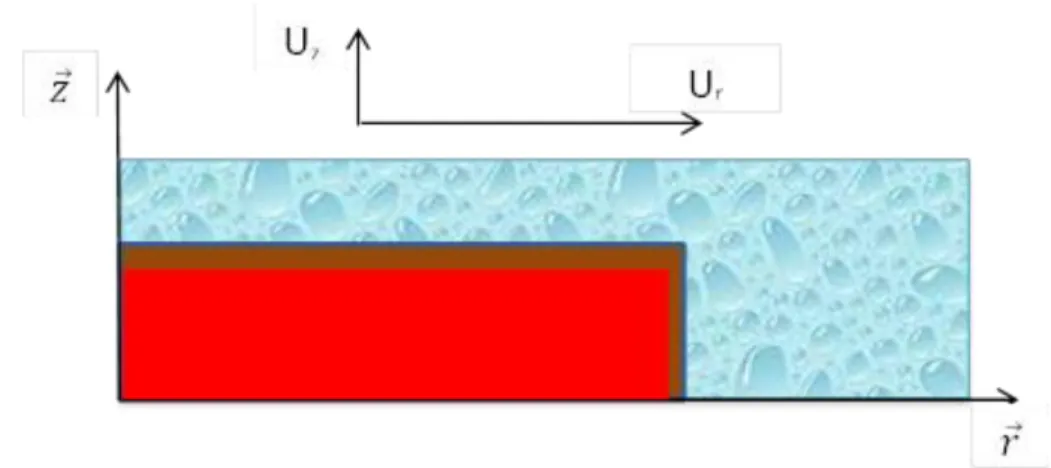
The schematic diagram of the flow considered is shown in fig.1 and the elementary volume dV considered is the melt surrounded by crust (volume delimited in red and brown).
Fig. 1 Schematic diagram of spreading under water.
2.1. Balance general equations
The model is built on the basis of Navier-Stokes equations for incompressible non-newtonian liquids. The flow is assumed to be symmetrical with respect to a straight line The integrated equations are obtained from the well-posed complete system of equations related to the flow of a corium composed with only one oxide phase and with a crust above it.
To simplify the system equations a list of commonly accepted hypotheses are described in the Table 1 in which the main approximation is thin layer condition [H5].
3/9
Table 1. Sample table: accuracy of nodal and characteristic methods
Considering the volume V equal to melt + crust
Mass balance :On the elementary volume dV, the continuity equation is written:
∭ (
𝜕𝜌𝑐𝜕𝑡
+ 𝑑𝑖𝑣 𝜌
𝑐𝑈⃗⃗ )𝑑𝑉
𝑣
= 0
(1)where 𝜌𝑐,
𝑈⃗⃗
are respectively, the density and the velocity of the melt.Continuity equation under assumption of incompressibility [H3] is written as follow :
∭ 𝑑𝑖𝑣 𝑈
𝑣⃗⃗⃗
𝑑𝑉 = 0
(2)That means 𝑈𝑟𝑆 is constant and so the volume flow rate is constant :
𝑄𝑡 = 𝜋𝑅(𝑡)
2𝐻(𝑡)
(3)Momentum balance :
On the same elementary volume dV, the Navier-Stokes equation is written : 𝜌𝑐∭ (𝜕𝑈⃗⃗ 𝜕𝑡 + (𝑈⃗⃗ . 𝑔𝑟𝑎𝑑⃗⃗⃗⃗⃗⃗⃗⃗⃗⃗ )𝑈⃗⃗ ) 𝑑𝑉 ⏟ 𝑖𝑛𝑒𝑟𝑡𝑖𝑎 = ∭ 𝜌⏟ 𝑐𝑔 𝑑𝑉 𝑔𝑟𝑎𝑣𝑖𝑡𝑦 + ∭ 𝑑𝑖𝑣𝜏̿ 𝑑𝑉⏟ 𝑠ℎ𝑒𝑎𝑟/ 𝑣𝑖𝑠𝑐𝑜𝑠𝑖𝑡𝑦 − ∬ 𝑝𝑛⃗ 𝑑𝑆⏟ 𝑝𝑟𝑒𝑠𝑠𝑢𝑟𝑒 − ∬ 𝜎⏟ 𝑟𝑢𝑝𝑡𝑛⃗ 𝑑𝑆 𝑓𝑎𝑖𝑙𝑢𝑟𝑒 𝑐𝑟𝑢𝑠𝑡 (4)
where 𝜌𝑐, 𝜏̿, and 𝜎𝑟𝑢𝑝𝑡 are, respectively, the density of the melt, the tensor of viscous stresses and the
cracking stress of the crust.
H1 Steady-state flow
H2 Newtonian fluid
H3 Incompressibility (ρc = constant)
H4 Density of water negligible compared to that of corium (ρwat << ρc)
H5 Shallow water hypothesis (Thickness of the melt << radius of the melt)
H6 Flow controlled by the crust strength
H7 The melt is always under water
H8 No bottom crust. Only upper and lateral crust
H9 Spreading basemat is horizontal
H10 No steam explosion
4/9
By projecting along the 𝑟 axis and in cylindrical coordinates the order of magnitude of the individual terms are as follow :
- Inertia term order of magnitude 𝑂(𝜌𝑐𝑈𝑟2𝜋𝑅(𝑡)𝐻(𝑡)) with 𝜕𝑈𝜕𝑡𝑟= 0 according to
approximation [H1],
- Gravity and pressure term order of magnitude 𝑂(𝜌𝑐𝑔𝜋𝑅(𝑡)𝐻(𝑡)2) with 𝑔𝑟𝑎𝑑⃗⃗⃗⃗⃗⃗⃗⃗⃗⃗ 𝑝∗=
𝑔𝑟𝑎𝑑⃗⃗⃗⃗⃗⃗⃗⃗⃗⃗ 𝑝 − 𝜌𝑔 where 𝑝∗ is the drive pressure of the flow,
- Shear and viscosity term order of magnitude 𝑂 (𝜇̅̅̅𝑈𝑐 𝑟 𝜋𝑅
2
𝑒𝑝 ) where 𝜇̅𝑐 is the equivalent
viscosity and 𝑒𝑝 the boundary layer thickness
with 𝜏𝑖𝑗= 2𝜇𝜀𝑖𝑗 and
𝜀
𝑖𝑗=
12(
𝜕𝑢𝜕𝑥𝑖𝑗
+
𝜕𝑢𝑗
𝜕𝑥𝑖
)
according approximation [H2],- Failure crust term order of magnitude 𝑂 (𝜎𝑟𝑢𝑝𝑡𝜋𝑅(𝑡)𝛿𝑓(𝑡)) with 𝛿𝑓(𝑡) crust thickness at the
spreading front
Finally the integro-differential equation is expressed by an algebric equation as following : 𝜌𝑐𝑈𝑟2𝜋𝑅(𝑡)𝐻(𝑡) + 𝜇 𝑐𝑈𝑟 𝜋𝑅(𝑡) 2 𝑒𝑝 + 𝜎𝑟𝑢𝑝𝑡𝜋𝑅(𝑡)𝛿𝑓(𝑡) ≅ 𝜌𝑐𝑔𝜋𝑅(𝑡)𝐻(𝑡) 2 (5) Energy balance :
Energy balance equation can be written in the following form, with the two last terms taking into account the power due to the crust.
𝜕𝜌𝑐ℎ 𝜕𝑡 + 𝑑𝑖𝑣(𝜌𝑐ℎ𝑈⃗⃗ ) = 𝜕𝑝 𝜕𝑡+ 𝑃 + ∅ + 𝑈⃗⃗ . 𝑔𝑟𝑎𝑑⃗⃗⃗⃗⃗⃗⃗⃗⃗⃗ 𝑝 + 𝑑𝑖𝑣𝜑⃗ − 𝑑𝑖𝑣(𝜎⏟ 𝑟𝑢𝑝𝑡𝑈⃗⃗ ) 𝑣𝑜𝑙𝑢𝑚𝑖𝑐 𝑐𝑜𝑛𝑡𝑟𝑎𝑐𝑡𝑖𝑜𝑛 + 𝑈⃗⃗ . 𝑔𝑟𝑎𝑑⏟ ⃗⃗⃗⃗⃗⃗⃗⃗⃗⃗ 𝜎𝑟𝑢𝑝𝑡 𝑝𝑜𝑤𝑒𝑟 𝑜𝑓 𝑡ℎ𝑒 𝑠𝑡𝑟𝑒𝑠𝑠 𝑓𝑜𝑟𝑐𝑒 (6)
As mentioned in the introduction, the simplified modelling focuses on the effect of upper crust. Nevertheless the crust at the melt-substrate interface may contribute to the evolution of the melt temperature. In fact in this study the melt temperature is assumed to be constant during the spreading (due to the low heat transfer through the crusts). Futhermore the repartition of decay heat density 𝑃 between crust and melt is not well known. So the energy balance equation will be reviewed.
3. UPPER CRUST MODEL
3.1 Crust thickness
Assuming the corium spreading is governed by the rupture stress of the crust, the mass (3) and momentum (5) equations become :
{𝜎 𝑄𝑡 = 𝜋𝑅(𝑡)2𝐻(𝑡)
5/9
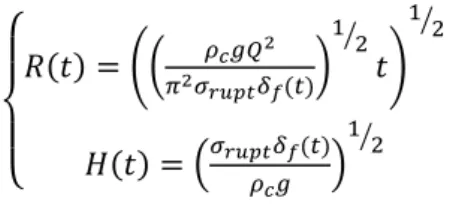
and give the time evolution of the spreading characteristic parameters 𝑅(𝑡) and 𝐻(𝑡) respectively the corium spreading length and thickness.
{ 𝑅(𝑡) = (( 𝜌𝑐𝑔𝑄2 𝜋2𝜎𝑟𝑢𝑝𝑡𝛿𝑓(𝑡)) 1 2 ⁄ 𝑡) 1 2 ⁄ 𝐻(𝑡) = (𝜎𝑟𝑢𝑝𝑡𝛿𝑓(𝑡) 𝜌𝑐𝑔 ) 1 2 ⁄ (8)
Surface crust growth dynamic is taken into account with the following specific model.(Fig.2)
Fig. 2 Heat fluxes at the interface corium/water with crust.
The transient heat conduction equation in the crust together with the energy balance at the interface (melt-surroundings for the upper crust) led to a set of two equations with two unknowns : the crust thickness and the surface temperature at the crust surface.
{ 𝑑𝑇𝑠𝑢𝑟𝑓 𝑑𝑡 = − 𝜆𝑐𝑟(𝑇𝑙𝑖𝑞−𝑇𝑠𝑎𝑡) ℎ𝑤𝑎𝑡(𝛿𝑓+ℎ𝑤𝑎𝑡𝜆𝑐𝑟) 2∗ 𝑑𝛿𝑓 𝑑𝑡 − 𝜆𝑐𝑟(𝑇𝑙𝑖𝑞−𝑇𝑠𝑎𝑡) 𝛿𝑓(ℎ𝑤𝑎𝑡+𝜆𝑐𝑟𝛿𝑓) 2∗ 𝑑ℎ𝑤𝑎𝑡 𝑑𝑇𝑠𝑢𝑟𝑓∗ 𝑑𝑇𝑠𝑢𝑟𝑓 𝑑𝑡 𝜌𝑐𝑟(𝐻𝑠𝑜𝑙+𝐶𝑝𝑐𝑟 2 (𝑇𝑙𝑖𝑞− 𝑇𝑠𝑢𝑟𝑓)) 𝑑𝛿𝑓 𝑑𝑡 = 𝜆𝑐𝑟( 𝑇𝑙𝑖𝑞−𝑇𝑠𝑢𝑟𝑓 𝛿𝑓 ) − ℎ𝑐(𝑇𝑐− 𝑇𝑙𝑖𝑞) − 𝑃𝛿𝑓 2 ℎ𝑤𝑎𝑡= ℎ𝑤𝑎𝑡(𝑇𝑠𝑢𝑟𝑓)
(9)
Three equations with three unknown parameters : ℎ𝑤𝑎𝑡, 𝑇𝑠𝑢𝑟𝑓, 𝛿𝑓, respectively two-phase heat
coefficient, crust surface temperature and crust thickness and with initial conditions :
{
𝛿𝑓(0) = 0
𝑇𝑖 = 𝑇𝑙𝑖𝑞
ℎ𝑤𝑎𝑡= ℎ𝑤𝑎𝑡(𝑇𝑙𝑖𝑞)
At the melt upper surface with an overlying water layer, the heat transfer ℎ𝑤𝑎𝑡 is calculated along the
Nukiyama’s [3] full boiling curve. In the nucleate boiling regime heat transfer is calculated using Rohsenow’s correlation and the critical heat flux is calculated using Zuber’s model [4]. In the film boiling regime, the melt to water heat transfer accounts for radiant heat transfer across the film and conduction.
The solving of the equation (9) at time ti+1 gives:
P
6/9
{
𝛿
𝑓(𝑡
𝑖+1) =
𝐵(𝑡𝐴(𝑡𝑖) 𝑖)(𝑡
𝑖+1− 𝑡
𝑖) + 𝛿
𝑓(𝑡
𝑖)
𝑇
𝑠𝑢𝑟𝑓(𝑡
𝑖+1) =
1−𝐷(𝑡𝐶(𝑡𝑖) 𝑖)∗𝑑𝑇𝑠𝑢𝑟𝑓𝑑ℎ𝑤𝑎𝑡∗
𝐵(𝑡𝑖) 𝐴(𝑡𝑖)(𝑡
𝑖+1− 𝑡
𝑖) + 𝑇
𝑠𝑢𝑟𝑓(𝑡
𝑖)
(10)
3.2 Comparison with volcanic lava model
The spread of volcanic lava under water has a certain similarity in behavior with corium spreading under water layer. In a magma eruption under water, Griffiths and Fink [2] approximated the crust thickness near the flow front as proportional to (𝐾𝑡)0.5, where 𝑡 is the time since the eruption
commenced and 𝐾 the thermal diffusivity. This implies considering that boiling leads to a constant temperature of 100°C at the crust surface.
Fig. 3 comparison crust thickness models
For spreading time less than 10 s the two models are similar. For greater spreading time, the crust thickness calculated with the Nukiyama model is about 30% greater than that calculated with volcanic lava model. An analogy with Fink&Griffiths model of volcanic lava led to a dependence on (kt) 0.46
4. THEMA MODELS
In the frame work of Severe Accident research, the spreading code THEMA [5], developed at CEA, aims at predicting extent of molten core after a vessel melt-through. The code is devoted to the simulation of spreading on dry surface, taking into account the melt solidification, as well as the possible melting of the substrate. In the current version of the code , the mechanical effect of the upper crust is discarded firstly for simplify the equations and secondly because the mechanical properties of the crust are not known.
One of the aims is to improve the THEMA code to take into account the corium spreading in a water layer. Modifications should be implemented concerning the momentum balance equation and the energy equation by adding terms concerning the effect of crust strength.
-0,002 0 0,002 0,004 0,006 0,008 0,01 0,012 0,014 0,016 0 50 100 150 200 250 300 350 400 450 500 cr u st th ic kn e ss(m ) time (s)
crust thickness
Nukiyama model lava model (kt)^0.5 (kt)^0.467/9
5. EXPERIMENTAL PROGRAM
There is currently a lack of experiment data in order to investigate physics of spreading and considers various generic situations favoring the assessment of models with crust effect on the spreading length. Some sensitivity studies showed that the crust stress values and conductivity of corium are essential in the spreading prediction but very poorly known. So dedicated experiments will be considered to measure these thermophysical properties used in the model.
To be the most representative of the reactor case, some integral experiments with large mass of prototypic corium are proposed and could be carried out in the future PLINIUS-2 experimental platform in Cadarache [6]. The test section could be an angular sector of 20 to 40° where 300 to 500 kg of prototypical corium would spread under water.
6. CONCLUSIONS
R&D programmes performed to study corium spreading have established that dry spreading of the corium formed during a core melt accident enables its later cooling. The corium spreads adequately, as long as the flowrate is sufficiently high.
The presence of a layer of water has an effect on spreading. In this case, corium flow depends on the mechanical behavior of the crust formed on the surface and at the front of the flow.
A parametric study shows that spreading within a water layer is principally controlled by the yield stress in crust at the flow front. The model has been developed and tested for a range of flow rates (0.1 𝑚3/𝑠 < 𝑄 < 0.5 𝑚3/𝑠) and stresses (0.1 𝑀𝑃𝑎 < 𝜎
𝑟𝑢𝑝𝑡 < 10 𝑀𝑃𝑎).
First, the corium crust formation modeling (upper and flow front) was needed. Thanks to this model, the crust thickness evolution with time can be described. An analogy with Fink&Griffiths [2] model of volcanic lava led to a dependence on t-0.46.
The parametric study shows that with the same flow rate, higher stress gives higher height and smaller radius. And with the same stress, the larger the flow rate is, the smaller the height is and the larger the radius is.
The aim is to improve the THEMA code taking into account the corium spreading in a water layer. For this, the following modifications should be done:
- The forces related to the yield stress in crust at the flow front have to be implemented in the momentum balance equation of THEMA,
- The power associated with the tensile strength of the crust have to be added in the energy balance equation of THEMA.
Finally, to validate the model, some experiments with large mass of prototypic corium are proposed. Indeed, as crust stress values and conductivity of corium crust are essential but very poorly known, first, dedicated experiments will be considered to measure these thermophysical data used in the model. Then, the validation of this new version of THEMA code will require experiments in more representative conditions: 300 to 500 kg prototypical corium spreading within an angular sector of 20° to 40°, assuming an effective crust yield stress from 0.1 MPa to 1 MPa. They could be carried out in the future PLINIUS-2 experimental platform in Cadarache.
8/9
NOMENCLATURESymbols Unit
Cp Specific heat J.kg-1.K-1
δf Crust thickness at the spreading front m
e Thickness m
ep Thickness of the viscous boundary layer diffusion m
ε emissivity -
F Force per unit length N.m-1
φ Local power viscous forces W.m-3
ϕ Heat flux W.m-2
g Gravity acceleration m.s-2
H Height of the melt m
Hsol Enthalpy of solidification J.kg
-1
h Enthalpy J.kg-1
K Heat diffusivity m2.s-1
λ Heat conductivity W.m-1.K-1
M Mass kg
µ Dynamic viscosity Pa.s
ν Kinematic viscosity m2.s-1
P Decay power density W.m-3
p Pressure Pa
Q Volumetric flow rate m3.s-1
R Radius of the spreading front m
ρ Density Kg.m-3
S Surface m2
σ Surface tension N.m-1
σrupt Crust rupture stress Pa
σstef Stefan-Boltzmann constant W.m
-2 .K-4 T Temperature K t Time s 𝜏̿ Shear stress Pa 𝑈⃗⃗ (𝑈𝑟, 𝑈𝑧) Velocity vector m.s-1 V Volume m3 Subscripts Xc corium Xcr crust Xcrit critical
Xfilm Vapor film
Xi inertia
Xl liquid
9/9
Xmin minimal
Xray radiation
Xsat Water at saturation
Xsol solidus
Xsurf surface
Xv vapor
Xwat water
ACKNOWLEDGMENTS
This work has been carried out within the framework of partnership with EDF. The authors would like to acknowledge EDF for their financial support and fruitful discussions.
REFERENCES
1. FINK, ROSS W. GRIFFITHS AND JONATHAN H. “Effects of surface cooling on the spreading of lava flows and domes.” J. Fluid Mech. vol.252, 667-702. 1993.
2. ALSMEYER H. et al, “Ex vessel core melt stabilization research, Nuclear Engineering and Design 235, pp. 271-284. 2005.
3. NUKIYAMA S. “Maximum and Minimum Values of Heat Transmitted from Metal to Boiling Water Under Atmospheric Pressure,” Journal of the Japanese Society of Mechanical Engineers, 37, pg 367 (1934).
4. HEWITT G.F., DELHAYE J.M., ZUBER N., “Multiphase Science and Technology, Volume 2” 5. SPINDLER B., VETEAU J.M. ”The simulation of melt spreading with THEMA code Part 1:
Model, assessment strategy and assessment against analytical and numerical solutions” Nuclear Engineering and Design 236 , pp. 415-424. 2006.
6. JOURNEAU C., BUFFE L., CASSIAUT-LOUIS N.,BOUYER V., HAQUET J.F., PILUSO P., PLUYETTE E., BOTTIN M., WILLERMOZ G., “PLINIUS2, a new Versatile Platform for Severe