
HAL Id: hal-02167090
https://hal.archives-ouvertes.fr/hal-02167090
Submitted on 27 Jun 2019
HAL is a multi-disciplinary open access
archive for the deposit and dissemination of
sci-entific research documents, whether they are
pub-lished or not. The documents may come from
teaching and research institutions in France or
abroad, or from public or private research centers.
L’archive ouverte pluridisciplinaire HAL, est
destinée au dépôt et à la diffusion de documents
scientifiques de niveau recherche, publiés ou non,
émanant des établissements d’enseignement et de
recherche français ou étrangers, des laboratoires
publics ou privés.
Towards Reproducible Wireless Experiments Using
R2lab
Mohamed Naoufal Mahfoudi, Thierry Parmentelat, Thierry Turletti, Walid
Dabbous
To cite this version:
Mohamed Naoufal Mahfoudi, Thierry Parmentelat, Thierry Turletti, Walid Dabbous. Towards
Re-producible Wireless Experiments Using R2lab. [Research Report] Inria - Sophia Antipolis; Université
Côte d’Azur. 2019. �hal-02167090�
Towards Reproducible Wireless Experiments Using R2lab
Extended Abstract
Mohamed Naoufal Mahfoudi
Universit´e Cˆote d’Azur, Inria, France [email protected]
Thierry Parmentelat, Thierry Turletti
Walid Dabbous
Universit´e Cˆote d’Azur, Inria, France [email protected]
ABSTRACT
Reproducibility is key in designing wireless systems and evaluat-ing their performance. Tryevaluat-ing to reproduce wireless experiments allowed us to identify some pitfalls, and possible ways to simplify the complex task of avoiding them. In this paper we expose a few considerations that we learned are instrumental for ensuring re-producibility of wireless experiments. Then we describe the steps we have taken to make our experiments easy to reproduce. We specifically address issues related to wireless hardware, as well as varying propagation channel conditions. We show that an exten-sive knowledge of the used hardware and of its design is required to guarantee that the inner state of the system has no negative impact on performance evaluation and experimental results. As for vari-ability of channel conditions, we make the case that a special setup or testbed is necessary so that one can control ambient wireless propagation environment, using for instance an anechoic chamber like R2lab.
1
ORION
We have launched a project called Orion [1] that focuses on the design of an orientation measurement system, based on the joint estimation of the angle of departure and the angle of arrival of a Wi-Fi signal. Our system exploits the presence of antenna ar-rays at both the transmitter and receiver ends. When a signal is radiated or received by an antenna array, a phase shift is created between the signals of adjacent antenna elements. By computing this phase difference from the CSI measurements, an estimation of the angles above is possible. As estimation techniques for the angle of arrival were already mentioned in several works before, we proposed a method for estimating the angle of departure, exploiting a well known MIMO mechanism called spatial multiplexing, and supported in commercial off-the-shelf (COTS) wireless cards. The reproducibility of our experiments was a driving force, as well as a necessity in the system design since an orientation measurement system requires consistency and resilience against recalibration or reset.
In [1] we explain in greater length the scientific challenges ad-dressed in this work, which focuses on properly dealing with var-ious sources of phase shifts and inconsistencies that need to be accounted for to achieve decent accuracy.
In the present paper, we wish to describe into more details the actual experimental methodology and work that was carried out to reach the results described in [1], with a focus on what is easily reproducible and what is not, and to discuss possible improvements in this regard.
2
EXPERIMENTAL METHODOLOGY
First and foremost, it has been crucially important for us to be able to use the R2lab testbed1in the early stages of the project, for an initial calibration phase.
2.1
R2lab, testbed for reproducible wireless
experiments
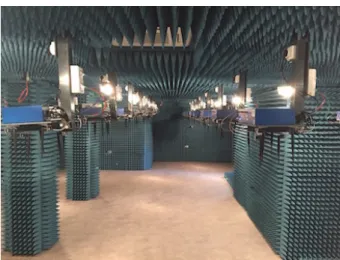
Room characteristics. The R2lab platform sits in a 90m2insulated anechoic chamber located in a basement of a building at Inria, Sophia Antipolis, France. Figure 1 shows a snapshot from inside the room and Figure 2 the topography. It hosts thirty-seven PC nodes on the ceiling scattered on a fixed grid; more than half of the nodes feature an SDR board, of various kinds. Such an environment
Figure 1: R2lab room
allows running various scenarios with wireless nodes that can be with line of sight or not between each other.
It is insulated from the external electromagnetic conditions by a Faraday cage. RF absorbers are needed to prevent high level of reflections on the copper foils.
Wi-Fi nodes. The 37 wireless nodes are Icarus2computers pro-vided by NITlab3with the following features:
• CPU Intel Coreffl i7-2600, 8M Cache at 3.40 GHz • 8GB DDR3
• 240 GB Solid State Drive
1FIT Reproducible Research Lab (R2lab) at Inria, URL: http://fit-r2lab.inria.fr 2Icarus node: https://nitlab.inf.uth.gr/NITlab/.
3NITlab:
Figure 2: R2lab topology
• 3 Gigabit Ethernet interfaces: one for remote node power and reset management, one for control used by the testbed management framework for providing access, and one for data, dedicated to experimentation, e.g., to create wired link or to connect to an SDR device such as USRP2 or N210. • 2 Wi-Fi MIMO NICs dedicated to experimentation: one
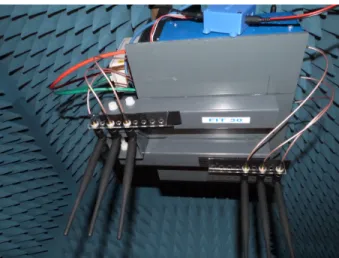
Atheros 802.11 93xx a/b/g/n and one Intel 5300. Each card is connected to 3 dual-band 5dBi antennas, operating on both 2.4GHz and 5GHz. Antennas are spaced of 2.8cm, which corresponds to half the wavelength at 5GHz, see photo at Figure 3.
Figure 3: Wi-Fi dual-band antennas for a node
To control and monitor each Icarus node, we use the NITlab’s Chassis Manager Card (called CM card); this device embarks a tiny web server that can serve HTTP requests to power on/off and reset the motherboard, or one attached USB device.
2.2
Using R2lab for calibration
The benefit of using R2lab is that its basic hardware components, like nodes and wireless devices and antennas, remain in a rela-tively constant configuration, which is a good thing in terms of reproducibility.
More importantly, being able to run experiments in a controlled environment, allowed us to draw conclusions between runs that differed in only a small set of parameters, which is something hardly possible in an open environment, if at all. Launching our first experiments in R3lab was instrumental in providing us the means to classify the various types of phase shifts and inconsistencies at work, and namely:
• Phase inconsistencies due to hardware defect: Intel Wi-Fi Link 5300 wireless cards suffer from a defect on the third RF chain when the card is tuned on the 2.4 GHz band, which further alters phase data. We decided to use the 5 GHz band which does not exhibit this issue.
• Phase inconsistencies not affecting the estimations: we could experimentally verify that within our approach - that does not use time-of-flight - even though sampling frequency offset (SFO) and central frequency offset (CFO) do bring phase shifts, they are equally applied to all RF-chains and thus can be ignored.
• Phase shift due to the adopted transmission mode: spatial multiplexing in the wireless card involves two tech-niques, spatial mapping (SM) and cyclic shift delay (CSD). They create phase shifts that need to be compensated for, using a mapping matrix from either the manufacturer’s datasheets, or from the IEEE 802.11n draft [2].
• Phase inconsistencies impairing reproducibility of results:RF oscillator phase offset is a constant phase shift added to each one of the RF chains of a wireless card. This phenomenon occurs due to the fact that the RF chains are locked at different instants when starting up the wire-less cards. Therefore, each RF chain will have a different constant offset added to the measured phase. This offset remains constant across one session4.
Using an anechoic chamber gave us a unique way to address each of these potential issues independently from one another.
As an illustration of the outcome of dealing with the last source of phase shifts, we showcase in Figure 4 the estimation results of AoA and AoD before and after applying the phase correction method introduced in [1]. That technique relies on measuring the RF oscillator offset from a known reference point. By doing so, we are able to reproduce comparable results throughout different measurement sessions.
2.3
Details on the experimental setup
In terms of software, the ORION paper uses the same technical substrate as OpenRF [3], namely Intel WiFi Link 5300 wireless cards, together with the Intel CSI tool [4], which allows interactions with the firmware, like reading or writing the channel state information (CSI) matrix for 802.11n HT packets.
4A session is a period during which hardware configuration is fixed. Typically a node
reset, a node reboot, or simply a change of frequency in the card, yields a new session.
Figure 4: Pseudospectrum for AoA (left) and AoD (right) be-fore (blue) and after (red) phase correction (from [1]).
In terms of radio, after determining that the 2.4GHz band could be an issue, we used the 5GHz band with 20MHz of bandwidth. We also set up the cards in injection mode, which avoids the need for an association with an AP, and allows raw Wi-Fi packets transmission. The antenna arrays installed in R2lab are fixed and thus inopera-ble for rotation estimation. Hence, we chose to use two external uniform linear antenna arrays (ULAs), which are connected to the nodes through extension cables in order to have more liberty of movement. These cables are 3 meters long and compatible with both the Wi-Fi bands with a 2dB signal attenuation for the 2.4GHz band. To respect the coplanar aspect of the experiments, and to deal with the cables’ rigidity, we have placed the ULAs on ladders at the same height as the R2lab nodes. The antennas used for our experi-ments are 5dBi omnidirectional, compatible with 2.4GHz as well as the 5GHz band. Since we are operating at a 5.32GHz frequency, we created a 2.8cm inter-antenna spacing, which corresponds to half-wavelength.
Finally, in our experiments, we have faced issues while attempt-ing to decode a packet at the receiver end when usattempt-ing 3 antennas with 3 spatial streams. So finally, we chose to operate with 2 spatial streams and a 2-antenna system at the transmitter end. As for the receiver, we had no problems while using the 3-antenna setting.
2.4
Using an orchestration engine
Given all the complexity described so far, it is obvious that numer-ous runs of the same scenario, or small variants of it, need to be carried out in order to fine-tune and validate the overall method. For that reason, being able to launch such runs as efficiently as pos-sible is very desirable, and to achieve this we have used nepi-ng5, a tool designed for R2lab that addresses precisely this kind of usage6. Based on this tool, we have been able to script7the actual data collection process, which can be achieved in no more than a few minutes even with a rather through set of nodes, while even more importantly letting the experimenter focus on meaningful issues, in-stead of having to focus on the tedious task of properly coordinating the various stages.
5Read the Docs documentation for nepi-ng at https://nepi-ng.inria.fr/ 6Tutorials for nepi-ng at https://r2lab.inria.fr/tutorial.md
7ORION data gathering script at https://github.com/parmentelat/r2lab/tree/public/
demos/jobs-angle-measure
2.5
Experimental material in a
git repository
As an additional step towards a more reproducible experiment, we have gathered in a single public git repository8a detailed de-scription of the system setup and of the hardware involved, with illustrations, that hopefully provides sufficient information on the measurement steps. Furthermore, to avoid any licensing problems when using MATLAB, the repository contains a python version of our code data post-processing tools, as well as a jupyter notebook9 that allows running all the steps of our angle estimation technique.
2.6
Running in a different environment
In order to make our system deployable, we needed to test our system in an open, realistic, and non-controlled wireless environ-ment as well. We chose to reproduce the same experienviron-ment in an office room. This setup involved several multipath clusters; the main difference with the original system setup in R2lab is the ele-vation of the antenna arrays, as we were careful to preserve their co-planarity. We have been using the same hardware as in R2lab, including antennas cables and antennas spacing.
With all these pieces in place, it has been rather straightforward to re-run the same experiments in such an open environment.
As a side effect, the same tools can, of course, be used by other experimenters to reproduce our results with reasonable effort. Here is a tentative list of the topics that may require extra work to do, in light of the feedback we have gathered so far:
• Hardware setup when reproducing outside of our premi-ses, setting up the right type of wireless cards and antennas should be rather straightforward, but will no doubt require some initial effort though.
• Position in space of the antennas: whether the experi-ment is run in R2lab, in our open environexperi-ment or other premises altogether, it is crucially important that anten-nas are properly spaced, and in a common plane. This is a feature that is hardly automatable, and so accounts for most of the time spent in variously tedious and possibly time-consuming activities.
• Software image we do provide a ready-to-load image for the R2lab nodes that is completely ready for running the experiment, but in the current state, this is not usable as such on other types of hardware, due to our imaging technique. In this regard, it would make sense to use more standard techniques like e.g., docker to manage images, although it is not yet clear if running in a container-based system can provide a level of hardware interaction that is typically needed in wireless experiments.
3
DISCUSSION ON REPRODUCIBILITY
In the early stages of our research work, and along the steps of our system design, our main concern was control and calibration of the hardware. In this context, having access to an anechoic chamber has been a tremendous asset.
Extensive knowledge of the hardware, along with a thorough understanding of its capabilities and limitations, are essential in
8ORION git repository https://github.com/naoufal51/Orion 9ORION notebook at https://www-sop.inria.fr/teams/diana/orion/
order to decide on a measurement system based on COTS hardware. For instance, in our case, the card was functioning abnormally in the 2.4GHz band. In the same spirit, we have published a study on some pitfalls to avoid when using COTS hardware in experimental testbeds [5].
As the project became more mature, our concerns have shifted to making the experiment more reproducible, and have lead us to manage the project more like a software development project; indeed in many respects the challenges for reproducibility have strong similarities with the ones of software development, and we believe that tools like source code management tools, maybe even test suite frameworks, as well as interactive computing concepts like notebooks, can be beneficial in building more reproducible research.
Finally, in terms of operating the R2lab testbed, this study has brought very fruitful insights as to what users expectations can be, and even if it is not possible for remote users to control for example the position of antennas, it is crucial to be able to accurately describing such details. We are currently in the process of more formally describing a reference configuration for all such elements in the room, so that users can return the chamber in a known and well-documented configuration.
4
CONCLUSION
In this paper, we present our methodology to facilitate the repro-ducibility of our wireless experiments. We consider two main types of problems impairing the reproducibility of wireless experiments, one related to the hardware/software and the other to the variability of the wireless channel. We outline that a sufficient knowledge of the hardware/software is essential, and often underestimated in the literature. We exhibit practical cases where it is essential to pro-vide mechanisms to correct possible defects of hardware in terms of measurement accuracy and reproducibility. Finally, we show that using controlled wireless environments such as an anechoic chamber is an essential asset when calibrating a wireless system, in addition to experimenting in more realistic wireless environments. [6]
ACKNOWLEDGMENTS
The R2lab wireless testbed at Inria has been funded by the ANR-10-EQPX-0031-01 (FIT). This work has been partly funded by the ANR-11-LABX-0031-01 (UCN@Sophia).
REFERENCES
[1] Mohamed Naoufal Mahfoudi, Thierry Turletti, Thierry Parmentelat, Fabien Ferrero, Leonardo Lizzi, Robert Staraj, and Walid Dabbous. ORION: Orientation Estimation Using Commodity Wi-Fi. In Workshop on Advances in Network Localization and Navigation (ANLN), Paris, France, May 2017.
[2] IEEE Standard for Information technology (2009). Local and metropolitan area networks— Specific requirements— Part 11: Wireless LAN Medium Access Control (MAC) and Physical Layer (PHY) Specifications Amendment 5: Enhancements for Higher Throughput, IEEE Std 802.11n-2009, Oct 2009.
[3] Swarun Kumar, Diego Cifuentes, Shyamnath Gollakota, and Dina Katabi. Bringing cross-layer mimo to today’s wireless lans. SIGCOMM Comput. Commun. Rev., 43(4):387–398, August 2013.
[4] Daniel Chaim Halperin, Wenju Hu, Anmol Sheth, and David Wetherall. Tool Release: Gathering 802.11N Traces with Channel State Information. ACM CCR, 41(1):53–53, Jan 2011.
[5] Cristian Tala, Luciano Ahumada, Diego Dujovne, Shafqat-Ur Rehman, Thierry Turletti, and Walid Dabbous. Guidelines for the Accurate Design of Empirical
Studies in Wireless Networks, pages 208–222. Springer Berlin Heidelberg, Berlin, Heidelberg, 2012.
[6] Ramon dos Reis Fontes, Mohamed Mahfoudi, Walid Dabbous, Thierry Turletti, and Christian Rothenberg. How far can we go? Towards Realistic Software-Defined Wireless Networking Experiments. The Computer Journal (Oxford), June 2017.
![Figure 4: Pseudospectrum for AoA (left) and AoD (right) be- be-fore (blue) and after (red) phase correction (from [1]).](https://thumb-eu.123doks.com/thumbv2/123doknet/13105966.386374/4.918.87.439.117.229/figure-pseudospectrum-aoa-left-aod-right-phase-correction.webp)
