HAL Id: tel-01165064
https://tel.archives-ouvertes.fr/tel-01165064
Submitted on 18 Jun 2015HAL is a multi-disciplinary open access archive for the deposit and dissemination of sci-entific research documents, whether they are pub-lished or not. The documents may come from teaching and research institutions in France or abroad, or from public or private research centers.
L’archive ouverte pluridisciplinaire HAL, est destinée au dépôt et à la diffusion de documents scientifiques de niveau recherche, publiés ou non, émanant des établissements d’enseignement et de recherche français ou étrangers, des laboratoires publics ou privés.
Design and optimization of wireless backhaul networks
Alvinice Kodjo
To cite this version:
Alvinice Kodjo. Design and optimization of wireless backhaul networks. Other [cs.OH]. Université Nice Sophia Antipolis, 2014. English. �NNT : 2014NICE4140�. �tel-01165064�
UNIVERSITÉ DE NICE - SOPHIA ANTIPOLIS
ÉCOLE DOCTORALE DES SCIENCES ET TECHNOLOGIES DE L’INFORMATION ET DE LA COMMUNICATION
THÈSE
pour obtenir le titre de
Docteur en Sciences
de l’Université de Nice - Sophia Antipolis
Mention : Informatique
Présentée par
Alvinice KODJO
Titre français
Dimensionnement et optimisation des
réseaux de collecte sans fil
Equipe projet COATI INRIA, I3S (CNRS/UNS)
Thèse dirigée par
David Coudert - COATI (INRIA, I3S (CNRS/UNS))
Soutenance le 18 Décembre 2014 Jury:
Président: Philippe Michelon - LIA (Avignon, France)
Rapporteurs: Hervé Rivano - INRIA (Lyon, France)
Dritan Nace - UTC (Compiègne, France)
Examinators: Brigitte Jaumard - CSE - UC (Montréal, Canada) Patrick Beatini - 3ROAM (Sophia Antipolis, France)
Acknowledgements
I would not have been able to arrive at the end of this thesis without the support and the encouragements of several people. I want to take this opportunity to sincerely thank them.
My heartfelt thanks to my advisor Dr David Coudert for all the confidence he placed in me throughout these years. He was always available to discuss with me when I was lost and provided me precious advices for solving my difficult problems. I also thank him for for the great patience he showed during the review of my manuscript.
I would like to thank Pr Dritan Nace and Dr Hervé Rivano who accepted to review my thesis. Their comments and suggestions helped me to provide clear explanations on essential elements of my thesis.
I am also thankful to all my co-authors without whom I would not certainly have obtained such qualities of results. It was a pleasure and a good experience for me to work with all of them. A special thanks to Pr Brigitte Jaumard who welcomed me in her team during a month in Montreal and who also agreed to be a member of my jury. I learnt a lot by working with her and I am grateful for the excellent example she has provided me as researcher and teacher.
I thank all the current and past members of the Mascotte/Coati team thanks to who it was always a pleasure to come to work. Thank you for pleasant moments shared together. My thanks also go to all my friends from Ubinet and Inria. One thousand thanks to Patricia Lachaume for the friendship and the kindness which she always showed with me. She is a very beautiful and a great lady I can never forget.
My life in Nice and Sophia would have been rather solitary without the presence of the members of the Bisso family. Thank you infinitely for the love, the friendship and the support during all this period.
To my dear Aminath Badarou who is more than a friend, I want to sincerely thank you for everything you have done for me in my life. She understands me better than anyone and always has the right words to confort me. We still have a lot to share.
I would like to express my infinite gratitude and my love to my dear parents, my brothers and sisters. Thank you Mom and Dad for your support and your prayers. You sacrificed a lot so I can be the woman I am today and I cannot thank you enough for that. A big thank to my sisters and brother for always being present by my side.
Finally, I dedicate this thesis to my lovely son Leroy-Jethro who is and will forever be the main engine of my life.
iii
Résumé
L’essentiel des travaux de cette thèse porte sur les réseaux de collectes de données sans fil. Ce type de réseaux présente l’avantage de permettre un déploiement facile et rapide à des coûts relativement faibles tout en offrant des capacités pouvant aller jusqu’à 1Gbps sur des liens d’une centaine de kilomètres. Nous avons étudié différents problèmes d’optimisation dans ces réseaux qui représentent de vrais chal-lenges pour les industriels du secteur.
Le premier problème porte sur l’allocation de capacités sur les liens à coût min-imum. Il a été résolu par une approche de programmation linéaire avec génération de colonnes. Notre modèle permet de résoudre des problèmes de grandes tailles. De plus, nous obtenons rapidement des solutions de très bonnes qualités.
Nous avons ensuite étudié le problème du partage d’infrastructure réseau entre opérateurs virtuels. L’objectif est alors de maximiser les revenus de l’opérateur de l’infrastructure physique tout en satisfaisant les demandes et les contraintes de qualité de service des opérateurs virtuels clients du réseau. Dans ce contexte, nous avons proposé une modélisation du problème en programmation linéaire en nombres entiers mixte. Notre formulation est robuste aux variations de trafic des opérateurs virtuels.
Un autre point de dépenses dans ce type de réseau est la consommation d’énergie. De nombreux opérateurs cherchent aujourd’hui à réduire la consommation d’énergie des réseaux, à la fois en utilisant des équipements plus performants et en utilisant des solutions de routage plus adaptées. Nous avons proposé une solution robuste, de routage basée sur la consommation d’energie du réseau. Le modèle proposé est basé sur les réseaux backbone mais il devrait être assez aisément adaptable aux réseaux de collectes sans fil. Notre solution a été formulée en utilisant un programme linéaire en nombre entiers mixte. Nous avons aussi proposé des heuristiques afin de trouver assez rapidement des solutions pour de grandes instances.
Le dernier travail de cette thèse porte sur les réseaux radio cognitifs et plus précisément sur le problème de partage de bande passante. Nous l’avons formalisé en utilisant un programme linéaire mais avec une autre approche d’optimisation robuste. Ce modèle diffère des autres cas d’optimization robuste abordé plus haut par la position des termes incertains du modèle. Pour la résolution, nous nous sommes basés sur la formulation linéaire à 2-niveaux proposé par Michel Minoux.
Cette thèse a été effectuée en partenariat avec la PME 3ROAM ((http://www. 3roam.com) et en collaboration avec différents chercheurs de diverses universités dans le monde. Elle a été co-financée par la région PACA et la PME 3ROAM.
iv
Abstract
The main work of this thesis focuses on the wireless backhaul networks. This type of network has the advantage of allowing rapid and easy deployment at relatively low costs while offering capacity of up to 1Gbps over links of a hundred of kilometers. We studied different optimization problems in such networks that represent real challenges for industrial sector.
The first issue addressed in Chapter 3 focuses on the capacity allocation on the links at minimum cost. It was solved by a linear programming approach with column generation. Our method solves the problems on large size networks. In addition, we quickly obtain very good quality solutions.
We then studied the problem of network infrastructure sharing between virtual operators. The objective is to maximize the revenue of the operator of the physical infrastructure while satisfying the demands (constraints of quality of service) of virtual operators customers of the network. In this context, we proposed a model to the problem using mixed integer linear programming. Our formulation is robust to changes in traffic demands of virtual operators.
Another operational expenditure in this type of network is the energy consump-tion. Many operators are now seeking to reduce network energy consumption, both by using more efficient equipments and by using more appropriate routing solutions. We proposed a robust energy-aware routing solution for the network. The proposed model is based on backbone networks, but it can easily be adapted to wireless back-haul networks. Our solution was formulated using a mixed integer linear program. We also proposed heuristics to find efficient solutions for large networks.
The last work of this thesis focuses on cognitive radio networks and more specifi-cally on the problem of bandwidth sharing. We formalized it using a linear program with a different approach to robust optimization. This model differs from other cases of robust optimization discussed above by the position of the uncertain terms in the model. We based our solution on the 2-stage linear robust formulation proposed by Michel Minoux.
This thesis was carried out in partnership with the SME 3ROAM (http://www. 3roam.com) and in collaboration with various researchers from different universities in the world. It was co-funded by the PACA province and the SME 3ROAM.
Contents
1 Introduction 1
1.1 Motivation and Context . . . 1
1.2 Broadband Wireless Access technologies . . . 4
1.3 Dimensioning and dynamic routing in Backhaul Networks . . . 7
1.4 Routing real fluctuated traffic in microwave wireless networks . . . . 8
1.5 Energy saving . . . 8
1.6 Tools and Techniques. . . 9
1.7 Thesis Organization and Contributions . . . 10
1.8 List of publications . . . 11 2 Preliminaries 13 2.1 Linear Programming . . . 13 2.2 Column generation . . . 15 2.3 Robust optimization . . . 16 2.3.1 Γ−robustness . . . 17
2.3.2 2-stage Robust LP with RHS uncertainty . . . 18
2.4 Introduction to the Optimization Programming Language, OPL . . . 19
3 Dimensioning of Microwave Wireless Networks 23 3.1 Introduction . . . 24
3.2 Related Work . . . 25
3.2.1 Literature Review . . . 25
3.2.2 Budget Constrained Optimization Model. . . 25
3.3 Network Model . . . 27
3.3.1 Definitions and Assumptions . . . 28
3.3.2 Problem formulation . . . 28
3.3.3 An Illustrative Example . . . 30
3.4 Solution of the Model . . . 31
3.4.1 The Random Column Enumeration (RCE) heuristic . . . 34
3.4.2 The Modified Column Generation (MCG) heuristic . . . 35
3.4.3 Initial Solution of the RMP . . . 36
3.5 Numerical Results . . . 37
3.5.1 Resolution process . . . 38
3.5.2 Solution quality . . . 38
3.5.3 Validation of the Results: Comparison with those of [CKCN14] 40 3.6 Conclusion. . . 40
vi Contents
4 Infrastructure sharing 43
4.1 Introduction . . . 43
4.2 Problem definition and nominal formulation . . . 46
4.2.1 Problem situation . . . 46
4.2.2 Static model formulation. . . 46
4.3 Robust model . . . 48
4.4 Computational results . . . 50
4.4.1 Computation settings and test instances . . . 50
4.4.2 Results and discussion . . . 51
4.5 Model limits. . . 56 4.6 Heuristics . . . 57 4.6.1 Powerset method . . . 57 4.6.2 Nominal-based method. . . 57 4.6.3 Greedy method . . . 59 4.6.4 Heuristics performance . . . 59 4.7 Conclusion. . . 62
5 Energy-aware Routing in Backbone Networks 63 5.1 Context and motivation . . . 64
5.2 Related Works . . . 66
5.2.1 Energy-aware Routing (EAR) . . . 66
5.2.2 Redundancy Elimination . . . 68
5.2.3 GreenRE - Energy Savings with Redundancy Elimination . . 69
5.3 Robust-GreenRE Model . . . 72
5.3.1 Compact formulation. . . 75
5.3.2 Constraint generation (Exact Algorithm) . . . 76
5.3.3 Heuristic Algorithm . . . 78
5.4 Computational Evaluation . . . 80
5.4.1 Test instances and Experimental settings . . . 80
5.4.2 Results and Discussion . . . 81
5.5 Conclusion. . . 89
6 Conclusion 91 A Optimization in Cognitive Radio Networks 93 A.1 Cognitive Radio Networks . . . 94
A.2 Related works and problem definition. . . 95
A.3 Nominal model . . . 98
A.4 Robust model . . . 99
A.5 Conclusion. . . 103
B Résumé des Travaux de thèse 105 B.1 Contexte et motivation . . . 105
Contents vii
B.3 Dimensionnement et routage dynamique dans les réseaux de collecte
à micro ondes . . . 112
B.4 Routage des requêtes de volumes variables dans les réseaux de collecte à micro ondes . . . 113
B.5 Les économies d’énergie . . . 114
B.6 Nos contributions . . . 115
B.7 Liste des publications . . . 121
B.8 Conclusion. . . 121
List of Figures
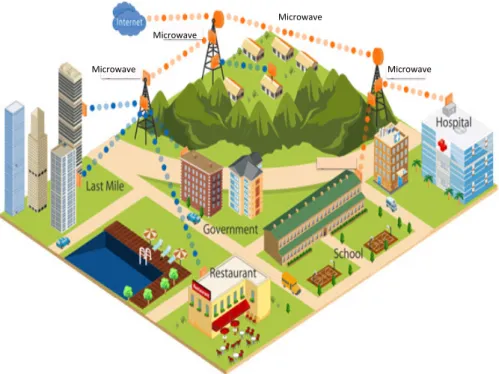
1.1 Example of Wireless backhaul network . . . 2
1.2 Global microwave market [HR09] . . . 3
1.3 Forecast backhaul connections in Europe [Obs10] . . . 4
1.4 Microwave link components . . . 6
2.1 Column generation algorithm flowchart. . . 17
2.2 OPL program of Example 2.1.1 . . . 22
3.1 Column Generation Process . . . 32
3.2 MCG Process . . . 36
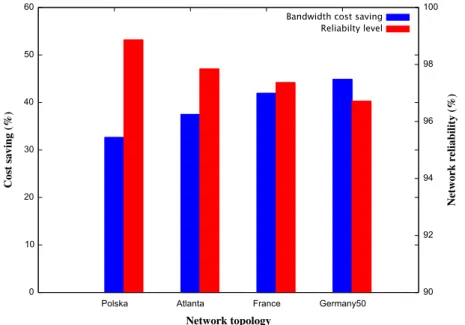
3.3 Cost saving vs. the worst case . . . 39
3.4 Reliability vs. the worst case . . . 39
4.1 Example of fixed broadband wireless network . . . 44
4.2 Traffic demands in Abilene network [KKR13] . . . 49
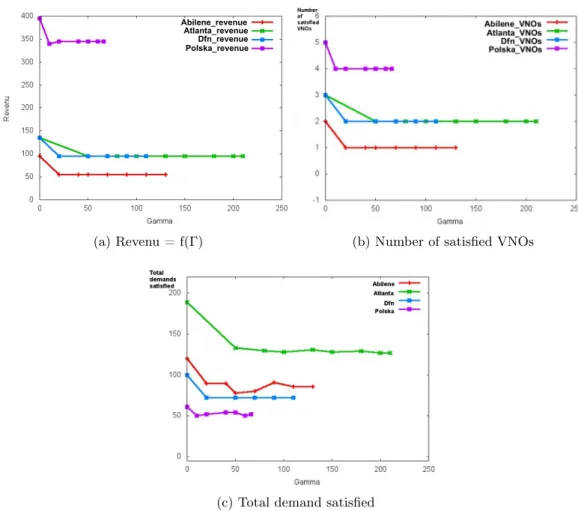
4.3 Evolution of the revenus (4.3a), number of satisfied VNOs (4.3b), and total number of satisfied demands (4.3c) as a function of Γ. . . 52
4.4 Repartition of satisfied demands per VNO when Γ increases for Abi-lene, Atlanta, and Polska. . . 53
4.5 Repartition of satisfied demand per VNO for Dfn.. . . 53
4.6 Evolution of the revenue (4.6a) and number of satisfied demands (4.6b) on Dfn instance for different values of β and Γ. . . 54
4.7 Dfn instance with three VNOs such that |D1| = 65 = R1, |D2| = 25 = R2, and |D3| = 20 = R3. . . 55
4.8 Resolution performance comparison with Γ = 5 . . . 61
4.9 Resolution performance comparison with Γ = 7 . . . 62
5.1 Energy profiles . . . 66
5.2 Example of Shortest Path Routing (SPR) vs. Energy-aware Routing (EAR) . . . 67
5.3 Reduction of end-to-end link load using WOC . . . 68
5.4 GreenRE with 50% of traffic redundancy . . . 69
5.5 Example of robustness . . . 72
5.6 Diagram of constraint generation method . . . 76
5.7 Example of iterations of the CG method . . . 78
5.8 Routing and RE-router placement on Abilene network . . . 81
5.9 Upper bound and lower bound: Compact Formulation (CF) vs. Con-straint Generation (CG) . . . 83
5.10 Optimality gaps: Compact Formulation (CF) vs. Constraint Gener-ation (CG) . . . 84
x List of Figures
5.11 Comparison of proposed methods on Abilene. . . 85
5.12 Energy savings vs. robustness for Abilene, Geant and Germany50 network . . . 86
5.13 CDF load of all links including links in sleep mode for Abilene, Geant and Germany50 networks. . . 88
5.14 Robust-GreenRE vs. GreenRE vs. EAR. . . 89
A.1 Cognitive radio Network architecture [ALVM06]. . . 95
A.2 A CRN instance . . . 97
A.3 Constraint generation process . . . 103
B.1 Exemple d’un réseau de collecte sans fil . . . 106
B.2 Marché globale des liaisons à micro ondes [HR09] . . . 107
B.3 Evolution et prévisions du nombre de liaisons des réseaux de collecte en Europe [Obs10] . . . 108
B.4 Composants d’un lien à micro ondes . . . 111
B.5 Le processus d’exécution du MCG . . . 117
B.6 Gain energétique vs. robustesse pour Abilene, Geant et Germany50 network . . . 120
List of Tables
3.1 Modulation discrete probability distributions . . . 31
3.2 Configurations for z`1,b1 = z`2,b1 = z`3,b1 = 1 . . . 31
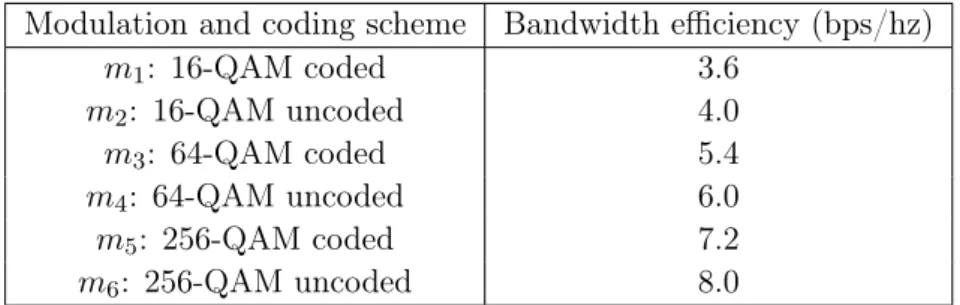
3.3 Modulation schemes and Bandwidth efficiency . . . 37
3.4 CG Results . . . 38
3.5 Resolution time (minutes) . . . 40
4.1 Test instances settings . . . 51
4.2 Dfn results in function of Γ . . . 55
4.3 Resolution time in seconds as function of Γ . . . 56
5.1 Demands and redundancy rates variation. . . 73
5.2 9 cases of the robustness . . . 73
5.3 Constraint Generation (CG) vs. Compact Formulation (CF) vs. Heuristic for Abilene network. . . 82
Chapter 1
Introduction
Contents
1.1 Motivation and Context . . . 1
1.2 Broadband Wireless Access technologies . . . 4
1.3 Dimensioning and dynamic routing in Backhaul Networks. 7 1.4 Routing real fluctuated traffic in microwave wireless networks 8 1.5 Energy saving. . . 8
1.6 Tools and Techniques . . . 9
1.7 Thesis Organization and Contributions . . . 10
1.8 List of publications . . . 11
As the use of broadband services via mobile internet devices such as smartphones continues to grow, network operators have to regularly upgrade their network capac-ity to meet customers expectations. Among the available technologies, microwave appears as a cost-effective transmission solution for extending the network cover-age and for providing bandwidth-intensive services to customers located in remote areas.In this thesis, we study multiple optimization problems related to the cost-effectiveness of fixed microwave backhaul networks. The backhaul network can be defined as the portion of the network infrastructure that provides interconnection between the base station and the core network (see Fig.1.1). In this chapter we first motivate the context of our work and then present the available broadband wireless technologies. Finally, we briefly define the problems we studied, we introduce the methodologies used to solve them and we conclude this chapter by presenting our contributions and the thesis organisation.
1.1
Motivation and Context
The advent of broadband services (high definition TV, Voice over IP, Video On Demand) has generated a rapid growth in data traffic, and consequently the need for higher data bandwidth. Due to this growth, "Backhauling" that means "getting data to the backbone", has become a central challenge for network operators. Not only do the operators need to improve customers experience, but they also have to generate sufficient revenues with regard to their capital and operational expendi-tures. To solve this problem, operators have to install infrastructures that improve
2 Chapter 1. Introduction
Figure 1.1: Example of Wireless backhaul network
their network capacity while using cost efficient technologies. Looking to the back-haul options, operators have the choice among several transmission technologies for building a backhaul network: the copper, the optical fiber and the microwave.
Copper cable is the traditional medium used for backhaul networks. It is the most widely deployed technology in telecommunication networks for historical rea-sons, and because it offered at the beginning enough bandwidth for a voice signal transmission. Nowadays, it can carry up to 100Mbps, but over half a kilometer only. However the current broadband technologies require from eight to sixteen times more capacity than the one offered by the basic unit of copper cable used in GSM. More-over the price of copper increases linearly with capacity. As a consequence, it is not a cost efficient choice for backhaul network [TZJ11].
Optical fiber is the second well known transmission technology used to deploy backhaul network. Fiber links are being installed and used increasingly during the last decade because of the very high capacity they offered compared to the copper. The optical technology is already offering Tb/s over hundreds of kilometers while some research work succeed to reach 1Pbps over 50km [Pea13]. However, the cost for deploying an optical fiber backhaul network is so high that operators are reluctant to invest in it for reaching remote areas with few inhabitants. Indeed, the return on investment for operators is low (if not null). The deployment cost is even higher when the geographical access conditions are difficult (mountains, forests, deserts, swamps, jungles...).
The last medium which is the object of this thesis is the microwave technology. This technology is a cost effective alternative to optical fiber when there is a need to provide high speed data connection in remote locations. Indeed, the capital expenditure needed to install one link is arounde20.000, all devices and man-power
1.1. Motivation and Context 3
included. The operational cost varies from one country to another. For instance, the cost for renting the frequency and the bandwidth for establishing one link in France ranges between e1.000 and e5.000 per year. This technology enables the deployment of point-to-point communication links (with clear line-of-sight) with a bit rate of up to 1Gbps between sites at distance up to 100km. It is therefore a very good choice for reaching remote locations, and so extending the coverage of a network operator.
Beside, it is forecast that the global mobile and wireless backhaul market will grow from $13.11 billion in 2013 to $23.3 billion by 2018 [mar13]. This fast growth is driven by the vast deployment of the LTE networks all over the world. In particular, the highest increase of the market is expected in south America and in emerging countries. The microwave backhaul network appears as the best solution for the lat-ter mainly because of its cost-effectiveness. Fig.1.2represents the global repartition of the transmission technologies in telecommunication market in 2009 and Fig. 1.3 shows the forecast, done in 2010, of microwave backhaul connection in Europe for the next five years.
Though this technology is highly attractive for network manufacturers and op-erators, it received very little attention from the research domain. As previous research work, Napoleao Nepomuceno addressed, in [Nep10], some optimization is-sues related to point-to-point microwave backhauls. Also authors in [HGZD12] and
in [HEOL13] presented respectively the challenges of a multi-gigabit wireless
back-haul system and the new challenges for backback-haul when the line of sight, needed for point-to-point, does not exist.
Figure 1.2: Global microwave market [HR09]
All these previous reasons represented the motivation of our studies during this thesis. We tried, from a mathematical research point of view, to answer some inter-esting optimization problems that occur in this kind of network. We were mainly driven by cost optimization in wireless microwave networks. We firstly considered the minimum cost design of this network while routing dynamically all the demands with a high network reliability. We also investigated on different strategies to make the backhaul network cost-effective and even profitable in terms of revenue. All of these issues were solved using linear programming methods that are explained in
4 Chapter 1. Introduction
Figure 1.3: Forecast backhaul connections in Europe [Obs10]
the next chapter.
1.2
Broadband Wireless Access technologies
Since the launch of mobile networks and the popularization of the Internet through the World Wide Web application, consumers’ habits have changed drastically from the unique use of voice services to the intensive utilization of data oriented services such as VoIP, real time-video and online-gaming among others. This has led to a rapid development of fixed broadband access technologies such as DSL (Digital Subscriber Line) and T1/E1 services, commonly used to access the Internet from residential and offices location in urban areas. However there is still a need for delivering these bandwidth-consuming services to the increasing number of mobile users, wherever they are located.
The aim of the emerging wireless data networks is to provide ubiquitous broadband access and wireless service, comparable to that of wireline networks, to wireless users. According to their coverage areas, wireless data networks can be categorized either as a Wireless Local Area Network (WLAN), a Wireless Metropolitan Area Network (WMAN) or as a Wireless Wide Area Network (WWAN).
WLANs with their coverage area of a few hundred meters are mostly used in home and office environment. They are commonly used through Access Point (AP) to which stations are connected in a point-to-multipoint (PMP) manner and can offer data rates up to 100Mb/s with 802.11n [VN10]. The most notable of WLANs is the IEEE802.11-Wifi family but we can also distinguish the HiperLAN [Joh99,DAB+02]. Finally we have to notice that there exists also a decentralized working mode of WLAN where all stations can talk to each others in an adhoc mode.
WMANs are wireless networks that enable users to estabish wireless connections between multiple locations within a metropolitan area. Consequently, their coverage area is approximately the size of a city. Different technologies have been developped in the context of WMANs. The most known are IEEE801.16-WiMax family, Hiper ACCES and HiperMAN. They provide broadband
con-1.2. Broadband Wireless Access technologies 5
nectivity to fixed, LOS (Line Of Sight), NLOS (Non-LOS) but also mobile subscribers. They are based on cells covered using Base Station (BS) to which Subscriber Stations (SS), that can be buildings or vehicles, are connected. A mesh topology mode is also supported by WMANs. WiMax helps to provide an aggregate data raw rate of up to 135Mb/s based on the modulation used in LOS communication, while up to 75Mb/s is offered in NLOS communication, and HiperMAN can support up to 25Mb/s for each sector of an AP. More technical details about these technologies are available in [KT07].
WWANs are commonly used to connect multiple WMANs located in physically distant areas. They mainly consist in satellite systems used principally in the downlink way. Another WWAN technology developped is the IEEE802.20 known as the Mobile Broadband Wireless Network (MBWA). The main goal of MBWA is to provide broadband access to highly mobile devices moving at a speed of up to 250km/h [BXG07] (in a car, a train, etc.).
Data from/to multiple WLANs can be aggregated and transmitted over a WMAN to the Internet and WWAN can help to interconnect different WMANs covering different areas. Beside these previous technologies, mobile technologies such as 3G (UMTS, HSPA, CDMA200, EV-DO) and 4G (LTE, LTE-Advanced) systems are also considered as broadband wireless access networks since they are nowadays providing high mobile data rates for their customers. They offer peak data rates up to 14,4 Mb/s to mobile devices. All of these technologies are trans-mitting data through the air using radio frequencies (RF). In the context of our research, we focused on the WMANs. More precisely, we studied problems related to a WMAN subnetwork that uses point-to-point (PtP) microwaves links to connect Base Stations (BSs) together and to route data traffic through the Internet or the backbone network.
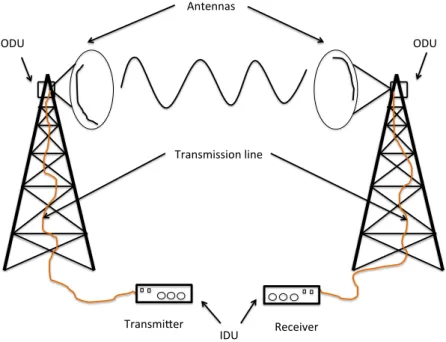
A single one-way microwave link between two stations located at fixed points includes four major elements: a transmitter, a receiver, transmission lines and an-tennas (see Fig. 1.4). The transmitter produces the microwave signal that carries the information to be communicated. It generates the microwave energy using the appropriate frequency and power, and modulates it with the input signal. From the transmitter, the signal is sent to the antenna through the transmission line. This latter is also in charge, at the receiving end of the microwave link, of transmitting the signal from the antenna to the receiver. At microwave frequencies, coaxial ca-bles and especially waveguides are the most frequently transmission lines used by engineers. The last elements of a microwave radio system are the antennas that are highly directional. On the transmitting end, the antenna emits the microwave signal from the transmission line into free space. At the receiver site, an antenna pointed toward the transmitting station collects the signal energy and feeds it into the trans-mission line for processing by the receiver. The microwave antennas characteristic of concentrating the received signal allows communication over long distances using small amounts of power. Finally, the receiver extracts information from the signal by demodulation [IG]. Transmitter and receiver components are usually referred to
6 Chapter 1. Introduction
as indoor unit (IDU) while the antenna is the outdoor unit (ODU). Nowadays, IDUs functions have evolved such that in addition to packet forwading, packet routing is also possible. Transmi(er Receiver Antennas Transmission line ODU ODU IDU
Figure 1.4: Microwave link components
Most of the commercially used terrestrial microwave PtP systems use frequen-cies from approximately 2 Ghz to 60 Ghz with maximum hop length of around 200km [Leh10]. Microwave PtP links operate either in licensed or unlicensed fre-quency bands. However unlicensed bands, because they are accessible to everyone, have the drawbacks of high interference probability and less data security that made the licensed bands the most used by network operators. Licensed microwave link frequencies used for wireless backhaul in a PtP wireless backhaul operate at the 6 GHz, 11 GHz, 18 GHz and 23 GHz bands. The reader is referred to [Nep10] for more details about requirements for the link power budget of a PtP microwave link and the adaptive modulation it is subject to.
Although the multiple advantages of microwave backhaul networks and their cost-effectiveness, PtP microwave transmissions are affected by external factors such as excessive rains, thunderstorms, high winds, earthing and selective fading among others. This, in addition to the renewal cost of the frequency licenses and band-widths make the minimum cost design of a wireless backhaul network a difficult optimization problem. This is the first we address in this thesis.
In order to reduce the operational expenditures of such a network, we also studied a minimum cost power consumption problem using an energy aware routing (EAR) approach. In addition, we worked on a multi-operators microwave backhaul network, with the objective of maximizing the revenue of the network infrastructure owner
1.3. Dimensioning and dynamic routing in Backhaul Networks 7
with respect to the demand satisfaction constraints. In this problem, we considered traffic volumes that vary in time and different quality of service (QoS) policy for each network operator. These different problems are properly explained in the next sections.
1.3
Dimensioning and dynamic routing in Backhaul
Net-works
For any network operator or service provider, the main goal is to maximize its revenue while ensuring the satisfaction of its customers. In the context of telecommunication networks, in order to meet the needs of clients and offer them a good quality of experience, one of the key elements is to have a network with sufficient capacity on its links. Network operators should thus design their networks such that enough capacities are available on links to serve all clients needs anywhere and at anytime. For microwave backhaul network, this requirement has a central place since the base stations traffic needs have to be fully met. Otherwise the data that have to be transported will either be delayed or lost. The capacity allocation on microwave network links is closely related to the efficient utilisation of the radio frequency spectrum ressource. However this resource is limited and regulated, and thus expensive. The challenge here is then to cost-efficiently provide sufficient capacity in order to meet customer satisfaction. From a technical point of view, to determine the capacity of a microwave link, we need to know the channel bandwidth B and the modulation scheme m-QAM used to transmit data, with QAM standing for Quadratic Adaptative Modulation. We use the following formula to calculate the capacity:
Capacity[bps] = n.B[Hz] where n = log2m
While the modulation scheme used in microwave radio systems is based on the adaptative modulation system, the bandwidth assignment on each link is a network engineer’s decision. In fact, the adaptative modulation system refers to the au-tomatic modulation adjustment that a wireless system can make to prevent some weather-related fading. It has been developped mainly to help the radio network to adapt itself in bad transmission context in order to meet the bit error rate (BER) requirements. To reduce the total cost of bandwidths license renewal fees on the whole network, there is a difficult optimization problem to be solved by the en-gineer at the network planning step. The main constraint of this problem is to satisfy all the traffic demands. This constraint corresponds to the satisfaction of the well-known multi-commodities flow (MCF) problem [GCF99,Tom66,BCGT98]. The MCF problem consists in routing commodities (here data traffic) from their sources to their sinks through a given network with respect to the capacity of the links. The minimum cost bandwidth assignment problem, with the constraint of high network reliability, was studied by Napoleão Nepomuceno in his thesis [Nep10] using a chance-constrained programming method.
8 Chapter 1. Introduction
Unlike the work of Nepomuceno, in this thesis we solved this problem when considering a dynamic routing of demands. This differs from the previous work in the static data routing they have adopted. We also modeled the problem such that the solution is scalable and applicable to large networks (hundreds of links). This work, done in collaboration with David Coudert, Brigitte Jaumard (Concor-dia University, Canada), Mejdi Kaddour (Oran University, Algeria) and Napoleão Nepomuceno (Fortaleza University, Brazil), involves the utilization of mixed integer linear programs (MILP) through a column generation method as well as a local search algorithm. Chapter 3 is devoted to the resolution of this problem.
1.4
Routing real fluctuated traffic in microwave wireless
networks
As pointed out previously, microwave backhaul network represents an attractive solution for telecom operators and wireless Internet service providers to offer high speed data rate to customers living in rural environment. However, it may not be cost-effective for a network operator to fully deploy its own infrastructure, espe-cially when the number of targeted customers is small. An idea to overcome this difficulty is to share the network infrastructure among several network operators aiming at covering the same geographical area. This strategy is also recommended by national telecommunications regulatory authorities for an efficient use of the radio spectrum among multiples operators. In this infrastructure sharing context, with the assumption that the network is already designed, we first investigated the revenue maximization problem for the network infrastructure owner. This objective was subject to the constraint of satisfying the maximum demands for each virtual network operator with respect to their respective QoS policy. We then took in con-sideration the uncertainty of traffic demands to make the problem as realistic as possible. To tackle this problem, we firstly propose an integer linear program (ILP) and a robust optimization method to handle the uncertainty factor. This problem, solved in collaboration with David Coudert and Christelle Caillouet (University of Nice Sophia Antipolis) is detailed in Chapter 4 of this thesis.
1.5
Energy saving
In the search for cost optimization strategies for backhaul networks, power con-sumption has been identified as a non-negligeable portion of operators operational expenditures (OPEX). In 2011, Tombaz et al have reported in [TMW+11], based on [PVD+08], that 0,5% of the global energy is consumed by mobile communication and around 80% of the power consumption in the mobile networks stems from the radio access network, namely radio base stations. With the installation of a larger number of base stations required to satisfy the ever-increasing traffic demand, this number is expected to double by 2020. This makes power consumption one of the major issues to address by network operators especially in order to reduce their
1.6. Tools and Techniques 9
OPEX. It is mentionned in the Next Generation Mobile Networks optimised back-haul requirement [All08, requirement R88], that different consumption modes should be available so that backhaul hadwares could automatically switch to the one with lowest power consumption. The idea, for backhaul network operators is then to find a solution to adapt their energy consumption to their traffic, in such a way that unused base stations consume as few energy as possible.
The same problem also occurs in the Internet core network. Based on recent studies, the power consumption of Internet’s infrastructure is estimated to be be-tween 1.1% and 1.9% of the 16 TW used by the humanity [BAH+09,RM11,BHT11,
HBF+11]. In [TBA+08], authors identify that most Internet energy is consumed by access network and routers. They also state that this consumption will increase to over 4% as the access rate increases and that IP routers will be the energy bottleneck of the Internet.
A proposal to limit this energy consumption growth is to use energy aware routing (EAR) [CSB+08,CMN09,BCRR12]. So together with Truong Khoa Phan, previ-ously PhD student in the Coati team, we decided to investigate this problem in the context of backbone networks. Our main objective was to minimize the total energy consumption of the network under some specific constraints. Based on Phan’s previ-ous works [GMPR12,CKPT13], the problem was first tackled using EAR combined to the so called Redundancy Elimination (RE) technique [AGA+08,ZCM11,ZA14]. Then, using the robust optimization method, we extended the formulation intro-ducing some uncertainty on the traffic demand. Linear programs, a heuristic and an exact algorithms were developed to solve this problem. We present this work in Chapter5 of this manuscript.
Even if EAR and RE are not yet available in microwave backhaul networks, we believe that our models could be adapted and applicable to this kind of networks.
1.6
Tools and Techniques
Throughout this thesis, our approach was first to propose as simple as possible models using linear programming (LP). This results either in simple LP models, or in an Integer Linear Program (ILP) or even in a Mixed Integer Linear Program (MILP). To handle uncertainties, when it is the case, we apply the adequate robust optimization method with necessary modifications. When the model appears to be difficult to solve or non linear, we investigate on the most suitable way to overpass the difficulty, sometimes using column generation, constraint generation, constraint reformulation or heuristic method.
In order to validate the relevance and the quality of our models, we run some experiments with test instances taken from available online libraries such as SNDlib [OWPT10], using a commercial solver, CPLEX [II14]. The models are coded using different languages depending on the model complexity. Python, Java and Optimization Programming Language (OPL) are the most used during our the-sis. Based on our simulation results, when the optimal solution appears difficult
10 Chapter 1. Introduction
to get, we try to propose some alternative approaches such as greedy algorithm or local search method. We finalize the work with a deep analysis of our results.
1.7
Thesis Organization and Contributions
We start this manuscript by defining and explaining the main concepts of the math-emathical tools we used to help the readers to understand our mathematical ap-proaches.
In Chapter 2, we first give a brief description of linear programming, the sub-class method of operation research commonly used in this thesis. We then introduce the readers to the Column Generation method, and how it helps to overpass reso-lution difficulties when facing big instances. The robust optimization concept, used to handle uncertainties in our models is developped in the next section. We end this chapter by initiating the reader to a programming language, OPL for optimization programming language, that we used to implement most of our models.
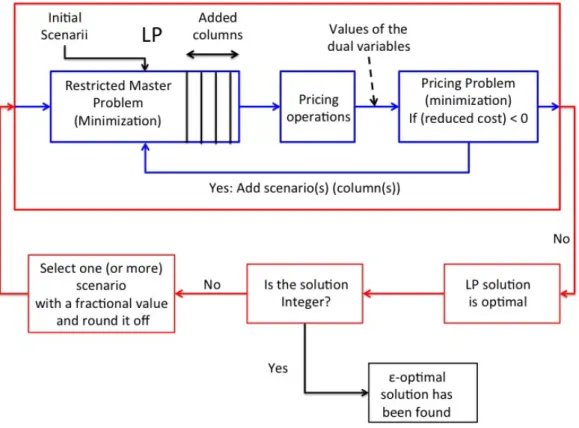
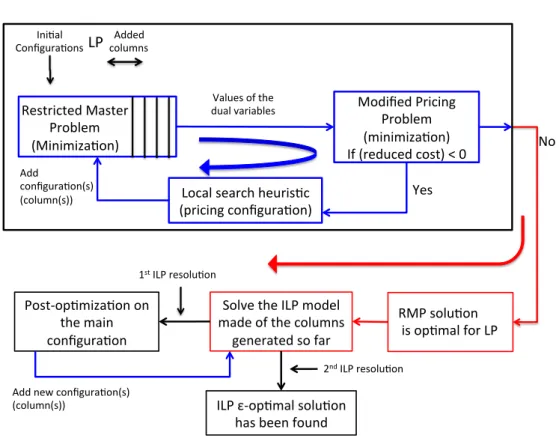
Chapter 3 is devoted to the minimum cost bandwidth assignment problem in microwave backhaul networks. The objective is to propose a solution that guarantees a dynamic routing of traffic demand, even under bad channel conditions, and that can also be applied to big instances. The column generation method was used for this purpose. A column generation heuristic combined with a local search approach is used to overcome a non-linear and non convex term in the objective function of our model. Experimental tests on realistic network topologies using our resolution approach highlight a cost saving up to 45%. This work is concluded by a comparative study with the results gotten in [CKCN14].
This study has been done in collaboration with David Coudert, Brigitte Jau-mard (Concordia University, Canada), Mejdi Kaddour (Oran University, Algeria) and Napoleão Nepomuceno (Fortaleza University, Brazil) and the results have been submitted in [KJN+14].
In Chapter 4, we investigated on maximizing the total income of a physical net-work operator (PNO) when sharing its infrastructure with multiple virtual operators (VNO) under demand uncertainties and QoS constraints. The Γ-robust approach developped by Bertsimas and Sim [BS04] helped to propose a solution in which the PNO can offer a best effort service to all its customers while maximizing its revenue. Finally, we proposed differents heuristics to solve this problem with larger network instances.
The results of this work, done in collaboration with David Coudert and Christelle Caillouet-Molle (University of Nice Sophia-Antipolis, France), have been published
1.8. List of publications 11
Chapter 5 concerns an advanced problem of energy consumption. Motivated by the goal to adapt the energy consumption of the network to the quantity and the content of the traffic, we used the GreenRE model proposed by Coudert et
al [CKPT13] and extended it by considering uncertainties on traffic volume and
compression rate. The robust optimization model developped through a MILP, plus a heuristic, helped us to save from 16% to 28% of ernergy compared to the classical GreenRE method.
This work has been done in collaboration with David Coudert and Truong Khoa Phan1 (University of Nice Sophia-Antipolis, France). The results of this chapter lead to the following publications [CKP14a,CKP14b].
Appendix A presents a preliminary work on cognitive radio mesh network. The goal of these networks is the utilization of unused radio spectrum. Unauthorized users, called secondary users, are allowed to transmit on unused frequency carriers even if they are licensed bands. Nonetheless they have to release the channel as soon as a licensed user, called primary user, starts its transmission. We were interested in this technology and more precisely in the spectrum assignment problem under uncertainty on the primary users transmission time. In the LP model we proposed, we tried to maximize the overall troughput of secondary users transmissions using different transmission channels. Unlike the precedent robust models we worked on before, in this case, the uncertainty is on the right-hand side of the LP which forced us to apply the 2-stage robust method proposed by Minoux in [Min07]. Non-linearities of the model are tackled through a constraint generation method. This is an ongoing work that we have to conclude with consistent simulation results.
This work is done in collaboration with Mejdi Kaddour (University of Oran, Algeria).
1.8
List of publications
We list below the publications associated to the research presented in this thesis.
[KJN+14] A. Kodjo, B. Jaumard, N. Nepomuceno, M. Kaddour, D. Coudert.
Dimensioning microwave wireless networks, submitted to IEEE International Conference on Communications (ICC), 2015, UK.
[CKP14a] D. Coudert, A. Kodjo, and T.K. Phan. Robust Energy-aware Routing
with Redundancy Elimination, 2014 (Research report and Journal in revision).
[CKP14b] D. Coudert, A. Kodjo and T.K. Phan. Robust Optimization for
Energy-aware Routing with Redundancy Elimination In ALGOTEL 2014, France.
1
12 Chapter 1. Introduction
[KCCM14] A. Kodjo, D. Coudert and C. Caillouet-Molle. Optimisation robuste
pour le partage de reseaux d’acces micro-ondes entre operateurs In ROADEF, 2014, France.
[CCK13] C. Caillouet-Molle, D. Coudert and A. Kodjo Robust optimization in
multi-operators microwave backhaul networks. In IEEE Global Information Infrastructure and Networking Symposium (GIIS) 2013, Italy.
This thesis was supported by SME 3ROAM based in Sophia Antipolis, and the PACA province.
Chapter 2
Preliminaries
Contents 2.1 Linear Programming . . . 13 2.2 Column generation . . . 15 2.3 Robust optimization. . . 16 2.3.1 Γ−robustness . . . 172.3.2 2-stage Robust LP with RHS uncertainty . . . 18
2.4 Introduction to the Optimization Programming Language,
OPL . . . 19
In this chapter, we briefly present the different mathematical methods used as modelisation tools for the problems studied throughout this thesis. We start with a definition of the linear programming method and the presentation of the duality concept. Then, we introduce the column generation algorithm used in Chapter 3 of this thesis. The robust optimization methods used to handle data uncertainty in the problems we studied is also presented. We finally conclude this chapter with an introduction to a mathematical programing language that made the development of ours models easier.
2.1
Linear Programming
Linear Programming (LP) is a fundamental area of mathematical programming. It is concerned with the optimization (maximization or minimization) of a linear function of the form f (x1, x2, . . . , xn) = c1x1+ c2x2+ · · · + cnxn, called objective
function, while satisfying a set of linear equality and/or inequality constraints. Let x = (x1, x2, . . . , xn)T be the vector of the decision variables and c =
(c1, c2, . . . , cn)T be the vector of coefficients of the objective function. When
us-ing matrix notation, a linear program can therefore be of the form:
max X j∈J cjxj s.t. X j∈J Ajxj ≤ b xj ≥ 0 ∀ j ∈ J (2.1)
14 Chapter 2. Preliminaries
where |J | = n and A ∈ Rm×n = {Aj, j ∈ J } is the constraint matrix in which the element aij corresponds to the coefficient of the variable xj in the ith constraint and b ∈ Rm, called the right-hand-side vector represents the maximal requirements to be satisfied. The program constraints defines the feasible set corresponding to the set of vectors satisfying all the constraints of the program. A vector x∗ is called the optimal solution or optimum of a LP if it is the one among the feasible set that has the best value of the objective function. Many combinatorial optimization problems are modeled with linear programming. In this thesis, we use linear programming to model optimization problems arising in telecommunication networks. A modelisa-tion using LP of the so-called multicommodity flow (MCF) problem, which is the basis of most of the problems studied in this thesis, is presented in Example2.1.1. Example 2.1.1. Let G = (V, E) be a directed graph, where V is the set of nodes, E is the set of edges and each edge (u, v) ∈ E has a capacity c(u, v) ≥ 0. Consider also a set D = {di = (si, ti), i = 1 . . . k} of k demands where siand tiare respectively the
demand source and destination. The objective of this MCF is to find the flows that maximize the network throughput while satisfying the capacity constraints. This problem is modeled as follows:
LP Maximize X i=1...k X w∈V fi(si, w) subject to: X v∈V fi(u, v) = X w∈V fi(w, u) ∀ u ∈ V − {si, ti}, ∀ i = 1 . . . k X w∈V fi(w, ti) = X v∈V fi(si, v) ∀ i = 1 . . . k X i=1...k
fi(u, v) ≤ c(u, v) ∀ (u, v) ∈ E
fi(u, v) ≥ 0 ∀ (u, v) ∈ E, ∀ i = 1 . . . k
The first two constraints are usually referred to as flow conservation constraints while the last constraint represents the capacity constraints. We talk about Integer Linear Program (ILP) when all variables are integral and about Mixed Integer Linear Program (MILP) when only some of the variables have to be integral.
One important property of linear programming is the notion of duality. To any linear program of the form presented in Model (2.1), called primal, is associated another linear program, called dual of the following form:
min bTy
s.t. ATy ≥ c
2.2. Column generation 15
with the same vectors c and b and the same matrix A. y = (y1, y2, . . . , ym) is the
vector of the dual variables where each variable yi is associated to the ithconstraint of the primal model. Notice that the dual of the dual is the primal and that when the primal has n variables and m constraints, its dual has m variables and n constraints. Let x and y be feasible solutions of respectively the primal and the dual. Then:
bTy = yTb ≥ yT(Ax) = (yTA)x = (ATy)x ≥ cx (2.3) This relation between the primal and the dual, called theweak duality theorem , shows that the objective value of any feasible solution of a dual is an upper bound of the any feasible solution of the primal and consequently an upper bound of the optimal solution of the primal. This is useful for estimating the gap between a feasible solution and the optimum when feasible solutions are available but finding the optimal one is too hard.
Furthermore, it has been proved through thestrong duality theorem , that if the primal has an optimal solution x∗, then the optimal solution y∗ of the dual is such that
cTx∗= bTy∗
This relation is very important when solving some LP models. In Chapter 3of this thesis, we use the dual values to express the reduced cost of variables, when ap-plying the column generation method presented in the next section. When dealing with robust optimization method in Chapters4and5, we use the strong duality the-orem. This allows us to express our optimization problem in a compact formulation that is easier to solve than the original primal model.
2.2
Column generation
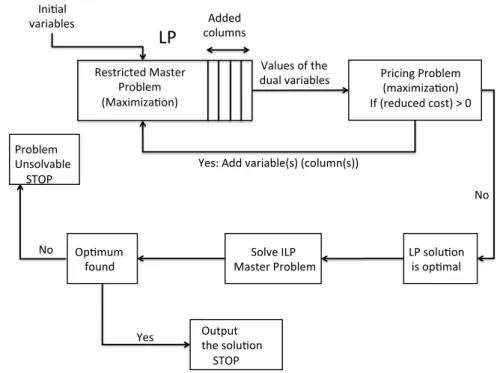
Column generation refers to linear programming (LP) algorithms designed to solve large-scale problems in which there are a huge number of variables compared to the number of constraints. In general, these linear programs are too large to consider all the variables explicitly. It is known that only a tiny fraction of the variables is needed to prove optimality. So the goal of column generation is to find the optimal solution of the problem without enumerating all variables, but by generating only the variables which have the potential to improve the objective function. To achieve that, the problem to be solved (the master problem, MP) is split into two sub-problems: the restricted master problem (RMP) and the pricing problem (PP).
Let us consider the MP of the form of the Model (2.1) and let J0 ⊆ J be a subset of indices in J . The RMP is the master problem in which we consider only the variables with indices in J0. Notice that when all the variables needed to find the optimal solution of the MP will be generated and available in the RMP, then the RMP optimal solution will be the MP optimal solution. The PP is a new problem created to generate the variables that can improve the MP objective function. The column generation algorithm consists in solving iteratively the RMP followed by
16 Chapter 2. Preliminaries
the PP until no more variable that can improve the RMP current solution can be generated by the PP.
The pricing problem is particular since its objective function has the following form:
rj∗ = Maximize{cj− y∗AJ | j ∈ J }
where y∗ is the dual optimal solution of the RMP. The pricing objective function is referred to as the reduced cost. When the MP is a minimization function, the pricing objective is to be minimized too. Depending on the value of rj∗, two situations are
possible:
• If rj∗ ≥ 0 (resp. rj∗ ≤ 0 in the minimization case), then the variable xj∗ is
added to J0 and its coefficients (cj∗, Aj ∗
) to the RMP.
• If rj∗ < 0 (resp. rj∗ > 0 in the minimization case), it means that there is
no more variable that can improve the RMP objective value. So the optimal solution of the MP is found by solving the RMP.
If a new variable is added to the RMP, then the RMP is solved to optimality, its dual values are derivated to solve the new pricing problem and the process continues until no more variable is generated.
When the MP is a MILP, the column generation algorithm is run firstly with a relaxation of the RMP until no more variable can be generated by the PP. Then based, on the generated variables, the integer version of the RMP is resolved. The flowchart of this column generation algorithm is presented in Fig. 2.1.
The effectiveness and the performance of the column generation method is very dependent on the way to generate the columns. Indeed the pricing problems of many real life problems, when column generation is applied, are often NP-Hard. An example of this case is presented in Chapter 3where the pricing objective function is non-linear. We overcome this difficulty by generating the variables through an heuristic algorithm. Other methods are available in the litterature to solve the pricing model. The reader is referred to [DL05,DDS05,Van05] for more details about this method.
2.3
Robust optimization
In general, when we define a linear program, like the one presented in Model (2.1), we consider all the input parameters (c, A and b) as exact known values. How-ever in pratice, for many problems, the values of these parameters are uncertain. Robust optimization is the field of optimization theory that deals with optimiza-tion problems in which data uncertainty is considered for some input data. This uncertainty can be expressed in terms of probability distribution, like in stochas-tic programming, but in robust linear programming there is an uncertainty set, U ⊆ Rn× Rm×n× Rm, that contains all possible values for the data (c, A, b). In
2.3. Robust optimization 17 Restricted Master Problem (Maximiza4on) Added columns
LP
Ini4al variables Pricing Problem (maximiza4on) If (reduced cost) > 0 Values of thedual variables
Yes: Add variable(s) (column(s))
LP solu4on is op4mal Solve ILP Master Problem Op4mum found Output the solu4on STOP Yes No Problem Unsolvable STOP No
Figure 2.1: Column generation algorithm flowchart
the litterature, different uncertainty sets have been considered when solving robust problems. For example, ellipsoidal uncertainty set and an uncertainty set modeled as a polyhedron have been respectively considered in [BTEGN09,AYP11]. Many more or less conservative approaches have also been developped to solve linear ro-bust models [Soy73,EGOL98,BTN00,BTN02,BS03,Min07]. In this thesis, we are interested in Γ−robustness and in the 2-stage robust LP.
2.3.1 Γ−robustness
Γ−robustness is the subfield of linear robust optimization domain which considers that the parameters (c, b), as presented in Model (2.1), are certain while the elements of the vectors Aj are uncertain. Assume the ith constraint of this model expressed in inequation (2.4).
X
j∈J
aijxj ≤ bi (2.4)
aij is here considered as a random variable taking values in the interval [¯aij −
ˆ
aij, ¯aij + ˆaij] with ¯aij being its average (or nominal) value and ˆaij its maximum
deviation. The Γ−robustness approach has been proposed by Bertsimas and Sim in [BS04]. They take the advantage of a particular uncertainty set to provide a less conservative robust formulation compared to others robust models proposed in the litterature [Soy73,EGOL98,BTN00,BTN02]. They considered that it is unlikely that all aij fluctuate and reach their peak values simultaneously, in contrary to Soyster
18 Chapter 2. Preliminaries
in [Soy73] that considered the same uncertain interval but proposed a model for
the case where all aij have a value equal to ¯aij+ ˆaij. For that, they defined a real
parameter 0 ≤ Γ ≤ |J | that represents the robustness level considered. Thus the Γ-robust solution stays optimal for all the cases where up to Γ of the uncertain coefficients are allowed to change. For the sake of simplicity, we consider here Γ as an integer value. The objective of Γ−robustness is to find the optimal solution x when Γ many (but arbitrary) coefficients deviate from their nominal values. Under this assumption, Constraint (2.4) is replaced by:
X j∈J ¯ aijxj+ max {S|S⊆J ,|S|=Γ} X j∈S ˆ aijxj ≤ bi (2.5) where δ(x, Γ) = max{S|S⊆J ,|S|=Γ}P
j∈Saˆijxj is the maximum deviation that can be
introduced in the constraint by at most Γ coefficients fluctuating simultaneously. Moreover, it has been proved by Bertsimas and Sim that given an arbitrary reali-sation, the probability that constraint (2.5) is violated is about 1 − Φ(Γ−1√
p ), where
Φ is the cumulative distribution function of a standard normal and p is the number of uncertain coefficients. With this model of uncertainty, Bertsimas and Sim show that finding an optimal Γ−robust solution can be reduced to solving an ordinary linear program only moderately increased in size, thus opening the way to large scale applications.
Γ−robustness is used in Chapters 4 and 5 of this thesis to model some traf-fic uncertainty considered in our problems. With this technique, we were able to formulate the robust counterpart of the studied problems as linear programs. This method, applied in multiple network optimization problems in the littera-ture [KKR11,CKPT13,CKS13], has the main advantage to offer a good trade-off between the level of robustness and the cost of the solution. However this formula-tion is not satisfying when the uncertainty is on the Right-hand-side (RHS) of the LP. Indeed, when the objective is uncertain, Γ−robustness can be applied by transform-ing the objective into a constraint. Therefore, Minoux proposes a method to handle this RHS uncertainty that is more natural in certain situations [Min07,Min11]. We present it in the next section.
2.3.2 2-stage Robust LP with RHS uncertainty
RHS uncertainty in LP is a particular subclass of columnwise uncertainty model, unlike the "rowwise" when coefficents of a row are uncertain (Γ−robustness case). A first natural idea to handle such problems is to use the LP duality to reformulate them as robust LPs with uncertainty on the objective. Minoux [Min07] shows in this restrictive case that the objective of the robust counterpart of a dual problem is totally different from the one of the dual of a robust model. So one can not use standard duality theory to convert a columnwise uncertain linear program into a rowwise uncertain linear program while preserving equivalence.
Also, Minoux proposed a model to handle the 2-stage robust LP problem with RHS uncertainty [Min11]. They are problems or applications in which the process of
2.4. Introduction to the Optimization Programming Language, OPL 19
decision-making under uncertainty can be decomposed in two successive steps. The first stage concerns the decisions to be made before knowing anything about which realization of uncertainty will arise while the second stage is related to the decison taken after realization of uncertainty. The choice of this models was made because they can produce less conservative solutions as compared with single-stage robust LP models with RHS uncertainty. Model (2.6) represents the general form of these problems.
max cTy
s.t. A1y + A2z ≤ b
y, z ≥ 0 (2.6)
with b taking value in the uncertainty set B. y and z are respectively the first and second stage variables. y is a feasible solution for the robust model when it belongs to the set Y = {y|y ≥ 0 and ∀ b ∈ B, ∃ z ≥ 0 : A2z ≤ b − A1y} and the optimal
solution corresponds to
max
y∈Y c
Ty
Based on Farka’s Lemma [DJ14], the author derives a large scale LP model for the robust model. However a direct resolution of this model can be very difficult due to its tremendeous number of constraints. A proposed way to overcome this difficulty is to apply the constraint generation method using a specific nonconvex separation problem. It has been proved that these problems are generally NP-Hard but polynomial algorithms can be found for some applications.
This method has been applyied to the cognitive network problem studied in the Appendix of this thesis. We detail there the methodology to obtain the large scale LP of the robust model and also to define the specific separation problem adapted to our application.
2.4
Introduction to the Optimization Programming
Lan-guage, OPL
Once an optimization problem is modeled as a linear program, it remains to use it for solving different problems instances. It is also important to compare the per-formances of the proposed model with other formulations, if any. This is useful for identifying the advantages and the drawbacks of the formulation and eventually pro-pose improvements. To do so, we use various programming languages to implement (and solve) the mathematical model using some optimization solvers.
In the context of this thesis, different programming language have been used, depending on the model complexity: Python, Java and Optimization Programming Language (OPL). Python and Java are well-known programming languages so we
20 Chapter 2. Preliminaries
will not present them here. OPL1 is a high-level optimization language currently developped by IBM to ease mathematical programming. For instance, it facilitates the implementation and test of linear programs using column generations. In the following, we give a brief overview of the OPL language.
OPL, is a modeling language for mathematical programming and combinatorial optimization problems modeled using LP, ILP, MILP or Constraint Programming (CP). It has originally been developped by Pascal van Hentenryck. Like others modeling languages such as AMPL [FGK93] and GAMS [BM04], OPL allows the user to code mathematical models with a syntax similar to their algebraic notation. This allows for a very concise and readable definition of problems in the domain of optimization. Among its features, it proposes some new concepts for scheduling and resource allocation problems. It also allows to import data from databases or Excel spreasheets.
An OPL program consists of three (3) main sections:
1. Declaration of the constants and decision variables. This section is concerned with the elements that compose the model. For each input of the problem, the user specifies its type and its value. OPL supports 2 data types, the basic ones (integer, float, string, boolean) and the data collections (set, tuple, array, range). These constants can be initialized directly in the model file (.mod) or in a specific data file (.dat). Initializing the data in a separate file has the advantage that it can be different for various problem instances. Concerning the problem variables, the user defines their types and the domain of their values. The decision variables are declared using the keyword dvar. Strictly positive variables are declared using one of the data types int+ and float+. However variables in OPL can be of different types such as arrays.
2. Expression of the optimization model (objective function and constraints). The maximization or minimization objective is described and the user ex-presses the constraints that must be fulfilled for a solution to be feasible. The model is specified using
maximize ... subject to.
Though when no optimization is need, the set of constraints is specified using the keyword solve.
3. Customization of the search procedure or the solving algorithm. This section is dedicated to the expression of the searching method. This is the place where the user can implement a specific algorithm that uses the model variables and that is needed to solve the problem. It is also the place where the model is generated and given to the solver for searching the solutions.
OPL allows multiple operations on the data. For instance, classical operations such as addition and multiplication are available on floats and integers. Other
1Although this section ressembles an advertisement for a commercial tool, this is not our ob-jective. The objective of this section is only to share a user experience on a tool that allowed us to implement quite easily complex formulations.
2.4. Introduction to the Optimization Programming Language, OPL 21
operations like getting the maximum or the minimum value of a set or rounding a float are also possible. A complete list of available operations on data using OPL is referenced in [VH99] and also available online. Fig. 2.2 shows how to write the problem of Example2.1.1 using OPL.
As explained before, OPL is a modeling language that helps to express the constraints on decision variables. However, an optimization application might also need functionality for manipulating data. This “non-modeling” expressiveness of the OPL language is called scripting and available as OPL Script. It interacts with OPL models and helps to combine them. For instance, the customization of the search procedure is done using OPL Script. It manipulates scripting variables denoted by means of the keyword var. Note that these variables are different from OPL modeling decision variables. OPL Script is used in three different situations:
• Preprocessing: to prepare the data that will be used by the model. • Postprocessing: to work on or to manipulate model solutions
• Flow control: to define combinations of the data and the model and to solve the model. It is also used to chain multiple models like in the case of colum generation.
The development and the deployment of optimization problems modeled using OPL are simplified when using the IBM ILOG CPLEX Optimization Studio [II14]. This software package combines the solver engines such as IBM CPLEX and IBM CP Optimizer [II14] with a tightly integrated IDE and the modeling language OPL. With IBM academic Initiative, researchers and students can have a free acces to IBM ILOG CPLEX Optimization studio and CPLEX solvers. All documentation about this language are available online. To get help when using this language, IBM teams and OPL users are reachable for technical discussions on the IBM forum.
22 Chapter 2. Preliminaries
Chapter 3
Dimensioning of Microwave
Wireless Networks
Contents 3.1 Introduction . . . 24 3.2 Related Work. . . 25 3.2.1 Literature Review . . . 253.2.2 Budget Constrained Optimization Model . . . 25
3.3 Network Model. . . 27
3.3.1 Definitions and Assumptions . . . 28
3.3.2 Problem formulation . . . 28
3.3.3 An Illustrative Example . . . 30
3.4 Solution of the Model . . . 31
3.4.1 The Random Column Enumeration (RCE) heuristic . . . 34
3.4.2 The Modified Column Generation (MCG) heuristic . . . 35
3.4.3 Initial Solution of the RMP . . . 36
3.5 Numerical Results . . . 37
3.5.1 Resolution process . . . 38
3.5.2 Solution quality. . . 38
3.5.3 Validation of the Results: Comparison with those of [CKCN14] 40
3.6 Conclusion . . . 40
We aim at dimensioning fixed broadband microwave wireless networks under unreliable channel conditions. As the capacity of microwave links is prone to vari-ations, such a dimensioning differs from the classical ones. Considering that link capacities of these networks vary depending on channel conditions, this problem can be formulated as the determination of the minimum cost bandwidth assignment on the links of the network in which the traffic requirements can be met with high probability.
This problem was previously studied in [CKCN14]. The optimization model proposed here represents a major step forward since we consider dynamic rout-ing. Experimental results show that the obtained solutions can save up to 45% of bandwidth cost compared to the case where a bandwidth over-provisioning policy is applied uniformly over all the links. Comparisons with previous work also show that
24 Chapter 3. Dimensioning of Microwave Wireless Networks
we can solve much larger instances than before in significantly shorter computing times, with a comparable reliability level.
3.1
Introduction
Offering a good quality service in telecommunications requires first of all a precise design and dimensioning of the network. The dimensioning consists in assigning sufficient ressources to networks to ensure in good conditions the routing of the traffic. This step is much more crucial when designing microwave backauls to guar-antee a high network reliability. Actually, weather conditions and variability in time and in the space of the radio propagation channel introduce data transmission outage events. A common solution applied by network operators is the capacity over-provisioning of their networks.
In microwave networks, a link’s capacity is determined using the channel band-width and the modulation scheme used to transmit the traffic. However, the radio spectrum is a limited and expensive natural ressource whose efficient use is proned by regulatory authorithies. Thus, capacity overprovisioning is not cost effective for net-work operators, especially when extending their netnet-work coverage in remote areas. This is the reason that motivated us to study the minimum cost dimensioning prob-lem of microwave networks. We aim at assigning to each network link the minimum cost bandwidth that allow the routing of all traffic demands with high probability. This problem entails a complex design decision aiming at balancing bandwidth-cost efficiency and network reliability in order to cope with channel fluctuations.
To overcome outage events due to fading phenomena, modern microwave systems employ adaptive modulation and coding which has been proved to considerably enhance link performance [GC97,GC98]. In practice, to keep the BER (Bit error rate) performance, this technique entails the variability of the link’s capacity.
Fading phenomena are described in statistical terms and the probability of fades of a particular magnitude can be evaluated through analytical tech-niques [Bar72,Vig75,Cra96]. Coudert et al proposed in [CNR10] to identify a finite set of efficient radio configurations , for which no configuration that presents bet-ter bandwidth efficiency for a lower SNR (signal to noise ratio) requirement exists. They had then associated a discrete probability distribution with these selected con-figurations, derived either from statistical studies or from fading models and power budget calculations.
Under the assumption of a discrete probability distribution is known for each microwave link and bandwidth, we propose here an optimization model to dimension fixed broadband wireless microwave networks under unreliable channel conditions. The model determines the minimum cost bandwidth assignment of the links in the network such that a required reliability level of the solution is satisfied, i.e., the se-lection of bandwidth is made in order to reduce bandwidth costs while guaranteeing that traffic requirements can be met with high probability. We assume dynamic routing (i.e., routing decisions are made according to channel conditions) so as to