Publisher’s version / Version de l'éditeur:
Technical Note (National Research Council of Canada. Division of Building Research), 1971-12-01
READ THESE TERMS AND CONDITIONS CAREFULLY BEFORE USING THIS WEBSITE.
https://nrc-publications.canada.ca/eng/copyright
Vous avez des questions? Nous pouvons vous aider. Pour communiquer directement avec un auteur, consultez la première page de la revue dans laquelle son article a été publié afin de trouver ses coordonnées. Si vous n’arrivez pas à les repérer, communiquez avec nous à [email protected].
Questions? Contact the NRC Publications Archive team at
[email protected]. If you wish to email the authors directly, please see the first page of the publication for their contact information.
NRC Publications Archive
Archives des publications du CNRC
For the publisher’s version, please access the DOI link below./ Pour consulter la version de l’éditeur, utilisez le lien DOI ci-dessous.
https://doi.org/10.4224/20338349
Access and use of this website and the material on it are subject to the Terms and Conditions set forth at
Experimental Masking Noise Installation in an Open Planned Office
Hegvold, L. W.
https://publications-cnrc.canada.ca/fra/droits
L’accès à ce site Web et l’utilisation de son contenu sont assujettis aux conditions présentées dans le site LISEZ CES CONDITIONS ATTENTIVEMENT AVANT D’UTILISER CE SITE WEB.
NRC Publications Record / Notice d'Archives des publications de CNRC:
https://nrc-publications.canada.ca/eng/view/object/?id=a4996133-3713-4a59-9ae3-042b0e99eebc https://publications-cnrc.canada.ca/fra/voir/objet/?id=a4996133-3713-4a59-9ae3-042b0e99eebc
DIVISION OF BUILDING RESEARCH
NATIONAL RESEARCH COUNCIL OF CANADA
'fEClHIN ][CAL
NOT]E
No.
563
PREPARED BY L. W. Hegvo1d CHECKED BY T. D. N. APPROVED BY A. G. W.
DATE December 1971
PREPARED FOR
SUBJECT
Inquiry and Record Purpose s
EXPERIMENTAL MASKING NOISE INSTALLATION IN AN OPEN PLANNED OFFICE
This study was carried out in an open office that is a pilot scheme set up by a federal government department. It was undertaken following complaints by staff about noise and lack of speech privacy. The problem was a particularly serious one as some 90 per cent of those accommodated in the pilot scheme were involved in the study and discussion of confidential matters.
The installation occupied approximately 14,000 sq ft of floor space, with carpeted floor and mineral fibre acoustic tile suspended ceiling.
J'he portion involved in these experiments is shown in Figure 1. The wall area was 50 per cent glass, the remainder being painted cement render. The layout consisted of work stations almost totally enclosed by office divider screens and associated furniture. The surfaces of these screens and the furniture were reflective with the exception of a small area of sound-absorbing treatment around the telephone location.
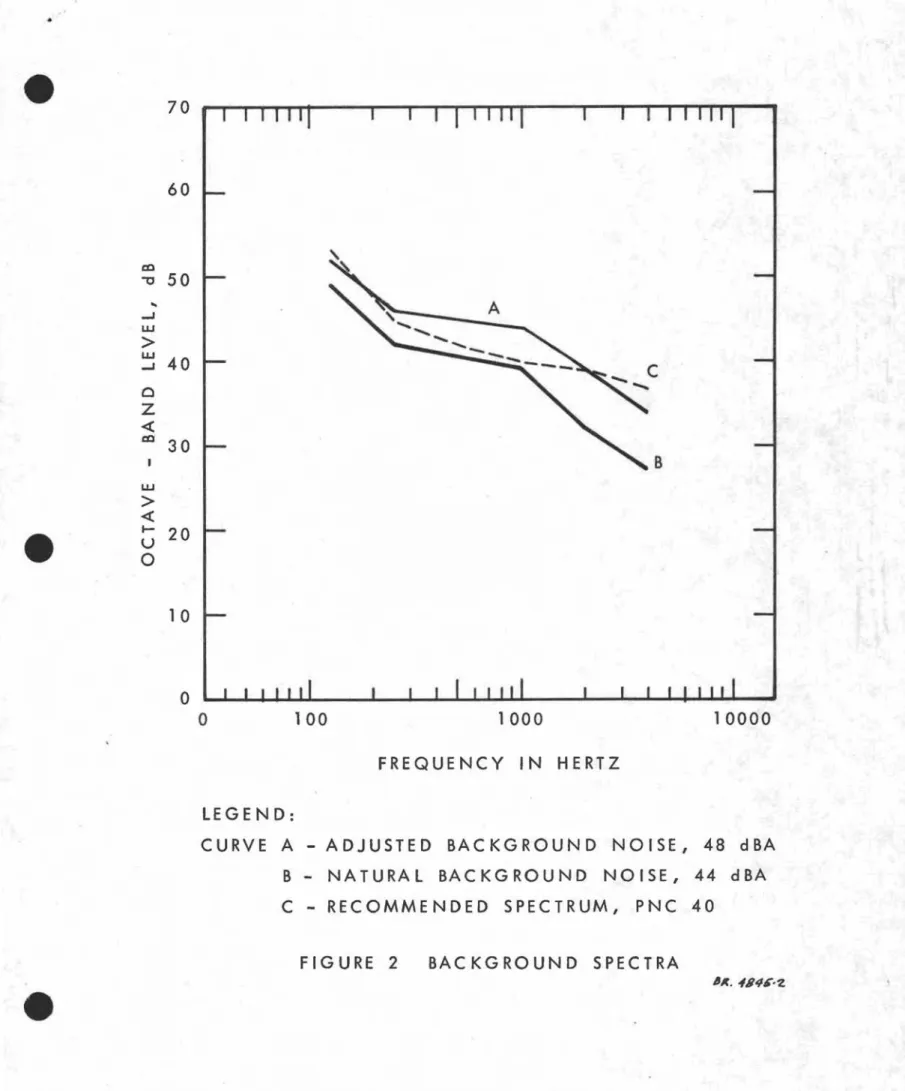
Apart from two electric typewriters intermittently operated at one end of the office, the background noise was due to speech, with som.e broad-band noise in the perimeter work stations resulting from air-conditioning outlets. The prevailing background mise was measured at 44 dB(A) but varied from 40 to 46 dB(A). Curve B, Figure 2, shows the existing background noise spectrum. Speech privacy between work stations was very low.
2
-ABSORPTION TREATMENT
As both wall and sCreen surfaces were reflective, approximately 60 ft2 of 1/2 in. rigid glass fibre board (Noise Reduction Coefficient
=
approximately 0.6). was distributed temporarily over the surfaces of each work station in 2 ft by 4 ft panels. The added absorption reduced the background noise level by only 1 to 2 dB (A), but made a noticeable difference to both the reverberant quality of each work station and the speech level received in the adjoining station.MASKING NOISE INSTALLATION
The noise system installed consisted of a commercially available white-noise generator with inbuilt spectrum-shaping networks. The
signal was fed to an amplifier and four 5-in. loudspeakers placed at 8-ft centres covering two work stations.
The sound level at the ear of a seated person was initially set at 50 dB(A), and the employees occupying the work stations were requested to adjust the level to the most acceptable value.
The initial level of 50 dB{A) was considered too high for comfort although it did provide excellent speech privacy.
Re-examination of the system after 3 days showed that a level of 48 dB(A} had been settled on at which the background noise was considered
unobtrusive and the work environment improved to a satisfactory privacy condition.
Curve B, Figure 2, gives the spectrum of the natural background noise, and for comparison a spectrum that has been recommended for background noise is also plotted (curve C). Curve A is the spectrum of the masking noise finally used in this experiment. It was chosen on the basis of preliminary listening tests of the four available channels on the noise generator. The exact form did not appear to be critical in the laboratory tests, and the subjects involved in the office study did not find the character of the noise disturbing.
The final decision of the subjects was that they were sorry to see the installation removed. This was significant, as their initial attitude to the system was somewhat antagonistic. However, they still expressed a preference for private offices for their type of
activity. It should be noted that they had previously been accommodated in private offices and were therefore unaccustomed to an open office situation.
3
-CONCLUSION
It would appear that a simplified masking noise system with in-expensive components could be used to advantage in certain open office installations where speech privacy is low.
The exact form of the noise spectrum does not seem critical, and the cost of shaping the spectrum to suit individual installations can be minimized if a fixed spectrum shape is provided and a conventional amplifier with bas s and treble controls is used to make adjustments to obtain a generally satisfactory spectrum shape. Although it is still possible that this system might lead to some complaints about either the character or the level of the background noise, indications are that the se would be few.
,
DIRECTOR'S OFFICEI
TALKER
P
POSITION 2 GENERAL OFFICE\111
ADDED ADSORPTIONCOo
®
C
0
) MONITORING POSITIONr¥
PARTITION HE I G H T=
80" 10' xlO'
approxQエMM]セFIGURE 1 LAYOUT OF OFFICE AREA USED FOR TESTS
,
70
60
co -0 50..
-' w>
w 40 -' 0 Z 4: co 30B
w>
4: I-20u
0
1 0o
o
100 1000 FREQUENCY IN HERTZ 10000 LEGEND:CURVE A - ADJUSTED BACKGROUND NOISE, 48 dBA B - NATURAL BACKGROUND NOISE, 44 dBA C - RECOMMENDED SPECTRUM, PNC 40