CONNECTED STRANGERS:
MANIPULATING SOCIAL PERCEPTIONS TO STUDY TRUST by
Sheng-Ying Pao Submitted to the
Program in Media Arts and Sciences, School of Architecture and Planning,
in partial fulfillment of the requirements of the degree of Master of Science
at the
MASSACHUSETTS INSTITUTE OF TECHNOLOGY UiuJv~e 2-010j
May 2010
© 2010 Massachusetts Institute of Technology. All rights reserved.
ARCHIVES MASSACHUSETTS INSTITUTE OF TECHNOLOGY
JUN 0
8
2010
LIBRARIES
4 Signature of AuthorProgram in Media Arts and Sciences
May 7, 2010
Certified by
Debj oy Professor of Media Arts and Aiences MIT Media Laboratory Thesis Supervisor
Accepted by
Prof. Pattie Maes Associate Academic Head Program in Media Arts and Sciences
CONNECTED STRANGERS:
MANIPULATING SOCIAL PERCEPTIONS TO STUDY TRUST
bySheng-Ying Pao Submitted to the
Program in Media Arts and Sciences,
School of Architecture and Planning, on May 18, 2010
in partial fulfillment of the requirements of the degree of Master of Science
at the Massachusetts Institute of Technology
May 2010
Abstract
Economic views of trust, grounded in repeated game theory and behavioral economics experiments, largely ignore social factors such as personal relationships between subjects. In this study, we designed a new experimental procedure, the "Social Lending Game", in which aspects of trust are measured as a function of differing social contexts. The procedure harnesses real-world social relationships while keeping subjects' identities confidential. We developed relationship mining methods that categorize social connections into trustful ties, distrustful ties, and neutral ties. Subjects in the Social Lending Game were led to believe they were paired up with a stranger with real social connections to them. The perceived social connections were systematically manipulated to different types and strengths of social ties to measure the effect of social perception on trusting behavior. Surprisingly, we found that people trust strangers as much as they trust a friend's friend. In contrast, people distrust strangers when they are told that there exists no social connection to the strangers. These methods and results point to a number of future research topics that leverage social networks to reinvestigate utility theory, trust-based decisions and risk-taking behaviors in social contexts.
CONNECTED STRANGERS:
MANIPULATING SOCIAL PERCEPTIONS TO STUDY TRUST
bySheng-Ying Pao
Advisor
Deb Roy Professor of Media Arts an iences Program in Media Arts and Sciences, MIT
Thesis Reader
Alex (irifdy) Pentland Professor of Media Arts and Sciences Program in Media Arts and Sciences, MIT
Joseph Paradiso Professor of Media Arts and Sciences Program in Media Arts and Sciences, MIT Thesis Reader
Acknowledgements
I would like to acknowledge all those who have supported me during my thesis work:
My advisor, Deb Roy, who has been a constant inspiration to me and has
supported my ideas. My thesis readers, Alex (Sandy) Pentland and Joseph Paradiso, for taking the time to guide me though the thesis process and providing invaluable feedback.
Professors Ernst Fehr, Drazen Prelec, Josh Ackerman, Bank of America senior vice president Erik Ross, and vice president Sean Jones for discussing my thesis in its early stages and providing valuable feedback on the design and implementation of my experiment. Professors Frank Moss and Pattie Maes for their insightful critiques of my thesis proposal.
I would also like to acknowledge the UROP interns whom I mentored. Peter Rigano tried out different ideas with me, no matter how late it was in the evenings. Natasha Nath and Wendy Cheang volunteered to help with subject recruitment and scheduling. Together with Jorge Simosa, they helped with running the experiments even over the weekends. Robert Drenkhahn assisted in the early stage of integrating the experiment platform with Facebook. Their contribution sped up the data collection process, and their participation has brought briskness to my research journey.
It is my great fortune to have met many awesome people at MIT who nourished this work from different perspectives. There are many whom I would like to thank: Florian Ederer, Sachin Banker, and Randall Lewis from Sloan School of Management for insightful questions and discussions in the early stage of the study; Nan-Wei Gong, Bo Morgan, Aaron Zinman, Dawei Shen, Drew Harry, and Sajid Sadi from the Media Lab for feedback on my thesis proposal. Stefanie Tellex, Jeff Orkin, Brandon Roy, Soroush Vosoughi, Rony Kubat, Sophia Yuditskaya, Kleovoulos Tsourides, Philip DeCamp, Kaname Tomite, Hilke Reckman, Matt Miller, and George Shaw from the Cognitive Machines group for their feedback and support.
I deeply appreciate all the effort from Mutsumi Sullivan, Karina Lundahl, Yuko
Barnaby, Linda Peterson, Aaron Solle and other administrative staff at the Media Lab. I would like to specially thank MIT Behavior Research Lab manager Sarah Wang for her help with utilizing the equipment and space for the experiment.
Financially, this work has been supported by the MIT Media Lab and the Center for Future Banking. Thank you for providing funding to perform this research.
Without a group of great friends, I would not be as brave and stay sane. I would like to specially thank Alexander Reben for his constant help, encouragement, and suggestions whenever I am in need. I would also like to thank Chi-Yen Hsiao for all the support and joyful times.
Most important of all, I would like to thank my family: Dad, Mom, Sheng-Chih and Sheng-Hao, for your love, hope, and unwavering support.
I'd like to dedicate this thesis to my grandmother. I wish I could call her again to
Table of Contents
Abstract... 3 Acknowledgem ents... 7 Chapter 1 Introduction...13 . M otivation ... 13 1.2 Contributions... 14 1.3 Roadmap ... 16Chapter 2 M easuring Trust ... 19
2.1 Empirical Assumptions...19
2.2 Trust in Social Exchanges ... 20
2.3 M easuring Trust in Social Contexts... 21
Chapter 3 Leveraging Social Perception to Study Trust ... 23
3 .1 Sco p e ... 23
3.2 Social Perception... 25
3.3
Assumptions and Predictions ... 26Chapter 4 Relationship M ining ... 27
4.1 Purpose... 27
4.2 Relationship M ining M ethods... 28
4.2.1 Social Ties Conditioned on Trust ... 28
4.2.2 Algorithm for Categorizing Social Relationships...29
4.3 M anipulating Social Perception ... 31
Chapter 5 Social Lending Gam e ---... 35
5.1 Purpose...35
5.2.1 The Investm ent Task... - .... 37
5.2.2 Spending O thers' M oney... 40
5.2.3 M easuring Risk Preferences ... 41
5.2.4 Measuring Trust, with Respect to Social Perception ... 44
5.2.5 Measuring Reciprocity, with Respect to Social Perception ... 46
5.3 Comparing with Previous Economics Games ... 48
Chapter 6 Experiment Procedure ---... 51
6.1 Experim ental Design Overview... .... 51
6.1.1 Experiment Components ... 51
6.1.2 Social Network in Sequential Experiments---...-...-53
6.1.3 Pretest-Posttest Design Combining with Repeated Measures ---... 54
6.1.4 Standardizing Experiment Procedure...-- -- -55
6.2 Endowment ...---...---. 56
6.3 Experiment Design---...--- -58
6.3.1 The Relationship-mining Survey...---58
6-3.2 The Complete Stranger Experiment ... 62
6.3.3 The Connected Stranger Experiment ... 63
6.3.4 The review questionnaire... 68
6.4 Subject Recruitm ent ... 68
6.5 Subjects Pairing... 69
6.6 Social Identity and Confidentiality ... 71
Chapter 7 System Design---...73
7.1 System Overview ...---.---...--- 73
7.2 Integrating Actual Social Networks... 73
7.3 Interface Design for Behavioral Study...76
Chapter 8 Results ... 79
8.1 Influence of Social Perceptions on Trust...79
8.1.1 Negative Social Perceptions Undermined Trust ... 8o 8.1.2 Model of Trust between Strangers ... 82
8.1.3 Trust along Social Distance ... 85
8.2 Influence of Social Perception on Risk Preference ... 87
8.3 Influence of Social Perceptions on Reciprocity ... 89
Chapter 9 Conclusions and Future Work... 93
References ... 97
Appendix... 101
Appendix A Subject Prescreening...103
Appendix B Instruction for Experiments Phase i...107
Appendix C Demographics Survey...109
Appendix D Instruction for Experiments Phase 2 ... ml Appendix E Review Questionnaire ... 115
Appendix F COUHES Approval & Consent Form... 123
Chapter
i
Introduction
i.1
Motivation
Trust, risk, and reciprocity are important factors which influence human decisions. Trust has been defined in many ways and been studied across various disciplines [1-3].
Economic views of trust, either rooted in repeated game theory or in behavioral economics experiments, have provided the assumptions to study trust-based behaviors [41.
However, individual choices do not appear to be consistent with these assumptions that a rational decision maker follows [5-71. People are not exclusively self-interested. More trust and altruism are observed between strangers than empirical assumptions predict. Is there something missing in the economics and game theory assumptions?
The question of how to measure trust accurately and reliably is debated [8-n]. Most of the previous studies have only focused on the utility from monetary exchanges. However, they may over-simplify trusting behavior in social exchanges. Social utilities play as an important role as money or goods in everyday exchanges. For example, in person to person transactions, a purchasing decision is not only based on price but also on perceived
social attributes about the seller. In the context of business, people often refer to their social connection to others in order to gain credibility. This implies that each party in an exchange should not be considered the same. The social accounts of individual behavior should be taken into account while studying trust.
Yet, the previous designs of economics experiments, such as the standard trust game, do not accommodate such social contexts involving real social networks. The assumptions which their experimental models are based on ignore social factors such as the personal relationships between subjects. In addition, the problem of the previous design is that it is difficult to keep the anonymity of paired subjects while investigating behaviors using actual social relationships between them. Furthermore, whether the standard trust game measures trust is still controversial [12]. A new game that
incorporates social reality to examine trust-based behavior is needed.
We considered social perception rooted in the network structure of social capitals to study trust-based decisions. Does referring to mutual friends really motivate trust and reciprocity? How do trust-based decisions vary with different strengths of social relationships? Are people more trusting when there exist perceived social connections?
In addition, previous studies show that trust is more essential for ensuring cooperation between strangers than for supporting cooperation among people who directly interact [5]. On the other hand, as virtual interactions increase, there is less to gauge this perceived trust upon. The impression of a person can be shaped by the perceived connections on his or her social networks. Such social perceptions may have greater impact on trust between strangers since there is no other information to rely on. How can we leverage social perceptions to motivate trust between strangers or entry-stage interactions?
1.2
Contributions
We manipulated social perceptions to examine trust, risk preference, and reciprocity. The role of perceived social connections in trust-based exchanges was investigated using real-world social networks.
A new experimental model, embodied as the "Social Lending Game", was designed to leverage social aspects to investigate trust. Differing from existing empirical methods, new assumptions and predictions of trust-based behaviors are proposed. The Social Lending Game incorporates actual social relations. The experimental model accommodates social strategic moves of each individual. It is fundamentally different from empirical methods in the following manners:
First, the emphasis in the Social Lending Game is on the impact of social perception on trust-based behaviors. We developed relationship mining methods, as well as the experimental procedures, to accurately measure trust. The relationship mining methods can serve as a methodology to categorize social relations not only for the present study, but for future research and theories on social ties.
Second, we identified the "free money effect" and other factors that may introduce bias in empirical experiments. We set up a situation where subjects may suffer a loss due to their decisions in the game. This is as opposed to the standard trust game where subjects are offered free money and extra bonus for sure. In addition, the Social Lending Game allows us to investigate how people use money from others. Also, the design allows risk to be examined separate from trust, to address the ambiguity in empirical experiments [12]. Comparing with the standard trust game, the design of the Social Lending Game, with the investment task and the refundable participation fee, can more accurately reflect trust, risk preferences and reciprocity.
We designed and implemented a unique economics experiment platform. In order to integrate actual social networks in the measurement of trust, the platform is connected with Facebook'. This platform allows the experiment to incorporate subjects' social identities while their real identities in the experiment are kept confidential. The experiment system, along with the unique endowment procedure and subject pairing method, has confronted one of the biggest challenges in previous economics experiment designs.
1 Facebook: http://www.facebook.com/ One reason we selected Facebook was that it has been the largest social network since 2008. Also, Facebook users use real identities.
Finally, the unique data gathered from the experiment reveals the effect of social perception on trust, risk preference and reciprocity. We found that people place trust and reciprocity on a complete stranger as much as on a trustful friend's friend. In contrast, people distrust a stranger when they are told that the stranger is not socially connected through any acquaintances. Also, when the perceived connection to a stranger is through negative social ties, people are far more likely to break trust. The results can be applied to everyday exchanges ranging from entry-stage interactions to decisions in the virtual world. Furthermore, the results around risk preferences are different from the prediction. When people believe the stranger is connected through a trustful friend, they tend to make riskier decisions; otherwise, they are risk-averse. Further results show that weather can forecast risk preferences. The findings may serve as basis of future research on individual trusting and risk-taking behaviors as well as interpersonal interactions.
1.3
Roadmap
The motivation and an overview of the present work are given in chapter 1.
Chapter 2 critically reviews the empirical assumptions and methods in research around
trust, with specific focus on the measurement of trust in social context. The summary of this chapter leads to the idea that trust-based decisions should be measured when games accommodate social strategic actions. A new experimental model that leverages social aspects to examine trust was proposed.
Chapter 3 extends the experimental model to the research framework that leverages social perception to study trust. The core elements in the present study are defined. It covers the scope of trust, the dynamics underlying social perception, and the challenges we confronted around this topic. Differing from empirical methods, new assumptions and predictions of trust-based behaviors are proposed.
Along the lines of leveraging social perception to study trust, chapter 4 and chapter 5 cover the two major domains of this study -- the composition of forming social perceptions and the foundation of measuring trust. Chapter 4 describes the relationship mining methods we developed to categorize and create social perception. Relevant theories and methodologies around social ties are reviewed. Chapter 5 presents the Social
Lending Game. By leveraging relationship mining using actual social network data, the Social Lending Game served as an experimental model which investigated how social perceptions influence trust-based decisions. A critical comparison between the designs of the Social Lending Game and of empirical economics games is provided. We identified noisy factors such as the "free money effect" in previous studies. The fundamental differences and uniqueness of the present game design are discussed at the end of chapter 5.
Chapter 6 describes the design and implementation of the experiment and elucidates how the relationship mining results are integrated with the Social Lending Game in the experiment. It demonstrates seven experimental treatments leveraging social perceptions to examine trust. In addition, it uncovers the unique endowment procedure and subject pairing methods. Chapter 7 gives the technical details in system design. It shows how the experiment platform integrates actual social networks, and how the interface accommodates the experimental treatments. Combining chapter 6 and 7, it reveals the methodologies we developed to incorporate actual social identity while keeping anonymity in the experiment regarding trust-based behaviors.
The findings from the experiment are shown in chapter 8. The results of this study appear in the following sequence: First, the summary of the data and the analysis procedure are provided. Second, we considered social perceptions polar, and analyzed its effect on trust. Third, we argued the conclusion from previous studies regarding trust between strangers. We formed our theory supported by experimental evidence. As opposed to the polarity of social perception, we analyzed the strengths of social perceptions thereafter. Finally, unexpected findings around risk preference are disclosed. Chapter 9 concluded this work and points to directions for future research opportunities and applications.
Chapter
2
Measuring Trust
2.1
Empirical Assumptions
A long-established tradition in economics assumes human beings to be exclusively
self-interested. Since Adam Smith, "the vast forces of greed" and the mechanics of self-interest have been fundamental to most economic accounts of individual behavior
and aggregate social phenomena
[4].
Game theoretic modeling has also viewed agents asbeing concerned with maximizing their own utility.
Based on these assumptions, several approaches were developed to measure trust, trustworthiness and reciprocity. Since Berg, et. al proposed the trust game, it has become
the standard measurement of trust [31. However, experiments using the trust game rarely
end in the perfect Nash equilibrium. Empirical assumptions predict that self-interest should lead to no trust in the game. Trust game experiments show substantially more trust and altruism than equilibrium predicts.
Several papers have shown that the behavior in the trust game is affected by other motivations besides trust in the partner. Levitt and List argue that in the lab there are
several factors, such as experimenter's scrutiny, that may induce the more socially acceptable reactions [13]. Other factors include individual risk aversion [8-9] and altruism [io-ni]. These results raise the question: Can we trust the trust game to accurately measure trust?
Despite the debate over whether the standard trust game measures trust, previous studies show that people deviate from purely self-interested behavior in a trusting and reciprocal manner [5]. This raised the bigger question: Is there something missing in the economics and game theory assumptions?
2.2
Trust in Social Exchanges
In everyday exchanges, people decide how to bargain with one another not only based on the transaction value, but also based on with whom they encountered. Decisions that lead to such social exchanges usually involve trust. However, most experimental studies that investigated trust simply match anonymous random subjects with one another. Also, game theoretic models and most economics models assume all partners are the same. The design in empirical games has coupled with the assumption that all players were self-interest. It leaves no room for social accounts of individual behavior.
Several previous studies considered the influence of the partner when studying behavior in social exchanges. Blount compared the effect of causal attributions on choice in social decision making when the partners were perceived as humans versus machines
[14]. Ball, et. al tested for the effect of social status in a laboratory experimental market
[15.]
Mulford, et al. examined the perceived physical attractiveness of a partner and examined both cooperative-versus-defect choices and play-versus-not-play in a prisoner's dilemma game setting [16]. Scharlemann, et al. investigated the influence of the facial expression (a smile) of a partner on strategy taken in a 2-player game [17]. Slonim and Garbarino allowed partner selection in trust game and modified dictator game[18]. Others have focused on differences between genders in socially-oriented (selfless) behavior, individually-oriented (selfish) behavior, and risk-taking tendency [19-21]. However, none of them has focused on the influence of social relationships between the paired subjects.
A previous study focused on social capital and trust [22]. They looked at whether
trusting behavior and trustworthiness rise with the number of common friends the subjects have. However, their experiment was run with friends, or with people who were asked to interact with each other beforehand, to provide a list of their common friends. This design introduced bias from the prior knowledge about the paired partner, especially when the paired partners were already friends before participating in the study. Research has shown that cumulative interactions can be construed as an important form of
knowledge-based or personalized trust [23-28]. In addition, the decisions can be
influenced by other factors such as gender, facial expression, physical attractiveness, social
status, etc [15-21]. The results may not reflect the effect of social capital on trust and
trustworthiness.
Burt and Knez investigated the "third-party effects" on trust in organizational
behavior [29] They focused on social relations versus trust in a study of trust among
managers in a high-tech firm by self-report surveys. As they demonstrated, gossip constitutes a valuable source of "second-hand" knowledge about others. However, as Kramer reviewed, " The effects of gossip on trust judgments are complex and not always in
the service of rational assessment of others' trustworthiness" [30]. Also, the answers to the
standard trust questionnaire are not correlated with the trusting behavior in the standard
trust game [22, 31]. This implies that the self-report responses to do-you-trust type
questions may not be consistent with actual behavior regarding trust.
2-3
Measuring Trust in Social Contexts
Humans are social animals, therefore trust should be considered in social context.
Previous evidence shows that trust is a form of social intelligence [32]. However, few of the
previous studies have focused on social connection between the paired partners when studying trust-based decisions. What have been missing in empirical measurement of trust were the social accounts of individual behavior.
As game theory and traditional economic assumptions failed to rationalize trusting behavior, social action should be considered as rational behavior. Previous research has
has estimated social utility functions in different contexts[34]. Extending the work on social utility, Loewenstein and Thompson had manipulated social relationship to examine interpersonal comparisons regarding the preferences for outcomes to self and others [35]-Although this study is not focused on trust, they incorporate social utility into account to study decision making in interpersonal contexts.
Past experiments using the standard trust game and the dictator game have over-simplified the conditions such that they neglect the social aspects in decision-making [3, 36]. Social perceptions of people who are involved in the decisions should not be decoupled from the measurements of utility while studying trust.
Trust-based decisions should be measured when games accommodate social strategic moves, by introducing a social context in the experimental models. The present research considers social perceptions to study trust, reciprocity, and risk preference. Further discussions are given in following chapters.
Chapter
3
Leveraging Social Perception to
Study Trust
3.1
Scope
We leveraged social aspects to examine trust, reciprocity, and risk preferences.
Trust has been defined in many ways across various disciplines [1-2]. In the present study,
we focus on trust in regard of material exchanges. This is as opposed to nonmaterial things such as trust in knowledge exchange, morals, love, etc. As one of the most important social aspects in everyday exchanges, we considered "social perception" which is rooted in the network structure of social capitals to study trust-based decisions.
In this study, social perception refers to the perception of interpersonal relations.
The fundamental dimensions underlying social perception is discussed in section 3.2. We
focus on the impression formed from perceived social connections between people. This research addresses the questions: How do trust-based decisions vary with different strengths of social connections? How do they change with various social distances in social structure?
The influence of social perception on trust-based behaviors was examined in our experimental model. One of the biggest challenges is how to keep the anonymity of paired subjects while investigating behaviors based on actual social relations between them. Previous studies acquire the subjects' social relationships to one another by self reporting [22, 30]. However, such methods sacrifice anonymity and bring in factors that influence trusting behavior between paired subjects. Although other research keep the anonymity to ensure the credibility of experiment results, they have no means to incorporate social connections into account [3]. There exists a trade-off between retaining anonymity between the paired subjects and incorporating social reality.
To confront this challenge, we conducted our experiment with human subjects who were strangers. We incorporated their actual social network on Facebook and subjects were led to believe they were playing with a stranger with real social connections to them. We developed the relationship mining methods to categorize their social relationships to their real friends. Furthermore, we manipulated the relations between paired subjects to examine how social perceptions influence trusting behaviors.
In addition, we identified the effect on trust, risk preferences and reciprocity exclusively from social perceptions. Previous study has included subjects who were already friends or acquaintances [22]. As discussed earlier, these results may be influenced by prior knowledge of other perceived social attributes, such as the other party's social status, communities they belongs to, etc. These social factors were excluded from our study to prevent bias. We exclusively focused on the effect of social perception, regarding perceived social connections. To do this, we conducted the experiment with complete strangers and they were not allowed to meet each other during the entire experiment. The social distance between people in this study was characterized following the definitions of "degrees of separation" in social networks [37-38]. The social perceptions examined were perceptions of people who were in 2 or more degrees of separation. We assumed that on the basis of their first degree connections, people formed social perceptions of one another and hence influenced trust.
Leveraging actual social network to study trust between strangers also allows us to investigate interactions in the entry stage. It is common that when people first meet, they
introduce each other by referring to possible mutual friends. In business contexts, people tend to strengthen their bond by referring to their shared social connections among each other. However, does acknowledging mutual friends really strengthen social bond? Are people more trusting when there are perceived social connections? These questions were addressed by means of leveraging social perception to study trust.
3.2
Social Perception
Bourdieu first defined the concept of social capital as the following: "The aggregate of the actual or potential resources which are linked to possession of a durable network of more or less institutionalized relationships of mutual acquaintance or recognition" [39] According to Bourdieu's definition, social capital consists of the following two decomposable elements: first, the social relationship itself that allows individuals to claim access to resources possessed by their associates; second, the amount and quality of those resources. On the basis of Bourdieu's definition, Portes concluded that "Transactions involving social capital tend to be characterized by unspecified obligations, uncertain time horizons, and the possible violation of reciprocity expectations" [40].
As several studies have pointed out, social capital facilitates individual's
occupational attainment [41-43]. Other studies show that it improves companies' business
operations [44-46]. Social capital is found to be significantly related to resource exchange
and product innovation
[47].
Most of the past studies have focused on the value created bysocial capital. However, few of them examine the potential risk of social capital or investigate the impact of social capital on trust.
Perceived social capital belonging to a person forms a certain impression of him/her. As the saying goes, "birds of a feather flock together." As the social perception is established, it serves as the basis for people to make assumptions to categorize others, predict behaviors, and make decisions thereafter. In this study, social perception refers to the perception of social capital that one possesses. The impression of that person can be shaped by the perceived connections on his or her social networks.
3-3 Assumptions and Predictions
We assumed that such social perceptions altered trust. Furthermore, we focused on the impression formed from perceived social connections between one another. These perceived social connections could be acquaintances, close friends, or enemies. Since there is no other information to rely upon, the influence of social perception on trust is even more effective in the entry stage interactions or between strangers.
How far can social perception be carried over through a social networks and influence trust? In everyday exchanges, a common strategy to get a good bargain is to leverage social connections as referrals. We assumed that social perception of whom one encountered with dominated the uncertainty where trust based upon. However, does social capital always motivate trust? Are there risks of having social capital?
We predicted social perception altered trust, risk preferences and reciprocity in two manners. First, we considered the social distance on a given social network. The social perception formed based upon one's social capital would have different strength of impact on trust according to the distance. The increase of trust should be proportional to the social distance.
In addition, social perception should be further considered polar. Positive (trustful) social perception induced stronger trusting behavior, while negative (distrustful) social perception damaged trust. Neutral social perception should lead to baseline behaviors, where observed trust should be in between those with trusting and distrusting
Chapter 4
Relationship Mining
4.1
Purpose
The purpose of relationship mining is to categorize the social connections on a given social network. In order to investigate the impact of social perceptions on trust, reciprocity and risk preference, we manipulated social perceptions into different types and strengths. In this study, we considered social perceptions rooted in the network structure of social capitals. In other words, the impressions of one's first degree friends are projected onto strangers and hence form the perceptions of the strangers. Since the social perceptions are formed based upon the social capital one possesses, it is important to not only identify the social capital one has, but also categorize it according to trust.
We developed the relationship mining methods that categorize social relationships to one's first degree friends according to trust. The relationship mining results serve as the basis for manipulating social perceptions in various experimental treatments in the "Connected Strangers Experiment" (see section 6.3.3 for the experiment design).
In addition, the relationship mining allows us to incorporate actual social networks while keeping the anonymity of paired subjects in the experiment. To do this, the social relations of the social capital subjects have are genuine, while the social relations beyond 2 or more degrees of separation were manipulated to create various
social perceptions in different experimental conditions. With the relationship mining methods, we categorized real-world social connections into trustful tie, distrustful tie, and neutral tie. By leveraging the actual social relationships, we manipulated social perceptions to investigate trust-based decisions.
4.2 Relationship Mining Methods
4.2.1 Social Ties Conditioned on Trust
This study scoped trust in terms of trust in monetary exchanges (Chapter 3). We categorized the relations of one's first degree social capitals regarding the same aspect of trust - monetary exchanges. Previous studies provided quantitative measurement of social ties [48-49]. Recent studies focused on predictive models that map virtual social networks to the strength of social ties by analyzing quantitative variables on social media sites
[50-51]. The results may represent tie strength well, but the correlation of tie strength and trust are vaguely seen. In addition, the data collected from social media sites may provide an objective view for quantitative analysis of tie strength. However, such methods may not represent the actual level of trust a subject has.
In order to identify and categorize the social ties in terms of trust, we developed the relationship-mining survey. The survey questions are scenarios involving the subject and their actual friends. The survey questions for relationship mining are as follows:
1. Will you lend $ioo to Thomas if he asks? o Yes.
o No.
2. Do you believe Andrew will return the $ioo borrowed from you?
o No.
o I'm not sure.
3. You have an urgent need of $100. Will you ask Sophia to lend you some
money?
o Yes.
o No.
4. Jessica is in a rush and needs your help...
Jessica gives you sioo that her friend will come pick up from you within
30 minutes. However, no one shows up. You decide not to wait for the friend and keep the sioo in your wallet. On your way home, the sioo gets stolen! You will ...
o say sorry to Jessica and may or may not return the entire $100.
o pay back Jessica the full amount of money by all means.
o think that $100 between you two is not a big deal. Either of you will cover it.
We incorporated actual social networks of each subject on Facebook. To gain an adequate amount of information about one's social capital without introducing bias in the survey, forty friends were randomly picked and displayed in a random sequence. Each survey question is with regard to a friend, while the corresponding name, picture, social network, and further information of that friend are displayed along with the question on a web-based interface. Subjects' identities and their responses in the survey are kept secret. This method allows us to gather comprehensive information of one's social capital and keep their identity confidential. Also, the data collected is from the subjective view of each person, and would represent their impressions of each of their friends in terms of trust.
4.2.2 Algorithm for Categorizing Social Relationships
Based on the relationship mining results, the social connections between a person and his/her first degree friends were categorized into a trustful tie, a distrustful tie, or a neutral tie. We further differentiated trust regarding lending money and borrowing money.
Questions i and 2 in the relationship-mining survey are to indentify the lender's respect of
trust, while questions 3 and 4 are with respect to the borrower. The algorithm for categorizing the social relationships is as follows:
For trust regarding lending,
If ((the answer to Qi is "Yes") & (the answer to Q2 is "yes"))
{
The relationship == trustful; }else if ((the answer to Qi is "No") & (the answer to Q2 is NOT "I'm not sure")
{
The relationship == distrustful; }else
{
The relationship == neutral;}
For trust regarding borrowing,
If ((the answer to
Q3
is "Yes") & (the answer toQ4
is NOT "i")){
The relationship == trustful; }
else if ((the answer to
Q3 is "No" ) & (the answer to
Q4
is "1")){
The relationship == distrustful; }
else {The relationship == neutral; }
The relationship-mining survey incorporating actual social networks, in conjunction with the categorizing algorithm, allows us to identify a subject's social capital and to classify his/her social connections in terms of trust. The results serve as the basis for the Social Lending Game (Chapter 5) where a pair of strangers would participate as a borrower and a lender. The above algorithm of trust regarding borrowing is applied for a subject who participated as a borrower, and that of trust regarding lending is applied for a lender.
4-3 Manipulating Social Perception
Using the results from relationships mining, we generated the "Social Connection
Graph" (Figure i). The Social Connection Graph illustrates the social relations among
strangers who participate as lender-borrower pairs in the social lending experiment.
'--, I----I j 1 j I / I, Participant 1
:
,' Participant 2 I, Ii II I, SI'
II David You Participant 3 Friend B Friend A Jane ---en You YouFigure i. Types of social connections for generating the Social Connection Graph.
Three types of social connections are generated: the trustful connection, the
distrustful connection, and no connection. As illustrated in Figure 1, for example, the
subject and participant i had a common friend, David. Also, the degree of separation between the paired strangers was two. Since David was identified as a trustful friend according to the relationship mining results, David was a trustful connection between the subject and participant 1. Similarly, Ben connecting the subject and participant 2 had been categorized as a distrustful friend, and the degree of separation was two. This formed the
I I
ITrustful () I Distrustful (-)I
distrustful connection. If there is no connection between the two strangers, no mutual friend will be displayed.
In addition, various strengths of social connection are generated. As shown in
Figure 1, participant 3 was four degrees away from the subject, and their mutual friend
Jane had been categorized to be a trustful friend. The first degree friend is the basis when forming the social perception. To investigate the impact of strengths of social connections, as opposed to types of social connections, we considered only a trustful tie as the first degree connection when varying the strengths of social connection. Social connections of
3 degrees to 6 degrees of separation were generated, as displayed in Figure 2. The first
degree friend is the social capital identified in the relationships mining, so only the first degree friend is listed on the Social Connection Graph. Other friends beyond first degree are displayed as anonymous, including the other participants.
3 Steps 4 Steps 6 Steps 6 Steps
Friend's Friend Friend's Friend Friends Friend Partieipant D
I Stop 2 Steps_________
Friend's Friend Friends Friend Participant C
you s4d Sadi (MiT) Sajd sadl's Friend
Friend's Friend Participant B
Participant A
Figure 2. Different strengths of social connections in the Social Connection Graph.
By arranging a different first degree friend on the Social Connection Graph,
different types of social connections between paired anonymous subjects can be arranged.
By tuning the degrees of separation between the two subjects, the strengths of the social
connection between them can be changed. The social perceptions one may have of the paired participant can be manipulated by arranging a specific Social Connection Graph, which served as the basis of different treatments in this experiment using the Social
Chapter
5
Social Lending Game
5.1
Purpose
The Social Lending Game is designed to model trust, reciprocity and risk preferences. By leveraging relationship mining using actual social network data (Chapter 4), the Social Lending Game serves as an experimental model which investigates the effect of social perceptions on trust-based decisions. In addition, the design decomposes decisions made by anonymously paired lenders/borrowers, to further examine self-other discrepancies in risk preference.
The experiment model of the Social Lending Game considers realistic social lending situations. Unlike empirical economics games, such as the standard trust game where the experimenter tripled the money between two players, the money sent from one subject in the Social Lending Game may be increased or may be gambled away due to the
other subject's decisions
[31.
The Social Lending Game with the investment task is aexperiment design. With which, the Social Lending Game models trust, risk-preferences, and reciprocity in an accurate sense, it also investigates the effect of social perceptions.
5.2
Social Lending Game Design
As an experimental model for testing the hypotheses, we considered the simplest social landing situation, where the financial transactions occur between one borrower and one lender.
Figure 3 depicts the game tree of the Social Lending Game. The borrower and the lender are paired up in the initial stage. Each of them is endowed with same amount of initial capital Mo. A unique endowment method was designed for the experiment in order
to ensure subjects consciously regard the money as their own money (see section 6.2 for
the endowment method.)
Mo : M Initial capital: Mo - Mr (Lender) M-Lend M1(0:Mo] ----M1 Risky Investment: Return: N[0:2.5MI] ent Dec Mi Inv R N[ Repay M2 (0:N+MoI Pi payoff = Mo - Ma+ M2 P2 payoff - MO + N - M2 Borrower) Refundable participation fee: Mo Safe * Mo estment eturn: 0:1.2M1I N 4oM. ---Defect Pi payoff = Mo -Mi Papayoff = Mo + N
Figure 3. The game tree of the Social Lending Game.
-- 0
Lend $0
P1 payoff= Mo
The borrower and lender are not allowed to choose each other. They are paired up based on their social relationships on social networks. According to the relationship mining results, we identified their relationship regarding trust using actual social network data (Chapter 4). In the Social Lending Game, a borrower is paired up with a specific lender who is a stranger, but could be socially connected through their common friends (see Chapter 6 for further discussion on subject pairing.) The paired-up lender and borrower are not allowed to meet each other. This is to keep them as strangers during the game. Although they are strangers to each other, they are given the Social Connection
Graph and corresponding information (Figure 17 and section 6.3-3), showing who their
common friends are, and how far they could be linked to each other on their social network. In the experiment, the social connection information was given before and during their decisions.
The lender makes the lending decision, which is used to model trust as a function of social perception. The decisions made by the borrower include an investment decision and a repayment decision. The investment decision is to test the hypotheses of risk preferences. The repayment decision is to model reciprocity.
5.2.1 The Investment Task
As the most realistic social lending situation, the borrower is in need of money to remove his current deficit, while the lender may expect to increase her future utility from making the loan. In the Social Lending Game, we considered a borrower who needs money for making an investment. A great investment opportunity is provided, where a return better than the annual average return of stock market investments could be earned.
The investment simply consists of two options:
Investment option 1 is a high risk-high return investment.
Investment option 2 is a low risk-low return investment.
As the simplest investment situation, the borrower only has to pick one of the investment options, using the entire loan (M,) given from the lender. The investment
return (N) is calculated based on given winning possibilities. With investment option 1,
(N=2.5M,). With investment option 2, the risk to lose the entire loan is io% (N=o), with a
90% chance to gain 20% profit (N=1.2M1).
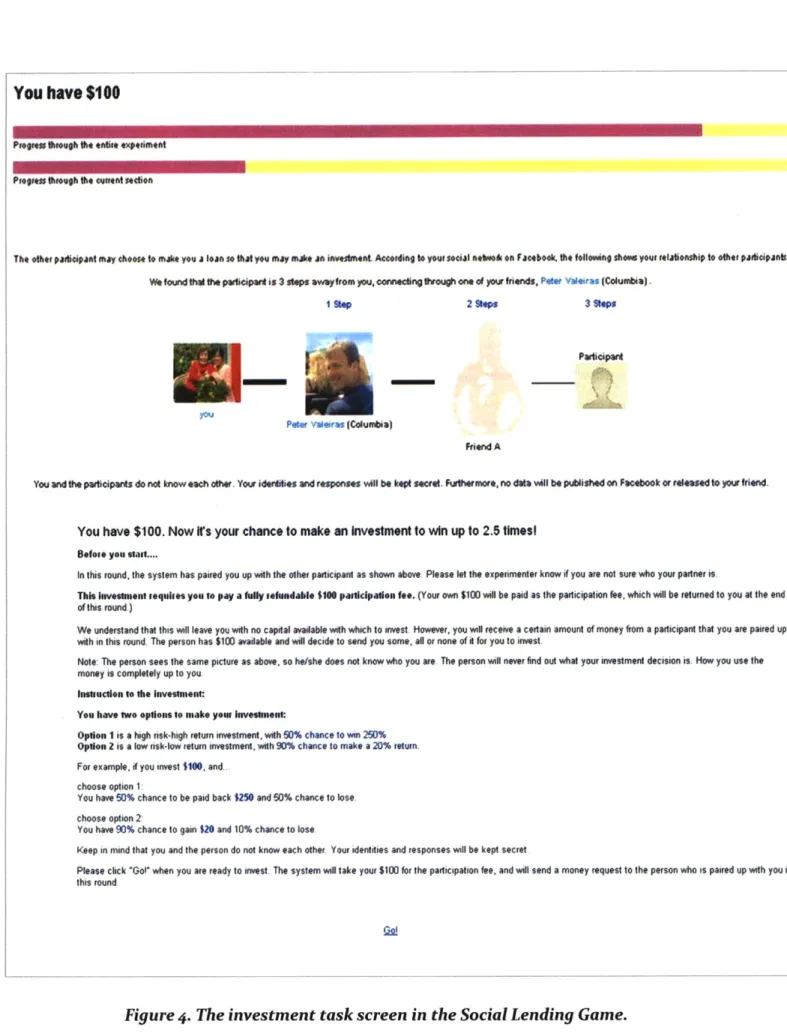
Figure 4 is the screen illustrating the investment options for borrowers in the Social Lending Game. On the same screen, a borrower can see the Social Connection Graph showing the connection from them to the lender on social networks. Before they can start to make their investment choice, the borrower has to pay a "participation fee" in order to enter the investment. The reason for the participation fee arrangement is to model how people use the money of others. Would social perception change the risk-taking behavior? See section 5.2.2, "Spending Others' Money" for further discussion.
You have $100
Progrem theugh the entire experiment Progres through the current section
The other participant may choose to make you a loan so that you may make an investment. Aocording to your social nebtWk on Facebook. the following shoew your relatioship to other padicipants.
We found that the participard is 3 steps awayfrom you, connocting thwough one of your friends, Peter Valeiras (Columbia).
1 stp 2 Sps 3 seps
Participant
Peter Valeras (Columbia)
Friend A
You and the participants do not know each other. Your identities and responses will be kept secret. Furthermore, no data will be pulished on Facebook or released to your friend.
You have $100. Now Ws your chance to make an Investment to win up to 2.5 timesI
Before you start....
In this round, the system has paired you up with the other participant as shown above. Please let the experimenter know if you are not sure who your partner is.
This linestment iequires you to pay a fully refundable $100 participation fee. (Your own $100 will be paid as the participation fee, which will be retumed to you at the end of this round.)
We understand that this will leave you with no capital available with which to invest. However, you will receive a certain amount of money from a participant that you are paired up with in this round. The person has $100 available and will decide to send you some, all or none of it for you to invest.
Note: The person sees the same picture as above, so he/she does not know who you are, The person will never find out what your investment decision is. How you use the money is completely up to you.
Insiucdon to the Investment:
You have two options to make your liement:
Option 1 is a high risk-high return investment, with 50% chance to win 250% Option 2 is a low risk-low return investment, with 90% chance to make a 20% retum. For example, if you invest $100, and
choose option 1:
You have 50% chance to be paid back $250 and 50% chance to lose choose option 2:
You have 90% chance to gain $20 and 10% chance to lose.
Keep in mind that you and the person do not know each other. Your identities and responses will be kept secret
Please click "Got" when you are ready to invest. The system will take your $100 for the participation fee, and wilt send a money request to the person who is paired up with you in this round.
5.2.2 Spending Others' Money
The borrower is given an initial capital M.. However, we purposely put the borrower in the situation that they do not have enough money to invest, by doing the following:
In order to make the investment, the borrower is required to pay a fully refundable "participation fee" before they could continue. The participation fee costs the same amount as the initial capital Mo. In other words, the borrower's own capital is frozen until the end of the investment. At that time, the participation fee (MO) is returned along with the investment principal and profit (N) (Figure 3). This leaves the borrower with no capital available with which to invest, and hence the borrower has to use money from a stranger to make the investment.
The reasons for charging the borrower the participation fee and leaving them with no money to invest are described as follows:
First, either investment option has a certain risk to lose the money (M,) borrowed from the stranger. The fully refundable participation fee is in fact collateral that ensures the borrower to have the ability to pay back (Figure 3). Lenders are also aware of this before they make their lending decisions. The lender's screen reads "The borrower needs more capital to make an investment to earn up to 50%. Their own capital (M.) is paid for a refundable participation fee, which will be returned to them with the investment profit. The borrower will use the money sent from you to make the investment." Thus, the investment risk would not influence the lender's decision. The lender's only risk is the borrower not repaying the loan. This makes the lender's decision rely on their understanding of the borrower, while the only information about the borrower is from the Social Connection Graph. When a lender makes the lending decision, they may only be influenced by the social perception of the borrower, but not by the investment risks or other factors.
Note that when the borrower is given the investment options, the participation fee is presented as a required fee to enter the investment. This provides them with a reason to request the loan from the lender. This setting is fundamentally different from the
empirical methods that the money receiver receives a set of free money for no reason. Further discussions about this are given in section 5.3.
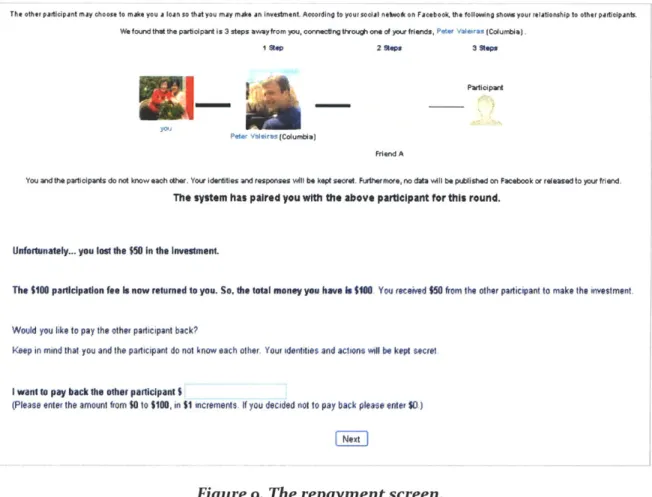
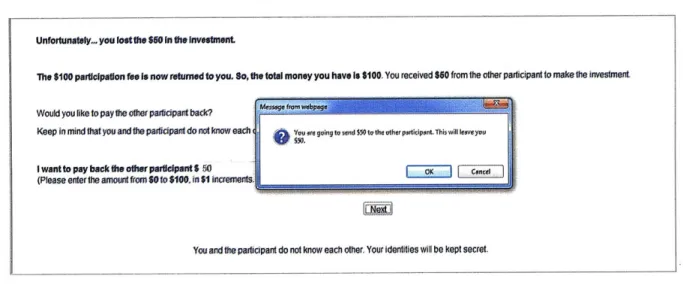
The setting also clearly separates the other's money from the borrower's own money. As shown in Figure 4, terms or concepts such as "collateral" are avoided in the description about the participation fee, because collateral implies that the borrower has the obligation to pay back. We leave the repayment decision with the borrower at the end of the game when their own money (MO) is returned. They are asked to payback using their own money, without being predefined as collateral. The purpose is to prevent mixing the borrower's own money with the lender's money. They use only money from others to invest. This allows us to investigate how people use someone else's money, as oppose to their own money.
5.2.3 Measuring Risk Preferences
The incentive to borrow is to make an investment profit. Using the loan from the lender, the experiment task is to model how people use money from others. How would the risk preference be different when the lender is a complete stranger, versus the case when the lender is a friend's friend?
To identify whether risk preferences are influenced by social perceptions, the Social Connection Graph is given on the investment option screen (Figure 4) and on the decision screen (Figure 5). The borrower is given only the following information:
1. The descriptions of the two investment options.
2. Through which friend the borrower can be linked to the lender.
We hypothesized that risk preferences can be influenced by social perception. Furthermore, we hypothesized that people tend to make riskier choices when the social connection was loose, i.e., when the lender is three steps or further, and when the connection is a distrustful tie (Chapter 4). On the other hand, we hypothesized that safer investment decisions would be made when using the money from connected strangers with a strong, trustful social tie.
Progress through the entire experiment
Progres through the current section
The other participant may choose to make you a loan so that you may make an investment. According to your social netsuik on Facebook, the following shows your relationship to other paticipants.
We found that the participant Is 3 steps away from you, connecting through one of your friends, Peter Valeiras (Columbia).
I step 2 Steps 3 Seps
Participart
Peter Valeiras (Columbia)
Friend A
You and the participants do not know each other. Your Identities and responses will be kept secret. Furthermore, no daa will be published on Facebook or released to your friend.
The system has paired you with the above participant for this round.
Investment
Your $100 Is paid for the partiolpation fee. (This fe a will be returned to you at the and of this round.)
The other participant just received your money request. You will use hwisher moneyto invest.
Please make your investment decision while he/she is deciding the amount of money to give you. (from $0 to $100)
p.s. They do not know your investment decision. How you use their money Is all up to you.
Accordng to your social network on Facebook, the graph shows your relationship to the other participant paired up with you in this round.
Keep in mind that you and the participant do not know each other. Your identities and actions will be kept secret.
The other participant sees the same graph and knows your social relationship.
Please make your Investment decision: I want to put money in
o Option 1 - high risk high return Investment, with 50% chance to win 250%.
o Option 2 - low rk- low return investment, with 90% to gain 20% profit.
Figure 5. The decision screen for the investment, to model risk preferences using money from others, who can be socially connected as shown in the Social Connection Graph
above the investment options. The borrower's own money (M.) is locked by the participation fee.
We purposely arranged the expectation values for the two investment options to be close but different:
* Option 1 is a high risk-high return investment, with a 50% to win 250%.
* Option 2 is a low risk-low return investment, with a 90% chance to make a
20% return.
For example, if one invests $100, by choosing option 1, they have a 50% chance to
be paid back $250 and a 50% chance to get so. By choosing option 2, they have a 90%
chance to be paid back $120 and a 1o% chance to get so.
People tend to be risk-averse [52-54]. If the two options had same expectation
values, a risk-averse agent may regard option 2 superior to option 1. We arranged the
expectation value of option 1 to be slightly better than option two, in order to compensate for this effect.
Note that no information about the loan amount (M,) is given at this point. The investment decision is the borrower's discretion alone. However, the size of loan from the lender may signal trust, and may in turn change the borrower's decisions. To prevent such an influence, the borrower is asked to make the investment decision at the same time when the lender is sending the loan (Figure 5). This is to ensure that the investment decision is made regardless of the size of the loan.
Progressthrough the entire experiment
Progressthrough the current section
Transferring money...
Please hold on. The other participant is still deciding how much to land you, from $0 to $100...
Your $100 is paid for the participation fee, and your investmert decision has been made.
Once he/she makes the decision, the money vAll be transfered to you and the system wili calculate your investment otcome!
Figure 6. The transaction screen. The loan amount is not revealed until after the borrower makes their investment decision.
In addition, we arranged the transaction screen as shown in Figure 6. This way, the
loan amount (M1) from the lender is revealed only after the investment decision is made.
The system requests the lender's decision through the Internet. The money from the lender is transferred to the borrower after this point, as shown in Figure 7. This further separates the borrower's own capital from the lender's, to measure how people spend money from others, and to model whether trust and reciprocity can be influenced by social perceptions.
Progress through the entire experiment Progress through the current section
Your capital:
We've heard back from the other participant. He/She decided to lend you $50
You have chosen investment option 1 (high risk- high return Investment, with 50% chance to win 250%).
Your original $100 is kept as the refundable fee so that only the $50 from the other participant is used to invest. The investment has been processed
Please click "Next" to see the investment results!
Nest
Figure 7. The loan-receiving screen. The money
from
the lender is kept separatefrom
theborrower's own money.
5.2.4 Measuring Trust, with Respect to Social Perception
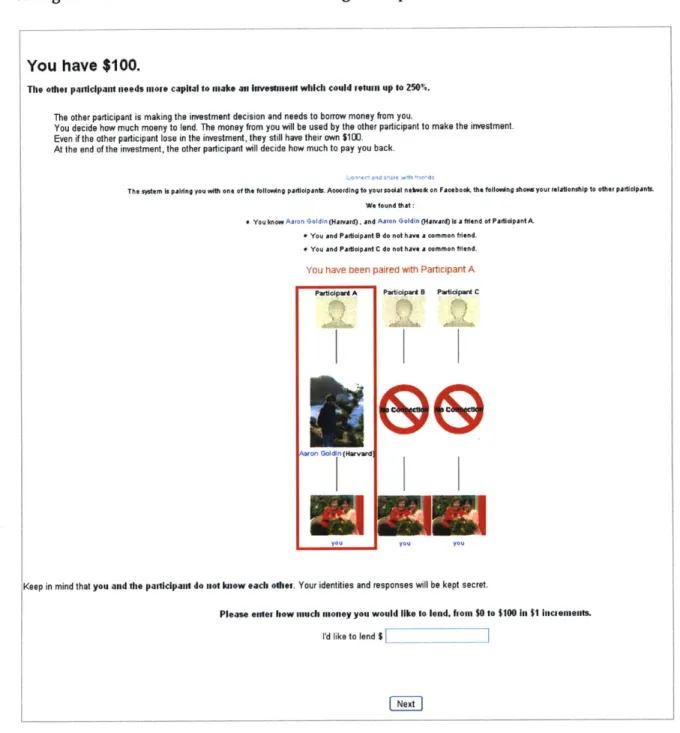
The lender decides whether they want to pass any of their endowment (MO) to the borrower. The lender's decision screen is shown in Figure 8, where a Social Connection Graph is displayed to show the social connection between the lender and the borrower. The content of the Social Connection Graph is based on the relationship mining results and experiment treatment. See Chapter 4 and section 6.3.3 for further descriptions. In this
example, the lender's friend Aaron knew the borrower. The borrower and the lender were strangers and were not allowed to meet during the experiment.
You have $100.
The othe participant nseeds more capital to make an Invesitment whIch could retum up to 250%.
The other participant is making the investment decision and needs to borrow money from you.
You decide how much moeny to lend. The money from you will be used by the other participant to make the investment. Even if the other participant lose in the investment, they still have their own $100.
At the end of the investment, the other participant will decide how much to pay you back.
The system is pairing you with one of the following participants. According to your social netmok on Faobook, the following shove your relationship to other partiolpants. We found that:
a You know Aaron Goldin(Harvard). and Aaron Goldin (Harvard) is a friend of Partiolpant A.
* You and Participant B do not have a common friend.
" You and Participant c do not have a common friend.
You have been paired with Participant A Parotipad A Participart B Participard c
Aaron Goldn (Harvard
you you you
Keep in mind that you and the paticipant do not know each other. Your identities and responses will be kept secret.
Please enter how much money you would like to lend, from $0 to $100 In $1 Inctements. Id like to lend $
Next
Figure 8. The decision screen for lending, to model influences of social perceptions on trust.
The decision screen shows the lender the following:
1. Through which friend the borrower can be linked to the lender.