HAL Id: cea-02341486
https://hal-cea.archives-ouvertes.fr/cea-02341486
Submitted on 31 Oct 2019
HAL is a multi-disciplinary open access
archive for the deposit and dissemination of
sci-entific research documents, whether they are
pub-lished or not. The documents may come from
teaching and research institutions in France or
abroad, or from public or private research centers.
L’archive ouverte pluridisciplinaire HAL, est
destinée au dépôt et à la diffusion de documents
scientifiques de niveau recherche, publiés ou non,
émanant des établissements d’enseignement et de
recherche français ou étrangers, des laboratoires
publics ou privés.
Hybrid integration of carbon nanotubes in silicon
photonic resonators
Elena Duran-Valdeiglesias, Weiwei Zhang, Carlos Alonso-Ramos, Xavier Le
Roux, Samuel Serna, Thi-Hong-Cam Hoang, Matteo Balestrieri, Delphine
Marris-Morini, Eric Cassan, Francesca Intonti, et al.
To cite this version:
Elena Duran-Valdeiglesias, Weiwei Zhang, Carlos Alonso-Ramos, Xavier Le Roux, Samuel Serna, et
al.. Hybrid integration of carbon nanotubes in silicon photonic resonators. 19th European Conference
on Integrated Optics, Apr 2017, Eindhoven, Netherlands. �cea-02341486�
1 9
t hE U R O P E A N C O N F E R E N C E O N I N T E G R A T E D O P T I C S
1
Hybrid integration of carbon nanotubes in silicon
photonic resonators
Elena DURAN-VALDEIGLESIAS1*, Weiwei ZHANG1, Carlos ALONSO-RAMOS1,
Xavier LE ROUX1, Samuel SERNA1, Thi-Hong-Cam HOANG1, Matteo BALESTRIERI2 ,
Delphine MARRIS-MORINI1, Eric CASSAN1, Francesca INTONTI2, Francesco SARTI2,
Niccolò CASELLI2, Federico LA CHINA2, Massimo GURIOLI2, Arianna FILORAMO3,
Laurent VIVIEN1
1Centre de Nanosciences et de Nanotechnologies, Univ. Paris Sud, CNRS, Université Paris
Saclay, 91405 Orsay, France
2Department of Physics, University of Florence European Laboratory for Non-linear
Spectroscopy, 50019 Sesto Fiorentino (FI), Italy
3 LICSEN, NIMBE, CEA, CNRS, Université Paris-Saclay, CEA Saclay 91191 Gif-sur-Yvette
Cedex, France
On-chip integration of all photonic components in the silicon platform is an important goal to accomplish high efficiency, low energy consumption, low cost and device miniaturization. However, silicon does not have efficient light emission or detection in the telecommunication wavelength range (close to 1.3µm and 1.55µm). Hence, hybrid integration of III-V materials or germanium is commonly adopted for the implementation of lasers and photodetectors. Nevertheless, these heterogeneous integration schemes compromise the low cost of using silicon [1].
Carbon nanotubes (CNTs) have recently been proposed as an attractive one-dimensional light emitting material [2]. Interestingly, semiconducting single wall carbon nanotubes (SWNTs) are a versatile material with room temperature light detection and emission in the near-infrared. SWNTs also exhibit intrinsic room temperature optical gain [3], which makes them a very interesting candidate for the realization of lasers in Si photonics. In addition, SWNTs have shown compatibility with Si CMOS process. Furthermore, recent advances in polymer-assisted selection of semiconducting SWNT and deposition techniques, poise this solution-processed approach to deliver a high quality material produced at large volumes and low cost. Here, we report on the development of a new integration scheme to couple the light emission from SWNTs into Si photonic resonators. In this scheme, Si structures are protected with an HSQ (Hydrogen Silses Quioxane) layer, defining specific interaction regions, and polymer-sorted SWNTs are drop casted on top. The SWNT photo-luminescence (PL) enhancement achievable in a micro-ring resonator is directly proportional to the overlap between the SWNTs layer and the evanescent field of the waveguide mode and inversely proportional to the propagation loss [4, 5]. By defining small interaction windows with the size of the illumination spot of our Ti:Sapphire pump, we ensure that all SWNTs in contact with the waveguide are excited. This way
1 9
t hE U R O P E A N C O N F E R E N C E O N I N T E G R A T E D O P T I C S
2
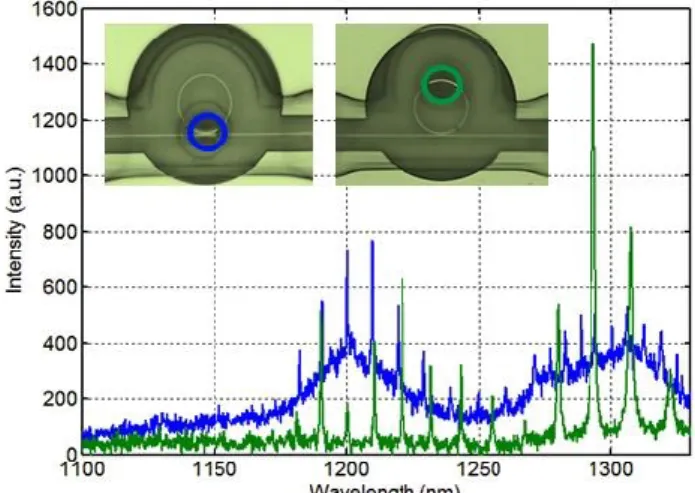
we obviate unwanted absorption arising from non-excited SWNTs, thereby improving the emission enhancement in our Si micro-ring resonators.As an illustrative example, Fig. 1 shows the collected PL spectrum for two Si micro-resonators, one with the interaction window in the ring-to-bus coupling region (blue line and SEM on the left), and another with the interaction region within the ring (green line and SEM on the right). The micro-ring with the interaction window in the ring-to-bus coupling region exhibits two wideband lobes, around 1.2µm and 1.3µm wavelength, that correspond with the emission of our polymer-sorted SWNTs solution [6]. On top of this emission, we observe a set of remarkably sharp resonance enhancement peaks produced in the Si micro-ring. Interestingly, when we place the interaction window within the ring is possible to remove the SWNT background emission, substantially improving the signal-to-noise ratio.
These results pave the way for the realization of integrated sources with high spectral purity operating within the O Datacom band, based on the combination of SWNTs and Si micro-resonators.
Fig. 1. PL intensity as a function of the wavelength for two different scenarios. In blue line when the interaction region is in the coupler between ring and bus waveguide. In green
line when the interaction area is placed within the ring.
This work has been supported by the European project FET CARTOON. References
[1] Vivien, L. and Pavesi, L., Handbook of silicon photonics, Taylor & Francis, 2013.
[2] Saito, R., Dresselhaus, G. and Dresselhaus, M. S., Physical Properties of Carbon Nanotubes, Imperial College Press, 1998.
[3] Gaufrès, E., Izard, N., Le Roux, X., Marris-Morini, D., Kazaoui, S., Cassan, E. and Vivien, L., Optical gain in carbon nanotubes, Appl. Phys. Lett. Vol. 96, no. 23, pp. 231105-231108, 2010. [4] Noury, A., Le Roux, X., Vivien, L., and Izard, N., Controlling carbon nanotube
photoluminescence using silicon microring resonators, Nanotechnology, Vol. 25, no. 21, pp. 215201, 2014.
[5] Noury, A., Le Roux, X., Vivien, L., and Izard, N., Enhanced light emission from carbon nanotubes integrated in silicon micro-resonator, Nanotechnology, Vol. 26, no. 34, p. 345201, 2015. [6] Izard, N., Kazaoui, S., Hata, K., Okazaki, T., Saito, T., Iijima, S., and Minami, N.,
Semiconductor-enriched single wall carbon nanotube networks applied to field effect transistors, Appl. Phys. Lett., Vol. 92, no. 24, p. 243112, 2008.