Publisher’s version / Version de l'éditeur:
Vous avez des questions? Nous pouvons vous aider. Pour communiquer directement avec un auteur, consultez la
première page de la revue dans laquelle son article a été publié afin de trouver ses coordonnées. Si vous n’arrivez pas à les repérer, communiquez avec nous à [email protected].
Questions? Contact the NRC Publications Archive team at
[email protected]. If you wish to email the authors directly, please see the first page of the publication for their contact information.
https://publications-cnrc.canada.ca/fra/droits
L’accès à ce site Web et l’utilisation de son contenu sont assujettis aux conditions présentées dans le site LISEZ CES CONDITIONS ATTENTIVEMENT AVANT D’UTILISER CE SITE WEB.
Technical Translation (National Research Council of Canada), 1960
READ THESE TERMS AND CONDITIONS CAREFULLY BEFORE USING THIS WEBSITE.
https://nrc-publications.canada.ca/eng/copyright
NRC Publications Archive Record / Notice des Archives des publications du CNRC :
https://nrc-publications.canada.ca/eng/view/object/?id=0e7332a2-0ace-4a39-8469-fb81428590ef https://publications-cnrc.canada.ca/fra/voir/objet/?id=0e7332a2-0ace-4a39-8469-fb81428590ef
NRC Publications Archive
Archives des publications du CNRC
For the publisher’s version, please access the DOI link below./ Pour consulter la version de l’éditeur, utilisez le lien DOI ci-dessous.
https://doi.org/10.4224/20359154
Access and use of this website and the material on it are subject to the Terms and Conditions set forth at
New theory to explain frost action
Keinonen, L.; National Research Council of Canada. Division of Building
Research
SQr
q.J../NJ.t'f
NRC TT·920
NATIONAL RESEARCH COUNCIL OF CANADA
TECHNICAL TRANSLATION 920
NEW THEORY TO EXPLAIN FROST ACTION
BY LEO KEINONEN FROM RAKENNUSINSINOORI, 13 (3); 48 - 49 1957 TRANSLATED BY
u.
V. HELAVATHIS IS THE SEVENTY· FIRST OF THE SERIES OF TRANSLATIONS PREPARED FOR THE DIVISION OF BUILDING RESEARCH
OTTAWA
1960
NRC TT·920
NATIONAL RESEARCH COUNCIL OF CANADA
Technical Translation 920
Title: New theory to explain frost action
(Uusi teoria routlmisilmion selvlttamlseksi)
Author: Leo Keinonen
Reference: Rakennusinsinoori, 13 (3): 48-19, 1957
Translator: U.V. Helava, Division of Applied ?hysics,
(
,
PREFACE
The Division of Building Research is currently engaged in studying frost action phenomena in soils particularly the process involved at the ice-water interface. It is hoped that the Division's studies will provide a sound basis for the development of methods for preventing destructive frost action that can be employed under field conditions.
At the present time, the mechanism of ice
lensing is not fully understood. This paper by Leo Keinonen i8 therefore of particular interest since
it presents yet a further quite logical possible explanation of the process.
The Division of Building Research makes avail-able English translations of studies in its own
field reported in other languages with the hope that they will be helpful in disseminating useful scienti-fic information. The
N.R.C.
Translations Section therefore provides a valuable service; the Division 1s indebted to Mr. U.V. Helava for this translation.Ottawa,
December 1960
R.F.
Legget, DirectorNE1>/ THEORY TO explャ|ャセヲrZIst ACTION
As is well known, soil freezes under certain circumstances in such a way that the amount of water in soil increases very
considerably due to the so-called frost phenomena. It is possible that ice layers several cm thick may develop during this process in the freezing soil. How this growth of ice layers happens and what is the reason for the accumulation of water in the freezing soil are questions in the field of frost studies that are still not explained as far as their basic character is concerned.
The renowned Swedish frost researcher, G. Beskow, has presented an assumption on the growth of ice crystals that will now be
explained bec£use the first part of my theory, which will be dis-cussed later, is based on entirely the same way of thinking.
Beskow started from the fact that the soil particles are
enveloped by water films in which the water pressure is considerably higher than the pressure of water, e.g. in the middle of pores in
the soil. Due to the high pressure, the freeZing point of the water in the water films is lONer than that of the IIfree waterll inside the
pores.
When the temperature of the soil goes down, the first ice
crystals are therefore formed in the pore centres. With decreasing temperature the molecules of the outer water films also start to join with the ice crystal. 3eskow mentions (reference I, pp. 42-43) that the absorption water films are elastic and tend to maintain a thickness which corresponds to the prevailing pressure. On the basis of this assumption he then explains the progress of the phenomenon as follows. Due to the property mentioned above, the water films have a tendency to return to their original thickness in places
where the ice crystal has penetrated the film and therefore the film pushes the ice crystal further away from the soil particles. With the ice crystal, however, some water molecules frozen to the crystal will also be pushed further, that is, the ice crystal will grow
•
•
-1-The water films in turn replace the lost water by taking water from the parts of the pores that are not yet frozen and, according to 3eskow, new water moves to the pores mainly because of the
capil-larity. With repetition of this cycle the ice crystal continues to
grow.
This explanation of Beskow on the growth of the lee crystal is also approved by the so-called cohesion power theory which,
however, maintains that the 」。ーゥャャセイゥエケ is not the main force for
absorption of water, but the movement of water into the centres of freezing is caused by the cohesion power of water.
Against the 」セーャャQ。イゥエケ theory of 3eskow one can present an
argument that the capillarity presupposes the formation of a
meniscus surface which cannot take place, for example, within soil
fully soaked by water. On the other hand, the cohesion theory cannot
explain, using the almost non-existent cohesion of water, the
generation of absorption forces which exceed 1 kp/cm2
. *
The third theory that explains the growth of the lee crystals is based on the unequality of surface tension forces between solI
and ice crystal, soil and water, and water and ice crystal. This
however does not take into account the highly exceptional circum-stances that prevail close to the surfaces of soil particles.
The Facts on Which エィセセキ Theory is Based
Water molecules in soil are highly dipolar. This means that
one can visualize water molecules as oblong Objects having at one end a positive H ion and at the other end a negative OH ion
(reference 2, pp. 88 and 298). The dipolpr molecules like this are
arranged according to the electrical forces.
In addition, it is a well-known fact that during the formation of a crystal the molecules tend to find such an arrangement and to combine in such a way the the highest possible balance of electrical forces is obtained on the outer surface of the crystal (reference 2,
p. 89). The molecular structure of water 1s simple and the outer
•
-5-surface of crystal is neutral. Instead, clay and other minerals that have a complicated molecular structure have, particularly at the outer surfaces, in the edges and in the corners, unsatisfied atoms. Therefore electrical charges occur on the outer surfaces of crystals of this kind. The outer surfaces of soil particles have generally negative electrical charges (reference 3, p. 23).
Theory on Growth of Ice Crystal
Figure la is a diagram based on the aforementioned facts, showing the situation where the ice crystal has penetrated to the water film, which is the phase on which I completely agree with the explanation of Beskow. Due to the electrical forces on the surface of soil particles and the dipolar character of the water molecules, the water molecules have taken an arrange:ncnt as shown in the
figure. Because of its electrical charge a soil particle attracts each water molecule With a force that becomes greater the closer the water molecule is to the soil particle. The water molecules may form chains whLch still increases the force of attraction. Instead, the ice crystal is only very セj・。ォャケ attracted towards the soil
particle because the water molecules in the ice crystal are no lonter electrically active towards their outer surface. Therefore the molecules of an ice crystal are in a way lighter than the
molecules of the water films when considering this matter from the point of view of the soil particle. By applying to this miniature universe the law of Archimedes we obtain the result that the ice crystal is pushed away from the water film by a force that is equal to the difference between the attraction forces affecting water and ice molecules. Due to these forces the ice crystal is pushed out from the water film.
Is it possible that the factors explained above could cause such great forces that we know the frost can have? The molecular forces in question are really enormous. Among others Zunker has presented calculations according to which the pressures in the
water films can exceed 40,000 kp/cm2 (reference 4, p. 128). If, in
,
0
-セ、、ゥエゥッョL we take into account that in the freezing soil tens of thousands of ice crystals may be growing side by side per each square em, we can see that even the very great force of frost can be explained to be caused by these molecular forces.
Theory on Creation of Suction Force
Above only the growth process of the ice crystal has been
studied. This growth, however, can take place only if a
sufficient amount of water is available. As was mentioned in the
beginning, attempts have been made to explain this phenomenon using
capillarity and cohesion force. However, when considering this
matter from the point of view of mechanics the thought comes to
mind that the movement of water is caused by "horror vacui" , that is, by air pressure that affects all the water in the soil.
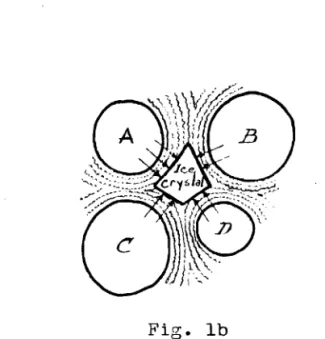
'when the ice crystal wi thin the soi L pore cont inues to grow,
it is probable that there are several places where the forces that push the ice crystal away from the soil particles are acting in such a way that the ice crystal cannot approach too close to the soil
particles in spite of its continual growth. For this reason the
entire pore expands - in a way explodes - on which occasion the
cracks that may extend outside the soil pore will be filled by water due to the air pressure, which perhaps is somewhat diminished by the
capillari ty force. This water is mostly" free water" and it freezes
in the normal way.
A second method of absorption that always takes place under the
conditions explained above is shown in Figure Ie. This movement
of water is caused by the following reason:
The fact that some molecules of the water film have been frozen into the ice crystal and then move away from the water film with the ice crystal means that there is a deficiency of molecules in the
water film. Since the surface of the water film is an equipotential
surface comparable to the surface of sea water, the process セエゥ」ィ
occurs in the water film is the same as that which takes place in the sea when, for example, we lift up an oar that has been in the
-7-wat er : the trJater surface returns to its previous height and the
IIdepression" left by the oar is filled due to a force that
corresponds to the depth at which the oar wa s , In the same way the
depression left on the water film by the ice crystal is filled and the deficiency of molecules is compensated using the facilities of all neighbouring water films if no excess water is available from outside these films.
This assumption explains the large measured values of absorp-tion forces that I menabsorp-tioned at the beginning of my paper and that
can be presented 3-8 an argument against cohesion and capillarity
theories.
セ is New in the EXRlalned Theory
So far when discussinz the growth of the ice crystal it has been found satisfactory to suggest, wi tbout explaining the matter
in detail, that the molecular forces on the surfaces of soil
particles have a certain influence in this phenomenon. Similarly,
weak assumptions on the influence of the capillary force or cohesion have been presented in connection trlith the origin of the suction
force.
The theory on the growth of the ice crystal as explained above gives satisfactory explanations to all the phenomena and factors
connected with this matter. Although all the facts on which the
theory is based have been known for a long time, no application to the explanation of frost phenomena has yet been made.
The intention has been to present the theory in a II popular"
form using the method of explanation based on electrical forces as
is common in soil physics. However, the theory is in fact based on
unsatisfied connections of molecules, exchange of ions and bridges of ions as far as the physical-chemical foundation of the theory is concerned, and using this basis it is perhaps possible to explain the phenomena in a more "correct" way.
,
Mセ
What is the Possible Importance of the New Theory
Particularly when starting from the foundation implied directly above, using the new theory it may be possible to explain the
exceptional phenomena in the behaviour of different types of soils
as far as frost action is concerned. Considering the means for
preventing frost, it is now possible to strive more purposefully
toward the required effect; for example, by using chemicals that
have certain kinds of properties as far as the exchange of ions is concerned to cause changes in the known factors in the soil that affect the progress of frost phenomena.
On the basis of the new theory one can assume that the frost
action in the soil can be changed using electrical fields. How
strong a field is reQuired for this purpose is not known but, for example, according to Swedish experiments on compressibility, it has
been found that an electrical current of 0.04 - 0.19 amperes has
caused considerable changes in the water films that envelope the
soil particles (reference 5, pp. 92-100). However, it may be too
ッセエゥュゥウエゥ」 to assume that the electrical potential difference that
exists between metal surfaces of different temperatures - one metal
plate in unfrozen soil, the other one in the frozen surface layer
-would be sufficient to prevent frost action. In this case the cold
Qセ alf could be used as a means to prevent the frost.
Closing Remark
Unfortunately, I must present my theory for certain reasons
without directly supporting experiments. However, since my theory
is based on known facts and since it is possible, using this theory,
to explain serveral phenomena not clearly explaineQ so far, I have
-9-References
1. Beskow, G. The formation of frost and frost heaving.
Statens Vaginstitut Meddelande 48. Stockholm, 1935.
2. Wooltorton, F.L.D. The Scientific Basis of Road Design.
London, 1954.
3. Baver, L.D. Soil Physics. New York, 1948.
4. Keso, L. Maavesista. Eripainos Maataloustieteellinen
Aikakauskirja Vuosikerta 13.
5. Silfverberg, L. A number of soil-physical problems.
Sartryck ur Statens Geotekniska Instituts Meddelande no.2. Stockholm, 1949.
Fig. la
An ice crystal has penetrated into the water envelopes surrounding
the solI particles. The water envelopes contain water molecules
in a special arrangement. The surface of the solI particle
J
-10-Fig. Ib
The forces created during the growth of the ice crystal tend to push the crystal farther from the soil particles.
Because of these forces the soil particles
A,
B,C
andD
move away from each otherFig. lc
An ice crystal has moved away from a soil particle leaving behind it a "depression". Even if there is air in the
pores, water will flow to the depression from outer water films