HAL Id: in2p3-00129137
http://hal.in2p3.fr/in2p3-00129137
Submitted on 6 Feb 2007HAL is a multi-disciplinary open access
archive for the deposit and dissemination of sci-entific research documents, whether they are pub-lished or not. The documents may come from teaching and research institutions in France or abroad, or from public or private research centers.
L’archive ouverte pluridisciplinaire HAL, est destinée au dépôt et à la diffusion de documents scientifiques de niveau recherche, publiés ou non, émanant des établissements d’enseignement et de recherche français ou étrangers, des laboratoires publics ou privés.
Nuclear activation techniques for analysis of laser
induced energetic protons
M. Tarisien, F. Gobet, F. Hannachi, M.M. Aléonard, G. Claverie, M.
Gerbaux, G. Malka, J.N. Scheurer, V. Méot, P. Morel, et al.
To cite this version:
M. Tarisien, F. Gobet, F. Hannachi, M.M. Aléonard, G. Claverie, et al.. Nuclear activation techniques for analysis of laser induced energetic protons. O.Cabellos, J.Sanz, G.Velarde, J.M.Perlado. 29th European Conference on Laser Interaction with Matter, Jun 2006, Madrid, Spain. pp.592-597, 2007. �in2p3-00129137�
Nuclear activation technique
for analysis of laser induced energetic protons
M.Tarisien1, F.Gobet1, F.Hannachi1, M.M.Aléonard1, G.Claverie1, M.Gerbaux1, G.Malka1, J.N.Scheurer1, V.Méot2, P.Morel2, P.Audebert3, E.Bambrink3, P.Nicolai4,
V.Tikhonchuk4, K.U.Amthor5
1
Centre d’Etudes Nucléaires de Bordeaux – Gradignan, France
2
CEA/DAM Ile de France, Bruyères-le châtel, France
3
Laboratoire pour l’Utilisation des Lasers Intenses, Palaiseau, France
4
CEntre Lasers Intenses et Applications, Talence, France
5
Institut für Optik und Quantenelektronik, Jena, Germany
ABSTRACT
With the very rapid development of high intensity lasers, very high protons fluxes (at least 1013 protons are expected in a few picoseconds bunch) will be available which cannot be characterized by usual detection techniques. For that purpose, we have developed a method in which the particles induce nuclear reactions in a stack of copper foils leading to β+ emitters of short periods which can be detected with a very good signal to noise ratio. The initial kinetic energy distribution of the incident particles is reconstructed from the number of reactions induced in each foil. This technique has been validated at the 12 MV Tandem of CEA/DAM Bruyères-le-Châtel and used at the 100TW laser of LULI to characterize laser-accelerated proton beams. In the latter case, comparison is made with the results obtained with radiochromic films.
1. Introduction
Considerable progress has recently been made in generating proton beams in the interaction of a high intensity (1019 W/cm2) femtosecond laser pulse with a solid target [1-4]. Typically, 1012 particles with an exponential like energy distribution are produced with a small emittance in one bunch of a few picoseconds. In a few years much higher protons fluxes will be available which can be used in different domains related to nuclear physics (intense pulsed source for large scale ion accelerators [5], production of radioisotopes for medical applications [6]). In addition, nuclear reaction yields and nuclear decay rates might be studied with such beams in extreme conditions, as for example in dense and hot plasma.
All these applications need characterization of the laser induced very high proton fluxes beam, at least as regards their energy distribution. Few methods of detection are currently available. Silicon detectors can only be used after dispersing the proton trajectories with a magnetic spectrometer. Track detectors as CR39 are an alternative, but after the exposure, the analysis requires not straightforward processing such as chemical etching under controlled conditions [7]. Furthermore an overlap of tracks can occur even at low proton flux (less than 1011 protons/cm2) which forbids any quantitative measurement. Another possibility is the use of RadioChromic Film (RCF) based on the relation between its optical density and the energy deposited by the incident ionizing particles [8]. However, these films do not discriminate between the different types of ionizing particles. Furthermore there optical
density saturates for a proton fluxes around 1012 particles/cm2, which could be a limitation in the future.
Another possibility is a proton detection based on nuclear reactions induced by the protons in a sample [9]. These reactions of well-known cross sections can produce radioactive nuclei. In a stack of samples, each foil acts as a low energy proton filter for the following ones and the energy distribution can be deduced from the number of reactions with the help of simulations. In this study we consider a stack of copper foils in which 63Cu(p,n)63Zn reactions are induced. The 63Zn nucleus is a β+ emitter which allows an accurate determination of the reaction yield. With such copper samples, the distribution of protons with energy higher than 4.1 MeV (reaction threshold) can be obtained. The unfolding of the measured data (i.e. the number of decays detected) needs a knowledge of both the response function of the stack and the β+-decay detection efficiency.
2. The detection setup and the Monte Carlo simulations
2.1 Determination of the response function of the copper stack
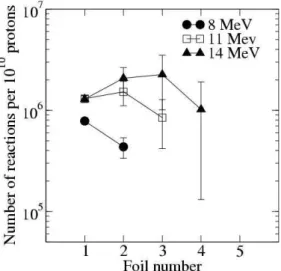
To characterize a proton beam with an energy lower than 20 MeV, we have chosen a stack made of five 3×3 cm2 copper foils of different thicknesses: 50, 75, 100, 100 and 100 µm from the front to the back. The response function of the stack is the probability that one proton of a given incident energy induces a reaction in one given foil. This response function has been calculated using the Monte Carlo code SRIM [10]. The calculation consists in the estimate of the mean proton energy distribution in each of 85 virtual foils, 5 µm thick each, making up the stack. A number of 105 monoenergetic protons has been sent onto the stack. This procedure has been repeated for proton energies from 4 to 20 MeV by 50 keV steps. Knowing the energy dependence of the 63Cu(p,n)63Zn cross-section [11], straightforward calculations give the reaction yield in each virtual foil and finally the response function of the whole stack for each incident energy. The calculated numbers of reactions in each foil for 1010 incident protons are shown on Fig.1 for three different proton energies. We can see that the higher the proton energy, the higher the number of activated foils.
Figure 1. Number of 63Cu (p,n)63Zn reactions calculated in each of the 5 copper foils making up the stack (n°1: 50 µm thick, n°2: 75 µm thick and n°3-4-5: 100 µm thick) for 1010 incident protons at 8, 11 and 14 MeV. Lines are drawn to guide the eye. The error bars are of statistical origin.
2.2 Detection of the ββββ+-decay and efficiency calculation
The number of (p,n) reactions in each foil is deduced from the measurement of the β+ activity. In the case of 63Zn (38.5 min half-life), 93% of the decays produce one positron which slows down in the surrounding matter, producing one e+-e- pair which annihilation gives two 511 keV γ-rays emitted back to back. These photons are measured in coincidence using two 2”×2” NaI(Tl) or two 2”×4” BaF2 detectors set face to face. The geometry of the
whole set-up has been optimized using the Monte Carlo code GEANT3 [12]. To allow a well-localized positron annihilation, each foil is sandwiched between copper sheets, 1 mm thick, and enclosed between both detectors. An acquisition system allows a detection in coincidence with a very good signal to noise ratio. Typically, we measured respectively a background of 0.4 ± 0.1 and 13 ± 2 annihilation events per minute with the NaI and BaF2 counting stations.
The main source of background comes from positrons produced after cosmic ray interactions with detectors. The dead time of the acquisition system is measured and taken into account to calculate the true counting rates.
To measure the efficiency of the counting system we would require the use of a calibrated widespread 63Zn source which does not exist at the standard. This efficiency is therefore calculated using the Monte Carlo code GEANT 3 [12]. A uniform population of 106 decaying 63Zn (taking into account both the β+ and γ emission [13]) in each stack foil is used in the simulation. The detection efficiency is defined by the ratio of the number of 511 keV photon pairs detected in coincidence in both detectors to the number of simulated decays. These efficiencies are 4.8 ± 0.1 and 12.2 ± 0.1 annihilation events detected per 100 63Zn decays respectively in NaI and BaF2 counting stations.
In order to test the validity of the method, such calculations have also been made with a calibrated β+ 22Na source allowing a quantitative comparison with experimental data. For the NaI counting station, the measured efficiency is 4.2 ± 0.1 % whereas the simulated efficiency is 4.6 ± 0.1 %. In the case of a BaF2 station the experimental efficiency is larger
(9.0 ± 0.2 %) whereas 9.7 ± 0.1 % is obtained in the simulation. The differences observed between the measured and the simulated efficiencies are of the order of 10%. This systematic difference is taken into account in the error bars for the calculation of the number of reactions. Nevertheless, these data exhibit good agreements and allow to rely on the simulated efficiency to calculate the 63Zn decays rate. Let us notice that the differences between 22Na and 63Zn efficiencies are of the order of 25% for the BaF2 counting stations and show the
necessity to take into account properly both the characteristics of the γ decay of the residual nuclei and the size of the source.
2.3 Determination of the energy distribution
A conventional unfolding method requires a number of parameters which must be at most the number of independent experimental data. As we will see in the following, at most four foils were active in the different measurements made with the Tandem accelerator or with the high intensity laser facility used. That means that no more than four points in the proton energy spectra could be obtained between 4 and 20 MeV. However it is still possible to control the validity of our experimental setup with both measurements. First, the Tandem accelerator proton beam is monoenergetic: only two independent parameters are involved (the proton energy and the number of incident particles). Second, the energy distribution of the laser induced proton beam is generally considered as an exponential one with a cut-off at high energy. Such a distribution is characterized by three independent parameters: the number of protons at a given energy, the “temperature” of the distribution and the high energy cut-off. As the number of independent parameters is lower than the number of foils used, a least
squares method can be developed in order to find the energy distribution which reproduces these experimental data at the best.
3. Calibration with a Tandem accelerator
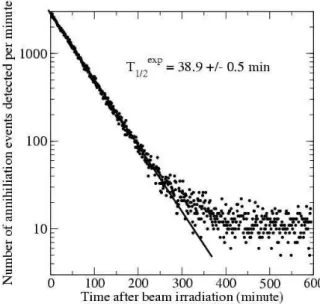
A calibration has been carried out with the CEA/DAM Bruyères-le-Châtel Tandem accelerator. Two monoenergetic protons beams of 8 and 10 MeV (± 100 keV) have been used. In each case, the number of incident protons has been measured with a Faraday cup. This allows a quantitative comparison between the beam energy distribution and the one deduced from the reaction rates in the stack. After irradiation, each of the five foils is set in a NaI or a BaF2 counting station. Fig. 2 shows the typical time dependence of the counting rate using a
BaF2 counting station. The number of annihilation events detected decreases exponentially
with a measured half-life of 38.9 min which is characteristic of 63Zn decay.
Figure 2. Typical radioactive decay of a stack foil exposed to a proton beam: the exponential signal has a measured half-life of 38.9 min according to the production of 63Zn nuclei by (p,n) reactions. The background of the BaF2 station is around 13 annihilation events per minute.
Respectively (3.8 ± 0.1) 1011 and (2.0 ± 0.2) 1011 protons of respectively 8 and 10 MeV have been sent on identical stacks. Table 1 gives the number of 63Cu(p,n)63Zn reactions measured in each foil in comparison with the number calculated using the known characteristics of the proton beam and the stack response function.
Table 1: Measured and simulated number of reactions in each foil of the copper stack using two monoenergetic protons beams produced with the 12 MV Tandem at CEA Bruyères-le-châtel.
8 MeV: Foil n°1 Foil n° 2 Foil n° 3 Foil n°
4
Experimental number of reactions (21.8 ± 2.6) 106 (16.5 ± 2.1) 106 0 0
Simulated number of reactions (30.2 ± 5.2) 106 (17.4 ± 5.5) 106 0 0
10 MeV
Experimental number of reactions (18.8 ± 2.8) 106 (22.5 ± 2.8) 106 (12.1 ± 1.7) 106 0
The Table 2 shows the results obtained from the least squares method. A good agreement is obtained for the two data points (10% differences at maximum) which confirms the reliability of the method.
Table 2: Parameters of the two protons beams used: comparison between the setting and the values deduced from the fit.
Energy of the proton beam Number of incident protons
Setting Fitting Direct measurement Fitting
8.0 ± 0.1 MeV 8.3 ± 0.4 MeV (3.8 ± 0.4) 1011 (3.3 ± 1.6) 1011
10.0 ± 0.1 MeV 11.1 ± 0.3 MeV (2.0 ± 0.2) 1011 (1.7 ± 0.4) 1011
4. Application on a high intensity laser facility
The 100 TW laser at Laboratoire pour l’Utilisation des Lasers Intenses (LULI), France, has been used for this measurement. Laser pulses with energy up to 20 J, 0.8 µm wavelength and 800 fs average duration have been focused onto an aluminium target 9 µm thick at normal incidence. The peak intensity is of the order of 2×10¹⁹ W/cm2. The multi-MeV proton beam produced has been diagnosed following two ways: RadioChromic Films (RCF) and nuclear reactions induced in the copper stack. The traditional RCF method [8] gives an energy distribution with an exponential shape characterized by a temperature T = 2.0 ± 0.5 MeV, an energy cut-off Ec = 12 ± 1 MeV and a number of incident protons, N = (4 ± 2) 1010
protons / MeV at 4 MeV.
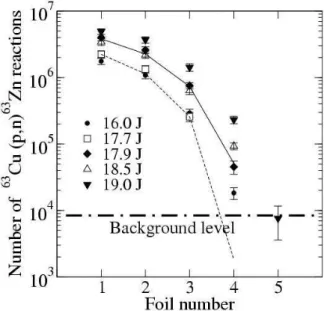
Five laser shots have been fired using the copper stack previously described. The number of reactions determined in each foil is reported on Fig.3.
Figure 3. Number of (p,n) reactions in each foil of the copper stack for different laser energies on the target (between 16 and 19 J). Due to the background level we cannot measure less than 8000 reactions. For explanation of the curves see the text.
The dashed line of Fig.3 connects the expected numbers of reactions obtained with the energy distribution parameters measured with the RCF techniques. The solid line of Fig.3 connects the expected numbers of reactions obtained with the average distribution parameters measured with the activation method and the least squares fitting (T = 2.2 ± 0.4 MeV, Ec = 13.5 ± 1.5
MeV, number of protons N = 5.4 ± 1.5 1010 protons / MeV at 4 MeV). A good agreement is achieved between the RCF and the activation method results.
5. Conclusion and perspectives
Proton beams generated by a Tandem accelerator and a high intensity laser pulse focused on an aluminium foil have been used to induce (p,n) nuclear reactions in copper samples. The measurement of the activity in the samples and an accurate calculation of the detection efficiency allow a determination of the reaction yield. Using these data and the response function of the stack, the proton energy distribution has been determined by a least squares fitting method and successfully compared with: 1) the characteristics of the monoenergetic beam produced with a Tandem accelerator; 2) the energy distribution measured with RCF in the case of laser induced proton beam. The differences observed are lower than 10% in each case and give a good confidence in the nuclear activation method. This might be a very promising way to determine the energy distributions of high proton fluxes delivered with the next generation of high intensity lasers.
Using only a few copper foils, the proton energy spectrum has been measured in the range 4 – 20 MeV. This range of energy can be easily extended using more foils or other materials. For instance, a few carbon foils could be used to induce other nuclear reactions such as 12C(p,γ)13N for which the energy threshold is much lower. Finally one should note that in this study we have validated the energy spectrum measurement using an “a priori” shape of the distribution. Obviously, the next step will be to determine this shape by conventional unfolding algorithms, using a higher number of stack foils.
6. References
[1] T.Tajima et al (2002), Phys. Rev. Spec. Top. Accel. Beams, 5, 031301 [2] I. Spencer et al (2003), Phys. Rev. E, 67, 046402
[3] E.L. Clark et al (2000), Phys. Rev. Lett., 85, 1654 [4] T.E. Cowan et al (2000), Phys. Rev. Lett., 84, 903 [5] S. Bulanov et al (2002), Plasma Phys. Rep., 28, 453 [6] K.W.D. Ledingham et al (2004), J. Phys. D, 37, 2341 [7] F.Seguin et al (2003), Rev. Sci. Instrum. 74, 975
[8] E. Breschi et al (2004), Nucl. Instr. and Meth. A 522, 190 [9] I. Spencer et al (2001), Nucl. Instr. and Meth. B 183, 449
[10] J.F Ziegler, J.P. Biersack, U. Littmark, (1985) The Stopping and Range of Ions in Solids, Pergamon Press, New York
[11] D.Rochman et al, Experimental Nuclear Reaction Data (EXFOR/CSISRS), http://www.nndc.bnl.gov/exfor3/exfor00.htm
[12] R.Brun, M.Hansroul and J.C.Lassalle (1982), GEANT Users’s Guide, CERN Report No.DD/EE/82