
HAL Id: cea-02476871
https://hal-cea.archives-ouvertes.fr/cea-02476871
Submitted on 13 Feb 2020HAL is a multi-disciplinary open access
archive for the deposit and dissemination of sci-entific research documents, whether they are pub-lished or not. The documents may come from teaching and research institutions in France or abroad, or from public or private research centers.
L’archive ouverte pluridisciplinaire HAL, est destinée au dépôt et à la diffusion de documents scientifiques de niveau recherche, publiés ou non, émanant des établissements d’enseignement et de recherche français ou étrangers, des laboratoires publics ou privés.
Marie-Martine Bé, Vanessa Chisté, Christophe Dulieu, Edgardo Browne,
Valery Chechev, Nikolay Kuzmenko, Filip Kondev, Aurelian Luca, Monica
Galan, Andrew C Pearce, et al.
To cite this version:
Marie-Martine Bé, Vanessa Chisté, Christophe Dulieu, Edgardo Browne, Valery Chechev, et al.. Table of radionuclides (Comments on evaluation). Bureau International des Poids et Mesures. Comments on evaluation, 2008, Table of radionuclides. �cea-02476871�
Table of Radionuclides
(Comments on evalution)
M.-M. B
É, V. C
HISTÉ, C. D
ULIEUE. B
ROWNE, C. B
AGLINV.P. C
HECHEV, A. E
GOROV, N.K. K
UZMENKO, V.O. S
ERGEEVF.G. K
ONDEVA. L
UCAM. G
ALÁNX. H
UANG, B. W
ANGR.G. H
ELMERE. S
CHÖNFELD, R. D
ERSCHV.R. V
ANIN, R.M. de C
ASTROA.L. N
ICHOLST.D. M
ACM
AHON, A. P
EARCEK.B. L
EES.C. W
UVolumes 1-4, 2008
BUREAU INTERNATIONAL DES POIDS ET MESURES
Pavillon de Breteuil, F-92310 SÈVRES
TABLE DE RADIONUCLÉIDES TABLE OF RADIONUCLIDES
COMMENTS ON EVALUATIONS
Marie-Martine BÉ, Vanessa CHISTÉ, Christophe DULIEU, Laboratoire National Henri Becquerel (LNHB), France ; Edgardo BROWNE, Lawrence Berkeley National Laboratory (LBNL), USA ;
Valery CHECHEV, Nikolay KUZMENKO, Khlopin Radium Institute (KRI), Russia ; Filip G. KONDEV, Argonne National Laboratory (ANL), USA ;
Aurelian LUCA, Horia Hulubei National Institute of Physics and Nuclear Engineering (IFIN-HH), Romania ; Mónica GALÁN, Laboratorio de Metrología de Radiaciones Ionizantes (CIEMAT), Spain ;
Andrew PEARCE, National Physical Laboratory (NPL), United Kingdom ; Xiaolong HUANG, China Institute of Atomic Energy (CIAE), China.
Monographie BIPM-5 - Table of Radionuclides, Comments on evaluations, Volume 4
Marie-Martine BÉ, Vanessa CHISTÉ, Christophe DULIEU, Laboratoire National Henri Becquerel (LNHB), France ; Edgardo BROWNE, Lawrence Berkeley National Laboratory (LBNL), USA ;
Valery CHECHEV, Nikolay KUZMENKO, Khlopin Radium Institute (KRI), Russia ; Filip G. KONDEV, Argonne National Laboratory (ANL), USA ;
Aurelian LUCA, Horia Hulubei National Institute of Physics and Nuclear Engineering (IFIN-HH), Romania ; Mónica GALÁN, Laboratorio de Metrología de Radiaciones Ionizantes (CIEMAT), Spain ;
Andrew PEARCE, National Physical Laboratory (NPL), United Kingdom ; Xiaolong HUANG, China Institute of Atomic Energy (CIAE), China.
Sommaire
Depuis quelques années, un groupe composé d’évaluateurs spécialistes des données de décroissance radioactive s’est formé, avec l’objectif de réaliser une évaluation soigneuse et documentée de ces données pour des radionucléides intervenant dans de nombreuses applications. Ces évaluateurs se sont mis d’accord sur une méthodologie commune. Ce rapport inclut les commentaires sur les évaluations des radionucléides figurant dans le rapport Monographie BIPM-5, volume 4 :
133I, 133Xe, 133Xem, 135Xem, 139Ce, 206Tl, 210Tl, 210Pb, 210Bi, 210Po, 213Po, 214Pb, 214Bi, 214Po, 217Rn, 218Po, 218At, 218Rn, 221Fr, 222Rn, 226Ra, 227Ac, 232U, 236U, 237Np, 238Np, 239U, 239Np, 239Pu, 241Pu, 246Cm, 252Cf.
Summary
Over the past years, an informal collaboration of decay-data evaluators has been assembled with the goal of creating high-quality, well-documented evaluations of the decay data for a selected set of radionuclides that are of interest in various applications. This report includes, for each radionuclide, the evaluator’s comments on how the evaluation was carried out for the radionuclides that are in the Monographie BIPM-5, volume 4:
133I, 133Xe, 133Xem, 135Xem, 139Ce, 206Tl, 210Tl, 210Pb, 210Bi, 210Po, 213Po, 214Pb, 214Bi, 214Po, 217Rn, 218Po, 218At, 218Rn, 221Fr, 222Rn, 226Ra, 227Ac, 232U, 236U, 237Np, 238Np, 239U, 239Np, 239Pu, 241Pu, 246Cm, 252Cf.
Monographie BIPM-5 - Table of Radionuclides, Comments on evaluations, volume 1 to 3
3H, 7Be, 11C, 13N, 15O, 18F, 24Na, 32P, 33P, 44Sc, 44Ti, 46Sc, 51Cr, 54Mn, 55Fe, 56Mn, 56Co, 57Co, 57Ni, 59Fe, 60Co, 63Ni, 64Cu, 65Zn, 66Ga, 67Ga, 79Se, 85Kr, 85Sr, 88Y, 89Sr, 90Sr, 90Y, 90Ym, 93Nbm, 99Mo, 99Tcm, 108Ag, 108Agm, 109Cd, 110Ag, 110Agm, 111In, 123Tem, 123I, 125Sb, 129I, 131I, 131Xem, 133Ba, 137Cs, 140Ba, 140La, 152Eu, 153Sm, 153Gd, 154Eu, 155Eu, 159Gd, 166Ho, 166Hom, 169Yb, 170Tm, 177Lu, 186Re, 198Au, 201Tl, 203Hg, 203Pb, 204Tl, 208Tl, 212Pb, 212Bi, 212Po, 216Po, 220Rn, 224Ra, 227Th, 228Th, 233Th, 233Pa, 234U, 236Np, 236Npm, 237U, 238U, 238Pu, 240Pu, 241Am, 242Pu, 242Cm, 243Am, 244Cm.
TABLE DE RADIONUCLÉIDES – COMMENTAIRES SUR LES ÉVALUATIONS
De nombreuses applications nécessitent la connaissance des données liées à la désintégration des radioéléments, telles que la période radioactive, les énergies et les intensités des divers rayonnements. Pour répondre aux demandes des utilisateurs, le Laboratoire National Henri Becquerel (LNE - LNHB, France) a, de 1982 à 1987, publié une table en quatre volumes [87Ta, 99Be]. Puis, en 1993 une coopération a été établie avec le Physikalisch-Technische Bundesanstalt (PTB, Allemagne) afin de reprendre cette étude et de la développer. En 1995, un nouveau groupe de travail international nommé Decay Data Evaluation Project (DDEP) s’est formé qui, en plus des deux laboratoires nationaux précédents, inclut : Idaho National Engineering and Environmental Laboratory (INEEL, USA), Lawrence Berkeley National Laboratory (LBNL, USA), Brookhaven National Laboratory (BNL, USA) et Khlopin Radium Institute (KRI, Russie).
Le propos de ce groupe est de fournir aux utilisateurs des données soigneusement évaluées qui puissent servir de référence. A cette fin, tous les membres du groupe suivent une méthodologie commune qui comprend :
• la lecture attentive de toutes les publications relatives à une grandeur ;
• une analyse statistique des données retenues ;
• le choix et l’utilisation des mêmes jeux de données, pour celles ayant fait l’objet d’études spécifiques par des spécialistes, tels les coefficients de conversion interne.
Tous ces points sont développés en détail dans le chapitre « Rules for evaluation and compilations ».
Par ailleurs, toutes les évaluations sont documentées et l’établissement des valeurs retenues explicité. Ce document est ensuite relu par deux membres du groupe.
Ce 4ème volume regroupe les commentaires liés à l’évaluation des radionucléides suivants : 133I, 133Xe, 133Xem, 135Xem, 139Ce, 206Tl, 210Tl, 210Pb, 210Bi, 210Po, 213Po, 214Pb, 214Bi, 214Po, 217Rn, 218Po, 218At, 218Rn, 221Fr, 222Rn, 226Ra, 227Ac, 232U, 236U, 237Np, 238Np, 239U, 239Np, 239Pu, 241Pu, 246Cm, 252Cf,
ainsi que ceux précédemment publiés dans les volumes 1 à 3 :
3H, 7Be, 11C, 13N, 15O, 18F, 24Na, 32P, 33P, 44Sc, 44Ti, 46Sc, 51Cr, 54Mn, 55Fe, 56Mn, 56Co, 57Co, 57Ni, 59Fe, 60Co, 63Ni, 64Cu, 65Zn, 66Ga, 67Ga, 79Se, 85Kr, 85Sr, 88Y, 89Sr, 90Sr, 90Y, 90Ym, 93Nbm, 99Mo, 99Tcm, 108Ag, 108Agm, 109Cd, 110Ag, 110Agm, 111In, 123Tem, 123I, 125Sb, 129I, 131I, 131Xem, 133Ba, 137Cs, 140Ba, 140La, 152Eu, 153Sm, 153Gd, 154Eu, 155Eu, 159Gd, 166Ho, 166Hom, 169Yb, 170Tm, 177Lu, 186Re, 198Au, 201Tl, 203Hg, 203Pb, 204Tl, 208Tl, 212Pb, 212Bi, 212Po, 216Po, 220Rn, 224Ra, 227Th, 228Th, 233Th, 233Pa, 234U, 236Np, 236Npm, 237U, 238U, 238Pu, 240Pu, 241Am, 242Pu, 242Cm, 243Am, 244Cm.
Les données de décroissance radioactive de ces radionucléides peuvent être trouvées dans la Monographie BIPM-5 de la « Table de radionucléides », dans le CD-Rom NUCLÉIDE édité par le LNHB ou sur les pages web : http://www.nucleide.org/NucData.htm
TABLE OF RADIONUCLIDES – COMMENTS ON EVALUATIONS
Basic properties of radionuclides, such as half-life, decay mode and branchings, radiation energies and emission probabilities are commonly used in various research fields. To meet the demand for these data the LNHB produced a table that was published in four volumes [87Ta, 99Be] from 1982 to 1987. In 1993, a cooperative agreement was established between the Laboratoire National Henri Becquerel (LNE - LNHB, France) and the Physikalisch-Technische Bundesanstalt (PTB, Germany) to continue and expand this work. In 1995, a new international collaboration was formed, the Decay Data Evaluation Project (DDEP), which has the same objectives. Along with the evaluators from LNHB and PTB, this collaboration includes others from the Idaho National Engineering and Environmental Laboratory (INEEL, USA), the Lawrence Berkeley National Laboratory (LBNL, USA), the Brookhaven National Laboratory (BNL, USA) and the Khlopin Radium Institute (KRI, Russia). Its objective has been to provide carefully produced recommended values, which may eventually become standard data. With this goal in mind, the collaboration has adopted a uniform evaluation methodology that contains the following :
• a critical review of relevant publications;
• an accounting of all measured data;
• a uniform statistical analysis of the data;
• a presentation of values for quantities such as internal conversion coefficients, etc.
• a review of evaluation by two other members of the collaboration.
These topics are described in detail in the chapter “Rules for evaluation and compilations”. The evaluation of each individual radionuclide has a section (presented here) that describes the procedures used for deducing the recommended values. This documentation is included in order to establish the quality and completeness of each evaluation. It can also provide the basis for any future reevaluation by the DDEP or other groups.
This fourth volume contains the procedures and comments relevant to the evaluation for the following radionuclides :
133I, 133Xe, 133Xem, 135Xem, 139Ce, 206Tl, 210Tl, 210Pb, 210Bi, 210Po, 213Po, 214Pb, 214Bi, 214Po, 217Rn, 218Po, 218At, 218Rn, 221Fr, 222Rn, 226Ra, 227Ac, 232U, 236U, 237Np, 238Np, 239U, 239Np, 239Pu, 241Pu, 246Cm, 252Cf,
as well as those previously published in volumes 1 to 3:
3H, 7Be, 11C, 13N, 15O, 18F, 24Na, 32P, 33P, 44Sc, 44Ti, 46Sc, 51Cr, 54Mn, 55Fe, 56Mn, 56Co, 57Co, 57Ni, 59Fe, 60Co, 63Ni, 64Cu, 65Zn, 66Ga, 67Ga, 79Se, 85Kr, 85Sr, 88Y, 89Sr, 90Sr, 90Y, 90Ym, 93Nbm, 99Mo, 99Tcm, 108Ag, 108Agm, 109Cd, 110Ag, 110Agm, 111In, 123Tem, 123I, 125Sb, 129I, 131I, 131Xem, 133Ba, 137Cs, 140Ba, 140La, 152Eu, 153Sm, 153Gd, 154Eu, 155Eu, 159Gd, 166Ho, 166Hom, 169Yb, 170Tm, 177Lu, 186Re, 198Au, 201Tl, 203Hg, 203Pb, 204Tl, 208Tl, 212Pb, 212Bi, 212Po, 216Po, 220Rn, 224Ra, 227Th, 228Th, 233Th, 233Pa, 234U, 236Np, 236Npm, 237U, 238U, 238Pu, 240Pu, 241Am, 242Pu, 242Cm, 243Am, 244Cm.
These evaluations may be found in the BIPM-5 Monographie, on the CD-Rom NUCLÉIDE published by the LNHB or in the web pages : http://www.nucleide.org/NucData.htm
A goal of the DDEP is to avoid future duplication of effort by disseminating these critically evaluated data with the hope that they will be included in many other collections of decay data.
REFERENCES
[87Ta] Table de Radionucléides, F. Lagoutine, N. Coursol, J. Legrand. ISBN 2-7272-0078-1 (LMRI, 1982-1987).
[85Zi] W.L. Zijp, Netherland Energy Research Foundation, ECN, Petten, The Netherlands, Rep. ECN-179.
[96He] R.G. Helmer, Proceedings of the Int. Symp. "Advances in alpha-, beta- and gamma-ray Spectrometry", St. Petersburg, September 1996, p. 71.
[96Be] M.-M. Bé, B. Duchemin and J. Lamé. Nucl. Instrum. Methods A369 (1996) 523 and Bulletin du Bureau National de Métrologie 110 (1998).
[99In] Table de Radionucléides. Introduction, nouvelle version. Introduction, revised version.
Einleitung, überarbeitete Fassung. ISBN 2-7272-0201-6, BNM-CEA/LNHB BP 52, 91191 Gif-sur-Yvette Cedex, France.
[99Be] M.-M. Bé, E. Browne, V. Chechev, R.G. Helmer, E. Schönfeld. Table de Radionucléides, ISBN 2-7272-0200-8 and ISBN 2-7272-0211-3 (LNHB, 1988-1999).
[04Be] M.-M. Bé, E. Browne, V. Chechev, V. Chisté, R. Dersch, C. Dulieu, R.G. Helmer, T.D.
MacMahon, A.L. Nichols, E. Schönfeld. Table of Radionuclides, Monographie BIPM-5, ISBN
92-822-2207-7 (set) and ISBN 92-822-2205-5 (CD), CEA/BNM-LNHB, 91191 Gif-sur-Yvette, France and BIPM, Pavillon de Breteuil, 92312 Sèvres, France.
and
M.-M. Bé, E. Browne, V. Chechev, V. Chisté, R. Dersch, C. Dulieu, R.G. Helmer, N. Kuzmenco, A.L. Nichols, E. Schönfeld. NUCLÉIDE, Table de Radionucléides sur CD-Rom, Version 2-2004, CEA/BNM-LNHB, 91191 Gif-sur-Yvette, France.
[06Be] Monographie BIPM-5 – Table of Radionuclides, Volume 3
Marie-Martine BÉ, Vanessa CHISTÉ, Christophe DULIEU, (LNHB), France ; Edgardo BROWNE, Coral BAGLIN, (LBNL), USA ; Valery CHECHEV, Nikolay KUZMENKO, (KRI), Russia ; Richard HELMER, (INEEL), USA ; Filip KONDEV, (ANL), USA ; T. Desmond MACMAHON, (NPL), U.K. ; Kyung Beom LEE, (KRISS), South Korea.
Table of Radionuclides, Monographie BIPM-5, ISSN 92-822-2204-7 (set), ISBN 92-822-2218-7
(Vol. 3) and ISBN 92-822-2219-5 (CD), CEA/LNE-LNHB, 91191 Gif-sur-Yvette, France and BIPM, Pavillon de Breteuil, 92312 Sèvres, France.
AUTEURS POUR CORRESPONDANCE AUTHOR’S MAIL ADDRESSES
ADRESSEN DER AUTOREN AUTORES PARA CORRESPONDENCIA
Toutes demandes de renseignements concernant les données recommandées et la façon dont elles ont été établies doivent être adressées directement aux auteurs des évaluations.
Information on the data and the evaluation procedures is available from the authors listed below.
Informationen über die Daten und Evaluationsprozeduren können bei den im folgenden zusammengestellten Autoren angefordert werden.
Todos los pedidos de información sobre datos recomendados y los métodos de evaluacion utilizados, deben dirigirse directamente a los autores de las evaluaciones.
Dr. Marie-Martine Bé
CEA/LNHB
91191 Gif-sur-Yvette, CEDEX, France Tel: 33-1-69-08-46-41
Fax: 33-1-69-08-26-19 E-mail: [email protected]
Dr. Edgardo Browne
Lawrence Berkeley National Laboratory
MS 88RO192, Berkeley, California 94720, USA Tel: (510) 486-7647
Fax: (510) 486-5757 E-mail: [email protected]
Dr. Valery P. Chechev
V.G. Khlopin Radium Institute
28, 2nd Murinsky Ave., 194021 St. Petersburg, Russia Tel: 007 (812) 2473706
Fax: 007 (812) 2478095 E-mail: [email protected]
Dr. Vanessa Chisté
CEA/LNHB
91191 Gif-sur-Yvette, CEDEX, France Tel: 33-1-69-08-63-07
Fax: 33-1-69-08-26-19 E-mail: [email protected]
Dr. Filip G. Kondev
Applied Physics and Nuclear Data, Nuclear Engineering Division Argonne National Laboratory
9700 South Cass Ave. Argonne, IL 60439, USA Tel: 1-(630) 252-4484
Fax: 1-(630) 252-5287 E-mail: [email protected]
Dr. Mónica Galán
CIEMAT, Laboratorio de Metrologia de Radiaciones Ionizantes Avenida de la Complutense, 22
28040 Madrid, Spain
E-mail: [email protected]
Dr. Andrew Pearce
National Physical Laboratory Teddington,
Middlesex, TW11 OLM, United Kingdom E-mail: [email protected]
Dr. Aurelian Luca
IFIN-HH/Radionuclide Metrology Laboratory 407 Atomistilor street
PO Box MG-6
077125 Mahurele, Ilfov County, Romania E-mail : [email protected]
Dr. Xialong Huang
China Nuclear Data center PO Box 275 (41)
Beijing, China
RULES FOR EVALUATION AND COMPILATIONS
1. DATA SOURCES
Two main sources of data are used to obtain the recommended values:
- specific data evaluated from all available original publications (e.g., half-life),
- data already evaluated and compiled by specialists (e.g., Q-values); if a subsequent experimental study exists, the resulting measured value may be used, and its reference be included in a list of references for such a radionuclide.
2. EVALUATION RULES
All intermediate stages in the compilation and evaluation of a decay parameter are not presented in detail in order to avoid unnecessary complexity. The main stages comprise the following:
- critical analysis of published results and, if necessary, correction of these results to account for more recent values hitherto unavailable to the original experimentalists; as a rule, results without associated uncertainties are discarded, and the rejection of values is documented;
- data obtained through private communications are used only when all of the necessary information has been provided directly by the scientist who performed the measurements;
- adjustments may be made to the reported uncertainties;
- recommended values are deduced from an analysis of all measurements (or theoretical considerations), along with their standard deviations with a 1s confidence level.
2.1. Evaluation of uncertainties
Definitions from “Guide to the expression of uncertainty in measurement” [1]:
Uncertainty (of measurement): parameter associated with the result of a measurement that characterizes
the dispersion of the values that could reasonably be attributed to the measurand.
Standard uncertainty: uncertainty of the result of a measurement expressed as a standard deviation. Type A evaluation (of uncertainty): method of evaluation of uncertainty by the statistical analysis of a
series of observations.
Type B evaluation (of uncertainty): method of evaluation of uncertainty by means other than the
The uncertainties given by authors are re-evaluated by combining the standard uncertainties σA and σB through the general law of variance propagation:
2 2 B A c u = σ +σ (1)
where uc is the combined standard uncertainty,
σA is the type A standard deviation, and
σB is the type B standard uncertainty.
When the authors give insufficient information concerning their uncertainty calculations, the combined uncertainty uc may be estimated by the evaluator, based on a knowledge of the measurement method(s).
2.2. Determination of the best value and associated uncertainty (a) Results obtained by one author using one method
Sometimes only the final mean value and the combined standard uncertainty are given in the original publication. The following procedure is adopted if sufficient details are known.
For n individual values ai (i = 1…n), the best value is the arithmetical mean:
∑
= = n i i n a a 1 (2)with type A standard deviation:
2 1 2 ) 1 ( ) ( ) ( − − =
∑
n n a a a i i A σ (3)If there are m contributions σBj (j = 1…m) to the type B standard uncertainty that are independent of each other:
( )
2 1 1 2 =∑
= m j Bj B a σ σ (4)Combined standard uncertainty:
( )
a( )
a( )
a uc = σA2 +σB2 (5) Recommended value:( )
a
u
a
a
=
±
c (6)(b) Results obtained by several authors employing the same method
For n individual values
a
i(
i
=
1
...
n
)
having a standard deviation σAi and a type B uncertainty σBi, the best value is obtained by taking the mean weighted by the inverse of the variances.(
)
(
)
∑
∑
=
22/
1
/
Ai i Ai i ia
a
σ
σ
(7)The associated values σA, σB are:
( )
(
)
12 2 / 1 − =∑
i Ai A a σ σ (8)( )
i( )
Bi min Ba
=
∑
σ
σ
orσ
B( )
a
=
∑
i( )
σ
Bi min2 orσ
B( )
a
=
( )
σ
B min depending on the individual case, althoughσ
B( )
a
cannot be less than the smallest σBi.σA and σB are combined quadratically to determine uc:
( )
a( )
a( )
auc = σA2 +σB2 (9)
and the recommended value is given by the expression:
( )
a
u
a
a
=
±
c (10)(c) Results obtained by different methods
When different measurement techniques have been applied, a weighted average is calculated using the combined uncertainties of the individual values as weights.
For n independent values ai, each with a combined standard uncertainty uci, a weight pi proportional to the inverse of the square of the individual uci can be assigned to each value.
∑
∑
= ==
n i i n i i i wp
a
p
a
1 1 (11)where the weights are
1
/
2.
i
c i
u
p
=
An internal and an external uncertainty can be assigned to the mean value [2, 3]:
( )
( )
1/ 2 12 − =∑
i c w int a ui σ (12)The internal variance int
( )
aw2
σ is the expected uncertainty of the mean, based on the individual a priori variances 2
i
c
u
(by uncertainty propagation).The external uncertainty is given by the equation:
( )
(
(
)
)
2 1 2 2 2/
1
1
/
−
−
=
∑
∑
i i c c w i i w extu
n
u
a
a
a
σ
(13)The external variance ext
( )
aw2
σ includes the scatter of the data, and is based on the amount by which each ai deviates from the mean when measured as a fraction of each given uncertainty uci.
A measure of the consistency of the data is given by the ratio [2, 3]:
(
1)
/ / = 2 − n int ext σ χ σ (14)If this ratio is significantly greater than unity, at least one of the input data most probably has an underestimated uciwhich should be increased.
A critical value of
χ
2/
(
n
−
1
)
at 1 % confidence level is used as a practical test for discrepant data. Thefollowing table lists critical values of
χ
2/
(
n
−
1
)
for an increasing degree of freedom ν =n−1 [4].ν critical χ2 /(n – 1) ν critical χ2 /(n – 1) 1 6.6 12 2.2 2 4.6 13 2.1 3 3.8 14 2.1 4 3.3 15 2.0 5 3.0 16 2.0 6 2.8 17 2.0 7 2.6 18-21 1.9 8 2.5 22-26 1.8 9 2.4 27-30 1.7 10 2.3 11 2.2 >30 1 + 2.33
2
/
ν
Ifχ
2/(
n
−
1
)
≤
critical
χ
2/(
n
−
1
)
, the recommended value is given by:( )
w intw
a
a
a
=
±
σ
(15)If
χ
2/(
n
−
1
)
>
critical
χ
2/(
n
−
1
)
, the method of limitation of the relative statistical weight [3, 5] isrecommended when there are three or more values; uncertainty of a value contributing more than 50 % to the total weight is increased to reduce its contribution to 50 % . The weighted and unweighted average and critical
χ
2/
(
n
−
1
)
are then recalculated:if
χ
2/
(
n
−
1
)
≤
critical
χ
2/
(
n
−
1
)
, the recommended value is given by:( )
( )
(
int w ext w)
w
a
a
a
a
=
±
the
larger
of
σ
and
σ
(16)if
χ
2/
(
n
−
1
)
>
critical
χ
2/
( )
n
−
1
, the weighted or unweighted mean is chosen, depending onwhether or not the uncertainties of the average values make them overlap with each other. If overlap occurs, the weighted average is recommended; otherwise the unweighted average is chosen. In either case, the uncertainty can be increased to cover the most accurate value.
Parameters evaluated according to these procedures and rules include half-lives, number of emitted particles, and some internal-conversion coefficients. All remaining data given in the tables of recommended data are generally taken from compilations.
2.3. Balanced decay schemes
All the probabilities for transitions and emitted radiations correspond to balanced decay schemes and permit the formulation of a fully consistent set of values. This balance implies the fulfillment of physical conservation principles as follows:
− The sum of the transition probabilities for all the transitions (α, β, ε) is equal to 1 (or 100 %); consequently, the sum of all the γ-ray transition probabilities (photons + internal conversion electrons) and all the (α, β, or ε) transitions feeding directly to the ground state is equal to 1 (or 100 %).
− For an excited nuclear level, the sum of the transition probabilities (α, β, γ, ε) feeding the level is equal to the sum of the transition probabilities depopulating this level;
− If the relative γ-ray emission probabilities P
( )
rel γi are known, the absolute emission probability P(abs)γi can be obtained from the equation:( )
abs P( )
rel NP γi = γi× (17)
where N is the normalization factor, which may be determined from the equation:
( )
rel
(
1
)
1
B
,
P
N
i t i+
i=
−
∑
γα
(18)where αti is the total conversion coefficient, and B, the (α, β, or ε) absolute branching to the ground state. The sum in equation (18) includes all the γ-ray transitions feeding the ground state.
3. COMPILATIONS
3.1. β and electron capture transitions
Depending on the individual radionuclide, the β-particle transition energies are either evaluated from experimental data (maximum β energies), or deduced from the atomic mass differences obtained from the tabulations of Audi and Wapstra [6] and the γ transition energies. The average β-particle energies are generally computed [7], and their log ft values as well as their ε/β+ ratios are calculated using the tables of Gove and Martin [8].
Electron-capture transition energies are deduced from atomic mass differences and γ-ray transition energies. Capture probabilities PK, PL … for allowed and non-unique first forbidden transitions can be calculated from equations where the ratios of the radial wave function components of the electron [9-11] and the corrective terms for exchange XL/K [12-16] are evaluated from tables.
3.2. γ-ray transitions
Internal conversion coefficients of pure multipolarity transitions are evaluated and compared with theoretical values that are interpolated from the tables of either Rösel et al. using a cubic spline method for 30 < Z < 104 [17], or Band et al. [18]. The agreement of these theoretical values with experimental results is about 3 %.
Internal-conversion coefficients are calculated as described in Ref. [19] in order to include the effects of nuclear penetration in some M1 and E2 transitions.
Internal conversion coefficients for transitions with mixed multipolarities (e.g., M1 + E2) are calculated using tables of theoretical values using mixing ratios as shown below :
αi(M1+E2) = αi(M1) 1/1+δ2 + αi(E2) δ2/1+δ2 (19) where i = K, L1, L2, … T, refers to the individual atomic shell.
ap coefficients for pair production are interpolated from theoretical values [20], with a precision between 5 % and 10 %.
3.3. Level spins and parities
Level spins and parities are usually from Nuclear Data Sheets [21].
3.4. Atomic shell constants
K-shell fluorescence yields
ω
K and their uncertainties are taken from the evaluation of Bambynek et al. [22-24] with uncertainties ranging from 1 % (Z > 35) to 10 % (Z = 5), and from subsequent experimental results.Mean L-shell fluorescence yields
ω
L are taken from the evaluation of Schönfeld and Janßen [25]. This evaluation includes both experimental [26-28] and theoretical values [29], and their uncertainties are equal to 4 % (for Z > 29).Mean M-shell fluorescence yields
ω
M are obtained from the fitting of experimental data by Hubbell [28, 30].Relative X-ray emission rates (Kß/Ka) are taken from Schönfeld and Janßen [25], and Ka1/Ka2 from the theoretical values of Scofield [31]; uncertainties are assumed to be of the order of 1 %.
X-ray radiation energies are taken from the tables of Bearden [32].
Relative emission probabilities of K-Auger electron groups are deduced from the X-ray ratio, with uncertainties of the order of 3 % [25].
Energies of the K and L-Auger electrons are taken from Larkins [33].
The mean number of vacancies created in the L shell (from one K hole)
n
KLand in the M shell (from one L hole)n
LM are estimated from the preceding values.3.5. m0c2energy 2
0c
REFERENCES
[1] Guide to the expression of uncertainty in measurement, ISBN 92-67-20185-X ISO, Geneva, 1993. [2] WINKLER, G., “Data fitting and evaluation techniques for radioactive decay data”, Proc. Symp. on
Nuclear Data Evaluation Methodology, Brookhaven National Laboratory, USA, October 1992, World Scientific, Singapore (1993).
[3] ZIJP, W.L., On the statistical evaluation of inconsistent measurement results illustrated on the example of the 90Sr half-life, ECN Petten, Report ECN-179 (1985).
[4] BEVINGTON, P.R., Data Reduction and Error Analysis for the Physical Sciences, Appendix C-4, McGraw-Hill (1969).
[5] X-ray and gamma-ray standards for detector calibration, IAEA-TECDOC-619, Vienna (1991). [6] AUDI, G., WAPSTRA, A.H., The 1995 Atomic Mass Evaluation, Nucl. Phys. A595 (1995) 4. [7] ENSDF – Logft program, ENSDF analysis and checking codes, Brookhaven National Laboratory,
USA.
[8] GOVE, N.B., MARTIN, M.J., Nucl. Data Tables A10 (1971) 205. [9] SUSLOV, Y.P., Bull. Acad. Sci. USSR Phys. Ser. 33 (1969) 74.
[10] BEHRENS, H., JANECKE, J., in Landolt-Bornstein: Numerical Data and Functional Relationships in Science and Technology, New Series Group 1, Vol. 4: Numerical Tables for Beta Decay and Electron Capture, Springer-Verlag, Berlin (1969).
[11] MARTIN, M.J., BLICHERT-TOFT, P.H., Nucl. Data Tables A8 (1970) 1.
[12] BAHCALL, J.N., Phys. Rev. 129 (1963) 2683; ibid., Phys. Rev. 132 (1963) 362; ibid., Nucl. Phys.
71 (1965) 267.
[13] FAESSLER, J.A., HUSTER, E., KRAFFT, O., KRAHN, F., Z. Phys. 238 (1970) 352. [14] SUSLOV, Y.P., Bull. Acad. Sci. USSR Phys. Ser. 34 (1970) 91.
[15] VATAI, E., Nucl. Phys. A156 (1970) 541.
[16] SCHÖNFELD, E., Appl. Radiat. Isot. 49 (1998) 1353.
[17] RÖSEL, F., FRIES, H.M., ALDER, K., PAULI, H.C., At. Data Nucl. Data Tables 21 (1978) 91. [18] BAND, I.M., TRZHASKOVSKAYA, M.B., NESTOR Jr., C.W., TIKKANEN, P.O., RAMAN, S.,
At. Data Nucl. Data Tables 81 (2002) 1.
[19] PAULI, H.C., RAFF, U., A computer program for international conversion coefficients and particles parameters, Computer Physics Communications 9 (1975) 392.
[20] SCHLUTER, P., SOFF, G., At. Data Nucl. Data Tables 24 (1979) 509.
[21] NUCLEAR DATA SHEETS, National Nuclear Data Center, Brookhaven National Laboratory, USA.
[22] BAMBYNEK, W., CRASEMANN, B., FINK, R.W., FREUND, H.-U., MARK, H., SWIFT, C.D., PRICE, R.E., VENUGOPALA RAO, P., Rev. Mod. Phys. 44 (1972) 716.
[23] BAMBYNEK, W., Proc. Conf. on X-Ray and Inner Shell Processes in Atoms, Molecules and Solids, 20-24 August 1984, Leipzig, Germany.
[24] W. BAMBYNEK, “Reorganization of atomic shells after radioactive decay”, Proc. 2nd Int. Summer School, Low–level measurements of man-made radionuclides in the environment, June 1990, La Rabida, Huelva, Spain, World Scientific, Singapore (1991) 156-174.
[25] SCHÖNFELD, E., JANSZEN, H., PTB report Ra-37 (1995).
[26] MITCHELL, I.V., BARFOOT, K.M., Particle-induced X-Ray Emission Analysis, Application to Analytical Problems, Nucl. Sci. Appl. 1 (1981) 99-162.
[27] COHEN, D.D., Nucl. Instrum. Meth. Phys. Res. B22 (1987) 55.
[28] HUBBELL, J.H., Bibliography and current status of K, L, and higher shell fluorescence yields for computation of photon energy absorption coefficients. NIST internal report 89-4144 (1989).
[29] PURI, S., MEHTA, D., CHAND, B., SINGH, N., TREHAN, P.N., X-Ray Spectrometry 22 (1993) 358.
[30] HUBBELL, J.H., TREHAN, P.N., SINGH, N., CHAND, B., MEHTA, D., GARG, M.L., GARG, R.R., SINGH, S., PURI, S., J. Phys. Chem. Ref. Data 23 (1994) 339.
[31] SCOFIELD, J.H., Phys. Rev. A9 (1974) 1041. [32] BEARDEN, J.A., Rev. Mod. Phys. 39 (1967) 78.
[33] LARKINS, F.P., At. Data Nucl. Data Tables 20 (1977) 313. [34] MOHR, P.J., TAYLOR, B.N., Rev. Mod. Phys. 72 (2000) 351.
Mass Nuclide Page Mass Nuclide Page Mass Nuclide Page
3 H-3 1 111 In-111 255 213 Po-213 547
7 Be-7 9 123 Te-123m 261 214 Pb-214 551
11 C-11 13 123 I-123 265 214 Bi-214 559
13 N-13 17 125 Sb-125 275 214 Po-214 573
15 O-15 21 129 I-129 289 216 Po-216 577
18 F-18 25 131 I-131 293 217 Rn-217 581
24 Na-24 29 131 Xe-131m 301 218 Po-218 583
32 P-32 37 133 I-133 303 218 At-218 585 33 P-33 41 133 Xe-133 309 218 Rn-218 587 44 Sc-44 43 133 Xe-133m 315 220 Rn-220 589 44 Ti-44 49 133 Ba-133 319 221 Fr-221 593 46 Sc-46 55 135 Xe-135m 329 222 Rn-222 601 51 Cr-51 59 137 Cs-137 335 224 Ra-224 603 54 Mn-54 63 139 Ce-139 343 226 Ra-226 607
55 Fe-55 69 140 Ba-140 349 227 Ac-227 613
56 Mn-56 73 140 La-140 355 227 Th-227 619
56 Co-56 79 152 Eu-152 367 228 Th-228 631
57 Co-57 97 153 Sm-153 387 232 U-232 637
57 Ni-57 107 153 Gd-153 399 233 Th-233 645
59 Fe-59 113 154 Eu-154 405 233 Pa-233 651
60 Co-60 121 155 Eu-155 417 234 U-234 661
63 Ni-63 125 159 Gd-159 425 236 U-236 667
64 Cu-64 127 166 Ho-166 431 236 Np-236 671
65 Zn-65 133 166 Ho-166m 435 236 Np-236m 677
66 Ga-66 139 169 Yb-169 445 237 U-237 681
67 Ga-67 151 170 Tm-170 451 237 Np-237 689
79 Se-79 159 177 Lu-177 457 238 U-238 695
85 Kr-85 161 186 Re-186 465 238 Np-238 701 85 Sr-85 165 198 Au-198 471 238 Pu-238 707 88 Y-88 169 201 Tl-201 479 239 U-239 719 89 Sr-89 175 203 Hg-203 483 239 Np-239 725 90 Sr-90 179 203 Pb-203 487 239 Pu-239 731 90 Y-90 181 204 Tl-204 493 240 Pu-240 755 90 Y-90m 185 206 Tl-206 497 241 Pu-241 765 93 Nb-93m 189 208 Tl-208 505 241 Am-241 775 99 Mo-99 193 210 Tl-210 515 242 Pu-242 785 99 Tc-99m 211 210 Pb-210 519 242 Cm-242 791
108 Ag108 221 210 Bi-210 525 243 Am-243 799
108 Ag-108m 225 210 Po-210 529 244 Cm-244 809
109 Cd-109 229 212 Pb-212 533 246 Cm-246 819
110 Ag-110 237 212 Bi-212 537 252 Cf-252 825
3
H – Comments on Evaluation
by V.P. Chechev
The initial 3H decay data evaluation was done by Chechev in 1998 (1999Be). This current (revised) evaluation was carried out in April 2006. The literature available by April 2006 was included.
1. DECAY SCHEME
3H decays 100 % by β−-emission directly to the ground state of 3He.
2. NUCLEAR DATA
Q− value is from 2003Au03.
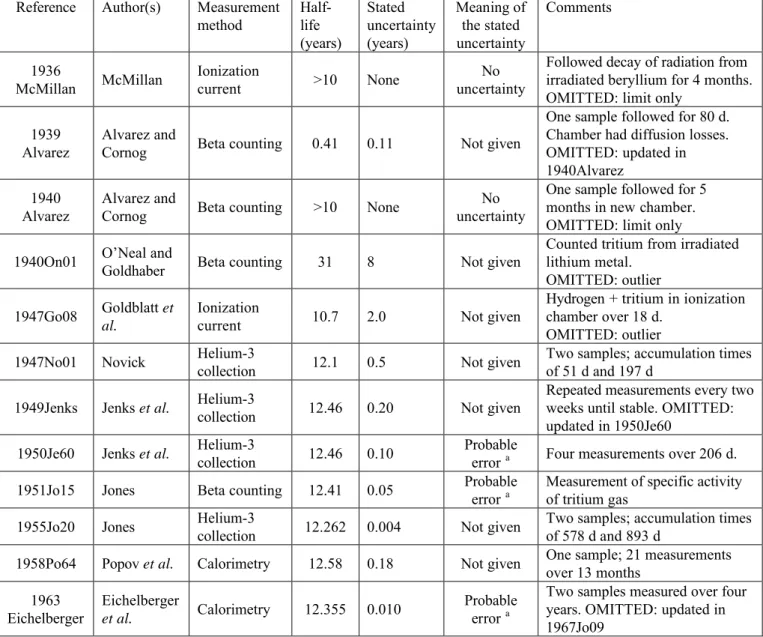
The evaluated 3H half-life is based on the experimental data given in Table 1. This table has been taken from the paper of Lucas and Unterweger (2000Lu17) which contains a comprehensive review and critical evaluation of the half-life of tritium.
Table 1. Experimental values of the 3H half-life (in years)
Reference Author(s) Measurement method Half-life
(years) Stated uncertainty (years) Meaning of the stated uncertainty Comments 1936
McMillan McMillan Ionization current >10 None uncertainty No
Followed decay of radiation from irradiated beryllium for 4 months. OMITTED: limit only
1939
Alvarez Alvarez and Cornog Beta counting 0.41 0.11 Not given
One sample followed for 80 d. Chamber had diffusion losses. OMITTED: updated in 1940Alvarez
1940
Alvarez Alvarez and Cornog Beta counting >10 None uncertainty No
One sample followed for 5 months in new chamber. OMITTED: limit only
1940On01 O’Neal and Goldhaber Beta counting 31 8 Not given Counted tritium from irradiated lithium metal. OMITTED: outlier
1947Go08 Goldblatt et
al.
Ionization
current 10.7 2.0 Not given
Hydrogen + tritium in ionization chamber over 18 d.
OMITTED: outlier
1947No01 Novick Helium-3 collection 12.1 0.5 Not given Two samples; accumulation times of 51 d and 197 d 1949Jenks Jenks et al. Helium-3 collection 12.46 0.20 Not given Repeated measurements every two weeks until stable. OMITTED:
updated in 1950Je60
1950Je60 Jenks et al. Helium-3 collection 12.46 0.10 Probable error a Four measurements over 206 d.
1951Jo15 Jones Beta counting 12.41 0.05 Probable error a Measurement of specific activity of tritium gas
1955Jo20 Jones Helium-3 collection 12.262 0.004 Not given Two samples; accumulation times of 578 d and 893 d 1958Po64 Popov et al. Calorimetry 12.58 0.18 Not given One sample; 21 measurements over 13 months
1963
Eichelberger Eichelberger et al. Calorimetry 12.355 0.010
Probable error a
Two samples measured over four years. OMITTED: updated in 1967Jo09
1966Merritt Merritt and Taylor Beta counting 12.31 0.13 Not given Five gas counting measurements over 13 years 1967Jo09 Jordan et al. Calorimetry 12.346 0.002 Probable error a
Five samples; 266 measurements over 6 years. OMITTED: updated in 1977RuZZ
1967Jo10 Jones Helium-3 collection 12.25 12.31 0.08 0.42 confidence 99.7 % limits
Two samples; accumulation times of 450 d to 800 d. Only the first value is usually quoted
1977RuZZ Rudy and Jordan Calorimetry 12.3232 0.0043 confidence 95 % limits
Eight samples; 1353 measurements over 16 years 1980Un01 Unterweger
et al. Beta counting 12.43 0.05
1 standard uncertainty
Two sets of gas counting measurements 18 years apart. OMITTED: updated in 2000Unterweger
1987Bu28 Budick et al. Bremsstrahlung counting 12.29 0.10 Not given Two samples of tritium + xenon gas measured over 320 d. OMITTED: updated in 1991Bu13 1987Ol04 Oliver et al. Helium-3 collection 12.38 0.03 uncertainty 1 standard Fifteen samples, each with accumulation times of 1 year to 2
years
1987Si01 Simpson Beta counting 12.32 0.03 uncertainty 1 standard Tritium implanted in Si(Li) detector measured over 5.5 years 1988 Akulov Akulov et al. Helium-3 collection 12.279 0.033 uncertainty 1 standard Five series of measurements over 846 d
1991Bu13 Budick et al. Bremsstrahlung counting 12.31 0.03 uncertainty 1 standard Two samples of tritium + xenon gas measured over 5.5 years 2000
Unterweger Unterweger and Lucas Beta counting 12.33 0.03 uncertainty 1 standard Three sets of gas counting measurements over 38 years
a The probable error, PE , is the deviation from the population mean, µ , such that 50 % of the observations may be
expected to lie between µ− PE and µ + PE . For a normal distribution, the probable error can be converted to the standard deviation by multiplying by 1.4826.
As seen from Table 1 there are a number of measurements of the tritium half-life. Three of them stand out by their high precision (1955Jo20, 1967Jo09, 1977RuZZ). However, the uncertainties stated for the half-life in these works do not include an estimation of possible systematic errors. There are available newer measurements and discussions of the tritium half-life, so it is possible to estimate an "external" minimum uncertainty due to systematic effects (σmin) that should be added to the uncertainties stated in 1955Jo20, 1967Jo09 and 1977RuZZ. At that we can take into account the following circumstances:
a) The 3He collection result of 1955Jo20 has been obtained using only two points on each decay curve (for two samples). In the later work by the same method (1967Jo09) many experimental points were obtained on the decay curves (also for two samples) and the estimated systematic uncertainty made up 0.8 % for a 99.7 % confidence level.
b) The result of 1977RuZZ is a continuation of the measurements of 1967Jo09 for two tritide solids by calorimetric method for an additional 12 years. The difference of results of 1967Jo09 and 1977RuZZ proved to be 0.2 %, more than 5σexp from 1977RuZZ and more than 10σexp from 1967Jo09.
c) The comparative analysis of measurements of the radioactivity concentrations in several NBS tritiated-water standards over an 18-year period 1961 - 1978 (1980Un01) showed that for agreement of measurements (at given tritium half-life) their estimated standard errors (including a calorimetric method) should not be less 0.2 %.
Thus we have sufficient grounds for adding the "external" systematic error σmin = 0.002.T1/2 (3H) into the uncertainties quoted in 1955Jo20, 1967Jo09 and 1977RuZZ. Lucas and Unterweger (2000Lu17) estimated the standard uncertainty of 1955Jo20 as 0.030 yr and that of 1977RuZZ as 0.025 yr.
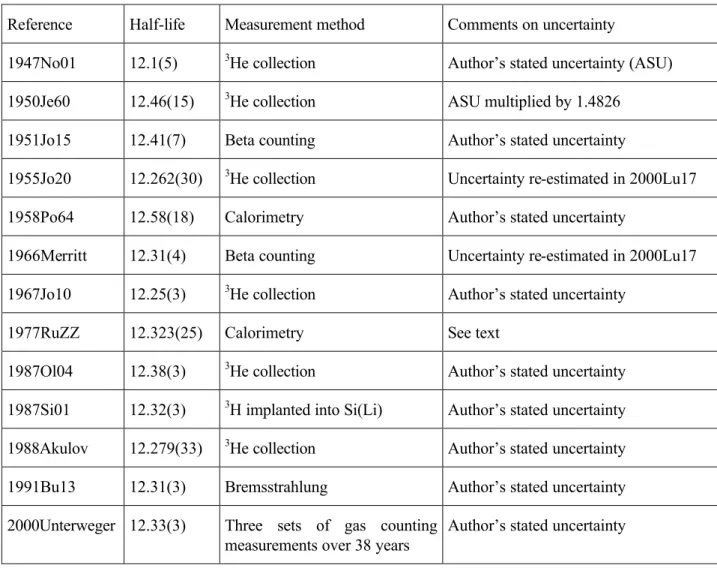
omitting the ten measurement results (see Comments in Table 1) and adjusting the uncertainties of 1955Jo20, 1977RuZZ and 1966Merritt. Latter was re-estimated in 2000Lu17.
Table 2. Selected measurement results for tritium half-life (in years)
Reference Half-life Measurement method Comments on uncertainty
1947No01 12.1(5) 3He collection Author’s stated uncertainty (ASU) 1950Je60 12.46(15) 3He collection ASU multiplied by 1.4826
1951Jo15 12.41(7) Beta counting Author’s stated uncertainty
1955Jo20 12.262(30) 3He collection Uncertainty re-estimated in 2000Lu17 1958Po64 12.58(18) Calorimetry Author’s stated uncertainty
1966Merritt 12.31(4) Beta counting Uncertainty re-estimated in 2000Lu17 1967Jo10 12.25(3) 3He collection Author’s stated uncertainty
1977RuZZ 12.323(25) Calorimetry See text
1987Ol04 12.38(3) 3He collection Author’s stated uncertainty 1987Si01 12.32(3) 3H implanted into Si(Li) Author’s stated uncertainty 1988Akulov 12.279(33) 3He collection Author’s stated uncertainty 1991Bu13 12.31(3) Bremsstrahlung Author’s stated uncertainty 2000Unterweger 12.33(3) Three sets of gas counting
measurements over 38 years Author’s stated uncertainty
A weighted average for the final data set is 12.312 with an internal uncertainty of 0.010 and an external uncertainty of 0.013 and a reduced χ2/ν = 1.6. An unweighted average is 12.33(3).
Different statistical procedures from 1994Ka08 give the similar results: UINF, LWM, NORM – 12.312(10), PINF, BAYS and MBAYS – 12.312(13), IEXW – 12.314(14), RAJ – 12.311(10), CHV – 12.317(16). Lucas and Unterweger (2000Lu17) used three other statistical procedures including the method of determining the median and the estimated standard deviation of the median and adopted the value of 12.318(25).
The LWEIGHT computer program using the LWM procedure has led to the recommended value of 12.312(10).
The EV1NEW computer program (2000Ch01) has chosen the weighted average of 12.312 and recommended the smallest experimental uncertainty of 0.025 as a final uncertainty.
The adopted value of the 3H half-life is 12.312(25) years, or 4497(9) days.
It should be noted this half-life value has been evaluated for molecular tritium. The half-life of atomic tritium is less by ∼0.26% (2004Ak16). See also 2005Ak04 for a bare triton half-life.
2.1. Tritium Beta End-Point Energy (E
β0)
The tritium beta end-point energy depends upon the chemical state of the tritium in an experiment. The expression for Eβ0 of molecular tritium differs from that of a "bare" nucleus by the "chemical shift"
final states (SFS). (Here the B values indicate electron binding energies for He+ ion and tritium atom, R indicates a chemical state).
For known 3He-3H atom mass difference (∆Mc2) the tritium beta "end-point" energy measured in some experiment is :
Eβ0 = ∆Mc2− Erec− [B(He) − B(T)] + [B(RHe+) − B(RT)] where Erec is the helium recoil energy.
For tritium atom (nuclide) Eβ0 = ∆Mc2− 3.4 eV − 64.3 eV + ∆E where ∆E = 40.82 eV.
With the recommended value of ∆Mc2, the beta end-point energy for tritium nuclide is obtained by this way as 18563.6 eV. It is difficult to estimate the uncertainty of the ∆E calculation in1985Ka21. Supposing it about the evaluated uncertainty of ∆Mc2 (Q value), we have E
β0 (3H nuclide) = 18.564(2)
keV.
For real forms of tritium sources in beta-spectrometry experiments the 3H end-point energies differ from the atomic value. For a molecular forms HT, CH3T, valine the calculated Eβ0 makes 18572(2) eV.
Below the measured end-point energies in some experiments are shown.
1987Bo07 Valine 18.579.4 ± 4 eV
1993Ba08 Molecular tritium 18.574.8 ± 0.6 eV 1993Su32 C14H15T6O2N3 18.578.3 ± 5.1 eV 1995St26 Gaseous tritium 18.568.5 ± 2.0 eV 2003Kr17 Gaseous tritium 18.570.5 eV
It should be noted that many works devoted to study of tritium beta-spectrum as it provided the most precise data of neutrino mass upper limit (see, for example, 2005Kr03, 2003Lo10, 2002Bo31 and references therein).
2.2. Average energy of beta particles of tritium per disintegration (<E
β>)
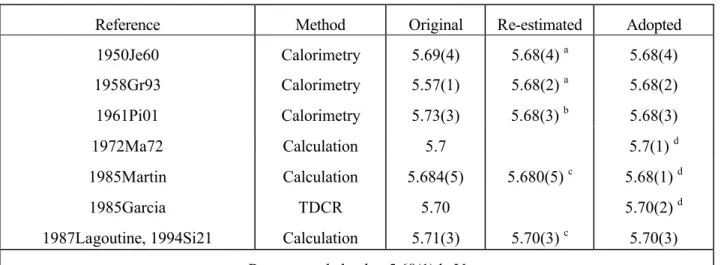
In Table 3 the available data of the <Eβ> have been presented. The recommended value <Eβ> has
been obtained as the weighted average after corrections into the original results of the experiments and calculations. The calculation of the <Eβ> with the LOGFT computer program using the adopted value Q−=
18.591(1) keV gives 5.68 (±0.0011) keV.
Table 3. The available data of the tritium average beta energy (per disintegration, keV)
Reference Method Original Re-estimated Adopted
1950Je60 Calorimetry 5.69(4) 5.68(4) a 5.68(4) 1958Gr93 Calorimetry 5.57(1) 5.68(2) a 5.68(2) 1961Pi01 Calorimetry 5.73(3) 5.68(3) b 5.68(3) 1972Ma72 Calculation 5.7 5.7(1) d 1985Martin Calculation 5.684(5) 5.680(5) c 5.68(1) d 1985Garcia TDCR 5.70 5.70(2) d
1987Lagoutine, 1994Si21 Calculation 5.71(3) 5.70(3) c 5.70(3) Recommended value 5.68(1) keV
a Corrected for the adopted tritium half-life of 12.312 y and heat output of 0.324(1) W/g b Corrected for the adopted tritium half-life of 12.312 y
c Corrected for the adopted decay energy (Q− = 18.591 keV)
3. REFERENCES
1936McMillan E.M. McMillan, Phys. Rev. 49(1936)875 [Half-life]
1939Alvarez L.W. Alvarez and L. Cornog, Phys. Rev. 56(1939)613 [Half-life]
1940Alvarez L.W. Alvarez and L. Cornog, Phys. Rev. 57(1940)248 [Half-life]
1940On01 R.D. O'Neal and M. Goldhaber, Phys. Rev. 58(1940)574 [Half-life]
1947Go08 M. Goldblatt, E.S. Robinson, and R.W. Spence, Phys. Rev. 72(1947)973 [Half-life]
1947No01 A. Novick, Phys. Rev. 72(1947)972 [Half-life]
1949Jenks G.H. Jenks, J.A. Ghormley, and F.H. Sweeton, Phys. Rev. 75(1949)701 [Half-life]
1950Je60 G.H. Jenks, F.H. Sweeton, and J.A. Ghormley, Phys. Rev. 80(1950)990 [Half-life, average beta energy]
1951Jo15 W.M. Jones, Phys. Rev. 83(1951)537 [Half-life]
1955Jo20 W.M. Jones, Phys. Rev. 100(1955)124 [Half-life]
1958Gr93 D.P. Gregory and D.A. Landsman, Phys. Rev. 109(1958)2091 [Average beta energy]
1958Po64 M.M. Popov et al., Atomnaya Energ.4(1958)269; J. Nucl. Energy 9(1959)190 [Half-life]
1961Pi01 W.L. Pillinger, J.J. Hentges, and J.A. Blair, Phys. Rev.121(1961)232 [Average beta energy]
1963Eichelberger J.F. Eichelberger, G.R. Grove, and L.V. Jones. Progress Report MLM-1160, US Department of Energy, Mound Laboratory, Miamisburg, Ohio, June 1963, p.5-6
[Half-life]
1966Merritt J.S. Merritt, J.G.V. Taylor, Chalk River Report AECL-2510(1966) [Half-life]
1967Jo09 K.C. Jordan, B.C. Blanke, and W.A. Dudley, J. Inorg. Nucl. Chem. 29(1967)2129 [Half-life]
1967Jo10 P.M.S. Jones, J. Nucl. Materials 21(1967)239 [Half-life]
1972Ma72 J. Mantel, Intern. J. Appl. Rad. Isotopes 23(1972)407 [Average beta energy]
1977RuZZ C.R. Rudy and K.C. Jordan, In: MLM-2458, Monsanto Research Corporation, Miamisburg, Ohio(1977)
[Half-life]
1980Un01 M.P. Unterweger et al., Intern. J. Appl. Rad. Isotopes 31(1980)611 [Half-life]
1985Garcia E. Garcia-Torano and A. Grau Malonda, Comp. Phys. Commun. 36(1985)307. See also 1994Si21
[Average beta energy]
1985Ka21 I.G. Kaplan, G.V. Smelov, and V.N. Smutny, Phys.Lett. 161B(1985)389 [Beta end-point energy and Q-value]
1985Martin M.J. Martin, In: A handbook of radioactivity measurement procedures, NCRP Report No 58 (1985), 2nd Edition, NCRP, Bethesda, Maryland, 368-373
[Average beta energy]
1987Bo07 S.D. Boris et al., Phys.Rev.Lett. 58, 2019 (1987); Erratum Phys.Rev.Lett. 61, 245 (1988) [Beta end-point energy]
1987Bu28 B. Budick and Hong Lin, Bull.Amer.Phys.Soc.32 (1987)1063 [Half-life]
1987Lagoutine F. Lagoutine, N. Coursol, J. Legrand, Table de Radionucléides, ISBN-2-7272-0078-1 (LMRI, 1982-1987)
[Average beta energy]
1987Ol04 B.M. Oliver, H. Farrar IV, and M.M. Bretscher, Intern. J. Appl. Rad. Isotopes 38(1987)959 [Half-life]
1987Si01 J.J. Simpson, Phys. Rev. C35(1987)752 [Half-life]
1988Akulov Yu.A. Akulov, B.A. Mamyrin, L.V. Khabarin, V.S. Yudenich, and N.N. Ryazantseva, Zh. Tekh. Fiz. 14(1988)940, Sov. Tech. Phys. Lett. 14(1988)416
[Half-life]
1989Re04 A. Redondo and R.G.H. Robertson, Phys .Rev. C40(1989)368 [Beta end-point energy and Q-value]
1991Bu13 B. Budick, Jiansheng Chen, and Hong Lin, Phys. Rev. Lett. 67(1991)2630 [Half-life]
1993Ba08 H. Backe, H. Barth, J. Bonn et al., Nucl. Phys. A553(1991)313c [Beta end-point energy]
1993Su32 H. Sun, D. Liang, S. Chen et al. J. Chin, Nucl.Phys. 15(1993)261 [Beta end-point energy]
1994Ka08 S.F. Kafala, T.D. MacMahon, and P.W. Gray, Nucl. Instrum. Methods Phys. Res. A339(1994)151
[Evaluation technique]
1994Si21 B.R.S. Simpson and B.R. Meyer, Nucl. Instrum. Methods Phys. Res. A339(1994)14 [Average beta energy]
1995St26 W. Stoeffl and D.J. Decman, Phys. Rev. Lett. 75(1995)3237 [Beta end-point energy]
1999Be M.-M. Bé, E.Browne, V.Chechev et al. In: Table de Radionucléides, CEA-ISBN 2-7272-0200-8, Comments on Evaluations, CEA-ISBN 2-7272-0211-3. 1999
[3H decay data evaluation-1998]
2000Ch01 V.P. Chechev and A.G. Egorov, Appl. Radiat. Isot. 52(2000)601 [Evaluation technique]
2000Lu17 L.L. Lucas and M.P. Unterweger, J. Res. Natl. Inst. Stand. Technol. 104(2000)541 [Half-life evaluation]
2000Unterweger M.P. Unterweger and L.L. Lucas, Appl. Radiat. Isot. 52(2000)527 [Half-life]
2002Bo31 J. Bonn, B. Bornschein, L. Bornschein et al., Prog. Part. Nucl. Phys. 48(2002)133 [Tritium beta-spectrum]
2003Au03 G. Audi, A.H. Wapstra, and C. Thibault, Nucl. Phys. A729(2003)337 [Q-value]
2003Kr17 Ch. Kraus, J. Bonn, B. Bornschein et al., Nucl. Phys. A721(2003)533c [Beta end-point energy]
2003Lo10 V.M. Lobashev. Nucl. Phys. A719(2003)153c [Tritium beta-spectrum]
2004Ak16 Yu.A. Akulov and B.A. Mamyrin. Phys. Lett. B600(2004)41 [Half-life]
2005Ak04 Yu.A. Akulov and B.A. Mamyrin, Phys. Lett. B610(2005)45 [Half-life]
2005Kr03 Ch. Kraus, B. Bornschein, L. Bornschein et al., Eur. Phys. J. C40(2005)447 [Tritium beta-spectrum]
7
Be - Comments on Evaluation of Decay Data
by R. G. Helmer
This evaluation was originally done in 1996 by R. G. Helmer and E. Schönfeld and minor
editing was added in December 2000.
1. Decay Scheme
This decay scheme is complete since the only levels in
7Li below the decay energy are
populated.
2. Nuclear Data
The Q value is from the mass evaluation in 1995Au04.
The adopted half-life is 53.22 (6) days.
The
7Be half-life has been observed to vary depending on the chemical form of the
7Be.
Some of these measured variations are:
Reference
Chemical forms compared (
∆
T
½ ×10
4)/T
½
1949Se20
Be - BeO
1.5 (9)
1953Kr16
Be - BeO
1.3 (5)
BeO- BeF
26.1 (6)
Be - BeF
27.4 (5)
1956Bo36
Be - BeF
212 (1)
1970Jo21
BeO- BeF
211.3 (6)
BeO - BeBr
214.7 (6)
BeO- Be
4O(CH
3COO)
6-7.2 (6)
BeO- Be(C
5H
5)
28.0 (7)
BeO- Be(OH
2)
4-3.7 (8)
BeF
2- Be
4O(CH
3COO)
6-18.5 (8)
Be(C
5H
5)
2- Be(OH
2)
4-11.7 (11)
1999Hu20 BeO - Be(OH)
2-149.
BeO - Be
2+(OH
2)
4-98.
1999Ra12
Be in Au - Be in Al
2O
372 (7)
Excluding the much larger changes reported by 1999Hu20 and 1999Ra12, these measured changes
range from 0.01% to 0.2%, or from 0.005 to 0.10 days, or 0.08 days, if the organic compounds are also
omitted.
The adopted value of 53.22 (6) is from Limitation of Relative Statistical Weight (LRSW)
(1985ZiZY, 1992Ra09) analysis of 53 (2) (1940Hi01), 52.93 (22) (1949Se20), 53.61 (17) (1953Kr16), 53.0
(4) (1956Bo36), 53.5 (2) (1957Wr37), 53.1 (3) (1965En01), 53.52 (10) (1970Jo21), 53.0 (3) (1974Cr05),
53.17 (2) (1975La16), 53.16 (1) (1982ChZF), 53.284 (4) (1982RuZV), and 53.12 (7) (1996Ja10). In this
analysis the uncertainty of 1982RuZV value was increased from 0.004 to 0.0088 so that its relative
weight was reduced from 83 % to 50 %. The weighted average of these values is 53.225 with an internal
uncertainty of 0.006, a reduced-
χ
2of 10.5, and an external uncertainty of 0.020. This uncertainty is
increased by the LRSW method to 0.06 so that the most precise value of 53.284 is included; this
uncertainty also includes the next most precise value of 53.16.
The chemical forms of the samples for which these half-lives were determined are: 1949Se20 Be
metal or BeO and difference is not significant, 1953Kr16 Be metal, 1956Bo36 Be metal or BeF
2and
difference is not significant, 1970Jo21 average of data for BeF
2, BeO, and Be(C
5H
5)
2, and 1975La16
isolated Be atoms in aluminum matrix.
The adopted half-life is dominated by the values of 1975La16, 1982ChZF, and 1982RuZV
which contribute 10 %, 39 %, and 50 % of the relative weight, respectively. The values of 1982ChZF
and 1982RuZV differ by ~ 10
σ
and contribute 3.8 and 4.1 to the reduced-
χ
2value of 10.5. Since these
three values differ by 0.12 days and the chemical forms in the latter two cases are not known, the
chemical variation data in the above table suggest that some of this difference may be due to chemical
effects. This suggests that the adopted uncertainty of 0.06 days is reasonable for general use. In any
case, the data on the chemical effects indicate that the adopted value can certainly be used for Be and
BeO sources.
Values not used are 54.5 (J. F. Bonner as quoted in 1953Kr16, no uncertainty); and 54.3 (5)
(1947BoAA as quoted in 1953Kr16, superseded by value of 1956Bo36); and 53.694 (6), 53.416 (6), and
54.226 (6) (1999Hu20). The values of 1999Hu20 have very small uncertainties and have very large
variations, up to 1.5%, with chemical form which need to be confirmed. If this large shift and that of
1999Ra12 are correct, they would invalidate the uncertainty of our adopted value.
Also, the results of 2000Hu20 and 2000Li21 were obtained after this evaluation was completed,
but these results would not change the adopted value.
Recent experiments have shown that the half-life of 7Be increases as much as 0.7% by
imbedding this radionuclide in different matrices. The recommended value presented in this evaluation
should be adequate for Be and BeO samples.
2.1 Electron-capture transitions
The adopted value for the electron capture to the 477-keV level is P
ε(477) = 10.44 % (4). This
value is a weighted average of 10 (+20-7) (1938RuAA), 10.7 (20) (1949Wi13), 11.8 (12) (1949Tu06), 12.3
(6) (1951Di12), 10.35 (8) (1969TaZX), 10.47 (20) (1970MuZU), 10.42 (18) (1973Po10), 10.35 (8)
(1974Go26), 10.10 (45) (1983Ba15), 10.61 (23) (1983Da14), 10.6 (5) (1983Do07), 10.9 (11) (1983Kn10),
10.7 (2) (1983Ma34), 9.8 (5) (1983No03), 11.4 (7) (1984Ev01), 10.61 (17) (1984Fi10), and 10.49 (7)
(1984Sk01). This weighted average has an internal uncertainty of 0.039, a reduced-
χ
2of 1.35, and an
external uncertainty of 0.045. The adopted value is dominated by the values of 1969TaZX, 1974Go24,
and 1984Sk01 which contribute 23 %, 23 %, and 30 % of the relative weight, respectively. The largest
contribution to the reduced-
χ
2is 0.6 from 1951Di12.
Values not used are 10.32 (16) (1962Ta11, superseded by 1969TaZX) and 10.5 (2) (W. Poenitz,
1966, superseded by 1973Po10).
The P
Kand P
Lvalues of 0.908 (12) and 0.092 (12) were calculated from the tables in 1998Sc28.
The values from the LOGFT code are 0.97 and 0.03, which are different.
The
γ
-ray transition energy is computed from the
γ
-ray energy.
The internal-conversion coefficient is the measured value of 1964Kr04 and the mixing ratio was
also determined by 1964Kr04. The theoretical values interpolated from the tables of 1976Ba63 are
7.73
×10
-7for M1 and 2.96
×10
-6for E2.
The gamma transition probability is :
Within its uncertainty, P
γ(477) = I
γ(477)
×(1.0+
α
) = P
ε(477)
With I
γ(477) = 10.44 (4) % (c.f. § 2.1)
3. Atomic Data
The fluorescence yield is from the compilation of 1994Hu23.
4. Radiations
The conversion electron emission intensity is computed from P
γ(477) and
α
K.
The
γ
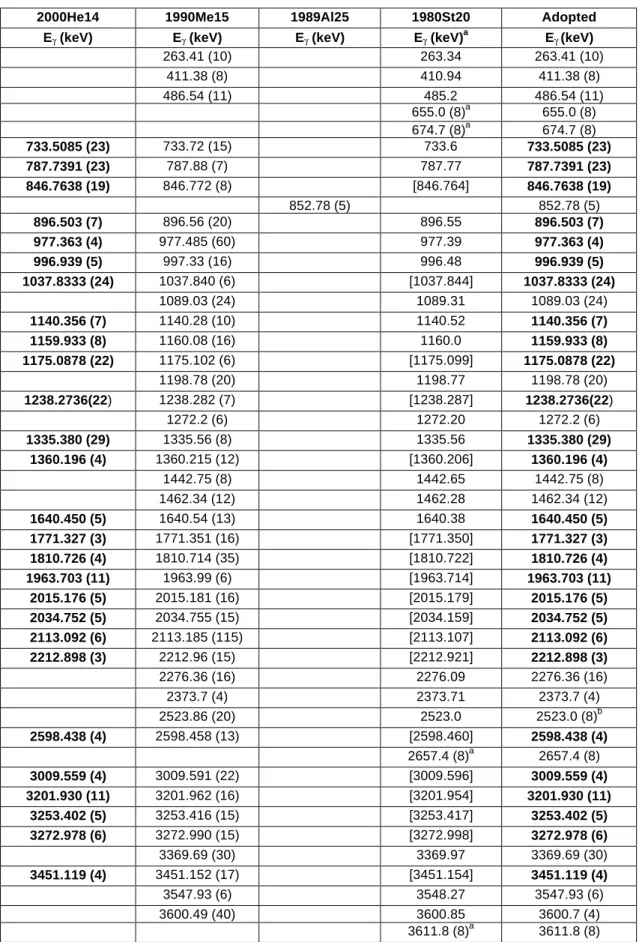
-ray energy is from the evaluation of 2000He14.
5. Main Production Modes
6


![Risiko- & [und] Schutzfaktoren der psychischen Gesundheit humanitärer Einsatzhelfer : eine systematische Literaturübersicht](data:image/gif;base64,R0lGODlhAQABAIAAAP///wAAACH5BAEAAAAALAAAAAABAAEAAAICRAEAOw==)